



University application advice for parents comes down to one principle: be the supportive guide, not the driver. Your job is to help your child stay organised, meet every UCAS deadline, weigh up courses and finances, and keep their confidence up — while they own the choices and write their own personal statement. This UK guide covers the full application timeline, how to choose universities, open days, entry requirements, student finance, how to help with the personal statement safely, and the mistakes parents most often make.
Whether you went to university yourself or this is all new to your family, you can give your child a real advantage simply by understanding the process. Below is a complete parents’ guide to applying to university in the UK, with a clear timeline, a planning checklist and worked examples.
Applying for a place at university is one of the biggest decisions in your child’s life. It involves their hard work and ambitions, and it carries the hopes of the whole family. Students have plenty of resources to research courses and universities, but parents benefit hugely from understanding the application process themselves — so they can step in calmly whenever their child hits a snag. If you are a parent or family member of an applicant, the advice below will help you give the right kind of support at the right time.
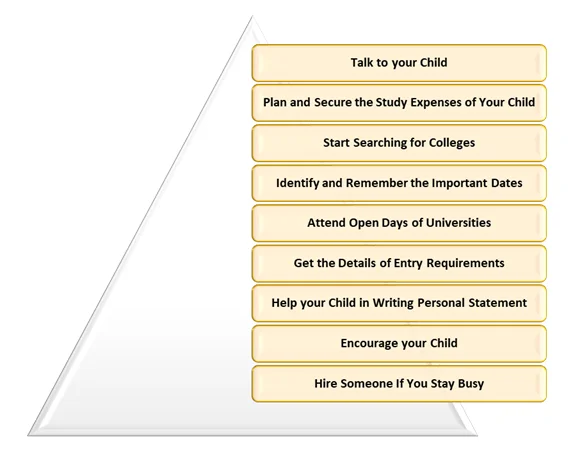
The Parent’s Role: Guide, Not Driver
The single most important piece of university application advice for parents is to understand the line between supporting and taking over. Admissions tutors can spot a personal statement written by a parent in seconds, and a student who has been pushed onto a course they did not choose rarely thrives. Your role is to be the project manager of logistics and morale — tracking dates, funding the research trips, asking good questions — while your child owns every decision and every word they submit.
“The most useful thing a parent can do is help their child stay organised and feel confident. The choices, and the personal statement, must be the student’s own — that is what universities are assessing.” — UCAS guidance for parents and guardians
Talk to Your Child First
This is the first and most important step. Many parents quietly decide a career path for their child and then steer them towards it. That usually backfires — your child ends up walking, reluctantly, down a road they did not choose. Instead, talk to them when they are in the mood to share, and listen more than you advise.
Get to know their genuine interests, strengths and goals. If they are unsure what to study — and most seventeen-year-olds are — help them identify the subjects they enjoy and the skills they are good at, rather than naming a course for them. Open questions work far better than instructions: What lessons do you actually look forward to? What would you happily read about at the weekend?
Help Them Choose the Right Universities
Many families assume choosing a university is simply a matter of picking somewhere convenient. In reality it is a demanding task, because competition is fierce and the number of applicants keeps rising. Each university sets specific entry criteria and deadlines, and meeting them takes planning that ideally starts in the early years of sixth form or college.
Encourage your child to look beyond league tables alone. Course content varies enormously between universities even when the title is identical, so compare module lists, contact hours, assessment methods, placement options and graduate outcomes. Location, accommodation costs, the size of the campus and the feel of the city all matter for day-to-day happiness. A good parents’ guide to choosing a university starts with the question, where will my child do their best work and be content living? — not just which name carries the most prestige?
Many strong applicants also start building their profile three to four years ahead through extra-curricular activities, part-time jobs, internships, volunteering and personal projects. These experiences strengthen both the UCAS application and the confidence your child brings to interviews. If your child is weighing up a subject, browsing real coursework can help — our academic samples library shows the standard of work expected at university across a wide range of subjects.
The UK University Application Timeline
The biggest source of family stress is missed dates. Universities publish strict deadlines for UCAS submission, and these can occasionally shift, so confirm them each cycle. The table below sets out a typical timeline for a student applying in Year 13 (the final year of sixth form), with the practical job a parent can do at each stage. Use it as a planning checklist for the year.
| When | Stage | What the student does | How a parent can help |
|---|---|---|---|
| Spring & summer (Year 12) | Research | Explores subjects, attends taster days, shortlists courses | Fund and attend campus visits; ask open questions about interests |
| Summer & early autumn | Open days & drafting | Visits universities; starts the personal statement | Help book open days; read drafts and give honest feedback (not rewrites) |
| Mid-September | UCAS opens | Completes the UCAS application form and adds choices | Sit with them while they register; check finance documents are ready |
| Mid-October | Early deadline | Submits for Oxford, Cambridge, and most medicine, dentistry and veterinary courses | Diary the date weeks ahead; arrange any admissions tests |
| Late January | Equal-consideration deadline | Submits for the majority of undergraduate courses | Build in a buffer — aim to finish two weeks early |
| Spring | Offers & replies | Receives offers; chooses firm and insurance choices | Talk through the options calmly; let them decide |
| Spring | Student finance | Applies for tuition and maintenance loans | Provide household income evidence promptly for assessment |
| August | Results & Clearing | Confirms place or uses Clearing if needed | Stay calm; keep phone lines and a list of backup courses ready |
Add every one of these dates to a shared calendar and set reminders a fortnight in advance. The simplest, most valuable thing you can do as a parent is make sure no deadline is missed — especially the UCAS submission date and the student finance application, which families routinely leave too late.
Attend Open Days Together
Universities run open days to introduce prospective students to their courses, facilities and student life. They are the single best way to test whether a place feels right. Try to visit the open days of every university your child is seriously considering. Meet the teaching staff, talk to current students, and seek out other parents — they often share the practical details prospectuses leave out, from accommodation quality to the cost of living in the city.
Prepare a few questions in advance together: contact hours, class sizes, assessment style, placement and study-abroad options, graduate employability, and what support exists for students who struggle. Let your child lead the conversations where they can — it builds the confidence they will need at interview.
Understand the Entry Requirements
Once you have a shortlist, study the entry requirements for each course carefully. These usually combine specific A-level (or equivalent) grades, sometimes named subjects, and occasionally an admissions test or interview. Knowing the requirements early lets you plan realistically around your child’s predicted grades and helps them target the effort needed to meet them. It also prevents the heartbreak of falling in love with a course that needs a subject your child is not taking.
Aim for a balanced list of five choices: one or two aspirational, two or three that match the predicted grades, and at least one safer option whose requirements are comfortably within reach.
Plan and Secure the Finances Early
You may have known your child’s ambitions for years, but the cost of university still needs careful planning around your household income. If funding from savings is not realistic, there are well-established alternatives — chiefly the government tuition fee loan and maintenance loan, plus university bursaries, scholarships and hardship funds. Gather full information on the support available so there are no nasty surprises at application time.
Maintenance support is means-tested, which means the university and Student Finance will need evidence of household income, so keep your paperwork in order and submit it promptly — delays here are a common reason students start term short of money. It also helps to clear or organise regular commitments such as tax, instalments and bills in advance, so your child is not held up when applying for finance or bursaries.
Help With the Personal Statement — the Right Way
The personal statement is where your child presents their skills, motivation and suitability for the course, so the admissions team can offer a place based on their own merits. This is the part where parents are most tempted to over-help — and where doing so is most damaging. You must not write it for them. Universities assess the student, and a statement that does not sound like the applicant raises immediate red flags.
What you can do is enormously valuable. Help them brainstorm the experiences, achievements and turning points worth including. Talk through which extra-curricular activities and personal stories best demonstrate their passion for the subject. Remind them to start well before the deadline, and proofread the final draft for spelling, grammar and clarity — without changing their voice. If you would like to understand the format your child needs to follow, read our guide on how to write a UCAS personal statement, and explore more examples and tips in our personal statement resource library.
Knowing how the wider form fits together also helps you support without overstepping. Our step-by-step walkthrough of how to complete your UCAS application explains each section — from adding courses to references and submission — so you can prompt your child at the right moments.
Common Mistakes Parents Make (and How to Avoid Them)
Even the most caring parents trip over the same hurdles. Watch out for these:
- Choosing the course or university for your child instead of with them — it shows, and it rarely lasts.
- Writing or heavily editing the personal statement, which compromises authenticity and risks academic-integrity flags.
- Leaving the UCAS submission or student finance application to the last week.
- Focusing only on league-table rank and ignoring course content, location and cost of living.
- Adding pressure during results week instead of staying calm and supportive.
- Forgetting to plan for Clearing as a perfectly respectable route, not a failure.
A Checklist of Positive Things Parents Can Do
- Keep a shared calendar of every UCAS and finance deadline with two-week reminders.
- Attend open days and ask practical questions about teaching and support.
- Compare module content and graduate outcomes, not just rankings.
- Get the household-income paperwork ready early for the finance assessment.
- Proofread the personal statement for errors while keeping your child’s voice.
- Encourage extra-curricular activities, work experience and skill-building.
- Stay positive, especially around results day and Clearing.
Encourage and Reassure Your Child
Some students manage their responsibilities easily; others need a steadier hand. Parental encouragement plays a real part in building a student’s confidence. Remind them of important dates and tasks gently, and celebrate progress rather than nagging about what is left. If you encourage your child to keep up their studies, extra-curricular activities and the application itself, it inspires them to push towards their goals. Support them if they want to learn a new skill, attend a workshop or volunteer in the community — all of which strengthen both the person and the application.
At the same time, do not leave everything to your child. A light, regular check that things are on track helps make sure nothing slips through the cracks — while still leaving them firmly in charge.
If You Are a Busy Parent
Many parents juggle demanding jobs and other commitments, and in a hectic life it can feel impossible to give the application the time it needs. Where you can, supporting your child yourself is always best — it is your encouragement they value most. If you genuinely cannot make the time for the personal statement specifically, a reputable academic support service can guide and coach your child through the process. Used properly, this means feedback, structure and proofreading — never a statement written on your child’s behalf, which would breach admissions rules. Our personal statement writing services are built around guiding the applicant, so the final work remains genuinely their own.
This same principle carries through the rest of your child’s academic journey. Once they are at university, the support they may need shifts from applications to coursework, and our wider academic writing services follow the same guide-don’t-do-it-for-them ethos. For now, though, your focus is the application — and your encouragement is the most powerful tool you have.
Help Your Child Shine in Their Personal Statement
Expert UK guidance and proofreading that keeps your child’s authentic voice — clear, coherent and admissions-ready.
Final Thoughts
The best university application advice for parents is also the simplest: understand the process, organise the logistics, fund the research, keep your child’s spirits up — and then let them own the decisions and the words. Do that, and you give your child the two things that matter most: a calm, well-planned application and the confidence that the achievement is genuinely theirs.





