
The best personal statement tips come down to one rule: show, don’t tell. Instead of claiming you are passionate, hard-working or curious, prove it with specific evidence, a clear narrative and a tight, error-free structure that an admissions tutor can read in under two minutes. This guide covers exactly what to do and what to avoid — the dos and don’ts, a side-by-side comparison of weak versus strong lines, a worked example you can model, a quick self-check table and a six-question FAQ — so your statement reads like you and earns its place at the top of the pile.
Whether you are applying to university through UCAS, for a postgraduate course, a scholarship or a graduate job, the principles below apply. We focus on the practical craft of writing a strong statement; if you want a step-by-step structure to follow, see our guide on how to write a UCAS personal statement.
What is a personal statement?
A personal statement is a short, focused overview of your personality that highlights your skills, strengths, achievements and goals. It accompanies a formal application and gives you the one chance, in your own voice, to convince the reader — an admissions officer, scholarship panel or recruiter — that you are the right fit for a particular course, award or role. A good statement does not simply list facts already on your form; it explains why you, and backs every claim with evidence.
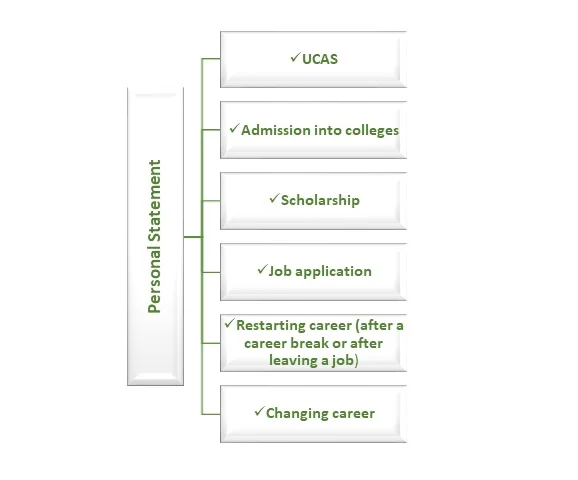
Most UK applicants meet personal statements first through UCAS, but the same skill is reused throughout your academic and professional life: postgraduate applications, funding bids and job applications all ask a version of the same question. The advice in this article is deliberately about the how — the writing tips, dos and don’ts — rather than the slug-by-slug structure, which we cover separately.
Why your personal statement matters
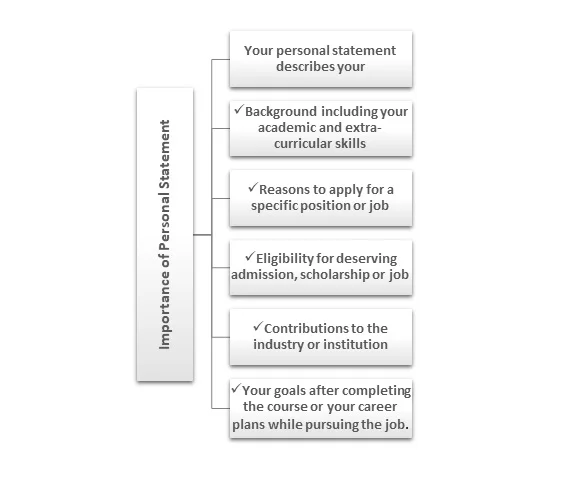
Whether you are applying for college, university, a scholarship or a job, the personal statement is often the only part of your application written entirely in your own words. Grades and references tell the reader what you have done; the statement tells them who you are and how you think. When two candidates have near-identical results, the statement is frequently the deciding factor — it is your opportunity to convince the reader that you are a perfect fit for a particular position.
Admissions tutors read hundreds of statements in a single cycle, often spending a couple of minutes on each. That reality shapes every tip below: be specific, be quick to the point, and make every sentence earn its place. Before you write a word, it helps to get the opening right — our guide on how to start a personal statement shows how to open with a hook that is genuine rather than clichéd.
Personal statement tips at a glance
The fastest way to internalise good practice is to see the wrong move beside the right one. The table below distils the most common personal statement tips into a do/don’t comparison you can scan before every draft.
| Element | Do this | Avoid this |
|---|---|---|
| Opening line | A specific moment or question that sparked your interest | A famous quote or “From a young age…” |
| Evidence | “I ran a coding club for 12 Year 9 pupils” | “I have excellent leadership skills” |
| Tone | Your natural, active voice | Thesaurus words you would never say aloud |
| Focus | Mostly the subject; some wider interests | A life story unrelated to the course |
| Structure | Clear paragraphs, one idea each | One dense block of text |
| Accuracy | Proofread by you plus two others | Submitting a first draft with typos |
| Originality | Entirely your own words | Borrowed phrasing or a copied template |
Do’s while writing personal statements
Research thoroughly before you write
Always research the college, faculty, course and career scope before writing your statement. Make separate lists of the course details and your eligibility for that course, including your skills, important events, achievements and future goals. Mapping the two against each other helps you select the most relevant and essential points — and quietly drop the ones that do not serve your case.
Treat it as creative writing
While writing a personal statement, work as if you are crafting a short piece of creative non-fiction. You can win the reader over through an engaging style and genuine storytelling. Choose a clear, distinctive voice that holds attention, but never at the expense of clarity: if a sentence is hard to follow on first read, simplify it.
Narrate your story
Your statement should complement your application by narrating the crucial aspects of your personality and the experiences that shaped you. Write with real interest in your own subject so the piece reads as a story with momentum, not a flat list of skills and dates.
Be yourself, in your own voice
Use your own tone and ideas rather than borrowing others’. Favour the active voice and let the writing sound natural rather than ornate.
Be honest
Provide accurate information about your skills, experiences and achievements. Tutors interview, ask follow-up questions and recognise inflated claims; an exaggeration you cannot defend does more damage than a modest truth.
Use specific names, illustrations and references
Concrete detail makes your application stand out and makes you memorable. Anchor your claims to real moments:
- During my trip to a local archaeology dig, I learned to record stratigraphy…
- Volunteering at my college’s open day, I led tours for 40 prospective students…
- My week shadowing a team at Charing Cross Hospital showed me…
- My EPQ on anger management in adolescents taught me…
Use compelling opening lines
Your statement should engage from the first line. It is often easiest to write the opening last, once you know what the piece is really about. Strong, honest openers include:
- The first time I debugged a program at 2am and it finally ran, I was hooked…
- I am applying to this course because… (followed immediately by a specific reason)
- A single seminar on behavioural economics changed how I see every shop I walk into…
- Taking apart my first engine left oil on my hands and a question in my head…
Focus on your strengths — then prove them
Talk about the skills and motivations that genuinely drive you, then evidence each one. It is never enough simply to assert a quality; show how you developed and used it. The contrast below is the single most important of all the personal statement tips:
| Telling (weak) | Showing (strong) |
|---|---|
| I have extraordinary communication skills. | Attending three debating workshops sharpened how I structure an argument under pressure. |
| I’m a dedicated, hard-working individual. | Balancing a part-time tutoring job with A-levels taught me to plan a week to the hour. |
| I’m a great writer. | Editing my school magazine for two years tightened my prose and my deadlines. |
| I’m an excellent public speaker. | Compering my college showcase for 200 people cured most of my stage nerves. |
Each “showing” line gives the reader a verifiable scene and a transferable skill. Do this for every quality you claim, and a sceptical tutor becomes a convinced one.
Don’ts while writing personal statements
Just as important as the dos are the habits that quietly sink otherwise capable applicants. Avoid the following:
Clutter
Keep sentences short and direct. Cut wordy phrases, unnecessary auxiliary verbs, filler conjunctions and anything that does not carry meaning. If a word can be removed without loss, remove it — tutors reward economy.
Clichés
Do not try to impress with fancy phrasing; focus on convincing the reader you deserve the place. Avoid stock language such as:
- Quotes and “words to live by” from other people
- Proverbs like “all that glitters is not gold”
- Empty self-labels: “hard-working individual”, “thirst for knowledge”, “ardent learner”
This kind of language gives only a vague impression. Replace every cliché with a specific, evidenced detail.
Grammar and spelling mistakes
Accurate language is how your ideas reach the reader intact. Check grammar, punctuation and spelling carefully; if you struggle to spot your own errors, ask friends, family or a teacher to read it. Proofreading tools help, but no tool replaces a second human eye — read the statement aloud to catch what your eyes skim.
Copying another person’s statement
No matter how much you admire someone’s writing, never copy and paste their statement. Universities run every personal statement through similarity-detection software, and a match can have your application rejected for plagiarism. Write your own from the ground up, and if you want to check your draft for accidental overlap before you submit, run it through a reputable plagiarism checker.
“We can tell within a paragraph whether a statement was written by the applicant. The ones that work are specific, honest and reflective — not the ones stuffed with long words.” — UK university admissions tutor
Structure the statement so it flows
Even brilliant material fails if it arrives in a jumble. A reliable shape is: a specific hook, two or three body paragraphs that each develop one theme with evidence, a short paragraph on wider interests or experiences, and a forward-looking close. Aim for one idea per paragraph and use the last sentence of each to bridge into the next. Tutors skim under time pressure, so a clear skeleton makes your strongest points impossible to miss.
Tailor every claim to the course or role
Generic statements read as if they were sent to twenty places — because they usually were. Reread the course description and mirror its language where it is honestly true of you. If the programme stresses research, lead with the project where you designed your own method; if it stresses collaboration, foreground the team you coordinated. Targeting does not mean flattery; it means proving you understand what this particular opportunity actually involves.
Revise in passes, not all at once
Strong writing is rewriting. Draft freely first to get the substance down, then edit in separate passes: one for structure, one for evidence, one for clarity and length, and a final one purely for grammar and spelling. Leave at least a day between drafting and editing so you read the words as a stranger would. Most weak statements are simply first drafts that ran out of time — building in revision is the cheapest quality upgrade available.
Common mistakes — and the quick fix
Most rejections share a handful of avoidable patterns. The table below pairs each with a one-line remedy you can apply in your next edit.
| Common mistake | Why it hurts | Quick fix |
|---|---|---|
| Listing activities without reflection | Reads like a CV, shows no insight | Add a sentence on what each taught you |
| Spending half the statement on childhood | Burns words before reaching the subject | Cut to one line; pivot fast to the course |
| Repeating the same point | Wastes scarce characters | Merge overlapping paragraphs |
| Negative or apologetic tone | Undermines confidence in you | Reframe weaknesses as lessons learned |
| Trying to be funny | Humour rarely lands on a cold read | Keep it warm and sincere instead |
What to write about
If you are staring at a blank page, anchor your draft around these six prompts. Together they cover everything a reader wants to know, in roughly the order they want it:
- Your background and the experiences that shaped your interest.
- The skills and qualities relevant to the course or role.
- Achievements and the challenges you overcame to reach them.
- Your reasons for pursuing this specific opportunity.
- Your future goals and where this step leads.
- How you will contribute to — and benefit from — the community you are joining.
A quick self-check before you submit
Run your final draft against this checklist. If you cannot tick every box, edit until you can.
- The opening line is specific and could only have been written by you.
- Every skill I claim is backed by a real example.
- Roughly 70–80% of the statement is about the subject or role.
- There are no clichés, quotes or borrowed phrases.
- It reads smoothly aloud, with no clutter.
- Two other people have proofread it for spelling and grammar.
- It is entirely my own work and within the word or character limit.
Bringing it all together
The strongest personal statements are not the ones with the longest words — they are the ones where every claim is earned. Research the course, write in your own voice, prove each strength with a real example, cut the clutter and clichés, and proofread until it is flawless. Do that, and your statement will sound like you on your best, most honest day, which is exactly what admissions tutors are hoping to find.
If you would like a second opinion, expert feedback or a fully bespoke draft built around your experiences, our specialists can help — see our personal statement writing services for support that keeps the work entirely yours.
Get expert help with your personal statement
Clear, original and tailored to your application — written by UK academics who know what admissions tutors look for.