


You send an application, and the messages start arriving: emails, portal notifications, texts from open-day teams, and sometimes an actual envelope on the doormat. None of it is accidental. Universities plan their applicant communications as carefully as any marketing campaign, because they are competing for you.
This guide explains the channels universities use to reach applicants, why printed mail still exists in a digital admissions world, what each type of message says about where you stand, and which communications genuinely deserve your attention.
The Channels Universities Use to Reach You
Universities do not lack ways to contact you. They have email, text messages, social media, paid search ads, applicant portals, school and counsellor outreach, virtual events and campus-visit campaigns. The problem, from their side, is that every competing institution has the same tools.
That competition plays out in your inbox. You might receive several admissions emails in one afternoon: some get skimmed, some ignored, and some disappear under school updates, shopping promotions and app notifications.
Admissions teams know this, which is why the most organised universities deliberately mix their channels rather than relying on email alone.
Why You Still Get Printed Mail From Universities
Printed mail gives universities something digital channels rarely achieve: a physical presence in your home. A prospectus can sit on your desk for weeks. A campus mailer can land on the kitchen table and reappear during the actual decision conversation with your family.
For universities, mail is not a replacement for digital outreach. It is a way to make their digital outreach easier to notice, remember and act on, which is why so much of it now carries QR codes and personalised links back to their websites.
Producing it is a specialist industry in its own right. Many admissions and marketing teams work with dedicated higher-education direct mail providers to design these campaigns, from prospectuses and admitted-student packs to interactive mailers with video screens and virtual campus tours.
That does not mean every brochure deserves your attention. Generic mail is easy to dismiss, and admissions teams know it. The pieces worth reading are the ones that feel specific to your stage, your course interests and the decision you are actually trying to make.
What the Mail You Receive Says About Where You Stand
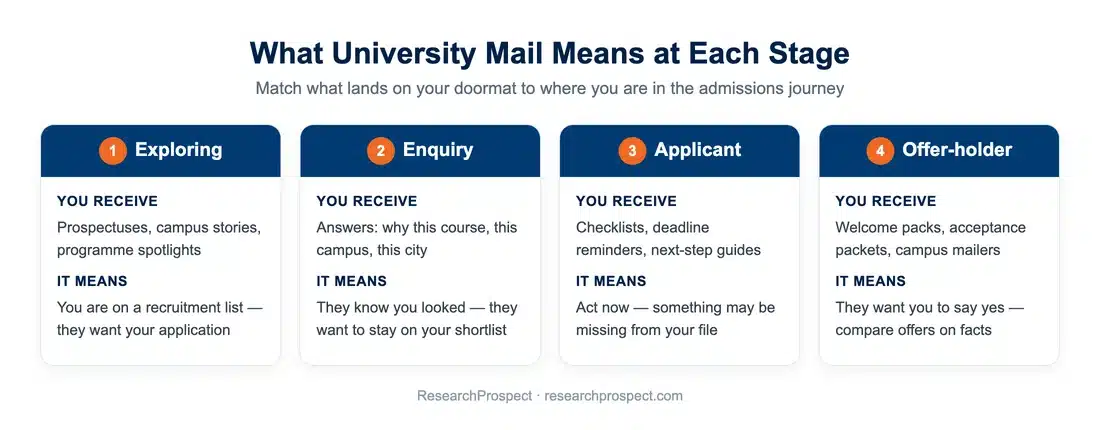
Well-run admissions teams do not send one broad campaign. They map their communications to the applicant journey, which means you can read the mail you receive as a signal of where you sit in their process.
| Exploring | Campus stories, programme spotlights and personality pieces. You are on a recruitment list, often from an enquiry, a school event or an admissions fair. They want your application. |
| Enquiry | Sharper answers: why this course, why this campus, why this city. They know you have shown interest and want to stay on your shortlist. |
| Applicant | Checklists, deadline reminders and next-step guides. Treat these seriously — they often mean something is missing from your file. |
| Offer-holder | Welcome packs, acceptance packets and campus-themed mailers. These are yield campaigns: the university wants you to accept. Enjoy them, then compare offers on facts. |
The applicant-stage messages matter most. A checklist or deadline reminder is not marketing; it is the university reducing friction so you complete missing actions, whether that is a reference, a document upload or your personal statement.
Why Your Family Gets Involved
University decisions rarely happen alone. Parents and guardians weigh in on cost, distance, safety and support, and universities know it. That is one reason physical mail persists: it gets shared in a way email never is.
A prospectus left on the counter gets picked up by a parent. A sibling comments on it. A school counsellor sees it in a meeting. Universities design family-facing pieces to be practical for exactly this audience: fees, scholarships, housing, safety and deadlines rather than brand language.
That practicality is also a useful test. If a glossy piece is vague about costs, aid steps or deadlines, that tells you something about what the university wants to lead with.
How to Act on Admissions Communications
Modern admissions mail almost always points to a digital next step: a QR code, a personalised link or a campaign landing page. Universities track who scans and visits, because it helps them measure what works. Engaging through those official links can genuinely register your interest with some institutions.
- Check every stated deadline against your own application tracker, not just the mailer
- Act on checklists quickly — they usually flag genuinely missing items
- Use the official applicant portal for anything binding: offers, deposits, accommodation
- Keep one folder (physical or photographed) for everything each university sends
- Verify the sender before scanning codes or clicking links — the domain should match the official university site
Read the Signals — But Do Not Be Swayed by Gloss
A beautiful mailer proves the university has a good marketing team. It does not prove the course, the teaching or the support services are right for you. Course content, accreditation, graduate outcomes, cost and location should still drive the decision — and your side of the conversation, starting with your personal statement, should be built on the same evidence.
It also helps to know the pressure behind the polish. The National Student Clearinghouse Research Center reported that undergraduate enrolment rose in spring 2025 but remained below pre-pandemic levels, so institutions are competing hard for every applicant. Bodies like NACAC track these admissions trends year-round.
In other words, universities need applicants as much as applicants need places. Read their communications twice: once as information, and once as marketing. The confident move is to enjoy being courted while choosing on evidence.
Working on your university application?
Our academic team helps you plan, draft and polish a personal statement that admissions teams actually read.