




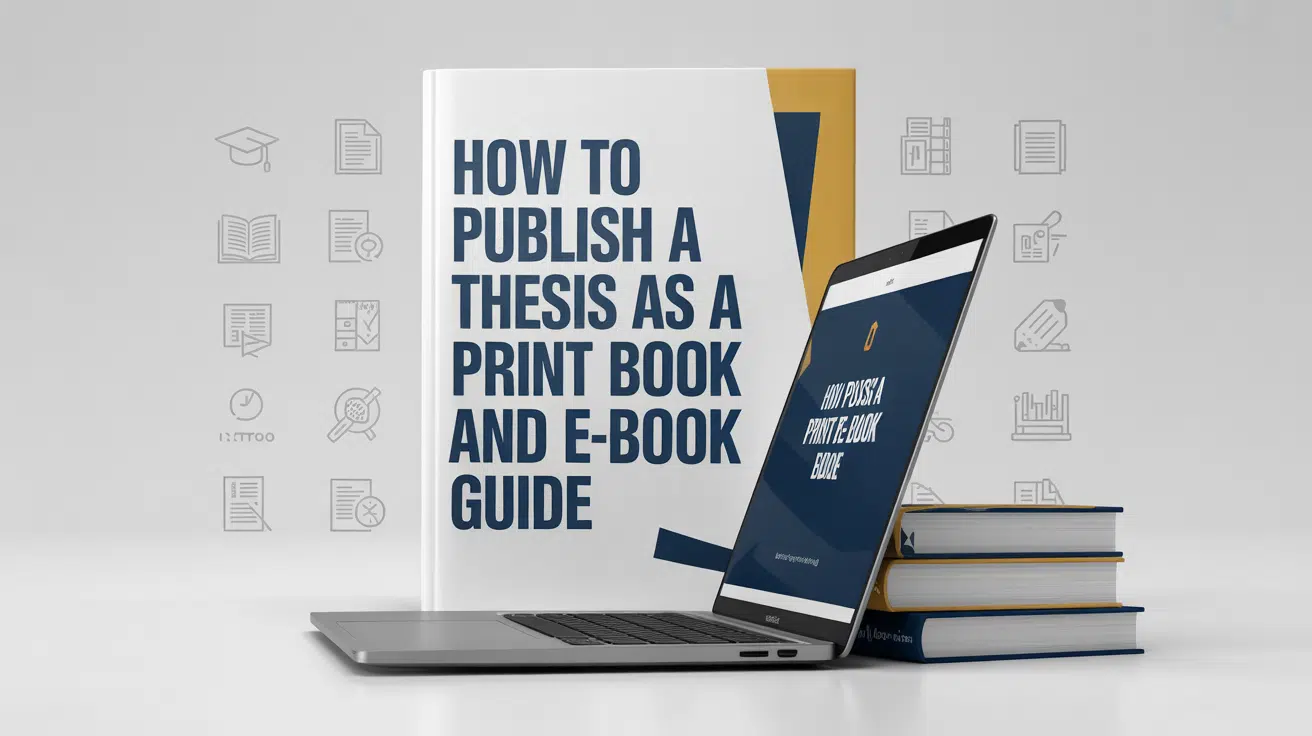
You spend years on a thesis, pass the viva, file the final copy… and then it sits in a repository and on your laptop. That document holds serious work. It shapes how you think about your subject and it deserves more than three examiners and a bored relative at graduation.
Good news: a thesis can grow into a book. You can publish it as a printed copy, an e‑book, or both. You do not need a famous name or a huge budget. You need a clear plan, honest editing, and the right place to publish.
Thesis First (What You Actually Wrote)
A thesis or dissertation is a formal academic document. It follows strict rules that suit examiners. Guides on how to structure a dissertation or thesis usually include:
- Front matter such as title page, acknowledgements, abstract, table of contents
- Core chapters: Introduction, literature review, theoretical framework, methodology, findings, discussion, conclusion
- End matter: recommendations, reference list, appendices
The literature review shows how you use scholarly sources and synthesise sources. The methodology chapter shows that your research design, data collection, and analysis match standards for qualitative vs quantitative research, primary vs secondary research, and reliability and validity.
Readers of a book do not need that level of detail. They care about the story of the research, what you found, and why it matters to them.
How a Thesis Differs from a Book People Choose to Read
A book based on a thesis is still serious. It still draws on your research questions, problem statement, hypothesis, and findings. Yet it serves a new audience. Key shifts:
- Audience: A thesis speaks to examiners and subject specialists, a book speaks to a wider academic community, students, or practitioners.
- Voice: A thesis often uses long sentences and heavy passive voice, a book keeps a clear academic tone but uses shorter sentences and direct claims.
- Structure: In a thesis the literature review and methodology sit in long separate chapters, in a book you may weave parts of the literature review into each chapter and cut the methodology down.
- Length: Many theses sit around 80,000–100,000 words, most publishers want a tighter book with repetition and large tables removed or moved to an appendix.
So a book is not just “thesis plus a nicer cover”. It is a new version of your work.
Can a Thesis Be Published as a Book?
Yes. Many academic publishers and university presses accept proposals that grow out of doctoral theses. Some, like Springer, state that they will consider books based on a PhD thesis once it has been revised for a wider audience and is not just a direct copy of the dissertation.
You can also publish your thesis yourself through self‑publishing services. In that case you act as both author and publisher. You choose the trim size, page layout, cover, and formats. Three paths make sense for most graduates:
- A proposal to an academic or specialist publisher
- Self‑publishing a print book with a UK printer or print‑on‑demand service
- Self‑publishing an e‑book through platforms like Kindle Direct Publishing or Kobo Writing Life
Looking for dissertation help?
Research Prospect to the rescue then!
We have expert writers on our team who are skilled at helping students with dissertations across a
variety of disciplines. Guaranteeing 100% satisfaction!
Is Your Thesis Ready to Become a Book?
Before you rush into publishing, step back and look at your thesis as raw material. Ask yourself:
- Does the topic speak to readers beyond your examiners?
- Can you state the main argument in two or three sentences?
- Do the findings still feel current?
- Are you comfortable revising texts that have already passed the examination?
Write a one‑page summary. Include your problem statement, main research questions, methods (for example, case studies or surveys), and key conclusions. If someone outside your field can read that page and say “I see why this matters”, you probably have a book project.
Turning Thesis Chapters Into Book Chapters
The next step is structure. At this stage, ideas from a dissertation step by step guide are useful, but you now write for readers, not examiners. A simple pattern for a book based on a thesis might look like this:
- Opening chapter: Set the scene, explain the central puzzle, sketch your approach in a few paragraphs.
- Context chapter: A tighter version of your literature review that focuses on the gap your research fills.
- Methods chapter: A clear summary of your research methodology and data collection, kept short.
- Finding chapters: Two or three chapters that present the main results, either by theme or by research question.
- Discussion chapter: Link the findings back to theory and practice.
- Final chapter: Conclusion and recommendations.
What happens to the thesis‑only parts?
- Large tables, long interview transcripts, and full questionnaires move to an appendix or an online file.
- Detailed notes on research paradigm, theoretical framework, or conceptual framework shrink to a few focused paragraphs.
- Repeated explanation of variables or detailed statistical tests can be shortened unless vital.
You still follow the logic of research papers: clear research questions, sound methods, and honest findings. You just present them in a way that keeps readers turning pages.
Language Shift (From Viva Voice to Reader‑Friendly Style)
A thesis tends to sound careful, dense, and long. A book can stay serious and still use a cleaner style. When you revise chapters:
- Shorten sentences
- Use topic sentences so each paragraph has a clear focus
- Fix grammar issues like subject‑verb agreement, dangling modifiers, and misplaced modifiers
- Keep punctuation simple
If English is not your first language, a professional edit brings big gains. Good editors know how to polish an argument without changing your meaning. Services that work on editing and proofreading dissertations often extend that work to book manuscripts.
Referencing, Plagiarism, and Self‑plagiarism
A common worry is self‑plagiarism. In simple terms:
- Your thesis is usually your copyright, though some universities keep a licence to host it in their repository.
- A book based on a thesis is fine as long as you reshape the text, update parts, and meet the publisher’s rules. Springer and other presses say this when they talk about revising a thesis into a monograph.
Keep in mind:
- Learn what is plagiarism and the main types of plagiarism.
- Read about what is self‑plagiarism and how to avoid it.
- When you reuse text or data from your own thesis, say so in a short note.
- Cite any published articles that came out of the thesis.
Your reference style may change. A thesis might follow Harvard referencing style with in‑text citation and a long reference list. A publisher might ask for another system, or for MLA style with in‑text citation and a list of works cited. This is mostly a formatting job, but it still needs care.
Print Choices (Academic Presses and UK Book Printers)
Once the manuscript starts to look like a book, you choose between traditional publishing, self‑publishing, or a mix.
Academic and specialist presses
Many big names in academic publishing consider book proposals based on theses. Lists of academic publishers often include presses such as Springer, Routledge, Palgrave Macmillan, Bristol University Press, and others.
You usually send a proposal with:
- A summary of the argument
- A chapter outline
- A sample chapter
- A short note on likely readers and course use
UK printers and short‑run services
Several UK companies print books in small batches or on demand:
- Short Run Press in Exeter prints paperbacks and hardbacks for global publishers and individual authors.
- BookPrintingUK offers short‑run digital book printing and print‑on‑demand services.
- SelfPublishingBooks.co.uk and Dolman Scott support authors who want on‑demand book printing in the UK.
You can order a modest print run, keep copies for events or teaching, and reorder when stock runs low.
Self‑publishing Your Thesis as an E‑book
E‑books give your work reach beyond any single campus. Many readers now buy research based books as Kindle or EPUB files.
Major platforms include:
- Amazon Kindle Direct Publishing (KDP) for Kindle e‑books and print‑on‑demand paperbacks
- Kobo Writing Life for e‑books and audiobooks
- Apple Books and Google Play Books for readers on iOS and Android
- Draft2Digital and similar services, which distribute your e‑book to several stores at once
In the UK, Bookshop.org now also sells e‑books through independent bookshops, so a title that starts life as a thesis can later appear in digital storefronts that support local stores.
For an e‑book version, you need:
- Clean formatting
- A contents page that works on screens instead of a thesis‑style table of contents
- A cover that looks clear at thumbnail size
- Basic metadata such as keywords and a short description
You can use the same core content for a print‑on‑demand paperback and an e‑book so libraries, students, and general readers each pick the format they like.
A Simple Timeline for Thesis‑to‑book
Each project is different, yet a basic sequence helps you move.
- Pause and plan: Take time after the viva and note what examiners liked and where they saw gaps.
- Assess the thesis: Write a short overview with problem statement, research questions, methods, and main findings.
- Restructure and rewrite: Draft a new table of contents, then trim the literature review and shorten the methodology.
- Check references and ethics: Update sources, adjust to the new referencing system, and watch plagiarism and permissions.
- Publish: Choose presses, UK printers, or self‑publishing platforms, upload files, approve proofs.
This process often takes months, so set a realistic timeline and work in stages.
Frequently Asked Questions
You can, but it rarely works. Most presses ask for a revised manuscript that reads like a book, not a thesis.
Check your regulations and any deposit form you signed. Many universities let you keep copyright while they hold a non‑exclusive licence to store the thesis.
Keep only the tables and figures that readers need to follow the story. Long data tables, raw questionnaires, and full transcripts can sit in a short research appendix or an online file. Check image rights and ask for permission if charts or photos come from other sources.
In most cases yes. A thesis style literature review for a research paper can run for many pages. For a book, you keep the authors and debates that support your main argument and drop long side notes. The goal is to guide readers, not list every study in your field.





