



You’ve spent months building an argument chapter by chapter, and the page count still doesn’t match what your handbook demands. Maybe you’re 4,000 words past the ceiling with a defense date closing in fast.
Or maybe the final chapter reads thin, and you’re short by a few thousand words with no obvious place to add more. Either way, the panic feels identical at midnight, and it usually ends the same way — deleting or padding at random, hoping the number fixes itself.
It won’t. Trim a dissertation carelessly and you lose the connective tissue that makes an argument hold together. Stretch it with filler and it reads exactly like what it is. So what actually helps?
Finding where the mismatch comes from, then fixing that one spot instead of attacking the whole document with a red pen.
Start by Confirming Where the Numbers Sit
Don’t touch a single paragraph yet. Total word count tells you almost nothing on its own — what matters is which sections are driving the imbalance.
A dissertation with a bloated literature review and a thin discussion chapter needs a completely different fix than one where every section just runs slightly long.
Open each chapter on its own and check how many words belong to it, rather than trusting one running total from your word processor.
A surprising number of students find the imbalance sits almost entirely in one place, often the literature review if the draft runs long, or the discussion and limitations sections if it runs short.
Worked example: 11,800 words against a 10,000-word limit
Counted chapter by chapter, the draft splits like this: introduction 1,100, literature review 3,900, methodology 1,500, results 2,000, discussion 2,600 and conclusion 700.
Against a typical split for a 10,000-word dissertation, the literature review carries most of the excess. Cutting summary there recovers well over 1,000 words without touching the chapters that hold the argument.
Once you know which chapter is the culprit, run it through a free online grammar and style checker before you start cutting.
The Getsolved grammar checker catches passive constructions, filler phrases like “due to the fact that” and repeated wording in seconds, and those are usually the cheapest words to remove, since fixing them tightens a chapter without touching the argument.
It won’t decide which ideas deserve to stay, but as a first diagnostic, it saves you from guessing.
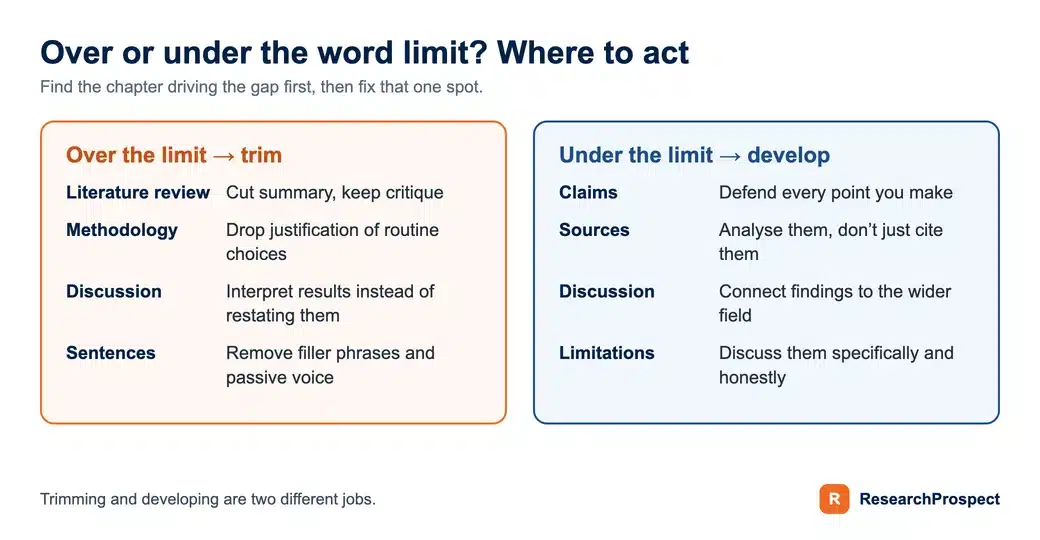
Once you know where the numbers actually sit, the real editing splits into two very different jobs.
Why the Number Exists at All
A required length isn’t red tape for its own sake. Committees use it to judge whether you can develop an argument to the depth a topic deserves while still keeping things concise. Go dramatically over and it can signal weak prioritization, or an inability to edit your own work.
Fall well short and it usually points to something else — thin evidence, a literature review that never got past summarizing. Most schools allow a small cushion, often around 10%. Ignore it consistently, in either direction, and marks tend to suffer.
Trim a dissertation carelessly and you lose the connective tissue that makes an argument hold together.
When the Draft Has Run Long
A few patterns show up again and again in oversized dissertations. The literature review summarizes far more studies than it actually critiques. Methodology sections justify choices that were already obvious from context. The results chapter states a finding once, and the discussion restates it almost word for word.
Introductions and conclusions restate each other instead of framing and closing. And somewhere in the middle, long unbroken sentences end up carrying three or four ideas that each deserved their own space.
None of that means shortening a dissertation has to be a demolition job. A few things consistently work:
- Merge paragraphs that make a similar point from slightly different angles instead of keeping both versions.
- Shorten quotes down to the phrase that actually carries meaning, then paraphrase the rest.
- Cut throat-clearing phrases like “it can be seen that” or “due to the fact that” — they add words, not meaning.
- Move numbers into a table instead of describing them across three sentences. Tables usually don’t count toward the total anyway.
- For every paragraph, ask what it actually proves. If it only describes something without analyzing it, cut it or rework it into analysis.
- Swap passive constructions for active ones where you can. “The researchers measured X” beats “X was measured by the researchers” almost every time.
Where trimming tends to pay off fastest, by chapter:
| Chapter | Where the excess usually hides | Fastest fix |
|---|---|---|
| Introduction | Repeats what the conclusion already covers | Cut the overlap, keep the framing |
| Literature review | Summary without critique | Merge similar studies, drop pure summary |
| Methodology | Justifies routine, uncontested choices | Remove unnecessary justification |
| Results | States the same finding twice | Say it once |
| Discussion | Restates results before interpreting them | Keep interpretation, drop restatement |
| Conclusion | Introduces new detail instead of closing | Trim to summary and implications |
If you’re still over after all that, look hard at whether an entire subsection earns its place — a tangential case study, an extra theoretical detour. Sometimes it doesn’t, and that’s fine to admit.
Still over the word limit?
Our dissertation editors cut repetition and tighten every chapter without weakening your argument.
When the Draft Falls Short
Underlength dissertations almost always share one root cause: the writer states ideas but never develops them. You’ll usually spot the signs: claims that go undefended, sources you cite but never analyze, a discussion chapter that restates findings instead of exploring what they mean, limitations you dismiss in a single sentence.
Reaching the target the right way means digging deeper into what’s already on the page, not decorating it with extra words. A few ways to do that:
Ask why each key point matters, how it supports your argument, and what it implies more broadly — answering those questions honestly, in writing, adds real content fast.
Do more with the evidence you already have instead of hunting for new sources; explain where studies disagree, or where their limitations actually matter for your argument. Check your paragraph structure too.
A complete academic paragraph usually has a topic sentence, an explanation, evidence, and analysis tying it back to the research question — short paragraphs are often just missing one of those pieces.
The discussion chapter deserves particular attention here. It’s usually where thin dissertations lose the most ground, since that’s the one place where results should connect to the wider field.
And don’t skimp on limitations — a specific, honest discussion of where your study falls short is one of the more legitimate ways to add real depth, and most committees respect it far more than vague hedging.
Chapters still feeling thin?
Work with a subject specialist who can help you develop your analysis, discussion and limitations properly.
Before You Hit Submit
Once the length sits where it should, you’re not quite done.
A final read-through catches things that editing for word count tends to introduce — an abrupt transition where a paragraph got cut, a reference to a section that no longer exists, a term you used inconsistently after merging two others.
This is proofreading in the strict sense: slow, line by line, focused on consistency rather than argument. Reading the document aloud helps. So does printing a page and marking it by hand — both catch things a screen quietly hides.
Getting the length right isn’t really separate from writing well in the first place. It’s part of what solid academic writing looks like.
A dissertation that lands comfortably within its target range, with every section pulling its own weight, reads like the work of someone who knows exactly what they’re arguing and exactly how much room it needs.
That leaves a stronger impression than either a document stuffed with filler or one cut down to the bone.





