

Private tuition has become more and more popular in UK secondary schools over the last 5 to 10 years. According to the Sutton Trust’s 2026 report, 29% of secondary school pupils in England and Wales have had private tuition at some point. In London, the figure is 45%.
Sources: Sutton Trust, Private Tutoring 2026; Education Endowment Foundation, Teaching and Learning Toolkit.
With that many tutors out there, the hard part isn’t finding one. It’s finding one that can actually work for you.
This guide covers where you can find A Level tutors, how much each option costs, and how to tell a competent tutor apart from someone who simply got good grades.
Where to find an A Level tutor
There are five main routes. Each suits a different budget and level of involvement.
1. Online tutor marketplaces
Marketplaces like Superprof and Tutorful list thousands of independent tutors. All you have to do is search by subject, read their profiles and get in touch with them directly.
The pro here is obvious: you get a wide range of prices and choices. The downside is that you have to do all the vetting yourself.
On Superprof, for example, you have to pay for a Student Pass to contact tutors for 30 days, and DBS checks aren’t part of the listing.
2. Online tutoring platforms
Platforms such as MyTutor, Spires and TutorChase sit between a marketplace and an agency. They recruit and interview tutors, then let you choose from a filtered pool.
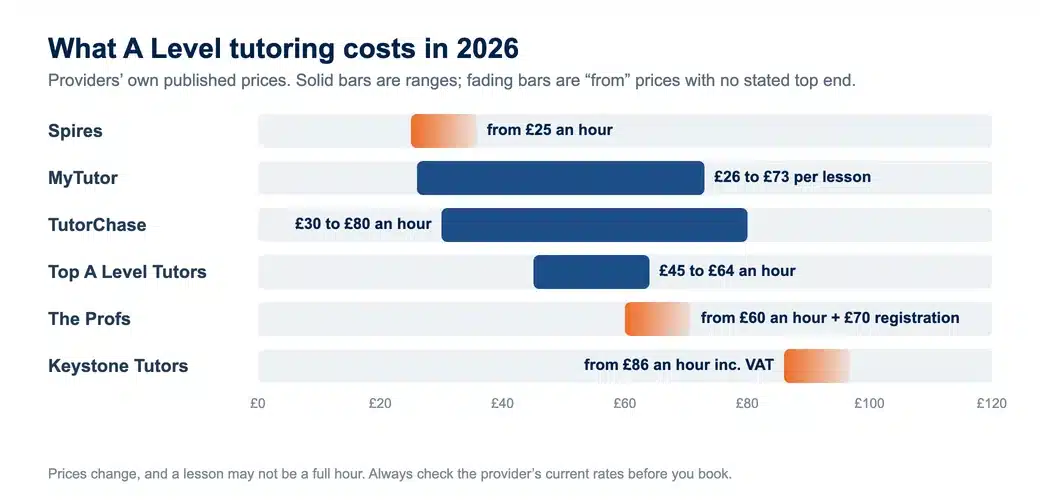
MyTutor’s tutors are mostly undergraduates from UK universities who are interviewed and must pass an enhanced DBS check. Lessons cost £26 to £73, depending on the tutor’s price level. On Spires, you post a request and tutors bid for it, with school-level lessons from £25 an hour.
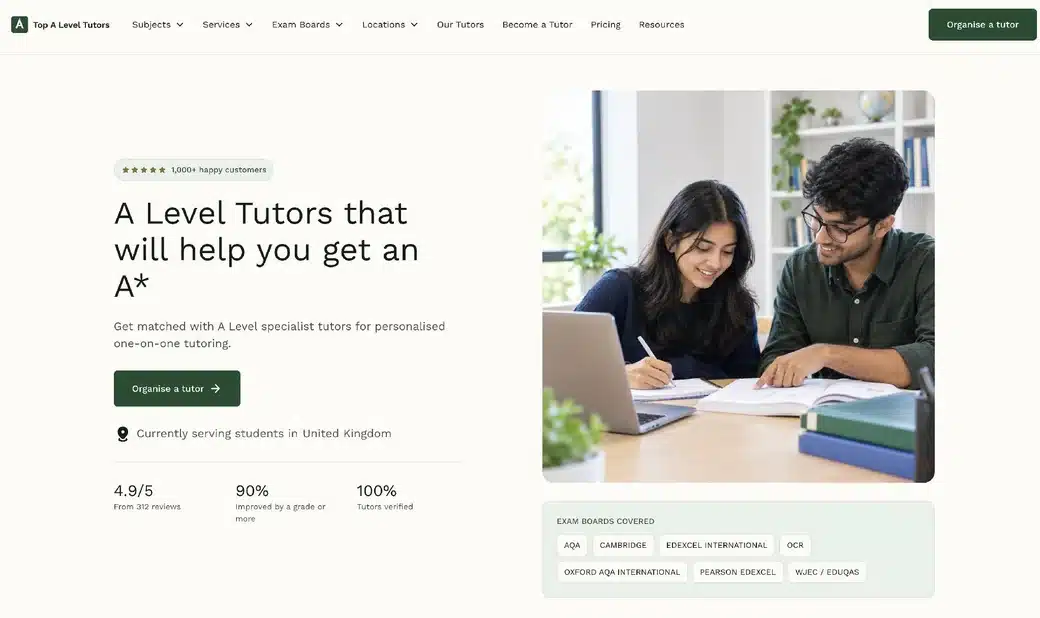
Some platforms specialise in exam-level subjects only. Top A Level Tutors, for example, covers A Level, GCSE and IGCSE.
Instead of browsing listings, you fill in a short form and a Learning Advisor matches you with a tutor by subject, exam board and target grade. Lessons start at £45 an hour with recent top-scoring graduates, or £64 with qualified teachers and examiners.
3. Specialist tutoring agencies
Specialist tutoring agencies do the searching for you. All you have to do is explain what you need, and they match you with a tutor they’ve already vetted. They usually cost more, but they save time and tend to come with stricter checks.
At the premium end, The Profs charges from £60 an hour for school-level tuition, plus a £70 registration fee. London-based Keystone Tutors starts at £86 an hour including VAT.
4. Your school and word of mouth
A lot of people jump straight to searching online, when you can often find local tutors, or teachers who tutor privately, through your school or people you know.
When the Sutton Trust last surveyed teachers in 2019, around a quarter of secondary school teachers said they had done some private tutoring, so it’s more common than you’d think.
Asking other parents, older students or your sixth form can turn up tutors who already know your school’s exam board and teaching style, which can work well.
5. The Tutors’ Association
The Tutors’ Association is the UK’s professional body for tutors. Its members must hold a recent enhanced DBS certificate, provide two references and sign up to its Code of Practice. It’s easy to search its register for members, which gives you a baseline of checks before you even make contact.
One note if you’re using older guides: First Tutors, once one of the largest UK directories, closed in May 2026, so links to it no longer work.
How much does an A Level tutor cost?
Rates vary widely by route and by the tutor’s experience. Based on providers’ own published prices in 2026:
| Route | Example | Typical A Level price |
|---|---|---|
| Marketplace | Tutorful | Tutors set their own rates |
| Platform | MyTutor | £26 to £73 per lesson |
| Platform | Spires | School level from £25 an hour |
| Platform | TutorChase | £30 to £80 an hour |
| Platform | Top A Level Tutors | £45 to £64 an hour |
| Premium agency | The Profs | From £60 an hour, plus £70 registration |
| Premium agency | Keystone Tutors | From £86 an hour including VAT |
In general, recent graduates are cheaper and fine for building understanding and confidence.
Qualified teachers and examiners cost more, but they’re worth it if the problem is exam technique, or you’re aiming for an A*.
Worked example: what 10 hours of A Level tuition costs
Using the published starting prices above, the same 10 hours can more than treble in cost depending on the route:
These are minimums, so the actual cost depends on the tutor you pick and how long each lesson runs.
Applying to university as well?
Our writers can help you turn your A Level subjects and ambitions into a strong UCAS personal statement.
Online or in person?
For most A Level students, online works just as well. The Education Endowment Foundation (EEF), which reviews evidence on what works in schools, found that online one-to-one tuition has broadly similar effects to face-to-face lessons.
Online also widens your choice. Instead of picking from the handful of Chemistry tutors within driving distance, you can choose someone who specialises in your exact specification.
In-person lessons still suit some students, especially younger ones or those who find it hard to focus on a screen. Just expect to pay more and have fewer tutors to choose from.
How to choose a good A Level tutor
Top grades alone don’t make someone a good tutor. Before you commit, ask these questions:
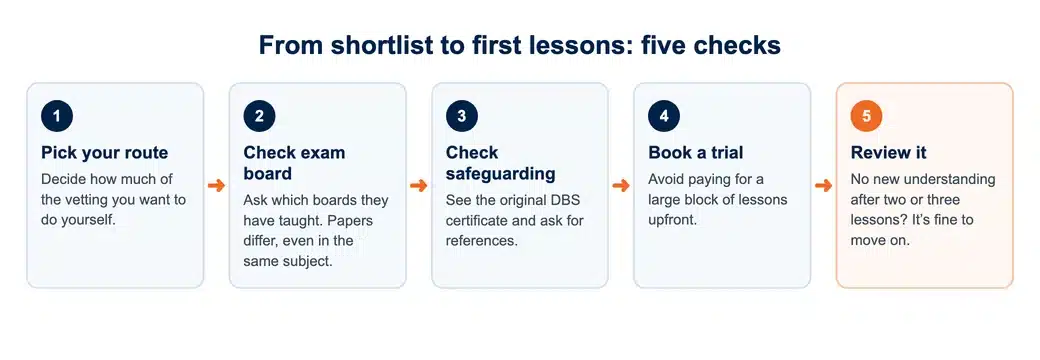
- Which exam board have you taught? AQA, Edexcel, OCR and WJEC papers differ, even in the same subject. A tutor should know your specification and its mark schemes.
- Have you examined, and can you show it? Examiner experience is valuable, but it’s also easy to claim. A good tutor won’t mind being asked.
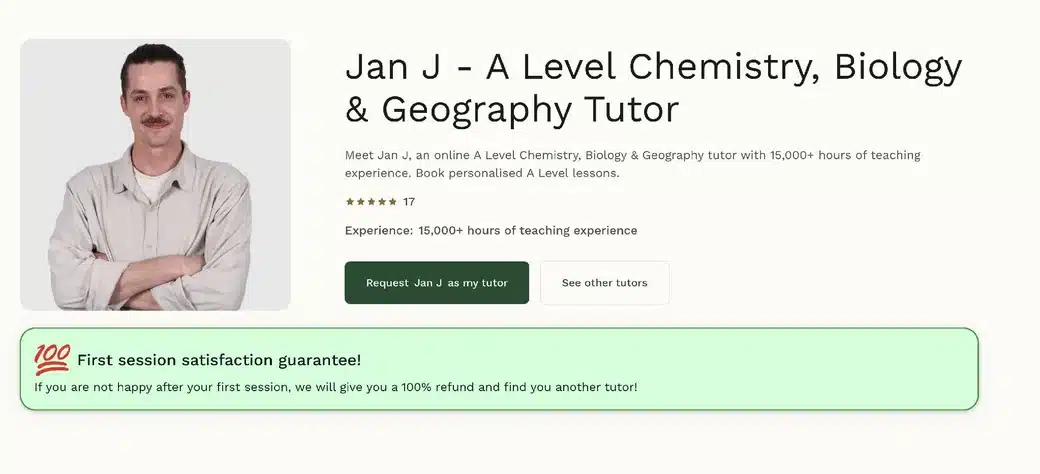
- Can we start with a trial or diagnostic lesson? Avoid paying for a large block of lessons upfront until you know the tutor works for you.
- How will we know it’s working? Look for regular progress updates and practice on past papers.
- Can I see your DBS certificate and references? Especially important for students under 18.
- What’s your cancellation policy? Get it in writing before you start.
After the first session, ask the student a simple question: did they understand something they didn’t before? If the answer is no after two or three lessons, it’s fine to move on.
Safeguarding and DBS checks
Private tutoring is largely unregulated in the UK. A self-employed tutor working directly for parents isn’t legally required to have a DBS check, which is why it’s worth asking.
Since January 2026, self-employed tutors can apply for an enhanced DBS check themselves through a registered umbrella body. Before that, they needed an organisation to apply for them. An enhanced check costs £41 from October 2026.
If a tutor shows you a certificate, GOV.UK guidance suggests:
- Ask to see the original, not a copy.
- Check it covers the “child workforce” and look at the issue date.
- If the tutor is on the DBS Update Service, you can run a free online status check to see if anything has changed.
Agencies and most platforms handle these checks for you, which is one of the main reasons parents use them.
Getting the most from A Level tuition
The EEF estimates that one-to-one tuition adds around five months of progress on average, and four months at secondary level. It works best when sessions are regular and closely linked to what the student is learning in class.
So share the student’s specification, recent mock papers and teacher feedback with the tutor from the start.
A tutor who can see exactly where marks are being lost will make far better use of each hour than one starting from scratch.
Revising from your own notes?
Get clear, well-organised exam notes written around your course and topics.
The bottom line
The best place to find an A Level tutor depends on how much vetting you want to do yourself. Marketplaces give you the widest choice at the lowest prices. Platforms and agencies cost more, but handle the checks and the matching for you.
Whichever route you choose, prioritise exam-board knowledge, ask for a trial lesson, and check safeguarding before the first session. If exams have already gone badly, our guide to resitting an exam covers what to do next.