


Nearly half of students now ask AI about their university options. UCAS found that out when it polled more than 4,000 of its registered students last November; the write-up, The Role of AI in Student Decision Making, landed in June 2026.
About 48% were using AI to look at their options, and 61% used it to weigh one place against another.
The same students don’t trust it much, though. Almost three quarters, 73%, had been told something wrong or misleading by an AI tool. Just 10% would call it very trustworthy for a big decision.
Source: UCAS, The Role of AI in Student Decision Making (June 2026), 4,000+ registered students.
The US picture is similar. EAB asked more than 5,000 American high schoolers in late 2025, and 46% were using ChatGPT or something like it to search for colleges.
In spring 2025 it was 26%. And 18% had dropped a college from their list because of something an AI told them.
Plenty of students act on answers they don’t fully believe, then. I’ve spent a fair bit of time on the other side of that decision.
I worked as a content marketer in Pearson’s online learning department, on online master’s programmes run with King’s College London, and these days I study how education providers publish information, so I’ve seen why those answers go wrong and what’s worth checking before you trust one.
Why does AI get course information wrong?
Mostly because the pages it learns from are thin. A chatbot can only repeat what’s out there. If a provider never wrote down its fees, the chatbot can’t know them either.
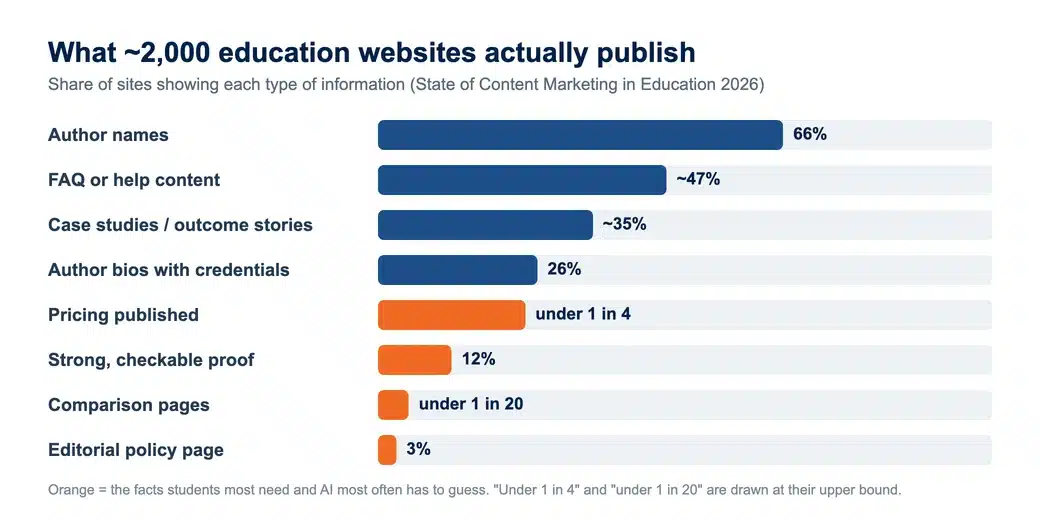
This year we pored over roughly 2,000 education company websites, from 47 countries, for our State of Content Marketing in Education 2026 study. I should say the sample is mostly online course platforms, edtech companies, language schools, test prep, and private schools.
Big public universities are thin in the sample. But the gaps jumped out. Pricing appeared on fewer than one in four sites. Comparison pages showed up on fewer than one in twenty. Only about 47% had FAQ or help content at all.
Other researchers found the same thing from the student side. In Ruffalo Noel Levitz’s 2025 E-Expectations report, 91% of students said they use college websites (nothing else came close).
What annoyed them most? Not being able to find details on specific programmes, at 26%. Another 13% couldn’t find what recent graduates had gone on to do. RNL also surveyed families that year. 99% of them wanted clear costs. Around a quarter struggled to find them.
If a page says nothing about fees, the AI will often fill the gap anyway, and it rarely sounds unsure.
One student in the UCAS report put it well, saying they turn to AI when university websites “do not directly provide the information.” That’s the exact moment an AI answer is least reliable.
Students turn to AI when university websites “do not directly provide the information.”Student quoted in UCAS, The Role of AI in Student Decision Making (2026)
AI also struggles with categories. I once asked a deep-research tool for a list of education technology experts, and it came back with a strange mix of people who had little to do with the field.
My best guess is that, to the model, “edtech” mostly means learning management software. If it can misread a whole sector, it can certainly misread which programme suits you.
Which three facts should you check at the source?
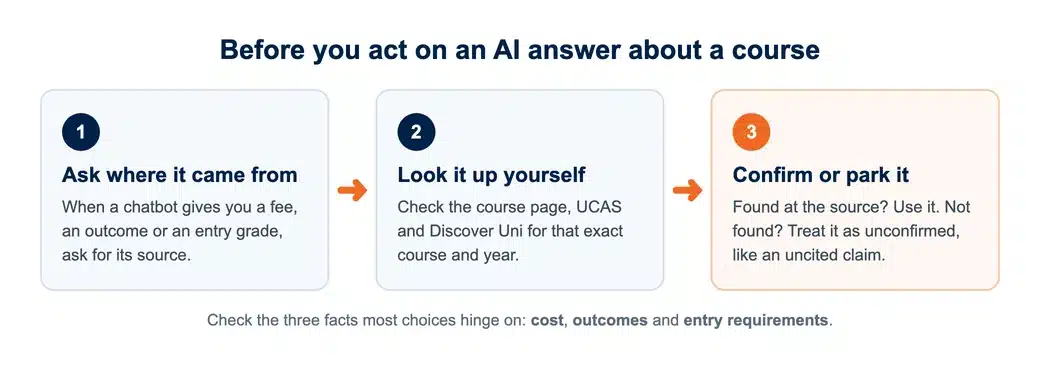
Cost, outcomes, and entry requirements. Most choices hinge on those, so I’d check each one myself. Cost means tuition plus whatever extra fees there are, and what you actually get for it.
Outcomes means what people who did this exact course went on to do, not the university as a whole. Entry requirements shift from one year to the next, so an AI trained on last year’s page can easily be out of date.
In the UK you’ve got the course page itself, UCAS, and Discover Uni (it has course-level numbers on satisfaction, how many students carry on, and what graduates earn). When a chatbot hands you a number, ask where it got it.
| Fact to check | What it should cover | Why AI gets it wrong | Where to check in the UK |
|---|---|---|---|
| Cost | Tuition plus any extra fees, and what you actually get for it | Pricing appears on fewer than one in four education sites, so the gap gets filled | The course page |
| Outcomes | What people on this exact course went on to do, not the university as a whole | Strong, checkable proof appears on only 12% of sites | Discover Uni (course-level data) |
| Entry requirements | The grades and conditions for your year of entry | They change every year, and an AI may be working from last year’s page | The course page and UCAS |
Then look it up. If you can’t find it at the source, treat it as unconfirmed. You’d apply the same rule to a citation in your coursework, and it works just as well here.
The UCAS students seem to know this already. Many said they check AI answers against UCAS and university websites. The trouble is that the websites themselves are often the weak link, which brings us back to the study.
How can you tell evidence from marketing?
Course pages are full of claims. Fewer of them back those claims up. In our study, case studies or outcome stories appeared on roughly 35% of sites, and only 12% showed strong proof, meaning evidence a sceptical reader could actually check.
Author names appeared on 66% of sites, but author bios with credentials on just 26%, and an editorial policy page on 3%.
Example: what persuaded applicants to King’s College London online master’s programmes
I saw what changes a decision when I worked on the King’s online master’s programmes. These cost around £21,000. The people applying were mostly working professionals and international students, and many researched for months before they applied, looking for proof of outcomes.
Pages built around other students’ voices, written testimonials, and alumni interviews converted at about 1.7 times the average. Students who used a practical tool, such as a salary calculator or a funding planner, converted at about 2.1 times the baseline.
So other students’ experiences and numbers you can work with were more persuasive than anything the university said about itself. Use that as your filter. A named student describing what happened after the course tells you far more than a phrase like “world-class teaching”.
QS’s International Student Survey found that 63% of international students put teaching quality first when choosing a course, and that most link it to rankings and graduate employment rates. You can check both of those yourself.
What does this mean for your own research?
If you’re writing a dissertation, this is the same problem you’ll meet in your literature review. The HEPI and Kortext Student Generative AI Survey 2026 found 95% of UK undergraduates use AI in some way.
The 2025 edition found 51% were put off by false results, or hallucinations. The fix in both cases is triangulation. Don’t trust any single source, human or machine, until another independent source agrees.
Struggling to triangulate your sources?
A subject specialist can help you build a literature review that weighs and cross-checks the evidence properly.
We built our own study that way on purpose. It ran two separate analyses, one of websites and one of around 1,000 job posts, and kept them apart so each could check the other.
We reported proportions rather than precise counts, and we labelled estimates as directional where the method couldn’t support more.
Using websites as data for your own project? You could do worse than copy that.
- Be upfront about your sample and what’s missing from it.
- And tell the reader which numbers you’d stand behind and which are rough.
One more thing from my work. Some of the best-performing education content I’ve seen drew on academic and field research that AI models hadn’t absorbed yet. Generic AI writing couldn’t compete with it because it simply didn’t have the material.
Original research is getting rarer as more of the web gets written by machines, and that makes it worth more. Your dissertation might be one of the few places a question gets properly answered.
Want your own research done properly?
Work with a UK academic on a dissertation built on sources you can stand behind.