


An online Doctor of Education, or Ed.D., suits working professionals who want to solve problems while staying in the field. It focuses on applied leadership, research and organisational change — a degree for people who have seen a broken process at close range and thought hard about how it could be fixed. This guide looks at where an Ed.D. can take you, and how to choose a program that fits a working life.
American education has reached a point where good intentions need better tools. In January 2025, the Nation’s Report Card showed fourth-grade reading scores fell from 2022 and stayed below 2019 levels. For leaders, that means the old habit of admiring a problem has reached its sell-by date — and it explains why applied, evidence-led leadership training has become so valuable.
Leadership with evidence behind it
A good Ed.D. gives leaders a better way to ask questions. A principal may want to know why attendance has fallen; a non-profit manager may want proof that a tutoring program helps; a business owner may need to train staff across several sites. In each case a hunch can start the work, but evidence should do the steering. An online education doctorate degree focuses on applied leadership, research and organisational change — so students use evidence to improve schools, non-profits, businesses and public agencies rather than studying policy as a museum piece.
The need is real. The U.S. Department of Education reports that chronic absenteeism reached about 31% in 2021–22 and fell to 28% in 2022–23 (defined as missing 10% or more of school), according to its attendance resource. Those numbers demand family outreach, data review and teacher support — not another poster in the hallway.
A “dissertation in practice” — a research project tied to a real problem in a real setting — lets a school leader test an attendance plan before rolling it out across every grade, or a non-profit prove to donors that a program did more than produce warm photographs.
Career paths beyond the classroom
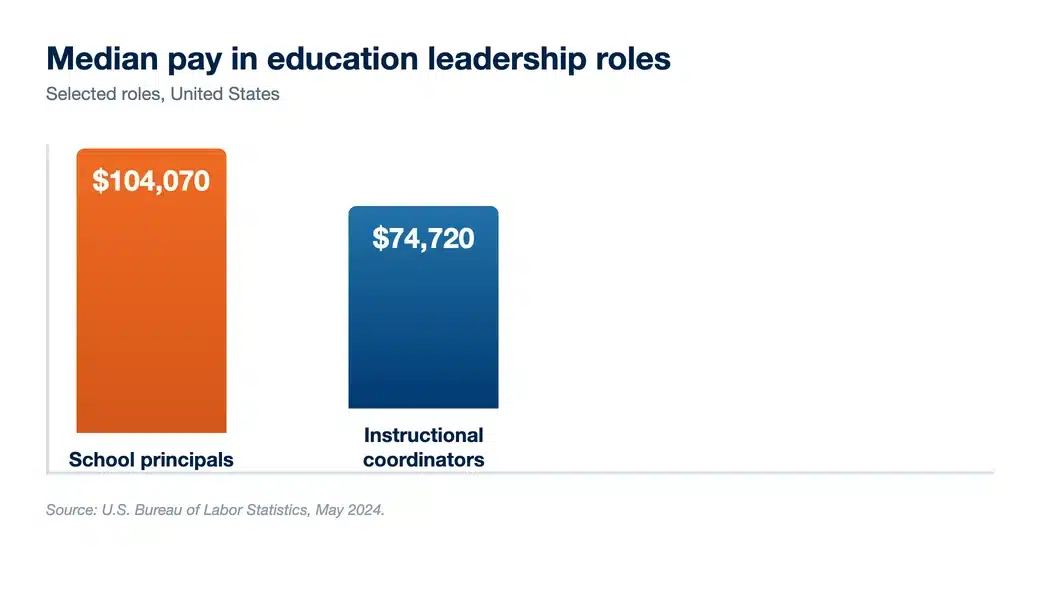
Many people hear “education doctorate” and think only of school districts. That view misses much of the point. Modern organisations need people who can teach adults, design training and manage change — in healthcare, government, workforce development and community services. The pay and outlook reflect that breadth:
| Role | Median pay (May 2024) | Outlook 2024–34 |
|---|---|---|
| School principals | $104,070 | ~20,800 openings/yr |
| Instructional coordinators | $74,720 | Master’s + experience |
| Training & development managers | Above average | +6% (faster than average) |
| Social & community service managers | Programme leadership | +6% (faster than average) |
Serving students who need more than good wishes
Special education gives this degree a strong public purpose: 7.5 million students aged 3–21 received services under IDEA in 2022–23, equal to 15% of public-school students. Leaders in this space need legal knowledge, budget judgement and empathy with a spine. Online study helps, because leaving work for years carries its own cost — and 53.8% of postsecondary students enrolled in distance-education courses in autumn 2024. Students who want help with the academic writing itself often lean on our dissertation support and essay writing along the way.
Tackling an Ed.D. dissertation in practice?
From proposal to defence, our dissertation specialists help working professionals turn a real organisational problem into rigorous, defensible research.
Choosing the right program
Check accreditation, cost and fit before applying, and treat real numbers as a feature rather than a flaw — they refuse to flatter anyone. Licensure also needs careful checking: a degree may support advancement, but state rules can still control principal or superintendent credentials. Weigh the format, the dissertation structure and the support on offer together, and choose the program that fits the place where you already serve.