


When you picture higher education today, lecture halls and libraries are only part of the story. Universities are now shaped by learning platforms, AI, student-data systems, cybersecurity and hybrid classrooms — and steering all of that well has turned digital leadership into a core responsibility. This article looks at why it matters now, how AI has changed the conversation, and what prepares leaders to handle it.
Today’s universities are shaped by learning-management systems, AI, student-data platforms, cybersecurity tools and hybrid classrooms as much as by lecture halls and libraries. With that shift, digital leadership has become one of the most important responsibilities in modern higher education — and it is no longer just an IT issue, but a core leadership one.
Why preparation matters
The growing role of technology has changed what academic leaders need to know. Where past roles focused mainly on curriculum quality, faculty management and budgeting, leaders now make decisions about digital infrastructure, learning technologies and the ethical use of emerging tools. That shift is influencing leadership preparation: for educators moving into senior roles, an educational leadership doctorate degree offers a structured way to connect leadership theory with the real challenges institutions face.
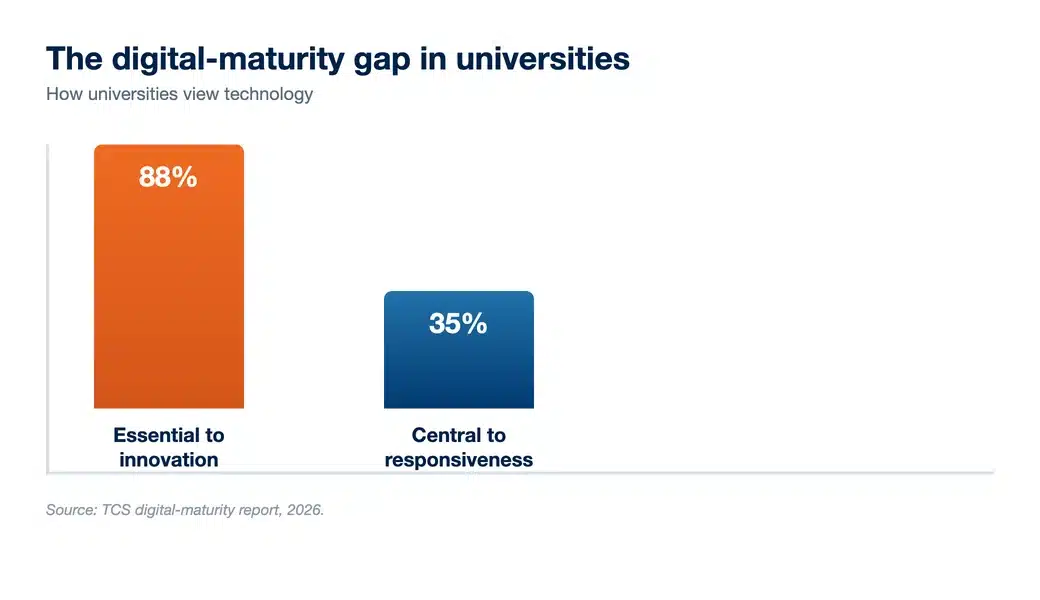
A 2026 report on digital maturity found that 61% of universities are still in the “evolving” stage — they have the tools, but not always the leadership structures or culture needed to use them well.
AI has changed the conversation
Artificial intelligence has quickly become one of the biggest tests of digital leadership. A few years ago, leaders were mainly asking whether students should be allowed to use AI tools; now the question is how AI should be integrated into academic life. The 2025 HEPI and Kortext Student Generative AI Survey found that 92% of UK students were using AI in 2025, up from 66% the year before. Universities can no longer treat AI as a side issue — it is already lodged in academic work.
Strong digital leaders do not simply ban AI or wave it through. They create clear, practical policy that can still evolve. A workable framework usually includes:
- Clear AI disclosure rules
- Approved-use categories
- Academic-integrity guidance
- Staff training
- Student-facing examples of acceptable and unacceptable AI use
Higher education in numbers
A handful of recent figures show why digital leadership has moved to the centre of the agenda:
| Indicator | Figure | Source |
|---|---|---|
| UK students using generative AI (2025) | 92% — up from 66% in 2024 | HEPI & Kortext, 2025 |
| Universities still at the “evolving” digital-maturity stage | 61% | TCS, 2026 |
| Faculty fully prepared for online course design | 28% | CHLOE 10, 2025 |
| Students reporting Wi-Fi problems on or off campus | 60% | Jisc, 2024/25 |
Online learning needs more than technology
Online and hybrid learning are now permanent features of higher education, but institutional readiness is uneven. The 2025 CHLOE 10 report found only 28% of faculty were considered fully prepared for online course design, while 45% were fully prepared for online teaching. This is where digital leadership has a direct impact on learning quality — leaders need to invest in instructional design, faculty development, accessibility, student orientation and course quality assurance. Simply placing content online is not the same as building a strong digital learning experience.
Researching your Ed.D. dissertation?
Our dissertation specialists support educational-leadership research from proposal and methodology through to analysis and final submission.
Students expect better digital experiences
Students interact with polished digital platforms every day, so they notice when university systems feel dated. A 2024/25 survey found 86% of students rated their digital learning environment above average — yet 60% reported struggling with Wi-Fi on or off campus. Good digital leadership is often less about exciting technology and more about making sure students can access materials and support without unnecessary friction. The challenge is balance: AI tools can improve productivity, but they also raise questions about authorship, bias, privacy and academic integrity, and leaders must encourage innovation without losing sight of academic values.
Related reading
- Evaluating Research in Online DBA Programs
- How an Online Ed.D. Can Advance Your Career
- How to Check Your Work for Plagiarism and AI Before You Submit