


Swine diseases are illnesses and infections that affect pigs. They can be caused by viruses, bacteria, parasites, fungi, nutritional deficiencies, toxins, or environmental factors.
Some diseases affect individual animals, while others spread quickly through a herd — via direct contact, respiratory droplets, faecal contamination, contaminated equipment, feed or water, and the movement of infected animals or people, depending on the pathogen.
Disease can affect pig growth, reproduction, immunity, welfare, and overall productivity. That is why understanding how diseases develop and how pigs respond to infection is essential for improving prevention and treatment strategies. Here is where a porcine ELISA kit comes into play.
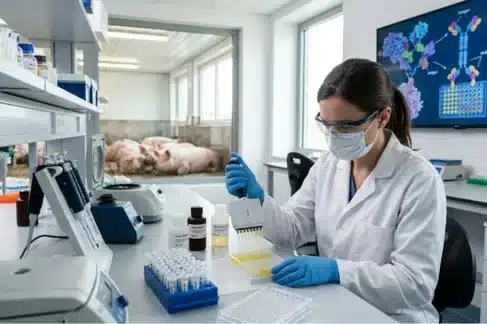
What is a Porcine ELISA Kit?
ELISA stands for Enzyme-Linked Immunosorbent Assay. It is a plate-based technique used to detect and quantify the amount of analyte present in a biological sample. These analytes may include proteins, antibodies, hormones, cytokines, or other biomolecules.
It relies on antigen-antibody interactions. When an enzyme-linked antibody is added, it produces a signal directly proportional to the amount of analyte present in the sample. The technique is known for:
- High sensitivity
- High specificity
- Quick and reproducible results
- Compatibility and versatility
- Affordability
Porcine ELISA kits are designed to detect and quantify specific molecules in samples obtained from pigs. These samples can be porcine serum, plasma, tissue homogenates, or other validated sample types.
The specific performance of a kit depends on the target analyte, assay format, sample type, and the validation characteristics of the individual kit.
How Porcine ELISA Kits Help in Swine Disease Research
Measure Immune Responses
When a pathogen enters a pig’s body, the immune system activates different defence mechanisms. It may produce antibodies, cytokines, chemokines, and other immune-related proteins.
Researchers measure these molecules in biological samples using porcine ELISA kits, then compare the altered levels with those found in healthy animals. This helps them understand how strongly the immune system responds.
Study Inflammation
Inflammation is the body’s response to infection and tissue damage. During swine disease, inflammatory signalling molecules may increase or decrease depending on the pathogen and stage of infection.
Researchers can use porcine ELISA kits to quantify inflammatory biomarkers and examine how they change at different stages of disease.
This helps them understand when inflammation begins, how strong the response is, whether it changes during disease progression, and how experimental treatments influence inflammatory responses.
Monitor Disease Progression
Swine diseases develop over different periods. Some infections produce rapid clinical changes, while others cause less obvious changes that develop gradually.
Researchers can measure biomarkers at different time points to build a clearer picture of disease progression. For example, samples may be collected before infection and at selected intervals after infection.
The resulting measurements show whether a particular biomarker changes during the course of infection. These findings can be combined with clinical observations, pathological findings, and other laboratory tests.
Evaluate Vaccine Responses
Vaccination is a key strategy for preventing and controlling infectious diseases in swine. However, researchers need to understand whether a vaccine produces an appropriate immune response.
Porcine ELISA kits support vaccine studies by measuring antibodies or other immune-related biomarkers in samples collected from vaccinated animals.
Researchers may compare antibody levels before and after vaccination, or evaluate responses between vaccinated and control groups. Such measurements contribute to the assessment of immune responses generated during vaccine research.
However, ELISA results are generally interpreted alongside other measures rather than being used as the only indicator of vaccine effectiveness.
Support Biomarker Research
Biomarkers are measurable biological indicators that provide information about a physiological or pathological process.
In swine disease research, researchers may study biomarkers associated with infection, inflammation, immune activation, tissue damage, or recovery.
Porcine ELISA kits help measure selected biomarkers across many samples. Used with other laboratory techniques, these measurements help researchers identify patterns that may be associated with particular disease processes.
Compare Different Experimental Groups
Research studies often involve multiple groups of animals. For example, researchers may compare healthy pigs with infected pigs, or evaluate different treatment groups.
Using the same validated ELISA procedure across samples lets researchers compare analyte concentrations between groups. Statistical analysis of these measurements may reveal meaningful differences.
This approach is useful when investigating how infection, vaccination, treatment, age, environmental conditions, or other experimental factors affect biological responses.
The Bottom Line
Now that you know how porcine ELISA kits help in swine disease research, what are you waiting for? Find a reliable supplier for high-quality ELISA kits that support your experiment — otherwise, you may have to compromise on your results.
Frequently Asked Questions
Porcine ELISA kits can work with different sample types, including porcine serum, plasma, tissue homogenates, or other validated biological samples.
It is recommended to choose a kit that is compatible with your specific sample type.
Consider the target analyte, sample type, assay sensitivity, specificity, detection range, species reactivity, and validation data.
Choosing a kit that matches the experimental requirements helps produce more reliable and interpretable results.
Sample handling, storage conditions, dilution, incubation time, reagent preparation, and adherence to the assay protocol can all influence results.
Use appropriate controls and follow the manufacturer’s instructions to improve consistency between experiments.
Porcine ELISA kits can work with different sample types, including porcine serum, plasma, tissue homogenates, or other validated biological samples.
It is recommended to choose a kit that is compatible with your specific sample type.
Consider the target analyte, sample type, assay sensitivity, specificity, detection range, species reactivity, and validation data.
Choosing a kit that matches the experimental requirements helps produce more reliable and interpretable results.
Sample handling, storage conditions, dilution, incubation time, reagent preparation, and adherence to the assay protocol can all influence results.
Use appropriate controls and follow the manufacturer’s instructions to improve consistency between experiments.