If you study online, you already know the freedom it gives you. You can take a course taught by a professor on the other side of the world, work at your own pace, and earn a credential without ever setting foot on a campus.
For many students, it is the only realistic route to a good education.
But there is a catch you have probably met already: proving what you actually learned. Traditional certificates are just digital files, and digital files are easy to copy or quietly alter.
When an employer wants to confirm your diploma is real, they usually have to contact your school and wait — and that wait can cost you the offer.
Blockchain is starting to fix this. Using distributed ledgers, your course provider can issue a credential anyone can verify instantly, with no phone call and no awkward follow-up email.
This guide walks through what that looks like in practice, where it is already used, and what to expect as more of your courses start working this way.
Why This Matters to You as a Student
Your credentials are protected and easy to prove
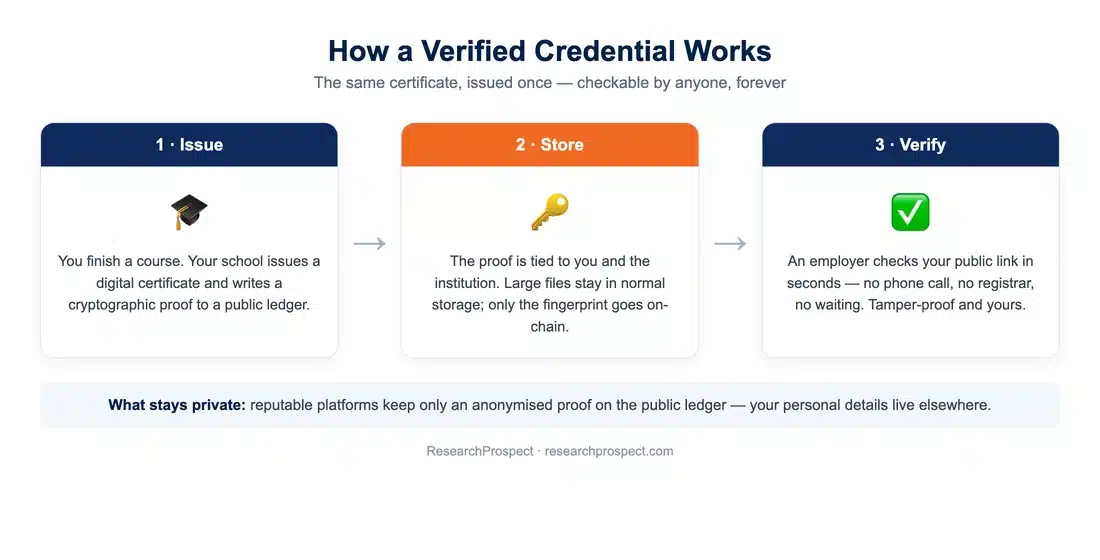
The biggest advantage is simple: your certificate becomes very hard to fake or lose. When you finish a course, your school issues a digital certificate and records a cryptographic proof of it on a public ledger.
That record cannot be altered or deleted — not by you, not by anyone else.
If an employer or another university wants to check your certificate is real, they can verify it themselves in seconds, using nothing more than your public credential link.
Behind the scenes this relies on specialised education software development work, but as a student what you care about is simpler: your achievements recognised quickly, kept safe, and genuinely yours.
It also protects you from fraudulent look-alike certificates. Because your record is cryptographically tied to you and to the institution that issued it, there is no ambiguity about what is genuine.
Your learning history travels with you
Think about how many platforms you have used: a coding bootcamp here, a language app there, maybe a professional certificate from a university’s online arm. Right now all of that history lives inside separate accounts on separate platforms.
If one shuts down, you could lose proof of work that took months.
Distributed ledgers change this by putting you in control of your own record. Instead of your transcript being locked inside one company’s database, you hold a lifetime record that does not depend on any single platform surviving.
You decide what to share, and with whom — just your data-analytics certificate, say, and not your entire history.
Staying motivated through the tough parts
If you have ever started an online course full of enthusiasm and quietly stopped showing up around week four, you are far from alone.
Online courses have some of the highest dropout rates in education, mostly because it is easy to lose momentum when no one is checking in on you.
Some platforms use blockchain-based tokens to help. You might earn tokens for finishing a module, helping a classmate, or passing a tough exam, and sometimes exchange them for premium access, tutoring or merchandise. Visible, cumulative progress that is actually worth something can make a real difference when motivation slips.
Real Examples You Might Already Recognise
This is not a hypothetical future technology. It is already part of some programmes you may be considering.
| MIT & Learning Machine | MIT issues digital diplomas anchored to a public network, so graduates can share a verifiable diploma with any employer, anywhere, without the registrar being involved each time. |
| Blockcerts | An open standard many schools use to issue secure, tamper-proof certificates. Because it is open rather than vendor-owned, schools are not locked into one supplier — good news for the long-term reliability of your records. |
| ODEM | Connects students, instructors and employers using smart contracts to manage enrolment and progress. Once you finish, your verified records update automatically — no manual paperwork at your end. |
What’s Happening Behind the Scenes
You do not need to become a programmer to benefit from any of this, but it helps to understand roughly what makes it possible — especially if you are trusting these systems with your academic record.
- Smart contracts run the rules automatically — drop a course in the first week and a contract can process your refund with no call to support.
- Wallets hold the keys that prove a credential is yours. Most student platforms use custodial wallets, so you just log in with a normal username and password.
- Large files stay off-chain. Your recorded lectures live on ordinary cloud or decentralised storage; the ledger holds only a small cryptographic fingerprint proving nothing was tampered with.
What to Watch Out For as a Learner
It is worth knowing this technology is not perfect yet, and you may meet some friction as more schools adopt it.
Privacy rules vary by country, and your right to have personal data removed can be hard to reconcile with a ledger designed to be permanent.
Reputable platforms keep only anonymised proofs on the public ledger and your real details elsewhere — but it is fair to ask any platform exactly what gets stored, and where.
Not every school has the budget or technical staff to build these systems, so smaller institutions may roll them out slowly or lean on outside partners. And if you have never used a digital wallet, expect a small learning curve the first time you set one up.
Treat any credential the same way you would treat your own writing: verify it, protect it, and keep your own copies. The same care that keeps your digital life secure applies to your academic record.
The Bigger Picture for the Academic Community
None of this is really about the technology for its own sake.
It is about giving you a way to prove your work that cannot be quietly altered, does not depend on a single company staying in business, and does not require you to wait on someone else’s schedule to be believed.
As more providers adopt this approach, expect verification to keep getting faster, your records to become more portable, and ownership of your academic history to become the norm rather than the exception.
The technology is still maturing, but the direction is clear: your achievements should belong to you, and they should be easy for the world to trust.
Focus on the work behind the credential
A verified certificate only means as much as the learning behind it. Our academic team helps you produce original, well-researched work you can stand behind.