


Writing a dissertation is perhaps the most challenging and rewarding academic task that an academician has to face in their academic journey. It is a prerequisite for graduating and an essential tool for many to move from the realm of reading and learning from content to creating content for the academic fraternity. There are many decisions that need to be made while writing a dissertation, from selecting the right topic and tools for the research to designing the research and writing the dissertation.
The most commonly used research methodology for writing a dissertation is quantitative research methodology. This is particularly true for academic disciplines like science, health sciences, and business studies, for which quantitative research methodology is the only viable and accepted methodology for writing a dissertation. This is a scientific approach that is designed to test a theory or hypothesis and find the actual effect or debunk a theory altogether by stating that it does not exist or that the effect does not exist in the manner that the theory suggests. The approach is scientific and uses clear methodology to test the theory and find evidence for or against the existence of a relationship between the variables that the theory suggests.
Quantitative research methodology is a strict and demanding methodology that requires a high level of knowledge and expertise in the field and a good amount of strategy and practical approach towards designing the research methodology for the dissertation. It is particularly important for those who aim to publish their dissertation in a journal and need to understand the essential steps that need to be followed for conducting quantitative research for the dissertation.
Table of Contents
Quantitative vs. Qualitative Research
It is essential for an academic writer to understand the difference between quantitative and qualitative research methodologies and the tools and approaches that each of these methodologies uses for arriving at a conclusion for the research that is conducted by the academic writer.
Quantitative research methodology is designed for arriving at a conclusion that is quantifiable and measurable in nature. This methodology is designed for arriving at a conclusion that tests a theory or hypothesis or answers a research question that a writer may have in mind for the research that is being conducted by the writer.
On the other hand, qualitative research is exploratory research that does not have a specific outcome in mind. It focuses more on the human experience. It is conducted when the researcher wants to find out why people think or do something in a particular way. It does not set out to prove or disprove anything. Instead, it seeks to have a better understanding of something or a social phenomenon. In this type of research, images, videos, or documents are analysed. In this case, the aim is to develop a theory based on what has been observed.
Which One Should You Choose?
The choice of either qualitative or quantitative research depends entirely on what the research aims to find out. In the medical field, for example, one may choose to research the efficacy of a newly introduced drug. On the other hand, one may want to find out how a patient feels about their recovery process. In some cases, both types of research may be conducted to get information from different perspectives. However, to get a clear understanding of the two types of research, one may want to look at examples.
| Qualitative question (why/how) | Quantitative question (what/how much) | |
|---|---|---|
| Healthcare | How do patients experience the process of recovering from surgery? | What is the average recovery time for patients after surgery? |
| Employment | Why do some employees feel more motivated in a work-from-home environment? | How does work-from-home impact employee productivity levels? |
| Lifestyle | What are the cultural influences on dietary habits among teenagers? | What percentage of teenagers adhere to recommended dietary guidelines? |
Quantitative Research: Step by Step
There are several things you need to consider before conducting quantitative research, and several questions you need to ask yourself before you even start to write your dissertation.
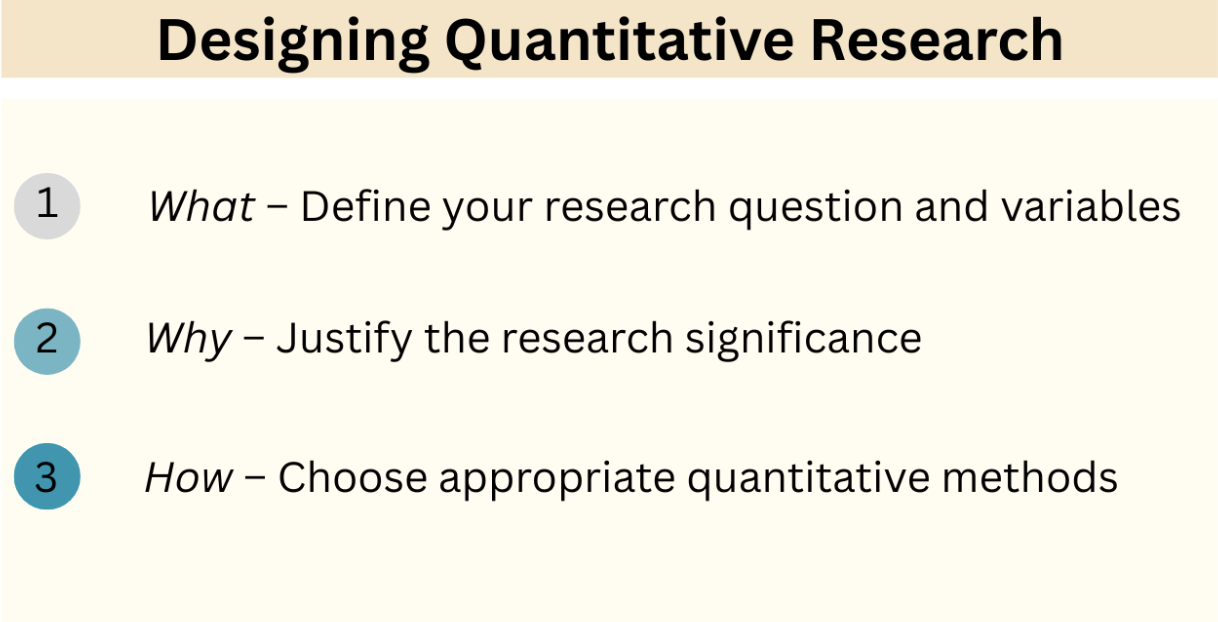
Define the ‘What’
The first step is to define the topic, or rather, the research problem. In order to do that, it is necessary to have a general idea of what is known about the topic and what still remains to be found out. In most cases, you will have to adjust or even change your initial topic. However, it is very important to start with the selection of a proper topic, followed by the next steps in chronological order, in order to avoid serious pitfalls and waste time on something that is not going to work out anyway. In order to select a proper topic, it is recommended to create a checklist with the main points:
- Is the topic reasonable?
- Is it relevant or outdated?
- What are the trends in this research area?
- Do I have the means to research the topic?
At this step, a concept, variables, and what it is exactly that you wish to focus your research on are being determined.
Define the ‘Why’
This is where you need to go a bit deeper into the literature. To establish the relevance of your topic, you need to have reliable sources and a realistic assessment of the state of the art. It is a process that requires you to:
- Identify the limitations of previous research;
- Specify the gap in knowledge;
- Stress the importance of your research;
- Explain the impact it can have.
With this knowledge, you can now formulate your hypothesis. Having a comprehensive overview of the current state of knowledge allows you to establish a solid theoretical framework to bridge a specific gap in the literature. While these steps are indispensable for conducting quantitative research, they also provide all the necessary components for your dissertation’s introduction. By clearly defining the ‘why’ early on, you build a stable foundation for the rest of your study.
Determine the ‘How’
It’s now time to think about a plan. How are you going to answer your research question in the best possible manner? How are you going to test your hypothesis? To design your research, you need to think about what you believe to be the best way to fulfill your purpose. Some of the key aspects you need to elaborate on at this stage are:
- How are you going to obtain your sample or gather a study population?
- How are you going to carry out your research? What methods, materials, and services will you need?
- How are you going to gather your data? Will you use surveys, personal data, or numerical data?
- How are you going to analyse your data? What statistical tools will you need?
For basic descriptive statistics, such as calculating the central tendency of your data set, you can use a mean, median, and mode calculator to ensure your baseline figures are accurate before moving into more complex inferential statistics.
This information will be included in the section on methodology for your dissertation. This section needs to be logical and easy to follow, as you need to be prepared to make a case for any decisions that you make in this section, for example, in choosing participants for a study or using a specific type of experiment. It is only when you have a solid study design in place and a clear idea of how you are going to accomplish this that you are really ready to proceed with the actual research.
Presenting the Results
After obtaining all the data and analysing it, it is now the right time to interpret the results in the context of your hypothesis and earlier literature. There are a couple of things that need to be kept in mind while interpreting the data:
- The right words need to be chosen and only the significance of the impact needs to be stated if it is supported by statistics.
- The limitations of the study need to be stated.
- The possible implications of the study need to be stated.
It is assumed that the dissertation consists of separate sections for the results, discussion, and conclusion. However, it may also be a combined section for the results and the discussion in some departments of the university. It is important to understand the guidelines of the university that the student is a part of.
In the discussion section of the dissertation, the next level of interpretation is reached from simply stating the results and explaining the implications to comparing the results with those of similar studies that have been done earlier. This section delves deeper into the limitations of the study and the possible ways in which it can be overcome in the future.
Finally, the conclusion section should recap your major findings and their implications. It must be logically derived from the above analysis and round up the narrative of your dissertation without introducing any new data or arguments
Conclusion
Finishing your quantitative dissertation is an important milestone in your academic life that marks your transition from a student to a researcher. Although the process of data collection and analysis may be a steep learning curve for you, the significance and value of your work are not entirely dependent on the results you obtain at the end. It depends on the quality and appropriate presentation and discussion of your results and findings
Even if your results are not entirely in support of your initial hypothesis, your work may prove to be extremely valuable to the academic community as long as it is well-executed and provides reliable and objective evidence for future researchers. This way, you can be rest assured that your dissertation is academically sound.
Frequently Asked Questions
Quantitative research deals with numerical data, statistical analysis, and objective measures to validate theories and identify trends. Qualitative research deals with non-numerical data such as text, audio, and video to gain deeper insights and knowledge about concepts, subjective opinions, and real-life situations.
There isn’t a specific “correct” answer, as it varies depending on your population size, desired margin of error, etc. A commonly cited standard in social sciences research is a minimum of 100 participants. I would always suggest consulting an online sample size calculator or statistical power analysis tool to obtain an exact figure.
Yes, you can. This approach is known as a mixed-methods dissertation. This approach is extremely well-respected in academic circles, as you get a broad overview from your quantitative results combined with a more in-depth exploration of your qualitative findings. However, you should be aware that mixed methods dissertations take a great deal more time to complete.
A p-value, or probability value, is a statistical measure of the likelihood of your results occurring by random chance if your null hypothesis were actually true. A low p-value (usually < 0.05) indicates a strong effect against your null hypothesis, meaning your results are statistically significant and a real effect or relationship exists.
Insignificant results are just as valid a contribution to academic research as any. In your discussion chapter, you will need to discuss your results, including an honest discussion about what you found. This may be due to a variety of factors, such as a limitation of your methodology, sample size, or simply that the theory just doesn’t apply in your specific context. This is a very mature academic response.