


The admissions committee chair has already reviewed two hundred applications. Finally, it is the turn of your PhD application — but a quick scan doesn’t surface what they are looking for, and months of work risk being set aside before the content is even read.
In an academic CV, decision-makers expect to find:
- Deep research potential
- Publications with clear output
- Academic references
Early-career researchers with no prior CV experience often mistake this document for a standard resume. When that happens, reviewers don’t find the structure they expect, and an application can lose consideration before the content is read. An academic CV follows a different structure: it emphasises research and academic potential rather than transferable skills.
This guide covers how an academic CV differs from a resume, which sections to include, how to format it, and the mistakes to avoid.
What Is an Academic CV?
An academic curriculum vitae (CV) is a summary of your educational and academic background, research experience, and, sometimes, teaching experience. It is typically used in applications for high-level academic programmes and academic, scientific, or research roles. By comparison, resume format examples show how job-focused documents prioritise relevant professional experience and transferable skills.
The sections it usually covers include:
- Contact information
- Education
- Professional experience
- Academic publications and presentations
- Grants, fellowships, and awards
- Affiliations with professional or academic organisations
An academic CV is often confused with a standard resume. In practice, the two are very different:
| Academic CV | Standard Resume | |
|---|---|---|
| Length | 2 to 10+ pages (depending on career level) | 1–2 pages |
| Depth of detail | Covers a full academic record. | Includes only career experience relevant to the target position; focus on brevity. |
| Tone and focus | Factual and focused on credentials. | Self-promotional. |
| Leading sections | Scholarly achievements, publications, and academic service. | Work history and transferable skills. |
Beyond content, an academic CV serves different goals from a standard resume. A resume is built for a typical job search; an academic CV is used for:
- PhD programme applications
- Research fellowship applications
- Postdoc positions
- Faculty job searches
- Grant proposals
What to Include in Your Academic CV
An academic CV follows a standard structure. Its sections include:
- Contact information
- Education
- Research experience
- Publications and presentations
- Teaching experience
- Awards, grants, and fellowships
- Additional sections (e.g., affiliations, skills)
The content of these sections stays broadly the same across applications. Even so, you should align their weight with the programme or role you are applying for. For example:
- Graduate school application: focus on academic credentials and research experience.
- Postdoc and faculty positions: emphasise education, publications, and teaching experience.
Each subsection below covers a key section to include, with presentation tips.
Contact Information and Digital Presence
The header of an academic CV is reserved for contact information, giving reviewers an instant way to reach you. The basics to include are:
- Full name
- Institutional email address (preferred over a personal email because it looks more professional and verifies your current academic affiliation)
- Phone number
- Location (city and country only)
Optionally, add links that demonstrate your digital presence in the academic space. Links considered relevant in an academic context include:
- ORCID iD
- Google Scholar profile
- Personal academic website
Social media links are typically excluded. A LinkedIn link is sometimes acceptable, but it carries less weight in academic applications than in standard job applications.
Other things to leave out of a CV are:
- Photos and personal identifiers (e.g., age or marital status), which are excluded to prevent unconscious bias.
- Full addresses, omitted for security and because academic communication is mostly digital.
- Non-academic work records or achievements, since an academic CV should focus on research, academic service, and teaching.
Here is a sample header structure from a successful University of Pennsylvania graduate CV:

Education
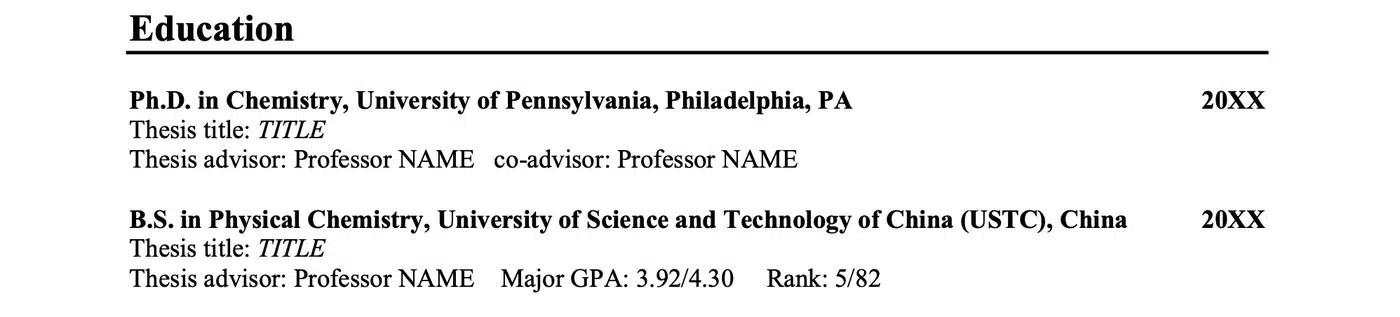
After the header, add a divider and an education section under the same heading. List your degrees in reverse chronological order, starting with the most recent. Every entry should include:
- Degree level
- Area of study
- Name and location of the institution
- Thesis title
- Thesis advisor name
- Year of graduation
If you are currently studying toward a degree, list it with the same detail, mark it “In progress,” and add an expected graduation year. If you are completing your PhD (you have passed your qualifying exams and are working on a dissertation), use the designation “Candidate.” For example:
“PhD Candidate in Sociology” instead of “PhD in Sociology”
If you are writing a CV for a PhD application, list your Master’s thesis title as well. Include an undergraduate degree only if it is relevant to your current research area.
Here is a sample of the education section:
Research Experience
In the research experience section, you can mention:
- MA/PhD research projects
- Research assistantships
- Visiting researcher roles
- Lab technician positions with a research component
- Independent projects that produced a concrete output
For every entry, include:
- Role title
- Institution
- Dates
- 2–3 lines summarising the research topic, methods, and output (e.g., papers published in peer-reviewed journals, datasets created, software developed)
Important: unlike the teaching section, this section is not about your role and responsibilities. Focus on the contribution you made through your research.
Depending on your field, you will emphasise different details. In STEM, reviewers care most about technical execution and replicability, so detail your methods. In the humanities, the method is often standard, but how you frame the research question matters most.
Here is what a weak and a strong research-experience entry look like:
| Feature | Weak Entry | Strong Entry |
|---|---|---|
| Focus | Repetitive administrative work and daily tasks. | Research outcomes and intellectual contribution. |
| Context | Vague; doesn’t make clear why and how the research was performed. | Specific; clearly defines research goals, questions, and methods. |
| Evidence | Generalised phrases like “gained experience in…” | Tangible outputs, e.g., “created a dataset…” |
| Language | Passive verbs that frame you as a helper: “maintained,” “observed,” “assisted.” | Active verbs that frame you as a contributor: “analysed,” “designed,” “optimised.” |
Publications and Conference Presentations
Divide publications and presentations into subcategories by value:
- Peer-reviewed journal articles
- Conference papers
- Presentations and talks
Within each subcategory, list entries in reverse chronological order. For publications, use a citation style that matches your discipline:
- Humanities: MLA
- Education, Psychology, and Sciences: APA
- Social sciences: Chicago Author-Date and Harvard
- Business, History, and Fine Arts: Chicago/Turabian
- STEM: IEEE, CSE, ACM, and ACS
For unpublished work, use descriptive labels such as “Submitted,” “Editorial assessment,” or “Peer review.” If you haven’t submitted yet, don’t present work as forthcoming — label it “in preparation” or “in progress.”
If you are an early-stage PhD student with a thin publication list, still list any work that demonstrates research activity, including:
- Conference presentations
- Invited talks
- Papers in progress
- Thesis chapters under review
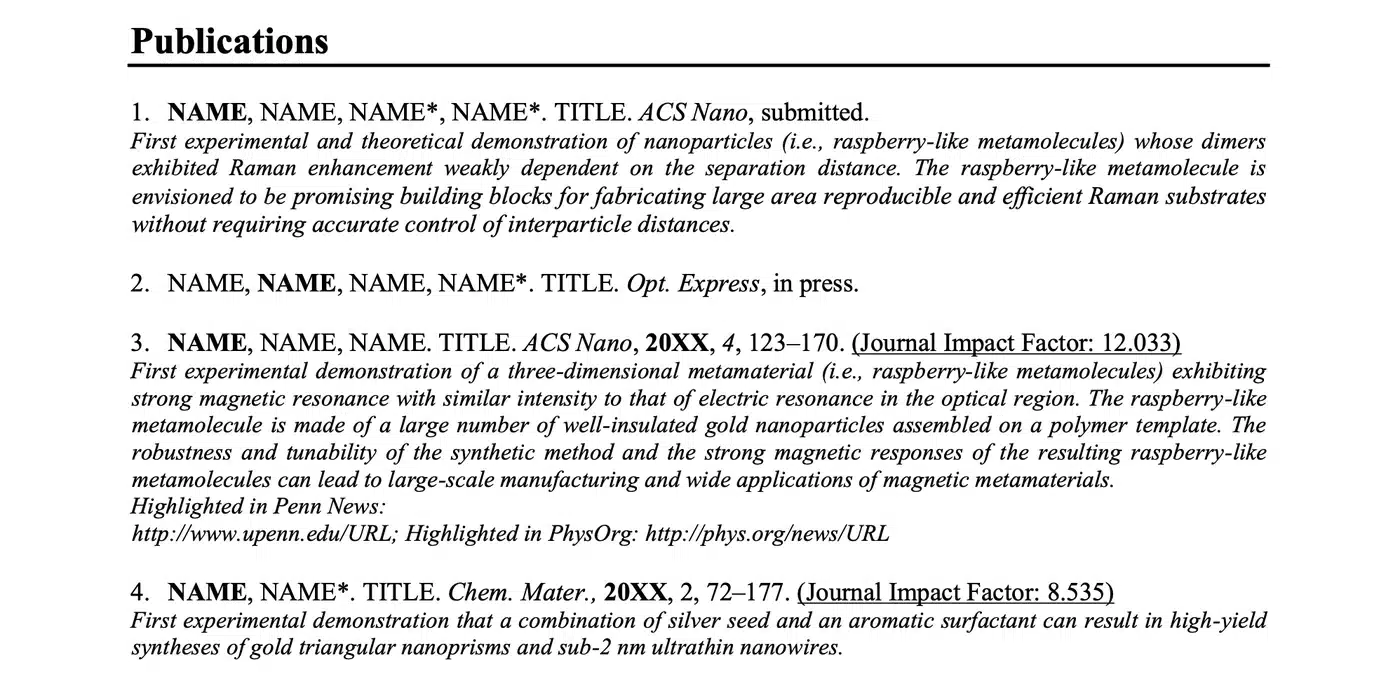
Here is an example of this section:
Teaching Experience
This section can be omitted when applying for PhD programmes if you don’t have relevant experience — doctoral programmes expect your current experience to be mostly studying and research, so it shouldn’t disqualify you.
In a CV for an academic position, list teaching experience in a separate section in reverse chronological order. For each entry, include:
- Role (e.g., instructor of record, teaching assistant, postdoctoral lecturer)
- Course title/department
- Institution
- Semester and year(s)
- Class size (if large)
Under each entry, add a short summary of the responsibilities that show independent teaching, for example:
- “Supervised X students during lab experiments.”
- “Hosted group discussions.”
- “Helped students assess their progress and prepare for exams.”
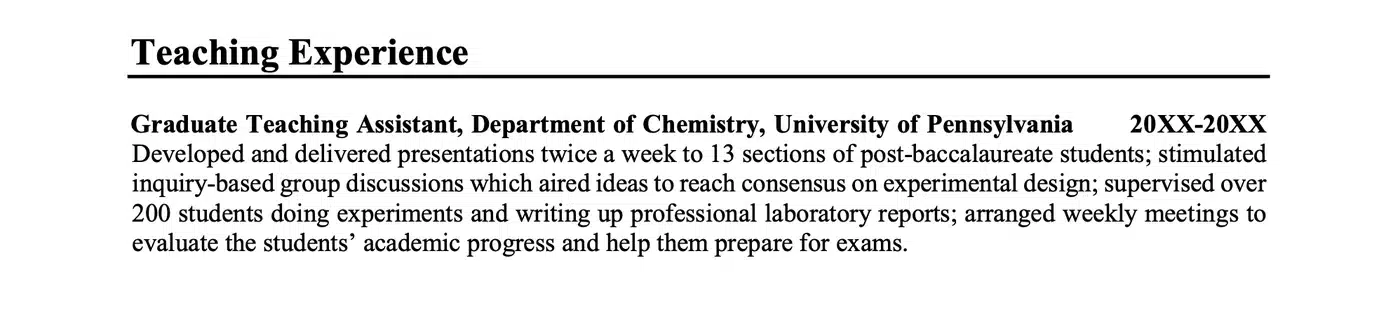
When applying for faculty positions, also include your methods of instruction, course design, student outcomes, and similar details. Here is an example of a teaching-experience entry:
Awards, Grants, and Fellowships
Create a separate “Grants, fellowships, & awards” section to highlight outstanding academic accomplishments. Include:
- Competitively awarded fellowships
- Departmental prizes
- External research grants
- Travel grants for presenting at conferences
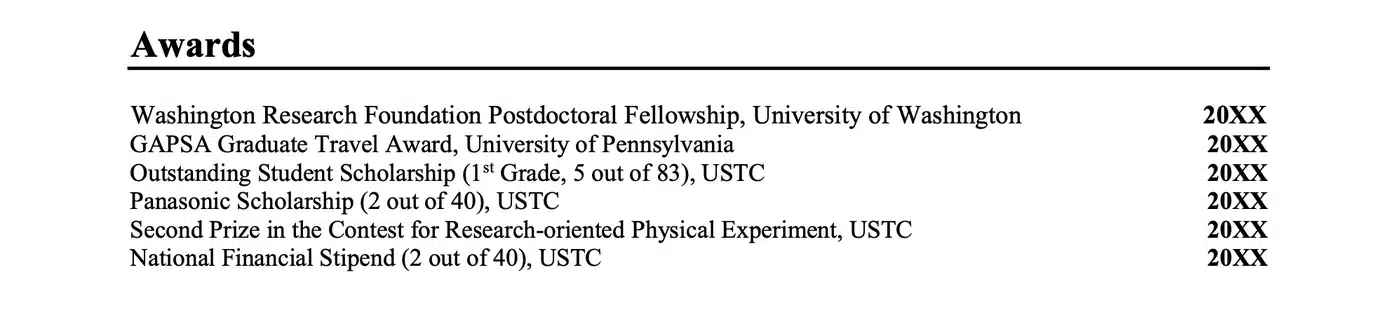
List in reverse chronological order. For every item, specify the award/grant/fellowship name, the granting organisation, and the year received.
Important: leave out items that don’t carry relevance or value — participation certificates or automatic scholarships awarded without competitive selection add little. By contrast, for a national or international competition you can add a short note on selectivity to build credibility, e.g., “Awarded to 10 recipients globally.” Here is a sample awards section:
Skills, Languages, and References
This section isn’t always included, but it can give the selection committee more on your readiness and global research reach. Include:
- Skills: relevant software, research tools, and lab techniques you are proficient in. Omit generic tools (e.g., word processors or Excel) and anything not relevant to the field.
- Languages: the languages you know, with proficiency indicated using CEFR levels (C1, B2, etc.) or labels (native speaker, fluent, working proficiency).
- References: 2–3 academic referees, each with name, title, institution, and institutional email. A CV for graduate school should include at least one current or recent research supervisor.
How to Format Your Academic CV
Once your sections are ready, organise them in a standard academic CV format that looks professional and reads easily. The basic formatting rules:
| Formatting Element | Recommendations |
|---|---|
| Font | Choose standard fonts like Arial or Times New Roman. Complex, stylised fonts reduce readability and look less professional. |
| Font size | Keep body text at 11–12 pt for optimal readability. Anything below 10 pt is harder to scan. |
| Margins | The golden rule is 1-inch margins on all sides. Narrower margins make the document look compressed. |
| CV length | There is no universal rule. The benchmark for early-stage PhD applicants is 2 pages; some CVs run to 4+ pages when the record justifies it. Don’t pad the length with white space or oversized fonts. |
| Entry presentation | Use an identical structure for every entry within a section — list details in the same sequence and apply the same formatting (bullets, bold, italics). |
Export the final document as a professionally formatted PDF. The format is universally accessible, opens anywhere without a special account, and preserves your layout. For submissions via academic portals, check the file-size limit first; if your CV contains scanned pages, embedded images, or tables, you may need to compress it with a reliable online PDF compressor to meet those limits without losing quality.
Common Mistakes to Avoid
Three mistakes can hurt your application the most:
- Mistake 1: Following a standard resume structure. A typical resume is a one- or two-page summary of work experience that emphasises hard, soft, and transferable skills. That is not what academic institutions expect; using it signals unfamiliarity with the standards and denies reviewers the context they need.
- Mistake 2: Merging sections or using unclear headings. Combining research and teaching in a shared “Experience” section, or labelling a publications section “Projects,” makes your CV harder to navigate.
- Mistake 3: Inconsistent formatting. Different presentation templates within a section, or different formatting across sections, signals a lack of attention to detail.
Bonus tip: if you need a starting point, successful examples show what a strong CV looks like in your field. Many institutions post samples on their department and programme websites — the University of Cambridge, for instance, maintains a large guide with CV examples for graduate school and postdoc positions.
Conclusion
Building an academic CV with no prior experience can feel daunting, but you now have a clear starting point. Use the tips above to organise and format your experience in a way that meets academic expectations.
Once it is built, treat your CV as a living document. Update sections regularly — keeping it current takes far less effort than rebuilding it from scratch for every application.
Key takeaways:
- An academic CV is different from a typical job resume: it keeps the focus on research and scholarly work, and the wrong format can sideline an application early.
- A logical section order and consistent structure make your CV readable.
- Early-stage PhD researchers with a thin publication list can show working papers, in-progress theses, and conference presentations to demonstrate research activity.
- PDF is the preferred export format; a PDF compressor helps reduce file size for submission portals.
- Update your CV regularly with new publications, awards, and roles.
Frequently Asked Questions
Curriculum vitae is a Latin term that translates as “course of life.” The document is a formal summary of your academic and professional background. It typically covers your contact information; education (degree level, schools attended, and dates of graduation); professional experience; publications and presentations at academic conferences; grants, fellowships, and awards; and professional affiliations. In everyday use, the term overlaps with “resume,” but a CV is longer, more detailed, and more academically focused — it is mainly used to apply for academic, research, or highly specialised positions.
There is no fixed rule; the length should match the target position and your current experience. As benchmarks: an early-career CV (e.g., PhD applicants) is around 2 pages; a mid-career CV (postdocs or assistant professors) is 3–4 pages; and senior faculty CVs run to 4+ pages when supported by a solid record. Whatever the target, avoid filling space by widening margins, enlarging fonts, or listing irrelevant coursework — keep it focused and relevant.
The base content (your experience, publications, and so on) stays the same across applications, but the sections you prioritise should change with the application type and the records you can demonstrate. For a graduate-school CV, focus on academic background — GPA, coursework, and research experience. For a faculty CV, focus on education and experience, and emphasise publications, professional affiliations, and your research and teaching record. It is also important to adjust the formatting to any programme-specific requirements.