


The RICS APC final assessment interview is where months of preparation come together. It builds directly on your case study, so strong preparation here turns a good submission into a pass. This guide explains the format and how to get ready.
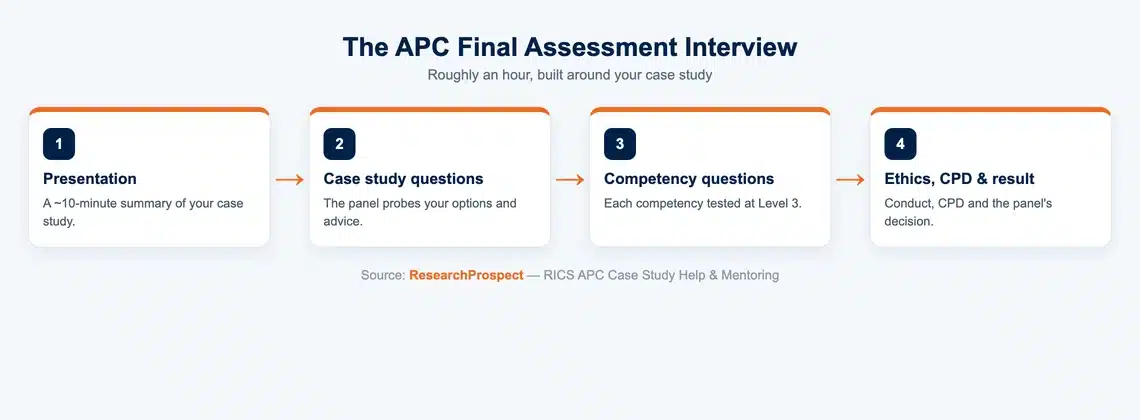
The interview format
The final assessment is a structured interview, usually around an hour, in front of an assessment panel. It opens with your presentation, moves into questioning on your case study and competencies, and covers ethics and CPD. Every part draws on your submission, so the better your case study, the more comfortable the interview.
Your 10-minute presentation
Your presentation should summarise the case study, not re-read it. Cover the key issues, the options you weighed, the advice you gave and the outcome, and finish with what you learned. Keep slides clean, practise to time, and rehearse out loud until it is fluent — running over time creates a poor first impression.
The questions to expect
The panel will probe your judgement. Be ready for questions like these:
| Area | Typical questions |
|---|---|
| Case study | Why did you recommend that option over the alternatives? What would you do differently? |
| Competencies | Probing each declared competency at Level 3 with real examples. |
| Ethics | How did you apply the RICS Rules of Conduct? How would you handle a conflict of interest? |
| CPD | What have you learned recently and how have you applied it? |
How to answer with confidence
Answer the question asked, give a reasoned response, and support it with a concrete example. It is fine to pause and think. If you do not know something, say so honestly and explain how you would find out — bluffing is quickly exposed and damages your credibility. Every claim in your case study is fair game, so be ready to defend all of it.
Ethics, CPD and conduct
Ethics questions are not optional extras — failing them can fail the whole assessment. Know the RICS Rules of Conduct, be ready to apply them to realistic scenarios, and have clear examples of recent CPD and how it has improved your practice.
Common interview mistakes
- Reading the case study aloud instead of presenting it.
- Running over the presentation time.
- Describing rather than justifying decisions.
- Weak or rehearsed-sounding ethics answers.
- Bluffing instead of admitting a knowledge gap.
Want a mock interview with a chartered assessor?
Practise under realistic questioning and get detailed feedback with RICS case study help and mentoring.
Final thoughts
The interview rewards preparation. Rehearse your presentation, anticipate the questions, know your ethics, and make sure your case study is reviewed and watertight before the day. Do that, and you walk in ready to perform.
Need help with your RICS APC case study?
Get a free review and a clear plan from experienced APC mentors who have supported 100+ professionals through the end-to-end process. Packages from £1,750.
Related RICS APC resources
- RICS APC case study example & structure
- RICS APC SOE examples (mandatory + technical)
- RICS APC case study help & mentoring
Frequently Asked Questions
It usually lasts around an hour. It begins with your presentation of roughly 10 minutes, followed by questioning from the panel on your case study, competencies, ethics and CPD.
Summarise your case study — the key issues, the options you weighed, the advice you gave and the outcome — and finish with what you learned. Present it; do not read the case study aloud, and keep to time.
Expect questions probing your judgement on the case study, each competency at Level 3, your application of the RICS Rules of Conduct and ethics, and your recent CPD. Every claim in your submission is fair game.
Be honest. Say you are not certain and explain how you would find out or who you would consult. Assessors respect this far more than bluffing, which is usually obvious and damaging.
Very. Ethics is a mandatory area and weak answers can fail the whole assessment. Know the Rules of Conduct and be ready to apply them to realistic scenarios.
Rehearse your presentation to time, anticipate likely questions, prepare ethics and CPD examples, and have your case study reviewed so you can defend every claim. Mock interviews with feedback are the most effective preparation.