


Good RICS APC case study preparation starts months before the deadline, not days. Candidates who plan early choose stronger projects, evidence their competencies properly and walk into the final interview confident. This guide sets out a clear, step-by-step preparation plan.
Why preparation starts months early
The single biggest predictor of a strong case study is how early you start. Early preparation lets you choose the right project while you are still working on it, gather evidence as you go, and leave time to draft, review and rehearse. Leaving it to the final weeks forces compromises — a weaker project, thinner evidence and no time to act on feedback.
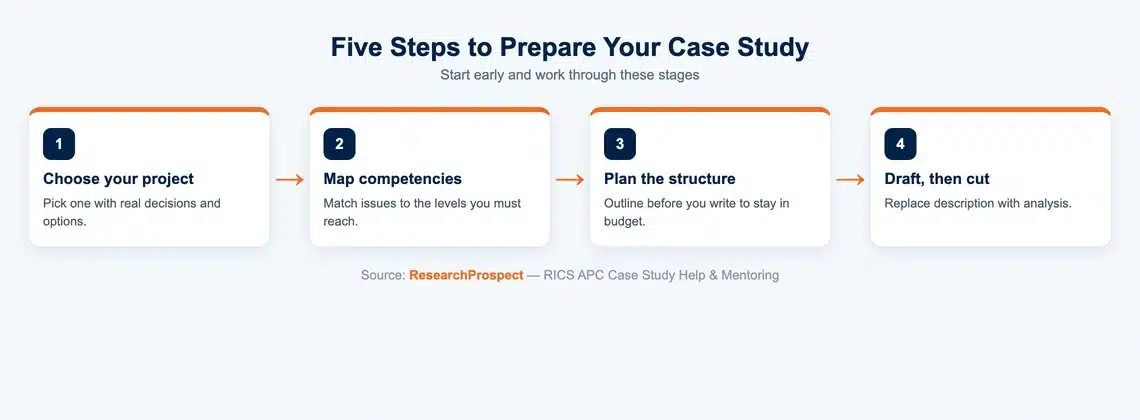
The five steps to prepare
Choose your project
Pick a project where you held genuine responsibility and faced real decisions with options to compare — not necessarily the largest scheme. It must fall within the last 24 months.
Map your competencies
List your declared competencies and the level each must reach, then map the issues in your project to them so every requirement is clearly evidenced.
Plan the structure
Outline the introduction, key issues, options and advice, and reflection before you write. Planning first keeps you within 3,000 words and protects space for analysis.
Draft, then cut
Write a full first draft, then edit ruthlessly — replacing description with analysis until every paragraph shows judgement or reflection.
A preparation timeline
A realistic timeline keeps you on track:
| When | Focus |
|---|---|
| 6+ months out | Identify candidate projects; start gathering evidence. |
| 3-4 months out | Choose your project; map competencies; plan structure. |
| 2 months out | Write and refine your full draft. |
| 3-4 weeks out | Get an expert review and act on feedback. |
| Final weeks | Rehearse and prepare your presentation and answers. |
Choosing the right project
Use this test: could you talk about the project, under questioning, for a full hour? The best case studies come from projects with genuine decisions and trade-offs, where you can evidence several competencies at once. A single, well-chosen project is usually cleaner than stitching several together.
Mapping your competencies
Your competencies are the backbone of the case study. For each issue you write about, note which competencies it evidences and at what level. If a required competency is not covered, choose an issue that does cover it — do not leave gaps for the assessors to find.
Common preparation pitfalls
- Starting too late and settling for a weak project.
- Choosing a prestigious project with no real decisions.
- Writing before planning, then blowing the word count.
- Skipping the review and rehearsal stages.
Need help preparing your RICS APC case study?
Get one-to-one support to plan, structure and evidence your submission with RICS case study help and mentoring.
Final thoughts
Preparation is where the APC is won. Start early, choose a project with real decisions, map your competencies, and leave time to review and rehearse before your final assessment interview.
Need help with your RICS APC case study?
Get a free review and a clear plan from experienced APC mentors who have supported 100+ professionals through the end-to-end process. Packages from £1,750.
Related RICS APC resources
- RICS APC case study example & structure
- RICS APC SOE examples (mandatory + technical)
- RICS APC case study help & mentoring
Frequently Asked Questions
Ideally six months or more before submission. Early preparation lets you choose the right project while you are still working on it, gather evidence as you go, and leave time to draft, review and rehearse.
Pick a project where you held real responsibility and faced decisions with genuine options — one you could discuss under questioning for an hour. It should let you evidence several competencies and fall within the last 24 months.
Usually one well-chosen project is cleaner: it gives the panel a single context and lets you go deep on a few connected issues rather than skating across many.
Map each issue in your case study to the competencies it demonstrates and the level required. If a competency is not covered, choose an issue that covers it rather than leaving a gap.
Most candidates spend several months, with intensive writing in the final two to three months and time built in for review and rehearsal. Rushing any stage shows in the final submission.
No — it must be your own work. What helps is mentoring: guidance on choosing your project, structuring, evidencing competencies and rehearsing, so your own submission reaches the required standard.