


Competencies are the backbone of the RICS APC. Understanding what Levels 1, 2 and 3 actually require — and how to evidence them — is essential to passing your assessment and writing a strong case study.
What competencies are in the RICS APC
Competencies describe the skills and abilities you must demonstrate to qualify. Each pathway specifies a set of competencies and the level you must reach in each. They are how the RICS standardises assessment across thousands of candidates and dozens of pathways — and they are what your diary, case study and interview must evidence.
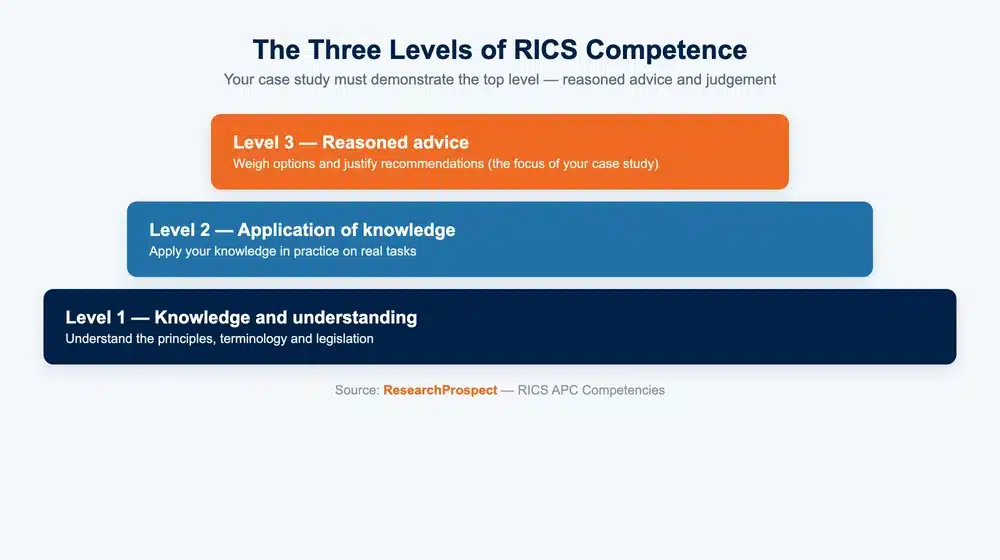
The three levels explained
The three levels build on each other:
| Level | Meaning | How to show it |
|---|---|---|
| Level 1 | Knowledge and understanding | Explain the relevant principles, terminology and legislation. |
| Level 2 | Application of knowledge | Describe how you applied that knowledge in practice on real tasks. |
| Level 3 | Reasoned advice and depth | Weigh options and justify recommendations — the focus of your case study. |
The jump from Level 2 to Level 3 is where most candidates lose marks. Level 2 describes what you did; Level 3 explains the options you weighed and why you advised as you did. Your case study is the main place to prove Level 3.
Mandatory, core and optional competencies
Every pathway groups competencies into three types:
| Type | What it covers |
|---|---|
| Mandatory | Professional, ethical and business skills — including ethics, conduct, communication and accounting principles. |
| Core (technical) | The central technical competencies of your pathway, usually required to Level 3. |
| Optional | Competencies you select to complete your pathway, to specified levels. |
How to evidence each level
Evidence comes from your day-to-day work, recorded in your diary and demonstrated in your submission. For Level 1, show understanding; for Level 2, show application; for Level 3, show judgement. Be specific: vague claims like “I have experience of valuation” evidence nothing. Concrete examples of decisions and advice do.
Competencies in your case study
Choose case study issues that let you evidence several competencies at Level 3 at once, and make the link explicit. During preparation, map each issue to the competencies it covers so nothing required is left out.
Common competency mistakes
- Confusing Level 2 (application) with Level 3 (reasoned advice).
- Declaring competencies you cannot evidence.
- Vague, general claims with no concrete examples.
- Leaving a required competency uncovered in the case study.
Unsure your competencies hit the right level?
Have a chartered mentor benchmark your competency evidence with RICS case study help and mentoring.
Final thoughts
Get your competencies right and the rest of the APC falls into place. Know the level each must reach, evidence it with concrete examples, and prove Level 3 in your case study and final interview.
Need help with your RICS APC case study?
Get a free review and a clear plan from experienced APC mentors who have supported 100+ professionals through the end-to-end process. Packages from £1,750.
Related RICS APC resources
- RICS APC case study example & structure
- RICS APC SOE examples (mandatory + technical)
- RICS APC case study help & mentoring
Frequently Asked Questions
Level 1 is knowledge and understanding, Level 2 is application of that knowledge in practice, and Level 3 is providing reasoned advice and exercising professional judgement. Your case study must demonstrate Level 3.
Level 2 describes how you applied knowledge to a task. Level 3 goes further: you weigh options and justify your recommendation. Moving from describing to advising is where most candidates need to focus.
Mandatory competencies are the professional, ethical and business skills every candidate must demonstrate, such as ethics and conduct, communication, teamworking and accounting principles, to the levels your pathway specifies.
It varies by pathway, but you will typically evidence a set of mandatory competencies plus core technical and optional competencies, each to a specified level. Check your pathway guide for the exact requirements.
Through concrete examples from your work — recorded in your diary and demonstrated in your submission. Show understanding for Level 1, application for Level 2, and reasoned advice for Level 3.
Throughout: in your diary, your summary of experience, your case study and your final interview. The case study is the key place to demonstrate Level 3 reasoned advice.