A real Undergraduate psychology dissertation discussion chapter example, free to read in full below — get one written for your own study, or browse more discussion chapter samples.
Type
Dissertation Discussion
Subject
Psychology
Level
Undergraduate
Word count
1,041
Quality
1st / 74%
This chapter revisits the aim of the study and interprets the statistical findings reported in Chapter 4. It considers what the observed relationships between sleep and academic performance mean, why they might have emerged, and how they sit alongside the wider body of research on student learning.
The study set out to examine the relationship between sleep quality and academic performance among university students. It aimed to establish whether the perceived quality of sleep, rather than its duration alone, was associated with attainment as measured by grade point average (GPA).
A secondary aim was to explore the role of two behavioural and experiential correlates: pre-bed screen use and self-reported daytime fatigue. Both were included because student sleep is increasingly shaped by digital habits and irregular schedules (Hershner and Chervin, 2014).
Framing the aim this way allowed the analysis to move beyond the common assumption that simply sleeping longer improves grades. Instead, it treated sleep as a multidimensional construct in which restfulness, continuity and daytime consequences all matter for learning.
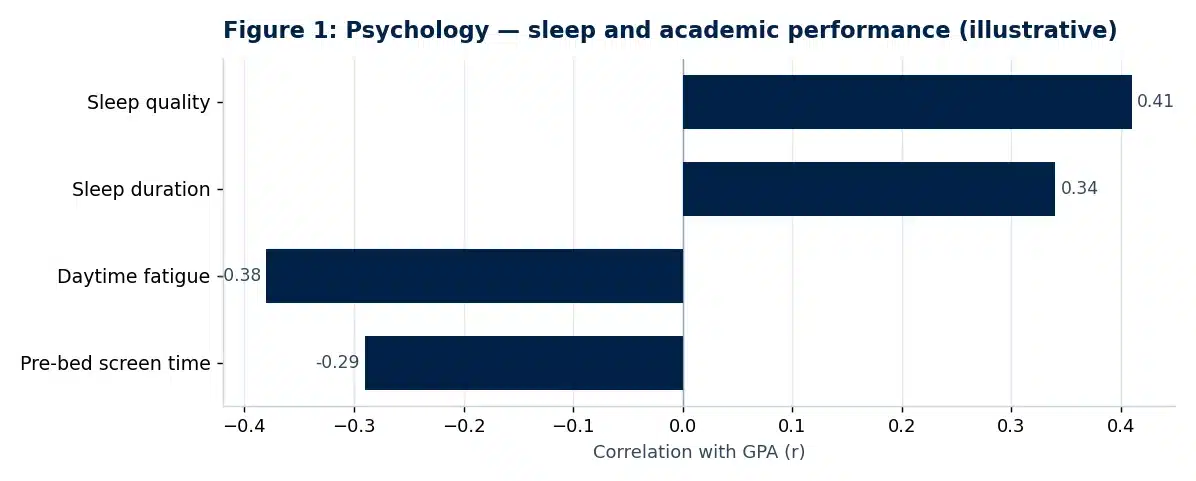
The central finding was that sleep quality correlated more strongly with GPA (r = 0.41) than sleep duration did (r = 0.34). This suggests that how well students sleep is a better predictor of attainment than how long they remain in bed.
This pattern is plausible on cognitive grounds. Fragmented or shallow sleep disrupts the consolidation of memory that occurs during deep and REM stages, weakening the retention of newly learned material (Walker, 2008). Duration alone cannot capture this loss of restorative depth.
Daytime fatigue was negatively associated with attainment (r = -0.38), the strongest negative relationship observed. Tired students appear less able to sustain attention, encode information and engage with demanding tasks, which plausibly translates into lower marks over an academic year.
Pre-bed screen time showed a weaker negative association with GPA (r = -0.29). Late device use may delay sleep onset and suppress melatonin through blue-light exposure, but its effect on grades seems partly indirect, operating through reduced sleep quality (Chang et al., 2015).
Taken together, the findings point to a coherent chain. Screen habits and poor-quality sleep contribute to daytime tiredness, and that tiredness, more than any single behaviour, appears most closely tied to weaker academic outcomes.
| Key finding | Interpretation |
| Sleep quality correlated more strongly with GPA (r = 0.41) than sleep duration (r = 0.34) | Restorative, uninterrupted sleep supports memory consolidation and concentration; time in bed matters less than the quality of that time. |
| Daytime fatigue was negatively associated with attainment (r = -0.38) | Tiredness undermines attention, encoding and effortful study, making it the most damaging correlate of lower grades in this sample. |
| Pre-bed screen time was negatively associated with GPA (r = -0.29) | Late-night device use likely harms attainment indirectly by delaying and degrading sleep rather than affecting grades directly. |
Dissertation Chapter Writing Service
Need a psychology discussion chapter written to this standard?
Our subject specialists write to your exact brief — fully referenced, plagiarism-free and delivered on time, with a free plagiarism report.
The primacy of sleep quality over duration echoes earlier work. Pilcher, Ginter and Sadowsky (1997) reported that subjective sleep quality predicted student wellbeing and performance more reliably than the number of hours slept, a conclusion this study reinforces.
The negative association between daytime fatigue and attainment aligns with Curcio, Ferrara and De Gennaro (2006), who found that sleepiness impaired attention and academic functioning. The present results extend this to a UK undergraduate sample using GPA as the outcome.
Findings on screen use are broadly consistent with Hysing et al. (2015), who linked bedtime electronic media to shorter, poorer sleep in young people. The comparatively modest correlation here supports the view that screens act on grades indirectly.
Some studies, however, report stronger direct effects of sleep duration (Gomes, Tavares and de Azevedo, 2011). The weaker duration association observed here may reflect this sample’s relatively uniform sleep length, which would restrict variance and attenuate the correlation.
The results support a quality-led model of the sleep-performance relationship rather than a purely quantity-based one. They suggest that theories of academic attainment should treat restorative sleep as a mechanism enabling learning, not merely a background lifestyle variable.
The findings sit comfortably within cognitive accounts of memory consolidation, in which sleep architecture stabilises encoded information (Walker, 2008). Poor-quality sleep interrupts this process, offering a theoretical route from restless nights to weaker recall and lower marks.
They also lend support to a mediation perspective. Rather than screens directly lowering grades, the pattern implies a pathway in which behavioural inputs shape sleep quality, sleep quality shapes daytime fatigue, and fatigue shapes performance.
For students, the findings suggest that improving sleep quality may benefit attainment more than simply extending time in bed. Consistent routines, a wind-down period and reduced late-night screen use offer practical, low-cost starting points.
For universities, the results indicate value in sleep-focused wellbeing support. Institutions might consider the following measures:
Because daytime fatigue emerged as the strongest correlate, interventions that reduce tiredness, such as workload pacing and better-timed assessments, may yield the clearest academic returns for the effort involved.
Several limitations qualify these conclusions. The design was cross-sectional and correlational, so causal direction cannot be established. Poor sleep may lower grades, but academic stress may equally disturb sleep, and the two likely influence one another.
Sleep and screen use were measured through self-report, which is vulnerable to recall bias and social desirability. Objective measures, such as actigraphy, would provide a more accurate picture of sleep quality and continuity.
The sample was drawn from a single institution and may not represent students in other disciplines, countries or age groups. GPA also captures attainment imperfectly, omitting engagement, effort and subject difficulty (Richardson, Abraham and Bond, 2012).
Finally, potential confounders, including workload, mental health and part-time employment, were not fully controlled. These factors could shape both sleep and grades, and their omission may have inflated or masked some of the observed relationships.
Together, these interpretations and limitations set the stage for the final chapter, which draws the study’s conclusions, revisits its contribution to understanding student sleep, and offers recommendations for practice and future research.
Chang, A.-M., Aeschbach, D., Duffy, J.F. and Czeisler, C.A. (2015) ‘Evening use of light-emitting eReaders negatively affects sleep, circadian timing, and next-morning alertness’, Proceedings of the National Academy of Sciences, 112(4), pp. 1232-1237.
Hershner, S.D. and Chervin, R.D. (2014) ‘Causes and consequences of sleepiness among college students’, Nature and Science of Sleep, 6, pp. 73-84.
Walker, M.P. (2008) ‘Cognitive consequences of sleep and sleep loss’, Sleep Medicine, 9(Suppl. 1), pp. S29-S34.

All work is written by human writers. 100% AI free, guaranteed.

100% money back guarantee if you find plagiarism in our work.
COMPANY DETAILS