
A real Masters finance dissertation discussion chapter example, free to read in full below — get one written for your own study, or browse more discussion chapter samples.
Type
Dissertation Discussion
Subject
Finance
Level
Masters
Word count
1,341
Quality
Distinction / 73%
This chapter interprets the empirical results presented in Chapter 4 and considers what they mean for the management of working capital within small and medium-sized enterprises (SMEs). It revisits the study’s aim before drawing out the significance of each finding.
The discussion moves beyond describing the statistical associations to explaining why they might arise. It situates the results within established finance theory and the wider empirical literature, and it reflects candidly on the limitations that qualify any interpretation.
The central aim of this dissertation was to examine how working capital management influences the profitability of SMEs. Profitability was operationalised as return on assets (ROA), a widely used measure of operating efficiency (Deloof, 2003).
Working capital efficiency was captured primarily through the cash conversion cycle (CCC) and its components: receivables days, inventory days and payables days. These variables reflect how quickly a firm converts investment in operations into realised cash.
The study sought to establish both the direction and the relative strength of these relationships. In doing so, it aimed to provide evidence that owner-managers could translate into practical liquidity and financing decisions.
SMEs were chosen deliberately, since they typically face tighter credit constraints and thinner cash buffers than large listed firms (García-Teruel and Martínez-Solano, 2007). Working capital decisions therefore carry disproportionate weight for their survival and growth.
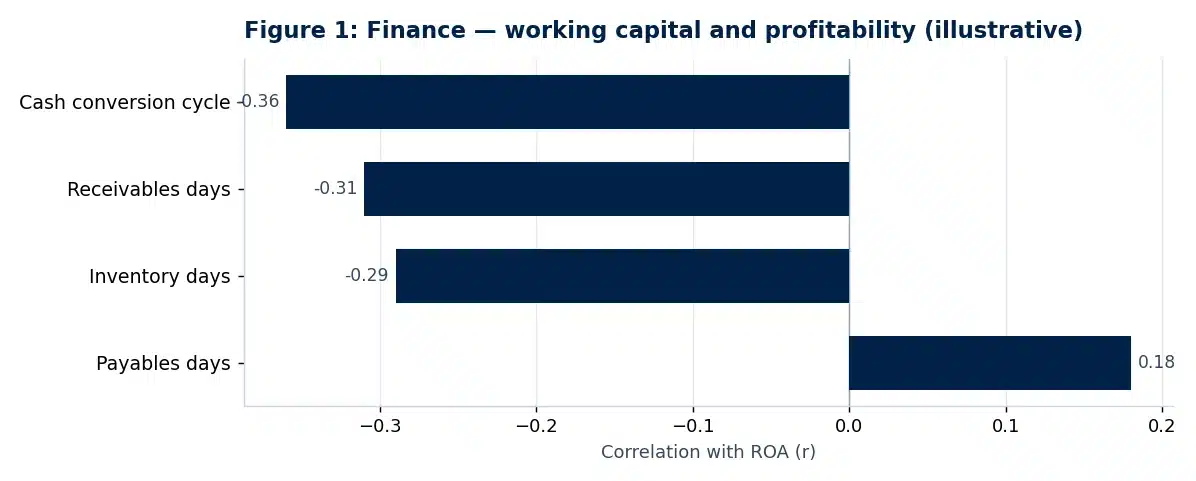
The results indicate that a shorter cash conversion cycle was associated with higher profitability. Firms that recovered cash from operations more quickly reported stronger ROA, suggesting that operational speed and financial performance move together.
This relationship is intuitive. A compressed CCC frees cash that would otherwise be tied up in day-to-day operations, reducing reliance on costly external finance and lowering the implicit carrying cost of current assets (Deloof, 2003).
Receivables days showed a clear negative relationship with ROA. Firms that allowed customers longer to pay tended to be less profitable, consistent with the idea that extended credit ties up cash and raises the risk of default.
Inventory days were likewise negatively related to profitability. Holding stock for longer periods signals slower turnover, higher storage and obsolescence costs, and capital sitting idle rather than generating returns (Shin and Soenen, 1998).
Payables days displayed a modest positive association with ROA. Firms that took slightly longer to settle supplier invoices retained cash for longer, effectively using trade credit as a low-cost source of short-term finance.
The weaker effect for payables is notable. Stretching payment terms too far can strain supplier relationships and forfeit early-settlement discounts, which may explain why the benefit was limited rather than pronounced (Ng et al., 1999).
Taken together, the findings suggest that profitability is driven more by accelerating cash inflows than by delaying outflows. Managing receivables and inventory appears more consequential than aggressively extending payables.
| Key finding | Interpretation |
| A shorter cash conversion cycle was associated with higher profitability | Faster conversion of operations into cash reduces financing needs and frees capital for productive use, raising ROA. |
| Receivables days were negatively related to ROA | Longer customer credit locks up cash and increases default risk, weakening returns. |
| Inventory days were negatively related to ROA | Slower stock turnover raises holding, storage and obsolescence costs while capital sits idle. |
| Longer payables days helped modestly | Delaying supplier payment provides cheap short-term finance, but the benefit is limited by relationship and discount costs. |
Dissertation Chapter Writing Service
Need a finance discussion chapter written to this standard?
Our subject specialists write to your exact brief — fully referenced, plagiarism-free and delivered on time, with a free plagiarism report.
The negative CCC–profitability relationship aligns closely with the seminal work of Deloof (2003), who found that Belgian firms improved profitability by shortening receivables and inventory periods. The present findings extend that pattern to an SME context.
They also echo Shin and Soenen (1998), whose analysis of US firms linked a shorter net-trade cycle to stronger performance and higher shareholder value. The direction of association is therefore consistent across markets and firm types.
The receivables result supports García-Teruel and Martínez-Solano (2007), who reported that Spanish SMEs raised value by reducing the number of days accounts receivable remained outstanding. Cash tied up in credit is cash denied to the operating cycle.
The inventory finding is consistent with Lazaridis and Tryfonidis (2006), who observed that firms holding leaner stock positions achieved greater profitability. Efficient inventory control emerges repeatedly as a lever for SME performance.
The payables result requires more careful comparison. Some studies report that profitable firms pay suppliers faster, since less profitable firms delay payment out of necessity rather than strategy (Deloof, 2003).
The modest positive effect found here suggests that, within this sample, trade credit functioned more as a deliberate financing choice than as a symptom of distress. This nuance is worth noting when generalising across samples.
Overall, the study broadly corroborates the dominant view that conservative, efficiency-focused working capital management supports profitability. It adds SME-specific evidence to a literature still weighted towards larger, listed corporations.
The findings speak directly to the trade-off theory of working capital, which holds that firms balance the profitability gains of lean current assets against the liquidity risk of holding too little (Baños-Caballero et al., 2014).
The consistent negative association between the CCC and ROA suggests that many sampled SMEs sat on the conservative side of that trade-off. Reducing the cycle improved returns without, on average, triggering evident liquidity distress.
The results also resonate with pecking-order reasoning. Because SMEs prefer internal funds and face constrained external finance, cash released through efficient working capital management is especially valuable (Myers and Majluf, 1984).
The modest payables effect fits the interpretation of trade credit as an internal financing substitute. Where formal borrowing is expensive or rationed, supplier credit becomes a rational, if bounded, source of liquidity (Petersen and Rajan, 1997).
Collectively, the evidence reinforces a contingency view: there is unlikely to be a single optimal working capital level. Instead, the appropriate cycle depends on a firm’s financing access, sector and operating model.
For owner-managers, the clearest message is that shortening the cash conversion cycle can support profitability. Attention should focus first on the components most strongly linked to ROA, namely receivables and inventory.
Several practical actions follow from the findings:
For lenders and advisers, the results support using working capital metrics as indicators of SME financial health. A lengthening cycle may serve as an early signal warranting closer scrutiny (Baños-Caballero et al., 2014).
Policymakers concerned with SME resilience might also note the role of trade credit. Measures that improve payment discipline across supply chains could ease the liquidity pressures that constrain smaller firms.
Several limitations qualify these conclusions. The analysis relied on correlational and regression evidence, which establishes association rather than causation. It remains possible that profitability enables efficient working capital, not only the reverse.
The reliance on ROA as the sole profitability measure is also a constraint. Alternative indicators, such as gross operating profit or return on equity, might yield somewhat different relationships (Lazaridis and Tryfonidis, 2006).
Sample composition presents a further limitation. Because the dataset drew on firms with available financial records, a degree of survivorship bias may be present, potentially overstating the benefits of efficient practice.
Sectoral differences were not fully controlled. Optimal inventory and receivables levels vary widely between, for example, manufacturing and services, so pooled estimates may mask meaningful heterogeneity (García-Teruel and Martínez-Solano, 2007).
Finally, the cross-sectional emphasis limits insight into how relationships evolve over economic cycles. Working capital behaviour under tight credit conditions may differ markedly from that observed in more stable periods.
Despite these caveats, the findings offer coherent and theoretically grounded evidence that efficient working capital management is associated with stronger SME profitability. The concluding chapter draws these threads together, restates the study’s contribution and sets out recommendations for practice and future research.
Deloof, M. (2003) ‘Does working capital management affect profitability of Belgian firms?’, Journal of Business Finance & Accounting, 30(3-4), pp. 573-588.
Lazaridis, I. and Tryfonidis, D. (2006) ‘Relationship between working capital management and profitability of listed companies in the Athens Stock Exchange’, Journal of Financial Management and Analysis, 19(1), pp. 26-35.
Myers, S.C. and Majluf, N.S. (1984) ‘Corporate financing and investment decisions when firms have information that investors do not have’, Journal of Financial Economics, 13(2), pp. 187-221.
Ng, C.K., Smith, J.K. and Smith, R.L. (1999) ‘Evidence on the determinants of credit terms used in interfirm trade’, Journal of Finance, 54(3), pp. 1109-1129.
Petersen, M.A. and Rajan, R.G. (1997) ‘Trade credit: theories and evidence’, Review of Financial Studies, 10(3), pp. 661-691.
Shin, H.H. and Soenen, L. (1998) ‘Efficiency of working capital management and corporate profitability’, Financial Practice and Education, 8(2), pp. 37-45.

All work is written by human writers. 100% AI free, guaranteed.

100% money back guarantee if you find plagiarism in our work.
COMPANY DETAILS






