A real Undergraduate sociology dissertation discussion chapter example, free to read in full below — get one written for your own study, or browse more discussion chapter samples.
Type
Dissertation Discussion
Subject
Sociology
Level
Undergraduate
Word count
1,230
Quality
2:1 / 65%
This chapter revisits the aim of the study and interprets the findings presented in the previous chapter. It moves beyond describing the data towards explaining what the patterns mean for our understanding of young adults’ political lives (Braun and Clarke, 2006).
The discussion situates the results within existing scholarship, draws out their theoretical and practical significance, and acknowledges the limitations that qualify any conclusions. In doing so, it prepares the ground for the recommendations that follow.
The study set out to examine the relationship between social media use and political participation among young adults aged eighteen to twenty-five. It sought to distinguish which forms of online activity, if any, were most closely linked to genuine civic engagement.
This aim responded to a longstanding debate. Some scholars celebrate social media as a democratising force, while others dismiss much online activity as low-effort “slacktivism” (Morozov, 2011). The research aimed to test these competing claims empirically.
A survey design measured four categories of online behaviour: political discussion, information-seeking, content sharing, and their association with both online and offline participation. The intention was to identify meaningful distinctions rather than treat “social media use” as a single, undifferentiated variable.
Clarifying the aim matters because the findings only acquire significance in relation to it. The purpose was not simply to establish that young people use social media, but to understand how different uses translate, or fail to translate, into political action.
The central finding was that online political discussion and information-seeking were most strongly associated with participation. Discussion showed the strongest correlation, suggesting that interactive, dialogic uses of social media are more consequential than passive consumption (Gil de Zúñiga et al., 2012).
This pattern is intuitively coherent. Discussing politics requires young adults to articulate positions, encounter disagreement, and reflect on their views. Such cognitive and social effort appears to deepen engagement in ways that simply scrolling a feed does not.
Information-seeking followed closely behind. When young people actively pursue political news and information online, they build the knowledge base that underpins informed participation. This active orientation contrasts sharply with incidental exposure (Boulianne, 2015).
By contrast, passive sharing showed a notably weaker association with participation. Reposting or forwarding content demands little cognitive investment and may function more as identity signalling than as a genuine step towards civic action (Morozov, 2011).
Importantly, online engagement predicted some offline activism. This challenges the assumption that digital participation merely substitutes for “real” politics. For a meaningful minority, online activity appeared to act as a gateway to protest, volunteering, or campaigning.
The relationship between online and offline activity was moderate rather than strong. This suggests that digital engagement facilitates offline participation for some, but does not automatically guarantee it across the whole cohort.
The table below summarises how each key finding may be interpreted.
| Key finding | Interpretation |
| Online discussion most strongly associated with participation | Interactive, effortful uses of social media deepen engagement more than passive consumption does. |
| Information-seeking closely linked to participation | Actively pursuing political information builds the knowledge that underpins informed civic action. |
| Passive sharing showed a weaker association | Low-effort reposting may reflect identity signalling rather than genuine political commitment. |
| Online engagement predicted some offline activism | Digital participation can act as a gateway to offline action, though not for all young adults. |
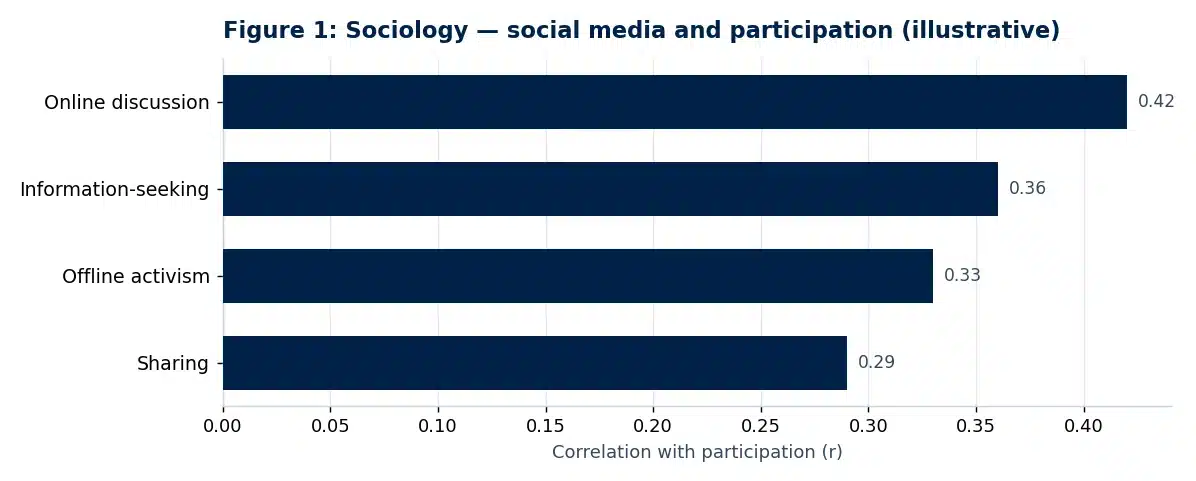
Taken together, the findings point to a clear message. Not all social media use is equal; the quality and effort of the activity matter far more than the sheer quantity of time spent online.
Dissertation Chapter Writing Service
Need a sociology discussion chapter written to this standard?
Our subject specialists write to your exact brief — fully referenced, plagiarism-free and delivered on time, with a free plagiarism report.
These results align substantially with Boulianne’s (2015) meta-analysis, which found a positive but variable relationship between social media use and participation. The present study extends this by specifying which uses drive the effect.
The prominence of online discussion supports Gil de Zúñiga et al. (2012), who argued that political expression on social media fosters “social capital” and civic engagement. Dialogue, rather than mere presence, emerges as the active ingredient in both accounts.
The weaker role of passive sharing lends partial support to Morozov’s (2011) “slacktivism” critique. However, the findings temper his pessimism, since sharing was not entirely inert but simply less powerful than more demanding activities.
The link between online and offline activism contradicts the strong substitution thesis. Instead, it echoes Vissers and Stolle (2014), who found that Facebook use could stimulate, rather than replace, conventional participation over time.
Where this study diverges is in its emphasis on gradation. Much earlier work treated social media as either wholly beneficial or wholly trivial. The present results suggest a more nuanced picture of a spectrum of engagement (Theocharis, 2015).
The findings speak directly to civic voluntarism theory (Verba et al., 1995), which holds that participation depends on resources, engagement, and recruitment networks. Online discussion and information-seeking appear to cultivate precisely these psychological and informational resources.
They also support a differentiated model of digital citizenship. Rather than a binary of “engaged” versus “disengaged”, the data suggest a ladder of participation on which young adults occupy varying rungs (Theocharis, 2015).
Social capital theory offers further explanatory power. Interactive online activity may generate bridging ties across diverse networks, which in turn lower the barriers to collective action (Putnam, 2000; Gil de Zúñiga et al., 2012).
Theoretically, the gateway relationship between online and offline activism implies a process of political socialisation. Digital spaces may function as low-cost arenas where young people rehearse civic identities before enacting them more fully offline.
For civic educators and youth organisations, the findings carry an important lesson. Interventions should encourage active, dialogic engagement rather than simply urging young people to “share” or “like” political content.
Practical measures might include:
For political campaigners, the results caution against equating high share counts with genuine mobilisation. Metrics of engagement should distinguish meaningful interaction from superficial circulation of content (Morozov, 2011).
For platform designers, the evidence suggests a responsibility to foster deliberative features. Tools that reward thoughtful discussion, rather than reactive sharing, may better support healthy democratic participation among young users.
Several limitations qualify these conclusions. First, the cross-sectional design cannot establish causation. Although online engagement correlated with participation, it remains possible that already-engaged young adults simply gravitate towards political activity online (Boulianne, 2015).
Second, the study relied on self-reported measures. Respondents may over-report socially desirable behaviours such as activism, or misjudge how much political discussion they genuinely undertake, introducing potential response bias.
Third, the sample was drawn from a limited demographic and geographic pool. This restricts the generalisability of the findings to young adults in other cultural or national contexts with different media environments.
Finally, the study measured broad categories of activity rather than the content or quality of specific interactions. Two young people classed as “discussing politics” may engage in very different ways, a nuance the survey could not capture.
Despite these limitations, the study offers a clear and coherent picture of how different social media uses relate to political participation. The following chapter draws these threads together, restating the contribution of the research and setting out recommendations for practice and future study.
Boulianne, S. (2015) ‘Social media use and participation: a meta-analysis of current research’, Information, Communication & Society, 18(5), pp. 524-538.
Braun, V. and Clarke, V. (2006) ‘Using thematic analysis in psychology’, Qualitative Research in Psychology, 3(2), pp. 77-101.
Morozov, E. (2011) The Net Delusion: How Not to Liberate the World. London: Allen Lane.
Theocharis, Y. (2015) ‘The conceptualization of digitally networked participation’, Social Media + Society, 1(2), pp. 1-14.
Verba, S., Schlozman, K.L. and Brady, H.E. (1995) Voice and Equality: Civic Voluntarism in American Politics. Cambridge, MA: Harvard University Press.

All work is written by human writers. 100% AI free, guaranteed.

100% money back guarantee if you find plagiarism in our work.
COMPANY DETAILS