A real PhD fine arts dissertation sample, free to read in full below — get one written for your own title.
Type
Dissertation
Subject
Fine Arts
Level
PhD
Word count
91,102
Quality
Doctoral standard
This thesis identifies and critically examines the teaching collection assembled for the Leeds School of Design, established in 1846 under the Leeds Mechanics’ Institution and Literary Society. The nucleus of this collection was a generic set of plaster casts, prints and publications distributed by the Head School of Design at Somerset House in London, founded in 1837. This approved selection of pedagogic objects was augmented with local donations of paintings, prints, decorative arts and photographs. This thesis proposes that these supplementary objects, and the ways in which they were displayed, represented a resistance to standardisation and a renegotiation of the role of art and design education in relation to existing voluntary societies and their associated public exhibitions.
Chapter one investigates the contested curriculum of the Schools of Design and the role of the Royal Academy in its construction. The question addressed concerns how the same reproductions of canonical antique statuary came to be deployed as vehicles for the transmission of a mutable set of ideological positions related to the concepts of art and its applications, industry and consumption and the division of labour. The distinction between the training of the artist and the artisan is also considered on a local level through the Leeds Academy of Arts, which was active between 1852 and 1855.
Chapter two explores the philosophical, political and economic positions that informed the practice of the Leeds School of Design, beginning with a Foucauldian analysis of the behaviours and beliefs inculcated in the students through the regulation of space, time and work. The culture of autodidacticism and the associated approaches to political economy developed by Edward Baines Junior and Samuel Smiles are articulated as a means of understanding the climate in which state-sponsored education was received in a regional context. These intellectual conditions are further elaborated through the practice of the travelling public lecture.
Chapter three considers the temporary exhibitions, conversazioni and soirées associated with art and design education in Leeds, beginning with the first polytechnic public exhibition organised by the Mechanics’ Institution at the Albion Street Music Hall in 1839. The strategic appropriation of architecture associated with commercial and industrial activity for the purpose of display is considered through the work of Henri Lefebvre on the social production of space.
The fourth and final chapter considers the itinerancy of the pedagogic object and the emergence of circulating collections composed of applied arts, reproductions in plaster, fictile ivory and electrotype and photographs. The mobilisation of material culture through these didactic collections will be analysed through a variety of critical frameworks, including historical materialism, post-structuralism and social geography, as appropriate to discrete aspects of the archive.
| Date | Leeds | London |
|---|---|---|
| 1837 | The Government School of Design established at Somerset House with John Buonarotti Papworth as Director. William Dyce sent to Europe to report on continental methods of instruction. | |
| 1838 | Benjamin Robert Haydon delivered lecture series to the Philosophical and Literary Society and the Literary Institution. Samuel Smiles arrived to edit the Leeds Times. | Society for Promoting Practical Design established at Savile House by William Ewart MP, with the support of Benjamin Robert Haydon, to rival the Government School of Design by teaching from the figure. |
| 1839 | First Leeds Public Exhibition at the Albion Street Music Hall. | |
| 1840 | Railway connection to London established. | |
| 1841 | ||
| 1842 | First application by the Leeds Mechanics’ Institution for a grant to establish a School of Design rejected. First commercial photography studio established. | Society for Promoting Practical Design disbands. The first plates of The Drawing Book of the Government School of Design by William Dyce published by Chapman & Hall. |
| 1843 | Second Leeds Public Exhibition at the Albion Street Music Hall. Edward Baines Junior published Alarm to the Nation against government interference in education. | Charles Heath Wilson appointed Director of the Schools of Design. A new set of rules and regulations established across the national network of branch schools. |
| 1844 | Purchases made from the Paris Exposition by Charles Heath Wilson. | |
| 1845 | Third Leeds Public Exhibition at the Albion Street Music Hall. | ‘The Rebellion of Forty-Five’ over the provision of figure drawing. |
| 1846 | The Leeds School of Design established. Circulating collection of French Manufactures exhibited with the new teaching collection. | Death of Benjamin Robert Haydon. |
| 1847 | Teaching begins at 22 East Parade under Claude Lorraine Nursey. First conversazione held. | |
| 1848 | Thomas Gaunt appointed to replace Claude Lorraine Nursey as Master. | Ralph Nicholson Wornum appointed Lecturer on the History, Principles and Practice of Ornamental Art. |
| 1849 | Ralph Nicholson Wornum delivered the first of a series of lectures on ornamental art at the Leeds Stock Exchange. | Select Committee on the Schools of Design. |
| 1850 | Further lectures by Wornum on stained glass and renaissance ornament. Conversazione held to liquidate the debt of the School. | |
| 1851 | Further lectures by Wornum on details of form and harmonies of colour. | Great Exhibition of the Works of Industry of All Nations. |
| 1852 | School of Design renamed School of Ornamental Art. Leeds Academy of Arts established by Richard Waller at 8 Bond Street. Wornum delivered the last of his series of lectures on ornamental art. Leeds Photographic Society established. | School of Design moved to Marlborough House and renamed School of Ornamental Art. Museum of Manufactures established by Henry Cole under the Department of Practical Art. Richard Redgrave appointed Art Superintendent. |
| 1853 | Renamed School of Practical Art. John Charles Robinson delivered lectures on elementary drawing as Teacher’s Training Master. First exhibition of the Leeds Academy of Arts. | School and Museum reconstituted under the renamed Department of Science and Art as part of the Board of Trade. |
| 1854 | John Charles Swallow appointed Headmaster of the Leeds School of Practical Art. | The Circulating Collection or ‘Travelling Museum’ established from the collections at Marlborough House. |
| 1855 | Circulating Collection exhibited. Leeds Academy of Art disbands. | Objects and photographs acquired at the Paris Universal Exhibition. |
| 1856 | Exhibition of the Circulating Collection ended on 5 January. | Owen Jones’ Grammar of Ornament and Ralph Nicholson Wornum’s Analysis of Ornament published. |
| 1857 | Exhibition of the Circulating Collection of Photographs at the Leeds School of Practical Art. | The School and Museum complete the transfer from Marlborough House to South Kensington. |
The central concern of this thesis is the relationship between objects and knowledge in the developing institutional contexts of education and exhibitions in Leeds between 1837 and 1857. The collection, circulation and display of these objects was associated with the emergence of a national network of Schools of Design, supported by the state and administered by a more established network of regional voluntary societies with their own discrete priorities. This study addresses the specific conditions under which the Leeds School of Design, established in 1846, operated under a centralised bureaucracy which attempted to construct a standardised mode and measure of art and design education through pedagogic objects. The thesis traces this generic teaching collection from London to Leeds and, more importantly, the ways in which it was augmented and exhibited according to a regional agenda that has been marginalised in the literature as provincial and provisional.
For instance, in his canonical account of the Schools of Design Quentin Bell concluded that ‘the [regional] Schools were a new venture set up by a Government which had had no experience in such matters, to serve localities which knew even less than did the Government’ and characterised the art masters of these schools in the following terms: ‘it is doubtful whether they ever achieved any results of enduring value; but they were not without heroism’. More recently Raphael Cardoso Denis has suggested that ‘the teaching in branch and provincial Schools of Art tended to remain at an agonizingly basic level’ and Paul Wood described the curriculum as ‘sheer tedium and […] utter restriction of any intellectual horizon’. It is the task of this thesis to refute these generalised interpretations by relocating what has been cast as peripheral activity to the centre.
The teaching collection assembled for the Leeds School of Design, under the auspices of the Leeds Mechanics’ Institution and Literary Society, was installed in the attic rooms of 22 East Parade in November 1846. Shortly afterwards, Christopher Leefe Dresser, an engineer, architect and prominent member of the Committee of the Leeds School of Design, articulated his aspirations for the collection in the following terms:
In this room then he could make acquaintance with beauty of form; and having constantly before his eyes specimens of art by the great masters, his mind will gradually become coloured with their feeling – he will learn to distinguish the true form the false, and his gradually and naturally refining taste will stamp itself upon the labour of his hands.
The method by which knowledge was imparted to the student was thus conceived as a form of osmosis, which operated under the assumption that progressive encounters with the object would imprint the eyes, mind and hand of the student with its aesthetic and moral lessons. This understanding of the mechanism by which knowledge and taste would be diffused was also applied to the exhibition of pedagogic objects in the public sphere. The objects selected to convey these principles consisted primarily of casts of Greco-Roman sculpture and architectural ornament, examples from the Italian Renaissance canon, alongside historical and contemporary manufactures of both national and international origin. Collectively these objects signified what Michael Conforti has described as the ‘international standards of art and design, the canonical touchstone for excellence in each of the fields they represent’. The persistence of these objects as archetypes for instruction in art and design, and the codification of the principles they were invested with, form important areas of investigation for this thesis, particularly where a discontinuity between the authority of antiquity and the acceleration of shifts in fashion and patterns of consumption threatened to undermine the wider economic imperatives of the Schools of Design.
In order to establish the parameters of this study, an introduction to the principal themes to be investigated will be necessary, alongside a concurrent discussion of their associated literature. The following introductory sections articulate the rationale for the chronological boundaries of this thesis, the historiography of the archive, the concept of the pedagogic object and the context of the Schools of Design in general, and the Leeds School of Design in particular.
The period between 1837 and 1857 is particularly significant for the investigation of the formation, circulation and exhibition of teaching collections in British art and design education because it covers the establishment of the first Government School of Design at Somerset House in 1837, the proliferation of the branch Schools of Design during the 1840s and the reconstitution of the system under Henry Cole from 1852 to 1857. The formal opening of the Leeds School of Design occurred in the middle of this period in 1847. The Leeds Mechanics’ Institution succeeded, on their second attempt, in securing a grant for the operational costs of a School of Design alongside the donation of a small, standard set of plaster casts and prints, which will be detailed in chapter one. As a branch school with a substantial archive that has not been subject to close examination, the Leeds School of Design provides an opportunity to analyse attempts by the Council of Management in London to impose uniformity in taste and training against local deviations.
Further to the development of these educational institutions, this period also allows for a concurrent and interdependent study of both central and regional exhibitionary practices. The Museum of Manufactures, established at Marlborough House in 1852, will be discussed to illustrate the relation between a permanent metropolitan collection and temporary regional exhibitions through the Circulating Collection established by the Museum, which toured the regional Schools from 1855 onwards. The year 1857 represents an appropriate moment to conclude this study as it marks the point at which both the School and Museum left Marlborough House for South Kensington. After this point the School and Museum arguably became quite different institutions and are represented by a much more substantial body of scholarship. In the same year, an exhibition of photographs lent by the Department of Science and Art was held at the Leeds School of Practical Art, which can be understood as a significant shift in the conceptual and material possibilities of the pedagogic object.
The period between 1837 and 1857 has been demarcated in different ways according to perceived points of rupture that have been most readily attributed to changes of personnel. This approach has positioned each successive Director, Headmaster or Superintendent as the primary agent of change or reform. The official institutional histories published by the Royal College of Art and the Victoria and Albert Museum, alongside the extended histories of art education by Quentin Bell and Stuart Macdonald, conform to this dominant model. This methodology is exemplified by the significance given to Henry Cole, firstly for his role in staging the Great Exhibition of the Works of Industry of All Nations in 1851 and secondly, for his reconstitution of the Schools of Design after his appointment to the position of General Superintendent in 1852.
This date is given further weight as a point of discontinuity because the locus shifted from Somerset House to Marlborough House, which was reinforced by a series of changes to the titles of the Schools, Museum and the Department responsible for their governance. Moreover, Cole’s adoption of ‘complete publicity’ rendered the teaching collection of the School visible to a wider demographic. For Henry Cole, public instruction was to be achieved through the collection and display of objects contained within a national repository and circulated around the regional schools under the assumption that, ‘unless museums and galleries are made subservient to purposes of education, they dwindle into very sleepy and useless institutions’. This point was reinforced and extended by John Charles Robinson as the first Curator of the Museum of Manufactures at Marlborough House:
The object of the Department of Science and Art being fundamentally educational, the Museum, as an integral part of its organization, is likewise essentially a teaching institution, actively instructional, as far as the nature of a permanent collection will allow; at the same time it is not to be regarded as a mere auxiliary to schools of art; it is addressed in equal measure to the general public, and even to the collector, whose pursuits it is, for many obvious reasons, clearly a national duty to countenance and encourage.
The development, extension and maintenance of a taste that was uniform in theory and practice was the central purpose of the Museum and its Circulating Collection. The concept of taste propagated by the Department was presented as both universal and empirical. According to Cole, individual agency was not to be trusted in the judgement of taste:
At last we are beginning to be sceptical of the soundness of the old proverb, “Every one to his own taste,” as though this taste were a property, where each one, whether wise or foolish, whether actually blind or having only eyes that cannot see, was free to settle the boundaries.
Richard Redgrave, who was appointed to the position of Art Superintendent in 1852, was responsible for the curriculum in the Schools under Cole’s regime and shared his colleague’s conviction that the public operated under a false belief in their capacity to judge the merits or deficiencies of a given object without recourse to regulations. For Cole and Redgrave, taste did not contain a subjective component and refined judgement could only be cultivated through exposure to objects illustrative of true and false principles. Extracts of this work were quoted in the early catalogues of the Museum alongside passages by Richard Redgrave, William Dyce and Gustav Friedrich Waagen to construct an aggregate doctrine to regulate the reception of both historical and contemporary material culture.
Although existing accounts map the territory and trajectory of art and design education, it is my intention to disrupt the authority and persistence of this interpretation by decentralising the narrative and looking to the social, cultural, political and economic framework through which these histories were mediated. Exhibitions, publications and lecture series also provided means of circulating these qualities across a wider population under the belief that, ‘in order to improve manufactures, the earliest work is, to elevate the Art-Education of the whole people [original emphasis]’.
The established interpretations of the Schools of Design and their descendants has relied upon the correspondence and publications held by the National Art Library and the archives of the Victoria and Albert Museum, now held at Blythe House. As such, the limited research conducted on the regional Schools of Design contains an embedded hierarchical distinction between the metropolitan and the provincial, with the activities of the periphery inflected with the priorities of the centre. In contrast, this thesis deploys an aggregate of local archives supplemented with underused material from national repositories in order to decentre the narrative.
One of the principal contributions of this thesis is the collation and interpretation of archives that have not been substantially investigated, the most important of which are the Leeds Institute Records held by the West Yorkshire Archive Service. This collection includes the minutes of the committee meetings of the Leeds Mechanics’ Institution and Literary Society in the years leading up to the establishment of a School of Design under their administration and the separate minutes of the sub-committee elected to manage the school. The circulars and correspondence sent from London to Leeds, often accompanied by a discursive commentary from the committee, have been particularly important for tracing the teaching collection and its reception.
The printed and published annual reports of the Mechanics’ Institution, with their accounts of the associated School of Design, also form part of the collection, which continues to represent an official public narrative. This archive does not include the separate reports issued by the Leeds School of Design, two of which have been located instead in the Science and Art Education Collection at the National Art Library. As such, the traces that have persisted in the historical record are dispersed, fragmentary and uneven. In this case, the primary material has been distributed between local and national collections with their own institutional and historical particularities.
The conciliatory character of the official reports issued by the Schools of Design was recognised by the former Honarary Secretary of the Leeds School, J.W. Hudson, in a letter to the Chairman of the Select Committee on the Schools of Design in May 1849 he claimed that: ‘the statements which annually appear in the reports of all the local schools, of the satisfaction of the council and the director in London at the progress of the pupils, is [sic] a stereotyped folly’. However, this embedded bias does not discount their use and usefulness in the construction of a historical discourse. For instance, the historian Hayden White observed that: ‘considered as historical evidence, all texts are regarded as being equally shot through with ideological elements or, what amounts to the same thing, as being equally transparent, reliable, or evidential’. Indeed, this embedded bias, once recognised and analysed, can be more revealing of underlying priorities than the content of the material itself.
In addition to the physical sites of the archive, the digitisation of nineteenth-century periodicals and pamphlets, principally by the British Library, has created a very different relation to the document. As Jacques Derrida has argued: ‘what is no longer archived in the same way is no longer lived in the same way. Archivable meaning is also and in advance codetermined by the structure that archives’. These relatively recent digital structures have allowed, in one sense, unprecedented access to printed and published sources from the nineteenth century. But in another sense, the dominance of the keyword search has brought a tyranny of its own: an asymmetrical proliferation of material on a scale that was not possible through previous technologies of storage and retrieval, such as microfilm or microfiche. Writing more than thirty years ago, White’s argument that ‘the historical record is both too full and too sparse’ now seems both prescient and highly relevant. The task is thus characterised, more than ever before, by ordering and classification, processes which have been articulated by Michel Foucault as intrinsic to the archive, as an apparatus that selects, discards and fragments:
The archive is first the law of what can be said, the system that governs the appearance of statements as unique events. But the archive is also that which determines that all these things said do not accumulate endlessly in an amorphous mass, nor are they inscribed in an unbroken linearity, nor do they disappear at the mercy of chance external accidents.
More than the accumulation of material traces, archives form the boundary of knowability and their mnemonic function continues to inform the practice of history. The rejection of the archival object as direct, neutral and unmediated evidence, as uncontested material proof, leads us to reconsider how archives might contribute to the recovery of a set of historical occurrences without reduction and assumption. Perhaps the most useful and appropriate approach is informed by semiotics: by referring to the objects of the archive as fragments and traces we begin to recognise their partial, contingent and arbitrary character without absolutely discarding their role in the production of knowledge. The approach outlined here has been applied to the analysis of contemporary journals and newspapers, which have been crucial to the developement of this thesis. Lyn Pykett has argued that the periodical press should be interpreted with caution and not taken to be reflective of general historical conditions, but firmly embedded within the wider context of their production and reception:
Periodicals can no longer be regarded in any simply reflective way as ‘evidence’ (either primary or secondary), as transparent records which give access to, and provide a means of recovering, the culture which they ‘mirror’. Far from being a mirror of Victorian culture, the periodicals have come to be seen as a central component of that culture […] and they can only be read and understood as part of that culture and society, and in the context of other knowledges about them.
Far from limiting the field, White has argued that this loss of confidence in the evidential capacity of material culture necessitates ‘a posture before the archive of history more dialogistic than analytic, more conversational than assertive and judgmental’. This discursive position has informed the methodology of this study, where the archive remains open to multiple readings and has the potential to support diverse and even contradictory statements about its meaning and significance. This is not intended to advocate recourse to relativism, but to recognise the resistance of the archive to singular readings and the extent to which this thesis is complicit in the construction of one of many possible historical narratives.
This thesis mobilises several related critical frameworks rather than adopting an a piori approach to the archive. This plurality, which attempts to be responsive rather than reductive, has been informed by the extent to which a particular theoretical position could be used to extend the understanding or provide a new analysis of a particular object or subject. Historical materialism and Marxist historiography underpin the analysis of social relations and class, the division of labour and the conditions of production and consumption related to the Schools of Design. The question of economic determinism associated with this approach will be addressed through the work of Mervyn Romans and Malcolm Quinn in their work on the politics of taste associated with the emergence of the Schools of Design, which forms part of the fourth section of this introduction.
In the discussion of the procedures developed by the Schools of Design in chapter two, it has been more appropriate to implement the post-structuralist methodology of Michel Foucault, applied the sphere of nineteenth-century education by Colin Trodd, in order to understand the mechanisms through which the student was monitored and controlled in preparation for work. Although the concepts of discipline and regulation are central to this discussion, it has been important to recognise that regional and individual agency were still possible and hegemonic relations had the capacity to be productive:
If power were never anything but repressive, it it never did anything but to say no, do you really think one would be brought up to obey it? What makes power hold good, what makes it accepted, is simply the fact that it doesn’t only weigh on us as a force that says no, but that it traverses and produces things, it induces pleasure, forms knowledge, produces discourse. It needs to be considered as a productive network which runs through the whole social body, much more than as a negative instance whose function is repression.
Productivity is also considered from the perspective of social geography, particularly through Henri Lefebvre, and more recently Simon Gunn and R.J. Morris, whose work under ‘the spatial turn’ has provided the means through which to understand the relations that produced, and were produced by, the spaces of education, culture and commerce that were central to ways in which the Leeds School of Design operated in the public sphere.
The concept of the pedagogic object is central to this study because it represents both the practical and ideological imperatives behind the use of objects as instructive tools for the training of designers for industry. The curriculum of the Schools of Design was engineered to extract the accumulated knowledge of the maker through mimesis: drawing in chalk, charcoal or graphite and modelling in clay or wax, as forms of what Anthony Burton has described as ‘controlled and scrupulous observation’. The plaster cast was the primary vehicle for this process and these objects operated beyond the classroom and performed a crucial role in mid-nineteenth century exhibitions and museum collections.
However, the liminal status of the cast as a repository of values without much intrinsic material worth has made the interpretation and reception of these objects a problem for art history. From the mid-twentieth century onwards, shifting institutional priorities resulted in the widespread disposal of cast collections, for which research and conservation represented an investment disproprotionate to the status of the plaster cast as an inauthentic reproduction under a modernist paradigm.
More recently, however, the plaster cast has been subject to critical re-evaluation from several different disciplines. For instance, important scholarship on plaster casts has been conducted in the fields of classics and archaeology, with an early example of a revisionist perspective provided by Mary Beard in an article that traced the origins of the Museum of Classical Archaeology in Cambridge. The collection of casts was used here to simultaneously reveal the distance between the nineteenth-century perception of the cast as the embodiment of ‘Greek genius’ and the twentieth-century refusal to attribute the qualities of the original to the reproduction. Beard concluded that the contested status of the plaster cast was an inherent component of their function and materiality: ‘casts represented a particularly powerful focus for dispute and negotiation; and they acted as particularly powerful symbolic tools for defining and policing the boundaries on and across which they sat’.
Similarly Peter Connor has written on the practice of collecting plaster casts in the context of an emerging nineteenth-century museum culture, which he has attributed to the central position these objects were given at the Great Exhibition of 1851. Although this exhibition displayed plaster casts of antique statuary, architectural ornament and contemporary sculpture on an unprecedented scale, the status of the Great Exhibition as a fulcrum, before which the plaster cast occupied a less significant position, will be questioned by this thesis. Connor also discussed the symbolic potency of the plaster cast as part of a wider cultural investment in the idea of antiquity: ‘the emphasis in the Victorian era on a classical education meant that an, as it were, authentic visual dimension to enliven their sense of gods and heroes, statesmen and warriors and poets was attractive’.
The notion that the subject of the plaster cast might have been revered as much as the form in the transmission of civic virtues and moral values is particularly relevant to their use as pedagogic objects in the context of a School of Design. The appropriation of antiquity as a model for social, economic and political activity in the nineteenth century will be discussed as part of chapter two, with reference to the papers delivered to the Leeds Philosophical and Literary Society by Edward Baines Junior.
The intersections between the discipline of museology and the practice of curatorship have also resulted in the study and reappraisal of cast collections. As part of their work with the sculpture collections at the Victoria and Albert Museum, Diane Bilbey and Marjorie Trusted traced the collection of plaster casts at the South Kensington Museum from the 1860s onwards, emphasising the curatorial role of John Charles Robinson in the formation of this collection. This narrative focuses particularly on the origins of the Cast Courts, constructed as the Architectural Courts in 1873. As a collection that has remained relatively intact and visible to the public, the objects of the Cast Courts continue to occupy a unique and privileged position in the discourse surrounding the plaster cast, which has been reinforced through internal research by curators, academics and conservators at the Victoria and Albert Museum. This work has been crucial to the interpretation of these objects, although the study of this collection has taken precedence over that of regional teaching collections, many of which have been dispersed or destroyed.
Malcolm Baker has extended the analysis of facsimiles and emphasised the interconnected nature of what he has described as a ‘reproductive continuum’ of plaster casts, electrotypes, fictile ivories and paper mosaics at the South Kensington Museum. Baker has recognised the shared instutitonal history of what would become the Royal College of Art and the Victoria and Albert Museum in 1896 and 1899 respectively, noting the interpretive distinction caused by this separation:
The shift from the museum as a resource (or indeed an instrument) for the training of designers and artisans to an institution which presented to its visitors a canon of European art was soon to separate the authentic ‘original’ objects from the reproductions and so largely side-line the cast collection.
Although Baker has provided a strong account of the different modes of reproduction collected, manufactured and displayed by the Museum, the question of the distribution and circulation of these objects beyond London has not been addressed and therefore this thesis will contribute to the understanding of this important practice. From a similar persepctive, Alan Wallach has written about the development of the cast museum in North America from the last quarter of the nineteenth century and into the early twentieth and like Baker, has drawn a parallel between the collection and display plaster casts and the institutionalisation of art history. Although this work is beyond both the geographical and historical scope of this study, Wallach has provided a useful conceptual framework under the rubric of ‘cast culture’, through which the significance of these objects can be analysed beyond the limited and limiting categories of authenticity and originality. For Wallach, the concept of cast culture explains the nineteenth-century perception of plaster casts as superior to the original objects in their capacity to communicate both aesthetic and didactic lessons beyond national borders.
This study addresses both the distance and the proximity between objects and knowledge in the copy and in the practice of copying. The distance in here is both temporal and ideological, which leads to a crucial question: what were the implications of the student drawing from a plaster cast or lithograph of an antique statue that was itself identified as a Roman copy of a Greek original? As Beard, Baker and Wallach have
demonstrated, this series of mediations was collapsed under the belief in the capacity of the copy to retain and transmit the same principles as the original was thought to embody. Anthony Hughes and Erich Ranfft have argued that the copy should not be considered a neutral object, on the basis that, ‘reproductive strategies are rarely merely passive but may have a powerful role on providing a frame within which the primary objects are seen’. In this way the plaster cast, chromolithograph, electrotype and photograph were deployed as surrogate objects, praised for their mobility and economy and promising ever more faithful renderings as the technologies of reproduction were refined and extended. This thesis will address the value, museological function and the particular conditions of the production and reception of these pedagogic objects, beginning with the prints and publications that were distributed for the teaching of elementary drawing in the branch Schools of Design.
The reproduction and repetition of linear, abstracted ornamental forms to be copied from prints ensured that the division of labour was produced, because this mimetic process prevented the student of the School of Design from pursuing or aspiring to the practice of fine art, for example, sketching was anathema to this system (plate 1). Although the Schools of Design may not have directly facilitated social mobility, the ideology of self-improvement operated within the bounds of the existing class structure, which will be discussed as part of chapter two. Drawing manuals and textbooks are also considered as pedagogic objects and as a means of standardising the output of the provincial Schools of Design. The reach of these publications extended beyond formal educative institutions into the domestic and commercial spheres, as Lara Kriegel has noted, ‘the School of Design’s early years coincided with a watershed moment in the proliferation of affordable drawing books, which made the onetime polite practice of ladies and artists accessible to mechanics, businessmen, and youths’. In the cases of Benjamin Robert Haydon, Ralph Nicholson Wornum and John Charles Robinson, published material will also be investigated in relation to the concept and practice of the travelling lecture series, as a process of disseminating knowledge to both students of the Schools of Design and to a wider public. The didactic lecture organised by the regional voluntary society was an established social form, extended by a rail network that had connected Leeds with London by 1840.
A different category of pedagogic object will be considered in chapter four as part of a wider discussion of circulating collections and the concept of itinerancy. Towards the end of the period in question, the Department of Science and Art began to commission, collect and circulate photographs.

Plate 1. William Dyce, Elementary Outlines of Ornament Number XVIII, lithograph mounted on card (1842-1843), 31 x 37.2 cm, Victoria & Albert Museum [Museum Number 15661].
Anthony Hamber has collated and synthesised an exhaustive array of primary sources to construct a critical, historical account of the photographic reproduction of the fine arts in the second half of the nineteenth century. A significant portion of the book is dedicated to detailed assessments of the increasing institutionalisation of photography, with particular attention to the role of the Department of Science and Art from 1853 onwards. The strength of this research lies in the balance between breadth and depth, although the emphasis is firmly on the metropolis and its institutions, specifically the National Gallery, British Museum and South Kensington Museum. Hamber included brief references to the collection and circulation of photographs at the Museum of Ornamental Art and allied Schools of Practical Art, but this area of investigation was ultimately disregarded due to the perceived scarcity of sources and the implicit assumption that they merely functioned as preliminary or provisional activities. Hamber concluded that, ‘the exact impact of the use of photographs as part of the Circulation Collections to the Schools of Art has yet to be fully examined’. Chapter four of this study begins to address this absence.
The formation of the Government School of Design at Somerset House in 1837 is most often directly attributed to the Select Committee on Arts and Manufactures led by William Ewart, which published reports in 1835 and 1836. This point of origin was embedded in two canonical accounts of art and design education: The Schools of Design by Quentin Bell, published in 1963, and The History and Philosophy of Art Education by Stuart Macdonald, published in 1970. The continued dominance of these two accounts has been discussed by Mervyn Romans as part of his work on the historiography of art and design education. Romans commended these two publications in the following terms:
Both Bell’s and Macdonald’s books were fundamentally important in establishing a chronology for the history of art and design education, without which future research would have been problematic […] Writers on the subjects of art and design, art and design education and frequently social history have good reason then to be grateful to Quentin Bell and Stuart Macdonald – gratitude that is evidenced by the regularity of their books being referenced in a wide range of allied texts.
Romans has criticised the tendency to accept the interpretation offered by these texts without question. His work has also provided a useful counterpoint to the established trope that the development of state education in art and design was simply a response to continental competition in the export market. The prevailing argument presented by Bell and Macdonald did not question the economic logic of the Select Committee, nor the selection of witnesses it called, and bypassed the contradictions and complexities of the documents. The significance of the Select Committee and its associated reports has also been questioned by Peter Cunningham, whose doctoral thesis Mervyn Romans credited with the first revisionist approach to the economic determinism that had pervaded the discourse and whose work argued instead that a more compelling motivation for both the central and regional middle classes was the diffusion of their particular conception of taste in a climate of increasingly public cultural activity. Government funding during this period, however, could only be justified if it brought tangible economic advantages by improving the quality of British manufactures, while at once stimulating the local and international market for these commodities through public exhibitions, lectures and publications. Similarly, Rafael Cardoso Denis has argued that the perception of economic benefit through increased competition was the only way that the state could be compelled to fund the purchase of objects and as such, was an argument used disingenuously by those desirous of forming collections in order to elevate the taste of the nation: ‘Parliamentary frugality was overcome by the argument that the manufacturing population needed training in design, so that Britain would thereby be better equipped to outdistance her international rivals’. The arguments presented against economic determinism have recently been subject to a critical analysis by Malcolm Quinn. Although Quinn welcomed the revisionist position adopted by Mervyn Romans, he emphasised the need to extend the understanding of ‘economic necessity’ in relation to the politics of the period. Instead of attempting to locate or relocate a principal explanation for the emergence of art and design education funded by central government, Quinn adopted a model of confluent factors in which politics, economics, social class and taste were both interdependent and inseparable. Furthermore, the conditions under which these factors operated must be considered in context, as Quinn has advocated:
The publicly funded art school in Britain, as it was distinguished from the academy of art, is an institutional ‘move’ that makes no sense outside the political economic game in which this move was made. This game depended on risking existing models of professionalism in art, in order to advance new combinations of politics, economics and public pedagogy under capital, in ways that are no longer readily recognisable.
A contrasting approach to the question of intention has been taken by Thomas Gretton, who subjected the minutes and reports of the Select Committee to semiotic scrutiny. For Gretton, the discontinuity and contradiction embedded in the language subverts attempts to read a singular and coherent narrative through the documents: ‘the Committee had so rich and confused an agenda and the document is so polyphonous in its voices that to construct any particular debate, conflict or consensus as its primary cause, context or consequence would be misleading’. The use of mutable terminology was particularly significant; art, design and taste were nebulous concepts which could be put to use to serve a variety of interests and positions. The development of these discrete but permeable discourses has become important area of investigation for this study.
The formation of a teaching collection for the Government School of Design from 1837 to 1852 is perhaps the most under-researched aspect of this subject. Anthony Burton has described the fragmentary and uneven nature of the archive relating to this period suggesting that, ‘reconstructing the School’s collection is now a matter of detective work’. Burton adds a footnote to this statement: ‘This is being conducted by my colleague, Clive Wainwright, for publication in a book on the making of the V&A collections’. Unfortunately Wainwright died in 1999 before the work had been completed. Components of this research were subsequently published as a series of articles edited by Charlotte Gere in the Journal of the History of Colections in 2002, which arguably remains the most detailed account of the collection before the addition of objects purchased from the Great Exhibition in 1851. The perception that the collection had its origins in these transactions is a point that this thesis will contest. This narrative has become dominant because it maps a simple linear trajectory towards South Kensington and provides Henry Cole with the status of the founder of what would become the Victoria and Albert Museum. Wainwright also recognised the weight of this interpretation:
Although the School of Design’s small collection (which became the foundation of the South Kensington Museum) included important modern pieces from the 1844 Paris Exposition, the acquisitions made at the Great Exhibition of 1851 in London have always been regarded as the true start of the Museum’s collection.
Wainwright did suggest, however, that there was scope for detailed research into the early collection and its reception, to which this thesis contributes by identifying the acquisitions made before 1851 and tracing their circulation to the Leeds School of Design and other regional institutions. In addition, the conditions of production and supply of plaster casts through established formatori di gesso, particularly the firm of Domenico Brucciani, will be investigated as a means of recovering the material and historical specificity of the plaster cast as distinct from its marble, bronze or wooden source.
The question of formation, relative both to collections and institutions, is not intended as a search for origins. Lara Kriegel has described the research she had published on mid-nineteenth century design reform as ‘essentially, a prehistory of the Victoria and Albert Museum’. Although the concept of a prehistory is to some extent a useful figurative device in this context, it also suggests a paucity of material that misrepresents the archive and casts the Victoria and Albert Museum as the point at which history begins. Using the same logic, this study could be considered a prehistory of what would become the Leeds College of Art, Leeds Art Gallery and Leeds City Museum. However, at a methodological level, this frame inherently diminishes the significance of what occurred before these institutions acquired their present nomenclature.
The social and economic ambitions of the Schools of Design were not limited to their students. For design reform to succeed, it was recognised that the wider public would also require instruction to guide their choices as consumers of manufactured commodities. This relationship has most frequently been discussed through the Great Exhibition of 1851 and its institutional afterlife as the Museum of Manufactures at Marlborough House. This thesis considers the circulation and exhibition of pedagogic objects in relation to art and design education from a position that is at once broader and more specific, in the sense that it investigates the wider conditions of nineteenth-century exhibitionary culture and the ways in which this culture manifested in an industrialised urban centre outside the metropolis. The existing history of this subject is composed of piecemeal accounts and institutional biographies, the most complete of which remains the slim volume by Peter Brears, Of Curiosities and Rare Things: The Story of Leeds City Museums, published in 1989. The exhibitionary activities of the Northern Society for the Encouragement of the Fine Arts, the Leeds Mechanics’ Institution and the Leeds Philosophical and Literary Society have been acknowledged, most notably as part of a wider consideration of middle class culture and the voluntary society by R.J. Morris. However, the role of the Leeds School of Design in the development and extension of exhibitionary culture has not been investigated.
The maintenance of social cohesion and the construction of collective identity were common functions of both the School and the Museum as disciplinary institutions and the publics to which these institutions addressed their instruction formed a complex and discontinuous interaction between rhetoric, intention and social class. However, the distance between the ideal, intended demographic and the actual recipients was significant. For the middle classes, and particularly for middle class women, the Schools of Design could be used as economical drawing schools through which the polite arts could be pursued without having to employ a private drawing master. The Schools often came to rely upon the subsidy provided by these pupils, which to some degree eroded their original intention to provide inexpensive instruction to prospective industrial designers. The first master of the Leeds School of Design, Claude Lorraine Nursey, was reprimanded for teaching private pupils in the studio of the School in the first six months of his tenure. To capitalise on the demand from the middle classes, the Committee proposed a Ladies Select Class with higher fees and gave Nursey permission to take private pupils outside a six mile radius of Leeds. Private classes were also established in the majority of the early branch Schools and operated under the threat of sanctions from the Council at Somerset House. According to Henry Cole these classes, ‘proved a desire on the part of the community generally to participate in the advantages of the schools, and that the limitation [to artisans] was wrong and ineffective’. For Cole, expanding the social remit of the Schools provided an opportunity to educate a more refined class of consumer. Particularly pertinent to this study is the use of the same teaching collections across differentiated classes, illustrating their capacity to embody quite different sets of technical, mechanical, aesthetic and moral lessons simultaneously.
Although education provided a model of social stratification, discipline and the division of labour, there were also significant dangers to the owners of the means of production in the education of their operatives and labourers. For example, the security of copyright could be damaged, as could competition between manufacturers. Peter Cunningham has suggested that the Schools of Design ‘were also feared as posing a threat to secrecy in the trade with artisans pooling the knowledge gained from their various employers’. The interdependencies of art, design, education and industry during this period forms a dense and complex field of investigation. Moreover, the status of the agents that corresponded to each sphere was also in flux. The unstable distinction between the artist, designer, artisan and operative has been the subject of discussion in relation to the interdependent processes of industrialisation, mechanisation and deskilling. For the advocates of the Schools of Design, the alliance between the disciplines was encapsulated in the phrase ‘the art of design’, as illustrated by the following account in support of the establishment of a School in Leeds:
It cannot be disguised that the people of England have hitherto fallen short of other countries in the art of design, and more especially of France: and yet there is scarcely any branch of instruction which working men may more agreeably and usefully cultivate than the art of design. The ability to design, or to work under the influence of a knowledge of the principles of art, will assuredly enable us to compete with foreign manufacturers in patterns, as well as in the cheapness and excellence of the fabric; and in a great manufacturing town like this, the importance of this talent cannot be too highly estimated.
In this context art was invested with a utilitarian logic, or as Louise Purbrick has suggested, ‘the arts were generally progressive, widely beneficial and vaguely benign and they had a specific function in a country whose economy was based on the international competitiveness of its industry’. Although this position is useful in the way that it makes the underlying ideological apparatus visible, this study broadens the discussion by including the discourses of aesthetics, taste and political economy in order to extend this field of inquiry. However, it will be important not to construct or reinforce an opposition between the concepts of art and industry. For example, Richard Carline has argued that industrial design was a problem for art: ‘the attitude towards art was undergoing change. Artists were now concerned with a wider range of activities and subjects than in the past […] and there were the new problems of industrial design’. Carline imposed a conception of art as that which should be preserved as transcendental and autonomous, the production of the gifted individual which remains untainted by the demands of the market. Carline went on to argue that these particular qualities were actively protected by manufacturers:
We are often inclined to regard the nineteenth century as a period of artistic philistinism. Yet people in authority, including manufacturers, often showed themselves well aware of the importance of good design and recognized the need for safeguarding art from the domination of the machine. Official reports or discussion in the press emphasized to a surprising degree that art must not be sacrificed merely in the interest of profit.
The perceived disparity between mass produced and individually crafted might also be read as a means of artificially inflating the value of the authored and the hand made while attempting to imbue the objects of mechanical production with the qualities associated with the arts, or as Siegfried Giedion has argued: ‘industry never tired of inventing new means to simulate handicraft with imitation materials and imitation forms’. In addition to the benefit of art to industry, it has also been argued that the wider process of industrialisation to some extent enabled forms of cultural and intellectual production. Cunningham has suggested that in Leeds ‘the demand for schools of design arose also from a growing interest in education and intellectual culture for its own sake, and in this respect too, industrial expansion was of at least indirect significance in producing the degree of prosperity and the type of social structure which facilitated cultural activity’. It is this interdependency of culture and capital that is of particular relevance to this study.
The title of this section refers to the impression recorded in the diary of the painter and polemicist Benjamin Robert Haydon on the occasion of his first visit to Leeds in February 1838. Although Haydon later moderated his opinion, the sense that mid nineteenth-century Leeds was a centre of capital but not of culture has to some extent persisted. The relationship between the Council of the Head School of Design at Somerset House and the local Committee of the branch Schools of Design was prescribed in two circulars: ‘Conditions relative to the Appointment, and Duties, of Local Committees of Management’ and ‘General Conditions enjoined by the Council relative to the Establishment, Maintenance, and Management of, Provincial Schools’. The latter contained the following two regulations:
7. The Council to prescribe the subjects, course, and method of instruction, and to select and appoint the Masters.
8. The general system or mode of instruction to be the same as at the Head School in Somerset House.
The assumption that these regulations were adhered to perhaps explains the paucity of research on the early history of the regional Schools of Design. The existing literature has most often taken the form of commemorative accounts commissioned by individual institutions on the occasion of an exhibition or anniversary. The surveys of British art and design education by Quentin Bell, Stuart Macdonald and Richard Carline contain discrete chapters about the branch Schools, although this body of scholarship casts the regional schools as passive recipients of centralised initiatives or, as in the case of Manchester School of Design in particular, as miscreant and dissenting. Adrian Rifin has offered an interpretation that typifies this sentiment: ‘by 1849 twenty-one schools in all had been founded willy nilly throughout the industrial centres of Britain. Their success and status was uneven, unpredictable, and problematic; in places they doubled up the educational programmes already being elaborated in the Mechanics’ Institutes’. This reductive discourse is exemplified in Leeds by the account of the history of Leeds College of Art and Design by David Boswell, published on the occasion of its centenary in 2003. Boswell collapsed the history of the institution before the twentieth century into one sentence: ‘In 1846 the Leeds Mechanics’ Institute and Literary Society opened its School of Design, which became a School of Art after further Government reorganisation in 1852, and moved into Brodrick’s new Institute building in 1868’. The nineteenth century in general, and the School of Design in particular, have again been figured as prehistorical by this account. The history of the institution is not presented as having begun in any real sense until the School of Art was provided with an autonomous architectural presence in the form of the Vernon Street building in 1903, hence the celebration of the centenary in 2003 rather than 1946. This point of origin was reinforced by the Education Act of 1902, which largely devolved the governance of the Schools to local authorities. The tropes of intervention and interference, centralisation and standardisation have consistently characterised both the historical and contemporary debates about the Schools of Design. However, an investigation of the contemporary commentary suggests that the particular needs of the locality were considered. Adrian Rifin has argued that the establishment of a national network of Schools of Design ‘changed the shape of the state, incidentally confronting the newly powerful groupings with a germinal contradiction between the need for the state and the ideology of free trade’. This contradiction is explored further in chapter two, in which the theory and practice of ‘voluntaryism’ is mapped against the development of educative and exhibitionary activities in Leeds.
The structure of this thesis is founded on four thematic chapters, which draw together contextual and historiographic analysis with case studies that investigate specific institutions, individuals and social formations, including public exhibitions. The first chapter traces the emergence of the Schools of Design in relation to the politics and pedagogy of the Royal Academy of Arts. It will be argued that the distinction between these two organisations was destabilised by their deployment of a teaching collection that was essentially composed of the same plaster casts of antique statuary and architectural ornament. The similarity was reinforced as regional Schools of Design, including Leeds, were provided with the alumni of the Academy as masters. The ideological and practical slippage between a form of instruction intended for the autonomous artist and a form of training ostensibly established for the improvement of industrial design played out in a distinctive way in Leeds. The Leeds Academy of Arts was founded in 1852, six years after the Leeds School of Design. This institution has never been the subject of scholarship and provides a new way of understanding the priorities and aspirations of the borough.
The second chapter probes the ideological and philosophical context of the Leeds School of Design as an instrument of socialisation and a locus for the negotiation of the role of the state. Instead of positioning the Leeds School of Design as the failed product of a misconceived project, it will be argued that the criteria through which the system has been judged precluded a discussion of the ways in which the parameters of the venture were reconfigured, in order to operate effectively for a variety of interested parties. This chapter considers why the Leeds Mechanics’ Institution and Literary Society were so determined to establish and maintain a School of Design, alongside how it functioned in relation to local industry and extended the practices of existing voluntary societies.
The third chapter continues to investigate the relationship between ‘voluntaryism’ and the Leeds School of Design, with a focus that shifts from the philosophical positions associated with the voluntary society to their practical manifestations, principally temporary exhibitions and their role in the social production of knowledge. Throughout this chapter, the spatial organisation of urban Leeds and the strategic appropriation of architecture associated with commercial and industrial activity will be investigated. It will be argued that the polytechnic exhibitions staged by the Leeds Mechanics’ Institution and Literary Society between 1839 and 1845 established an important precedent for the exhibitions held under the Leeds School of Design, through which the teaching collection, supplemented with local donations and work by students, was displayed before a public that had been primed to respond to these pedagogic objects. The contexts for these presentations also included the soirée and conversazione, considered here as distinct social forms which subtly reconfigured existing practices associated with the Leeds Mechanics’ Institution and the Philosophical and Literary Society to secure support for the Leeds School of Design.
The fourth and final chapter considers the itinerancy of the pedagogic object and the emergence of circulating collections for temporary public exhibition at the Schools of Design. The mobilisation of material culture will be discussed as another means through which central and regional concerns were negotiated, with standardisation both reinforced and resisted. Photographs entered these travelling collections in the mid 1850s and their novel conceptual and material identity will be explored in relation to an developing photographic culture. Cumulatively these four chapters aim to advance the understanding of the intersections between art and design education, objects of knowledge and exhibitionary culture in the context of the Leeds School of Design.
In 1846, three years after the Sheffield School of Design had been established, its new art master, Young Mitchell, addressed the students and subscribers with the following advice:
Those who would hold the first place in the contests of a wide and crowded industry, by which all the material wants of the world are largely supplied, must enlist beauty and purity of taste on their side. Nor is this truth a modern European discovery. The student of today finds it among the wreck of the past, and the foreign manufacturer has but the merit of the wisdom which has adopted it.
The past that informed the practice and pedagogy of the Schools of Design was principally Greco-Roman, which operated as an established canon of antique statuary and architectural ornament from which plaster casts, chromolithographs and electrotypes were produced, distributed and exhibited. This chapter investigates the relationship between the production and circulation of these pedagogic objects in the context of mid-nineteenth century design reform, in contrast to their established position in the academic tradition of art education. The contested role of the Royal Academy of Arts in the formation of the first Government School of Design at Somerset House will be analysed in relation to the deliberate differentiation of the curriculum and the subsequent dissemination of its academic principles and practice through the branch Schools of Design. The establishment of the Leeds Academy of Arts in 1852 will be considered as a manifestation of local dissatisfaction with the centralised restrictions imposed upon the Leeds School of Design in particular.
The relationship between the Royal Academy of Arts and the Government School of Design was fraught with contradiction from the inception of the latter in the summer of 1837, which was the tangential result of two reports issued by the Select Committee on Arts and Manufactures in 1835 and 1836. The specific objective of the Committee had been ‘to inquire into the best means of extending a knowledge of the Arts and Principles of Design among the People (especially the Manufacturing Population) of the Country; also to inquire into the constitution, management and affects of Institutions connected with the Arts’. The second part of the investigation was principally directed towards the disproportionate advantages enjoyed by the Royal Academy as a private society invested with the benefits of a public body. Quentin Bell summarised the misgivings of the Committee:
there was a tendency amongst the radical members to regard the Royal Academy with mistrust, to suspect it of being a stronghold of privilege and monopoly inimical to free competition, and to class it amongst those many other entrenched corporations which had outlived their usefulness and had become a cloak for jobbery, waste and inefficiency.
There was resentment expressed by several witnesses, including the artists Benjamin Robert Haydon, John Martin, George Clint and George Foggo; the German curator and art historian Gustav Friedrich Waagen; the sculptor George Rennie, the President of the Society of British Artists Frederick Hurlstone; the architect Thomas Leverton Donaldson; the engraver John Pye and indeed, the Chairman of the Select Committee William Ewart MP. Among the range of grievances expressed, a shared source of anger was the decision to accommodate the Royal Academy within the new National Gallery at the suggestion of the architect William Wilkins, which went ahead despite the opposition in 1837. The solution to this conflict of interests was considered to be the initiation of a mode of practical design education funded in part by the state for the benefit of the cultural and economic position of the country. The Schools of Design were to offer instruction to the industrial artisan; a figure conceived in direct opposition to the affluent aspiring artist of the Academy. Mervyn Romans has provided some of the most sustained and critical analysis of the terminology of social class in this context. With reference to the language of the Select Committee on Arts and Manufactures, Romans identified the complex variations used in the Reports:
the word ‘artisan’ is frequently used here, but ‘the people’ and ‘the manufacturing population’ are also terms commonly applied in the minutes. ‘Mechanics’, ‘workmen’, ‘operatives’ and ‘journeymen’ are intermingled with more convoluted terminology. ‘Manufacturing classes’, ‘classes of operatives’, ‘intelligent labourers’, ‘the labouring classes’, ‘active classes of the community’ and ‘men devoted to productive industry’ are but a further sample of the various descriptions used over the course of the hearings.
The semiotic slippage between these terms provided an incentive for the Academy to differentiate their curriculum from that of the nascent School of Design, although the construction of a differentiated programme of study was a complex and uneven undertaking, particularly as the teaching collection of plaster casts, many of which had been donated to the Academy Schools by the Prince Regent in 1816, was almost identical to the collection distributed to the School of Design.
Despite the hostility directed toward the Royal Academy from members of the Select Committee, its influence pervaded the formation of the Schools of Design. The Council appointed by Charles Poulett Thompson as President of the Board of Trade to govern the Schools was dominated by Academicians, which included the painters Charles Lock Eastlake (1793-1865), David Wilkie (1785-1841), Augustus Wall Callcott (1779-1844) and William Etty (1787-1849); the sculptors Francis Chantrey (1781-1841) and John Gibson (1790-1866) and the architect Charles Robert Cockerell (1788-1863). These appointments incensed the advocates of design reform associated with the Select Committee on Arts and Manufactures who had campaigned to limit the authority of the Academy, as it was feared that the Academicians would serve their own interests by undermining the new system to maintain their monopoly over art education. The most contested terrain in relation to the construction of an appropriate curriculum for the School of Design was the practice of drawing from the nude figure, which the Council viewed as firmly the domain of the Academy and by extension, of the high or fine arts. To encourage the artisan, operative or wage labourer to draw from life was to transgress the boundaries of social class and occupational aspiration. For example, James Skene (1775-1864), Secretary to the Board of Trustees for the Encouragement of Manufactures in Scotland and Secretary to the Royal Institution for the Encouragement of the Fine Arts in Scotland, was asked when giving evidence to the Select Committee on Arts and Manufactures on 21 August 1835:
In fact, is it not true that it is an exceedingly dangerous thing to pursue, in such institutions, those portions of art which may be said to be connected with individual taste or individual genius, since the tendency of so pursuing them must be to neglect those portions of art which are positive and true, and founded upon unvarying principles of art?
Skene answered with a simple ‘yes’. According to this argument there appeared to be too much potential for moral and formal error in the depiction of the figure, which the academic tradition had regulated through a process of idealisation, mediated and informed by the study of antique exemplars. It was not considered appropriate to transcribe or translate the physical features of the figure without the mediation provided by ideal archetypes. Carl Goldstein has suggested that, ‘to confront the live model meant, therefore, recalling the lessons learned from art about the unreliability of nature’. The architect John Buonarotti Papworth (1775-1847), who would be appointed the first Director of the Government School of Design at Somerset House two years after having given evidence at the Select Committee, was called as a witness immediately after Skene. Papworth concurred that the human figure constituted a dangerous diversion for the artisan, but went even further in his cautionary message by extending this anxiety to secondary representations displayed in public:
one of the events to be feared of an exhibition is, that by those higher departments of art, where human figures are the chief matter, young men might be tempted to leave the intended object to pursue that which is more accredited and honoured, and to the disadvantage of the manufacturing arts.
However, this perspective was not universal and the counterargument also had influential support, particular from the artist Benjamin Robert Haydon (1786-1846). It was his belief that the working classes and their productions would be elevated through drawing from life, which he also held to be the most efficient and effective means of developing the facility for correct design. Furthermore, education in the fine arts could mitigate the disruptive effects of what Lara Kriegel has described as ‘an industrial marketplace that threatened to degrade their skills’. This position was supported by Charles Toplis, the Vice-President of the London Mechanics’ Institution and Director of the Museum of National Manufactures, who made the following observations on the subject:
Many important branches of manufacture call for careful cultivation of the eye, for the purpose of arranging, assorting and contrasting colours, which, as an affair of taste, calls for some portion of a painter’s education. Other branches subservient to the luxuries, and what may indeed be regarded as the imperative wants of a highly civilized society, demand superior skill in the delineation of landscape, and even in the drawing and modelling of the human form, and of other complex figures. As many of these operations are executed with a skill and tact to satisfy the chastened eye of the professed artist, they give value and importance to the work which has
received their impress, and enhance the gratification of the cultivated possessor of the commodity. According to the argument presented by Toplis, the knowledge and skills applicable to the artisan were almost interchangeable with those required by the artist and the benefits to be derived from a traditional academic mode of art education operated at every level from production to consumption. To identify a settlement to the dispute, the Scottish artist William Dyce (1806-1864) was sent to France, Prussia and Bavaria in 1837 to assess the relative merits of existing continental systems of art and design education. The Council of the School of Design reported that:
The establishment of a proper system of tuition, adapted to the precise purposes of the school, was a subject that naturally engaged the earliest and most anxious consideration of the Council. In the absence of any example in this country of a school of a similar nature to that, the management of which had be intrusted [sic] to their care, they felt it difficult for them to decide on the peculiar form of instruction which its object demanded.
However, Dyce did not return to the Council with a recommendation to follow either a broadly French or Germanic mode of instruction, but a synthesis that appropriated aspects from each system. He was also much less perturbed than his colleagues at the prospect of the School of Design being appropriated by aspiring artists:
It is utterly preposterous to deny to artisans the full means of study necessary for the skilful exercise of their several crafts from any fear of their becoming artists; because if they do so, and are successful, it will not be matter of accusation against a school of design, that it first afforded them the means of acquiring celebrity.
Dyce went on to suggest that the choice between art and industry was ultimately a question of occupational security and renumeration: ‘the profits of a designer for industry in France are greater than those of a second rate artist. This is well known; and it acts as a safeguard against the ambition of becoming an artist’. Dyce drew attention to the absurdity of the anxiety surrounding the teaching of the human figure to the artisan, comparing it with the idea that teaching children to read and write would ‘deluge the world with poetry’. For Dyce, the real problems facing the industrial designer in England were the absence of social and economic status, alongside a lack of demand for ‘tasteful design’ among the ‘less opulent classes of the community’. In order to remedy this situation, Dyce suggested that the most appropriate mode of instruction for the School of Design should appropriate the werkstatt training of the Prussian and Bavarian systems and the atelier mode of the French. Design was not to be studied as an abstraction, but through its practical application and execution.
The first manifestation of workshop tuition was a new practical class at the Government School of Design with its own Jacquard machine and loom, which enabled the student to practice both the design and manufacture of woven textiles. However, the idea was unpopular and the class not well attended as the operatives were already familiar with the process. The expense of the workshop classes resulted in their demise until ‘Special Classes for Technical Education’ were introduced after the Head School had relocated to Marlborough House in 1852, when lessons were introduced in artistic anatomy, practical construction, wood engraving for ladies, porcelain painting, decoration of woven fabrics and flat surfaces, and the ornamental treatment of metals. Although advanced students were admitted to these classes at reduced rates if they had passed through the required stages of the National Course of Instruction, they remained prohibitively expensive both to run and to attend and were effectively discontinued in 1855.
Despite the arguments presented by Dyce for the limited inclusion of the human figure in the curriculum of the Government School of Design, during the first year of its operation under John Buonarotti Papworth, it was conspicuous by its absence. This lack prompted the establishment of a rival institution under William Ewart, the former Chairman of the Select Committee on Arts and Manufactures. Ewart remarked, ‘I am sorry to say, that the result of that enquiry, was not favourable to us as a nation studious of Art’. The Society for Promoting Practical Design was established in 1838 and operated a school until 1842. Having been briefly accommodated in the former house of Isaac Newton at 35 St Martin’s Street, the school settled at the nearby Savile House on the north side of Leicester Square (plate 2). Richard Altick has described Savile House as ‘a largely masculine domain’ during this period because it contained ‘a number of enterprises [that] were dedicated to the manly arts: gymnasiums for wrestling and boxing, fencing academies, gunsmiths and shooting galleries’. Lara Kriegel has been more explicit on the subject of the attractions of the Society in contrast to the School of Design: ‘its location held out tantalizing promises for students. Leicester Square was at the heart of London’s popular entertainment district, a hotbed for political radicalism, and the center [sic] of the artisanal engraving trade, which included a pornographic element’.
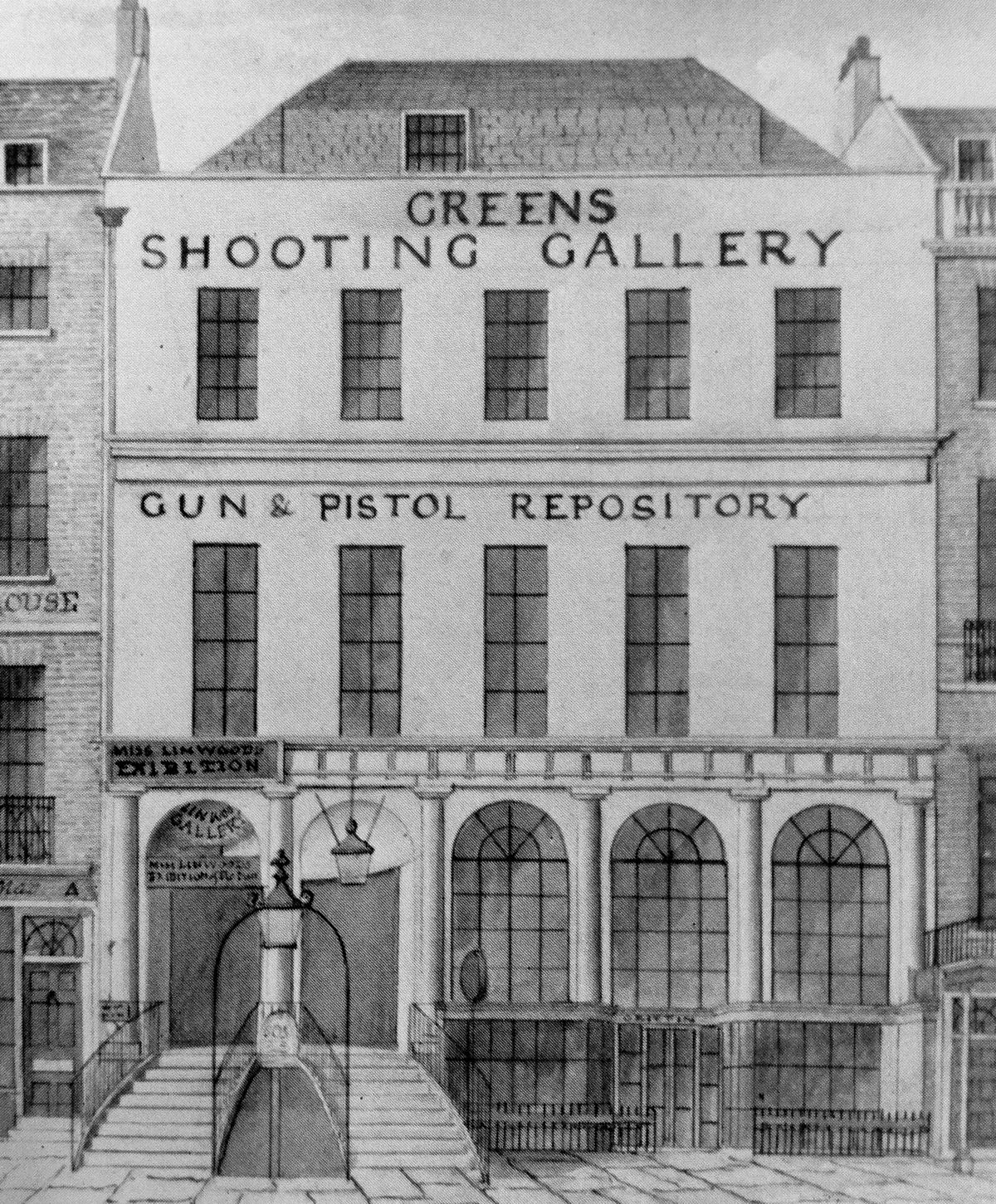
Plate 2. Anonymous, Savile House, Leicester Square, watercolour on paper (c.1840), Museum of London. Plate 32a in F.H.W. Sheppard, ed., Survey of London: The Parish of St Anne, Soho, vol. 34 (London: Athlone, 1966), [no pagination].
However, this influence was perhaps moderated by the presence of Mary Linwood, an acclaimed needlework artist who had established a gallery on the first floor of Savile House in 1809, which remained open until shortly after her death in 1845 (plate 3). Altick has suggested that, ‘it would be difficult to conceive of a public exhibition more staunchly decorous than one of famous paintings imitated in colored [sic] wool’. Despite the contrasting circumstances of the Society for Promoting Practical Design and the Government School of Design, there are conflicting accounts of the extent to which their respective curricula could be distinguished from one another. It has become customary to characterise the Society as inherently radical, particularly with reference to the employment of both male and female life models. However, one source contemporary with the opening of the School offered the following description that was more moderate in its distinction:
its objects, as well as general course of instruction, are very similar to the school just described [the Government School of Design at Somerset House]. This one, however, is supported by voluntary subscriptions and the quarterly payments of the pupils. The charges for the latter are very moderate, being only two shillings and sixpence per quarter for pupils under sixteen years of age, for older pupils, four shillings; admission to lectures, library, and museum, two shillings and sixpence per quarter.
The perceived similarity between the objectives of these two institutions was to some extent matched by the pedagogic objects chosen to illustrate their respective positions. At the first public meeting of the Society for Promoting Practical Design, held in the Minor Hall at Exeter Hall on The Strand on 11 January 1838, a collection of objects were displayed to the audience, which can be read as a manifesto of their collective ambitions:
On the platform were arranged a number of valuable specimens of antique Pompeian and Grecian works of art, brought by John Ashton Yates, Esq., M.P. Mr Purdon, of the Terra Cotta Depot, Adelaide-street, Strand, and of the Pantheon, Oxford-street, sent several beautiful specimens of studies, from the Etruscan vases in the British Museum, with original ornaments, and with designs from Flaxman. Mr. Kernot, the British and Foreign Bookseller, of Greek-street, Soho, lent, for the occasion, many valuable English and Foreign books and prints, illustrative of the internal decoration of Egypt, Greece, Etruria, Pompeii, and of the Louis Quatorze, and other modern styles.

Plate 3. Anonymous, View of Mary Linwood’s Galery, watercolour on paper (c. 1810), 7.5 x 11.5cm, Victoria and Albert Museum [Museum Number P.6-1985].
During the first year of its operation, the Society claimed to have taught almost a hundred students, who attended lectures every Tuesday and Friday. Benjamin Robert Haydon was engaged to deliver a course of twelve lectures on the fine arts, although there were also lectures provided on the subjects of ‘Architecture, Pneumatics, and the Steam Engine’. The account of the inaugural meeting of the Society included the reading of a letter in which Haydon offered his support to the project ‘as the only way to instil [sic] a sound taste into their minds’ and declared himself as an annual subscriber, but his involvement appears to have been limited. It has been argued by Bell, Kriegel and Macdonald that this model of education informed the subsequent direction of the Schools of Design and that in order to compete with this arrangement, figurative sculpture came to represent a utilitarian compromise which bypassed the more contentious call for life drawing to form part of the curriculum. As part of his evidence to the Select Committee on Arts and Manufactures on 3 March 1836, Henry Sass (1787-1844), a former student of the Royal Academy who had established his own School of Drawing in 1813, articulated the rationale that would be adopted by the Schools of Design:
we learn the anatomy of the human body perfectly from the surface of Greek statues; and although the study of anatomy at the present time is necessarily from dissection and from the study of the skeleton, yet I have found, if persons become too skilful in anatomy before they know the beautiful surface of the figure, that they are apt to express a knowledge to the destruction of beauty, and therefore I hold it to be good that they should study the anatomy on the surface, as they thereby become acquainted with the fine exterior of the form.
Inert classical plaster casts were reconfigured as archetypes of a particular conception of cultivated taste and technical precision, subtly differentiated from the way in which they were conceptualised by the Academy as agents of the ideal. Quentin Bell has allied this distinction to the wider proliferation of historicist and antiquarian interests, suggesting that:
Neo-classicism was, in fact, not a recrudescence of the Academic Idea, but part of a general tendency towards archaeology, a great turning back to the past which had already produced an interest in Gothic architecture and which was to provide one of the main currents of aesthetic thought in the nineteenth century.
In contrast, Paul Wood has argued that the reconceptualisation of the past during the nineteenth century resulted in ‘an etiolated classicism that had dried out into a husk and was increasingly incapable of addressing the effects of modernity’. The reverence for antiquity as the source of universal principles for the practice of art and design was not accepted without question by contemporaries either. For example, it was the opinion of the eminent Scottish house decorator David Ramsay Hay (1798-1866) that the study of botanical specimens was the only course of instruction appropriate to the study and application of ornamental design. As part of his evidence to the Select Committee on Arts and Manufactures on 15 June 1836, Hay made the following statement:
I consider it a mistaken idea that ornamental designers will be produced by setting young men to copy statues or pieces of sculptural ornament, however good they may be […] I consider servile copying of the works of others very injurious to the ornamental designer, as it retards originality of conception.
Instead, Hay called for ‘instruction in drawing and colouring which is applicable to manufactures and the useful arts generally, and which is not likely to mislead young men by giving them a distaste for the humbler professions and inducing them to attempt to become artists’. It is particularly interesting to see an opinion generally associated with the Academicians expressed by an artisan. Hay however had established a successful enterprise with prestigious commissions from both public and private clients and as such, his interests extended to the training of his future employees and their acceptance of a ‘humbler’ social and economic position.
After limited drawing from the figure had been introduced under William Dyce in 1838, further restrictions were imposed by Charles Heath Wilson, who had been installed as the Director of the Schools of Design in 1843. The Report of the Council of the School of Design for the year 1843 to 1844 reinforced the strict conditions attached to the study of the figure:
it is requisite that casts from objects in which figures are combined with ornament [original emphasis] should be placed in the figure room, as well as casts from ancient statues. The practical application of all that is taught in these classes should be shown, as much as possible, by the examples on the walls, which should not present merely the appearance of a class room for the Figure attached to an academy of Fine Arts.
It is clear that the objects of the teaching collection were a source of anxiety related to their association with academic art instruction, which was in turn connected to their capacity to define the spaces in which they were displayed. The regime imposed by Wilson earned him the ignominious title of ‘the Pompeiian Dictator’ for his insistence on the exclusive study of Ancient Roman and Italian Renaissance ornament. As a result of these increasing impediments, a group of senior students at Somerset House began a revolt in 1845 that came to be known as ‘The Rebellion of Forty-Five’, supported by the Master of the Figure School, John Rogers Herbert (1810-1890).
Although Wilson and Herbert occupied opposing territories in this skirmish, they were both products of traditional academic and atelier modes of art education. Wilson had studied in Italy under his father, the painter Andrew Wilson, before taking up a position as an art master at the Trustees’ Academy in Edinburgh. Herbert had trained at the Royal Academy Schools and was elected as an Associate in 1841 and a full Academician in 1846. In addition to the internal criticism from students and colleagues at the School of Design, Wilson’s methods and preferences were the subject of particularly scathing commentaries in Punch. One of the many satirical pieces laments the way in which an aspiring painter was stripped of his creative potential:
Being an encourager of the fine arts, I employed a young friend of mine, who seemed full of promise as a promissory note, to decorate my house in fresco, and I gave him the subject of the siege of Troy; for I know that enthusiastic youth delights in aiming so high that it shoots very often out of sight altogether. I did not interfere during the progress of the fresco, and the result was, that my wall was adorned with the following spirited battle-piece. You will perceive that the conception is fine, though the treatment is awkward.
The narrative continued with the young artist sent to the School of Design for two years, after which he presented his benefactor with a still life drawing to illustrate his achievements (plate 4). The composition was given the following assessment: ‘I can’t say I admire the sort of thing he has been taught to do so much as the style of the thing he did when he followed the natural bent of his own genius’. The patron continued to express his distaste for the antiquarian fragment favoured by Wilson: ‘men with their legs, feet, and arms broken short off, or Egyptian hieroglyphics of men capering about on Etruscan Vases’.
Plate 4
‘The School of Design’, Punch, vol. ix (5 July 1845), p. 21.
The result of this internal and external criticism was not a reassessment of the role of the figure in the curriculum of the Schools of Design, but an entrenchment and extension of Wilson’s position. Plaster casts of antique statuary were removed from the Figure Room and dispersed around the school as inert decorative objects, which disrupted their utility as a teaching collection. Furthermore, drawing from life was only to be conducted with a draped model, which was not necessarily dependent upon the presence of a living sitter through the use of lay figures, which were wooden or textile articulated mannequins used as substitutes for the human body (plate 5).
Plate 5
Lay Figure having belonged to the sculptor Louis François Roubiliac (1702-1762), bronze, wool, silk, cork, wood, leather, linen and cotton (1750-1762), height: 76 cm, Museum of London [Accession Number 29.130].
Despite the level of mediation, the Council of the School of Design reported that ‘instruction in drawing the human figure [original emphasis] forms a most important part of the course of education in the School’. An article written in the Athenæum noted the grievances of the students, with a distain for their position shared by the Art-Union:
One special wrong will show the state of affairs […] ‘We were desired,’ says one of these public-spirited youths, ‘to come prepared to draw from the Lay Figure set by Mr. Wilson; but so universal was the feeling of the uselessness of the study, that only two persons did draw from it.’ Could ignorant oppression go farther? What right had the Director, in this free country, to desire young men of an age capable of thinking and acting for themselves to draw from the Lay Figure? Of course, a tyrannical Council could not see the force of such arguments.
These distancing mechanisms escalated the conflict and Wilson ordered the gas to be turned off during the evening painting class taught by Herbert to withdraw both heat and light. In response, thirty three senior students wrote to the Board of Trade, with the support of Herbert, accusing Wilson of incompetency. The students were suspended until an apology was received and Herbert was replaced by John Callcott Horsley after the Council of the School of Design ruled in favour of Wilson.
The fact that a minor internal insurgency became the subject of vigorous discussion in pamphlets, periodicals and the Houses of Parliament provides an indication of the level of cultural, political and economic investment in the separation of artisanal instruction from artistic training. The determination to construct and reinforce this differentiation was arguably a response to the permeable boundaries between the two institutions. Bell proposed that, ‘a substantial minority must have treated the School as a preparatory class for the Academy. In fact, we know that there was a tendency for students to drift from the one establishment to the other’. Furthermore, concerns over the mutability of art and design education were to some extent analogous to the perceived fluidity of social relations generated by urban industrialisation. The construction of a differentiated curriculum for the Schools of Design was ultimately undermined by the Academicians whose influence extended to the formation of a teaching collection only tangentially related to the task at hand.
The principal solution to the problem of the human figure as an object of instruction was the plaster cast. These objects have been disregarded as a subject for scholarship until relatively recently, possibly as a result of the comprehensive destruction and disposal of these collections by schools of art and public museums from the 1950s onwards. However, the opinion that these objects were obsolete was not exclusive to the twentieth century. Reflecting on his education in the last quarter of the nineteenth century, Fred Miller described his antipathy towards these objects: ‘the same old casts which for years have hung up in schools of art have bred contempt because of one’s familiarity with them’. Miller went on to describe the character of his instruction in further detail:
The training I received at the West London School of Art was of a very rule-of-thumb character – drawing from uninteresting casts in a heated, fetid underground cellar, where the tuition, meagre as it was, was of as mechanical a character as the work during the day, and so deadening was it that after awhile I dropped going to the school. During my pupilage I developed a certain amount of technical facility, but I was sadly deficient in knowledge of form […] It was like reciting in a language one did not understand.
The intention of this practice of mimesis has been described by Macdonald: ‘the pupils would commit to memory a multiplicity of historic motifs, so that they could combine them anew and spawn mongrel designs’. However, the ways in which the knowledge thought to be embedded in the object could be accessed were not precisely articulated. Macdonald went on to characterise this belief as close to a form of osmosis: ‘mysticism was prevalent with regards to casts, and many believed that if these copies of antiquity were perused for hours the secrets of High Art might be revealed’. There were some attempts to differentiate the knowledge that could be gleaned from different plaster casts, as this example illustrates:
It is, moreover, desirable that male forms, and those of the severe character, such as the Discobolus, the Dancing Faun [plates 6 and 7], or the Fighting Gladiator, should first be studied, as imparting more information to the student than female forms or male statues of a more voluptuous character, such the Antinous or the Apollino, which are better attempted when beauty is to be studied after a certain amount of knowledge of form and proportion has been obtained.
It is not clear to what extent this advice was followed, nor how prevalent this gendered distinction between ‘information’ and ‘beauty’ might have been. However, the rationale appears to have been derived from the academic principle of the ideal associated with Joshua Reynolds’ Discourses, conflated with the quasi-empiricism of design reform. In this system of thought the vessel that stored and transmitted these mechanical and aesthetic lessons appears to have been considered as a neutral object without contingency or mediation, which has to some degree been maintained. The conditions of the production of plaster casts during the nineteenth century has only recently received critical attention.
Plate 6
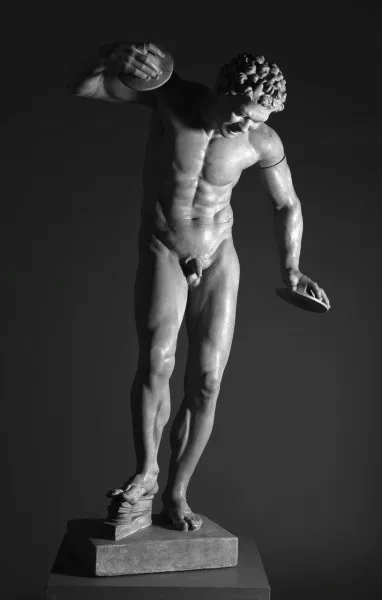
Anonymous, The Dancing Faun, plaster cast (18th century), height: 151 cm, Royal Academy of Arts.
Plate 7
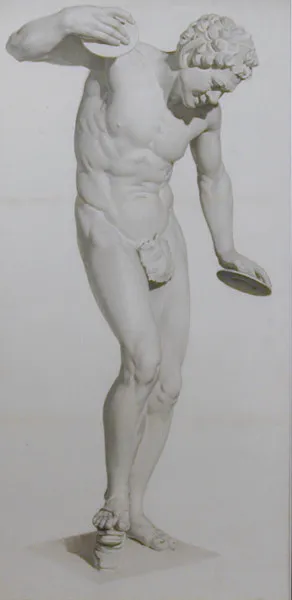
Student of the National Art Training School, Stage 8b: Human or Animal Figures Shaded from Cast (c. 1897), 86 x 51 cm, private collection.
Peter Malone has used trade directories to estimate the number of makers of plaster casts in London during this period, which varied between four and fifteen firms of almost exclusively Italian origin. The principal supplier of plaster casts to the Schools of Design was Domenico Brucciani of 5 Little Russell Street, Covent Garden (plate 8). The details of his life and work are in short supply, with the most information supplied by an obituary published in The Builder in 1880:
He was born at Lucca, in Italy, in 1815, and coming to England at an early age, started in business, fifty years ago, as a modeller and dealer in plaster-casts, in Russell-street, Covent-garden, where he has gathered together a remarkable collection of casts from ancient and modern works. He was long employed in the British Museum [from 1857] in producing casts from the marbles there. Although chiefly a plasterman in calling, he was an artist at heart. He lately presented to the Elgin-room, for the purposes of study, a cast of the Venus of Melos.
A more revealing account of his practice and profession was provided by the Illustrated London News in 1853, accompanied by an engraving ‘sketched by our artist’ (plate 9). It depicts two formatori, one of which may be Brucciani himself, at work on a mould and plaster cast of the equestrian statue of Charles I by Hubert Le Sueur (c. 1580-1658) at Charing Cross. The cast was to be displayed in the Sculpture Court of the Crystal Palace at its new location in Sydenham. The description of this ‘novel and interesting’ scene paid particular attention to the materiality and complexity of the process:
the bronze effigies of King Charles and the upper part of his horse seeming to issue from a rough misshapen mass of plaster. In the background, the upper portion of the King’s figure, in the snowy whiteness of new plaster, was being scraped from the incidental roughnesses and finished on the spot; whilst portions of moulds, sacks of plaster, a charcoal stove, ladders, and the miscellaneous appliances necessary to the casting – all white with plaster – were piled about, or placed most conveniently for use; and the bit and bridle, taken from the statue, were hanging on the sides of the hoarding.
Plate 8
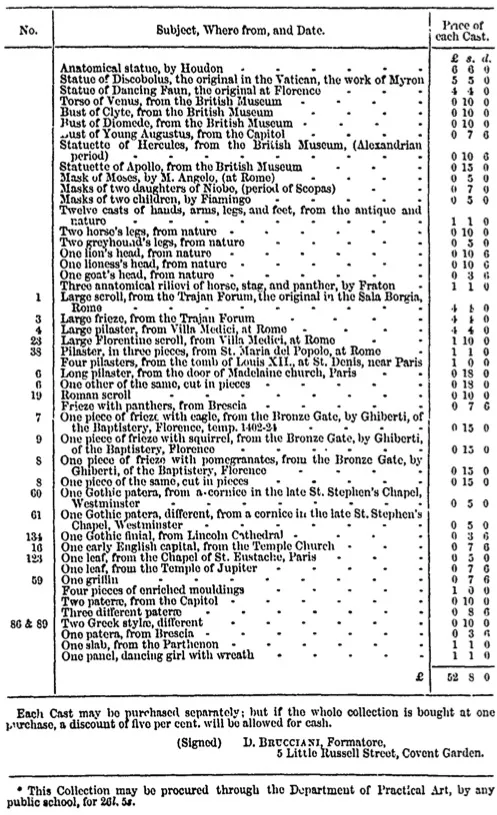
A Collection of Casts for use in Drawing Schools, recommended by the Department of Practical Art, and exhibited by permission at Marlborough House, Pall Mall, London, First Report of the Department of Practical Art (London: printed by George E. Eyre and William Spottiswoode for Her Majesty’s Stationary Office, 1853), Appendix II, p. 73.
Plate 9
Anonymous, Taking a Plaster Cast of the Statue of Charles the First, at Charing Cross, wood engraving, Illustrated London News, vol. xxii (19 March 1853), 23 x 17.5 cm, p. 224.
Although the plaster cast was the primary pedagogic object for the Schools of Design, publications and loose printed plates were also essential to the curriculum, particularly in the study of human anatomy ‘from the flat’ (plates 10 and 11). The Committee of the Leeds School of Design recorded the following two-dimensional additions to their teaching collection:
The analysis of the relative merits of deficiencies of a given object formed part of a wider empirical project which sought to reveal the universal principles of design. These principles were communicated through travelling lecture series, public exhibitions and publications such as Ralph Nicholson Wornum’s Analysis of Ornament and Owen Jones’ Grammar of Ornament, both published in 1856. The former was an introductory textbook approved by the Department of Science and Art and distributed as a prize to students for an exemplary piece of work submitted for examination. The latter, a costly folio edition of one hundred and twenty plates, was issued to provincial school libraries as a reward for exceptional performance.
Plate 10
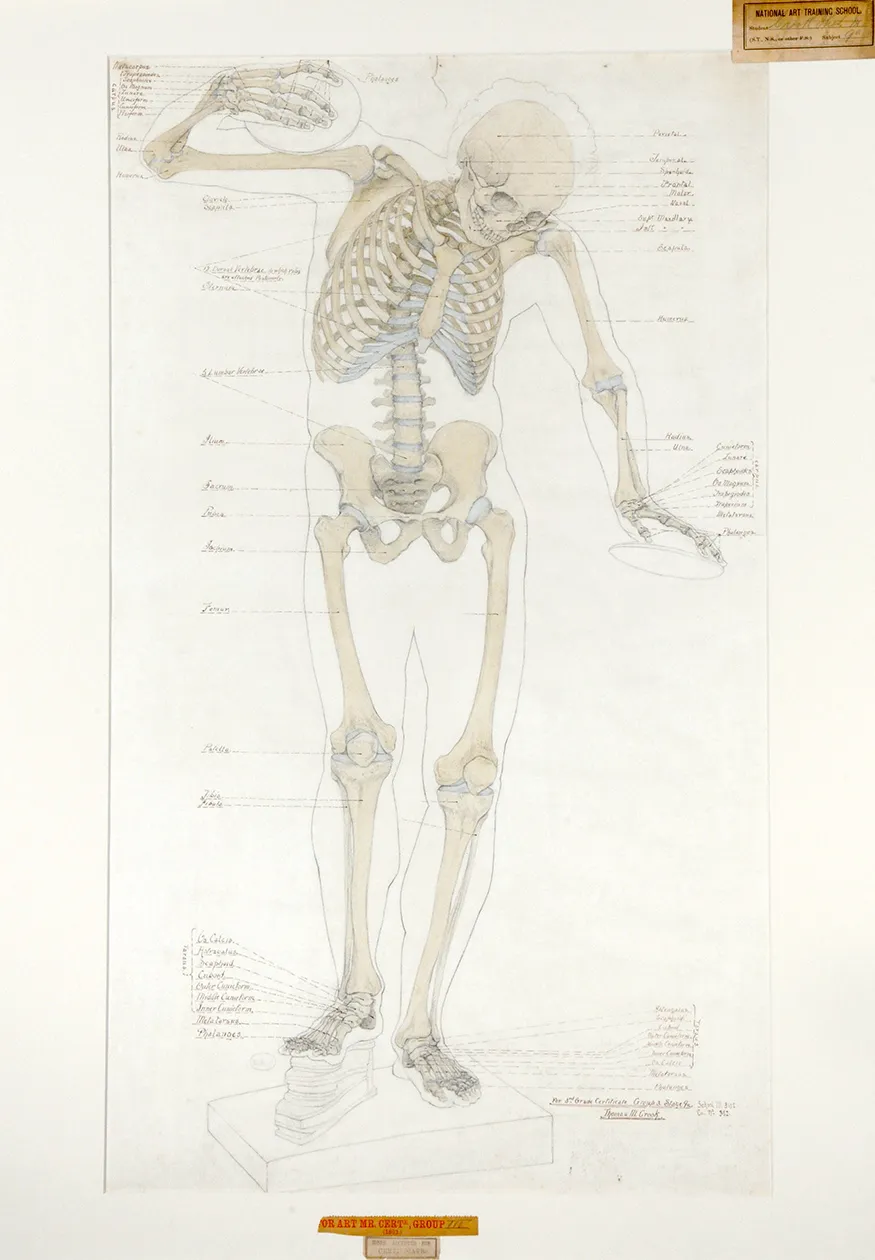
Thomas Mewburn Crook, Stage 9a: Anatomical Studies of the Human Figure from the Flat, pencil, ink and watercolour on paper (1893), 72.7 x 42.5 cm, Henry Moore Institute Archive, Leeds Museums and Galleries [Box 2005.34].
Plate 11

Thomas Mewburn Crook, Stage 9a: Anatomical Studies of the Human Figure from the Flat, pencil, ink and watercolour on paper (1893), 73 x 48.5 cm, Henry Moore Institute Archive, Leeds Museums and Galleries [Box 2005.34].
Plate 12

William Dyce, Chalk Drawing from a Plaster Cast, black chalk on paper (c. 1840), 36.3 x 47.7 cm, Victoria and Albert Museum [Museum Number 700-1898].
The first publication issued from within the system was The Drawing Book of the Government School of Design by William Dyce (plate 12). The Drawing Book was a series of seven publications intended for use by the Schools of Design and were also to be sold commercially to a broader public, with the first plates issued in 1842 and 1843. However according to Christopher Frayling, ‘Dyce’s book, which the Council had confidently expected to sell well at 3s. 6d. for each part, had been a commercial disaster. The Council had agreed with the publishers, Chapman and Hall, to pay for the drawings, their engraving on wood and a proportion of the publishers’ loss’.
Although the Drawing Book was neither completed nor considered to have been commercially successful, it did illustrate the priorities and methodology of the Government School of Design, as Rafael Cardoso Denis has suggested: ‘Dyce’s manual offered a radical departure from previous methods of drawing instruction, not only in the way its exercises were organised but also in the complex theoretical discussion of the nature of design and ornament which constitutes much of its introduction’. Richard Carline has traced the positivist impulse behind the curriculum: ‘Dyce was seeking to give art teaching a more scholarly and scientific basis than it had enjoyed hitherto. It was based on his own analysis of form and colour, but whether this purely theoretical approach was ever likely to bring out the artistic potentialities of his students is very doubtful’. However, few would argue that it had ever been the intention of the Schools of Design to cultivate artistic potentiality, as the ‘Rebellion of Forty-Five’ had shown.
In 1848 Wornum was appointed Lecturer on the History, Principles and Practice of Ornamental Art, during which time he gave lectures across the country. He was subsequently appointed Librarian and Keeper of Casts in 1852 and in this capacity he compiled an illustrated Catalogue of Ornamental Casts of the Renaissance Styles, through which it has been possible to trace some of the particular architectural objects distributed to the branch schools.
For example, the archive of the Leeds School of Design listed ‘two pieces from door of St. John’ in its collection. Through the Catalogue by Wornum and the inventory of stock supplied by the firm of Domenico Brucciani, it has been possible to identify these objects as fragments cast from the architrave of the Baptistry Doors in Florence by Lorenzo Ghiberti (plate 13). It is significant that these plaster casts were not reproductions of the sculptural reliefs most readily associated with this work, but the peripheral ornamentation. Wornum suggested that these particular casts should be used as an object lesson in the treatment of natural forms, which would otherwise be unacceptable without having been conventionalised:
Lorenzo Ghiberti has introduced natural imitations in his celebrated gates of the Baptistry of San Giovanni at Florence; but they are strictly accessory to a general plan, and symmetrically arranged; being neither negligently nor naturally disposed. They are bound in bunches or groups of various shapes and sizes, disposed in harmony with the main compartments of the gates, of which they are ornaments. And this is, perhaps, the utmost extent to which decorations of this class can be judiciously applied.
In an address to the students and subscribers of the Sheffield School of Design in 1846, Young Mitchell (1811-1865) made direct reference to these particular plaster casts and the qualities invested in them:
The gates of the Baptistery, at Florence, by Ghiberti, are so full of every high requisite of art, that an ample and intelligent study of these alone might make an artist, and casts of a portion of them, I am happy to find the School possess – would we had them entire! To these, and similar great works, do I then draw your attention, as the fountain head of all that is excellent and admirable in what is called decorative art. Let us copy them – not as mere copyists – but as men striving to work in the spirit which produced them, and let us no longer condescend to be the servile imitators of modern French and German art.
The desire expressed for the whole is particularly interesting, pointing towards local deviation from and ambitions above the limitations imposed by the Council of the Schools of Design. Despite attempts to anchor the lessons embodied in the pedagogic object, once they were circulated to the regions they were subject to distinct sets of historical, cultural and economic conditions that determined their reception and interpretation. The potential for misuse was further compounded by the strength of the association between plaster casts of antique statuary and the academy, which is why it is important to trace these objects from the centre to the periphery and to restore regional agency to the individuals and institutions responsible for the formation and dissemination of teaching collections.
Plate 13
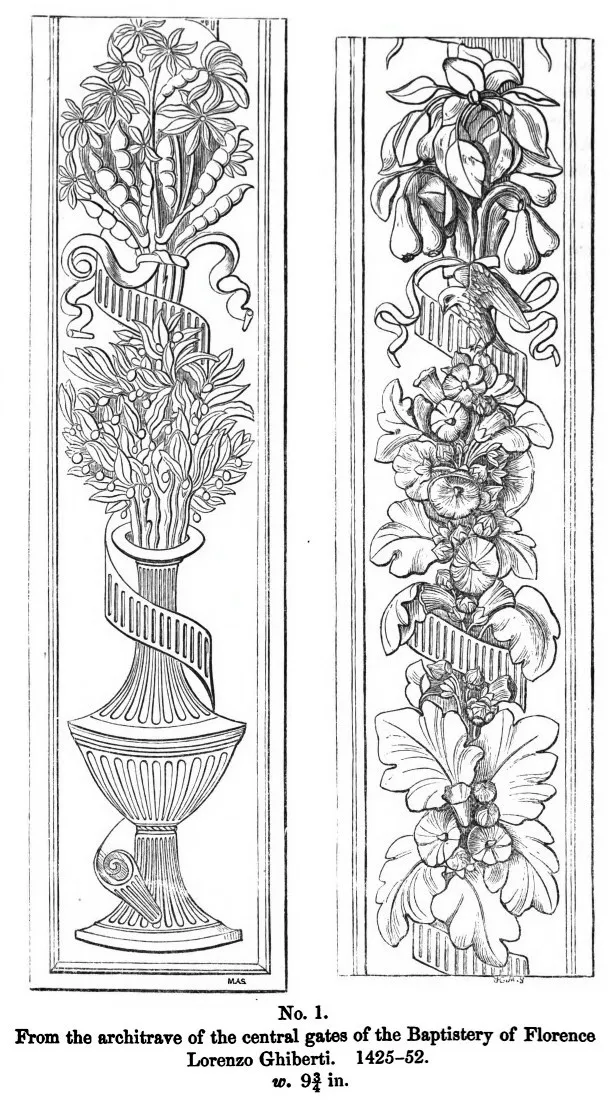
A Female Student of the Wood Engraving Class at Marlborough House, From the Architrave of the Central Gates of the Baptistery of Florence, wood engraving from the Catalogue of Ornamental Casts of the Renaissance Styles; Being Part of the Collection of the Department, by Ralph Nicholson Wornum (London: Longman, Brown, Green and Longmans, 1854), p. 21.
Drawing classes had been offered by the Leeds Mechanics’ Institution from its inception in 1824. Immediately prior to the establishment of the Leeds School of Design, the drawing master of the Institution, George Thurnell, taught ‘Mechanical, Architectural, Landscape, and Figure Drawing’ to over fifty pupils in two classes per week at the Hall of the Institution at 12 South Parade. Thurnell recorded that the classes were ‘attended by mechanics, engineers, joiners, masons, bricklayers, painters, engravers, wood carvers &c’.
This demographic precisely represented the intended recipients of art and design education as calculated by the Reports of the Select Committee on Arts and Manufactures and subsequently by the Council of the Government School of Design at Somerset House. The congruence between the existing instruction in drawing provided by the Mechanics’ Institution and the objectives of Schools of Design constituted the primary argument for a grant to be awarded to the Institution towards the inauguration of a branch school in Leeds:
The committee [of the Leeds Mechanics’ Institution] think that they have been carrying out on a limited scale some of the objects contemplated by the Council of the London School of Design, & as such preparing the way for more completed extended culture. The building which they now possess is not only proper for such a purpose, but one well suited for the reception of a collection of casts of works of art, & from its central situation & its arrangement, every way calculated to exhibit such a collection to the public, which its classes would be making the best application of such a donation by using it.
However, this first request was rejected because the Council of the School of Design did not consider it appropriate to subsidise and extend the activities of existing regional voluntary societies, despite their experience in a mode of education that was very much allied with their own interests. The Report of the Council gave the conditions under which an application would be reconsidered:
It would be found much more advisable to establish a School of Design at Leeds, under an independent body of persons, selected by the actual subscribers to such a School, than to place it under the care of an association formed for other and more extensive objects, and having no immediate relation to the Art of Design with reference to manufactures; we have suggested, therefore, that although we could not comply with the application in question, we should be prepared to assist a School of Design in Leeds, if set on foot there under the management of a separate Committee, independently of any other Institution.
In addition the woollen and worsted industries that formed the principal manufactures in Leeds during this period were not considered to be suitable forms of production for the application of decoration or design. The second application of 1846 by the President of the Institution, Edward Baines Junior was successful despite having only partially fulfilled the stipulations prescribed by the Council. The establishment of the York School of Design in 1842 through the intervention of William Etty RA, member of the Council of the Schools of Design and native of York, set a precedent for branch Schools of Design that negated their primary task.
As the town had no significant industries to benefit from the supply of skilled labour, the School adopted the position that the art education of the middle classes supported the economy by stimulating the demand for tasteful commodities, which would later be sanctioned under Henry Cole. In addition to the increasing malleability of the system, the Committee of the Leeds Mechanics’ Institution capitalised on the acquisition of 22 East Parade, an eighteenth-century merchant’s house approximately sixty yards from the Hall of the Institution that was rented for £57 per annum. This small but significant spatial separation enabled the Committee to persuade the Council of the Schools of Design that their intention was to found a quasi-autonomous School that would benefit from an umbilical connection to the founding Institution:
We beg to state for your information that we have been enabled to obtain suitable accommodation for a School of Design in a building rented by the Leeds Mechanics’ Institution and Literary Society and used by them for the purpose of a Day School, but separate from their own Hall. It is in the best part of the town and very nearly central: the rooms have been seen by Mr. Patterson Master of the York School of Design, and pronounced to be suitable. We have raised a fund adequate to make the needful alterations in the building and to provide the requisite furniture and fixtures. We propose to place the School of Design under the superintendence and management of the Committee of the Mechanics’ Institution by which means several important advantages will be secured.
The fund that had been raised in support of the second application was a subscription of £66 from ‘gentlemen anxious to promote the establishment of an efficient School of Design in Leeds’. The local subscription was a prerequisite to a successful application for a grant and was used as a measure of public support for the scheme. However, in this instance the subscription demonstrated the interests of the local political elite, dominated by the donations of William Beckett MP, William Aldam MP and the Mayor of Leeds and Vice President of the Mechanics’ Institution, John Darnton Luccock.
Although it was only necessary to equal the amount sought, the Leeds bid was reinforced by having requested only £30 in aid, combined with an offer to meet the cost of the salary of the art master at £100 per annum, which was also funded by a central grant at other branch schools. After an initial offer of a £50 contribution per annum, the secretary of the Council of the School of Design, Walter Riding Deverell, wrote again on the 29 August 1846 with a significantly increased offer: ‘the Council, with the sanction of Her Majesty’s Government has granted £80 towards the Salary of the Master for the current year and as announced in my communication of July £50 for School Furniture and £50 for examples of Art’. The first four cases of plaster casts were transported by the removal firm Pickfords in November 1846 and their contents were listed as follows:
This standard collection was almost immediately augmented with further examples from the canon of Greco-Roman Antiquity. However, the larger statues that were selected were not covered by the grant and appear to have been purchased on the ‘kind advice’ of the Director of the Head School at Somerset House:
The casts, drawings and other examples which the Council have done us the favor to send us by way of grant, have all arrived safely: and in addition to them, for the sake of opening with a good popular impression, we have ordered and obtained, at our own expense, but with the kind advice of your Director, Mr. C.H. Wilson, full sized casts of the Apollo Belvidere [sic], the Venus de Medici, the Venus of Milo, Germanicus, the Fighting Gladiator, the Discobolus, the bust of Ajax and some smaller ornaments and anatomical parts.
Plate 14
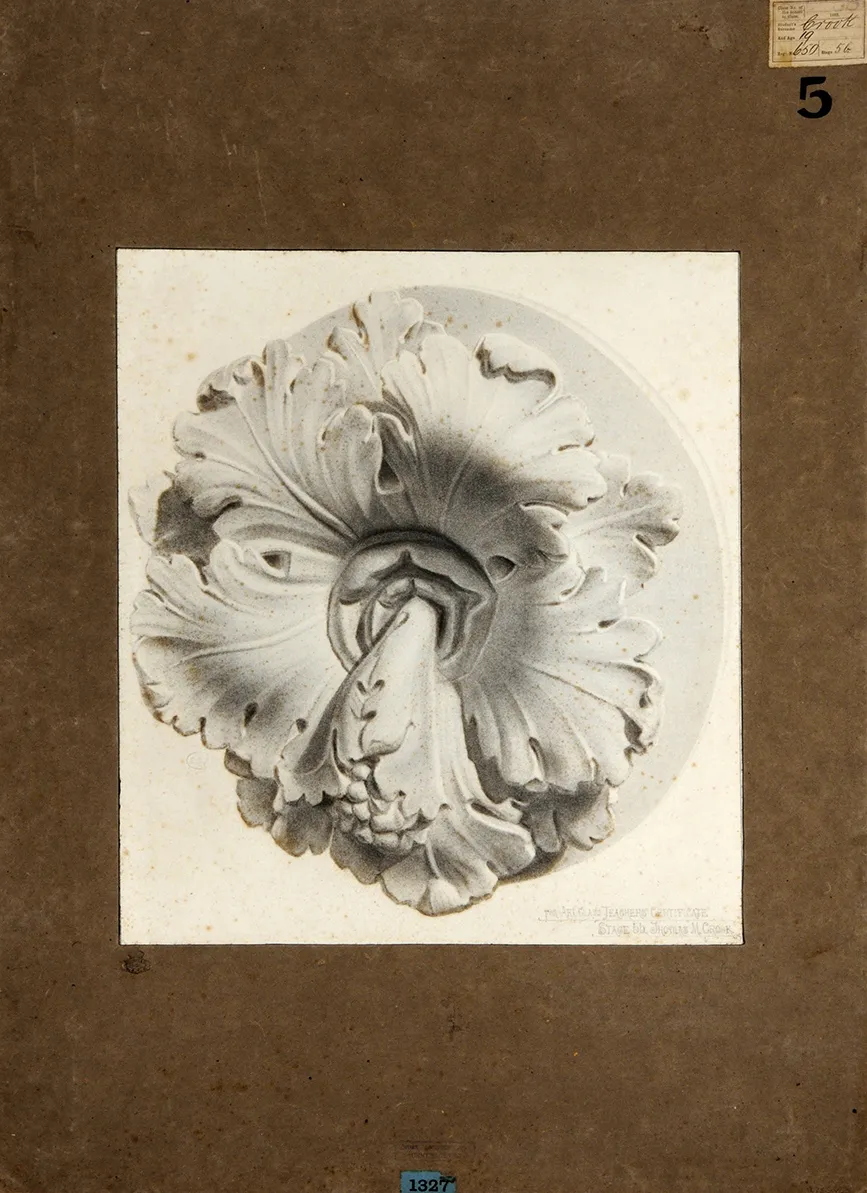
Thomas Mewburn Crook, Stage 5b: Shading from the Round: Shading from Cast of Ornament (Scroll from the Forum of Trajan, Plaster Cast Number 471), pencil on paper (1889), 60.2 x 48.4 cm, Henry Moore Institute Archive, Leeds Museums and Galleries [Box 2005.34].
To these objects were added a skeleton at £5.10.0 and an unspecified anatomical figure, most probably a copy of L’Ecorché (1767) by the French sculptor Jean-Antoine Houdon (1741-1828), at £3.10.0 (plates 15 and 16). The addition of these objects certainly resulted in a stronger collection, but it also led the School into debt before teaching had even commenced. The President of the Leeds School of Design stated to the Committee that they ‘hoped to raise a sufficient sum by Donations to cover this purchase’. By February 1847 the debt had still not been cleared and the significant sum of £57.8.0 was owed to the principal maker and supplier of plaster casts, Domenico Brucciani. It is possible that the Committee of the Leeds School of Design felt compelled to follow the ‘kind advice’ of Wilson in the purchase of these supplementary objects, to retain his favour and demonstrate their deference to the Council of Management in London.
In addition to these approved examples, the teaching collection at the Leeds School of Design was extended with local donations. For example, in June 1847, Tom Walter Green, a former maker and seller of prints and books, donated plaster casts taken from Lincoln Cathedral and from the Church of West Ardsley in Wakefield. Although Medieval and Gothic objects were not well represented in the standard teaching collection distributed to the regional schools, the lessons they could impart did not substantially deviate from the prescribed programme of study, because they could also be mined for historical motifs to be reconfigured and applied to manufactures.
Plate 15
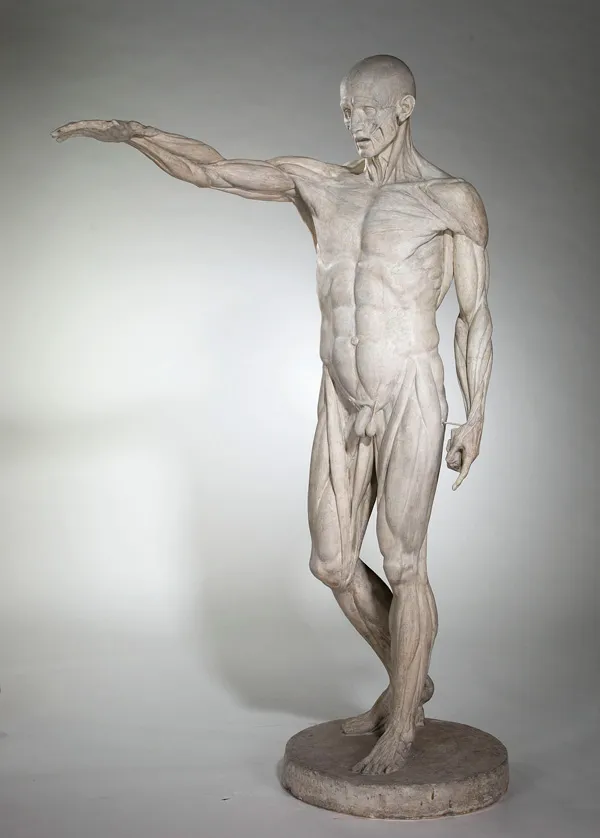
Jean-Antoine Houdon, L’Ecorché (Figure of a Flayed Man, Right Arm Extended Horizontally), plaster cast (1767), height: 181 cm, Académie de France, Rome.
Plate 16
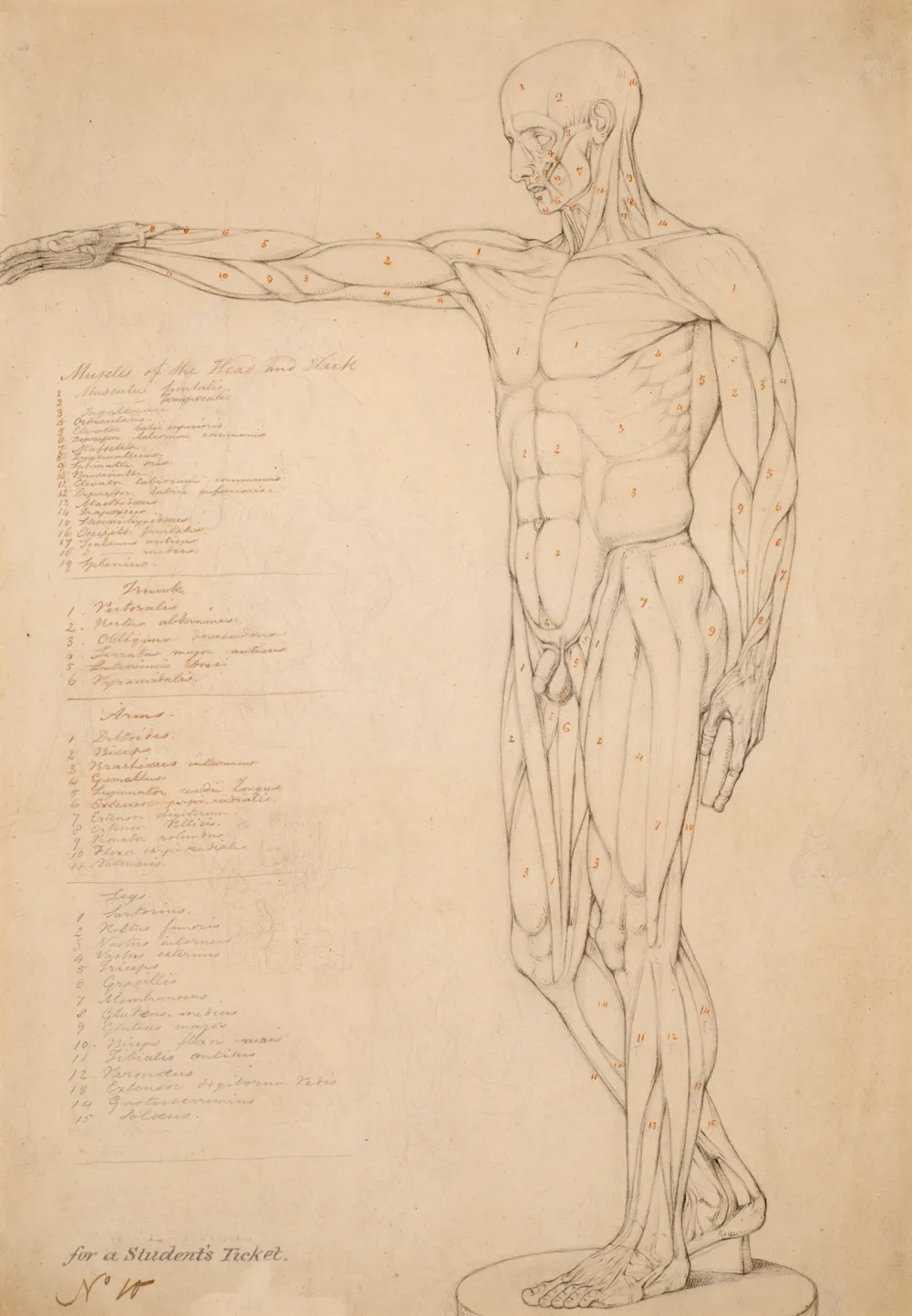
William Edward Frost RA, Study of the Muscles of a Male Figure, from an Écorché Cast, pencil on paper with annotations in red chalk (c. 1829), 52.6 x 35.9, Victoria and Albert Museum [Museum Number E.425.1948].
The Leeds Mercury recorded the circumstances in which the casts were produced:
They are taken in plaster by Mr. Keyworth, sculptor, of Hull. This is the first present to the School of Design since it has been opened, and it is to be hoped it will be followed by other donations of a similar description. These are very valuable to a School of Design, as examples to show what perfection wood carving was carried at that period, and how very far behind-hand we are in that art. Schools of Design are doing much towards bringing it to perfection again.
Other donations spoke directly to the concerns of the Schools of Design, such as the ‘12 Lithographic Drawings from Raphael’ that were provided by a ‘Rev. Mr. Elwin’ in March 1849. The work of Raphael occupied a particularly privileged position at the Schools of Design, ‘as a “canonical” painter whose compositions were also used in ornament, Raphael helped legitimize the applied arts’. This perspective was first articulated in this context by Gustav Waagen in his evidence to the Select Committee on Arts and Manufactures in 1835: ‘in former times the artists were more workmen, and the workmen were more artists, as in the time of Raphael, and it is very desirable to restore this happy connexion’.
However, objects donated to the Leeds School of Design did not always reinforce the position of the central administration. For example, Thomas Harvey (1812-1884) was recorded as ‘having presented a portrait of Mr. Joseph Sturge for the Portfolio of the School of Design’. Sturge (1793-1859) was a prominent Quaker and Abolitionist based in Birmingham, with associations to the Chartist and Nonconformist movements. Harvey, a practicing pharmacist, was an acquaintance of Sturge and shared his religious and political affiliations. That the Leeds School of Design agreed to accept the portrait for their collection suggests a degree of sympathy for these causes among the Members of the Committee, whose particular politics will be discussed as part of chapter two.
The provisions made for the new School of Design resulted in a reassessment of the drawing classes, which had previously operated as an aggregate of technical and academic training. The drawing classes were to continue under George Thurnell as a parallel course of instruction, although the content was reconfigured after the Inspector of the Schools of Design, Ambrose Poynter, took an active interest in this arrangement and sought to prevent the infringement of the sphere he represented. Poynter’s report to the Sub Committee of the Leeds School of Design included the following chastisement: ‘no Figure or Landscape Drawing should be taught in Mr. Thurnell’s Class but that those pupils belonging to it who wished to learn those branches of the Art should be allowed to attend the Government School’.
As the teaching of figure and landscape drawing had been so divisive in this context, it is particularly startling that Poynter had recommended the School of Design as the more appropriate territory for what were firmly fine art practices. Conversely, the prospectus for the drawing class of the Mechanics’ Institution described a curriculum that was particularly close to the founding principles of the School of Design:
Thurnell, under whose able and diligent superintendence, they are taught the principles of Drawing Plans; the Theory and use of the Geometrical Scale, together with their application in the construction of Machinery. Radical and Isometrical Perspective, based on the Laws of Vision and Geometric Truth, are also taught. It is the object of the Class to impart such useful knowledge as workmen, in the various branches of Trade and Manufactures, will find of daily application.
This disparity can be considered characteristic of the structure and implementation of the Schools of Design during their first decade. A further conflation of their activities occurred in 1848 when the drawing classes of the Mechanics’ Institution were transferred to rooms at 22 East Parade alongside the School of Design. An inspection three years later reiterated the need for strict delineation, while also undermining the independence of the classes with the recommendation that students of the School of Design would benefit from tuition in the drawing class of the Mechanics’ Institution:
Mr. Poynter expressed some surprise at the omission of instruction in Geometrical & Perspective Drawing from the School, & strongly urged upon the Committee the consideration of some plan for admitting the Pupils of the School of Design into Mr. Thurnell’s Class to perceive this very necessary instruction, & confining the studies under Mr. Thurnell to this department of the Art. Mr. Poynter had visited the Institution drawing class & spoke in high terms of Mr. Thurnell as a teacher.
That the inspector had visited the drawing class of the Mechanics’ Institution and strongly recommended the attendance of the students of the School of Design leads us to question the assertion made by Quentin Bell, that ‘the practical experience of these bodies [Mechanics’ Institutions] was disregarded’. The inverted relationship between the two systems may have been a result of the way in which art masters were recruited during the period preceding the specialised training of teachers for the Schools of Design.
Claude Lorraine Nursey (1816-1873) was appointed the first art master of the Leeds School and alongside the majority of his colleagues at the early branch Schools of Design, was an alumnus of the Royal Academy Schools. His father, Perry Nursey, was a modestly successful painter of landscapes whose friendship with the Academician David Wilkie led to a studio assistantship for his son. Shortly after having been installed in Leeds, Nursey articulated his position on the most contested of teaching methods: ‘every student in the school is required to draw the human figure, it being found by practical experience, that the accurate delineation of beautiful models of the human form, is the most efficient means of educating the hand, and the eye, and of promoting the refinement of taste’. However, this academic pedagogy was not met with universal approval and Nursey remained at the Leeds School of Design for less than two years.
The competing interests of academic and applied art education appear to have been under almost constant negotiation on both national and local levels. In order to understand the balance between these positions in Leeds, it is important to look to the conditions which resulted in an attempt to establish the Leeds Academy of Arts as a viable alternative or supplement to the Leeds School of Design.
The Academicians on the Council of the Schools of Design were not entirely successful in their attempt to construct a differentiated curriculum and an impermeable boundary around the Royal Academy Schools, although the proliferation of branch schools provided an opportunity to reassert their position. The Council of the School of Design was responsible for the appointment and payment of art masters, who were drawn from the alumni of the Royal Academy and dispatched to the provinces under the belief that this qualification alone would be sufficient. The artist William Bell Scott found himself in this position and was sent to inaugurate the Newcastle School of Design in 1844. After his retirement in 1864 he lambasted the cross-purposes that this strategy created: ‘every functionary employed in the effort to spread knowledge and taste, through schools of design, worked against obstacles both from without and within, hopeless of overcoming them, only trying to hide them, and not to commit himself by affirming or acting on ideas now universally acknowledged’.
Bell Scott readily admitted his distain for the regulations that prevented the study of the figure in particular and fine art in general. He declared: ‘I hung up the rules, and broke them by my own practice’. It was not only individual renegades who chose to disregard these centralised mandates; the Leeds School of Design also rejected elements of the scheme that did not suit their interests and objectives. For example, the Committee of the Leeds Mechanics’ Institution, the body responsible for the establishment and maintenance of the Leeds School of Design, chose to accept the rules issued by Charles Heath Wilson at Somerset House, ‘with the exception of Rule 4’. This referred to what was perhaps the most divisive regulation: ‘No Student to be admitted who is studying Fine Art solely for the purpose of being a Painter or Sculptor’.
To contravene this rule without incurring a penalty in the form of the loss of their annual government grant, many of those who entered the Schools were listed as ‘occupation undetermined’. This category was a euphemism used to indicate that the student had no intention of pursuing a career in industrial design or the applied arts. Despite this level of subterfuge there were occasions when it more prudent to emphasise the compliance of the curriculum. For example in 1846 the Leeds Mercury newspaper quoted Claude Lorraine Nursey on the mode of instruction he intended to employ when teaching commenced:
My system of education will be the same as that adopted at the head-school at Somerset-house. I shall endeavour to place before my pupils the best and most approved examples from sculptures, consisting of those works that the united judgement of successive ages have handed down to us. First and foremost, the remains of Greek and Roman art must be studied, until a thorough appreciation of their beauties has been imbibed.
By 1848 the emphasis had shifted. More affluent students, including women, had enrolled at the Schools of Design as an inexpensive alternative to the employment of a private drawing master. Charged a higher fee for their tuition, the middle classes subsidised the system, although their presence to some extent undermined the prescribed remit of the Schools to invest the working class artisan with the taste and proficiency required to design and execute superior manufactures. To court students of a higher social position with artistic aspirations the Leeds School of Design deliberately situated its curriculum in relation to the Royal Academy:
Mr. Nursey only follows up the plan adopted at the Royal Academy of Arts, London, (of which Mr. Nursey is a life student), where they compel all students entering as sculptors, to keep a considerable time in the Antique school, drawing outline in chalk before they are allowed to model.
Crucially both statements reference the same teaching collection of antique exemplars in support of their respective modes of instruction, which to some extent accounts for the slippage between systems. Recourse to the rhetoric of the academic tradition can be considered in light of a growing dissatisfaction with the structure, syllabus and results of the Schools of Design. The network of branch schools were generally considered to have failed to supply skilled labour to local industry, as the majority of students left the Schools after the elementary stages with only a basic command of drawing historic ornament in outline. Neither did the schools satisfy those with artistic ambitions, as the provision for tuition in life drawing, landscape and painting was limited. It was in this climate that an attempt was made in 1852 to establish a branch of the Royal Academy of Arts in Leeds, which can be viewed as a means of establishing a tangible boundary between fine art and its decorative applications for industry.
The idea was conceived by Richard Waller (1811-1882) and his associates during the winter of 1852 and from its inception it was intended that the Leeds Academy of Arts would
include ‘a School of Art adapted to a higher purpose that is usually found in Schools of Design’. Waller was a moderately successful painter from Skipton, who had been apprenticed to a coach maker before setting up studios in Manchester, London and Bradford. His obituary gave a short account of how he came to settle in Leeds: ‘through the influence of Mr. Kershaw, a gentleman very fond of works of art, Mr. Waller was persuaded to open a studio in Leeds. He occupied rooms in Park-square, now the site of the warehouses of Mr. Barran’. While in London in 1840 he is recorded as having become acquainted with Benjamin Robert Haydon, whose ideas on public art and instruction seem to have informed his own. In a statement to the Leeds Mercury, it was declared that:
The primary object of the Academy is the general improvement of art in the locality. In the plan of its promoters, it is not viewed as a rival institution to the School of Design, but as an aid to that admirable society, in furthering the study of the higher branches of art, to which the School of Design may be considered as preparatory; and by thus encouraging a taste for the higher productions of art, it is intended to open an access by artistic merit to provincial honours, capable of raising to due estimation those whose talents entitle them to distinction.
The Committee secured the endorsement of the President of the Royal Academy, Sir Charles Eastlake, who was appointed Honorary President of the Leeds Academy of Arts. In addition, the majority of Academicians and Associates of the Royal Academy agreed to be Honorary Members of this novel regional outpost. The Leeds Academy was modelled on its parent institution insofar as it was to incorporate a school and hold an annual exhibition to generate income. To secure additional support, the Academy appropriated the familiar economic logic of the Schools of Design:
A knowledge of form and of the harmony and delicate blending of colours, is indispensably necessary for excellence in the design and execution of all descriptions of what are called fancy goods: and whatever institution tends to diffuse this refined taste amongst that portion of the community especially, who are connected with our staple manufacture, from the merchant to the humblest weaver, ranks as a most useful auxiliary to the progress of practical art – the basis of our manufacturing superiority, in many important respects, over the most skillful of our foreign competitors. Such being the case, we think it will not be presumption on our part to look for encouragement and aid from the élite of this town and neighbourhood, and especially from our Merchant-Princes and Opulent Manufacturers.
However the ‘Merchant-Princes and Opulent Manufacturers’ of the locality offered only limited patronage and as a result, the Leeds Academy of Arts was active for less than three years before it was reconstituted as an equally short-lived Art Union. The first annual exhibition, held between June and September 1853, was considered a success, if not an entirely profitable venture. Premises at 8 Bond Street, described as ‘spacious buildings in the most central part of town’ were rented and furnished to house both the school and exhibitions (plate 17). The debt incurred by the Academy during this process was not cleared. A second exhibition was hastily arranged as a solution to the precarious financial position. The attendance, however, was not as high as the first exhibition and Waller admitted that ‘the winter exhibition was got up at a most serious loss to the Academy’.
The third and final exhibition, held during the autumn of 1854, resulted in a scandal from which the Academy never recovered. After the exhibition had closed, the pictures due to be returned to London were impounded by the Great Northern Railway Company because the bill of £49 for the transport of the works displayed at the previous exhibition had not been paid. The Athenæum, a weekly literary journal published in London, picked up the story in April 1855:
The Artists, at least, as a body, will derive a salutary warning from the fact, and learn, when one or more unknown individuals introduce themselves into their studios, with specious demeanour, with a printed form containing a goodly array of names of persons, not a fraction of whom are interested in the subject of fine art, with a plausible prospect of a local Art Union – in the hope of cultivating a taste for the arts in their district, already in possession of that universal panacea for the production of provincial artizan progress – a School of Design – the artist of London will, it is to be hoped, be on his guard ere he rashly confide his property to plausible and specious persons who early in their interviews address themselves to his pecuniary interests.
Anonymous, 8 Bond Street, photograph (1935), Leeds Library and Information Services [C LIP Bond (1)].
The 140 artists whose work had been seized arranged to meet in order to resolve the dispute. Legal action was suggested, but it was decided that ‘law, few artists have a taste for’ and it would be cheaper to pay the amount that was owed between them. This action proved sufficiently embarrassing for a subscription to be instigated in Leeds to clear the debt and ‘to prevent a public disgrace and severe individual injury from being entailed by that Exhibition’. Sixteen cases of pictures were released back to their owners in May 1855, almost a year after they had been sent for exhibition, which marked the dissolution of the Leeds Academy of Arts. The Leeds Mercury lamented: ‘this department of art must relapse into the sleep from which the abortive attempt of the Academy has failed to arouse it’.
In summary, the practice and pedagogy of mid-nineteenth century art and design education were deeply contested on both national and regional levels. Competing interests resulted in a hybrid system which appropriated existing modes of instruction from local, continental and historical models, the composition of which was frequently adjusted and subject to local variation. The Leeds School of Design oscillated between subservience and subversion in relation to the central authority responsible for the prescription of its objects and curriculum, which will be discussed further in chapter two.
Dissertation Writing Service
Need a fine arts dissertation written to this standard?
Our subject specialists write to your exact brief — fully referenced, plagiarism-free and delivered on time, with a free plagiarism report.
The Leeds School of Design, in accordance with the wider network of centrally administered branch schools, was intended to supply skilled designers to local manufacturers and by extension, improve the quality of both production and consumption on a national scale. This ostensibly transparent relationship between instruction, employment and economics has obscured the structural discontinuities of the scheme. In his essay on the Schools of Design, Adrian Rifin described the set of antithetical aspirations that provided the incentive for the project:
The relation between the words art and industry, fine arts and industrial art, industry and design, and the relations between these types of couplets constitute a special discourse on the paradise that capitalism would become if only one could reconcile the differences that they suppose. A paradise realized through the perfect harmonization of production and consumption.
As this ‘paradise’ was not considered to have been achieved by the Schools of Design, the dominant narratives, chiefly articulated by Quentin Bell and Stuart Macdonald, have characterised their conception and implementation somewhere between flawed and abject failure. These secondary interpretations have relied on the testimonies provided as part of the 1849 Select Committee on the Schools of Design for primary evidence of the deficiencies of this system. For example, J.W. Hudson, Secretary of the Manchester Athenæum and former Honorary Secretary of the Leeds School of Design, provided an itemised summary of systemic faults:
Hudson went on to describe each defect in some detail, alongside his recommended remedies. This assessment reinforced the position of Henry Cole, who had lobbied for the Select Committee as a platform from which to launch his bid to reconfigure the Schools of Design in his own image. Stuart Macdonald has suggested that even Cole’s detractors inadvertently supported his cause: ‘all the witnesses served Cole’s purpose, for, though many expressed opinions contrary to his, all the conflicting views, especially those of the management, inspectorate, and staff, suggested utter confusion to the public’. He continued to lobby for reform and the Board of Trade eventually ceded control of the Schools of Design in January 1852, after Cole had reinforced his credentials through his role in the organisation of the Great Exhibition of 1851.
The documentation that proliferated after the administration of the Schools had been reconfigured under a new Department of Science and Art in 1853 resulted in an interpretive disparity which continues to dominate the discourse. For this reason, Lara Kriegel has suggested that, ‘those who do give heed to the [School of Design’s] early years find themselves caught, by and large, in teleological narratives that seek to explain the institution’s inevitable failures or anticipate its ultimate triumph’. These narratives have been reinforced by attempts to judge the system by its own internal logic. This assumes that a singular, coherent logic existed and fails to consider the schools as part of the wider apparatus of socialisation during a period of political and economic discontinuity, in which the boundaries of class were contested.
In this context, preparation for employment does not necessarily relate to the level to which the curriculum was appropriate, successful or effective. Instead, this chapter considers the schools as part of the broader apparatus of social ordering and differentiation, particularly in relation to the maintenance and extension of the division of labour. For example, the teaching methods developed by the Schools of Design will be related to the spatial and temporal management of the student body in preparation for work. Furthermore, the contested interactions between the state and the regional voluntary sphere will be investigated with particular reference to the ways in which provincial institutions deviated from approved methods, objects and demographics. The role of the visiting speaker and public lecture will provide a final means through which these negotiations between centre and periphery can be reconsidered.
The Rules and Regulations of the Leeds School of Design were drawn up by a sub-committee of the Leeds Mechanics’ Institute and Literary Society prior to the school’s official opening in 1847. According to the minutes of this committee, they had been ‘compiled from the several provincial Government Schools of Design’. Although perhaps keen to appear informed by their regional peers rather than directed by and from the metropolis, the rules were principally lifted from the set conceived in 1843 by Charles Heath Wilson. They had principally been formulated to reinforce a uniform and rigid set of behaviours across the network of regional institutions. This set of rules regulated the activity of the student at the level of the body and its position in space. For example, rule twelve stated: ‘the Students are required to conduct themselves with order, quietness, and regularity and to sit down immediately in their proper places on coming into the School. No talking to be permitted, nor unnecessary moving about’.
These restrictions might be thought of as representing what Michel Foucault has described as, ‘a subtle coercion, of obtaining holds upon it at the level of the mechanism itself – movements, gestures, attitudes, rapidity’. The production of a ‘docile body’ extended to the prescription of how a pencil or piece of chalk should be held in the hand, which trained the student for the level of exactitude, uniformity and repetition demanded by mechanised production. This practice extended beyond the Schools of Design to the concurrent development of drawing manuals geared towards the operative classes:
As opposed to supervised work, however, self-instruction posed the risk of students deviating from approved methods and examples. In order to minimise this danger, most manuals stressed the importance of close adherence to the prescribed instructions. In fact, the preoccupation with surveillance was so strong that some authors took the trouble to detail the finer points of how students should sit, hold their chalk, clean their slates or sharpen their pencils.
Paul Wood has suggested that this precision also extended to the teacher: ‘it is telling that one of the recurring motifs in contemporary debate was that of ‘drill’, referring not only to the repetitive mode of instruction inflicted on the students but equally to the figure of the “well-drilled South Kensington teacher”’. The position of the body in space and the degree to which it was subject to light and heat was also rigorously controlled. The importance of these material and environmental conditions upon the body as the site of instruction might be considered to have framed the process of knowledge production and acquisition.
During the initial conversion of the upper rooms of 22 East Parade into suitable accommodation for the Leeds School of Design, the structural alterations were centrally prescribed and inspected. This extended to the materials to be used and the size of the skylights to be installed. For example, a letter was read to the Committee from Charles Heath Wilson, ‘suggesting and recommending principles of iron instead of the heavy beams in the alterations of the roof of the house in East Parade & requesting duplicate plans be sent to him’. And later in the same year, ‘a letter from Mr. C.H. Wilson the Director of the Government School of Design was read, it recommended two skylights in the roof of the house each 8 feet in width & 12 feet in length’.
The organisation of space was also determined by the furniture approved for use in the schools, particularly the drawing boards at which the student would sit or stand for the duration of their work (plate 18). As the central administration became more sophisticated, particular products were endorsed through the official documents circulated by the Department of Science and Art, such as the gas burners and shades ‘supplied by Mr. Forrest, Neville’s-court, Fetter-lane, Fleet-street, London’ (plate 19). These measures, although positioned around the provision of functional, moderately comfortable environments in which to receive instruction, both enabled and restricted activities according to their utility for efficient production. For example, the use of gas burners was calculated to artificially increase the time that the schools could remain open, extending beyond the hours of natural daylight specifically to solicit the attendance of wage labourers to the classes held after the working day had finished. This deployment of technical apparatus in a specific spatial arrangement had both physical and ideological implications; the body was made industrious through its relation to the spaces of production:
Disciplinary control does not consist simply in teaching or imposing a series of particular gestures; it imposes the best relation between a gesture and the overall position of the body, which is its conditions of efficiency and speed. In the correct use of the body, which makes possible a correct use of time, nothing must remain idle or useless.

Elevation and Section of the Desk and Drawing Board recommended for the use of the Drawing Schools in connexion with the Department, First Report of the Department of Practical Art (London: printed by George E. Eyre and William Spottiswoode for Her Majesty’s Stationary Office, 1853), p. 69.
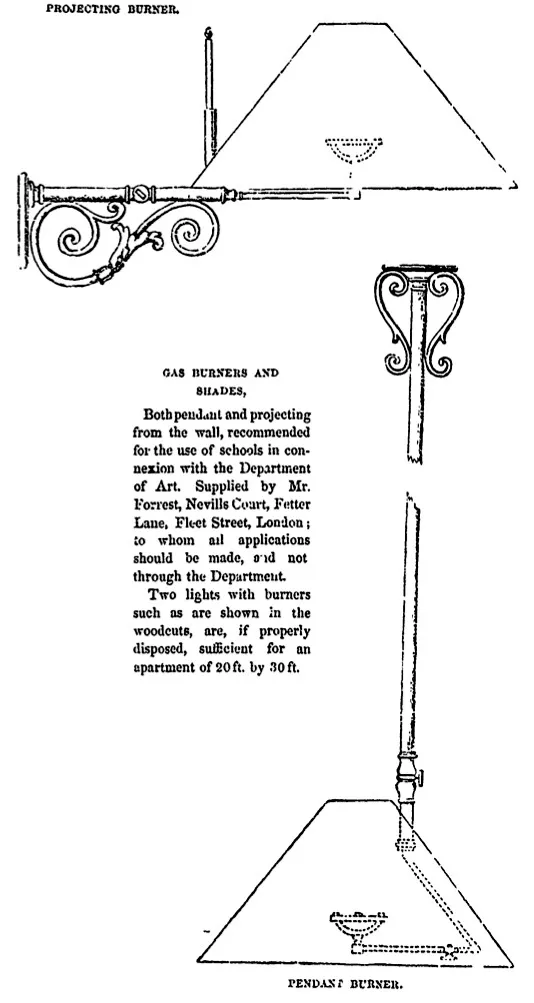
Gas Burners for Lighting Schools, First Report of the Department of Practical Art (London: printed by George E. Eyre and William Spottiswoode for Her Majesty’s Stationary Office, 1853), p. 70.
The division of space worked in symbiotic relation with the delineation of time into units identified with specific tasks. The laborious curriculum of the Schools of Design was subject to contemporary criticism; the most frequent target for the satirist was the length of time a student was expected to spend working on a drawing and the degree of precision and uniformity that was required. A drawing in black and while chalk by R.W. Herman exemplified the refined characteristics that were cultivated in students that progressed beyond the elementary linear drawing stages (plate 20). The reverse of the drawing is inscribed with the following: ‘obtained the first prize ever offered by the Government School of Design for drawing ornament from the cast’. In 1848 Herman was appointed to teach elementary freehand drawing as an Evening Master at the Head School at Somerset House, with the following endorsements:
He was one of the first students who entered the School of Design, of the advantages of which he has since largely availed himself, as proved by his having gained two of the chief prizes in ornament, and the the commendations bestowed on him by Mr. Redgrave and Mr. Horsley, and indeed by the committee also. Mr. Poynter, I believe, can speak highly of his qualifications in private teaching, in the duties of which he has for some time been largely and successfully engaged […] I have explained to him the duties that would be required of him; the teaching of free-hand drawing, and to make himself generally capable of affording hints on the capabilities of students for the higher school; and he promises the most thorough endeavours and zeal. I have a hearty confidence in his efficiency.
This confidence in his abilities continued: by 1863 Herman had risen to Deputy Headmaster of the National Art Training School at South Kensington, a direct descendant of the Government School of Design.

R.W. Herman, Study of Ornament from the Cast, black and white chalks on buff paper (1840), 43.8 x 66.7 cm, Victoria and Albert Museum [Museum Number E.1967-1909].
The repetitive hatching, shading and stumping arguably inculcated more than technical exactitude; moral training through the promotion of rigorous and patient study was allied with the qualities of truth, temperance and improvement. For example, in an ‘Address to the Working Classes’ by the Rev. J.S. Howson, Principal of the Liverpool Collegiate Institute, it was suggested that tuition in drawing, ‘encourages a habit of neatness and order. It gives them a taste for innocent amusement, and may be the means hereafter of keeping them from a great deal of harm’. This particular argument was perhaps used as a mechanism to distance the Schools from the practice of polite and leisurely tuition in sketching and painting. Furthermore, statements were often issued by the branch Schools of Design to remind prospective students of the length of time they should expect to study. The committee of the Leeds School also entered into this management of expectations, which was also addressed, albeit indirectly, to local manufacturers and the wider public:
It is too often found that Students enter a School of Design with the expectation of at once acquiring a knowledge of making Designs, and are disappointed on finding that a steady and persevering attention is requisite – that the prescribed rules must be strictly adhered to, and that to arrive at proficiency they must labour patiently and carefully.
Drawing in the Schools of Design, and later in the reconfigured Schools of Practical and Ornamental Art, was more closely associated with the disciplines of science and mathematics, although the separation between the spheres of the fine and mechanical, technical or applied arts was neither complete nor without tension. Looking back on the system he had adopted in 1852, Henry Cole reflected on the problems of the Schools of Design and concluded that, ‘many points needed solution before designs for manufactures could be improved by weary artizans, fagging at elementary drawing on winter evenings’. Young Mitchell sought to remind his students at the Sheffield School of Design of the mental discipline and serious, conscientious practice required by the course of study, positioned as an investment which would inevitably result in pecuniary benefits proportionate to their skill:
Drawing must not be regarded as a mere amusement, but as a severe study, dependent more upon the mind than the hand […] each hour spent here in careful study will do the work, and produce the wages of many in their future career. He who to the character of an expert workman shall add the reputation of a good draughtsman, will always find himself sought after and employed at a high rate of remuneration. Earnest and well directed labour is seldom unrewarded.
The precise relation between this system of education and subsequent employment is complex and difficult to ascertain. The demand from manufacturers for workers trained in the Schools of Design has been questioned, in part as a result of the additional costs that would be incurred through the employment of skilled labour. As part of wider reforms to the existing system of art and design education, Henry Cole recognised that there had been little incentive for manufacturers to employ operatives educated in the Schools of Design:
It might be asked, What part does the artizan act in the production of manufactures? and answered, Simply to perform, almost as a machine, what his employer directs him. Does his employer – the manufacturer – want the artizan’s greater education in art? Are the manufacturer’s commercial transactions hindered for want of the better art? Is he sensible of the want? Is he a competent judge of the better art if it were placed before him? As better art involves labour of a higher grade, and therefore increased cost, is he willing to embark increased capital in its production?
According to Cole, the answer to all these questions was negative without the incentive of consumer demand. The manufacturer was characterised as philistine, ignorant of correct taste and above all, motivated by profit. Although this perceived discontinuity between education and industry was accurate in some instances, there is some evidence to suggest that that the system did function as it was intended in particular, localised circumstances. It had been argued that the School of Design was an inappropriate institution for Leeds as the production of woollens and worsted was based upon utility rather than decoration, and as such, did not lend itself to the application of art in the same way as other more refined industries. However, looking beyond the dominant manufactures of the borough, instances of cooperation and mutual benefit that disrupt the notion that the school was entirely irrelevant to the local economy are revealed. For example, the minutes of the committee of the Leeds School of Design recorded the following:
Some of our leading Upholsterers and Paper Stainers have the strongest sense of the want there has hitherto been of any means for the study of Design on good and correct principles: and they will support the School in various ways, such as giving us patterns of French papers &c. for reference, telling us what they conceive to be wanted, and encouraging the young persons in their employment to study in the School. The help of such practical men will be valuable.
Of course it is possible that the collaboration between the school and the manufacturer was mediated by existing social relationships and interests. However, within two years of the establishment of the School of Design the Leeds Mercury reported that Trumble and Cooke, respected importers and manufacturers of wallpapers and regular donors to local exhibitions and conversazioni, were to take on a student from the Leeds School as an assistant designer:
It speaks well for the School of Design, that in so short a time as it has been open, young men are so far advanced as to be able to fill such situations as these; and it evinces a good feeling on the part of Messrs. Trumble and Cooke, as an appreciation of the School of Design from the proper quarter; for it must ever be borne in mind that the main and principal objects of these schools is to educate students in the sound principles and practices of art, so that they may become designers for the local manufacturers; and it is to be hoped the other manufacturers of this district will in like manner avail themselves of its benefits.
Most significantly, Trumble and Cooke were not simply a small regional concern; by 1859 their increasing reputation had led to an exclusive contract to manufacture the wallpaper designs of Owen Jones. Although this integration might be considered anomalous, in wider terms the training received by the student of the School of Design could also be considered as preparation for working within the capitalist mode of production in its broader sense by inculcating efficiency, discipline and servility. As Colin Trodd has argued:
Repetition within the temporal sequence, the reduction of the experience of education to the functional logic of work-time: this is the production of a narrative about time in which it is an infinity of separate yet repeatable moments. Within this discourse education becomes a process in which learning is identified with the specific culture of work; and the division of labour is mirrored by the division of time.
The principal agents in this hierarchy were the master, the pupil-teacher and the student. In addition, the objects of instruction might also be thought of as having their own particular agency; they were afforded their own place and privileges and their presence defined the space of learning. For example, when the plaster casts were exhibited to the public in the first conversazione of the Leeds School of Design, it was reported that their presence ‘gave a classic appearance to the room’. These objects were also subject to regulation. For instance, rule number eleven of the Leeds School of Design set out the relation between the student, their own materials and the property of the School:
Each Student, before leaving the School, will be required to remove his copy, block, stand, and drawing board to the place assigned for them. No Student to handle or misplace any of the casts or other examples; and any Student who in any way injures the property of the School, to be held responsible, and to pay for the damage.
The proper places assigned to the objects and instruments of the School of Design might also be said to have created a set of ritualised behaviours marking the beginning and the end of work-time. Stuart Macdonald has provided a description of the arrangements at Somerset House:
On entry the pupils went straight to their places with their drawing boards and paper, and then sat in rows behind the stands upon which their boards rested, while the master handed out diagrams of patterns or ornament on cards, or in books […] the pupils were not allowed to talk, nor to move about, nor to touch any casts, so even their concept of Round was Flat.
The notion of property in this respect is not straightforward: the student was required to supply their own drawing board and materials, but they were to be purchased from and stored within the School. Furthermore, the materials supplied by the Council at Somerset House remained under central ownership and the branch schools were merely the temporary custodians of the objects granted to them: ‘all supplies of Furniture, Books, and Examples of Ornamental Art, provided by Outfit Grant from the Council, are understood to be the property of the Council, entrusted to the local Committee for the use of the Schools’. As such, injury to this property would not be punished directly, but the School would not be remunerated for its loss.
In order to render the student obedient, a discrete disciplinary space was necessary to order the interactions between these agents. In the first years of its operation the Leeds School of Design employed only one art master to oversee the instruction of a single class at a time. Although the number of students in each class fluctuated considerably and was never as large as other provincial schools, the arrangement of the teaching space had to facilitate the maintenance of order and reinforce the hierarchical distinction between master and student. This was perhaps modelled upon the spatial division of the class at Somerset House, an illustration of which depicts the master seated high above the students working diligently on all sides under constant observation (plate 21).
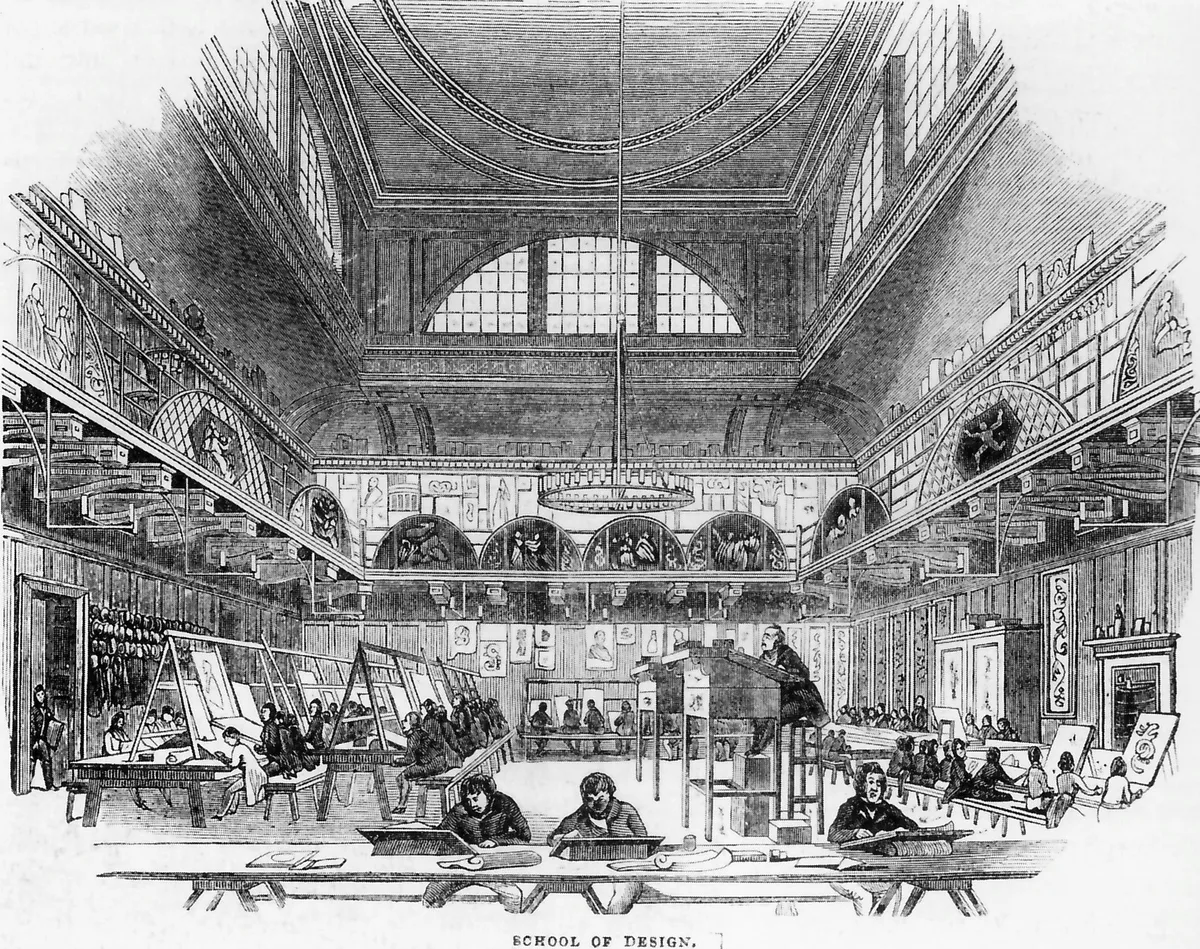
Anonymous, School of Design, wood engraving, Supplement to the Illustrated London News, vol. ii (27 May 1843), 12 x 15.8 cm, p. 375.
However, this representation must be considered as constructed for a particular purpose. It was in the interests of the School of Design to project an image of order and productivity during a period of intense scrutiny of its activities and social utility, especially in the justification of continued economic support from the state. Despite the mediations embedded in this illustration, there remains an important point to be drawn concerning the nature and effects of surveillance in the spaces of education. The effectiveness of this process did not rely upon covert operation as the hierarchy is deliberately transparent:
The exercise of discipline presupposes a mechanism that coerces by means of observation; an apparatus in which the techniques that make it possible to see induce effects of power, and in which, conversely, the means of coercion make those on whom that are applied clearly visible.
As such, the school acted as a ‘pedagogical machine’ in which the practice of surveillance was inherent to the procedure of teaching. As the remit of the Schools of Design was extended to the peripatetic teaching of elementary drawing in local state-sponsored elementary schools, the nature of observation shifted, becoming closer to the monitorial system of training, an intermediate class of pupil-teachers to which elements of the master’s responsibilities were delegated. The distinction between the supervisor and the supervised was replicated in the division of labour, particularly as part of mechanised factory production wherein the role of the overlooker became embedded in and essential to the system. These liminal positions between the master or employer and the student or operative arguably functioned as an economical means of extending discipline and encouraging self-censorship among the lowest strata, while providing them with the possibility of aspiration, self-improvement and limited social mobility, or as Rifin has articulated, ‘to offer a way of making the most of your place, rather than of leaving it’.
The construction of social stratification was also bolstered by the process and ritual of examinations, the results of which operated both on individual and institutional levels. For the provincial schools the number of candidates, their relative achievement and the level of examinations for which they submitted work determined the pecuniary support they received from the state. Edward Baines Junior, the President of the Leeds Mechanics’ Institution during the period in which the organisation offered a bid to host a School of Design, recognised the intimate connection between this financial transaction and the relations of power it created:
Where State money is granted, State control must necessarily exist. To suppose otherwise is a palpable delusion. The right of inspection, and the power of granting or withholding money on the report of the Inspector, are the best possible methods of controlling, because they give a moral certainty of obedience, without the unpleasant form of coercion!
Two modes of inspection operated in parallel: the work of the students was sent from the branch schools to London for examination by a small panel and the schools themselves were examined by a centrally appointed inspector who travelled across the country reporting on the quality of accommodation, the degree to which the master applied approved modes of instruction, regulated behaviour, attendance and the relative achievement of the students (plate 22). The authority of the central agency could be extended and reinforced by regularly shifting the parameters and characteristics of observation.
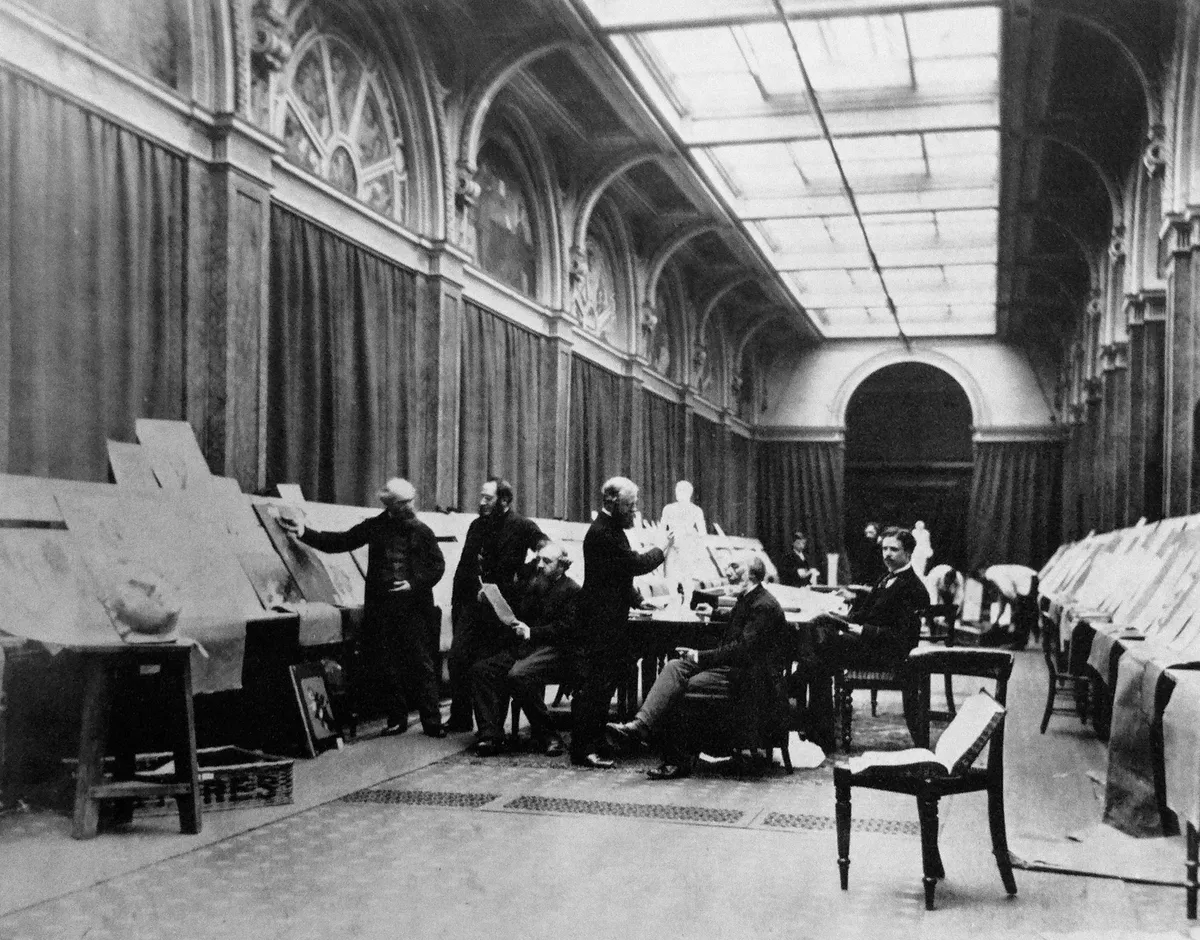
Anonymous, Students’ Work being Judged in the Present Room 101 of the Victoria and Albert Museum, photograph, (c. 1871), Victoria & Albert Museum. Plate 3a in F.H.W. Sheppard, ed., Survey of London: The Museums Area of South Kensington and Westminster, vol. 38 (London: Athlone, 1975), [no pagination].
Despite the imposition of more rigorous regulation and administration during the tenure of Henry Cole from 1852, the criteria to which work was examined was not subject to the empiricism that pervaded the new regime and remained largely a matter of subjective judgement. This process was again inflected with academic principles, as the examiners appointed in 1852 were all associated with the Royal Academy, as discussed in chapter one. The role of the Academician in the Schools of Ornamental Art was perhaps less discontinuous than in the formation of the Schools of Design because Cole had formally lifted the restrictions which had previously sought to prevent the admittance of students who were not intending to pursue a career in industrial design, instead advocating the view that art should be studied for its application to manufactures. This perspective had been articulated in the Reports of the Select Committee on Arts and Manufactures, in which Thomas Gretton identified the belief that, ‘art could be a special sort of factor in production, not a quality but a quotient with a price, entering the processes of adding value just like the cost of transport, or raw materials’. The diminishing contradictions between the systems of art and design education did not, however, simplify the process of judgement. The panel qualified their statements with a recourse to relativism:
On proceeding to examine the large number of works submitted to us, various causes appeared to us to interfere with a strict comparison of their merits. Firstly, The different character of the works themselves; Secondly, The different ages of the students by whom they were executed; Thirdly, The longer or shorter time during which the students may have been receiving instruction in the schools; Fourthly, The impossibility of ascertaining the amount of instruction which many may have received before entering the schools.
One of the only points of consensus that emerged was that the work of the students could only legitimately be compared with other work from the same school, so great was the variation of both quantity and quality across the branch institutions. However reasonable this rationale might have been, it undermined the process of moderation and standardised output by embedding differentiation into the system. In order to administer a rapidly expanding network of branch schools, it became necessary to modify and limit the practice of sending work to London for examination. The Leeds Mercury reported on the changes to the process examinational visits would now be made to the provincial schools under the following terms:
Quite recently the department has resolved on urging these examinational visits to a much greater degree of strictness of detail, in requiring each pupil to perform his work under the immediate eye of the inspector. He is thus able to judge with perfect certainty and accuracy as to the method of tuition pursued in each school, of the general progress of the pupils.
Subjecting the master and students to an additional layer of surveillance arguably consolidated the authority of the Department of Science and Art under which the schools were managed from 1853 onwards. Direct observation of the student at work marked a distinct move towards ranking the student and school by more precise increments and is perhaps indicative of the empirical aspirations of the Department. It has been argued that it was the visibility of power and hierarchy in the process of examination that determined its efficiency:
Clearly the student is a unit in a system where everything is subject to a process of measurement and examination. Here is a mode of classification based in the complete transparency of instruction, discipline and power. All tasks, actions and movements are monitored or regulated within a space where education is employment because knowledge is equated with the management of time.
The interdependent management of work-time and work-space operated beyond the system of art and design education and its discrete objectives. As students were required to declare their existing and intended employment on entry to the Schools of Design, it is possible to observe the variation of occupations and the shifts in the proportions of students from particular social backgrounds. Although, as with all statistical records, the information is not to be considered transparent or as necessarily representative of historical conditions, we can perhaps learn something of the discrepancies and discontinuities that had leaked into the system. For example, alongside the expected artisanal trades of carving, engraving and ornamental masonry, the figures for the occupations of the male students at the Leeds School of Design for 1848 and 1849 also show significant numbers employed in administrative, bureaucratic and white-collar positions such as clerks, land surveyors and medical students (appendix 1 and 2).
This table does not discriminate between the classes these student were enrolled in, making it difficult to determine the students who studied on day release from their employers from those who studied in a voluntary or supplementary capacity. Although these roles appear to have had only a tangential relation at best to the project of design reform, it is important to consider the wider significance of the structures and processes of education for industrialised society. The transmission of particular technical skills could be considered to some extent secondary to the perpetuation of a stratified labour force in support of the broader industrialised infrastructure. Writing in the late 1960s, the sociologist Geoffrey Bantock articulated the relationship between examination and the political economy of the nineteenth century:
the real proliferation of the examination system follows the gradual democratisation and the opening of careers to talents which accompanied the developing political emancipation of the nineteenth century; and this, in turn, was stimulated by the rapidly growing needs of a system of governmental and industrial organisation which required a large variety of expertise for its implementation.
There were concerns about the increase in occupations directly funded, and by extension controlled, by central government. Writing against this situation in relation to the extension of governmental involvement in elementary education, Edward Baines Junior argued that, ‘the proposed system would train the very children, from their earliest entrance into the school, to obsequious servility […] The very babe would become venal, – the very boy a parasite!’ In some respects Baines’ concerns were legitimate. As this form of art and design education became more established, the training of pupil-teachers and masters from the existing stock of students was formalised when what had been the Government School of Design in London was relocated to Marlborough House, leaving the remaining classes at Somerset House solely for the provision of teacher training. This internal replication bypassed the discontinuities that beset the early years of the Schools of Design, when art masters had been drawn largely from the alumni of the Royal Academy Schools and other similar institutions and dispatched to the provinces to ennoble the local population.
In summary, the shifting conditions of industrial production can be considered to have altered the structure and practice of education in relation to the organisation of space, time, knowledge and the physical body. However, to suggest that the Schools of Design were simply a product or reflection of industrialisation bypasses the complexity of both national and regional modes of production. Far from being a decisive transitional moment, Dror Wahrman has argued that, ‘the heuristic notion of an ‘industrial revolution’ is quite problematic’ and has suggested instead that this process took place over a much longer period of time than is generally accepted and was uneven in its progression and effects. Furthermore, the notion that industrialisation resulted in a clean dichotomy between a class of employers and of wage labourers has also been subject to revision: ‘the measures of middle-class structure obtained for Leeds in the 1830s show that only a minority, albeit a substantial minority were engaged in manufacturing production and that of this group a much smaller percentage employed large numbers of wage labourers’.
This assessment also leads us to reconsider the role of education in general and the Schools of Design in particular in the division of labour. Firstly, we might conclude that the students were drawn from more diverse occupations than the operative and artisanal archetypes; it might even be argued that the petit bourgeoisie dominated both the culture and composition of the schools. Secondly, that the Schools of Design did not necessarily function under the terms on which they were founded did not mean they were entirely dysfunctional: the division of time into productive units, the organisation of space around observation and hierarchy, the repetitive and exacting nature of the drawing tasks, the encouragement of competition between peers and the processes of examination and inspection served to socialise the student into a culture of work that privileged efficiency, self-discipline and servility.
The political and philosophical context of the Schools of Design has most often been discussed in relation to the utilitarian position adopted by Henry Cole in his reorganisation of the former Schools of Design after 1852, typified by statements such as: ‘Cole’s educational model of painstaking progression from the simple to the complex was a fairly straightforward application of the utilitarianism he derived from Mill and Jeremy Bentham’. The friendship between John Stuart Mill (1806-73) and Cole has also been noted. However, this narrative does not account for the influence of local agency in the formation of specific strategies for the education of the industrial artisan in art and design. In order to trace the system of values embedded in the Leeds School of Design, this discussion will consider the practical and theoretical positions of Edward Baines Junior (1800-1890) and Samuel Smiles (1812-1904).
The ‘Bainesocracy’ was used as a pejorative term to describe the collective dominance of the Baines family over the contemporary political discourse, particularly through their proprietorship of the Leeds Mercury (plate 23). Samuel Smiles moved to Leeds in 1838 to become the editor of the Leeds Times, a radical newspaper in competition with the Leeds Mercury. Rather than referencing his later and more famous work, Self-Help: With Ilustrations of Character and Conduct of 1859, it is more appropriate in this regional context to consider the precursor to this publication, which took the form of a lecture delivered to the Bradford United Reform Club at the Bradford Mechanics’ Institution on 14 February 1842, entitled The Diffusion of Political Knowledge among the Working Classes. Kenneth Fielden has argued that Smiles’ time in Leeds was particularly significant to the formation of his autodidactic philosophy:
Leeds gave Self-Help a great fillip, for although adult education had much middle-class leadership there was a good deal that was working-class, a spontaneous response to felt needs […] Although Self-Help sounds like a ‘fifties or ‘sixties doctrine, much of Smiles’s drive was from the Leeds of 1840.
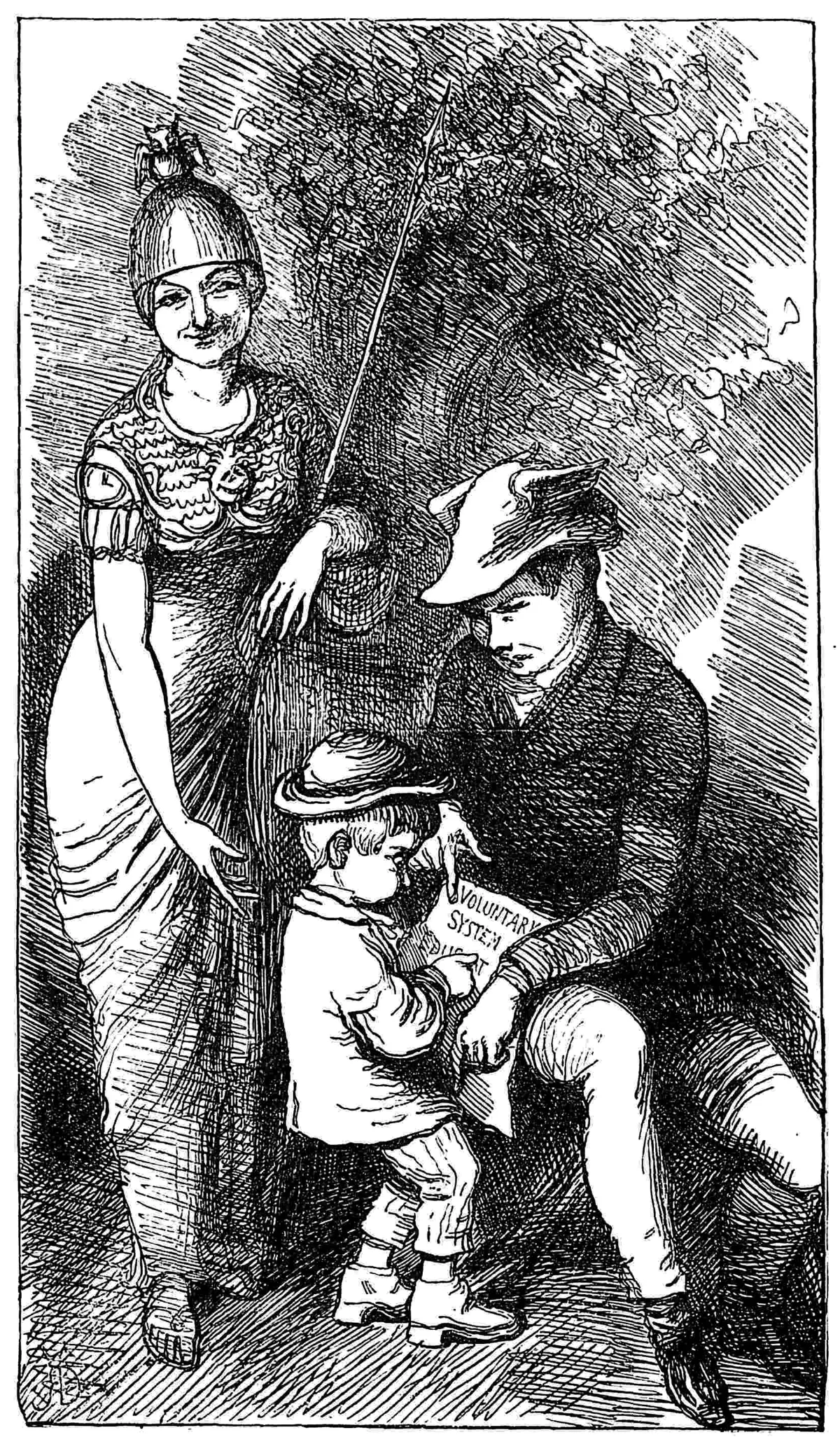
Anonymous, Baines, The Leeds Mercury, Instructing Young England, Afer CORREGGIO’S Picture of “Mercury Instructing Cupid in the Presence of Venus.”, wood engraving, Punch, vol. xii (22 May 1847), 17 x 9.8 cm, p. 210.
Baines and Smiles occupied different political territories, which shifted over time and in response to particular campaigns, although their respective positions intersected. For example, it has been argued that in their rejection of the principle of universal suffrage, ‘there was little to choose between the Smilesian Radicals and the Bainesocracy’. Moreover, the ideology of the voluntary society and ‘the Utopian dream of a wise and cultivated workforce’ provided common ground, which would be crucial to the development of art and design education in the borough.
In order to secure a grant from the government to establish a School of Design, an elected committee had to be formed to secure local subscriptions, arrange suitable accommodation and implement the directives of the central administration. In Leeds, this committee was composed entirely of existing members of the Mechanics’ Institution and Literary Society. As such, the School operated as a de facto extension of its existing educative activities and was considered from within the organisation as wholly consistent with its purpose to provide opportunities for self-improvement and advancement for the working classes. This social project has been characterised as inherently paternalistic in its attempt to impose the cultural values of the urban middle classes upon the working classes. Smiles lamented: ‘these institutions have generally failed to accomplish the objects for which they were established’. In his view the primary obstacle was the disparity between the objectives of the Institution and the composition of the membership:
In Leeds, containing a population of about 150,000 inhabitants, the average number of members during the last 10 years, has not been more than 250; of whom less than one-half have belonged to the working classes. At present, it is in contemplation to unite the Literary and Mechanics’ Institutions; and when this is accomplished, the Leeds Mechanics Institute may then be considered as a society of persons belonging to the middle classes.
As Smiles feared, the Leeds Mechanics’ Institution merged with the Leeds Literary Institution in 1842 to become the Leeds Mechanics’ Institution and Literary Society. Samuel Alberti has argued that the tacit function of the voluntary society was the construction and maintenance of middle class identity: ‘by avoiding religion and politics, as many of them did, philosophical societies served to provide an otherwise elusive coherence to the middle classes. Through voluntary associations, they asserted their presence, their taste and their authority in contrast with both the uncouth lower orders and the decadent aristocracy’. As part of this collective project, education was afforded an exalted status, offering transformative possibilities for the individual and for society, as Smiles described: ‘our desire is so to elevate the moral and intellectual condition of the mass, as to fit every individual member of society for the performance of his duties as a social and intelligent being’. In one of several papers read before the Leeds Philosophical and Literary Society, Baines offered the following assessment of the importance of education:
It has been truly said, that man is the creature of education. Although no artificial means can add to the number either of his intellectual or corporeal faculties, yet both allow wonderfully different degrees of improvement in their nature & skill in their employment. The mind, in particular, may be so far contracted by ignorance, so far enlarged & exalted by knowledge, that experience only would enable us to recognize, in two individuals who display its greatest diversity, creatures of the same species & of equal native powers.
In addition to a base level of innate intelligence, Baines also proposed other conditions necessary for both individual and social advancement, in part based upon observations made concerning the perceived pre-eminence of ancient Athenian art, science and judicial structures, with the implicit intention of attempting to replicate these conditions. Economic prosperity was one condition that Baines could claim for Leeds when he suggested that, ‘literature & science cannot flourish in any country, till a considerable proportion of the population of the inhabitants have acquired affluence, & can enjoy leisure’. This was in accordance with the assertion that wages in the manufacturing districts were higher than in other areas of the country, as woollen manufacture had not been subject to the same levels of mechanisation as other industries, including the production of cotton. Baines estimated the average weekly wage in this sphere at 12s. 6d. although the age, gender and particular role of the worker altered this figure considerably.
Connected to the notion that economic prosperity could foster cultural and intellectual progress was the belief in the capacity of competition to drive advancement at every level from the individual to the nation state. Baines partially attributed the success of the ancient Athenians to the ways in which competition permeated daily life in the struggle to attain and maintain citizenship and he particularly emphasised the beneficial effect upon the arts: ‘competition furnishes the greatest stimulus to excellence of almost every kind: to this, more than to any thing else, is the world indebted for all the works of art and the
productions of talent’. It was arguably the same rationale that led to the formation of the Schools of Design, with the negative premise that British production compared unfavourably with its continental equivalent: ‘many varieties of our national manufactures are actually suffering from competition with the foreigner, or are debarred from entering into competition with him, simply by our inferiority in that art of design, cultivated with such assiduous care and considerable success by other countries’. The assumption that this situation violated the natural order of nations was deeply entrenched, as the master of the Sheffield School of Design, Young Mitchell, articulated: ‘the sense of any inferiority sits uneasily on an Englishman’.
This continuous scrutiny and reflexive assessment also operated on a local level; the motivation for establishing new educational institutions could often be traced to the activities of other urban centres and the pragmatics of intercity competition. That Leeds had failed to secure a grant to establish a School of Design before Manchester, York, Sheffield and Birmingham was a source of real civic embarrassment. In addition, the individual student was subject to comparable competitive forces: belief in the virtue of competition was certainly perpetuated in the Schools of Design through the practice of awarding prizes and scholarships to students and their associated institutions as part of the process of inspection and examination.
In contrast, Smiles advocated collaboration: ‘the first great test of a civilized being is, in that he is able to co-operate or combine with others, for the purpose of obtaining some object which is desirable alike to all’. Moreover, collaboration was not to be bound by the distinctions of social status: ‘there should be cordial union and co-operation between the middle and working classes […] Let us sink all considerations of class and caste’.
In addition to economic prosperity and competition, Baines also specified the optimum political conditions necessary for progress: ‘nothing, so much as Liberty, promotes the intellectual advancement, the mental vigour, the virtue, the bravery, the wealth, & the power of nations’. The meaning of liberty in this context might be thought of as somewhat fluid, encapsulating a range of positions and interests. Baines most often deployed this terms in relation to individual, religious or regional self-determination in resistance to what was perceived as undue interference by the state. Self-governance in matters of education and religion was particularly preferable because it allowed for regional particularities and nimble adaptation to advancing social and technological circumstances.
However, Baines perceived constant threats to his conception of liberty in the form of national initiatives and standardised procedures: ‘in the matter of education, as of government, liberty is subject to irregularities, which are an eye-sore to the martinets of despotism, as well as to men who have imbibed from Continental examples the doctrinaire love of uniformity and centralization’. Smiles concurred with this position:
a Government, no matter how good, can do little or nothing towards making the idle and slovenly industrious, the improvident careful, the drunken sober, the lewd virtuous. No! These are reforms which must spring form the people themselves […] it is sheer folly to look to government for that which we have the means of doing for ourselves. Far more is always to be done by awakening and exciting the spirit of the people, than by the means of the tardy and extorted acts of the legislature […] if we leave it to a central government to decide what shall be the education of the people, we virtually give that government the power of directing public opinion, of stereotyping the national intellect, and of maintaining in the minds of the masses, certain determinate forms of thought, which may contain in them the germs of even the vilest forms of political and religious slavery.
In this respect it is particularly surprising that Baines was instrumental in securing a government grant towards the establishment of the Leeds School of Design, a system which was characterised by the state interference that Baines had so forcefully objected to in 1843. Central funding was increasingly sought by voluntary societies and used to advance agendas that were not necessarily officially sanctioned. What was advocated in opposition to standardising, monolithic national structures was self-governance or ‘voluntaryism’, which was allied with civic responsibility, correct moral behaviour and rational judgement. Baines made a case for this system with the following statement:
The advantages of self-government are so generally admitted, that all the modern reforms have been designed to make it more absolute. Not that self-government, either in a nation or a municipality, is a faultless system, but that on the whole it is incomparably the best system, because under it lives the ennobling spirit of Liberty. It has taught the people to look less to their governors, and more to themselves. It has given them the invaluable habit of self-reliance.
The tension between the prestige of state sponsorship and submission to a set of prescribed rules and regulations was expressed in a letter to the Leeds Inteligencer from a father of two former students of the Leeds School of Design, a Mr. Carbutt. He attempted to reconcile centralised subsidies for casts and teaching examples by claiming that the original works from which they were reproduced were public property and as such, should rightfully be distributed for the benefit of those who had collectively purchased them. In contrast, it was not thought legitimate to allow any other financial aid with the exception of local fees and subscriptions to support the schools. The writer of the letter expressed a very similar sentiment to Baines when he described, ‘the vicious principle which, as I think, underlies all governmental attempts to direct the training of the rising generation […] it is a disgrace to the Schools of Design that they should be dependent on Government aid for their existence’.
However, the basis upon which the state supported the branch schools underwent significant changes only five years after the establishment of the Leeds School of Design, which introduced the rhetoric of self-governance if not the practice. In a speech delivered at the Leeds School of Practical Art, J.C. Robinson articulated the new direction of the Department:
It will remain for localities and parties interested to take the initiative in all endeavours to extend the study of drawing, trusting at the same time that an energetic spirit of self-dependence will be manifested in every neighbourhood, which, whilst adopting the system promulgated by authority, and securing in the outset those aids and appliances which can only be obtained by the Government, will yet with wise and enlightened policy, from the first, resolve to make the continuance and development of the study matter of local concern only.
With the exception of the mandatory extension of elementary drawing into state-sponsored elementary schools, it might be argued that regional schools continued to operate in much the same manner as they always had, that is, by appeasing the central agency while perusing their own discrete socio-economic and cultural agendas. As part of the reformatory process implemented between 1852 and 1853, Henry Cole calculated the cost to the state of art education in Leeds as 10l. 11s. 2d. per student, per year. This figure was the highest in the country as a result of low numbers of students, low fees and diminishing local subsidies.
The situation was deemed untenable. Instead of encouraging the attendance of the working classes, the affordability of the schools had resulted in a higher proportion of more affluent students and as Cole argued, ‘no one values what may be had for nothing, especially those who can afford to pay’. However in contrast to the previous regime, Cole sought to encourage the presence of ‘all classes’ under the conviction that it was both more efficient and more effective to educate consumers rather than producers:
The School of Design had been founded expressly with the commercial object of improving the patterns of manufactures. It sought to do this by affording education in art to artizans only. From time to time attempts had been made, in various ways, to limit the education to that class of the community; but these attempts to circumscribe the action of the schools, arising upon a mistaken and imperfect view of the work to be done, did not succeed.
This seemingly inclusive approach to recruitment was also used to justify the incremental reduction of the grants that schools had previously been entitled to, working on the assumption that the local committees would use this limited deregulation to increase their income from higher fees. The new Department of Science and Art aimed to make the branch schools entirely self-supporting and predicted that ‘the motive power will thus be local and voluntary’ and would be wholly dependent upon ‘the local intelligence and energy of the inhabitants’.
However, this is not to suggest that these reforms were intended to entirely decentralise the existing system. In many respects overall control was retained and even extended as it operated under the guise of benign support and advice willingly sought:
The schools in this country, like other provincial institutions, could probably be conducted much better by local authorities than by any central system; and the management of them for the future should be placed as much as possible under the control of the localities themselves, which would soon find it their interest voluntarily to seek connexion with the central authority, for the appointment of masters, selection of examples, advice in management, lectures, and for higher instruction which the peculiar circumstances of the Metropolis enable it to supply.
In practice the relation between the centre and the periphery operated on a ‘mixed principle’ of private and public, voluntary initiatives and prescriptive order. Devolving the management and administration of regional schools brought the network closer to the model of a franchise; the central agency were absolved of financial responsibility while their control over the curriculum increased. Although the composition of local committees varied, it was the existing voluntary societies that mediated this process. Their association with centralised authority was to some extent discontinuous with the protectionism demonstrated in other spheres: ‘the voluntary society was by definition independent of the state. It has been identified from many different points of view as an ideal means for non-violent changes in social practice and the distribution of power’.
For the Mechanics’ Institution, the addition of a School of Design to their existing series of day and evening classes was both a pragmatic and an ideological manoeuvre, calculated to stabilise their local and national standing and secure continued support from the political, commercial and intellectual elite of the region. That the object of the Institution was deemed most consistent with that of the Schools of Design also provided an opportunity to extend the education of the wider public through lectures and exhibitions. These didactic provisions also functioned to consolidate the social identities of the members and subscribers, as Morris has suggested:
These societies provided two things that were crucial to middle-class formation. They began the task of building that unquestioned sense of being right and of not only having superior cultural and social values but of having the right and the duty to bring those values to others less fortunate. This was not the philanthropy of guilt as some have suggested for later in the nineteenth century but the philanthropy of confidence.
The extent to which philanthropic rhetoric translated into practice has been contested and the extents to which social mobility was encouraged and realised is particularly difficult to determine. The principle of self-improvement was deeply embedded in the voluntary society, although the middle classes were perhaps more interested in maintaining their differentiated position than inviting the lower orders to join them.
Morris has argued that the voluntary society provided a means through which the elite could maintain a distanced proximity to the proletariat in order to retain and extend their influence over them. Smiles identified an awareness and dissatisfaction with this situation among the working classes:
there is something about the management of these institutions which is by no means agreeable to the operative classes generally. They are supported mainly by patronage, and conducted by patronage also. Now, the intelligent portion of the working classes at the present day, hate patronage of any kind. They are in love with self-government and self-governing institutions.
Further complications arise in attempting to determine the demographic of the School of Design as the statistics published by the Mechanics’ Institution recorded only the current occupation of the students, many of which appear not to have come from the wage labouring and operative classes that had been the intended recipients of this particular type of education (appendix 1 and 2). Morris has speculated that in this context, ‘it was realistic for a tradesman or artisan to envisage moving into small business. The commercial bias of the subjects taught by the Institute suggest that many moved into white-collar jobs: confidential clerks, accountants, draughtsmen or supervisors’.
However, the degree of movement between social classes was perhaps more nuanced than the language of the voluntary society would imply. The composition of the executive committee, general membership and subscribers might be considered to have been both narrow and diverse. The parties involved were largely self-selecting and informed by a similar set of principles concerning the diffusion of knowledge. However, in order to maintain this internal cohesion, the Institution also had to serve as a mechanism for unifying external social, religious and political disparities, recognising ‘neither sect nor party in the commonwealth of letters’.
The arguments for voluntaryism in Leeds were characterised by the polemical pronouncements of Edward Baines Junior and Samuel Smiles. Although both presented a forceful defence of the precept and practice of self-governance, the extension of the state and local eagerness for its resources resulted in an uneasy amalgam in the School of Design. The plaster casts, publications and furnishings were received with gratitude, although the regulations, curriculum and system of inspections that accompanied them were not. As we have seen, these standardising strategies were subject to subversion in Leeds and other branch Schools of Design. The Council of the Schools of Design, and later the Department of Science and Art, adopted a different tactic to bring parity to the national network of schools, sending their own ideologues to propagate the approved tenets of the centre to the periphery.
As has been demonstrated, the voluntary society provided a locus for the negotiation of art and design education in Leeds. In addition to the dissemination of pedagogic objects, national and local priorities were also circulated through lecture series and visiting speakers. Three of the most significant figures to the practice and pedagogy of art and design education visited Leeds during the period in question: Benjamin Robert Haydon in 1838, Ralph Nicholson Wornum between 1849 and 1852 and John Charles Robinson in 1853.
Haydon began his career as a peripatetic lecturer at the London Mechanics’ Institution in 1835, with a series of talks chaired by George Birkbeck (1776-1841). As a response to the perceived failure of the Select Committee on Arts and Manufactures to undermine the monopoly enjoyed by the Royal Academy and establish a viable and differentiated mode of design education, Haydon extended his activities as a lobbyist by setting out on a national tour in support of his own theoretical and practical position:
While [William] Dyce had been touring the Continent assimilating German and French design training, Benjamin Haydon was touring Britain expounding the merits of an art education for artisans. He dined with wealthy manufacturers and lectured to mechanics, speeding by rail from city to city.
Between 5 and 18 February 1838 Haydon delivered a course of six lectures to the Leeds Philosophical and Literary Society. His first impressions of the town were not favourable: ‘After the spirit of London and Manchester, Leeds seems stupid. Nous verrons [we will see]’. The next day, having delivered a lecture the previous evening, Haydon’s assessment of the town had not improved: ‘they seem High-Church and bigoted. I was asked after if I meant to attack the Church, because I said the Reformation had ruined High Art’. However, by the time Haydon left Leeds for Manchester, he described having ‘met a kind reception and great enthusiasm’.
Haydon returned to ‘dear old steady Leeds’ ten months later, between 1 and 19 November 1838, to deliver the same course of lectures to the Leeds Literary Institution. The advertisement in the local periodical press ran as follows: ‘Illustrated by Sketches made at the Time by the highly gifted Artist, with the anatomical Precision and exquisite Truth of Touch for which he is so famous’. The lectures were to take place in the ‘Large Room’ of the Commercial Buildings, situated in the Mill Hill ward at the intersection of Park Row and Boar Lane (plate 24). Built between 1826 and 1829 during a period of particular prosperity, the exceptional cost of the Commercial Buildings had been met by a private joint-stock company. The opulent interior contained the following facilities:
On the ground floor was a large circular vestibule which served as the merchants’ exchange […] In addition to providing a new home for the Commercial News Room the premises contained a coffee room, a restaurant, a concert room/meeting hall, offices for solicitors and brokers and the West Riding Insurance Company, a committee room, and a fourteen-bedroom hotel.
Plate 24
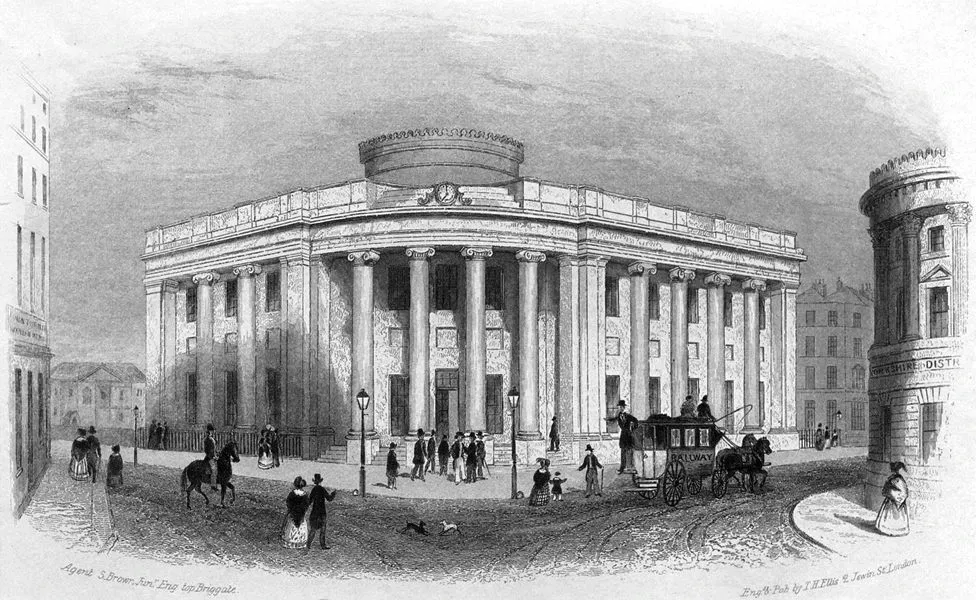
T.H. Ellis, Commercial Buildings Leeds, steel engraving (c. 1855), 10 x 16.5 cm, private collection.
Haydon returned to Leeds to repeat the course of Lectures for the Philosophical and Literary Society from 10 December 1838. This visit also received a brief but favourable review: ‘This eloquent lecturer has given his lectures on Art and Design to numerous and increasing audiences both at the hall of the Philosophical Society and before the Literary Institution. The lectures have been received with great favour and applause’. Stuart Macdonald has described the effect of his impassioned polemic:
Haydon fired his audiences with enthusiasm for art and for the setting up of provincial schools with the figure as the basis of study, maintaining that the human figure is the supreme work of design and form. He stressed that, after following a freehand course which included life drawing, some artisans could choose to be designers, others to be painters or sculptors.
Although the lectures delivered by Haydon in Leeds throughout 1838 appear to have been well received by the voluntary societies they were addressed to, they did not inspire corresponding action, as had been the case in Manchester during the previous year.
In contrast, the lecture series delivered in Leeds by Ralph Nicholson Wornum between 1849 and 1852 was sanctioned by the central authority. In his capacity as Lecturer on the History, Principles and Practice of Ornamental Art at Somerset House, Wornum began a course of sixteen instalments with two lectures on the ornamental art of Ancient Egypt at the prestigious Hall of the Leeds Stock Exchange on 29 March and 13 April 1849 (plates 25 and 26). The Committee of the Leeds School of Design ordered 800 tickets to be printed, with 300 sent ‘to the Donors and Subscribers, the principal Gentry, and parties connected in any way with the Art of Design’. Three rows of seats were reserved for pupils of the Leeds School and some of their drawings were exhibited. Wornum returned to Leeds to deliver two more lectures, the first on Greek and Roman ornamental art and the second on Early Christian and Byzantine art, in July 1849.
Plate 25
Anonymous, The Leeds Stock Exchange, wood engraving (c. 1870), Leeds Library and Information Services [T/LIP/Denby/3].
Plate 26
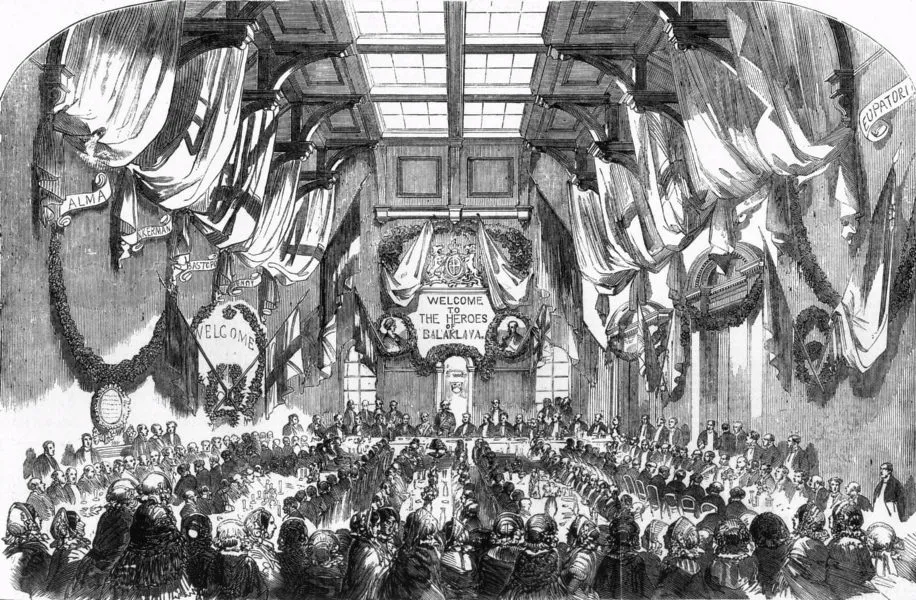
Anonymous, Banquet and Presentation of a Sword to the Earl of Cardigan, in the Hal of the Stock Exchange, Leeds, wood engraving, Supplement to the Ilustrated London News, vol. xxix (13 September 1856), 15.5 x 23.5 cm, p. 279.
The Leeds Mercury reported the objective of these lectures as: ‘to show the necessity of a knowledge of the history of art for the purposes of variety and originality in design’. To reinforce this point, visual evidence was provided to the audience in the form of ‘numerous beautiful engravings and diagrams’. It is possible that the first four lectures had not attracted as large an audience as had been anticipated, as the subsequent venue was the modest lecture theatre at the Mechanics’ Institution and tickets were issued free of charge to ‘friends of the school [of design]’. Wornum came back to Leeds to give two more lectures on the 8 and 10 May 1850, on stained glass and Renaissance ornament respectively. In contrast to the previous events, these lectures were described as being principally for students of the Leeds School of Design, with a limited number of tickets available to the public. Perhaps as a consequence, the Leeds Mercury reported that, ‘the room was filled, and the audience obviously took a deep interest in the subject’. The following year, on the 15 and 17 April 1851, Wornum’s lectures on ‘Details of Form’ and ‘Harmonies of Colour’ were even more specifically directed towards the students, having been held across the road from the Mechanics’ Institution at the Leeds School of Design on East Parade.
Stuart Macdonald has suggested that Wornum’s lectures were used strategically by the Newcastle School of Design under William Bell Scott, as a means of appeasing the central administration:
The Committee of Management in London could hardly approve a subsidy for the pursuit of fine art by ladies and gentlemen, and the Board of Trade withheld the grant for 1849. This was renewed the following year, partly as a result of a petition to Lord Granville, and partly because the committee of the School invited R.N. Wornum of the central School to give one of his rather unwanted lectures on historic ornament, thus demonstrating a slight leaning towards ornamental design.
It is possible that the Leeds School, also keen to secure continued annual bursaries from the state, engaged Wornum to fortify their credentials and deflect criticism. The intentions of the Leeds School are difficult to determine through the archive, although it might be significant that when inspected by Ambrose Poynter in October 1849, the Committee of the Leeds School made specific reference to the series of talks, having spoken ‘of Mr. Wornum’s lectures, and of their anticipation of another visit from him, in terms of great satisfaction’. However, Macdonald’s argument that Wornum’s lectures were used only as a pragmatic device at the Newcastle School does not take into account the relationship between Bell Scott and Wornum, who is referred to in the autobiographical notes of the former as ‘my old dear friend’. Furthermore, Bell Scott wrote that the they had ‘met every Saturday for eighteen months to draw from the life for an hour and a half’ and that he considered Wornum to be ‘possessed of great knowledge of art and its history, acquired both from extensive reading and from long residence in Germany and Italy’. This commentary does not necessarily suggest that Wornum would have been perceived as an appropriate candidate to direct an institution away from the fine arts.
Wornum appears to have concluded his series with four further lectures in Leeds in 1852. This programme of study was later formalised as Analysis of Ornament: The Characteristics of Styles: An Introduction to the Study of The History of Ornamental Art, which was published in 1856 and described as ‘adequately illustrated by the few engraved cuts contained in the work, which have been chiefly executed from casts in the collections of the Department, by the female students of the Wood-engraving Class at Marlborough House’ (plate 27). The book was divided into the following chronological categories: ‘The Ancient Styles’ of Egyptian, Greek, Roman; the ‘Medieval Styles’: of Byzantine, Saracenic and Gothic and ‘The Modern Styles’ of the French and Italian Renaissance, Cinquecento and Louis Quatorze. Following a Vasarian trajectory which offered the Cinquecento as the pinnacle of artistic achievement, Wornum described its antithesis in the decline and decadence of ‘the absurd Rococo […] the last of the nine lives of ornamental art’.
The final member of the triumvirate, John Charles Robinson, was dispatched to Leeds in May 1853 in his new capacity as Teachers’ Training Master. This position had been constructed as a means of communicating the ideological and logistical changes to the curriculum of the former Schools of Design under the new Department of Science and Art led by Henry Cole and Richard Redgrave. Stuart Macdonald summarised the duties of this post:
firstly, to visit the National and Public Elementary Day Schools to instruct teachers in Elementary Drawing; secondly to supervise instruction given in the London schools by masters-in-training of the Department; and thirdly, to prepare teaching manuals and drawing examples for copying.
The alterations to the mode of instruction were communicated both in theory and in practice. It was recorded that, ‘Mr. Robinson attended the School and offered a practical demonstration of the mode of elementary teaching proposed by giving a lesson to a class from the Day School of the Leeds Mechanics’ Institution’. As part of the same visit, Robinson also delivered a lecture at the School of Design ‘on Drawing, as an Essential Branch of Popular Education’, which was advertised in the Leeds Mercury in the following terms:
Plate 27
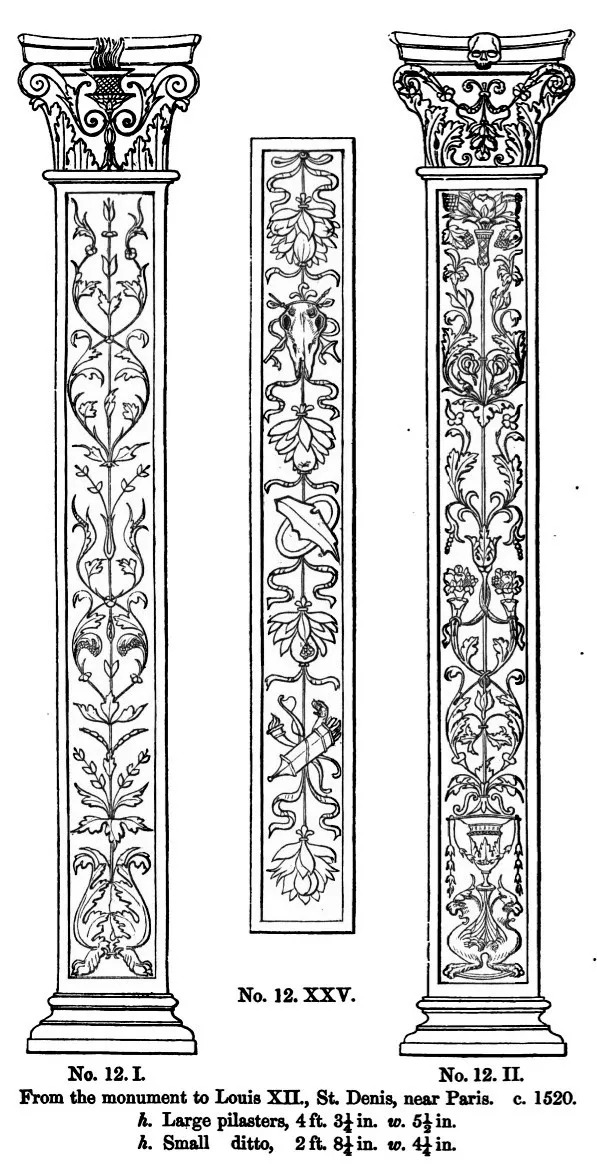
A Female Student of the Wood Engraving Class at Marlborough House, From the Monument to Louis XII, St. Denis, near Paris. c. 1520, wood engraving from Analysis of Ornament: The Characteristics of Styles: An Introduction to the Study of The History of Ornamental Art by Ralph Nicholson Wornum (London: Chapman and Hall, 1856), 18.5 x 10.5 cm, p. 103.
Mr. Robinson will explain and exemplify the plan of elementary instruction in drawing proposed to be given to children in public school, and the facilities now offered for the purpose, in connexion with the Leeds School of Design. The attendance of the clergy, and also of schoolmasters, teachers, and ladies and gentlemen interested in education, is invited.
Despite the invitation extended to interested parties, it was reported that ‘the attendance was not numerous’. As part of the lecture, Robinson addressed the structural deficiencies of the Schools of Design, which he damned with faint praise:
He did not admit that Schools of Design had been such great failures, but argued that they had accomplished more than could have been expected from them. He contended that drawing should have been as universally taught as reading, writing, and grammar, and the end of that would have been to predispose the faculties for art.
Robinson was appointed Superintendent of Art Collections in August 1853 and paradoxically it was though this position, based at the Museum of Ornamental Art at Marlborough House in London, that Robinson could claim to have had greater influence in the regions, principally through the Circulating Collection or ‘Travelling Museum’ discussed in chapter four.
In summary, instruction in art and design in mid nineteenth-century Leeds was informed by the developing industrial character of the borough and its attendant social formations. The Leeds Mechanics’ Institution and its progeny, the School of Design, were the locus for the negotiation of national and regional interests. The Leeds School of Design did engage with local manufacturers on a limited scale, although the ordering of knowledge, behaviour and the regulation of aspiration was arguably more useful to industry than the creation of a surplus of skilled designers expecting proportionate remuneration. The ways in which design education, industry and voluntaryism informed the concurrent development of an exhibitionary culture in Leeds will form the principal focus of the next chapter.
This chapter will analyse the intersection between the spaces of culture and commerce in mid-nineteenth century Leeds, principally through the mechanism of appropriating and repurposing existing spaces of economic and social exchange for temporary public exhibitions. Through the polytechnic public exhibitions of 1839-1845, the regular programme of soirées and conversazioni staged by the Mechanics’ Institution and the exhibitions associated with the Leeds School of Design, it is possible to overlay the production of space, meaning and knowledge with the production and consumption of commodities, which brought the characteristics of the museum and the market into close proximity and held them in productive tension.
In order to set the particular cultural geography of Leeds in context, it will be important to consider the wider conditions that determined the spatial organisation of the urban environment during this period. The most significant was the development and proliferation of industrialised production, which Doreen Massey has characterised as a fundamental shift in the labour process with associated ‘geographical implications’. A decade earlier, Henri Lefebvre had argued that these shifts in the nature of production had distinct social and spatial consequences: ‘the passage from one mode of production to another is of the highest theoretical importance for our purposes, for it results from contradictions in the social relations of production which cannot fail to leave their mark on space and indeed to revolutionize it’. Industrialisation has traditionally been linked to the trajectory of the middle classes, as Simon Gunn has articulated: ‘it was capitalism which brought an urban middle class of merchants, industrialists and allied professionals into being, and this class, in turn, acted as the principal agent of subsequent capitalist development’.
If the composition and interactions of and between publics partially defined the public exhibition, soirée and conversazione, the spaces of these encounters ordered their experience. The spaces under consideration are both external and internal, encompassing the urban sphere and its architectural language alongside the particular configuration of the exhibitions. Underpinning this analysis is Lefebvre’s conception of social space, as an inherently relational construction with ideological and epistemological implications. For Lefebvre, social space does not embody the opposition between the objective and the subjective. Rather, it is seen as a product of ‘the dialectical relationship which exists within the triad of the perceived, the conceived, and the lived’. As such, space is considered to be determined and deterministic, constructed and reconstructed by differentiated social agents:
Every space is already in place before the appearance in it of actors; these actors are collective as well as individual subjects inasmuch as the individuals are always members of groups or classes seeking to appropriate the space in question. The pre-existence of space conditions the subject’s presence, action and discourse, his competence and performance; yet the subject’s presence, action and discourse, at the same time as they presuppose this space, also negate it.
A point of rupture in relation to the consolidation of class identity and the urban environment has also been attributed to the First Reform Act of 1832, which resulted in the creation of two parliamentary seats for the Borough of Leeds. The Reform Act reorganised the urban geography of industrialised centres and according to R.J. Morris, ‘recreated Leeds as a legally defined socio-geographic unit of power’. The political reconstruction of Leeds contributed additional layers to what was already a dense matrix of spatial and architectural signs which acted as the locus of an exchange moving in two directions: both a product of, and influence upon social activity. As Doreen Massey has argued, ‘to say that space is relational means both that it should not be conceptualised as some absolute (that is to say, pre-existing) dimension and also that it is actually constructed out of, is a product of, the relations between social phenomena’.
Although Leeds would not be endowed with the status of a city until 1893, by the mid-nineteenth century the town could legitimately be described as a major urban centre. It has been noted that by 1775, Leeds was already the seventh largest town in the country, rising to fifth by 1851. For Lefebvre, the significance of these expanding urban spaces was in their capacity to assemble and accumulate ‘crowds, products in the markets, acts and symbols’. The same qualities could be applied equally to the public exhibition, which will be discussed through specific case studies further into this chapter.
Nineteenth-century Leeds was both architecturally and economically built upon eighteenth-century foundations; over half the houses in the borough had been constructed between 1780 and 1801, the majority of which were located in the rapidly expanding central wards within approximately four square miles. The borough was divided into twelve wards, eight of which were located in the central urban township (plate 28). The central ward of Mill Hill was the primary locus of civic, cultural and commercial activity in the borough, with the Coloured or Mixed Cloth Hall, Court House, Commercial Rooms and Mill Hill Chapel situated at the intersection of Boar Lane and Park Row. The Philosophical Hall was built in the middle of Park Row and the adjacent South and East Parades contained the Hall of the Mechanics’ Institution and the School of Design respectively. Running parallel to Park Row was Albion Street, the eastern boundary of the Mill Hill ward along which were the Albion Street Music Hall and the Leeds Stock Exchange. R.J. Morris has described the significance of this area through its ‘concentration of those forms of economic power which were central to middle class control, namely finance, marketing, distribution and the authority of the legal profession’.
Plate 28
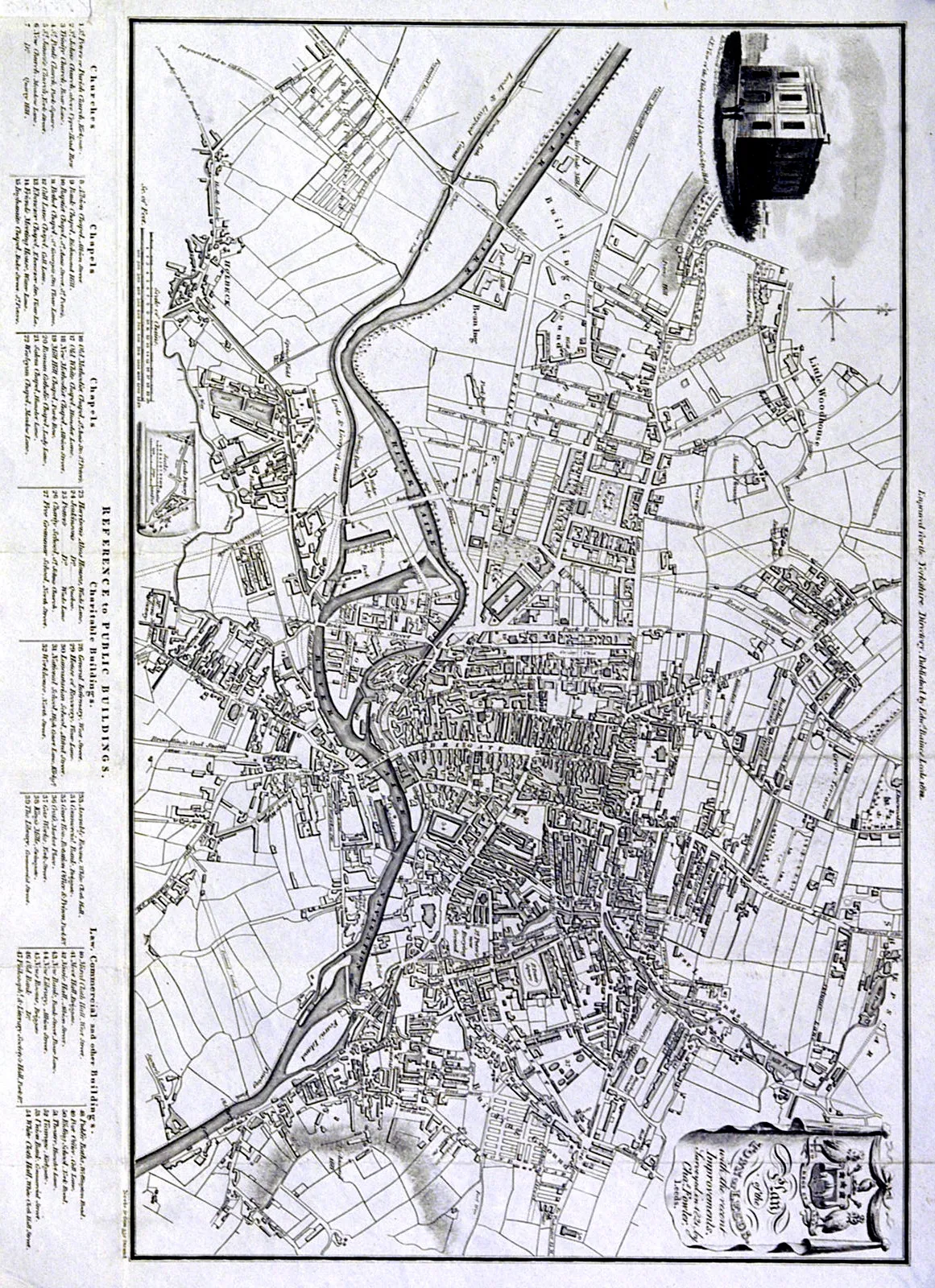
Charles Fowler, Plan of the Town of Leeds, with the Recent Improvements, copper engraving by Neele and Son (1821), 20 x 31 cm, published in The History, Directory, and Gazetteer of the County of York (Leeds: Edward Baines, 1822). The vignette on the left is the Philosophical Hall designed by Richard Dennis Chantrell (1793-1872) and erected in 1821.
That these professions and institutions continue to dominate Park Row and the surrounding area is an indication of the potency of this nineteenth-century spatial organisation.
The urban centre of Leeds had become a contested space by the mid-nineteenth century. What had been constructed as an affluent rural periphery around Park Square during the eighteenth century, had been subsumed by the urban industrial centre by the nineteenth. The factories around Wellington Street to the west, the densely populated ward of Kirkgate to the east and the heavy industry south of the River Aire had been associated with outbreaks of cholera and other contagious diseases in an influential report by Robert Baker published in 1842. Baker mapped these outbreaks against the areas populated by the working classes and the ‘less cleaned districts’ and noted a strong correlation between poverty, industry and disease (plate 29). The encroachment of Mill Hill resulted in the migration of the wealthiest inhabitants towards the Woodhouse area to the north, which left the Georgian houses around Park Square available for occupation by the middle classes. Baker summarised the social geography of Leeds in the starkest of terms:
by drawing a line through the centre of the map from north to south, the deaths in proportion to population on the east side of the map were, in 1839, as 1 to every 24; while on the other hand, in those parts of the town where the streets are spacious and wide, and the drainage sufficient, the deaths were only 1 to 36; both ratios being exceedingly high, but the difference remarkable.
Plate 29

Robert Baker, Sanitary Map of the Town of Leeds, lithograph by Stephen Sly (1842), British Library [G.13877-80].
Mill Hill was firmly situated on the western side of this axis, although the proximity of industry, disease and developments of dense housing for the working classes left these boundaries more permeable than this polarity suggested. The empirical impulse to map these rapidly shifting urban spaces has been noted by Simon Gunn:
From the 1830s cities like London, Paris and Manchester were increasingly subjected to mapping exercises, statistical surveys and other forms of information-gathering; for the first time the city became the object as well as the locus of knowledge. The result was to promote a conception of urban space as abstract, transparent and uniform, and hence amenable to various kinds of administrative and moral intervention from above.
However, these attempts to construct positivist knowledge from which policy could be formulated and enacted could be disrupted by the recalcitrant subjectivity of its inhabitants, as Gunn also argued: ‘the rational, abstract mapping of the city and its spaces always co-existed with other popular, lived, and potentially subversive, geographies’. It is thus the task of this chapter to map this social production of space through three case studies related to the Leeds School of Design and its associated public activities.
The spaces of culture and commerce in Leeds were strategically appropriated for temporary public exhibitions to harness their signifiers of intellectual and economic prosperity. Public exhibitions were an intrinsic component of the didactic programme of the Leeds School of Design between 1847 and 1857. This study will argue that these displays of the teaching collection, local manufactures, student work and donated objects were informed by a series of temporary exhibitions staged by the Leeds Mechanics’ Institution in 1839, 1843 and 1845. The Leeds Public Exhibition of Works of Art, Science, Natural History, and Manufacturing Skill took place between the 9 July and the 5 October 1839 at the Albion Street Music Hall (plate 30). This merits investigation both as a discrete event, a template for subsequent exhibitions and as a product of a wider set of socio-political and economic conditions, which allow for the exploration of the intersections between art and industry, taste and morality, commerce and culture, civic identity and social space.
The existing scholarship on the Leeds Public Exhibition of 1839 has taken the form of cursory references in journal articles and fleeting appearances in edited volumes. Articles by R.J. Morris and Toshio Kusamitsu have made brief references to the exhibition alongside what they have posited as comparable polytechnic displays in Manchester, Birmingham, Newcastle and Sheffield, which have themselves been figured as a set of generalised regional precedents of the Great Exhibition of 1851. The construction of this lineage, although recognising the significance of cultural manoeuvres taking place outside the capital, has to some degree obscured the specificity of the 1839 Exhibition. Caroline Arscott has offered the most sustained critical and contextualised analysis of this event, which also includes the subsequent exhibitions of 1843 and 1845. However, as with the account of the 1843 Exhibition by James Lomax, there has been a tendency to oscillate between conflating this set of three exhibitions and regarding them as singular and particular occurrences. Although there are legitimate and interesting comparisons to be drawn, it is this latter approach that will enable a more comprehensive archaeology of the Exhibition of 1839.
Plate 30
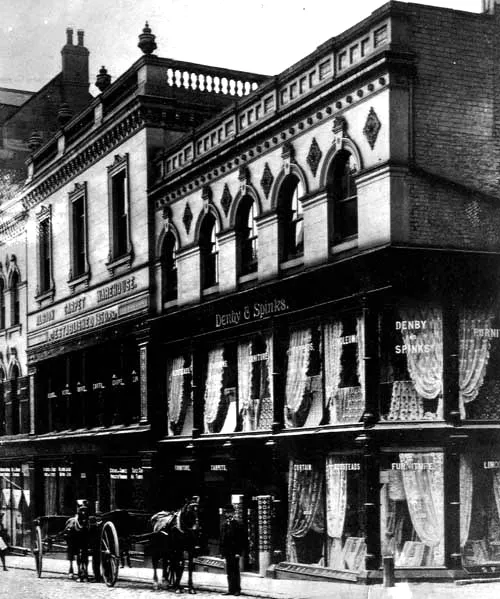
Anonymous, The Former Albion Street Music Hal, photograph (c. 1900), Leeds Library and Information Services [LEO 257].
The primary physical and textual material that has come to stand for the Leeds Public Exhibition are a catalogue of its contents, a descriptive guide to its objects and the contemporary coverage in the local periodical press. The descriptive guide was serialised in the Leeds Mercury newspaper during the run of the Exhibition and the publication was heavily advertised as both an educative tool and an object of posterity. The introduction to the guide set out its intentions:
It is hoped that unavoidably imperfect as they are, the descriptions will be a help to those who are desirous of deriving profit as well as intelligent pleasure from the objects displayed. They may afford information which few perhaps would otherwise obtain, and give a meaning to the articles of which they might otherwise be in great measure destitute. And long after the present Exhibition shall have been closed, and its contents again dispersed, these memoranda may retain an agreeable memorial to the visit to it, and an useful hand-book for future reference on various occasions.
The persistence of these particular traces in the archive reveals their dominance of the statement; they continue to represent a carefully controlled and official testimony which leads us to consider the weight of what is absent or silent in the historical record. Furthermore, the shared interests held by the publishers, the exhibition committee, those who lent objects and those who ultimately benefited from the profit made by the exhibition are significant: in some cases they are even the same individuals in different guises. For example, Edward Baines Junior was at once the editor of the Leeds Mercury, the vice-president of the Leeds Mechanics’ Institution, for whom the proceeds of the Exhibition were to fund the purchase of new premises, a donor of objects and the co-author of the descriptive guide to the Exhibition. Although Baines was to some extent exceptional in the level of his public activity, this interpenetration was present at varying degrees throughout the organisational structure.
The extent to which we can know the objects of the exhibition above descriptive textual accounts continues to be largely determined by authorship, as defined by the maker, lender or sitter. For example, the canonical paintings are relatively easily traced, especially in the instances where they have remained in the same private collections or entered public museums and galleries. The Picture Gallery of the Music Hall contained some of the most highly regarded paintings, including works attributed to Rubens, Rembrandt, Caravaggio, Correggio, van Dyck and Poussin (plate 31). For example, the descriptive guide noted that:
Plate 31
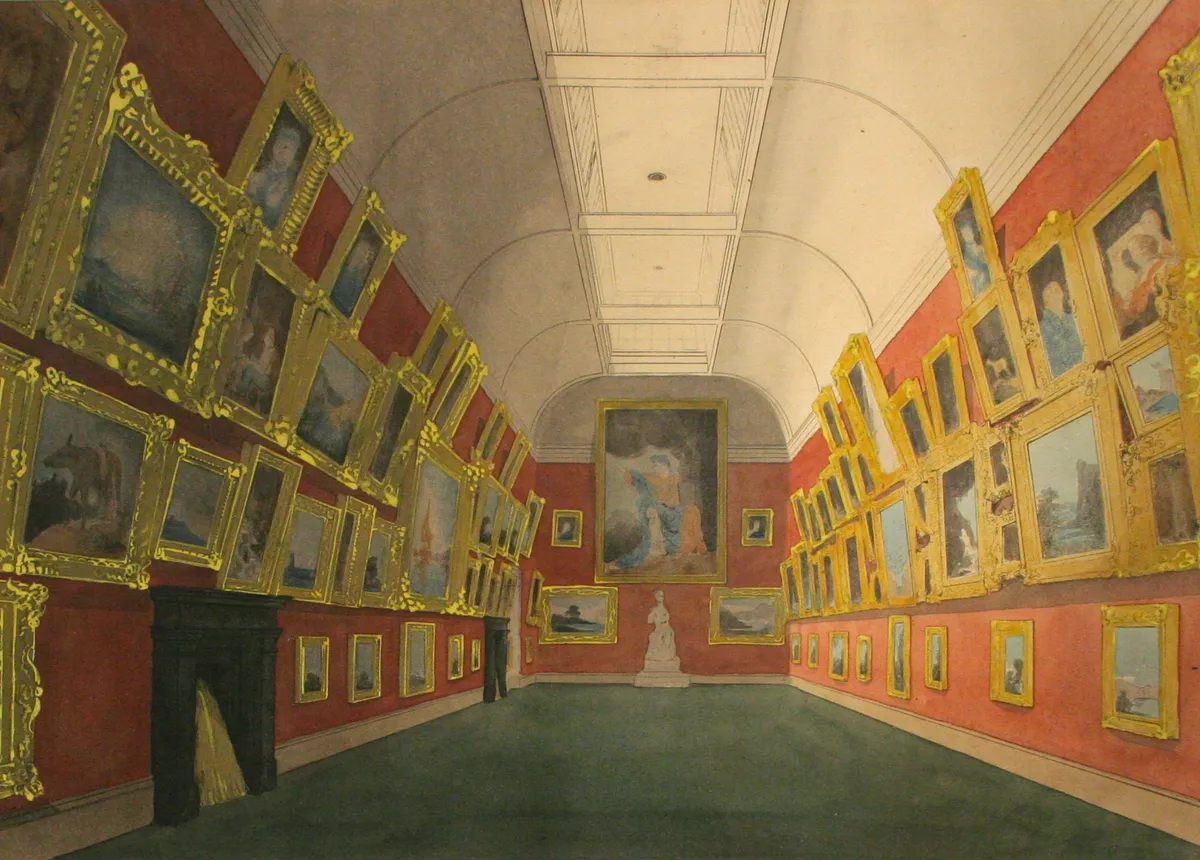
Joseph Rhodes, Old Music Hall in Albion St. Leeds (North Ante-Room) in 1839, watercolour on paper (1839), 45 x 35.5 cm, Leeds Museums and Galleries [LEEDM.E.1984.0086.0038].
Her Majesty the Queen has been graciously pleased to lend a small but faithful full-length portrait of herself, by Hayter. One gentleman, Francis Hawksworth Fawkes, Esq. Of Farnley hall, has lent upwards of fifty pictures to the Exhibition, including his entire series of water-colour drawings by Turner, forty in number – a unique and most valuable collection, besides the Fairfaxiana and other interesting curiosities.
Fawkes’ inherited collection of Fairfaxiana relating to the English Civil War is particularly well documented, as J.M.W. Turner had been commissioned to illustrate a selection of the objects displayed at Farnley Hall. The catalogue of the exhibition records instances where both the object and its respective watercolour were displayed, perhaps indicating a distinction between the instructive potential of the real and the representation or reproduction. Representational objects were generally preferred as both the subject and means of execution could provide both practical and moral instruction. The educative value of painting was reinforced by the descriptive companion to the Exhibition, which reflected the prevailing belief that the imitation of works considered to display correct and true principles represented the most desirable and appropriate method of training for both the artist and the wider public. Even Turner was subject to criticism in relation to what was regarded as an uneven approach to the truth of nature:
The earlier works of Turner are superior to the later, the artist having unaccountably fallen into an unnatural and meretricious gaudiness of colouring […] Turner’s drawings are singularly true to nature in all its moods and appearances, and their combined brilliance and chasteness charm the eye.
Another prolific lender to the exhibition was George Lane Fox of Bramham, an estate to the northeast of Leeds. Lane Fox is listed as having lent The Death of Germanicus by Nicholas Poussin, a work now held by the Minneapolis Institute of Arts. However, the provenance of what is thought to be the authentic work does not match the biography of the work lent to the exhibition, perhaps leading us to question the attribution of the painting displayed in Leeds. However, this disparity would not have undermined the didactic use value of the work, in the same way that the plaster cast did not rely on notions of authenticity to be an effective instrument of knowledge for art and design education.
Further complications arise in the identification of works as the medium is not specified in the catalogue and the titles were subject to degrees of variation. The catalogue lists a work by William Hogarth (1697-1764) with the title Scene in Covent Garden, Morning, displayed on Side C of the Ante-Room, which corresponds with the series The Four Times of the Day, painted in 1736 and published as four engravings in 1738. Although the catalogue lists this work with the other paintings displayed in this space, there is again a disparity between the record and the provenance of the object. At the time of the exhibition, the original painting was owned by Sir William Heathcote (1801-1881) and displayed at Hursley House in Hampshire, whereas the catalogue lists the donor of the work as ‘H. Hearon, Fulford’, which suggests that the work on display was an engraving or a copy of the painting by another unnamed artist. The point here is not that the catalogue was a disingenuous record of the contents of the exhibition, but that the distance between the description and the object was not as crucial to the curators or the audience in this nineteenth-century context as the instructive potential of the object was not dependent upon its originality, authenticity or singularity. This was also the intellectual climate that informed the use and reception of the teaching collection of the Leeds School of Design from 1846.
The philosophical, chemical and electrical apparatus displayed at the Exhibition would now be defined as more generalised scientific or technical instruments, although they represented distinct forms of knowledge and technology during the nineteenth century. However, the visual and sensory delineation between the arts and the sciences was perhaps less sharply defined, as Arscott has suggested, ‘it should not be thought that the art was pleasant or dazzling while the science provided the instruction. Science was presented in as spectacular way as possible’. Philosophical Apparatus included telescopes, orreries, surveying instruments and compasses. The majority of these objects were to be found on the central tables in the Picture Gallery although the Oxy-Hydrogen Microscope was presented on its own in the Tuning Room and demonstrated at regular intervals.
Slide preparations were used with the Microscope showing: ‘insects, leaves, and other objects, among the most minute which the glass can reach, and also among the most wonderful and beautiful in their conformation, as well as living animalculæ in the most rapid motion, are shown prodigiously magnified’. According to Altick this technology, ‘contributed little to material progress but was well suited for show business’. From the available descriptions, it appears that the Saloon was the site of some of the more miraculous and spectacular aspects of the Exhibition; ‘the Saloon or Concert-room, resounds with the noise of engines, machines, and scientific processes’.
Many of the experiments seem to have been conceived for performative and participatory as well as scientific interest. For example, balloons were used to demonstrate the relative densities of air and gas: ‘those exhibited are formed of animal membrane […] some are globular, others in the form of a fish. While new they ascend readily when filled with coal gas. One may frequently be seen floating near the ceiling of the Saloon’. The Electrical Apparatus on display was similarly theatrical, promising, ‘Electric Shocks at intervals’ and ‘a Thunder House, for illustrating the effects of electricity upon conductors to buildings, showing what would take place if struck by lightning when such a conductor was broken or damaged’. The exhibition of science, technology and engineering continued through the Leeds School of Design and the display of stereoscopes and photographic apparatus became a particularly notable feature, which will be discussed as part of chapter four.
If the identity of the objects of the Exhibition can be partially recovered through the catalogue, representing the space of the Exhibition relies largely upon contemporary descriptions and comparison with similar polytechnic displays. As the architectural vehicle for the Exhibition, the Albion Street Music Hall cannot be considered an ideologically neutral space and brief historical description of the building is necessary to understand the ways in which it constructed meaning. The Music Hall was built between 1792 and 1794, closed in 1870, acquired by the furnishers Denby and Spinks in 1876 and was finally demolished in 1973. In a contemporary description, Edward Parsons detailed its various uses:
The ground floor was for some years occupied as a hall for woollen manufacturers, especially for blankets, and afforded accommodation to those clothiers who were excluded from the Cloth Halls. It received, and for some time retained, the ignominious appellation of Tom Paine’s Hall. It is now appropriated to other purposes. The Leeds Concerts have long been conducted with great spirit and considerable success; the hall however has frequently witnessed exhibitions of a far more impressive character than its musical assemblies; it has often formed the scene in which the claims of the noblest institutions of British Christianity and benevolence have been presented to the consideration and the ever ready liberality of the inhabitants of the town.
As this quotation illustrates, the Music Hall was a site of overlapping and interpenetrating layers of architectural, commercial, cultural and religious meaning. Perhaps the most significant precedent for the Leeds Public Exhibition was set by the Northern Society for the Encouragement of the Fine Arts, who held an annual exhibition at the Music Hall between 1808 and 1833 in a set of three interconnecting rooms on the first floor. Although broadly comparable polytechnic exhibitions had been staged in Birmingham and Manchester in 1838, it has been argued that the exhibitions of painting held by the Northern Society provided a model that was more specific to the locality:
Although modelled on successful exhibitions held the previous summer in Manchester by the Chamber of Commerce, and in Birmingham, it had its roots in the traditions of Leeds life. The exhibitions of the Northern Society for the Encouragement of the Fine Arts, 1808-1833, had prepared the middle class for the appreciation of many of the works of art on loan to the Exhibition from the large town and country houses of the area.
The polytechnic exhibition became increasingly established as a form of knowledge production and distribution in the early nineteenth century. In addition to the regional precursors of the Leeds Exhibition, there are comparisons to be drawn with the more permanent institutions established in London. The National Gallery of Practical Science, also known as the Adelaide Gallery, was established in 1831 and the Polytechnic Institution in 1838 (plates 32 and 33). Although further research would be required to determine the extent to which the organisers of the Leeds Public Exhibition were aware of and influenced by these activities in the capital, there are compelling similarities between the range of objects displayed, their perceived pedagogic value and their arrangement in space. Caroline
Arscott has suggested a visit to London was made as part of the preparations for the Exhibition, although the details are not specific: ‘on at least one occasion a member of the organising committee made a special trip to London to solicit contributions, and met with some success’. One reference is made in the coverage of the Exhibition in the Leeds Mercury relating to one of several popular demonstrations: ‘in London, we believe the mice in the Adelaide Gallery appear to suffer considerably; but if this be so, it must be from a defect in the Diving Bell or the manner of using it’. This live experiment, along with others scheduled according to a timetable of events, took place in a large model canal in the Saloon of the Music Hall, which was also a central feature of the Adelaide Gallery.
Recalling the performances given by the Italian violinist Paganini on the 17th and 18th of January 1832, the musician George Haddock described the internal space of the Music Hall:
The Music Hall itself was unpretentious in the way of architecture, the entrance being in Albion Street. This opened into a moderately-sized vestibule, with a flight of broad stone steps on either side leading into the concert-room entrances. The hall itself, simple in decoration, was furnished with rows of seats, with a fixed platform of two or three tiers at one end and a small gallery at the other. From the roof, slightly arched, hung a number of chandeliers suspended by long chains, each chandelier containing 20 or 30 wax candles, by which means the hall was lighted. The body of the hall would seat about 700 or 800, and the gallery possibly 150 more. A very comfortable artists’ room and a tuning room for the orchestra had an entrance at the side of the building.
Plate 32
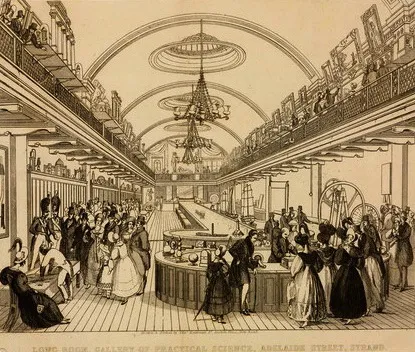
Thomas Kearnan, The Long Room, National Galery of Practical Science, etching (c. 1840), Science Museum [Image Number 10418520].
Plate 33
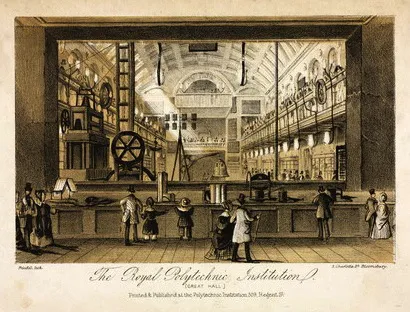
Adam Friedel, The Great Hal of the Royal Polytechnic Institution, lithograph (c. 1838), Science Museum [Image Number 10421179].
The way in which the visitor to the Exhibition traversed this space was tightly controlled and highly prescriptive. It was noted in the Leeds Mercury that, ‘the arrangements for preserving order are good, and have proved very effectual during the fair days. One of the regulations, which is needful to prevent confusion, is that the visitors shall move onwards through the suite of rooms, and not turn back from one room to another’. This single route of circulation was also reinforced through the Catalogue of the Exhibition, which gave the order of the rooms and also in some cases, the order in which the walls, display cases and individual objects should be viewed.
The behaviour and appearance of the working class exhibition visitor to the Leeds Public Exhibition of 1839 was frequently the subject of discussion in the periodical press, as Kate Hill had also found in her research on the commentary associated with Sheffield, which constructed an opposition between ‘respectable and rough’. The respectability of female working class visitors was specifically remarked upon: ‘on Thursday a large party of young women who were employed by the Mayor of Leeds, and whose appearance was very respectable, visited the Exhibition, a holiday and tickets having been given them by the gentleman’. The Mayor, James Holdforth, was also the owner of silk spinning factories in Leeds and the Chairman of the Committee who organised the Exhibition. Holdforth, in common with other employers of wage labourers, was also responsible for issuing his ‘principal men and mechanics’ with season tickets.
During the last month of the Exhibition, free or discounted admission was also granted to other groups. It was reported that, ‘during the past week the soldiers from the barracks, and the children from the Lancastrian and National schools have been admitted at stated periods, gratuitously’. This distinction between those provided with season tickets to visit the Exhibition at their leisure and those issued with a specific time to attend perhaps indicates a variation in the levels of access granted to a working class public that was no less stratified than other social groups. The Exhibition remained open until ten o’clock in the evening in order to allow the working classes to visit outside their working hours. As such, the time of day determined both the physical and ideological proximity to the objects: ‘from about the middle of each day the scene is very animated, but in the evenings – between the hours of seven and ten, the rooms (especially the Saloon) are [so] crowded that they would be almost unbearable’. So to be a working class visitor to the Leeds Public Exhibition was to be both part of and subject to the crowd.
The third and final polytechnic exhibition was held in 1845 with the ostensible intention of raising funds for the provision of public walks and baths, rather than for the direct pecuniary benefit of the Mechanics’ Institution. In addition to their general importance, these exhibitions constructed a context for the subsequent activities of the Leeds School of Design, which was supported and administrated by much the same group of voluntary agents. The display of contemporary and historical manufactures, antiquities and fine art, emerging technologies and the raw materials necessary for the production of commodities informed the content and economic imperatives of the exhibitions staged by and in association with the School of Design.
The soirée and the conversazione were social occasions organised by and for the political, economic and cultural elite, which included the Mayor, Members of Parliament, religious leaders, visiting luminaries and the ‘principal families of the borough’. Having taken the Chair at the conversazione held on 19 November 1855 to open a major exhibition at the Leeds School of Practical Art, the Reverend Walter Farquhar Hook (1798-1875) gently sent up the continental pretensions associated with the forms of interaction that had become embedded in the social practice of the voluntary society:
Ladies and Gentlemen, we are called upon to hold a Conversazione. Not being learned in Italian, I don’t know what a Conversazione is. But of this I am sure, it is not a soirée; for if the definition of a soirée given by great authority be correct, namely, boiled leg of mutton and trimmings – (laughter) – then this is not a soirée. This Conversazione, then, is very like what our Anglo-Saxon ancestors used to call a meeting. (Hear, hear).
The conversazione was differentiated from the soirée on several interconnected levels. Conversazioni were held in the Hall of the Mechanics’ Institution or the rooms of the School of Design, whereas the soirée appropriated the spaces of rational recreation such as the Albion Street Music Hall. The conversazione was a discursive form of social interaction, where exhibitions of work by the students of the School of Design were displayed alongside examples from the teaching collection and other local donations used to generate discussion or provide evidence for the arguments presented to those in attendance. The conversazione was also used as lobbying and fundraising mechanism, most often to appeal for subscriptions. This function was noted by the Committee of the Leeds Mechanics’ Institution and Literary Society after the Leeds School of Design had been operational for nine months:
The Committee find that in many towns it has been customary to hold Conversaziones [sic] in connection with the Schools of Design and they find that they are reported to have been very successful in attracting attention and support to the Institution. They therefore recommend that the experiment should be tried in Leeds, and that advantage should be taken of the occasion to solicit those who may be present to become Annual Subscribers. They suggest that on the occasion of the Conversazione the room should be furnished with pictures of first rate excellence, a few choice works of vertu and art and various specimens of the local Manufactures to which the application of Design is indispensable.
A connection has clearly been drawn between the success of this enterprise and the display of objects associated with the School of Design. Although no visual records of these events in Leeds have survived in the archive, two photographs taken at the Exeter School of Art in 1857 provide some indication of their content and arrangement (plates 34 and 35). It was initially suggested that the School would host four conversazioni each year, ‘to display the best specimens of the local manufacture, and also to lay before the visiters [sic] works on ornament, pictures, prints, and the best drawings of the pupils for matter of discussion and amusement’. The first conversazione took place on 8 October 1847 and although it was followed by further events, they appear to have been held annually rather than quarterly.
The decision to hold a conversazione often coincided with the need to raise additional funds with some urgency. For example in October 1850 the Committee of the Leeds School of Design recommended that a conversazione be held in advance of a canvass for subscriptions to liquidate a debt of £200 owed by the Institution. A conversazione was hastily arranged to take place in November 1850, ‘which was attended by upwards of a hundred persons, including many of the most influential and respectable of our townspeople’. The strategy proved moderately successful in that £100 was raised.
Plate 34
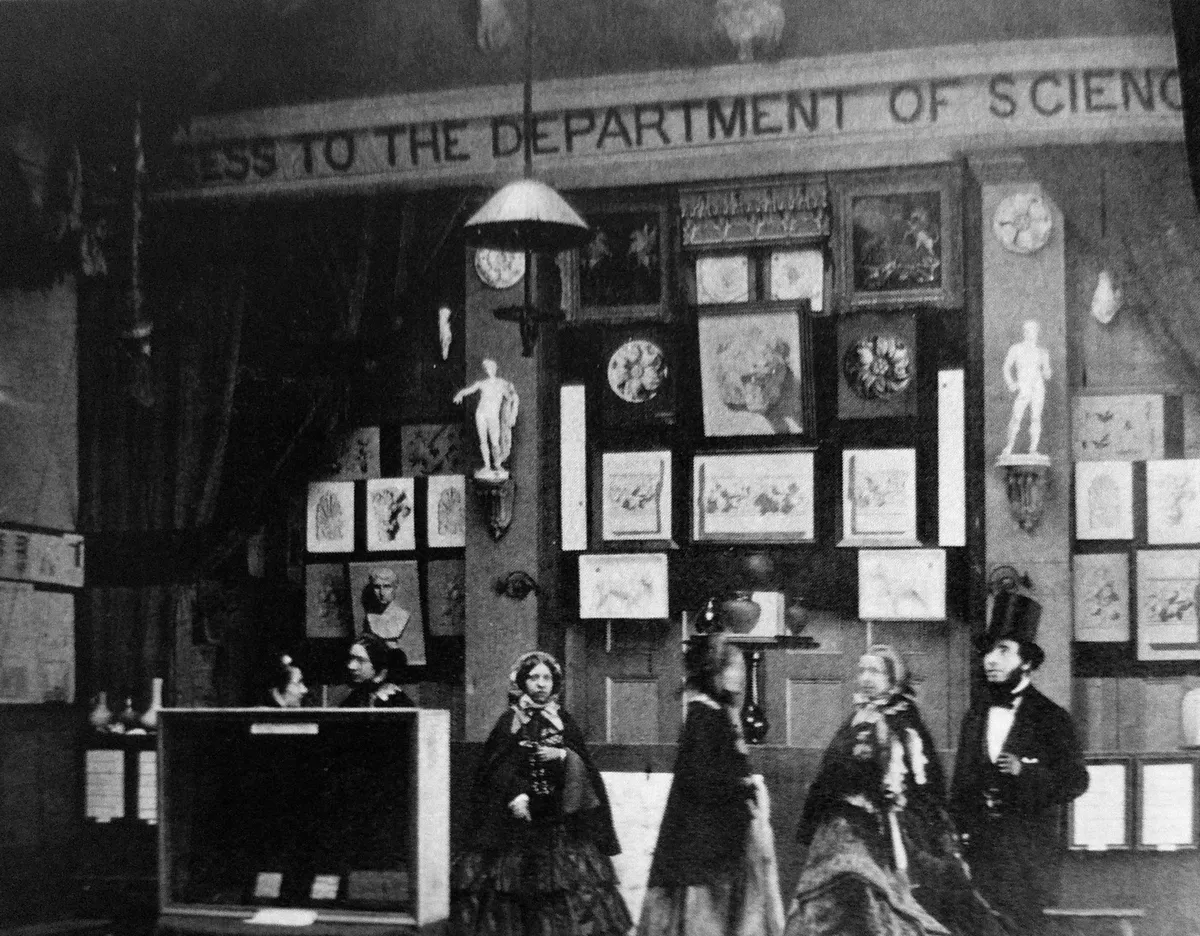
Anonymous, Exeter School of Art Exhibition, albumen print, (1857), Victoria and Albert Museum. Illustration 160 in Anthony J. Hamber, “A Higher Branch of the Art”: Photographing the Fine Arts in England, 1839-1880 (Amsterdam: Gordon & Breach, 1996), p. 270.
Plate 35

Anonymous, Exeter School of Art Exhibition, albumen print (1857), Plymouth University.
In contrast the soirée was a celebratory occasion that made strategic use of visiting guest speakers and external venues, to which a broader public were invited to purchase tickets. The services of Charles Dickens were secured for a ‘Grand Soirée of the Mechanics’ Institution’ on 1 December 1847 and it was reported that ‘no friend to education and popular improvement could have wished for a greater treat’. Dickens spoke of his support for the objectives of the Institution and specifically praised their establishment of a School of Design and the extent of the library’s collection. In 1852 the guest of honour was the former whig prime minister Lord John Russell (1792-1878), whose presence at the Soirée of the Leeds Mechanics’ Institution and Literary Society at the Albion Street Music Hall was represented by an engraving in the Ilustrated London News (plate 36).
Plate 36

Anonymous, Lord John Russel at the Soirée of the Leeds Mechanics’ Institution and Literary Society, wood engraving, Ilustrated London News, vol. xxi (18 December 1852), 15 x 23.5 cm, p. 544.
The inclusivity implied by the public nature of these activities disguised what might be considered a much more complex and differentiated set of relations. This disingenuous use, negatively defining that which is public as that which is not private, has been discussed as a reductive and generalised distinction by Jürgen Habermas:
We call events and occasions “public” when they are open to all, in contrast to closed or exclusive affairs – as when we speak of public places or public houses. But as in the expression “public building,” the term need not refer to general accessibility; the building does not even have to be open to public traffic.
With this statement Habermas revealed an important distinction between the public as a social body and the architectural and geographical public spaces that determine and are determined by the behaviour of this social body. As such, the idea of the public in relation to the soirée, conversazione and the production of knowledge can be analysed through the interconnected social and spatial spheres, taking into account their discontinuous and fragmentary characteristics. The dominant classification through which this public was understood was through social class, and according to the contemporary discourse it might be assumed that these events were organised by a middle class public keen to demonstrate their economic confidence, cultivated taste and philanthropic values towards a working class public who required educational and moral improvement. However, this narrative does not take into account the interplay between these social structures that did not conform to such rigid classifications, nor the distance between what is subjectively constructed from within and empirically constructed from without. As Alan Kidd and David Nicholls have argued:
The meanings of class have become increasingly more difficult to unpack as the concept evolved from its primitive sense of classification, that is of an attempt to position individuals within a static social hierarchy, to one which it signified complex social characteristics and dynamic social relationships. Part of this evolving complexity was the attempt to understand class not only as an objective phenomenon, measurable in terms of income or occupation or some other clearly definable index, but also as one with a subjective component – with consciousness, ideology and language.
This interpretation of collective identity disrupts the determinism that to some extent persists in the discourse. Dror Wahrman has also recognised this flexible interplay between base and superstructure: ‘the social process certainly imposes certain bearings and certain constraints on the possible and plausible ways in which it can be understood. But within these constraints there still remains a considerable space for different representations and interpretations of social reality’. In addition to these abstract complexities, the boundaries of class distinctions were subject to slippage, internal stratification and regional particularities. Kidd and Nicholls have argued that this heterogeneous social composition had beneficial consequences for the middle classes: ‘it was this very diversity emanating form a disunited bourgeoisie that, paradoxically, accounts for its hegemony, which was not dependent upon united class action’. As such, in this context it might be more productive to consider social class as a continuum, which is not necessarily to suggest a generalised fluidity, rather to allow for heterogeneity and discontinuous subject positions.
In addition to the demographic and economic factors which demarcate space, architecture also served as a means of transmitting specific cultural codes in an urban context. Kate Hill has suggested that ‘Victorian civic buildings, though implemented by architects and designers, were the expression of a particular vision of the city and its citizens. Moreover, civic architecture was used in such a way as to separate the elite from the rest of the town, and to enhance their status within the town itself and in relation to the rest of the country’.
The languages of Classical and Renaissance architecture were deployed across the principal building of Mill Hill as signs of permanence, cultural and moral authority and economic confidence. For example, the Philosophical Hall was designed by the architect Richard Dennis Chantrell (1793-1872), who had trained under Sir John Soane between 1807 and 1814. Peter Brears has described the realised design as ‘a restrained and dignified essay in the Greek Revival Style which was then growing in popularity’. As a result, the Philosophical Hall was immediately included in a set of tacitly approved buildings that were regularly used by the voluntary societies of Leeds for meetings, exhibitions and other public events. Morris has described the importance of the venue to the reputation of the society:
The place of the meeting indicated a claim to be a Leeds society, representing the borough as a community. The Court House was the seat of local government. Places like the [Albion Street] Music Hall and the Commercial Buildings had the same meaning. One indication that the Mechanics’ Institution was in trouble in the mid-1830s was the move of the annual general meeting to the society’s hired rooms in Park Row.
Dana Arnold has connected this appropriation of signs to the increased material availability of architectural artefacts and publications. However, the interpretation of this architectural language was contingent upon the level of cultural capital held by the observer:
The connection between architecture and urban experience was the result of an invested memory. The modern metropolis was not merely trying to imitate or copy the ancient world, rather the aesthetic vocabulary of antiquity was appropriated and a new syntax formulated to create an effective national visual language with encoded meanings for the educated classes.
The cumulative effect of the arrangement of urban space and architecture resulted in what Tony Bennett has characterised as ‘a set of cultural technologies concerned to organize a voluntary self-regulating citizenry’. It was ultimately the concept of culture that was deployed as an attempt to unify social, economic and political divisions, although the organisation of urban space and architecture determined the ways in which knowledge could be produced and circulated through the temporary exhibition, soirée and conversazione. The meaning generated by these social activities was contingent upon existing social networks and informed by the architectural spaces in which they were staged. Similarly, the next section of this chapter investigates the ways in which spaces of commerce and industry were strategically appropriated by the Leeds School of Design and its allied associations.
The appropriation of commercial space for the purposes of public exhibitions reinforced relations between culture and capital in mid-nineteenth century Leeds, with the Covered Market, Coloured and White Cloth Halls and the Stock Exchange used to provide architectural scale, urban centrality and signs of civic culture and commercial prosperity. With reference to Birmingham, Manchester and Leeds, Simon Gunn has suggested that nineteenth-century cities ‘developed as regional as well as industrial capitals. This role was symbolised by the exchanges and cloth halls that formed the meeting place and hub for the industries that colonised the larger manufacturing districts’. Although the voluntary societies of the borough were the principal instigators and beneficiaries of these exhibitions, there is also evidence that this practice was considered by the Leeds School of Practical Art. For example, a resolution passed by the Committee in 1854 proposed: ‘that specimens of the pupils [sic] execution be exhibited in suitable shop windows throughout the town’.
The outcome of this intriguing suggestion seems not to have passed into the archive, although the proposal itself indicates a level of engagement with the spaces of commerce and consumption. The Cloth Halls of Leeds had staged exhibitions and spectacles since the late eighteenth century, including an ‘Aerial Excursion’ by the Italian aeronaut Vincenzo Lunardi in 1786. Their centrality to both the spatial and economic composition of the borough made them ideal for temporary public events that sought to ally commercial prosperity with cultural prestige. Kevin Grady has argued, ‘the importance of the halls cannot be overstated: contemporaries thought them the foundation of Leeds’s commercial success in the eighteenth and nineteenth centuries’. The Edinburgh Gazetteer described the scale of the Coloured Cloth Hall as follows (plate 37):
It is a quadrangular building, enclosing an open area, where elections and other popular meetings are held. The building is 127½ yards long, and 66 broad. It is divided into six departments, which, from their magnitude, are called Streets, each containing two rows of stands, and every stand measuring 22 inches in front, and having marked on it the name of the clothier to whom it belongs. The total number of stands is 1800.
Plate 37

M. Jackson and W. Harvey, Coloured-cloth Hal: Interior, wood engraving (c. 1850), 19 x 14 cm, from The Land We Live In: A Pictorial and Literary Sketch-Book of the British Empire, vol. iii (1856), p. 38.
The Leeds School of Practical Art held their largest exhibition in 1855, bolstered by the inclusion of the Circulating collection of the Museum of Ornamental Art at Marlborough House, also known as the Travelling Museum. Additional accommodation was secured in a warehouse adjoining the school, although the total space was still considered insufficient. As a result, the minutes of 3 December 1855 recorded that the Committee ‘resolved to examine the upper floor of the Cloth Hall with a view to a future and more extensive Exhibition of the Fine Arts and Manufactures’. However, this resolution appears not to have been acted upon, as the next major exhibition at the Coloured Cloth Hall was the ‘Leeds Exhibition of Local Industry’ organised by the Leeds Chamber of Commerce and the British Association for the Advancement of Science.
The exhibition opened on 1 September 1858, a date that had been brought forward in order to coincide with the visit made by Queen Victoria and Prince Albert for the official opening of Leeds Town Hall. The exhibition was held in the north side of the upper hall, part of the basement and a temporary shed structure erected in the yard for the larger examples of machinery. Edward Baines Junior was the President of the Economic Science and Statistics Section of the British Association and on the occasion of the meeting in Leeds, he delivered a well-received paper, ‘On the Woollen Manufacture of England, with Special Reference to the Leeds Clothing District’, later published by the Journal of the Statistical Society. Both the paper and exhibition presented an empirical argument calculated to bolster confidence in the woollen and worsted industry against the competition posed by silk, linen and cotton processing, for which the architectural and spatial heft of the Cloth Hall provided the symbolic evidence of continued prosperity.
In addition to the appropriation of the spaces of wholesale trade, the Mechanics’ Institution had also sought to hold exhibitions in the retail spaces of Leeds. For example, the Covered Market was designed by the borough architect and surveyor Charles Tilney and completed in April 1857, two years after he had resigned after a request that his salary be increased from £300 to £500 was rejected (plate 38). The architect Joseph Paxton had amended and approved the designs and the local periodical press were keen cement the association with the Crystal Palace. Paxton had also given a lecture to the Leeds Philosophical and Literary Society on the 4 December 1855 entitled: ‘On the growth of London and other large towns, with suggestions for their better architectural arrangement, internal communication, and sanitary improvement’.
Plate 38


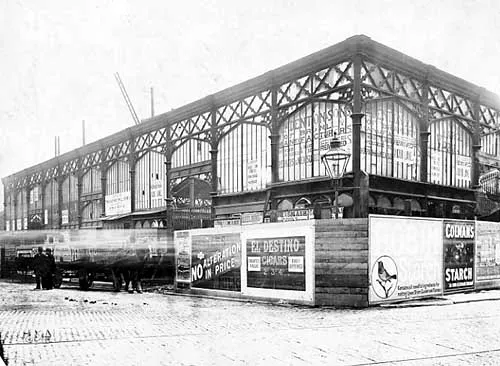
Charles Tilney, Design for Leeds Covered Market (1855), Interior of Leeds Covered Market, wood engraving (1885), and Leeds Covered Market, photograph (1901), Leeds Library and Information Services [D LIHM Covered (1)].
Before the new market was complete, the Mechanics’ Institution had considered it to be a highly desirable venue for a Bazaar and Exhibition ‘of articles of fancy, taste and utility, the products of the personal skill, genius, and industry, or of the liberality of such ladies and gentlemen as are friendly to the cause of popular education’. The committee reported: ‘already we have various promises of contributions from Manufacturers in London and elsewhere, from the Department of Science and Art, from the Museum of the same Department, from the Board of Trade, and from the Museum of India House’. The exhibition was originally intended to coincide with the opening of the market in order to preempt the Manchester Art Treasures Exhibition which was due to open several weeks later. It was hoped that the scheme would generate between £1500 and £2000 profit to dissolve the debts of the Institution and to begin a fund for a new building. However, the Annual Report of the Mechanics’ Institution for 1857 recorded that the exhibition had been postponed.
Members of the Committee had expressed reservations about the short time available to organise this event and the strong possibility that it would operate at a loss given that the premises were only available to them for one week, when most major exhibitions ran for between one and three months. As a result, the Bazaar and Exhibition was rescheduled for 1859, for which Royal patronage was secured. However, it seems not to have gone ahead, perhaps overshadowed by the success of the Exhibition of Local Industry at the Coloured Cloth Hall in 1858, which had very much infringed on the remit and resources of the Mechanics’ Institution and their membership. A further consideration may have been the position of the Covered Market in the Kirkgate ward, outside the respectable Mill Hill. In his report on the sanitary state of Kirkgate in 1842, Robert Baker noted increasing density of the population and the brutalising working and living conditions that led to ‘vicious habits and criminal propensities’. The presence of ‘highly offensive’ bone mills, slaughter houses, candle makers and the overcrowded burial ground of the Parish Church of Saint Peter contributed to the reputation of Kirkgate as a space of physical and moral decay.
Significantly most of the spaces that had been appropriated for temporary public exhibitions, soirees and conversazioni were made redundant by the shifting industrial, political and social composition of the borough: the Coloured Cloth Hall was demolished in 1890 as part of the redevelopment of City Square; in 1866 the Stock Exchange was repurposed by the furnishers Denby and Co. before they relocated to the Albion Street Music Hall as Denby and Spinks ten years later; the Covered Market was demolished in 1901 to make way for the Kirkgate Market that remains on the site. As such, the mid-nineteenth-century moment associated with the Leeds School of Design can be considered particularly distinctive regarding the level of interconnection between the spaces and activities of culture and commerce, engaged in a process of mutual reinforcement which defined the boundaries of knowledge, social class and consumption.
The final chapter builds on this discussion in relation to the concept and practice of circulating pedagogic objects for exhibition at the Leeds School of Design, which draws on both the tensions between local and national priorities considered in chapter two and the significance of the spaces of display examined in this section.
This chapter considers a specific category of pedagogic objects that were characterised by conceptual and practical itinerancy, as mobile and mutable objects disseminated across both national and transnational borders and exhibited in Leeds. Itinerancy is used here to describe both physical and metaphysical travel and the geographical, historical and interpretive distances covered by these objects. The term also incorporates productive associations with the professional itinerancy of the journeying tradesman and peripatetic teacher analogous to the function of the objects as promotional vehicles and didactic tools for art and design education. A further layer of resonance is provided by the figurative itinerancy of the circulation and modulation of knowledge, values and ideologies across the diverse sites which determined the context of display and interpretation.
The principle of circulating objects as a means of social and artistic edification began to gather momentum during the early decades of the nineteenth century. In his diary of 1811, Benjamin Robert Haydon recorded his ambition to see the state not only fund the purchase of the Elgin Marbles, but to have them reproduced in plaster and distributed to strategic locations in England, Ireland and Scotland:
Let the government purchase them; let molds be executed and casts be made from [them], let a set at the expense of government be sent down to Bath, Liverpool, Leeds, Dublin, & Edinburgh; this is the only way to circulate them through the Country, to impregnate the minds of the rising Students with such notions of beauty & form as will make them revolt instantly at defect as at the commission of a heinous crime.
The locations appear not to have been selected according to a consistent criterion: the respective capitals of Ireland and Scotland were obvious choices and the major commercial port of Liverpool perhaps another. However, it is not immediately clear why Haydon selected Bath as a potential recipient over the nearby city of Bristol as another populous port. It is possible that the presence of Roman antiquities and continued archaeological activity set in a prosperous Georgian townscape lent Bath a historical and cultural weight not matched by its neighbours in the south west. In contrast, Leeds was possibly selected for its geographical orientation, being equidistant from London and Edinburgh. Within five years of writing this entry, Haydon saw some of these objectives realised. In 1816 the government purchased the marbles for public display in the British Museum and the production and circulation of reproductions in two and three dimensions rapidly proliferated, although this process was not the centralised programme Haydon had proposed. For example, by 1823 a miniature copy of the Elgin Marbles had entered the collection of the Leeds Philosophical and Literary Society from a private donor.
In a draft version of a paper delivered to the Society in April 1823, ‘On the Elgin Marbles and the Causes of the Excellence of Grecian Sculpture’, Edward Baines Junior remarked on his ignorance of the conditions under which the miniature plaster reproductions were produced:
Of Mr. Hemming’s [sic] miniature models I know little, either as to their general reputation, or as to the share he had in restoring them. Whether the restoration, as well as the moulding, is entirely his own, or whether he copied from restored designs which Lord Elgin informed us were made by a skilful painter in his employ at Athens, I am ignorant. It is obvious that there is an essential difference between restoring the original marbles, and restoring casts from them.
The ‘artist-mechanic of Paisley’, John Henning (1771-1851), gave evidence to the Select Committee on Arts and Manufactures on 17 August 1835, through which it is possible to draw out revealing details about the making of this work and its subsequent dissemination. Henning was somewhat reluctantly granted permission to make drawings of the Elgin Marbles, from which he carved intaglio reliefs of the Parthenon Frieze into slate at a scale of 1:20 (plate 39). Henning completed the scheme in 1822 after twelve years of work, which included ‘filling up the defects’ of the frieze according to his own judgement. The full set of plaster casts was presented in ten glazed drawers set in a wooden case; a monumental, canonical example of antiquity had been made mobile in three dimensions (plate 40). The casts taken from these intricate moulds were immediately and extensively pirated and many examples of varying age, quality and entirety remain in circulation (plate 41).
The Art-Journal lay the blame at the hands of the itinerant Italian formatori di gesso for their ‘rude and inferior multiplications […] found on the well-laden shelf owned by the peripatetic Italian imago-seller’. However, respected and established publishers and institutions were also complicit in this practice; for example, the British Museum had used unauthorised and uncredited reproductions of Henning’s reliefs to complete a model of the Parthenon, which was displayed during his lifetime. Henning considered this practice a theft of his intellectual labour because he had reduced the scale and restored the fragmentary scenes of the Parthenon Frieze according to his own judgement. The level of interpretation inherent to this process allowed Henning to distance his work from the mechanical copy produced by casting or drawing directly from the original object.
He sought to distinguish his work further from ‘those vile copies’ produced by ‘the poor wandering Italians, who were the unconscious promulgators of the cheat’ through the status of his benefactors (plate 42). Those who had purchased the reliefs and patronised the project included ‘the Duke of Devonshire, the Marquis of Lansdowne, the Duke of York and George the fourth, with other nobles, gentlemen and ladies’.
Plate 39
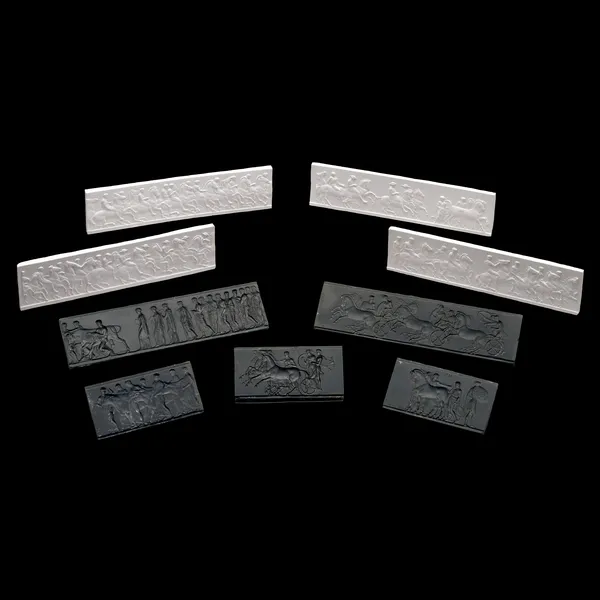
John Henning, Miniature Plaster Casts and Slate Moulds of the Parthenon Frieze (1816-1822), height: 2 inches, British Museum [Museum Number GR 1938, 11-18. 19-25].
Plate 40
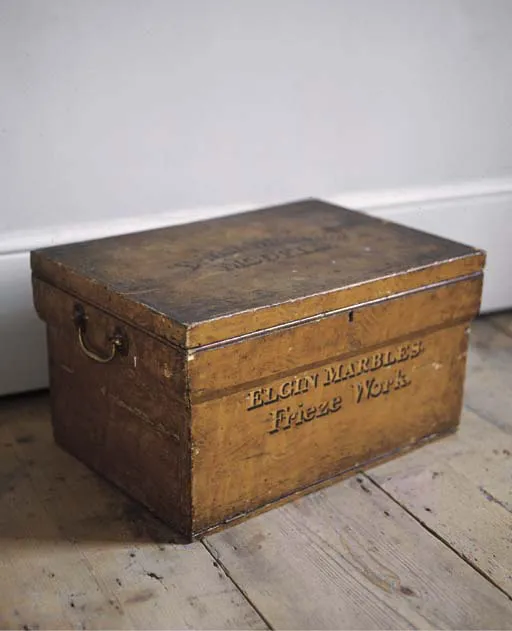
John Henning, ‘An English Set of Plaster Relief Panels of the Elgin Marbles’, ten glazed drawers of plaster casts in a painted pine case (c. 1822), sold at auction on 27 September 2004 for £8,963 [Christie’s: Lot 45, Sale Number 5543].
Plate 41
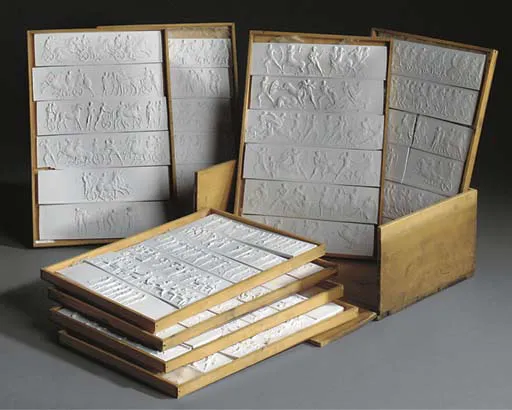
After John Henning, ‘A Cased Set of Plaster Relief Panels after the Elgin Marbles’, plaster casts on wooded trays in a painted box (19th century), width 42cm, sold at auction on 13 September 2005 for £1,320 [Christie’s: Lot Number 527, Sale Number 5771].
Plate 42
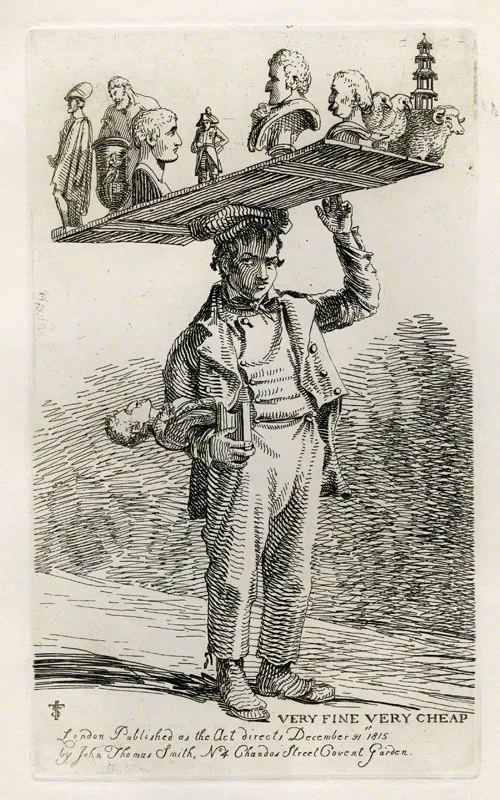
John Thomas Smith, Unknown Man Seling Plaster Figures, etching (1815), 26.7 x 18.5 cm, National Portrait Gallery [NPG D40098].
The clientele reinforced the superiority of these ‘original copies’ as objects of polite contemplation and educated taste. Furthermore, the testimonies of established artists were cited in support of significance of Henning’s achievement:
its value to artists is confirmed by the witness of Flaxman, John Henning’s attached friend; of Canova, whose letter of enthusiastic unsought praise is still treasured by the Scottish sculptor, and of many others who rank high in a calling which is the greatest of all.
In addition to their utility for the fine artist, the educative and economic possibilities of the itinerant object were embedded in the wider discursive climate of the Schools of Design. Published in 1836, the second report of the ‘Select Committee on Arts and their connexion with Manufactures’ recorded the belief that, ‘casts of the best specimens of Sculpture might be advantageously transmitted from the metropolis to the different towns’. In the wake of these reports, the Chairman of the Committee, William Ewart, addressed the assembled audience at the inaugural meeting of the Society for Promoting Practical Design at Exeter Hall on 11 January 1838:
And here let me add, it were well if the Government would attend to a suggestion made by the Parliamentary Committee before referred to, namely, that casts from the best remains of Art in the British Museum, be sent by the Government to every town of any magnitude throughout the country. How easily might this be done, now that railways in connexion with every great mart of trade and manufactures are about to be opened. By them a more rapid circulation will be given not only to travellers and merchandize, but also to ideas (hear, hear); and why should we not urge them as instruments for the diffusion of Science and the Arts! To enlighten and refine the public by means of galleries of Art is in all cases desirable. But how much the more desirable in climates such as ours!
This aspiration was to some extent realised as the collections of the Head School of Design at Somerset House became increasingly itinerant through the network of Branch or Provincial Schools of Design, which proliferated during the 1840s. The Council of the Schools of Design became increasingly concerned about the preservation and extension of a carefully calibrated and standardised mode of design education across a national system, which was first pursued through a common curriculum based upon the study of a regulated selection of examples. However, it quickly became necessary to operate a supplementary system of loaned objects as it had become unfeasible to duplicate the acquisitions which were most recent, most valuable or borrowed from other institutions or individuals. The commitment to the Circulating Collection was consolidated and formalised under Henry Cole during the first years of the Museum of Ornamental Art at Marlborough House, in connection with the reconfigured and reconceptualised Schools of Practical Art. As a legacy of the objects purchased from the Great Exhibition in 1851, the incentive for the distribution of the holdings of the Museum was inverted from a strategy to manage a dearth of objects to a surfeit, facilitated by an increasingly integrated rail network.
The Leeds School of Design was a regular recipient and exhibitor of collections of itinerant objects and in order to examine the specific educative and economic intent of this mode of distribution, three of its exhibitions will be considered: firstly, a collection of French manufactures exhibited on two occasions between 1846 and 1847 as part of the events that surrounded the opening of the School; secondly, the formalised Circulating Collection exhibited in Leeds between 1855 and 1856; and thirdly, a collection of photographs exhibited in 1857, which marked a distinct shift in the production and distribution of the instructive object by the Department of Science and Art.
On Saturday 5 December 1846, ‘a brilliant and unique collection of French manufactures, purchased by the Government for exhibition in the Schools of Design’ was displayed to the public at the Hall of the Leeds Mechanics’ Institution and Literary Society at 12 South Parade alongside the recently granted teaching collection of plaster casts for the School of Design that was to open on 11 January 1847. This collection was sent to other nascent schools as a manifesto intended to establish the ethos and secure the influence of the Head School at Somerset House. As Director of the Schools, Charles Heath Wilson had been sent to Paris to purchase objects from the Exposition de l’industrie fançaise, année 1844 (plate 43). The objects acquired were intended to augment the collections granted to the Schools by providing examples of contemporary continental manufactures. It was resolved that:
the Council [of the Schools of Design] should provide more efficient collections of appropriate examples of ornamental art for the Metropolitan and Provincial Schools, most of which are yet very inadequately supplied with normal examples and specimens, and are consequently prosecuting the prescribed course of study under the greatest disadvantages; and as it is desirable that, with this view, the Council should avail itself of the approaching general Exposition in Paris – the Director be deputed to visit Paris for this purpose in the ensuing month of June, and be authorised to purchase, to the extent of £1,400, the examples enumerated in the following statement [appendix 3].
However, the report later retracted the intention to distribute objects for permanent use in the schools in favour of forming a touring collection that would be presented as a temporary public exhibition in each region. The works were to travel by rail in purpose-built cases accompanied by a descriptive catalogue. It is not clear whether a new catalogue was to be produced for each exhibition. It is probable that standardised information was distributed through the Head School of Design at Somerset House to be published locally. For such a prescriptive and centralised structure to cede interpretive control to another agency would certainly have been anomalous, although the culture of classification, expertise and connoisseurship had yet to completely permeate the system.
Plate 43
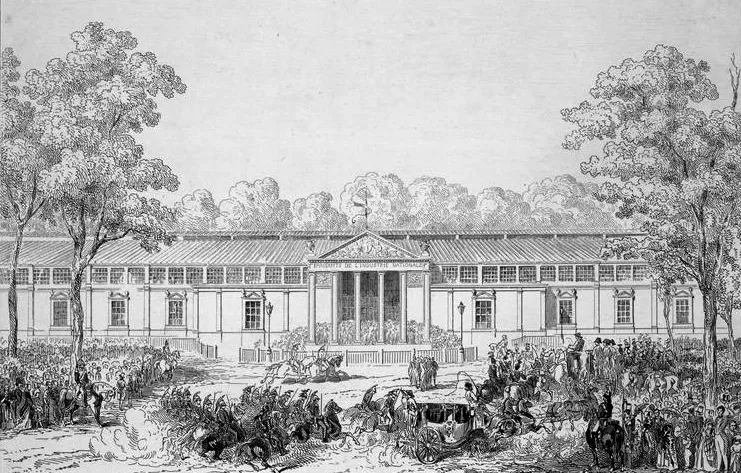
Charles Emile Jacque, Vue du Palais de l’industrie, etching (1844), New York Public Library [G331(I/II)].
In the absence of a catalogue issued by the Leeds School of Design, the exhibited objects can be partially recovered through The Fourth Report of the Council of the School of Design and a descriptive catalogue of the collection shown at the Norwich School of Design, published in 1846 (appendix 4 and 5). The copy of the latter held by the National Art Library at the Victoria and Albert Museum is annotated with what appear to be additions and corrections to the text (plate 44). A signature inscribed on the title page points towards the intriguing possibility that the notes were written by Ralph Nicholson Wornum (plate 45), whose lectures and publications informed the practice and pedagogy of the Schools of Design, discussed in chapter two. However, Wornum’s comments only pertained to the portion of the exhibition devoted to the display of the casts of antique statuary and architectural ornament shown alongside the specimens of French manufactures. The introduction to the contemporary continental objects invoked both admiration and anxiety:
These specimens illustrate, in an interesting manner, not only the application of taste to manufactures, but the extraordinary and rapid progress which the French are making in a number of important branches of trade. The degree of excellence the French have attained in some branches, such as, in Bronze, Casting, Porcelain, Silks, &c., has long been acknowledged; but amongst these specimens, we may notice their progress in Carpet Weaving; of the common sorts in Damask Weaving; and in the Fabric of Plate: in which last respect our superior excellence has unquestionably been surpassed, so far as taste and the execution of the decorative portion are concerned. The specimens of Earthenware may also excite our earnest attention, proving that in this important branch of commerce the French are advancing; for although these specimens are not made in rivalry of English Earthenware, still, in the Exhibition, Dinner and other Services were exhibited, of a very superior description, showing their progress in this manufacture, as in others; and some returns which have been procured show a prodigious increase of late in French commerce in respect of such wares.
Plate 44

Annotations to A Catalogue of the Casts, Figures, &c. Furnished by Government, for the use of the Students at the School of Design at Norwich, and also of a variety of Articles of French Manufacture, purchased by Government at the Great National Exhibition at Paris in 1844, which have been deposited at the School of Design, Norwich for One Month (Norwich: printed by Charles Muskett, 1846), p. 3. [National Art Library, Science and Art Education Collection, 97.E Box 0143].
Plate 45
Signature of Ralph Nicholson Wornum on the title page of A Catalogue of the Casts, Figures, &c. Furnished by Government, for the use of the Students at the School of Design at Norwich, and also of a variety of Articles of French Manufacture, purchased by Government at the Great National Exhibition at Paris in 1844, which have been deposited at the School of Design, Norwich for One Month’ (Norwich: printed by Charles Muskett, 1846), p. 2. [National Art Library, Science and Art Education Collection, 97.E Box 0143].
The exhibition appears to have been intended to stimulate local manufacturers to meet and exceed the caliber of French production. The description of these objects reads as a provocation to the English designer and manufacturer; the ‘rapid progress’ and ‘advancing’ enterprise of the French suggested an intolerable encroachment which required immediate correction. A limited selection of the objects acquired in Paris for this collection have been identified by Clive Wainwright through his important research into the early collections of the Government School of Design. For Wainwright, this activity represented the foundation of the collection of contemporary manufactured objects, ‘demonstrating to students the best of modern French design, by architects, artists, craftsmen and designers at the head of their professions, with the intention that they should better it. The identification of these works was possible particularly where they had retained their place in the permanent collection of the Victoria and Albert Museum, along with their 1844 museum numbers.
This body of work has been invaluable in tracing the empirical lineage of objects through the different incarnations of the Museum. However, the ways in which these objects were disseminated and interpreted, particularly outside the metropolis, was not a primary concern for Wainwright as an antiquarian scholar. In Leeds, the production and trade of decorative commodities informed by French designs was already firmly established and the suppliers and manufacturers of Parisian paper hangings, Trumble and Cooke, were particularly notable for their support of the School of Design, which was discussed in chapter two.
The works purchased from the Paris Exposition in 1844 for exhibition in British Schools of Design were not objects of mass production or consumption. Wilson selected exceptional and elaborate exemplars, often produced specifically for the exhibition as demonstrations of the superior taste and technical virtuosity of the manufacturer. For example, article number 60 in the catalogue issued by the Norwich School of Design was listed as a ‘Blue Vase, from Sèvres, called the Adelaide Vase’ and was bought with the grant allocated to Wilson for 12l. 11s. 2d. (plate 46). Although a contemporary work, the vase was decorated in a sixteenth-century French Renaissance manner, for which Wilson was known to have a particular penchant. The account of the item provided in the catalogue assumed a high degree of preexisting knowledge of the source material:
This beautiful article is painted in imitation of the celebrated old enamels of Limoges. The manufacture at Sèvres is too well known to need any account of it; but the artist-like skill with which the painting on the vase is executed, is worthy of notice.
The use of the descriptor ‘artist-like’ was particularly significant, as the students of the Schools of Design were not intended to aspire to the status of artists and yet were expected to mimic their accomplishments. Similarly, article number 67, a silver vase produced by the atelier of Frédéric-Jules Rudolphi was displayed as a unique showpiece, a model of the collaborative hierarchy between the designer and maker (plate 47). At 40l. it was one of the most expensive purchases made by Wilson in Paris. However, it was the anonymous chasers who were particularly recognised for their contribution to the success of the piece. The status of these artisans was used to legitimise the project of the British Schools of Design, with the application of art to manufacture and remuneration for their labour provided an aspirational model:
the chasing may be esteemed nearly perfect, so much sentiment and knowledge of art is shown in this process. The workmen who chase in this admirable manner are educated in Schools of Design, receiving in Paris very high wages, in some cases from ten to fifteen francs a day.
Plate 46
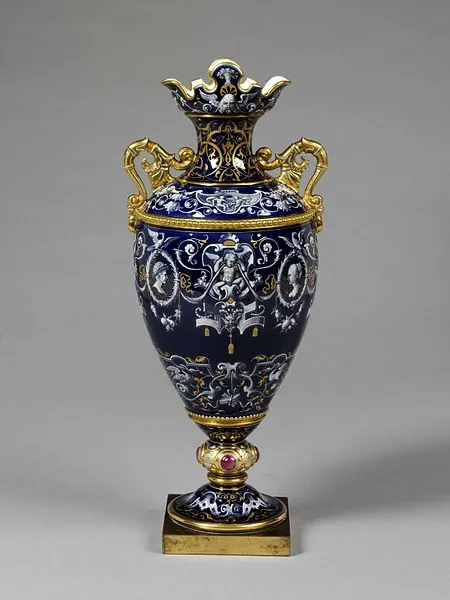
Jean-Charles-François Leloy for Sèvres, Vase Adelaide, enamelled hard-paste porcelain (1840-1844), 30 x 12 cm, Victoria and Albert Museum [Museum Number 467-1844].
Plate 47
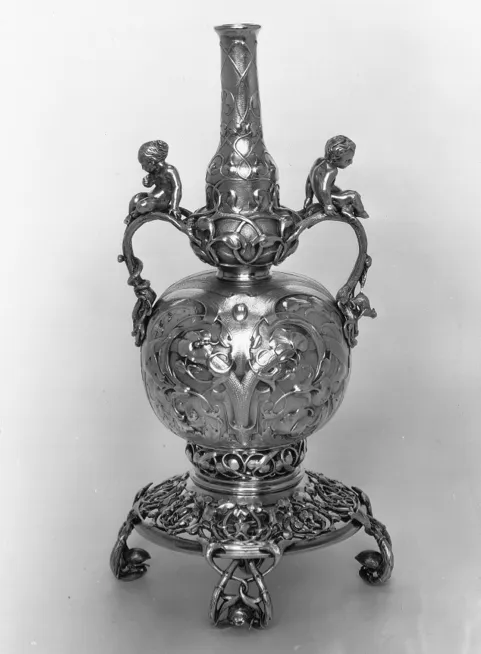
Frédéric-Jules Rudolphi, Silver Vase or Ornamental Perfume Bottle, chased, oxidized silver and parcel-gilt (c. 1844), 23 x 11 cm, Victoria and Albert Museum [Museum Number 919-1844].
A statuette of Icarus by Philippe Grass, cast in bronze by the founders Eck and Durand, was also purchased for the sum of 10l. 8s. (plate 48). The descriptive catalogue did not discuss the formal merits of this piece as an autonomous sculpture, but instead used it to illustrate another perceived virtue of continental modes of production: ‘the French sculptor has a great advantage in respect to the facility with which he may get his works cast in bronze, and the moderate price of the operation’. The manufacturing process was firmly foregrounded to draw particular attention to the infrastructure required to operate on the same terms as the French. Other examples of domestic decoration were purchased to illustrate much the same reasoning, including samples of parquet flooring manufactured by Marcellin in Paris and bought at 16s. 1d. each. These pieces were reproduced as chromolithographs for The Treasury of Ornamental Art in 1857 with a description by J.C. Robinson, the curator of the Museum of Ornamental Art (plate 49). Robinson detailed the historical and continental credentials that made these samples worthy of attention (appendix 6):
This kind of ornamental flooring has long been in general use in France, where carpets are of comparatively rare occurrence. Such floors are kept carefully waxed and polished, and, when partially covered with Oriental rugs or skins, have an excellent effect. The costliness and permanent nature of this mode of floor-decoration give it a certain importance, which, it may be incidentally remarked, is quite in keeping with the somewhat scanty, but architectonic, furniture of the higher class of Continental houses. The designs now illustrated are good and consistent, their rectilinear geometrical character being perfectly in accordance with the nature and mode of working wood. They are evidently based in mediæval Italian examples of geometrical tarsia work, which, in turn, were often derived from the Arabic or Saracenic interlaced patterns, which had become familiar to the Italian artists in other vehicles.
Plate 48. Philippe Grass, Icarus (Icare essayant ses Ailes), bronze (c. 1841), 55 x 25 x 20 cm, Victoria and Albert Museum [Museum Number 379-1844].
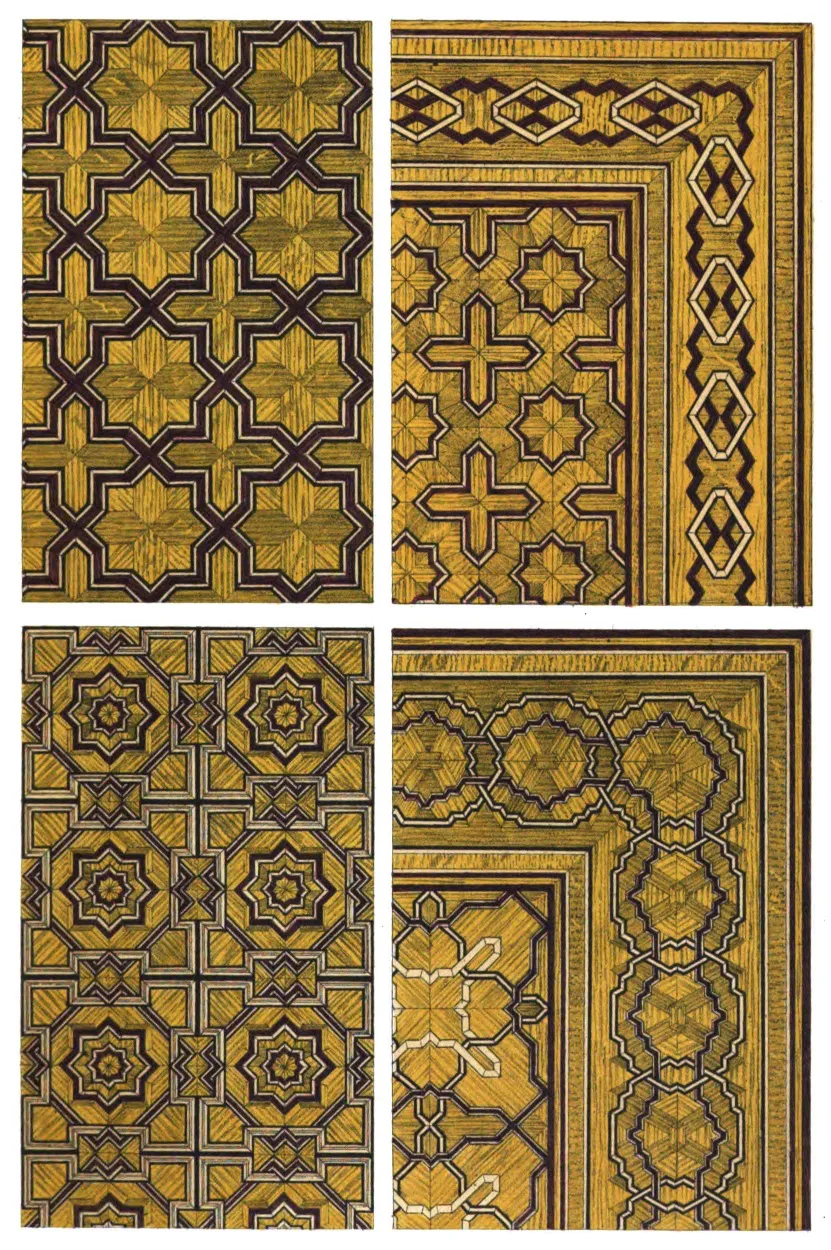
Plate 49. Francis Bedford, Specimens of Modern French Ornamental Wood Flooring, chromolithograph from The Treasury of Ornamental Art: Ilustrations of Objects and Vertù by J.C. Robinson (London: Day and Son, 1857), National Art Library 58.B.45. [Museum Number of the Parquet Panels 28-1844].
After these objects had been displayed in Leeds for one month Wilson requested that the collection be sent on to Stoke on Trent, where a School of Design had been established in 1846 to serve the potteries district. The collection of French Manufactures was exhibited in Leeds for a second time on 2 February 1847. The Committee of the Leeds Mechanics’ Institution and Literary Society reported that, ‘the attendance has been most numerous and highly satisfactory especially to those manufacturers who came from Bradford, Halifax and other towns to see these admirable specimens of French Manufacture’. The Leeds Mercury provided a favourable review, which supplied further details on the staging of the exhibition:
On Tuesday last, the models and designs furnished by Government to the Leeds School of Design were exhibited a second time prior to their removal to the town of Nottingham, which took place on Wednesday. A considerable number of the inhabitants of the town and neighbourhood availed themselves of the opportunity of inspecting the exhibition, and manifested much gratification. The room has been repainted for the purpose of “throwing up” the statues and models placed near the walls, and a very satisfactory effect was produced. Had the room been larger, the exhibition would have been relieved of its crowded appearance, and have been witnessed to much greater advantage.
The Council of the Schools of Design were also satisfied with the consequences of having circulated the collection around the fledgling branch schools outside the metropolis, suggesting that the objects:
excited much interest, and attracted the attention of numerous visitants practically engaged in the manufacture of similar articles, especially in the great commercial towns in which are situated the larger Schools; and instances have been reported to the Council of successful imitations having been produced, and of useful hints towards improvement having been suggested and acted on by manufacturing parties, to whose inspection these specimens have been submitted.
However, this positive assessment of the venture was conspicuously lacking in specific details. How far the instrumental intention of the collection was realised remains difficult to discern and is likely to have varied considerably from one location to another. The objects were certainly received with enthusiasm by those with vested interests in the success of the Leeds School of Design. The circulation of itinerant objects was formalised during the 1850s and it is in this direction that we turn our attention.
For 41 days between 24 November 1855 and 5 January 1856 the Leeds School of Practical Art exhibited the Circulating Collection, or ‘Travelling Museum’ of the Museum of Ornamental Art at Marlborough House in London. Examples of Italian Majolica, German and Flemish stoneware, Chinese porcelain, Russian engraving, French furniture, Turkish and Indian silks and Spanish and Irish lace embodied both the anxiety and possibility represented by foreign manufactures in relation to the perceived inferiority of the design and execution of British commodities. The collection represented an attempt to define and diffuse an international, standardised statement of the principles of correct design, informed by the practice and pedagogy of the exhibitionary and educative institutions of Paris, Lyons, Berlin and Munich. However, the regulations for the display of the travelling museum stipulated that a local collection must also be assembled to supplement the exhibition. This confluence of objects facilitates a comparison of regional, national and international priorities in the contexts of mid-nineteenth century British art and design education.
The formalised Circulating Collection was devised in 1854 and was operational by February 1855 as ‘a faithful abstract or abridgement of the Marlborough House Museum’ (appendix 7). The stated aim of the collection was ‘the illustration, by actual monuments, of all art which finds its material expression in objects of utility, or in works avowedly decorative’. In addition, the ‘travelling museum’ was arguably a means of appeasing the regional bodies that had contributed to the Great Exhibition of 1851 but not benefited from its pecuniary success. In a letter to the Royal Commissioners for the Great Exhibition dated 20 October 1851, James Kitson, in his capacity as President of the Leeds Mechanics’ Institution and Literary Society, expressed the opinion that:
any surplus funds at the disposal of the Commissioners, should be applied to the permanent support of Mechanics’ Institutes, and Schools of Design, as being the most comprehensive and effective agents in giving the people a sound, intellectual culture, diffusing among them a taste, a feeling, and a discrimination of those qualities which blend the beautiful and useful in manufactures, and imparting to a large number a systematic art training, fitting them to exercise the most important practical and progressive influence on those productions of national industry.
The Department of Science and Art, however, was too invested in the ideology of centralised authority to distribute the spoils of the Great Exhibition to the regions directly, even though their objectives appeared to have been broadly consistent. Part of the role of the Circulating Collection was the progressive and beneficent appearance it gave to the Department, which boasted:
for the first time perhaps in the history of museums of rendering moveable the treasures acquired, and of bringing home to the millions of the land opportunities for the study of the beautiful in art, which have hitherto, at least in some degree, been the privilege only of dwellers in metropolitan cities. This intention it is thought may be carried out with little injury to the Museum as a unity, and with great gain in the direction of the chief object of its foundation.
The collection was first displayed in Birmingham between 26 February and 12 April 1855 and on 3 June 1855 the Secretary of the Leeds School was instructed to write to both the Birmingham School and Marlborough House to determine ‘the expenses and necessary accommodation of the specimens of Ancient and Modern Manufacturing Art now exhibiting in the provinces’. By 3 November 1855 the Committee had answered these concerns: the cost of staging the exhibition was estimated at £49 2s. 9d. and a warehouse adjoining the School had been secured without charge for one month through William Beckett. Hosting the ‘travelling museum’ was perceived by the Committee of the Leeds Mechanics’ Institution and Literary Society as ‘a favourable opportunity for an effort to improve its financial position’. Pecuniary considerations were especially pertinent to the Leeds School of Practical Art under the reformatory regime of the Department of Science and Art.
During the first year of the nascent arrangement in 1853, an experiment was initiated at the Leeds School, which had been selected for having spent the most on the instruction of each student in 1851. To encourage the School to subsidise its own activities, 50l. of the master’s salary of 200l. was to be contributed from the fees of the students, where it had previously been paid through the system of central funding. After a year under the new structure it was reported that, ‘a gratifying result has attended this arrangement. The school was inspected early in December [1854], and found to be in a most efficient state. Leeds is, therefore, no longer a grant school, supported by State assistance’. Despite this praise, the withdrawal of the grant exacerbated the debts accrued by the School and so the decision to stage a public exhibition was at least partially pragmatic.
The Department of Science and Art had determined that students should be admitted free of charge, ‘but that all other persons, not students, pay a moderate fee for admission, which should be higher in the morning than the evening’. It was further stipulated that the profits should be used towards the expenses of the exhibition, including the transport of the objects, before ‘the balance be appropriated in the following proportions, namely; one quarter to the masters fee-fund; one-half to the purchase of examples for a permanent museum, &c; and one quarter to the general fund of the school’. However, it is possible that these regulations were waived for the Leeds School, as during a meeting between Thomas Wilson as Chairman of the Leeds School of Practical Art and Henry Cole it was recorded that, ‘Mr. Cole assented to the request of the Committee that the proceeds of the Exhibition […] be employed to liquidate the debt of the School’.
Notwithstanding the potential to return a profit, the expenses associated with the collection were significant and the financial position of the school was subject to real risk. The host institution was also responsible for the cost of transporting the objects from London, in ‘a carriage or truck, constructed especially for the purpose, and adapted to travel on all railways’ (appendix 8). The possibilities created by this mode of transport had been noted by the Council of the School of Design in their annual report of 1845, which noted that all the branch Schools of Design so far established were connected by the railway.
The Circulating Collection also had to be insured and protected for the duration of its display in the locality in which it was exhibited. There was a palpable concern for the security of the objects, most particularly for the Sèvres porcelain and assorted examples of china lent by Queen Victoria (plate 50). These examples were the subject of intense interest, particularly relative to their value, with one vase believed to be worth £1,000 and another £4,000. The hyperbolic tone associated with the royal patronage continued:
Beyond the intrinsic value and great beauty of this portion of the exhibition, the mere fact that the Queen had permitted the Department of Science and Art to select form her private collection whatever they deemed most useful for their purpose, and circulate them for exhibition amongst the various provincial Schools of Art, was of itself sufficient to ensure for the whole a large share of interest and attention. And could her Majesty have heard the warm and hearty praise which this gracious act elicited from the throng of visiters [sic] during the evening, we are sure she would have felt amply repaid for her condescension.

Plate 50. Anonymous, Sèvres China fom the Museum of Art Manufactures, at Marlborough House, wood engraving, Ilustrated London News (18 September 1852), 15 x 24 cm, p. 221.
In addition to having employed police and watchmen to guard the exhibits, Charles B. Worsnop of the Department of Science and Art accompanied the Circulating Collection to each location. Worsnop also delivered daily lectures on the collection, which were supplemented by lectures given ‘twice a week by a Leeds gentleman in the fine arts section’. This arrangement illustrates the negotiation of knowledge production between central and regional agents, institutions and individuals. The proposed model of bilateral activity appeared to offer a balanced solution, with ‘the continuance or extension of the system of Government co-operation now attempted depending entirely on correspondent local action’. Furthermore, it was intended that the exhibition of the Circulating Collection would stimulate interest in the formation of regional museums with composite collections of copies from the Museum of Ornamental Art, augmented with objects of local interest and importance.
The purchase of photographs, electrotypes and gelatine casts to reproduce objects held by the Museum can be considered an extension of the supply of plaster casts to the branch Schools of Art under the aegis of the Department. In contrast, the concurrent encouragement directed towards the formation of geographically specific collections of historical and contemporary industrial manufactures appeared to circumvent the centralised, standardised direction that had characterised the relationship throughout the 1830s and 1840s. However, the display of the Circulating Collection in Leeds did not lead to the formation of a permanent museum of the sort envisaged by the Department of Science and Art.
The extent to which the exhibition of the Circulating Collection was mediated by local interests and particularities is open to question, as the Department had established stringent procedures to ensure a uniform experience wherever it was staged. The spatial arrangement of the objects was predetermined by five large glazed cases and seventy glazed frames, which both contained the collection for transportation and provided the means of display. In addition to the constant presence of an officer from the Department of Science and Art whose secondary function was to provide public lectures, the interpretation of the objects was also controlled by the Department through the labels and catalogue which accompanied the collection and the classifications imposed upon it (appendix 9). This dominance of knowledge has persisted through the archive; the catalogue remains the most substantial account of this collection and necessarily informs subsequent investigations into its content and meaning.
The Leeds Mercury recorded the local donors to the exhibition with a limited description of the objects lent (appendix 10), which included: ‘a very imposing array of paintings, prints, sculpture, bronzes, gold and silver articles, and specimens of decorative art in paper, carpeting, &c., contributed by tradesmen and private gentlemen resident in Leeds’. However, the merits of these donations relative to the objects of the Circulating Collection were not directly discussed. The only comparison between the different sections of the exhibition was with the rooms of the School of Practical Art, which were described as ‘filled with sculpture’ but ‘less attractive than any other portion of the Exhibition’.
After the ‘travelling museum’ had moved on to Sheffield, the Leeds Mechanics’ Institution and Literary Society issued a celebratory account of the exhibition as part of their annual report:
The really successful Art Exhibition which was lately instituted in connection with the School, and which your Committee hope will be productive of great and varied good, is another and safe illustration, within a short space, of the necessity of carrying a really enterprising spirit into matters of education. When the scheme of an Exhibition was first mooted, and took the form of hazardous and expensive estimates, many friends of the School were doubtful of its success and utility, but by perseverance and economy on our part, met by the public spirit and liberality of many of our townsmen, we have succeeded in meeting all claims and providing for our people a cheap, valuable, and highly instructive display.
Despite this highly favourable appraisal and large number of visitors, the exhibition failed to return the profit that had been so sorely required for the School of Practical Art. Although the total receipts exceeded all four of the previous locations in which the collection had been displayed (appendix 11), it was reported that ‘the proceeds barely cover the expenses. Altogether there have been received £115, and the expenses are likely to amount to nearly this sum’. Despite the poor profit margins, the Circulating Collection conferred cultural capital on Leeds and its School of Practical Art, in the same way that the first collection of pedagogic objects associated with the School of Design had been so crucial as markers of the intellectual ambitions of this industrial borough.
The materiality of the pedagogic object was determined by its potential for itinerancy and it would appear that the drive towards mobility and economy on the part of centralised governmental agencies would lead to the adoption of photomechanical technologies of reproduction. The interpretation that the ‘far-sighted use of photography’ and ‘highly innovatory’ approach of Henry Cole was the sole stimulus for the production, circulation, collection and display of this new medium in the provinces will be questioned in relation to the activities of the Leeds School of Practical Art, which had been renamed as such in 1853. This discussion traces the donation of photographic material to the Leeds School, principally for temporary public exhibition, which begins with an investigation of two conversazioni held at the School, in November 1850 and February 1855, which featured photographs by Robert Hunt and John William Ramsden respectively. A comparison of the photographic practice of these two men, one from London and one from Leeds, will be used to draw out the entangled interests of science, art and commerce in the context of design education.
The role of photography in the Circulating Collection as it was exhibited in Leeds during 1855 and 1856 will then be investigated, specifically in relation to the interplay between the state-sanctioned practice of Charles Thurston Thompson and the work of an itinerant photographer named Baume, whose work was also displayed. This discussion concludes with a study of an exhibition of photographs at the Leeds School of Practical Art in 1857. The photographs were again derived from a centralised circulating collection, which for the first time included images of ancient sculpture and architecture not as autonomous objects or fragments, but set in the wider context of their geographical or archaeological location. This significant shift in focus will be analysed in relation to the plaster cast as a pedagogic object with the perceived capacity to replicate and disseminate the universal principles of art.
Photographs were part of the diverse range of objects donated to the Leeds School and like other pedagogic objects, were absorbed into the permanent teaching collection and displayed at temporary public exhibitions. For instance, the minutes of the Committee of the Leeds School of Practical Art recorded the following presentation: ‘Mr. Swallow Head Master of the School reported having received as a Donation to the School a series of Photographic Drawings from Miss Heaton, Park Square’. Miss Heaton was Ellen Heaton (1816-1894), who lived alone at 31 Park Square in the affluent ward of Mill Hill during this period. She was the elder sister of the eminent physician John Deakin Heaton (1817-1880) and both were prominent members of the principal voluntary associations in Leeds, including the Philosophical and Literary Society.
The absence of further descriptive details relating to this donation means that the particulars of the objects cannot be deduced; these ‘photographic drawings’ could have been the result of the cliché verre technique or derived from the use of a camera lucida. Whichever mode of production was employed, the pairing of photography and drawing was significant for the status of the maker, donor and recipient of the work. Photographers informed by the scientific aspects of the new technology, including William Henry Fox Talbot and Robert Hunt, preferred to conceptualise their images as self-making or ‘autogenic’, which for Steve Edwards resulted in ‘a powerful homologous displacement of human agency from the scene of production’. Through a close analysis of the photograph as a pedagogic object, this discussion attempts to make human agency visible and understand the relations between image and industry in the context of the Leeds School of Practical Art.
The Leeds School exhibited photographs with some frequency as part of their regular programme of conversazioni, a form of display and social interaction discussed in chapter three. Adrian Budge noted the inclusion of photographs in the conversazioni of the Leeds Philosophical and Literary Society and as part of the Second and Third Polytechnic Exhibitions of 1843 and 1845 respectively, but provided no reference to the exhibitions of photographs connected with the Mechanics’ Institution and School of Practical Art. Although superficially similar in structure, these exhibitions were important and distinctive because they provided a locus for the consideration of photography as a medium of both science and art for the mechanic and the artist.
Some of the earliest photographs exhibited in association with the Leeds School of Design were displayed in the context of a conversazione held in November 1850. It was recorded that, ‘Mr. Robt. Hunt, of London, also very kindly lent his beautiful collection of Photographs [sic], including portraits of several distinguished persons’. The absence of further details again frustrates attempts to trace the objects and their subjects, although the ‘portraits of several distinguished persons’ can be considered as part of broader attempts to confer prestige to the process of photography by association, in addition to encouraging the emulation of edifying examples. Here the didactic potential of the photograph occupied the moral territory previously held by the painted portrait, which was overlaid with a reinforced belief in the truth and fidelity of the mechanical representation.
The donor of these photographs was Robert Hunt (1807-1887), a scientist and photographer who from 1845 was Keeper of the Mining Record Office at the Museum of Practical Geology. In addition to having contributed articles to specialist photographic periodicals, Hunt had published several books on photography during the 1840s. In November 1850 Hunt delivered a series of three lectures for the Leeds Mechanics’ Institution and Literary Society entitled The Great Phenomena of Nature. The first lecture was described as a ‘remarkably lucid description of the primary qualities and laws of matter’ and encompassed observations relating to electromagnetism, chemistry and rudimentary physics. The second and third lectures attended to elements of biology, botany and the properties of light and heat, with a concluding appeal to ‘the young men in his audience to apply themselves to some branch of scientific inquiry, and reminding them not to trifle time away’.
Hunt found enough favour in Leeds to have been accepted as a donor of photographs to a second conversazione at the Leeds School of Practical Art in February 1855. Hunt had by this time risen to the position of Professor of the School of Mines, a post he had accepted in 1851 after having published successful handbooks to the Great Exhibition. Hunt is particularly significant to this discussion because his views on the utility of photography to the practice of art were well documented in both his own publications and contemporary photographic periodicals. According to Edwards, it was Hunt’s belief that ‘while photographic detail confirmed the vision of the men of science, it posed a threat to the artist because it was both mindless and seductive’.
It was the opinion of Hunt that the level of pictorial fidelity made possible by the photograph was actively harmful to the training of the aspiring artist, which makes his involvement with the Leeds School of Practical Art worth investigating. It is possible that in this instance the danger was mediated by the qualifier ‘practical’. The nascent designer may have been considered immune from the ‘seductive’ qualities of the photograph as they operated without the sensitive intellectual apparatus of the artist, which made them vulnerable to visual corruption. Hamber and Edwards have provided detailed critical accounts of the complex relationship between photography and fine art during the mid-nineteenth century, however the relationship with design and the applied or decorative arts has not received the same level of analysis.
The significance of this distinction can be approached through a comparative assessment of the practical and conceptual positions of Robert Hunt and John William Ramsden (1834-1894). Ramsden was also a donor of photographs to the conversazione at the Leeds School of Practical Art in February 1855. As a founder member and vice president of the Leeds Photographic Society purported to have been the owner of the first camera in the borough, Ramsden provides a particularly relevant illustration of the intersection between national and local and commercial and cultural interests. The Leeds Photographic Society was established as an autonomous subsidiary of the Philosophical and Literary Society in 1852, having inherited the self-defined social and intellectual prestige associated with the institution. In the following year, Ramsden established a commercial studio alongside Thomas Henry Briggs at 18 Park Row after the patent on the daguerreotype process was lifted in 1853 (plates 51 and 52). Ramsden continued to experiment with the available methods of producing photographic images and in February 1854 he wrote to William Henry Fox Talbot, one of the principal inventors of photography, to request a licence to use his process in Leeds. It is not clear if this letter received a reply or whether the request was granted, although the exhibition of February 1855 to which Ramsden lent photographs did include ‘photographs and talbotypes, by Mr. J.W. Ramsden and Professor Hunt’ so it is possible that the application was successful. The photographs produced by this method were described by Ramsden and Briggs as, ‘unequalled on account of their stability and uniformity of action, possessing a high degree of sensitiveness, at the same time producing pictures representing perfect gradations of light and shade’.
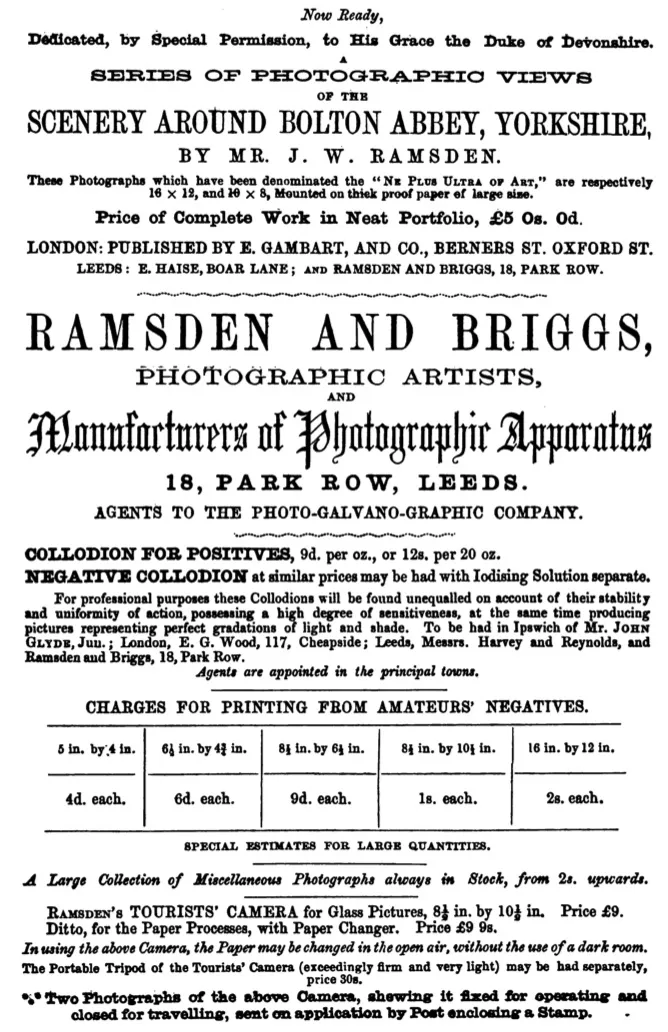
Plate 51. Advertisement for Ramsden and Briggs, from Suffolk in the Nineteenth Century: Physical, Social, Moral, Religious, and Industrial by John Glyde (London: Simpkin, Marshall & Co., 1856), p. 401.
Plate 52. Anonymous, 16-18 Park Row, photograph (1890), Leeds Library and Information Services [N LIC Park (1)]. The premises of Ramsden and Briggs can be seen on the far left of the photograph.
The emphasis on the accuracy of the resulting image echoed earlier commentaries on the fidelity of the plaster cast, chromolithograph and electrotype as ‘a proxy for the original’. The equivalence between the photograph to its source was mediated by the transformation of scale and translation of three dimensional space onto a two dimensional plane. However, the perception that the photograph provided an indexical image of the real and the truthful, in combination with the ease by which they could be circulated, resulted in a potent case for the photograph having been positioned as the optimum itinerant object.
In addition to the mechanical and scientific facets of commercial photography, John William Ramsden also identified himself as a ‘photographic artist’ and advertised his series of views around the Bolton Abbey estate as the ‘ne plus ultra of art’. Perhaps this statement demonstrated a degree of hyperbole, but it was to some extent endorsed by the reputation he developed as a photographer of landscapes and portraits of significant figures, which included John Ruskin and Queen Victoria. Ramsden extended his reputation further as a regular contributor to exhibitions outside Leeds. He displayed his work at the first exhibition of the Manchester Photographic Society in 1856 and fifteen waxed-paper and collodion photographs at the third exhibition of the Photographic Society of London in 1856 and thirteen at the sixth exhibition in 1859. In the same year, Ramsden exhibited photographs at the conversazione of the Halifax Literary and Philosophical Society, which were favourably received for both their practical utility and aesthetic merit:
Mr. J.W. Ramsden, of Leeds, sent several fine transfers, from his negatives, of scenery in the Lake district, and at Bolton Abbey, and also several photographs of machines. Whilst the latter show how useful the art may become to all manufacturers; the former, especially in their sky effects, show what may be done towards making photographs works of real art as well as of sun-painting.
Ramsden’s photographs of picturesque architecture and landscape were reviewed in the national periodicals in similar terms (plate 53). It became increasingly important for those interested in elevating the status of photography to provide evidence of artistic aptitude and manual proficiency. According to Edwards, the picturesque landscape provided a strategy towards this advancement, ‘because it offered an aesthetic of finding, not making. To make a “picture-like” image, the photographer had to discover a scene that matched artists’ rules’. The case against photography as a legitimate art was based upon the perceived negation of the hand and mind of the artist. The reference to ‘sun-painting’ in the previous quotation illustrates this absence of generative activity. Edwards has noted that, ‘the men of science thought of the agency of the sun in the same way that they conceived of steam power. Like steam, the sun was a natural force that could be harnessed to drive apparatus’. In these spheres, the origin of the photographic image was thought to be entirely mechanical, a chemical reaction resulting in a picture that was judged to be merely a neutral facsimile or scientific novelty. Anthony Hamber has argued that the terms of this debate prefigured photography, which only acted as a catalyst to broaden the distinction ‘between ‘mechanical’ reproduction and ‘interpretive’ manual processes’. The interpretive processes Hamber referred to were principally engraving and lithography, which were dependent upon the visual discrimination and manual dexterity of the craftsman.

Plate 53. John William Ramsden, Kirkstal Abbey, West Front, photograph from a waxed paper negative (c.1852-4), 16 x 21 cm, Leeds Photographic Society.
For example, as part of the evidence brought before the Select Committee on Arts and Manufactures in 1836, the engraver John Burnet articulated the central problem faced by the members of his profession: ‘The public consider engravers only as a set of ingenious mechanics, which is not the fact. The art of engraving, the department I talk of, is more a translation of a picture that a copying; it is a process of difficult management’. The photographer was confronted with a similar disparity, which Edwards has articulated through the opposition between ‘the elevated art picture and the base document’, which was itself an extrapolation of the concepts of ‘figured’ and ‘proper’ as defined by Richard Shiff. If the camera had yet to be established as a conduit of subjective creativity, its utility to the fine and applied arts had gained enough currency to be taken seriously as a didactic instrument. As such, the fundamental question relative to the photograph as a pedagogic object concerns the distance between the construction and reception of the image as document or picture, or even an aggregate which incorporated the characteristics of both categories.
Although innovative and diverse in their enterprise, Ramsden and Briggs were not the first to establish a commercial photography studio in Leeds. Samuel Topham (1791-1862) had opened a Photographic Portrait Gallery at 27 Park Row on 11 April 1842, having secured an exclusive licence to produce daguerreotypes in Leeds (plate 54). By 1844 William Huggon was listed as the photographer and Topham continued to trade as an engraver, lithographer and copper-plate printer with his son at 5 West Bar, Boar Lane. Huggon also began to offer photographic portraits from nearby premises at 30 Park Row; this appears not to have been a relocation but an extension of his activities. In addition, Huggon advertised himself separately as a ‘Consulting and Analytical Chemist’ and significantly, lectured to the Leeds Mechanics’ Institution in October 1844 ‘on the properties of explosive compounds’.
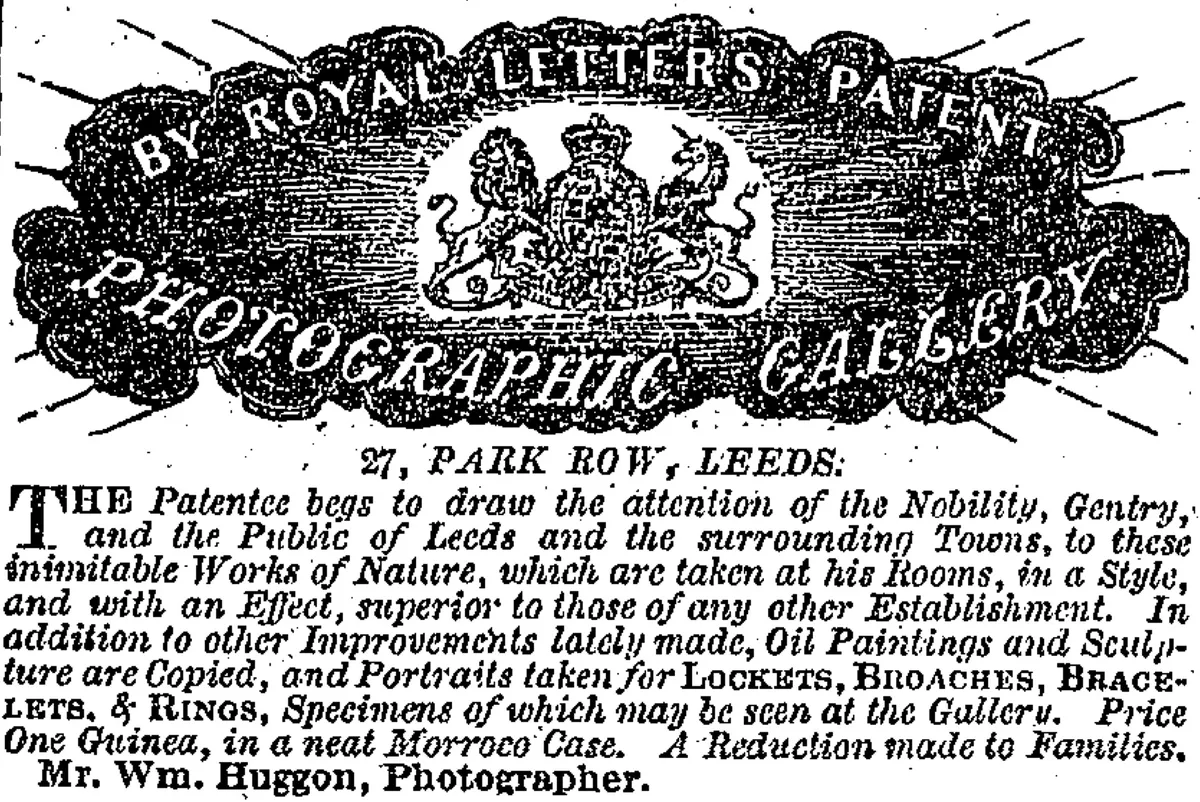
Plate 54. Advertisement for the Leeds Photographic Gallery, Leeds Mercury, 8 June 1844, p. 1.
Huggon was recorded as a member of the Committee of the Mechanics’ Institution from 1839 and by 1850, which means that he was part of the body that applied for and eventually secured a grant to establish the Leeds School of Design. Huggon also taught the Chemical Classes of the Mechanics’ Institution with ‘able and undiminished energy and talent’. It is notable that a practicing photographer was delivering lectures in such close proximity to the teaching of art and design, however the only point at which these disciplines intersected appears to have been an unspecified contribution made by Huggon to the Leeds School of Practical Art Exhibition of 1855. In his ability to colour photographs by hand to infuse the image with ‘truth’, Huggon was advertised in similar terms to John William Ramsden: ‘Mr. H’s. long experience, combined with chemical and artistic knowledge, enables him to produce a [Photographic] Portrait which is unequalled in any of the London establishments’. The synthesis of the objective precision of science with the metaphorical and moral truth of art was the ideal amalgam, as Edwards has argued: ‘imitation still had to be infused with mind and artistic rules. Truth, then, was not to be confused with the mere transcription of appearances’.
The first examples of photography approved by the Department of Science and Art to have been exhibited at the Leeds School of Practical Art formed part of the Circulating Collection exhibited between 1855 and 1856. The principal components were described locally as, ‘photographs of the chefs d’oeuvre of decorative furniture exhibited at Gore-house in 1853, under the auspices of the Department of Science and Art; photographs from objects in the Marlborough-house museum and various private collections’. In addition to the examples of photography sanctioned by the Department, the exhibition included local loaned examples of photography and associated apparatus, which was sparsely recorded by the Leeds Mercury as ‘photographs, by Mr. Baume, stereoscopes, &c’. A newspaper article which detailed the theft and recovery of a wooden press and photographic portrait placed Baume in Leeds during November 1855.
As a peripatetic photographer, Baume appears more sporadically in the archives than those operating permanent photographic studios. Adrian Budge traced his movements to Huddersfield during 1853 and Oxford immediately prior to his time in Leeds, although little else can be gleaned of his circumstances other than the possibility of a French or French-speaking background indicated by the title Monsieur, although it is also possible that this was an affectation used to indicate continental sophistication. Baume released a set of announcements in 1856 to advertise his continued presence in Leeds which indicated his location and services: ‘BAUME’S PHOTOGRAPHIC GALLERY, Opposite White Horse Hotel [Boar Lane], Leeds. MONS. BAUME returns his sincere thanks for past favours, and begs to inform his patrons that his stay in Leeds will be for a short time only. Mons. Baume further announces that his prices range from 5s. upwards. — March 7th, 1856’. Shortly afterwards Baume advertised for ‘a Young Gentleman of good address and respectable connexions, as canvasser for portraits, in place of a person of the name of Braithwaite, who left his service a few weeks ago’.
Baume’s previous assistant was Charles Henry Braithwaite, who had established a short-lived photographic business with Joseph Navey in 1856 at premises in Albion Street before the partnership was dissolved and both men pursued independent careers. Their separate trajectories illustrated the increasingly differentiated demographics served by photographic studios: Navey reduced the price of his photographic portraits to 3s. 6d. ‘so that really good pictures may be had at little more cost that the really bad ones’, while Braithwaite was based in a studio close to the main commercial thoroughfare of Briggate, but travelled to the homes of the political, cultural and industrial elite to capture more prestigious portraits. This demonstrated the increasing stratification of photography as a profession, with ‘some aiming for prestige, others barely managing respectability’. The evidence suggests that Baume tended towards the latter.
Although photographs and photographic technologies had been exhibited in Leeds during the 1840s and early 1850s, it was not until 1857 that an exhibition exclusively devoted to the medium was staged at and for the Leeds School of Practical Art. In May of that year, the following resolution was recorded: ‘that the Society of Art be asked for the use of the Photography now on Exhibition at Liverpool and that they be requested it be sent to Leeds on the same week when the Photographs are expected from the Department of Science and Art’. The Liverpool Mercury provided the only commentary on the photographic component of the exhibition, with the view that ‘some excellent photographs and engravings add much to the interest of the collection’. The combined selection was
displayed at the Leeds School of Practical Art in June 1857 and received the following review in the local periodical press:
The specimens are numerous, and many of them very beautiful. Especially interesting are a number of views taken in the Universal Exhibition of Industry, at Paris, which reproduce with the utmost fidelity the principal feature of that beautiful exposition of industry and art. Equally interesting to many will be the views of the remarkable ruins of Athens, Thebes, and other classic ground. Upon the whole, the specimens are novel and striking, and will well repay a visit.
The concepts of beauty, fidelity and novelty through which these objects were appraised, illustrated the position photography occupied during this period. Although the photograph continued some of the established functions of the three dimensional teaching collection, the examples lent to this exhibition extended the capacity of the pedagogic object to transmit knowledge of a subtly different kind. The photographic images displayed in Leeds documented continental exhibitions and distant archaeological sites in context, suggesting that the isolated object of antiquity was perhaps deficient in its capacity to communicate the conditions of its production to students of art and to a wider public. In addition to allowing the object to travel, the photograph also mobilised the sites and exhibitions in which they were located, which exposed the student to displays of geographically distant collections without having to visit in person.
Before the circulation of these images, students who studied at the branch schools would generally only have the means to visit the museums and art galleries in London as an award for exceptional achievement. For instance, William Andrews (1835-1914), a student of sixteen years old at the Coventry School of Design, was awarded a prize of thirty shillings to visit the Great Exhibition during August 1851. His diary records the extended duration of travel and the various modes of transport required to complete this hundred-mile journey, but unfortunately not his impression of the exhibition. However, these individual excursions across the country were neither economical nor efficient in their educative effect; under the tenure of Henry Cole from 1852 the photograph was increasingly used to bring the exhibition to the student.
For example, nineteen photographs of an exhibition of decorative furniture at Gore House taken by Charles Thurston Thompson (1816-1868) were selected for circulation as part of the ‘travelling museum’ exhibited in Leeds between 1855 and 1856. In addition, sixteen photographs of decorative arms and armour were included in the collection, having been exhibited at Marlborough House in 1854. It was perhaps revealing of the ways in which these images were intended to be interpreted, that the catalogue did not describe the photographs as autonomous objects, but instead recounted the particulars of the original display:
On that occasion upwards of one hundred and thirty specimens were brought together, on temporary loan, from all parts of United Kingdom, the number of objects, most of which were chefs d’œuvre of their several epochs, being limited only by the space at command. The principal contributor was Her Majesty the Queen, by whose gracious permission the rarest and most beautiful specimens of cabinet-work from Windsor Castle were brought to London.
Furthermore, the photographs of individual objects such as a late seventeenth-century Venetian mirror from the collection of John Webb (plate 55) were articulated in the catalogue as though the piece were present:
This Louis XIV style is perhaps seen to greater advantage in purely decorative objects, such as mirrors, candelabra, &c., than in strictly useful articles, where similar displays of florid ornament are too apt to induce structural inconsistencies. In the present instance the simple and well-contrasted mouldings that surround the glass give consistency and propriety to the whole composition, whilst the scroll and strap-work, and various ornamental motives, very elegant and effective in detail are judiciously connected with the framework of the glass, that various parts being well balanced and contrasted.
Plate 55

Charles Thurston Thompson, Venetian Mirror c.1700 fom the Colection of John Webb, albumen print from wet collodion on glass negative (1853), 23 x 16 cm, Victoria and Albert Museum [Museum Number 39:833].
The reflected presence of the photographer in the glass of the mirror was not worthy of note. The negation of the photograph as an object with its own material characteristics and conditions of production was consistent with the treatment of plaster casts; the reproduction was displaced by the object it reproduced. These descriptions also conformed to the prescriptive pronouncements of the Museum of Ornamental Art as an institution intended to be ‘instrumental in helping to form a general belief in true principles’. As illustrated above, the ‘true principles’ at stake encompassed both formal and moral judgements; ‘propriety’ and the judicious decisions of the designer and maker were inseparable from the qualities of ‘elegance’ and ‘balance’ in the positive appraisal of this mirror frame.
For the Department of Science and Art, the particular materiality of the photograph appears only to have been considered as far as it served to communicate these principles with improved efficiency and economy. However, photographic reproduction did not supersede the duplication of these objects in three dimensions; it was also reported that ‘seventy casts [of the mounts] were taken from the furniture lent to the Department last year, and exhibited at Gore House’. This additive approach to emerging technologies of reproduction has been noted by Malcolm Baker, who has explored the relations between plaster casts, electrotypes, fictile ivories, architectural models, brass rubbings, paper mosaics and photographs that were produced, collected, displayed and disseminated by what would become the South Kensington Museum from 1857. Baker concluded that, ‘the interconnectedness of these different modes of reproduction was not simply a matter of chance but rather one of intention and policy’. It is the development of this policy that we must now consider.
The photographic recording of exhibitions had become a international endeavour by the mid-1850s. Thurston Thompson was dispatched along with Robert Bingham by Henry Cole along to take photographs of the Paris Exposition Universelle of 1855. At this international exhibition, it was possible for an English photographer to capture images of Indian manufactures displayed in France, the results to be circulated around the provincial Schools of Practical Art in Britain (plate 56). In 1856 Henry Cole appointed Thurston Thompson as the first Superintendent of Photography to the Department of Science and Art. Mark Haworth-Booth has suggested that this arrangement ‘began a powerful programme of recording works of art, architecture and design in the interests of public education’.
In addition, photographs were employed to recontextualise the antique objects that had been the traditional foundation of art instruction. The antiquities of Egypt and Greece in particular had been radically detached from their historical, architectural and environmental context through the process of plaster casting, which rendered both complete and fragmentary objects with a sculptural consistency that to some extent erased their historical contingency. In contrast, the photograph could partially restore the setting of these works with a level of fidelity that was not invested in the engraving or lithograph as interpretive technologies of reproduction. It is most likely that the ‘ruins of Athens, Thebes, and other classic ground’ exhibited at the Leeds School of Practical Art in 1857 referred to the photographs taken by Maxime du Camp (1822-1894) of ‘Views in Egypt and Syria’ (plate 57 and appendix 12).
Plate 56

Charles Thurston Thompson, Raw Produce of India at the Paris Universal Exhibition 1855, albumen print from wet collodion on glass negative (1855), 22 x 29 cm, Victoria and Albert Museum [Museum Number 33:323].
Plate 57
Maxime du Camp, Statue of Memnon, Gournah, Thebes, salt print (c. 1852), 21.5 x 16.5 cm, Victoria & Albert Museum [Museum Number 36:512].
It is also possible that photographs by Francis Frith (1822-1898) entered this collection as Frith had also travelled through Egypt, Syria and Palestine between 1856 and 1859. These portfolios were absorbed into the ‘Universal Series’ of over four thousand photographs, which later entered the permanent collection of the Victoria and Albert Museum (plate 58).
Plate 58
Francis Frith, Statues of Memnon, Thebes, whole-plate albumen print from wet collodion on glass negative (c. 1850s), 17 x 20 cm, Victoria and Albert Museum [Museum Number: E. 208:3459-1994].
The publication of The Treasury of Ornamental Art in 1857 provides a final example through which some concluding thoughts on the photograph as a pedagogic object can be drawn. As this work illustrated, the documentary facility of photography did not always confer appropriate signifiers to the objects it represented. Photography was used strategically by the Department of Science and Art to elevate the status of its collections, although the process was not always direct. Photography was employed in this instance as a means of creating precise chromolithographs with an unequivocal objective:
In originating this series of Engravings, the intention has been to reproduce, as completely as the means and appliance of Art at the present day would admit, a class of works of art which, for want of any better generic title, must be designated by the some what trite terms, “ornamental” or “decorative” […] whatever may be the amount of art-power manifested in them, are regarded only as “objects of vertù” or curiosities, and held to be beneath the attention of the real connoisseur.
The implication was that the combined effect of these reprographic processes would result in a transmutation of perception; that the object was rendered worthy of the attention of the ‘real connoisseur’ through its representation. The distance between the photograph as an ‘unerring facsimile’ and the lithograph as ‘art’ correlates with the material and conceptual distance between the document and the picture. As Steve Edwards has argued, ‘these are two terms in an allegory of labor. At times, one half of this contradiction would be repressed; on occasion, the fragments would be mixed in a bewildering brew; sometimes the antagonism would not even be noticed’. In this instance the division of labour was embodied in a single person: both processes were conducted by Francis Bedford (1816-1894), whose career has been described by Hamber as ‘a link between lithography, chromolithography and photography’ (plate 59).
Plate 59

Frontispiece of The Treasury of Ornamental Art: Ilustrations of Objects and Vertù, Photographed fom the Originals and Drawn on Stone by F. Bedford; with Descriptive Notices by J.C. Robinson (London: Day and Son, 1857). [National Art Library 58.B.45].
What could a chromolithograph, derived from a photograph, invest in its subject that was not thought to be possible through photography alone? Hamber has argued that despite being a costly and laborious method, chromolithography was preferred for the reproduction of art objects because their colour could be augmented and the resulting image ‘had the aura of a traditional print’. In addition to an implicit reference to Walter Benjamin’s widely cited essay of 1936, ‘The Work of Art in the Age of Mechanical Reproduction’, this statement also suggests a persistence in the belief that the work of a highly skilled and intelligent hand could imbue the subject with the qualities of art.
As such, it could be argued that the photograph extended the mobility and shifted the perception of the pedagogic object, but did not supersede established modes of reproduction that were more dependent upon the manual and mental capacity of the maker. Furthermore, the photograph was employed in the instruction of art and design in a largely illustrative capacity, in contrast to the heuristic process of drawing and modelling the objects of a teaching collection in order to assimilate the cumulative knowledge they were thought to contain. In connection with the proliferation of international exhibitions after 1851, photography facilitated an increasingly international negotiation of the ideologies of art and design, industry and manufacture and the production of knowledge.
This study has shown that the teaching collections that were produced, circulated and exhibited for the purposes of art and design education in mid-nineteenth century Leeds were embedded in a wider set of historical, political, economic and cultural conditions. Unlike other investigations of the Schools of Design, this thesis has considered these conditions from a local perspective, using the Leeds School of Design as a means of understanding the ways in which the drive to centralise and standardise education in art and design was mediated by existing and emerging practices and institutions. Aside from the briefest of references, the activities of the Leeds School of Design have been excluded from the official history of art education in Leeds, in much the same way as the significance of temporary public exhibitions has been disregarded in favour of institutional biographies of Leeds Art Gallery and Leeds City Museum. This thesis has demonstrated that the Leeds School of Design and its attendant exhibitions were thoroughly enmeshed in the cultural development of the borough.
The ways in which the precepts of the Royal Academy infiltrated the curriculum of the Schools of Design is not necessarily considered here as a point of irreconcilable contradiction, but in many ways a productive opportunity for branch Schools of Design to pursue a model of art education, sponsored by the state, that suited their desire for the prestige associated with the fine arts. It is hardly surprising that the Leeds School of Design, alongside its neighbours in York, Sheffield, Manchester, Liverpool and Newcastle, operated within a broadly traditional mode of academic art instruction when the art masters they were supplied with had completed their education at the Royal Academy Schools and their teaching collections of plaster casts and prints of antique statuary were entirely consistent with the ethos of the Academy. The paintings, prints and publications that were subsequently donated to the Leeds School of Design by local individuals reinforced this bias.
However, the economic rationale of the Schools of Design remained a potent determinant and a belief in the capacity of art to invest local manufactures with additional cultural and commercial values was demonstrated by the involvement of manufactures of paper hangings, prints, ceramics, furniture, decorative metalwork and scientific apparatus in the exhibitions of the Leeds School of Design. The rhetoric of the annual reports, minutes and pronouncements in the periodical press also consistently referred to the economic necessity of instruction in design to remain competitive with superior continental production. However, the rehearsal of this argument appears to have become a reflex, as though it would become true through repetition alone.
Although the Leeds School of Design appropriated many of the principles and practices of the academy, the attempt to found a bona fide Academy of Arts in Leeds in 1852 suggests that the School of Design did not satisfy ‘the higher forms of artistic progress, which it is the object of Academies of Art to promote and secure’. However, the collapse of this venture after just three years and three exhibitions, with no indication that any teaching took place, suggests that it was misconceived, mismanaged, or a combination of the two. If it were true that the Leeds Academy of Arts intended to operate as a finishing school for the Leeds School of Design as the founders had proposed, and not just a means of appeasing a potential rivalry, it is possible that the students leaving the School of Design were either too familiar with the academic practices that had seeped into the system, or that the character of their instruction in elementary drawing was too rudimentary to allow such a progression. Furthermore, the Leeds Academy may have found it difficult to compete with the subsidised School of Design, which was also supported by the more established Leeds Mechanics’ Institution and Literary Society, with its influential and well-connected Committee of Management. It is difficult to draw firm conclusions from the limited archive of the Leeds Academy, although that this episode occurred at all exemplifies the slippage between art and design during this period.
The Schools of Design, as they operated between 1837 and 1852, have been characterised as an interesting experiment at best and abject failures at worst. These assessments have judged the system on its capacity to train designers for industry. Clearly the mimetic reproduction of antique statuary and architectural ornament was some distance away from the practical workshop training advocated by William Dyce in the wake of his assessment of French, Prussian and Bavarian precedents. However, this thesis has argued that the perception of failure has not accounted for the secondary outcomes of state sponsored education, particularly in drawing. Disciplined observation and the regulation of behaviour were allied with the inculcation of precision and patience, which were crucial components for the socialisation of an efficient and subservient industrialised workforce. Anthony Hughes and Erich Ranfft have argued that reproductions of sculpture served to fortify existing structures of power and influence: ‘repetition and dissemination of a motif or figure have constituted one of the simplest and most effective means of establishing and reinforcing political or religious authority’. In addition to the social, economic and political dimensions of the Schools of Design, Susan Beattie has offered one of the most balanced assessments of their cultural contribution:
It is doubtful whether the Government schools ever became precisely the kind of forcing-ground for industrial designers that had been first envisaged, but their quite remarkable success in establishing a higher status for applied design and decoration and a broader understanding of the term ‘art’ in the public consciousness is unquestionable.
As Beattie suggested, the Schools of Design brought didactic objects into the public domain, but they also galvanised existing voluntary societies in support of an extended exhibitionary culture. Although the Leeds School of Design was maintained by a government grant until 1854, local support to match the funding provided by the state through public subscriptions had always been built into the system. In his robust defense of voluntaryism and self-governance, Edward Baines Junior saw no contradiction in his role in securing centralised funding for Leeds, because the Mechanics’ Institution and Literary Society had always intended to operate a School of Design within their existing educative scheme. The regulations, approved curriculum and system of inspections were incidental and the central authority could generally be placated with disingenuous reassurances that the correct methods would be adhered to in the future.
Therefore, this thesis has argued that the Mechanics’ Institution selectively appropriated those elements of the School of Design that suited their ideology and ambitions and rejected those that did not. One aspect of the attempt to standardise the pedagogy of the Schools of Design that was embraced by the Mechanics’ Institution was the visiting speaker. In the case of Ralph Nicholson Wornum, the lecture series was both positioned as a continuation of the delivery of papers that had been an integral component of the voluntary society and as part of the tradition of the visiting luminary.
This thesis has proposed that one of the central contributions of the School of Design in Leeds was as a locus for temporary exhibitions. It has been argued here that the school continued the practice of the polytechnic public exhibition established by the Mechanics’ Institution in 1839. The Leeds School of Design was informed by the epistemological conventions of this form of display, in which heterogeneous objects were brought into a state of parity through their capacity for communicating and constructing knowledge. The Leeds Public Exhibition of 1839 also established a network of donors and collaborators from the landed gentry, the new political elite and local manufacturers, many of whom continued to offer their objects and expertise to the Leeds School of Design. In addition to their material contributions to the exhibitions associated with the school, this aggregate group engaged in the social production of knowledge through the conversazione and the soirée.
This thesis has argued that these public forms of interaction were a continuation of the activities of the existing voluntary societies of Leeds and that they were particularly effective promotional mechanisms. The teaching collection and the display of student work were deployed strategically in this context to lobby for additional subscriptions, which were used by local and national stakeholders as a means of measuring the level of public support for the School of Design. The spaces in which these events were staged have been shown by this thesis to have been crucial to their meaning. The elision of culture and capital proposed by the Schools of Design was expressed in the locations selected for public lectures and exhibitions. It has been argued here that the Stock Exchange, the Cloth Halls, the Covered Market and the Commercial Buildings were deliberately appropriated for their capacity to confer appropriate signifiers. More than a simple nod towards the economic imperatives of the School of Design, these spaces represented industrious behaviour, civic virtue, the centrality of capital and the morality of consumption.
The final consideration of this thesis was the significance of the circulation of pedagogic objects, chiefly for temporary public exhibition at the branch Schools of Design. The mobility of collections extended the capacity of the centre to standardise the activities of the periphery as part of what Janet Minihan termed ‘the nationalisation of culture’. After the donation of a teaching collection of plaster casts and printed plates on the establishment of a new school, the Council at Somerset House and later, the Department of Science and Art, reinforced their position through supplementary displays of approved objects to be passed from town to town. The first of these itinerant collections was composed of French manufactures, displayed in Leeds in 1846 and 1847. The potency of the competition generated by the perceived supremacy of French design and execution has been discussed, although it is the contention of this thesis that French manufactures were not particularly novel in mid-nineteenth century Leeds: the banker and politician William Beckett lent his own collection of French manufactures for display at the Leeds School of Design in 1847 and the local manufacturers of decorative paper hangings, Trumble and Cooke, regularly exhibited imported French designs and their own interpretations of them.
The display of local objects was a mandatory component of the official Circulating Collection under the Department of Science and Art, which was assembled from the collection of the Museum of Ornamental Art at Marlborough House in 1854. The ‘Travelling Museum’ was framed as an opportunity to visit an abridged version of the metropolitan museum, augmented with the best of the region’s fine and ornamental arts donated by the local gentry and political elite, with material examples of the primary industries of the district. The provision of local objects to some extent provided a counter-narrative to the Circulating Collection, although this manoeuvre was connected to the stimulation of local activity with two intended outcomes: the foundation of permanent provincial museums on the model of the Museum of Ornamental Art and to raise sufficient local support to withdraw central funding from the Leeds School of Practical Art. As such, it was not the local objects that were of primary interest to the Department of Science and Art, but the regional networks that could be constructed to fulfil its objectives without the associated expenditure.
The Circulating Collection arrived in Leeds with its own elaborate infrastructure, including its own railway carriage and display cabinets. However, as the Circulating Collection was being assembled, a new form of pedagogic object was becoming an increasingly viable supplement to the plaster cast, chromolithograph and electrotype. Photographs were included in the Circulating Collection exhibited in Leeds on a limited scale, but by 1857 the Department of Science and Art had built a collection large enough to be circulated without other materials. This thesis has argued that photography extended the didactic potential of the pedagogic object by appropriating the pictorial conventions of painting and by setting the objects of antiquity in their immediate geographical, spatial and material context. Furthermore, this study has found that the collection and display of photography was already established in connection with the School of Design through donations to the teaching collection, lectures associated with the science of the new medium and exhibitions staged alongside the programme of conversazioni before the arrival of the Circulating Collection in 1855.
In 1868 the Leeds School of Practical Art was transferred to purpose-built rooms in the new Mechanics’ Institution and Literary Society building on Cookridge Street, possibly alongside some of the plaster casts that arrived in Leeds as the foundation teaching collection 1846 (plate 60). The Headmaster Walter Smith recalled the conditions at the former School of Design:
It had been the cry for many years in Leeds that the institution of which they were a part had its art in a garret, and its science in a cellar, and it was literally true. One of the reports had said that in that room they roasted in hot weather, frozen when it was cold, drenched when it rained, and they knew the great difficulties they had had to contend with.
Plate 60
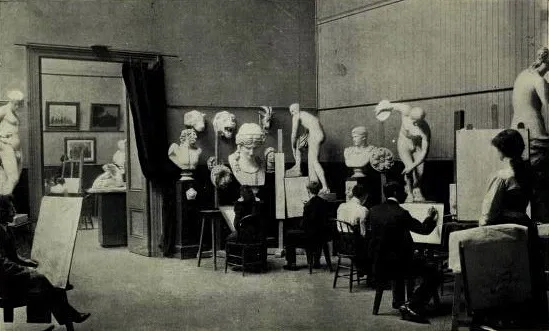
Anonymous, The Antique Room, plate from The Leeds Institute of Science, Art, and Literature: Historical Sketch, 1824-1900 (Leeds: Goodall & Suddick, 1901), p. 8.
It has ultimately been the intention of this thesis to demonstrate that the activities associated with this ‘garret’ at 22 East Parade were both informed by and would continue to inform a rich and distinctive exhibitionary culture in Leeds that existed long before the establishment of the municipal City Art Gallery and City Museum in 1888 and 1921 respectively. Furthermore, this study has extended the history and historiography of art and design education in Leeds and has revised and augmented the institutional biography of what would become the Leeds College of Art. Moreover, this thesis has contributed to the recovery of regional agency by relocating what has previously been cast as peripheral activity to a central position, thus providing a critical framework through which further studies of material culture outside the metropolis could be pursued.
Christopher Wilson’s Estate, Leeds, Deeds and Papers, West Yorkshire Archive Service, Leeds, WYL160/32
Leeds Institute Records 1826-1956, MS papers, West Yorkshire Archive Service, Leeds, WYL368
Oates Family of Leeds Records, MS papers, West Yorkshire Archive Service, Leeds, WYL36
Personal Papers of Edward Baines the Elder and Edward Baines the Younger, MS papers, West Yorkshire Archive Service, Leeds, WYL383
Catalogue of the Exhibition of Paintings, Curiosities, Models, Apparatus and Specimens of Nature and Art, at the Music-Hal, Leeds, for the Benefit of the Mechanics’ Institution; with the Names of the Contributors (Leeds: Edward Baines & Sons, 1839)
Catalogue of the Second Public Exhibition, of Paintings, Sculpture, Curiosities, Models, Apparatus, Machines at Work, and Specimens of Nature and Art: at the Music-Hal, Leeds, for the Benefit of the Mechanics’ Institution & Literary Society, with the Names of the Contributors (Leeds printed by Bolland & Kemplay, 1843)
Catalogue of the Leeds Third Polytechnic Exhibition, for Providing Public Walks and Baths, Containing a Magnificent Colection of Sculpture, Cartoons, Paintings, Antiquities, Curiosities, Philosophical Apparatus, Mechanical Models, &c. with the Names of the Contributors (Leeds: printed by Bolland & Kemplay, 1845)
Department of Practical Art, A Catalogue of the Articles of Ornamental Art, selected fom the Exhibition of the Works of Industry of Al Nations in 1851, and Purchased by the Government. Prepared at the Desire of the Lords of the Committee of Privy Council for Trade. With an Appendix (London: Chapman & Hall, 1852)
⎯ A Catalogue of the Articles of Ornamental Art, in the Museum of the Department, For the use of Students and Manufacturers, and the Consultation of the Public. With Appendices, 3rd edn (London: printed by George E. Eyre & William Spottiswoode for Her Majesty’s Stationary Office, 1852)
Department of Science and Art, Catalogues of Specimens of Cabinet Work, and of Studies fom the Schools of Art, exhibited at Gore House, Kensington (London: printed by George E. Eyre & William Spottiswoode for Her Majesty’s Stationary Office, 1853)
Leeds Academy of Arts, Annual Exhibition of the Academy of Arts, 8, Bond Street, Leeds. MDCCCLIII: The first (Leeds: printed by J. Buckton, 1853)
Leeds Philosophical and Literary Society, A Guide to the Museum of the Leeds Philosophical and Literary Society (Leeds: printed by H.W. Walker, 1854)
Norwich School of Design, A Catalogue of the Casts, Figures, &c. Furnished by Government, for the use of the Students at the School of Design at Norwich, and also of a Variety of Articles of French Manufacture, purchased by Government at the Great National Exhibition at Paris in 1844, which have been Deposited at the School of Design, Norwich for One Month (Norwich: printed by Charles Muskett, 1846)
Photographic Society of London, Exhibition of Photographs and Daguerreotypes at the Galery of the Society of Water Colour Painters, 5, Pal Mal East: Third Year (London: printed by Richard Barrett, 1856)
⎯ Exhibition of Photographs and Daguerreotypes at the Galery of the Society of British Artists, Suffolk Street, Pal Mal East: Sixth Year (London: printed by Richard Barrett, 1859)
Robinson, J.C., A Catalogue of the Museum of Ornamental Art at Marlborough House, Pal Mal. (Part I.), 3rd edn (London: printed by George E. Eyre & William Spottiswoode for Her Majesty’s Stationary Office, 1856)
⎯ Catalogue of a Colection of Works of Decorative Art: Being a Selection fom the Museum at Marlborough House, Circulated for Exhibition in Provincial Schools of Art (London: printed by George E. Eyre & William Spottiswoode for Her Majesty’s Stationary Office, 1855)
⎯ Catalogue of a Colection of Works of Decorative Art: Being a Selection fom the Museum at Marlborough House, Circulated for Exhibition in Provincial Schools of Art, 5th edn (London: printed by George E. Eyre & William Spottiswoode for Her Majesty’s Stationary Office, 1856)
⎯ Catalogue of “the Circulating Colection” of Works of Art, Selected fom the Museum at South Kensington: intended for Temporary Exhibition in Provincial Schools of Art (London: printed by George E. Eyre & William Spottiswoode for Her Majesty’s Stationary Office, 1861)
⎯ Italian Sculpture of the Middle Ages and Period of the Revival of Art. A Descriptive Catalogue of the Works forming the above Section of the Museum, with additional Ilustrative Notices (London: Chapman & Hall, 1862)
Science and Art Department of the Committee of Council on Education, Inventory of the Objects in the Art-Division of the Museum at South Kensington, Arranged According to the Dates of their Acquisition. Vol. I. For the Years 1852 to the End of 1867 (London: printed by George E. Eyre & William Spottiswoode for Her Majesty’s Stationary Office, 1868)
West, William and Edward Baines Junior et al, A Description of some of the Principal Paintings, Machinery, Models, Apparatus and other Curiosities at the Leeds Public Exhibition (Leeds: Edward Baines & Sons, 1839)
Wornum, Ralph Nicholson, Catalogue of Ornamental Casts of the Renaissance Styles; Being Part of the Colection of the Department. With Ilustrations in Wood, Engraved by the Female Students of the Wood Engraving Class (London: Longman, Brown, Green & Longmans, 1854)
Baker, Robert, On the State and Condition of the Town of Leeds in the West Riding of the County of York (London: Her Majesty’s Stationary Office, 1842)
Council of the School of Design, Report of the Council of the School of Design, 1842-3 (London: printed by William Clowes & Sons, 1843)
Department of Practical Art, First Report of the Department of Practical Art (London: printed by George E. Eyre & William Spottiswoode for Her Majesty’s Stationary Office, 1853)
Department of Science and Art, First Report of the Department of Science and Art (London: printed by George E. Eyre & William Spottiswoode for Her Majesty’s Stationary Office, 1854)
⎯ Second Report of the Department of Science and Art (London: printed by George E. Eyre & William Spottiswoode for Her Majesty’s Stationary Office, 1855)
⎯ Third Report of the Department of Science and Art (London: printed by George E. Eyre & William Spottiswoode for Her Majesty’s Stationary Office, 1856)
⎯ Fourth Report of the Department of Science and Art (London: printed by George E. Eyre & William Spottiswoode for Her Majesty’s Stationary Office, 1857)
⎯ Fifh Report of the Science and Art Department of the Committee of Council on Education (London: printed by George E. Eyre & William Spottiswoode for Her Majesty’s Stationary Office, 1858)
Dyce, William, Schools of Design. Copies of Reports made by Wiliam Dyce, Esq. Consequent to his Journey on an Inquiry into the State of Schools of Design, in Prussia, Bavaria, and France (London: House of Commons Papers, 1840)
Eastlake, Charles, Daniel Maclise and Richard Redgrave, Reports on the Works sent fom various Schools of Ornamental Art, and Exhibited at Marlborough House in May 1852 (London: printed by George E. Eyre & William Spottiswoode for Her Majesty’s Stationary Office, 1852)
Ewart, William, Report fom Select Committee on Arts and Manufactures: Together with the Minutes of Evidence, and Appendix (London: House of Commons Papers, 1835)
⎯ Report fom the Select Committee on Arts and their Connexion with Manufactures; with the Minutes of Evidence, Appendix and Index (London: House of Commons Papers 1836)
Gibson, Thomas Milner, Report fom the Select Committee on the School of Design (London: House of Commons Papers, 1849)
⎯ Copies of al Reports on the State of the Head or Provincial Schools, made to the Board of Trade, since August 1849 (London: House of Commons Papers, 1850)
Hume, National Galery. – School of Design. – Tower Admissions (London: House of Commons Papers, 1839)
Leeds Academy of Arts, First Annual Report of the Committee of the Leeds Academy of Arts, with List of Subscribers (Leeds: printed by J. Buckton, 1853)
Leeds Government School of Design, Report of the Committee of the Government School of Design, Leeds; for the year ending 31st December, 1848 (Leeds: printed by John Goodall, 1849)
⎯ Report of the Committee of the Government School of Design, Leeds; for the year ending December, 1849 (Leeds: printed by John Mills, 1850)
⎯ Report of the Committee of the Government School of Design, Leeds, for the year ending December 31st, 1851 (Leeds: printed by John Mills, 1852)
Leeds Mechanics’ Institution and Literary Society, Alphabetical Catalogue of the Library of the Leeds Mechanics’ Institution and Literary Society to which are added the Rules of the Institution (Leeds: printed by H.W. Walker, 1847)
⎯ Report Presented to the First General Meeting of the Leeds Mechanics’ Institution and Literary Society, June 20, 1842 (Leeds: printed by Edward Baines & Sons, 1842)
⎯ Report of the Committee of the Leeds Mechanics’ Institution and Literary Society, presented to the annual meeting, on the 18th January, 1844 (Leeds: printed by Edward Baines & Sons, 1844)
⎯ Report of the Committee of the Leeds Mechanics’ Institution and Literary Society, presented to the annual meeting, on the 22nd January, 1845 (Leeds: printed by Edward Baines & Sons, 1845)
⎯ Annual Report of the Committee of the Leeds Mechanics’ Institution and Literary Society, presented to the annual meeting, on the 21st January, 1846 (Leeds: printed by Bolland & Kemplay, 1846)
⎯ Annual Report of the Committee of the Leeds Mechanics’ Institution and Literary Society, presented to the annual meeting, on the 17th January, 1847 (Leeds: printed by Samuel Moxon, 1847)
⎯ Annual Report of the Committee of the Leeds Mechanics’ Institution and Literary Society, presented to the annual meeting, on the 26th January, 1848 (Leeds: Webb, Millington & Co., 1848)
⎯ Annual Report of the Committee of the Leeds Mechanics’ Institution and Literary Society, presented to the annual meeting, on the 26th January, 1849 (Leeds: printed by John Goodall, 1849)
⎯ Annual Report of the Committee of the Leeds Mechanics’ Institution and Literary Society, presented to the annual meeting on the 29th January, 1850 (Leeds: printed by John Mills, 1850)
⎯ Annual Report of the Committee of the Leeds Mechanics’ Institution and Literary Society, presented to the annual meeting, on the 29th [corrected fom the 26th] January, 1851 (Leeds: printed by John Goodall, 1851)
⎯ Annual Report of the Committee of the Leeds Mechanics’ Institution and Literary Society, presented to the annual meeting on the 22nd of January, 1852 (Leeds: printed by John Mills, 1852)
⎯ Annual Report of the Committee of the Leeds Mechanics’ Institution and Literary Society, presented to the annual meeting on the 24th January, 1853 (Leeds: printed by John Goodall, 1853)
⎯ Annual Report of the Committee of the Leeds Mechanics’ Institution and Literary Society, presented to the annual meeting on the 31st January, 1854 (Leeds: printed by John Goodall, 1854)
⎯ Annual Report of the Committee of the Leeds Mechanics’ Institution and Literary Society, presented to the annual meeting, on the 31st January, 1855 (Leeds: printed by John Goodall, 1855)
⎯ Annual Report of the Committee of the Leeds Mechanics’ Institution and Literary Society, presented to the annual meeting, on the 30th January, 1856 (Leeds: printed by John Kershaw & Son, 1856)
⎯ Annual Report of the Committee of the Leeds Mechanics’ Institution and Literary Society, presented to the Annual General Meeting of the Members and Subscribers, on the 30th January, 1857 (Leeds: printed by John Kershaw & Son, 1857)
⎯ Annual Report of the Committee of the Leeds Mechanics’ Institution and Literary Society, presented to the Annual General Meeting of the Members and Subscribers, on the 28th January, 1858 (Leeds: printed by Charles Goodall, 1858)
Leeds Government School of Design, Report of the Committee of the Government School of Design, Leeds, for the year ending December 31st, 1851 (Leeds, 1852)
Leeds School of Practical Art, A Report of the Proceedings at the Annual Conversazione, held in the Lecture Hal of the Mechanics’ Institution & Literary Society, June 3rd, 1857: W. Beckett Denison, President of the School in the Chair (Leeds: printed by Charles Goodall, 1857)
Lefevre, George John Shaw-, Report of a Special Committee of the Council of the Government School of Design (London: printed by William Clowes & Sons for Her Majesty’s Stationary Office, 1847)
Milnes, Richard Monckton, Report of the Second Special Committee of the Council of the Government School of Design (London: printed by William Clowes & Sons for Her Majesty’s Stationary Office, 1847)
Schools of Art, Return of the Amount Granted in respect of Schools of Art in the years 1853, 1854, 1855, and 1856, Respectively (London: House of Commons Papers, 1857)
School of Design, Report made to the Right Honourable Henry Labouchere, M.P., &c. &c. &c., President of the Board of Trade, by the Provisional Council of the School of Design (London: House of Commons Papers, 1841)
⎯ Report of the Council of the School of Design, 1842-3 (London: printed by William Clowes & Sons for Her Majesty’s Stationary Office, 1843)
⎯ Third Report of the Council of the School of Design, for the year 1843-44 London: printed by William Clowes & Sons for Her Majesty’s Stationary Office, 1844)
⎯ Fourth Report of the Council of the School of Design, for the year 1844-45 (London: printed by William Clowes & Sons for Her Majesty’s Stationary Office, 1845)
⎯ Fifh Report of the Council of the School of Design, for the year 1845-46 (London: printed by William Clowes & Sons for Her Majesty’s Stationary Office, 1846)
⎯ Copies of Al Reports on the State of the Head or Provincial Schools, made to the Board of Trade, since August 1849 (London: House of Commons Papers, 1850)
⎯ Reports and Documents Exhibiting the State and Progress of the Head and Branch Schools of Design during the last twelve months (London: House of Commons Papers, 1850)
⎯ Reports and Documents Exhibiting the State and Progress of the Head and Branch Schools of Design, in the year 1850-51 (London: printed by George Edward Eyre & William Spottiswood for Her Majesty’s Stationary Office, 1851)
⎯ Returns, showing the number of Masters and Assistant Masters in the Schools of Design in the United Kingdom (London, 1852)
Shaftesbury, Anthony Ashley Cooper, Earl of. Moral and Religious Education of the Working Classes, the Speech of Lord Ashley, in the House of Commons, on Tuesday, February 28, 1843 (London: John Ollivier, 1843)
Sheffield School of Design, Sixth Annual Report of the Government School of Design, Victoria Street, Glossop Road, Sheffield. With a Report of the Proceedings at the Annual Meeting, held in the Music Hal, Sep. 7, 1848 (Sheffield: printed by George Ridge, 1848)
⎯ A Report of the Proceedings at the Annual Meeting, held in the Music Hal, Sept. 2nd, 1847 (Sheffield: printed by George Ridge, 1847)
Baines, Edward, History, Directory & Gazetteer, of the County of York; with Select Lists of the Merchants & Traders of London, and the Principal Commercial and Manufacturing Towns of England, 2 vols (Leeds: Edward Baines, 1822)
⎯ An Alarm to the Nation on the Unjust, Unconstitutional and Dangerous Measure of State Education Proposed by the Government (London: Ward & Co; Simpkin, Marshall, & Co., 1847)
⎯ Education Best Promoted by Perfect Freedom, not by State Endowments. With Appendix, containing Official Returns of Education, in 1818, 1833, and 1851 (London; Leeds: John Snow & R. Newsome, 1854)
⎯ National Education. Remarks on the Speech and Plan of Lord John Russel (London: Ward & Co., 1856)
⎯ The Social, Educational and Religious State of the Manufacturing Districts; with Statistical Returns of the Means of Education and Religious Instruction in the Manufacturing Districts of Yorkshire, Lancashire, and Cheshire (London; Leeds: Simpkin, Marshall & T. Ward; Baines & Newsome, 1843)
⎯ Strictures on the New Government Measure of Education (London: John Snow, 1853)
⎯ Value of the Sabbath to the Working Classes – A letter to the Rt. Hon. The Earl of Shafesbury (Leeds: printed by Edward Baines & Sons, 1855)
⎯ ‘On the Woollen Manufacture of England, with Special Reference to the Leeds Clothing District’, Journal of the Statistical Society of London, 22:1 (1859), 1-34
Burchett, Richard, On the Central Training School for Art (London: Chapman & Hall, 1858)
Burke, John Bernard, A Genealogical and Heraldic Dictionary of the Peerage and Baronetage of the British Empire, 14th edn (London: Colburn, 1852)
Cole, Henry, On the Functions of the Science and Art Department (London: Chapman & Hall, 1857)
Cole, Henry and Richard Redgrave, Elementary Drawing Schools (London: printed by George E. Eyre & William Spottiswoode, Her Majesty’s Stationary Office, 1852)
⎯ Letter, dated March 10, 1852, addressed to the Right Hon. J.W. Henley, M.P., President of the Board of Trade, &c., &c., &c., by the Superintendents of the Department of Practical Art (London: printed at the Foreign Office, 1852)
⎯ Address of the Superintendent of the Department of Practical Art: Delivered in the Theatre at Marlborough House (London: Chapman & Hall, 1853)
Department of Science and Art, Correspondence between the Lords of the Committee of Privy Council for Trade, and the Lord Commissioners of Her Majesty’s Treasury, on the Constitution of the Department of Science and Art (London: printed by John Harrison & Sons, 1853)
Dyce, William, The Drawing Book of the Government School of Design (London: Chapman & Hall, 1842)
Fergusson, James, On a National Colection of Architectural Art (London: Chapman & Hall, 1858)
Fisher, John ed., An Ilustrated Record of the Retrospective Exhibition held at South Kensington 1896 (London: Chapman & Hall, 1897)
Fison, William, Mrs., Handbook of the British Association for the Advancement of Science (London: Longman, Green, Longman, and Roberts, 1859)
Haddock, G., Some Early Musical Recolections of G. Haddock, 2nd edn (London: Schott, 1906)
Hall, Samuel Carter, ed., ‘John Henning’, The Art-Journal, 11 (1849), 112-114
Haydon, Benjamin Robert, Lectures on Painting and Design, 2 vols (London: Longman, Green, Brown & Longmans, 1844-1846)
Hole, James, “Light, more Light!” On the Present State of Education amongst the Working Classes of Leeds, and How it can Best be Improved (London: Longman, Green, Longman & Roberts, 1860)
Hudson, J.W., The History of Adult Education, in which is comprised a Ful and Complete History of the Mechanics’ and Literary Institutions, Athenæums, Philosophical, Mental and Christian Improvement Societies, Literary Unions, Schools of Design, etc., of Great Britain, Ireland, America, etc. etc. (London: Longman, Brown, Green & Longman’s, 1851)
Hunt, Robert, A Popular Treatise on the Art of Photography, including Daguerreotype and al the new methods of producing pictures by the chemical agency of light (Glasgow: Richard Griffin, 1841)
⎯ Researches on Light: An Examination of al the Phenomena Connected with the Chemical and Molecular Changes produced by the Influence of the Solar Rays; embracing al the known Photographic Processes, and new Discoveries in the Art (London: printed by Longman, Brown, Green & Longmans, 1844)
⎯ The Poetry of Science, or Studies of the Physical Phenomena of Nature, 2nd edn (London: Reeve, Benham & Reeve, 1849)
⎯ Panthea, the Spirit of Nature (London: Reeve, Benham & Reeve, 1849)
⎯ Companion to the Official Catalogue. Synopsis of the Contents of the Great Exhibition of 1851, 9th edn (London: Spicer Brothers & W. Clowes & Sons, 1851)
⎯ Hunt’s Hand-Book to the Official Catalogues: An Explanatory Guide to the Natural Productions and Manufactures of the Great Exhibition of the Industry of Al Nations, 1851 (London: Spicer Brothers & W. Clowes & Sons, 1851)
Knight, Charles ed., The Land We Live In: A Pictorial and Literary Sketch-Book of the British Empire, vol. iii (London: Wm. S. Orr & Co., 1856)
Leeds Institute of Science, Art and Literature, The Leeds Institute of Science, Art, and Literature: Historical Sketch, 1824-1900 (Leeds: Goodall & Suddick, 1901)
⎯ The Leeds Institute of Science, Art and Literature: An Historical Sketch of One Hundred Years’ Work, 1824-1923 (Leeds: Jowett & Sowry, 1923)
Marx, Karl, A Contribution to the Critique of Political Economy, edited and translated by Maurice Dobb, original text: 1859 (New York: International, 1970)
Mayhall, John, The Annals and History of Leeds, and other places in the county of York, fom the Earliest Period to the Present Time (Leeds: Joseph Johnson, 1860)
Miller, Fred, The Training of a Crafsman (London: J.S. Virtue, 1898)
Mitchell, Young, Address to the Subscribers and Students, Delivered at the Annual Meeting of the Sheffield School of Design (Sheffield: printed by Robert Leader, 1846)
Morley, Henry, ‘A House Full of Horrors’, Household Words, 6:141 (1852), 265-270
Parsons, Edward, The Civil, Ecclesiastical, Literary, Commercial, and Miscelaneous History of Leeds, Bradford, Wakefield, Dewsbury, Otley, and the district within ten miles of Leeds (Leeds: Frederick Hobson, 1834)
Playfair, Lyon, On Scientific Institutions in Connexion with the Science and Art Department (London: Chapman & Hall, 1857)
Redgrave, Gilbert, R., Manual of Design, compiled fom the writings and addresses of Richard Redgrave, R.A., Surveyor of Her Majesty’s Pictures, Late Inspector-General for Art, Science and Art Department (London: Chapman & Hall, 1876)
Redgrave, Richard, On the Gif of the Sheepshanks Colection, with a view to the Formation of a National Galery of British Art (London: Chapman & Hall, 1857)
⎯ An Elementary Manual of Colour, with a Catechism, 4th edn (London: Chapman & Hall, 1853; repr. 1867)
Reid, Thomas Wemyss, ed., A Memoir of John Deakin Heaton, M.D. of Leeds (London: Longmans, Green & Co., 1883)
Reynolds, Joshua, Sir, Seven Discourses Delivered in the Royal Academy by the President (London: printed for T. Cadell, 1778)
Robinson, J.C., On the Museum of Art, (London: Chapman & Hall, 1858)
⎯ The Treasury of Ornamental Art: Ilustrations of Objects and Vertù, Photographed fom the Originals and Drawn on Stone by F. Bedford; with Descriptive Notices by J.C. Robinson (London: Day & Son, 1857 or 1858)
Sarsfield Taylor, W. B., The Origin, Progress, and Present Condition of the Fine Arts in Great Britain and Ireland, 2 vols (London: Whittaker, 1841)
Smiles, Samuel, The Diffusion of Political Knowledge among the Working Classes. An Address Delivered before the Members of the Bradford United Reform Club, February 14, 1842 (Leeds: Buckton, 1842)
⎯ Self-Help; with Ilustrations of Character and Conduct (London: John Murray, 1859)
Society for Promoting Practical Design, Account of the Inaugural Meeting of the Society for Promoting Practical Design and Diffusing a Knowledge and Love of the Arts among the People (London: Taylor & Walton, 1838)
Solly, Edward, Trade Museums, their Nature and Uses: considered in a letter addressed, by permission, to H.R.H. The Prince Albert (London: Longman, Brown, Green & Longmans, 1853)
Taylor, Richard Vickerman, The Biographia Leodiensis; or, Biographical Sketches of the Worthies of Leeds and Neighbourhood, fom the Norman Conquest to the Present Time (London: Simpkin, Marshall & Co; Leeds: John Hamer, 1865)
Taylor, Tom, ed., Life of Benjamin Robert Haydon, Historical Painter, fom his Autobiography and Journals, 2 vols (New York: Harper & Brothers, 1859)
Wampen, Henry, A Remark on the Great Exhibition as an Industrial University (London: printed by T. Brettell, 1852)
Winkelmann, Johann Joachim, Reflections on the Imitation of Greek Works in Painting and Sculpture, trans. by Elfriede Heyer and Roger C. Norton, original text: 1755 (La Salle, Illinois: Open Court, 1987)
Winkelmann, Johann Joachim, History of the Art of Antiquity, trans. by Harry Francis Mallgrave, original text: 1764 (Los Angeles: Getty Research Institute, 2006)
Wornum, Ralph Nicholson, Analysis of Ornament: The Characteristics of Styles: An Introduction to the Study of The History of Ornamental Art; Being an Outline of a Course of Sixteen Lectures on the Subject, Originaly Prepared for the Government Schools of Design in the Years 1848, 1849, 1850 (London: Chapman & Hall, 1856)
White, William, History, Gazetteer, and Directory, of the West-Riding of Yorkshire, with the City of York and the Port of Hul, 2 vols (Sheffield: Robert Leader, 1837)
White, William, Directory and Topography of Leeds, Bradford, Halifax, Huddersfield, Wakefield, and the Whole of the Clothing Districts of the West Riding of Yorkshire (Leeds: printed by Baines & Newsome, 1847)
Yapp, G.W., Art-Education at Home and Abroad: The British Museum, The National Galery, and the proposed Industrial University, 2nd edn (London: Chapman & Hall, 1853)
Alberti, Samuel, ‘Natural History and the Philosophical Societies of Late Victorian Yorkshire’, Archives of Natural History, 30:2 (2003), 342-358
Altick, Richard, The Shows of London (Cambridge, Massachusetts; London, England: Harvard University Press, 1978)
Arnold, Dana, Re-presenting the Metropolis: Architecture, Urban Experience and Social Life in London 1800-1840 (Aldershot; Vermont: Ashgate, 2000)
Arscott, Caroline, ”Without distinction of party’: The Polytechnic Exhibitions in Leeds 1839-45′, in The Culture of Capital: Art, Power and the Nineteenth-Century Middle Class, ed. by Janet Wolff and John Seed (Manchester; New York: Manchester University Press, 1988), pp. 135-158
Arscott, Caroline, Griselda Pollock and Janet Wolff, ‘The Partial View: The Visual Representation of the Early Nineteenth-Century Industrial City’, in The Culture of Capital: Art, Power and the Nineteenth-Century Middle Class, ed. by Janet Wolff and John Seed (Manchester: Manchester University Press, 1988), pp. 191-234
Ashwin, Clive, Art Education: Documents and Policies, 1768-1975 (London: Society for Research into Higher Education, 1975)
Baker, Malcolm, and Brenda Richardson, A Grand Design: The Art of the Victoria and Albert Museum, (London: V&A, 1997)
Baker, Malcolm, ‘The Reproductive Continuum: Plaster Casts, Paper Mosaics and Photographs as Complementary Modes of Reproduction in the Nineteenth-Century Museum’, in Plaster Casts: Making, Colecting and Displaying fom Classical Antiquity to the Present, ed. by Rune Frederiksen and Eckart Marchand (Berlin; New York: De Gruyter, 2010), pp. 485-500
Barthes, Roland, ‘The Discourse of History’, Comparative Criticism, 3 (1981), 7-20
Bantock, Geoffrey Herman, Culture, Industrialisation and Education (London: Routledge & Kegan Paul, 1968)
Beard, Mary, ‘Casts and Cast-offs: The Origins of the Museum of Classical Archaeology’, Proceedings of the Cambridge Philological Society, 39 (1993), 1-29
Beattie, Susan, The New Sculpture (New Haven; London: Yale University Press, 1983)
Bell, Quentin, The Schools of Design (London: Routledge & Kegan Paul, 1963)
Bennett, Tony, The Birth of the Museum: History, Theory, Politics (London: Routledge, 1995)
Beresford, Maurice, ‘The Face of Leeds, 1780-1914’, in A History of Modern Leeds, ed. by Derek Fraser (Manchester: Manchester University Press, 1980), pp. 72-112
⎯ East End, West End: The Face of Leeds During Urbanisation 1684-1842 (Leeds: The Thoresby Society, 1988)
Bilbey, Diane and Marjorie Trusted, ‘”The Question of Casts” – Collecting and Later Reassessment of the Cast Collections at South Kensington’, in Plaster Casts: Making, Colecting and Displaying fom Classical Antiquity to the Present, ed. by Rune Frederiksen and Eckart Marchand (Berlin; New York: De Gruyter, 2010), pp. 465-483
Bonser, Kenneth, J., The Music Hal Albion Street: Details of its History fom Various Sources (Leeds [n. pub.] 1957)
Borsay, Peter ed., The Eighteenth-Century Town: A Reader in English Urban History 1688-1820 (London: Longman, 1990)
Boswell, David, ‘Arts with Crafts: Battles over British Art Education and Their Impact on the Leeds Institute’s School of Art’, in Behind the Mosaic: One Hundred Years of Art Education, ed. by Corrine Miller (Leeds: Leeds Museums and Galleries, 2003), pp. 17-19
⎯ ‘A New School of Art for Leeds and the Local Reception of the Arts and Crafts Movement’, in Behind the Mosaic, ed. by Miller, pp. 21-2
⎯ ‘Teaching and Studying at Leeds School of Art and the Climate of Artistic Opinion’, in Behind the Mosaic, ed. by Miller, pp. 27-31
Bradford, Eveleigh, Headingley: ‘This Pleasant Rural Vilage’: Clues to the Past (Huddersfield: Northern Heritage Publications, 2008)
Brears, Peter, Of Curiosities and Rare Things: The Story of Leeds City Museums (Leeds: The Friends of Leeds City Museums, 1989)
Brett, David, ‘Drawing and the Ideology of Industrialization’, Design Issues, 3:2 (1986), 59-72
Briggs, Asa, ed., Chartist Studies (London: Macmillan, 1959)
Budge, Adrian, Early Photography in Leeds, 1839-1870 (Leeds: Leeds Art Galleries, 1981)
Burton, Anthony, Vision & Accident: The Story of the Victoria & Albert Museum (London: V&A, 1999)
⎯ ‘The Uses of the South Kensington Art Collections’, Journal of the History of Colections, 14:1 (2002), 79-95
Carline, Richard, Draw they Must: A History of the Teaching and Examining of Art (London: Arnold, 1968)
Chancellor, Valerie E., ed., Master and Artisan in Victorian England: The Diary of Wiliam Andrews and the Autobiography of Joseph Gutteridge (London: Evelyn, Adams & Mackay, 1969)
Cocks, Anna Somers, The Victoria and Albert Museum: The Making of the Colection (Leicester: Winward, 1980)
Conforti, Michael, ‘The Idealist Enterprise and the Applied Arts’, in A Grand Design: The Art of the Victoria and Albert Museum, ed. by Malcolm Baker and Brenda Richardson (London: V&A, 1997), pp. 23-47
Connor, Peter, ‘Cast-collecting in the Nineteenth Century: Scholarship, Aesthetics, Connoisseurship’, in Rediscovering Helenism: The Helenic Inheritance and the English Imagination ed. by G.W. Clarke (Cambridge: Cambridge University Press, 1989), pp. 187-235
Cunningham, Peter, ‘The Formation of the Schools of Design, 1830-1850, with Special Reference to Manchester, Birmingham and Leeds’ (unpublished doctoral thesis, University of Leeds, 1979)
Davis, Helen, ‘John Charles Robinson’s Work at the South Kensington Museum Part I: The Creation of the Collection of Italian Renaissance Objects at the Museum of Ornamental Art and the South Kensington Museum, 1853-62’, Journal of the History of Colections, 10:2 (1998), 169-188
Denis, Rafael Cardoso, ‘The Educated Eye and the Industrial Hand: Art and Design for the Working Classes in mid-Victorian Britain’ (unpublished doctoral thesis, Courtauld Institute of Art, 1995)
⎯ ‘Teaching by Example: Education and the Formation of South Kensington’s Museums’ in, A Grand Design: The Art of the Victoria and Albert Museum, ed. by Malcolm Baker and Brenda Richardson (London: V&A, 1997), pp. 107-116
⎯ ‘A Preliminary Survey of Drawing Manuals in Britain c. 1825-1875’ in Histories of Art and Design Education, ed. by Mervyn Romans (Bristol: Intellect, 2005), pp. 19-32
Denis, Rafael and Colin Trodd, eds., Art and the Academy in the Nineteenth Century (Manchester: Manchester University Press, 2000)
Derrida, Jacques, Archive Fever: A Freudian Impression, trans. by Eric Prenowitz (Chicago; London: University of Chicago Press, 1996)
Edwards, Steve, The Making of English Photography: Alegories (Pennsylvania: Pennsylvania State University Press, 2006)
Efland, Arthur D., A History of Art Education: Intelectual and Social Currents in the Teaching of the Visual Arts (New York: Teachers College Press, 1990)
Fenton, James, School of Genius: A History of the Royal Academy of Arts (London: Royal Academy of Arts, 2006)
Fielden, Kenneth, ‘Samuel Smiles and Self-Help’, Victorian Studies, 12:2 (1968), 155–176
Foucault, Michel, The Order of Things: An Archaeology of the Human Sciences, trans. by Alan Sheridan Smith (London: Tavistock, 1970)
⎯ The Archaeology of Knowledge, trans. by Alan Sheridan Smith (London: Tavistock, 1972)
⎯ Discipline and Punish: The Birth of the Prison, trans. by Alan Sheridan (London: Allen Lane, 1977)
⎯ ‘Nietzsche, Genealogy, History’, in Language, Counter-Memory, Practice: Selected Essays and Interviews by Michel Foucault, trans. by Donald F. Bouchard and Sherry Simon, ed. by Donald F. Bouchard (Cornell: Cornell University Press, 1977), reprinted in The Foucault Reader, ed. by Paul Rabinow (New York: Pantheon, 1984), pp. 76-100
Fraser, Derek, ‘Politics and Society in the Nineteenth Century’, in A History of Modern Leeds, ed. by Derek Fraser (Manchester: Manchester University Press, 1980), pp. 270-300
⎯ ‘The Life of Edward Baines: A Filial Biography of “The Great Liar of the North”‘, Northern History, 31 (1995), 208–222
Frayling, Christopher, The Royal Colege of Art: One Hundred and Fify Years of Art and Design (London: Barrie & Jenkins, 1987)
⎯ Art and Design: 100 Years at the Royal Colege of Art (London: Collings & Brown; Ilminster: Dennis, 1999)
⎯ Henry Cole and the Chamber of Horrors: The Curious Origins of the Victoria and Albert Museum (London: V&A, 2010)
Frederiksen, Rune and Eckart Marchand, eds., Plaster Casts: Making, Colecting and Displaying fom Classical Antiquity to the Present (Berlin; New York: De Gruyter, 2010)
Giedion, Siegfried, Mechanization Takes Command: A Contribution to Anonymous History (New York: Oxford University Press, 1948)
Goldstein, Carl, Teaching Art: Academies and Schools fom Vasari to Albers (Cambridge: Cambridge University Press, 1996)
Grady, Kevin, ‘Commercial, Marketing and Retail Amenities, 1700-1914’, in A History of Modern Leeds, ed. by Derek Fraser (Manchester: Manchester University Press, 1980), pp. 177-199
Graeme Chalmers, F., ‘Fanny McIan and London’s Female School of Design, 1842-57’, Woman’s Art Journal, 16:2 (1995), 3-9
Gretton, Thomas, ‘‘Art is cheaper and goes lower in France.’ The Language of the Parliamentary Select Committee on the Arts and Principles of Design of 1835-1836’, in Art in Bourgeois Society, 1790-1850, ed. by Andrew Hemingway and William Vaughan (Cambridge: Cambridge University Press, 1998), pp. 84-100
⎯ ‘Difference and Competition: The Imitation and Reproduction of Fine Art in a Nineteenth-Century Illustrated Weekly News Magazine’, Oxford Art Journal, 23:2 (2000), 143-162
⎯ ‘The Mass Image. A Social History of Photomechanical Reproduction in Victorian London’, History of Photography, 34:2 (2010), 207-209
Gunn, Simon, ‘The Public Sphere, Modernity and Consumption: New Perspectives on the History of the English Middle Class’, in Gender, Civic Culture and Consumerism: Middle-Class Identity in Britain, 1800-1940, ed. by Alan Kidd and David Nicholls (Manchester: Manchester University Press, 1999), pp. 12-29
⎯ The Public Culture of the Victorian Middle Class: Ritual and Authority and the English Industrial City 1840-1914 (Manchester; New York: Manchester University Press, 2000)
⎯ ‘‘The Spatial Turn’: Changing Histories of Space and Place’, in Identities in Space: Contested Terrains in the Western City since 1850, ed. by Simon Gunn and R.J. Morris (Aldershot; Burlington, Vermont: Ashgate, 2001), pp. 1-14
Habermas, Jürgen, The Structural Transformation of the Public Sphere: An Inquiry into a Category of Bourgeois Society, trans. by Thomas Burger and Frederick Lawrence, (Cambridge: Polity Press, 1989; repr. 2002)
Hamber, Anthony J., “A Higher Branch of the Art”: Photographing the Fine Arts in England, 1839-1880 (Amsterdam: Gordon & Breach, 1996)
⎯ ‘Building Nineteenth-Century Photographic Resources: The South Kensington Museum and William Blackmore’, Visual Resources, 26:3 (2010), 254-273
Harrison, J.F.C., ‘Chartism in Leeds’, in Chartist Studies, ed. by Asa Briggs (London: Macmillan, 1959), pp. 65-98
Haskell, Francis and Nicholas Penny, Taste and the Antique: The Lure of Classical Sculpture 1500-1900 (New Haven; London: Yale University Press, 1981)
⎯ The Most Beautiful Statues: The Taste for Antique Sculpture 1500-1900 (Oxford, Ashmolean Museum, 1981)
Haworth-Booth, Mark, Photography: An Independent Art: Photographs fom the Victoria and Albert Museum 1839-1996 (London: V&A, 1997)
Hemingway, Andrew and William Vaughan, eds., Art in Bourgeois Society, 1790-1850 (Cambridge: Cambridge University Press, 1998)
Hill, David, Turner in the North (New Haven; London: Yale University Press, 1996)
Hill, David, Turner and Leeds: Image of Industry (Huddersfield: Northern Arts Publications, 2008)
Hill, Kate, ‘Thoroughly embued with the spirit of Ancient Greece’: Symbolism and Space in Victorian Civic Culture’, in Gender, Civic Culture and Consumerism: Middle-Class Identity in Britain, 1800-1940, ed. by Alan Kidd and David Nicholls (Manchester: Manchester University Press, 1999), pp. 99-111
Hobsbawm, Eric, ‘Artisan or Labour Aristocrat?’, Economic History Review, 37:3 (1984), 355-372
Hughes, Anthony and Erich Ranfft eds., Sculpture and its Reproductions (London: Reaktion, 1997)
Irwin, David, ‘Art Versus Design: The Debate 1760-1860’, Journal of Design History, 4:4 (1991), 219-232
James, Elisabeth, ed. The Victoria and Albert Museum: A Bibliography and Exhibition Chronology, 1852-1996 (London: V&A, 1997)
Jenkins, Ian, ‘Acquisition and Supply of Casts of the Parthenon Sculptures by the British Museum, 1835-1939’, The Annual of the British School at Athens, 85 (1990), 89-114
Jeremiah, David, School of Art: A Hundred Years and More (Manchester: Manchester Polytechnic, 1980)
Jesperson, John Kresten, ‘Originality and Jones’ The Grammar of Ornament of 1856’, Journal of Design History, 21:2 (2008), 143-153
Kidd, Alan and David Nicholls eds., Gender, Civic Culture and Consumerism: Middle Class Identity in Britain, 1800-1940 (Manchester: Manchester University Press, 1999)
⎯ The Making of the British Middle Class? Studies of Regional and Cultural Diversity since the Eighteenth Century (Gloucestershire: Sutton, 1998)
Kirby, John, Useful and Celebrated: The Sheffield School of Art, 1843-1940 (Sheffield: Sheffield City Polytechnic & Sheffield Arts Department, 1987)
Kitson Clark, Edwin, The History of 100 Years of Life of the Leeds Philosophical and Literary Society (Leeds: Jowett & Sowry, 1924)
Korzenik, Diana, ‘How to Draw’ Books as Sources for Understanding Art Education of the Nineteenth Century’, in Histories of Art and Design Education, ed. by Mervyn Romans (Bristol: Intellect, 2005), pp. 33-40
Kriegel, Lara, Grand Designs: Labor, Empire, and the Museum in Victorian Culture (Durham, NC; London: Duke University Press, 2007)
Kristeller, Paul O., ‘The Modern System of the Arts: A Study in the History of Aesthetics, part I’, Journal of the History of Ideas, 12:4 (1951), 496-527
⎯ ‘The Modern System of the Arts: A Study in the History of Aesthetics, part II’, Journal of the History of Ideas, 13:1 (1952), 17-46
Kurtz, Donna Carol, The Reception of Classical Art in Britain: An Oxford Story of Plaster Casts fom the Antique (Oxford: Archaeopress, 2000)
Kusamitsu, Toshio, ‘Great Exhibitions before 1851’, History Workshop, 9:1 (1980), 70-89
Langton, John and R.J. Morris eds., Atlas of Industrializing Britain 1780-1914 (London; New York: Methuen, 1986)
The Leeds Institute of Science, Art, and Literature: Historical Sketch, 1824-1900 (Leeds: Goodall & Suddick, 1901)
The Leeds Institute of Science, Art and Literature: An Historical Sketch of One Hundred Years Work, 1824-1923 (Leeds: Jowett & Sowry, 1923)
Lefebvre, Henri, The Production of Space, trans. Donald Nicholson-Smith, (Oxford; Malden: Blackwell, 1974; repr. 2001)
Lomax, James, ‘Buying Antiques in Early Victorian Leeds: The 1843 Exhibition’, Furniture History, 33 (1997), 275-285
Lubbock, Jules, The Tyranny of Taste: The Politics of Architecture and Design in Britain 1550-1960 (New Haven; London: Yale University Press, 1995)
Lyon, Philippa and Jonathan M. Woodham, eds. Art and Design at Brighton 1859-2009: From Arts and Manufactures to the Creative and Cultural Industries (Brighton: University of Brighton, 2009)
Macdonald, Stuart, The History and Philosophy of Art Education (London: University of London Press, 1970)
Macleod, Dianne Sachko, Art and the Victorian Middle Class: Money and the Making of Cultural Identity (Cambridge: Cambridge University Press, 1996)
Massey, Doreen, Spatial Divisions of Labour: Social Structures and the Geography of Production (London: Macmillan Press, 1984)
Malone, Peter, ‘How the Smiths Made a Living’, in Plaster Casts: Making, Colecting and Displaying fom Classical Antiquity to the Present, ed. by Rune Frederiksen and Eckart Marchand (Berlin; New York: De Gruyter, 2010), pp. 163-177
Miller, Corrine, ed. Behind the Mosaic: One Hundred Years of Art Education (Leeds: Leeds Museums and Galleries, 2003)
Minihan, Janet, The Nationalization of Culture: The Development of State Subsidies to the Arts in Great Britain (London: Hamish Hamilton, 1977)
Minto, William, ed. Autobiographical Notes of the Life of Wiliam Bel Scott H.R.S.A., L.L.D. And Notices of his Artistic and Poetic Circle of Friends 1830 to 1882, vol. 1 (New York: AMS, 1970)
Morgan, C. J., ‘Demographic Change, 1771-1911’, in A History of Modern Leeds, ed. by Derek Fraser (Manchester: Manchester University Press, 1980), pp. 46-71
Morgan, Simon James, ‘Middle-class Women, Civic Virtue and Identity: Leeds and the West Riding of Yorkshire, c. 1830 – c. 1860’ (unpublished doctoral thesis, University of York, 2000)
Morris, Edward and Emma Roberts, The Liverpool Academy and Other Exhibitions of Contemporary Art in Liverpool 1774-1867: A History and Index of Artists and Works Exhibited (Liverpool: Liverpool University Press and National Museums & Galleries on Merseyside, 1998)
Morris, R. J., ‘Leeds and the Crystal Palace: A Provincial-Metropolitan Link Bringing Education to Industrial Society’, Victorian Studies, 13:3 (1970), 282-300
⎯ Class, Sect and Party: The Making of British Middle Class, Leeds 1820-1850 (Manchester: Manchester University Press, 1990)
⎯ ‘Voluntary Societies and British Urban Elites 1780-1850: An Analysis’, in The Eighteenth-Century Town: A Reader in English Urban History 1688-1820, ed. by Peter Borsay (London; New York: Longman, 1990), pp. 338-366
Norton, Jane Elizabeth, Guide to the National and Provincial Directories of England and Wales, Excluding London, Published before 1856 (London: Royal Historical Society, 1984)
Pearson, Robin, ‘Knowing One’s Place: Perceptions of Community in the Industrial Suburbs of Leeds, 1790-1890’, Journal of Social History, 27:2 (1993), 221-244
Pevsner, Nicholaus, Academies of Art Past and Present (Cambridge: Cambridge University Press, 1940)
⎯ High Victorian Design: A Study of the Exhibits of 1851 (London: Architectural Press, 1951)
Physick, John, Photography and the South Kensington Museum (London: V&A, 1975)
⎯ The Victoria and Albert Museum: The History of its Building (London: V&A, 1982)
Plamenatz, John, The English Utilitarians (Oxford: Basil Blackwell, 1949)
Pointon, Marcia, Wiliam Dyce 1806-1864: A Critical Biography (Oxford: Clarendon Press, 1979)
Poovey, Mary, Making a Social Body: British Cultural Formation 1830-1864 (Chicago; London: University of Chicago Press, 1995)
Pope, Williard Bissell, ed. The Diary of Benjamin Robert Haydon, 4 vols. (Cambridge, Massachusetts: Harvard University Press, 1960-1963)
Poulet, Anne L. et al, Jean-Antoine Houdon: Sculptor of the Enlightenment (Washington: National Gallery of Art and University of Chicago Press, 2003)
Purbrick, Louise, ‘South Kensington Museum: The Building of the House of Henry Cole’, in Art Apart: Art Institutions and Ideology across England and North America, ed. by Marcia Pointon (Manchester and New York: Manchester University Press, 1994), pp. 69-8
Pykett, Lyn, ‘Reading the Periodical Press: Text and Context’, in Investigating Victorian Journalism, ed. by Laurel Brake, Aled Jones and Lionel Madden (Basingstoke: Macmillan, 1990), pp. 3-18
Quinn, Malcolm, ‘The Political Economic Necessity of the Art School 1835-52’, International Journal of Art & Design Education, 30:1 (2011), 62-70
Rifin, Adrian, ‘Success Disavowed: The Schools of Design in Mid-Nineteenth Century Britain. (An Allegory)’, Journal of Design History, 1:2 (1988), 89-102
Ricoeur, Paul, Time and Narrative, vol. 3, translated by Kathleen Blamey and David Pellauer (Chicago: University of Chicago Press, 1988)
Romans, Mervyn, ‘Political, Economic, Social and Cultural Determinants in the History of Early to Mid-nineteenth Centur y Art and Design Education in Britain’ (unpublished doctoral thesis, University of Central England, 1998)
⎯ ‘Living in the Past: Some Revisionist Thoughts on the Historiography of Art and Design Education’, International Journal of Art & Design Education, 23:3 (2004), 270-277
⎯ ‘Social Class and the Origin of Public Art and Design Education in Britain: In Search of a Target Group’ in Histories of Art and Design Education: Colected Essays ed. by Mervyn Romans (Bristol: Intellect, 2005), pp. 55-65
⎯ ‘An Analysis of the Political Complexion of the 1835/6 Select Committee on Arts and Manufactures’, International Journal of Art & Design Education, 26:2 (2007), 215-224
Sennet, Richard, ed., Classic Essays on the Culture of Cities (New York: Appleton Century Crofts Educational Division, Meredith Corporation, 1969)
Sennett, Richard, The Crafsman (London: Penguin, 2008)
Sheppard, F.H.W., ed., Survey of London: The Parish of St Anne, Soho, vols. 33 and 34 (London: Athlone, 1966)
⎯ Survey of London: The Museums Area of South Kensington and Westminster, vol. 38 (London: Athlone, 1975)
Shiff, Richard, ‘Phototropism (Figuring the Proper)’, Studies in the History of Art, 20 (1989), 161-180
Sloboda, Stacey, ‘The Grammar of Ornament: Cosmopolitanism and Reform in British Design’, Journal of Design History, 21:3 (2008), 223-236
Stevens, Timothy and Peter Trippi, ‘An Encyclopedia of Treasures: The Idea of the Great Collection’ in A Grand Design: The Art of the Victoria and Albert Museum, ed. by Malcolm Baker and Brenda Richardson (London: V&A Publications, 1997), pp. 149-160
Surtees, Virginia, ed., Sublime & Instructive: Letters fom John Ruskin to Louisa, Marchioness of Waterford, Anna Blunden and Elen Heaton (London: Michael Joseph, 1972)
Sutton, Gordon, Artisan or Artist? A History of the Teaching of Art and Crafs in English Schools (Oxford: Pergamon, 1967)
Thornton, David, ‘Mr Mercury – A Biographical Study of Edward Baines with special reference to his role as Editor, Author and Politician’ (unpublished doctoral thesis, University of Leeds, 1999)
Trodd, Colin, ‘Formations of Cultural Identity: Art Criticism, the National Gallery and the Royal Academy, 1820-1863’ (unpublished doctoral thesis, University of Sussex, 1992)
⎯ ‘Culture, Class, City: The National Gallery, London and the Spaces of Education, 1822-57’, in Art Apart: Art Institutions and Ideology across England and North America, ed. by Marcia Pointon (Manchester and New York: Manchester University Press, 1994), pp. 33-49
⎯ ‘The Authority of Art: Cultural Criticism and the Idea of the Royal Academy in Mid-Victorian Britain’, Art History, 20:1 (1997), 3-22
⎯ ‘The Discipline of Pleasure; or, How Art History Looks at the Art Museum’, Museum and Society, 1:1 (2003), 17-29
Unwin, R.W., ‘Leeds Becomes a Transport Centre’ in A History of Modern Leeds, ed. by Derek Fraser (Manchester: Manchester University Press, 1980), pp. 113-141
Valentine, Helen and Mary Anne Stevens, From Reynolds to Lawrence: The First Sixty Years of the Royal Academy of Arts and its Colections: A Short Catalogue of the Paintings, Sculptures and Plaster Casts shown in the Private Rooms and the New Sculpture Galery at Burlington House (London: Royal Academy of Arts, 1991)
Valentine, Helen, ‘The Royal Academy Schools in the Victorian Period’, in Art in the Age of Queen Victoria: Treasures fom the Royal Academy of Arts Permanent Colection, ed. by Helen Valentine (New Haven; London: Yale University Press, 1999), pp. 40-47
Webb, Jane Alexandra, ‘An Analysis of the Select Committee on Arts and Manufactures of 1835-6: Anatomy, Benthamism and Design’ (unpublished doctoral thesis, University of Wolverhampton, 2003)
Wach, Howard M., ‘Culture and the Middle Classes: Popular Knowledge in Industrial Manchester’, The Journal of British Studies, 27:4 (1988), 375-404
Wainwright, Clive, ‘Principles True and False: Pugin and the Foundation of the Museum of Manufactures’, The Burlington Magazine, 136:1095 (1994), 357-364
⎯ ‘The Making of the South Kensington Museum I: The Government Schools of Design and the Founding Collection, 1837-51’, Journal of the History of Colections, 14:1 (2002), 3-23
⎯ ‘The Making of the South Kensington Museum II: Collecting Modern Manufactures: 1851 and the Great Exhibition’, Journal of the History of Colections, 14:1 (2002), 25-44
⎯ ‘The Making of the South Kensington Museum III: Collecting Abroad’, Journal of the History of Colections, 14:1 (2002), 45-61
⎯ ‘The Making of the South Kensington Museum IV: Relationships with the Trade: Webb and Bardini’, Journal of the History of Colections, 14:1 (2002), 63-78
Wallach, Alan, ‘The American Cast Museum: An Episode in the History of the Institutional Definition of Art’, in Exhibiting Contradiction: Essays on the Art Museum in the United States by Alan Wallach (Amherst: University of Massachusetts Press, 1998), pp. 38-56
Walsh, William Henry, An Introduction to the Philosophy of History (Bristol: Thoemmes, 1992)
Wahrman, Dror, Imagining the Middle Class: The Political Representation of Class in Britain, c. 1780-1840 (Cambridge: Cambridge University Press, 1995)
Ward, David, ‘Environs and Neighbours in the “Two Nations”: Residential Differentiation in Mid Nineteenth Century Leeds’, Journal of Historical Geography, 6:2 (1980), 133-162
Westgarth, Mark, ‘The Emergence of the Antique and Curiosity Dealer 1815-c.1850: The Commodification of Historical Objects’, 3 vols. (unpublished doctoral thesis: University of Southampton, 2006)
White, Hayden, Tropics of Discourse: Essays in Cultural Criticism (Baltimore; London, John Hopkins University Press, 1978)
⎯ The Content of the Form: Narrative Discourse and Historical Representation (Baltimore; London: John Hopkins University Press, 1987)
Williams, Raymond, Culture and Society 1780-1950 (London: Chatto & Windus, 1958; Middlesex: Penguin, 1958; repr. 1979)
Williamson, Paul, ed. European Sculpture at the Victoria and Albert Museum (London: V&A, 1996)
Wolff, Janet and John Seed eds. The Culture of Capital: Art, Power and the Nineteenth Century Middle Class (Manchester: Manchester University Press, 1988)
Wood, Paul, ‘Between God and the Saucepan: Some Aspects of Art Education in England from the Mid-Nineteenth Century’, in The History of British Art: 1870-Now, vol. 3, ed. by Chris Stephens (London: Tate, 2008), pp. 164-187
Yasuko, Suga, ‘Designing the Morality of Consumption: “Chamber of Horrors at the Museum of Ornamental Art, 1852-53’, Design Issues, 20:4 (2004), 43-56
| Employment | No. | Employment | No. |
|---|---|---|---|
| Architects | 2 | Painters & Decorators | 17 |
| Boot Maker | 1 | Plasterers | 4 |
| Block Cutter | 1 | Seal Engraver | 1 |
| Carvers and Gilders | 5 | Saddler | 1 |
| Clerks | 17 | School Boys | 18 |
| China & Glass Cutter | 1 | Upholsterers | 8 |
| Designers for Paper | 5 | Wire Worker | 1 |
| Engravers | 10 | Wood Carvers | 3 |
| Figure Maker | 1 | Whitesmith | 1 |
| Joiners | 2 | Engineers | 2 |
| Land Surveyor | 1 | Designers for Local Manufactures | 18 |
| Masons, Ornamental | 10 | Medical Students | 3 |
| Mechanic | 1 | = 137 |
Appendix 1 Table showing the occupations of the male students of the Leeds School of Design in 1848, from the Report of the Committee of the Government School of Design, Leeds; for the year ending 31st December, 1848, p. 4
| Employment | No. | Employment | No. |
|---|---|---|---|
| Architects | 10 | Mechanics | 2 |
| Book-keepers | 2 | Masons | 2 |
| Block Cutter | 1 | Painters and Decorators | 18 |
| Coach Painter | 1 | Plasterer | 1 |
| Clerks | 2 | Schoolmasters | 3 |
| Designers for Paper | 7 | Stone Carvers | 6 |
| Designers for local Manufactures | 10 | Saddler | 1 |
| Engineer | 1 | School-boys | 20 |
| Engravers | 11 | Teachers in National Schools | 2 |
| Figure Maker | 1 | Tailors | 3 |
| Gardeners | 3 | Upholsterers | 4 |
| Ironmongers | 2 | Wood Carvers | 5 |
| Land Surveyor | 1 | Woollen Manufacturers | 2 |
| Manufacturing Chemist | 1 | = 122 |
Appendix 2 Table showing the occupations of the male students of the Leeds School of Design in 1849, from the Report of the Committee of the Government School of Design, Leeds; for the year ending December, 1849, p. 4
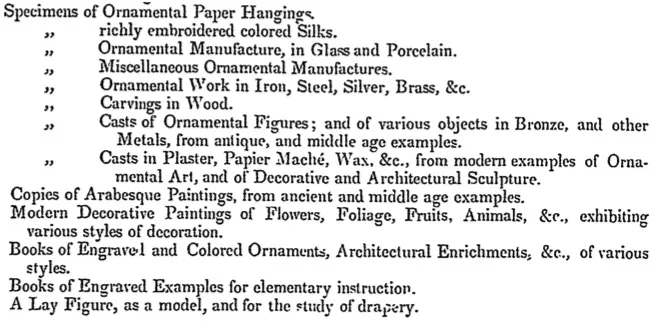
Appendix 3 List of examples to be purchased by Charles Heath Wilson from the Exposition de L’Industrie Française année 1844. Recorded in The Fourth Report of the Council of the School of Design, for the year 1844-45 (London: printed by William Clowes and Sons for Her Majesty’s Stationary Office, 1845) p. 11

Appendix 4 ‘Examples of various Ornamental Manufactures and of Decorative Painting, Books of Plates on Ornament, &c., being purchases made by the Director in Paris’, The Fourth Report of the Council of the School of Design, for the year 1844-45 (London: printed by William Clowes and Sons for Her Majesty’s Stationary Office, 1845) p. 38
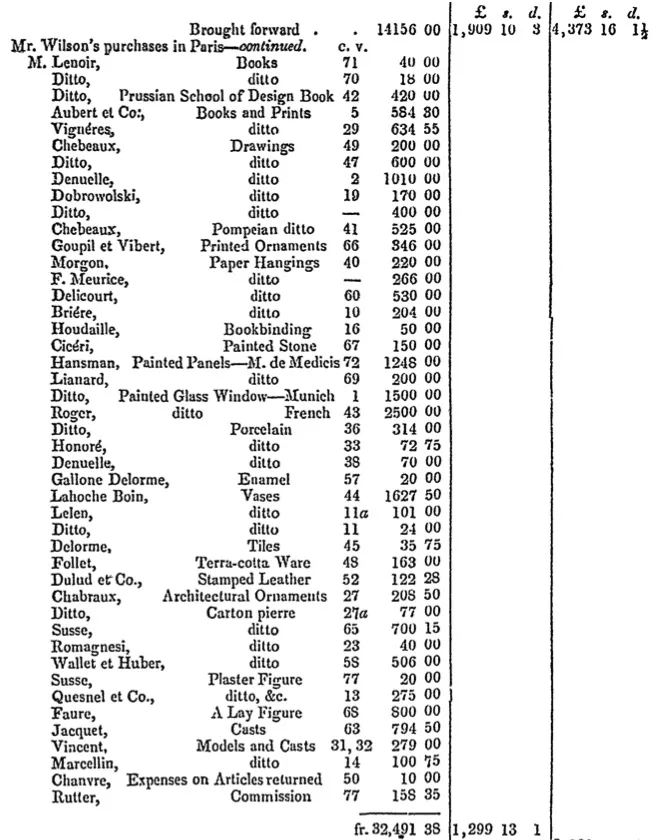
Appendix 5 ‘Mr. Wilson’s purchases in Paris – continued’, The Fourth Report of the Council of the School of Design, for the year 1844-45 (London: printed by William Clowes and Sons for Her Majesty’s Stationary Office, 1845) p. 39
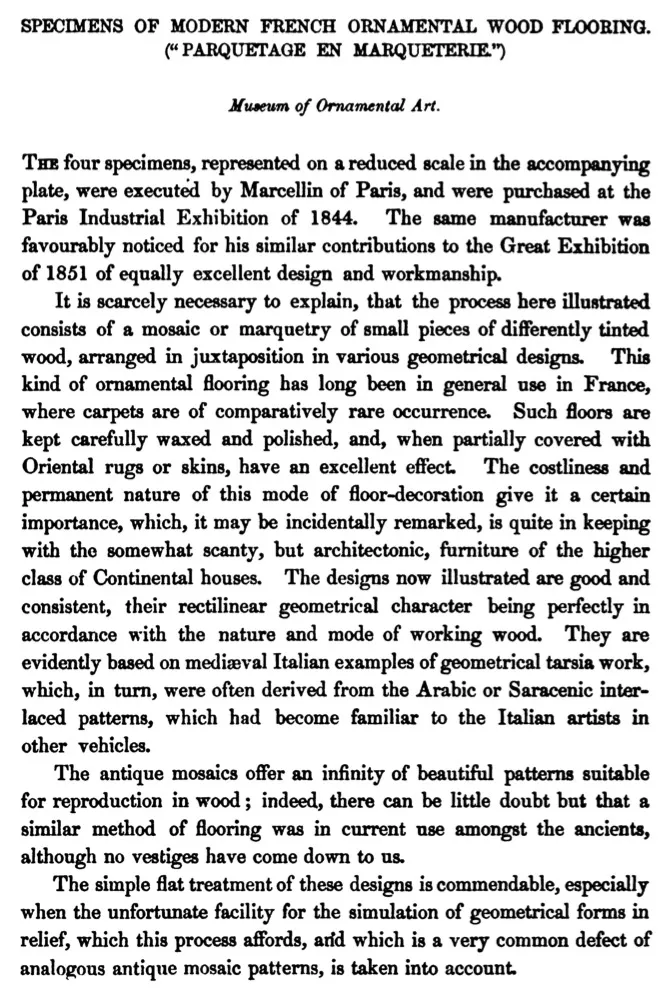
Appendix 6 J.C. Robinson, ‘Specimens of Modern French Ornamental Wood Flooring’, in The Treasury of Ornamental Art: Ilustrations of Objects and Vertù, Photographed fom the Originals and Drawn on Stone by F. Bedford; with Descriptive Notices by J.C. Robinson (London: Day and Son, 1857)

Appendix 7 Copy of a Circular to the Local Schools of Art on the Regulations for the Exhibition of the Circulating Collection, Catalogue of a Colection of Works of Decorative Art: Being a Selection fom the Museum at Marlborough House, Circulated for Exhibition in Provincial Schools of Art (London: printed by George E. Eyre and William Spottiswoode for Her Majesty’s Stationary Office, 1855), p. 2
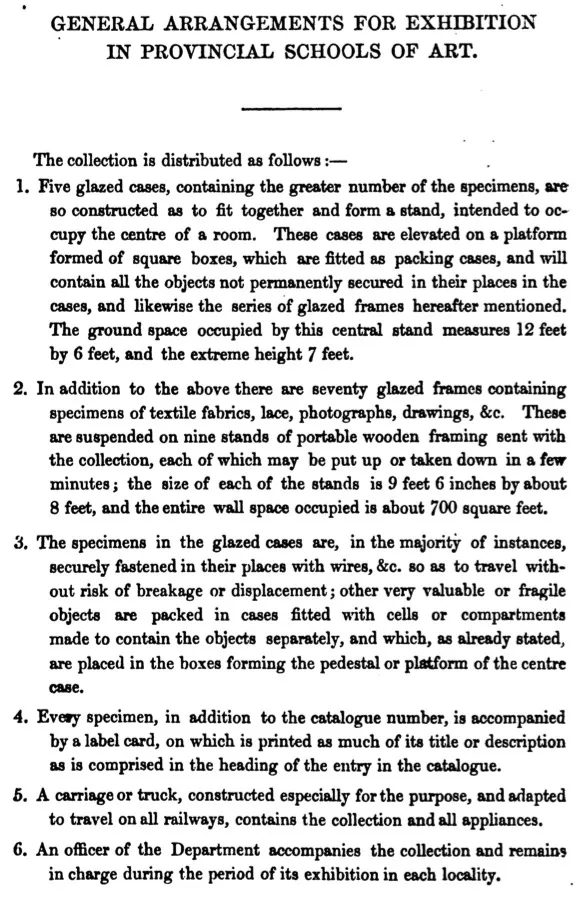
Appendix 8 ‘General Arrangements for Exhibition in Provincial Schools of Art’, Catalogue of a Colection of Works of Decorative Art: Being a Selection fom the Museum at Marlborough House, Circulated for Exhibition in Provincial Schools of Art (London: printed by George E. Eyre and William Spottiswoode for Her Majesty’s Stationary Office, 1855), p. 7

Appendix 9 Classification of the Circulating Museum Collection, Third Report of the Department of Science and Art (London: printed by George E. Eyre and William Spottiswoode for Her Majesty’s Stationary Office, 1856), p. 120
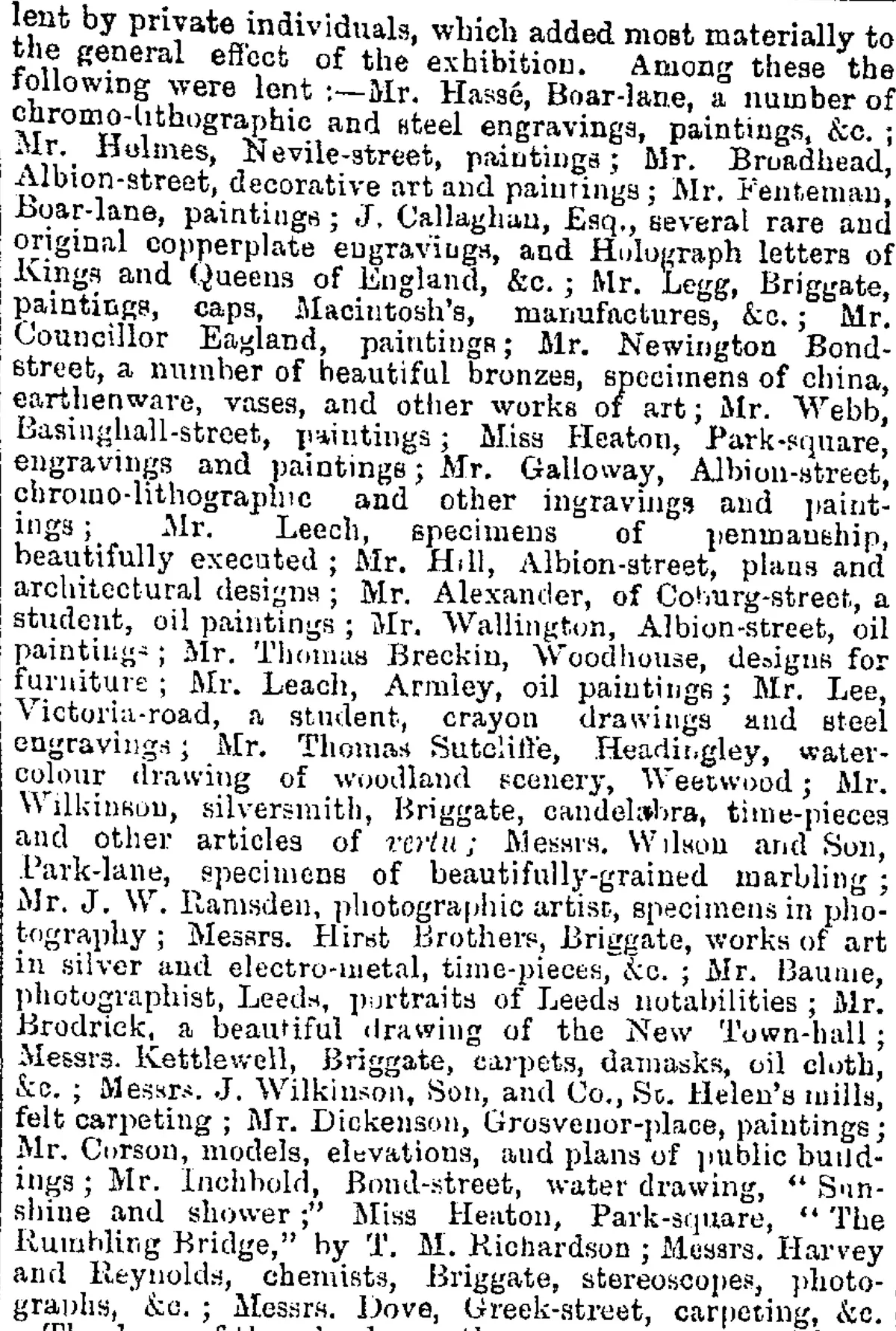
Appendix 10 A list of local donations to the Circulating Collection, ‘Leeds School of Practical Art. Great Exhibition & Conversazione Last Night’, Leeds Mercury, 20 November 1855, p. 3
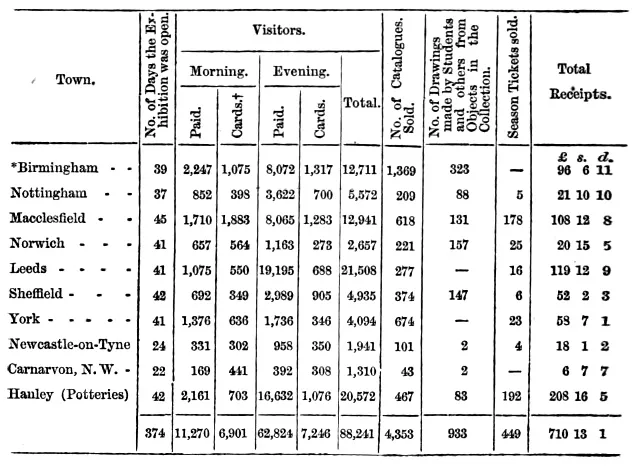
Appendix 11 Table of Returns of Visitors and Receipts for the Circulating Collection, February 1855 to November 1856, Catalogue of a Colection of Works of Decorative Art: Being a Selection fom the Museum at Marlborough House, Circulated for Exhibition in Provincial Schools of Art , 5th edn (London: printed by George E. Eyre and William Spottiswoode for Her Majesty’s Stationary Office, 1856), p. 8
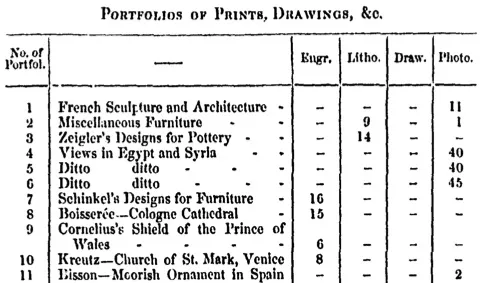
Appendix 12 Portfolios of Prints, Drawings, &c., First Report of the Department of Science and Art (London: printed by George E. Eyre and William Spottiswoode for Her Majesty’s Stationary Office, 1854), p. 342

All work is written by human writers. 100% AI free, guaranteed.

100% money back guarantee if you find plagiarism in our work.
COMPANY DETAILS