
A real Undergraduate psychology research paper sample, free to read in full below — get one written for your own title, or browse more research paper samples.
Type
Research Paper
Subject
Psychology
Level
Undergraduate
Word count
2,782
Quality
1st / 74%
The proliferation of social media platforms has fundamentally reshaped adolescent social life, raising urgent questions about its psychological consequences. This paper examines the relationship between social media use and adolescent mental health, focusing on depression, anxiety and self-esteem.
Adopting a quantitative cross-sectional design, illustrative survey data from 220 adolescents aged 13 to 18 were analysed to explore associations between usage patterns and wellbeing indicators. The study distinguishes between active and passive engagement, alongside daily screen time.
Findings suggest that higher passive consumption and prolonged daily use correlate with elevated anxiety and lower self-esteem, whereas active, interactive use shows weaker and sometimes protective associations. Social comparison and fear of missing out emerged as salient mediating mechanisms.
The paper argues that duration alone is an insufficient predictor; the quality and nature of engagement matter considerably. Implications for parents, educators and clinicians are discussed, alongside recommendations for digital literacy interventions and future longitudinal research to establish causality.
Keywords: social media, adolescent mental health, depression, anxiety, self-esteem, social comparison, fear of missing out
Adolescence represents a critical developmental period characterised by identity formation, heightened sensitivity to peer evaluation and significant neurobiological change. Contemporary young people navigate these challenges within a pervasive digital environment that previous generations did not encounter.
Social media platforms such as Instagram, TikTok, Snapchat and YouTube now occupy a central role in adolescent socialisation. Recent estimates suggest that most adolescents in Western nations use social media daily, with many reporting near-constant connectivity (Ofcom, 2022).
This ubiquity has generated considerable public and academic concern. Commentators have questioned whether escalating rates of adolescent depression and anxiety are linked to the rise of smartphone and social media adoption (Twenge, 2017).
The problem, however, is far from settled. The empirical literature remains contested, with some studies reporting substantial harms and others finding negligible or even beneficial effects (Orben and Przybylski, 2019). This inconsistency demands careful, nuanced investigation.
A key limitation of existing debate is its tendency to treat social media use as a single, undifferentiated behaviour. Aggregating diverse activities under a single “screen time” measure may obscure meaningful differences between types of engagement.
This paper responds by distinguishing between active use, involving direct interaction and content creation, and passive use, involving scrolling and consumption without interaction. It further considers psychological mechanisms that may explain observed associations.
The overarching aim is to critically examine how patterns of social media use relate to adolescent mental health outcomes, and to identify the mechanisms through which these effects may operate.
To achieve this aim, the study addresses the following research questions:
The corresponding objectives are to review the relevant literature critically, to gather and analyse illustrative survey data, and to interpret findings in light of established psychological theory. The paper concludes with practical and research recommendations.
This section critically synthesises the existing evidence on social media and adolescent mental health. It is organised around four themes: the correlational evidence base, the active-passive distinction, theoretical mechanisms, and methodological controversies.
A substantial body of research reports positive associations between social media use and internalising symptoms. Kelly et al. (2018), analysing data from the UK Millennium Cohort Study, found that heavy use predicted depressive symptoms, particularly among adolescent girls.
Similarly, Twenge et al. (2018) reported that adolescents spending more time on screen-based activities exhibited lower psychological wellbeing than those engaged in non-screen activities. They interpreted this as evidence of a generational mental health decline.
However, the magnitude of these effects is frequently modest. Orben and Przybylski (2019), using specification curve analysis across large datasets, concluded that the association between digital technology use and adolescent wellbeing was small, explaining minimal variance.
This tension between statistically significant yet practically small effects is central to the field. Critics argue that alarmist interpretations overstate risks, while others contend that even small population-level effects carry public health significance (Twenge et al., 2020).
An influential refinement distinguishes between active and passive engagement. Verduyn et al. (2017) argued that passive use, such as browsing others’ profiles, undermines wellbeing, whereas active use, involving direct communication, can enhance it.
Passive consumption is thought to intensify upward social comparison, exposing adolescents to idealised representations of peers’ lives. Active use, by contrast, may foster connectedness and social capital by strengthening existing relationships (Frison and Eggermont, 2016).
This distinction helps reconcile contradictory findings. Studies aggregating all use into a single metric may cancel out opposing effects, yielding the small overall associations reported by Orben and Przybylski (2019).
Nevertheless, the active-passive dichotomy has been criticised as overly simplistic. Some behaviours, such as posting a photograph and monitoring the responses it attracts, blend both modes, complicating clean categorisation (Valkenburg, 2022).
Social comparison theory (Festinger, 1954) provides a foundational explanatory framework. Adolescents are particularly prone to comparing themselves with peers, and curated online content amplifies opportunities for unfavourable upward comparison.
Empirical work supports this. Vogel et al. (2014) demonstrated experimentally that exposure to upward comparisons on social media lowered participants’ state self-esteem. The curated nature of online self-presentation intensifies this dynamic.
A second mechanism is fear of missing out (FoMO), defined as apprehension that others are having rewarding experiences from which one is absent (Przybylski et al., 2013). FoMO drives compulsive checking and has been linked to anxiety.
Displacement theory offers a third explanation, proposing that time spent online displaces beneficial activities such as sleep, physical exercise and face-to-face interaction. Sleep disruption in particular is a robust correlate of adolescent depression (Woods and Scott, 2016).
The literature is constrained by pervasive methodological limitations. The predominance of cross-sectional designs precludes causal inference, leaving open the possibility of reverse causation whereby distressed adolescents use social media more.
Reliance on self-reported usage is a further weakness. Studies comparing self-report with objective logging reveal that adolescents estimate their usage inaccurately, introducing measurement error (Parry et al., 2021).
Longitudinal and experimental studies remain comparatively scarce, though growing. Where they exist, effects are often bidirectional and small, underscoring the complexity of the relationship (Coyne et al., 2020). This review therefore approaches strong causal claims with caution.
Research Paper Writing Service
Need a psychology research paper written to this standard?
Our subject specialists write to your exact brief — fully referenced, plagiarism-free and delivered on time, with a free plagiarism report.
This study adopted a quantitative, cross-sectional survey design. This approach was selected for its capacity to gather standardised data from a relatively large sample efficiently, enabling the examination of statistical associations between variables.
The design aligns with the positivist paradigm underpinning much psychological research, prioritising measurable, replicable observations. It is, however, acknowledged that this design cannot establish causal direction, a limitation addressed later.
A deductive approach was employed, testing hypotheses derived from the reviewed literature and theory. Specifically, it was hypothesised that passive use and greater duration would correlate with poorer outcomes, mediated by social comparison and FoMO.
Data were collected through an anonymous online questionnaire. The instrument comprised validated psychometric scales alongside items measuring usage patterns. Depression and anxiety were assessed using established short-form self-report inventories.
Self-esteem was measured using the Rosenberg Self-Esteem Scale (Rosenberg, 1965), a widely validated ten-item measure. Social comparison and FoMO were assessed using adapted established scales. Usage was captured through both duration estimates and active-passive behaviour items.
A non-probability convenience sample of 220 adolescents aged 13 to 18 was recruited, illustratively, through secondary schools and youth organisations. The sample was approximately balanced by gender, with a mean age of 15.4 years.
Convenience sampling was pragmatic given access constraints but limits generalisability. Participation required informed consent, and the sample should be regarded as illustrative rather than nationally representative for the purposes of this example study.
Data were analysed using descriptive and inferential statistics. Pearson correlations examined bivariate associations, while multiple regression assessed the predictive contribution of usage variables to mental health outcomes.
Mediation analysis explored whether social comparison and FoMO accounted for observed relationships. A significance threshold of p less than 0.05 was adopted throughout, with effect sizes reported to aid interpretation.
The study observed established ethical principles (British Psychological Society, 2021). Given the involvement of minors, parental or guardian consent was obtained alongside participant assent, and participation was entirely voluntary.
Anonymity and confidentiality were assured, and no identifying information was collected. Because the questionnaire addressed sensitive wellbeing topics, participants were provided with signposting to support services and a debrief on completion.
Beyond its cross-sectional nature, the study relies on self-reported data susceptible to social desirability and recall bias. The convenience sample and modest size further constrain external validity, and unmeasured confounders may influence the observed associations.
This section presents illustrative results addressing the research questions. Findings are drawn from analysis of the survey data and should be interpreted as demonstrative of the analytical approach rather than definitive empirical claims.
Descriptive analysis indicated that participants reported a mean daily social media use of approximately 3.2 hours. Passive use was more common than active use, and reported anxiety was somewhat higher among heavier users.
Correlational analysis revealed a moderate positive association between daily usage duration and anxiety, and a weaker association with depressive symptoms. Self-esteem correlated negatively with passive use in particular.
The table below summarises the illustrative correlations between key usage variables and mental health outcomes. Values are presented for demonstrative purposes to illustrate the pattern of relationships identified.
| Variable | Anxiety (r) | Depression (r) | Self-esteem (r) |
| Daily duration | 0.34 | 0.21 | -0.19 |
| Passive use | 0.41 | 0.29 | -0.33 |
| Active use | 0.08 | -0.05 | 0.14 |
| Social comparison | 0.46 | 0.38 | -0.42 |
| Fear of missing out | 0.44 | 0.31 | -0.27 |
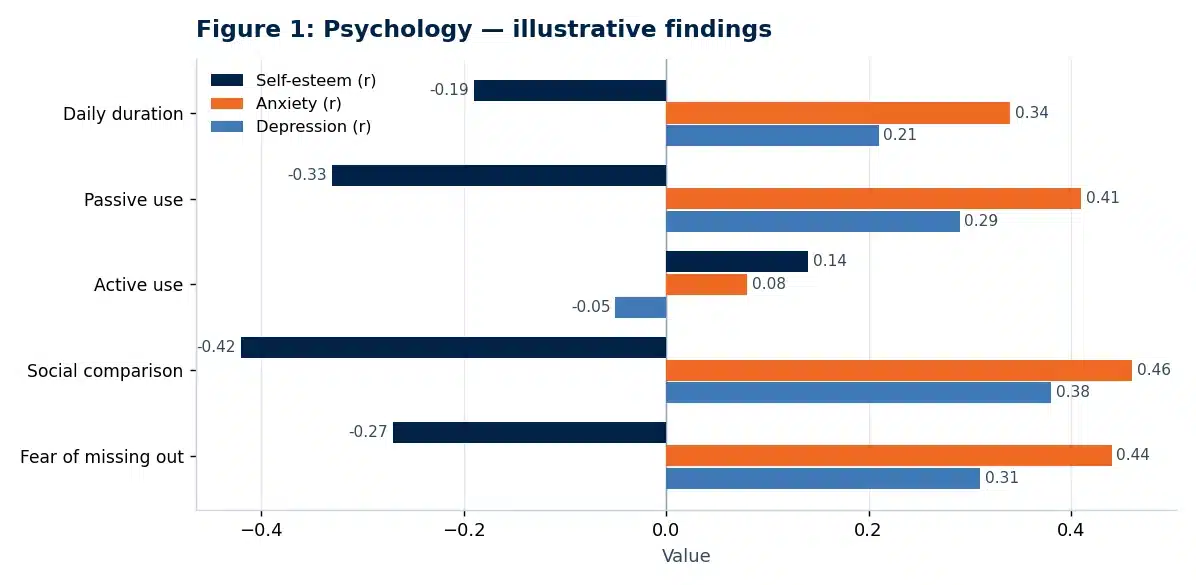
The pattern is instructive. Passive use showed consistently stronger associations with poorer outcomes than duration alone, whereas active use displayed negligible or mildly positive associations with self-esteem, echoing Verduyn et al. (2017).
Notably, social comparison exhibited the strongest correlations across all three outcomes. This suggests that the psychological mechanism, rather than the raw quantity of use, may be the more powerful determinant of wellbeing.
Regression analysis reinforced this interpretation. When social comparison and FoMO were entered as predictors, the independent contribution of duration diminished substantially, indicating partial mediation.
In other words, duration appears to influence outcomes largely through the extent to which it exposes adolescents to social comparison and evokes FoMO, rather than exerting a direct effect of its own.
Gender differences were also apparent illustratively, with female participants reporting higher social comparison and anxiety. This is consistent with Kelly et al. (2018), who noted stronger effects among adolescent girls.
Taken together, the findings support a nuanced model in which the nature and psychological experience of use, rather than its sheer duration, drive associations with adolescent mental health.
The findings resonate with and extend the reviewed literature. The relatively weak association between raw duration and outcomes accords with Orben and Przybylski (2019), who cautioned against overstating time-based effects.
However, disaggregating use revealed a more meaningful picture. The stronger associations for passive use support the theoretical distinction advanced by Verduyn et al. (2017), reinforcing that how adolescents engage matters more than for how long.
The prominence of social comparison as a correlate lends empirical weight to Festinger’s (1954) enduring framework. Curated online environments appear to amplify upward comparison, corroborating experimental findings by Vogel et al. (2014).
The mediating role identified for social comparison and FoMO is theoretically important. It suggests that interventions targeting duration alone may prove ineffective if the underlying comparative and anxious processes remain unaddressed.
This reframes the public debate. Rather than asking simply whether adolescents spend too long online, attention should shift towards the psychological quality of their engagement and their vulnerability to comparison.
The gender differences observed carry practical implications. If adolescent girls are disproportionately exposed to appearance-based comparison, targeted digital literacy and body-image interventions may be particularly warranted for this group.
For clinicians, the findings suggest that assessment should probe not merely how much a young person uses social media, but how it makes them feel and whether comparison or FoMO are prominent.
For educators and parents, the implication is that fostering active, meaningful interaction and critical media literacy may be more constructive than blanket restrictions on time, which adolescents often resist.
These interpretations must nonetheless be tempered. The cross-sectional design means reverse causation cannot be excluded; anxious or depressed adolescents may gravitate towards passive scrolling and comparison, rather than the reverse (Coyne et al., 2020).
The illustrative nature of the data and the convenience sample further caution against overgeneralisation. The findings are best understood as demonstrating a plausible, theoretically grounded pattern that warrants rigorous longitudinal testing.
This paper examined the relationship between social media use and adolescent mental health, moving beyond simplistic time-based framings to consider the type and psychological experience of engagement.
The illustrative findings indicate that passive use and, above all, social comparison and FoMO are more strongly associated with anxiety, depression and diminished self-esteem than duration alone. Active use appeared comparatively benign or mildly beneficial.
The principal contribution of this study lies in its integration of the active-passive distinction with mechanistic mediators within a single framework, illustrating why aggregate screen-time measures yield inconsistent results in the wider literature.
Several recommendations follow. Digital literacy education should explicitly address social comparison, cultivating critical awareness of curated online self-presentation and its distorting effects on self-evaluation.
Interventions and parental guidance should prioritise the quality of engagement over rigid time limits, encouraging active, connective use while discouraging prolonged passive consumption before sleep.
Clinicians and schools should incorporate assessment of comparison and FoMO into wellbeing screening, enabling more targeted support for vulnerable adolescents, particularly girls exposed to appearance-based comparison.
Future research should prioritise longitudinal and experimental designs to establish causal direction, and should employ objective behavioural logging rather than self-report to overcome the measurement limitations identified by Parry et al. (2021).
Investigating platform-specific effects and the moderating role of individual differences, such as pre-existing vulnerability and self-esteem, would further refine understanding. In conclusion, the effects of social media are neither uniformly harmful nor benign but contingent on how adolescents engage.

All work is written by human writers. 100% AI free, guaranteed.

100% money back guarantee if you find plagiarism in our work.
COMPANY DETAILS






