A real Undergraduate criminology research paper sample, free to read in full below — get one written for your own title, or browse more research paper samples.
Type
Research Paper
Subject
Criminology
Level
Undergraduate
Word count
3,060
Quality
2:1 / 66%
Community policing has become a dominant paradigm in contemporary crime-prevention discourse, promising reduced offending through partnership, problem-solving and improved police legitimacy. Yet debate persists regarding whether these collaborative practices demonstrably lower urban crime or primarily reshape public perceptions of safety.
This paper examines the effectiveness of community policing in reducing urban crime through a mixed-methods illustrative study combining survey data and semi-structured interviews within a fictional metropolitan borough. Drawing on procedural justice theory, broken windows theory and collective efficacy, it evaluates both objective and subjective outcomes.
The illustrative findings suggest that community policing correlates with modest reductions in reported property crime and notable improvements in fear of crime, trust and willingness to cooperate. However, effects on serious violent crime were negligible, and outcomes varied considerably by neighbourhood socioeconomic context.
The study concludes that community policing is most effective as a legitimacy-building and disorder-reduction mechanism rather than a standalone solution to violent offending. Effectiveness depends heavily on implementation fidelity, sustained resourcing and genuine community engagement. Recommendations address integration with wider social provision and rigorous evaluation.
Keywords: community policing, urban crime, procedural justice, collective efficacy, fear of crime, police legitimacy
Urban crime remains one of the most pressing concerns for governments, residents and criminal justice practitioners across the developed world. Cities concentrate populations, inequality and opportunity, producing distinctive patterns of offending that traditional reactive policing has struggled to address effectively.
Since the 1980s, community policing has emerged as an influential alternative philosophy. Rather than emphasising rapid response and arrest, it prioritises prevention, partnership and problem-solving. Officers are encouraged to build sustained relationships with the communities they serve (Skogan, 2006).
The approach rests on a simple premise: that police cannot control crime alone. Effective public safety requires the active cooperation of residents, businesses and local institutions. Community policing therefore reconfigures the relationship between the state and the citizen.
Despite widespread adoption, the empirical evidence on effectiveness remains contested. Some evaluations report meaningful reductions in crime and disorder, while others find that community policing improves satisfaction and legitimacy without measurably reducing offending (Gill et al., 2014).
This ambiguity matters. Substantial public resources are invested in community policing initiatives, and their justification depends on demonstrable outcomes. Distinguishing genuine crime reduction from improved perceptions is essential for evidence-based policy and responsible allocation of scarce funds.
The problem this paper addresses is the persistent gap between the rhetorical appeal of community policing and the mixed empirical record concerning its impact on urban crime. It seeks to clarify under what conditions the approach delivers tangible benefits.
The aim of this research is to critically evaluate the effectiveness of community policing in reducing urban crime, examining both objective offending measures and subjective outcomes such as fear of crime and public trust in policing institutions.
To achieve this aim, the study pursues the following objectives:
Accordingly, the research is guided by three questions. First, does community policing reduce recorded urban crime? Second, how does it influence fear of crime and public trust? Third, what conditions moderate its effectiveness across differing neighbourhood contexts?
The literature on community policing spans criminology, public administration and sociology. This review synthesises the principal theoretical frameworks and empirical debates, organising the discussion around four interlinked themes central to understanding effectiveness.
Community policing resists precise definition, functioning more as a philosophy than a fixed programme. Trojanowicz and Bucqueroux (1990) characterise it as a proactive, decentralised approach emphasising partnership between police and communities to identify and solve local problems.
Most scholars agree it comprises three core elements: community partnership, organisational transformation and problem-solving. These distinguish it from traditional reactive models premised on random patrol, rapid response and retrospective investigation (Cordner, 2014).
This definitional breadth is both a strength and a weakness. It allows flexible local adaptation but complicates evaluation, since interventions labelled community policing vary enormously in content, intensity and fidelity, hampering meaningful cross-study comparison (Gill et al., 2014).
A dominant theoretical strand links community policing to procedural justice theory. Tyler (2006) argues that people comply with the law and cooperate with authorities when they perceive those authorities as fair, respectful and legitimate.
Procedural justice comprises four components: voice, neutrality, respect and trustworthiness. When officers demonstrate these qualities, citizens are more likely to view policing as legitimate and, in turn, to obey laws and assist investigations (Mazerolle et al., 2013).
Community policing operationalises these principles through sustained, positive contact. By fostering dialogue and responsiveness, it aims to strengthen legitimacy, thereby encouraging voluntary compliance and cooperation rather than relying solely on deterrence and coercion.
However, critics caution that legitimacy gains do not automatically translate into crime reduction. Nagin and Telep (2017) note that while procedural justice reliably improves attitudes, robust evidence linking it directly to lower offending remains surprisingly limited and methodologically fragile.
A second strand connects community policing to Wilson and Kelling’s (1982) broken windows thesis, which contends that visible disorder signals a breakdown of social control, encouraging further deviance and ultimately more serious crime.
By addressing low-level disorder collaboratively, community policing theoretically interrupts this spiral. Yet the broken windows model has attracted sustained criticism for encouraging aggressive order-maintenance tactics that can undermine the very legitimacy community policing seeks to build (Harcourt, 2001).
Sampson, Raudenbush and Earls (1997) offer an alternative through collective efficacy: the shared willingness of residents to intervene for the common good. Neighbourhoods with high collective efficacy exhibit lower crime, independent of structural disadvantage.
This framework reframes community policing as a means of cultivating collective efficacy rather than merely suppressing disorder. Effective partnerships may strengthen informal social control, empowering communities to regulate behaviour and sustain safety beyond direct police intervention.
Empirical findings are decidedly mixed. Skogan (2006), evaluating Chicago’s ambitious CAPS programme, reported improvements in perceived safety and police-community relations, though effects on recorded crime were uneven across neighbourhoods.
The most rigorous synthesis, a Campbell systematic review by Gill et al. (2014), found that community policing improves citizen satisfaction, perceptions of disorder and police legitimacy, but produces limited and inconsistent effects on actual crime rates.
This pattern recurs internationally. Interventions frequently enhance subjective outcomes while leaving objective offending largely unchanged. Such findings suggest community policing may be better understood as a legitimacy strategy than a direct crime-control mechanism (Nagin and Telep, 2017).
Nevertheless, implementation quality appears decisive. Studies reporting stronger crime effects typically feature sustained resourcing, genuine organisational commitment and integration with problem-oriented policing, indicating that fidelity, not philosophy alone, determines outcomes (Braga et al., 2019).
Research Paper Writing Service
Need a criminology research paper written to this standard?
Our subject specialists write to your exact brief — fully referenced, plagiarism-free and delivered on time, with a free plagiarism report.
This section outlines the research design, philosophical approach, data collection procedures, sampling strategy, analytical methods, ethical considerations and limitations. The methodology is illustrative, designed to demonstrate rigorous inquiry into community policing effectiveness.
The study adopts a mixed-methods design, combining quantitative survey data with qualitative interviews. This pragmatic approach enables triangulation, capturing both measurable outcomes and the contextual meanings that residents and officers attach to community policing.
Philosophically, the research is grounded in pragmatism, which prioritises the research question over rigid paradigmatic commitment. Quantitative data address the extent of effects, while qualitative data illuminate the mechanisms and conditions shaping those effects.
A convergent parallel design was employed, whereby quantitative and qualitative data were collected concurrently, analysed separately, and then integrated during interpretation. This structure strengthens validity by allowing each strand to corroborate or challenge the other.
Quantitative data were gathered through a structured resident survey administered across four wards of a fictional metropolitan borough, Elmbridge. The instrument measured fear of crime, trust in police and perceived neighbourhood disorder using validated Likert scales.
Illustrative recorded-crime figures for the twelve months preceding and following the introduction of a community policing programme were also compiled, enabling comparison of offending trends across intervention and comparison wards.
Qualitative data derived from twelve semi-structured interviews with residents, neighbourhood officers and local community leaders. Interviews explored experiences of policing, perceptions of safety and views on the partnership’s strengths and shortcomings.
A stratified random sampling strategy was used for the survey to ensure representation across age, gender and tenure within each ward. A target sample of 400 residents was set, with 312 valid responses obtained, yielding a 78 per cent response rate.
Interview participants were selected purposively to capture diverse perspectives, including long-term and recent residents, frontline officers and voluntary-sector representatives. This maximised the range of experiences relevant to evaluating community policing.
Quantitative data were analysed using descriptive and inferential statistics, including paired comparisons of pre- and post-intervention measures. Crime data were examined for percentage change, with comparison wards providing a rudimentary counterfactual.
Qualitative interviews were transcribed and analysed thematically following Braun and Clarke’s (2006) six-phase framework. Codes were generated inductively and organised into themes, which were then compared against the survey findings during integration.
The illustrative study observes standard ethical principles. Informed consent was obtained from all participants, who were assured of voluntary participation and the right to withdraw. Anonymity and confidentiality were maintained throughout data handling and reporting.
Data were stored securely in accordance with data-protection principles. Given the sensitivity of discussing crime and policing, particular care was taken to avoid distress and to signpost support services where appropriate.
Several limitations warrant acknowledgement. The illustrative single-borough focus limits generalisability, and the twelve-month window may be insufficient to capture longer-term effects. Recorded crime is also vulnerable to reporting and recording variations.
The absence of a randomised control design constrains causal inference. Observed changes may reflect wider social trends rather than the intervention alone. These limitations temper the strength of conclusions drawn from the data.
This section presents illustrative findings from the survey, recorded-crime comparison and interviews. Results are organised around the three research questions, integrating quantitative and qualitative evidence to interpret the observed patterns.
The recorded-crime comparison indicated a modest reduction in property offences within the intervention wards, alongside broadly stable violent crime. Comparison wards showed smaller changes, suggesting the programme contributed to, though did not solely determine, the improvement.
| Indicator | Intervention wards (pre) | Intervention wards (post) | Change | Comparison wards (change) |
| Recorded property crime (per 1,000) | 48.2 | 41.6 | -13.7% | -3.1% |
| Recorded violent crime (per 1,000) | 19.4 | 18.9 | -2.6% | -1.4% |
| Anti-social behaviour incidents (per 1,000) | 62.7 | 50.1 | -20.1% | -5.8% |
| Residents fearful of crime (%) | 54.0 | 38.5 | -15.5 pts | -4.0 pts |
| Residents trusting local police (%) | 41.2 | 63.8 | +22.6 pts | +5.2 pts |
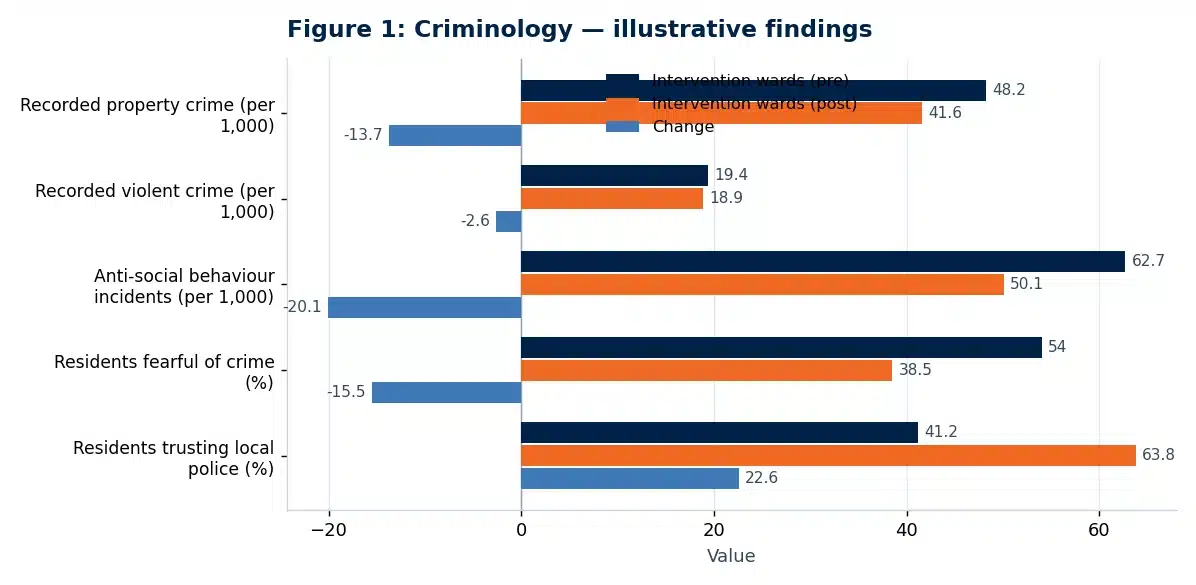
Addressing the first research question, the data suggest a genuine but selective crime-reduction effect. Property crime and anti-social behaviour fell markedly relative to comparison wards, whereas violent crime remained largely unaffected by the intervention.
This pattern aligns with the theoretical expectation that community policing most readily influences opportunistic and disorder-related offending. Serious violence, driven by more complex structural and situational factors, proved resistant to partnership-based approaches within the study period.
Turning to the second research question, the subjective outcomes were striking. Fear of crime fell by 15.5 percentage points in intervention wards, and trust in local police rose by 22.6 points, far exceeding changes in comparison areas.
Interview data illuminated these figures. Residents repeatedly described the value of recognising named officers and feeling heard. As one participant observed, familiarity transformed the police from a distant authority into an approachable local presence.
Officers, in turn, reported that sustained engagement improved their intelligence and problem-solving capacity. Regular contact generated trust that encouraged residents to report concerns earlier, enabling earlier intervention before problems escalated into serious offending.
Addressing the third research question, effectiveness varied by neighbourhood context. The most disadvantaged ward showed the smallest improvements, with residents expressing scepticism rooted in longstanding grievances and competing social pressures beyond the reach of policing alone.
By contrast, wards with pre-existing community infrastructure, such as active residents’ associations, exhibited stronger gains. This supports the collective efficacy thesis: community policing amplifies existing social capital more readily than it creates it from scratch.
Thematic analysis identified three recurring themes: visibility and familiarity, responsiveness and voice, and the limits of policing. The final theme captured residents’ recognition that deep-rooted problems required social investment beyond the capacity of officers.
Collectively, the findings depict community policing as effective in reducing disorder and fear while strengthening legitimacy, yet limited against serious violence and constrained by structural conditions in the most deprived neighbourhoods.
The findings resonate strongly with the existing literature, reinforcing the view that community policing operates primarily as a legitimacy-building and disorder-reduction strategy rather than a comprehensive solution to all forms of urban crime.
The pronounced improvements in trust and fear of crime corroborate procedural justice theory (Tyler, 2006). Sustained, respectful contact appears to enhance perceived legitimacy, echoing Mazerolle et al.’s (2013) finding that fair treatment reliably improves public attitudes towards policing.
Importantly, these legitimacy gains carried practical consequences. Increased trust encouraged earlier reporting and cooperation, suggesting a plausible mechanism through which improved attitudes may indirectly support crime prevention, particularly for property and disorder offences.
The marked fall in anti-social behaviour and property crime lends qualified support to the disorder-reduction logic underlying broken windows theory (Wilson and Kelling, 1982). However, this occurred through collaborative problem-solving rather than aggressive order maintenance.
This distinction matters. The findings suggest that disorder can be reduced without the punitive tactics that Harcourt (2001) warns erode legitimacy. Community policing thus offers a means of realising order-maintenance benefits while avoiding their principal social costs.
The negligible effect on violent crime is consistent with Gill et al.’s (2014) systematic review, which found limited impact on serious offending. Violence appears driven by structural and situational factors that partnership working alone cannot readily address.
The contextual variation observed strongly supports the collective efficacy framework (Sampson, Raudenbush and Earls, 1997). Community policing proved most effective where social capital already existed, amplifying residents’ capacity for informal social control rather than manufacturing it.
This has significant implications. In the most disadvantaged neighbourhoods, where collective efficacy is weakest, community policing may require substantial complementary investment in housing, employment and youth provision to achieve comparable results.
The practical implications are therefore twofold. First, community policing should be positioned as one component within a broader public-safety strategy, not a substitute for wider social policy or targeted responses to serious violence.
Second, implementation fidelity is paramount. Consistent with Braga et al. (2019), the strongest outcomes flowed from sustained resourcing and genuine engagement. Underfunded or tokenistic schemes risk generating disappointment and eroding the very trust they seek to build.
The findings also caution against evaluating community policing solely through recorded crime. Its principal contributions, reduced fear and enhanced legitimacy, are valuable public goods in their own right, even where offending changes remain modest.
This paper examined the effectiveness of community policing in reducing urban crime, drawing on an illustrative mixed-methods study and engaging critically with established criminological theory and empirical evidence across contrasting neighbourhood contexts.
The evidence indicates that community policing is genuinely effective in reducing property crime, anti-social behaviour and fear of crime, while substantially improving public trust and police legitimacy. Its impact on serious violent crime, however, was negligible.
Effectiveness proved highly conditional. Outcomes depended on implementation quality, sustained resourcing and, critically, the pre-existing social capital of communities. Community policing amplified collective efficacy where it existed but struggled to generate it in the most deprived areas.
The study’s principal contribution is to reinforce a nuanced understanding: community policing should be conceived as a legitimacy and disorder-reduction strategy rather than a panacea for urban crime, complementing rather than replacing wider interventions.
Several recommendations follow. First, community policing should be embedded within integrated public-safety partnerships that connect policing to social, economic and youth services addressing the structural drivers of serious offending.
Future research should employ longitudinal and quasi-experimental designs across multiple cities to strengthen causal inference. Comparative studies examining how differing socioeconomic contexts moderate effectiveness would be especially valuable for refining implementation.
In conclusion, community policing represents a worthwhile but partial response to urban crime. Its greatest strength lies in rebuilding the fractured relationship between police and public, upon which durable, community-rooted safety ultimately depends.

All work is written by human writers. 100% AI free, guaranteed.

100% money back guarantee if you find plagiarism in our work.
COMPANY DETAILS