A real Undergraduate human resource management research paper sample, free to read in full below — get one written for your own title, or browse more research paper samples.
Type
Research Paper
Subject
Human Resource Management
Level
Undergraduate
Word count
2,774
Quality
1st / 71%
Flexible working arrangements have become a central feature of contemporary human resource management, accelerated by the shift towards remote and hybrid models. This paper examines how such arrangements influence employee retention within knowledge-intensive organisations.
The study adopts an interpretivist, qualitative design, drawing on twelve semi-structured interviews with employees and human resource practitioners across professional-services firms. Thematic analysis was used to identify recurring patterns in participants’ accounts of flexibility, commitment, and intention to remain.
Findings indicate that flexible arrangements strengthen retention primarily through improved work-life balance, perceived organisational support, and greater autonomy. However, the relationship is conditional. Poorly managed flexibility generated isolation, blurred boundaries, and perceptions of inequity between office-based and remote staff.
The analysis suggests that flexibility functions less as a standalone benefit and more as a signal of trust embedded within wider organisational culture. Retention gains depend on managerial competence, fairness, and communication rather than policy existence alone.
The paper contributes an integrated understanding that connects social exchange theory with the job demands-resources model. It recommends that organisations treat flexibility as a managed capability, supported by training, clear expectations, and equitable access, rather than a passive perk.
Keywords: flexible working, employee retention, work-life balance, organisational support, human resource management, hybrid working.
Employee retention remains one of the most persistent challenges facing human resource management. High voluntary turnover imposes substantial costs through recruitment, lost productivity, and eroded institutional knowledge (Allen et al., 2010). Organisations increasingly seek strategic levers to retain valued staff.
Flexible working arrangements have emerged as a prominent response. These encompass practices such as remote working, hybrid schedules, flexitime, compressed hours, and job-sharing. Once treated as niche accommodations, they are now mainstream expectations, particularly among knowledge workers (CIPD, 2022).
The COVID-19 pandemic acted as a decisive catalyst. Enforced remote working demonstrated that many roles could be performed effectively outside the traditional office (Wang et al., 2021). Consequently, employee expectations shifted, and flexibility became a competitive factor in talent markets.
Despite widespread adoption, the relationship between flexibility and retention is neither simple nor uniform. Some studies report strong positive effects on loyalty and intention to stay, while others identify unintended consequences such as isolation and overwork (Kelliher and Anderson, 2010).
This ambiguity creates a practical problem for practitioners. Investing in flexible policies is costly and organisationally disruptive, yet the mechanisms through which flexibility affects retention remain insufficiently understood at the level of everyday employee experience.
The aim of this paper is therefore to examine how flexible working arrangements influence employee retention, and to identify the conditions under which flexibility supports or undermines an intention to remain.
To achieve this aim, the study pursues the following objectives:
The research is guided by two questions. First, in what ways do flexible working arrangements influence employees’ intention to remain? Second, what organisational and managerial conditions determine whether flexibility strengthens or weakens retention?
This review synthesises scholarship on flexible working and retention. Rather than cataloguing studies, it organises the evidence around three analytical themes and highlights tensions that motivate the present research.
Flexible working is best understood as an umbrella construct covering flexibility of time, location, and contract. Scholars distinguish employer-driven flexibility, which serves operational needs, from employee-centred flexibility that prioritises worker autonomy (Chung and van der Lippe, 2020).
Retention, meanwhile, is commonly operationalised through turnover intention, a reliable proximal predictor of actual departure (Griffeth et al., 2000). Focusing on intention allows researchers to capture the psychological antecedents of leaving before behaviour occurs.
Importantly, the two constructs are linked through perceptions rather than provisions. It is not the mere availability of flexibility that matters, but how employees interpret and experience it within their specific context (Kelliher and Anderson, 2010).
Social exchange theory offers a powerful explanatory lens. When organisations grant flexibility, employees may interpret this as an investment in their wellbeing, triggering a felt obligation to reciprocate through loyalty and discretionary effort (Blau, 1964; Eisenberger et al., 1986).
This reciprocity operates through perceived organisational support. Flexibility signals that the employer values employees as individuals, strengthening affective commitment and, in turn, the desire to remain (Rhoades and Eisenberger, 2002).
The job demands-resources model provides a complementary account. Flexibility can be viewed as a job resource that buffers demands and enables recovery, reducing burnout and its associated turnover risk (Bakker and Demerouti, 2007).
However, the same model warns that flexibility may intensify demands. Blurred boundaries between work and home can heighten workload and emotional exhaustion, potentially reversing the intended benefit (Wang et al., 2021).
These theories thus predict competing outcomes. Whether flexibility acts as a resource or a hidden demand depends on how it is designed and managed, an insight central to this study’s framing.
A substantial body of evidence links flexibility to positive retention outcomes. Employees with access to flexible arrangements consistently report higher job satisfaction, stronger commitment, and lower turnover intention (Allen et al., 2013).
Work-life balance is frequently identified as the mediating mechanism. By enabling employees to manage caring responsibilities and personal commitments, flexibility reduces work-family conflict, a well-established driver of departure (Greenhaus and Allen, 2011).
Yet the picture is contested. Kelliher and Anderson (2010) document an intensification effect, whereby employees reciprocate flexibility by working harder and longer, eroding the wellbeing gains that flexibility was intended to deliver.
Remote and hybrid arrangements raise further complications. Prolonged remote working has been associated with professional isolation, weakened social ties, and reduced visibility, which can harm career progression and commitment (Golden et al., 2008).
Equity concerns also emerge. Where flexibility is unevenly distributed, or where remote workers are perceived as less committed, perceptions of unfairness can damage morale among both flexible and office-based staff (Chung and van der Lippe, 2020).
The literature therefore converges on a conditional conclusion. Flexibility tends to support retention, but its effects are contingent on managerial practice, organisational culture, and the fairness of implementation, gaps this study addresses empirically.
Research Paper Writing Service
Need a human resource management research paper written to this standard?
Our subject specialists write to your exact brief — fully referenced, plagiarism-free and delivered on time, with a free plagiarism report.
This study adopts an interpretivist philosophy, reflecting the aim of understanding subjective employee experiences rather than measuring variables. Interpretivism assumes that reality is socially constructed and best accessed through participants’ own meanings (Saunders et al., 2019).
A qualitative, exploratory design was selected accordingly. This approach suits research questions concerned with how and why processes operate, allowing rich insight into the mechanisms connecting flexibility and retention.
An inductive approach was used, generating themes from the data rather than testing predetermined hypotheses. This reflects the contested state of the literature and the value of remaining open to unanticipated findings.
The strategy took the form of a small-scale interview study. Semi-structured interviews were chosen because they combine consistency across participants with the flexibility to probe individual experiences in depth.
Data were collected through twelve semi-structured interviews conducted online, each lasting approximately forty-five minutes. An interview guide covered experiences of flexibility, wellbeing, managerial support, and intention to remain.
Participants were selected using purposive sampling to ensure relevance. The sample comprised nine employees and three human resource practitioners drawn from professional-services organisations offering hybrid working, providing complementary perspectives.
Purposive sampling was appropriate given the exploratory aim, prioritising information-rich cases over statistical representativeness. The sample size aligns with guidance that data saturation is often achievable within twelve interviews in a homogeneous group.
Interviews were transcribed and analysed using Braun and Clarke’s (2006) six-phase thematic analysis. This method offers a systematic yet flexible route to identifying patterns of meaning across qualitative data.
Analysis proceeded from familiarisation and initial coding to the construction, review, and definition of themes. Coding was conducted manually, with an audit trail maintained to enhance transparency and analytical rigour.
The study followed established ethical principles. Informed consent was obtained, participation was voluntary, and participants could withdraw at any point without consequence (Bryman and Bell, 2015).
Confidentiality and anonymity were protected by removing identifying details and assigning pseudonyms. Data were stored securely and used solely for research purposes, consistent with data-protection requirements.
Several limitations should be acknowledged. The small, sector-specific sample limits transferability to other industries, particularly those where remote working is impractical, such as manufacturing or frontline services.
Additionally, self-reported intention may not translate into actual behaviour, and social-desirability bias cannot be excluded. These constraints are typical of small qualitative studies and inform the cautious interpretation of findings below.
Thematic analysis generated four principal themes. These were work-life balance as a retention anchor, flexibility as perceived trust, the risks of isolation and intensification, and fairness of access. The table summarises the pattern of responses.
| Theme | Participants referencing (n=12) | Association with intention to stay |
| Work-life balance | 11 | Strongly positive |
| Perceived trust and autonomy | 9 | Positive |
| Isolation and intensification | 7 | Negative |
| Fairness of access | 6 | Conditional |
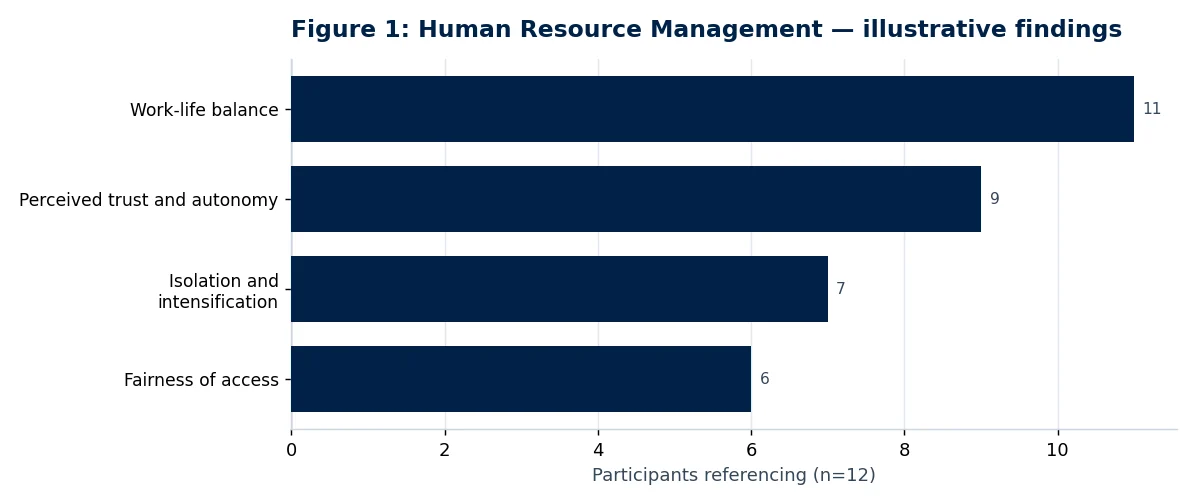
These figures are illustrative and reflect the qualitative emphasis of participants rather than statistical measurement. Their value lies in showing the relative prominence of each theme across the sample.
The most prominent theme was work-life balance. Eleven of twelve participants linked flexibility directly to their ability to manage personal commitments, and framed this as a decisive reason for staying.
One participant explained that hybrid working allowed her to manage childcare without sacrificing career progression, describing it as the single benefit she would be least willing to lose. Such accounts recurred consistently.
This finding supports the view that flexibility reduces work-family conflict, thereby strengthening retention (Greenhaus and Allen, 2011). Balance functioned as a tangible, everyday benefit that participants weighed heavily against alternative employers.
A second theme concerned the symbolic meaning of flexibility. Nine participants interpreted being trusted to work autonomously as evidence that their employer respected and valued them as professionals.
This perception fostered reciprocal commitment. Several described a sense of obligation to repay the employer’s trust through reliability and loyalty, echoing the logic of social exchange (Blau, 1964; Rhoades and Eisenberger, 2002).
Notably, participants distinguished genuine trust from surveillance. Where flexibility was accompanied by intrusive monitoring, its symbolic value collapsed, and the anticipated reciprocity did not materialise.
Countervailing experiences also emerged. Seven participants reported difficulties, including professional isolation, reduced informal contact, and a tendency to work longer hours when at home.
These accounts reflect the intensification effect and isolation risks noted in prior research (Kelliher and Anderson, 2010; Golden et al., 2008). For some, flexibility had become a hidden demand rather than a restorative resource.
Crucially, participants who described strong managerial support experienced these downsides less acutely. Regular check-ins and clear boundaries appeared to mitigate the risks, indicating the moderating role of management.
The final theme was fairness. Six participants raised concerns about unequal access to flexibility across roles, and about perceptions that remote workers were less committed than office-based colleagues.
Human resource practitioners were especially attuned to this tension. They noted that inconsistent application of policy generated resentment, undermining the retention benefits that flexibility was intended to deliver (Chung and van der Lippe, 2020).
The findings confirm that flexible working can strengthen retention, but they refine the mechanism. Flexibility mattered less as a benefit in itself and more as a signal of organisational trust and support.
This interpretation aligns closely with social exchange theory. The reciprocal commitment participants described illustrates how perceived organisational support converts a policy provision into an emotional bond that discourages departure (Rhoades and Eisenberger, 2002).
The prominence of work-life balance reinforces the resource perspective of the job demands-resources model. Flexibility functioned as a valued resource that eased competing demands, supporting wellbeing and, consequently, intention to remain (Bakker and Demerouti, 2007).
However, the isolation and intensification theme demonstrates the model’s dual edge. For a substantial minority, flexibility amplified demands, confirming Kelliher and Anderson’s (2010) warning that reciprocity can manifest as overwork rather than loyalty.
The study’s distinctive contribution lies in identifying management and fairness as the pivotal moderators. Flexibility supported retention where it was well managed and equitably applied, and threatened it where these conditions were absent.
This helps reconcile the contested literature. The mixed findings of prior studies may reflect variation not in flexibility itself, but in the managerial and cultural conditions surrounding its implementation.
The implications for practice are significant. Introducing flexible policies is insufficient; organisations must actively manage flexibility, equipping managers to sustain connection, set boundaries, and apply arrangements consistently across the workforce.
There are also implications for theory. The findings suggest that social exchange and job demands-resources perspectives are most illuminating when combined, since retention depends jointly on relational signalling and the practical balance of demands and resources.
This paper set out to examine how flexible working arrangements influence employee retention, and to identify the conditions shaping that relationship. The evidence supports a positive but conditional conclusion.
Flexibility strengthened retention chiefly by improving work-life balance and by signalling trust that employees reciprocated with commitment. These mechanisms align with social exchange theory and the resource logic of the job demands-resources model.
Yet flexibility was not universally beneficial. Isolation, intensification, and perceived unfairness could neutralise or reverse its advantages, revealing that policy provision alone does not guarantee improved retention.
The central contribution is the identification of managerial competence and equitable access as decisive moderators. Flexibility is best understood as a managed capability rather than a passive benefit conferred by policy.
Several recommendations follow for human resource practitioners:
The study’s limitations, notably its small, sector-specific sample, temper these conclusions. The findings are analytically rather than statistically generalisable and should be read as insight into mechanisms rather than population estimates.
Future research could pursue larger, cross-sectoral studies and longitudinal designs that track intention against actual turnover. Comparative work across industries where remote working is constrained would further clarify the boundaries of these findings.
In conclusion, flexible working is a valuable retention tool, but its returns depend on how thoughtfully it is designed, managed, and shared. Trust, fairness, and support transform flexibility from a perk into a genuine source of loyalty.

All work is written by human writers. 100% AI free, guaranteed.

100% money back guarantee if you find plagiarism in our work.
COMPANY DETAILS