A real Undergraduate construction management research paper sample, free to read in full below — get one written for your own title, or browse more research paper samples.
Type
Research Paper
Subject
Construction Management
Level
Undergraduate
Word count
2,814
Quality
1st / 71%
Building Information Modelling (BIM) has become a central instrument for improving efficiency, coordination and value across the construction sector, yet its uptake among small and medium-sized enterprises (SMEs) in the United Kingdom remains uneven. This paper investigates the drivers of, and barriers to, BIM adoption within UK construction SMEs, and considers how policy, culture and capability interact to shape implementation. Adopting an interpretive, questionnaire-based survey supplemented by illustrative qualitative commentary, the study draws on a sample of fifty-two SME professionals across contracting, consulting and specialist trades. Findings indicate that adoption is concentrated at lower BIM maturity levels, with cost, skills shortages and unclear client demand identified as the most significant obstacles. Perceived benefits, notably clash detection and improved collaboration, are recognised but frequently outweighed by short-term financial pressure. The analysis is interpreted through the Technology-Organisation-Environment framework and diffusion of innovation theory, revealing that organisational readiness and external mandates jointly determine progress. The paper concludes that targeted subsidy, standardised entry-level protocols and supply-chain mentoring are required to accelerate meaningful adoption. Contributions lie in situating SME behaviour within established adoption theory and proposing practical, proportionate recommendations for practitioners and policymakers.
Keywords: Building Information Modelling; construction SMEs; technology adoption; UK construction; digital transformation; BIM maturity.
The United Kingdom construction industry contributes substantially to national output yet has long been characterised by fragmentation, low productivity and adversarial working relationships. Digital technologies, and Building Information Modelling in particular, are widely promoted as remedies for these entrenched weaknesses.
BIM refers to a collaborative process of generating and managing shared digital representations of built assets across their lifecycle. It encompasses geometric models, structured data and interoperable workflows that support coordination between disciplines (Eastman et al., 2018).
Government intervention has shaped the UK context significantly. The 2011 Construction Strategy mandated collaborative Level 2 BIM on centrally procured projects from 2016, positioning the UK as an international leader in policy-driven adoption (Cabinet Office, 2011).
Despite this ambition, adoption remains stratified. Large contractors and consultancies have progressed towards mature, data-rich workflows, whereas small and medium-sized enterprises frequently lag behind, constrained by limited resources and uncertain returns (NBS, 2020).
This disparity is consequential because SMEs constitute the overwhelming majority of firms operating within the sector. If a large share of the supply chain cannot participate effectively in BIM-enabled projects, the aggregate benefits promised by digitalisation are unlikely to materialise.
The problem, therefore, is not whether BIM offers value, but why capable and willing smaller firms struggle to adopt it, and what conditions might enable proportionate, sustainable uptake across a fragmented supply chain.
The aim of this study is to examine the factors influencing BIM adoption among UK construction SMEs and to identify practical interventions that could support wider implementation.
The research is guided by the following objectives:
Correspondingly, three research questions frame the enquiry: What motivates SMEs to adopt BIM? What barriers most strongly inhibit adoption? And how might these barriers be mitigated through policy and practice?
The literature on BIM adoption spans technical, organisational and policy dimensions. This review synthesises key themes rather than cataloguing studies, focusing on how scholarship explains differential uptake between larger firms and SMEs within the UK.
BIM is best understood not as a single software product but as a socio-technical process. Succar (2009) proposed an influential maturity framework describing progression through stages of object-based modelling, model-based collaboration and network-based integration.
The UK’s own maturity ramp, distinguishing Levels 0 to 3, has structured national discourse. Level 2, emphasising separate discipline models exchanged through common data environments, became the practical benchmark for public projects (Cabinet Office, 2011).
Critics argue these linear models oversimplify reality. Many firms occupy hybrid positions, using modelling tools for visualisation without the collaborative data workflows that define genuine BIM maturity (Dainty et al., 2017).
A recurring driver is client and regulatory demand. Where public clients mandate BIM, suppliers adopt to remain eligible for work, illustrating coercive pressure within the sector’s institutional environment (Papadonikolaki, 2018).
Efficiency benefits also motivate adoption. Empirical studies associate BIM with improved clash detection, reduced rework, better cost certainty and enhanced coordination between design and construction teams (Bryde et al., 2013).
Competitive positioning represents a further driver. Firms perceive BIM capability as a differentiator that signals professionalism and technical credibility, particularly when tendering for higher-value or reputationally significant projects (Eadie et al., 2013).
Cost is consistently cited as the foremost barrier. Software licences, hardware upgrades and staff training impose disproportionate burdens on firms with constrained cash flow and limited capital reserves (Vidalakis et al., 2020).
Skills shortages compound financial constraints. SMEs frequently lack in-house expertise and cannot readily release staff for training, creating a capability gap that self-reinforces over successive projects (NBS, 2020).
Cultural resistance is equally significant. Established practices, scepticism about return on investment, and reluctance among experienced practitioners to alter familiar workflows slow organisational change (Dainty et al., 2017).
Uncertain demand deters investment. Where SMEs perceive inconsistent client requirements, they rationally defer adoption, unwilling to commit resources without assurance of tangible, recurring project opportunities (Vidalakis et al., 2020).
Rogers’ (2003) diffusion of innovation theory explains adoption through perceived attributes such as relative advantage, compatibility, complexity, trialability and observability. BIM scores highly on advantage yet poorly on complexity for smaller firms.
The Technology-Organisation-Environment (TOE) framework offers complementary explanatory power, situating adoption decisions within technological readiness, organisational capacity and external pressures (Tornatzky and Fleischer, 1990). This study adopts TOE as its principal analytical lens.
Together these frameworks suggest that adoption is neither purely technical nor purely economic, but emerges from the interaction of firm capability, cultural disposition and institutional context, a synthesis this study seeks to test empirically.
While extensive literature addresses BIM adoption generally, comparatively little examines the specific mechanisms through which UK SMEs navigate barriers post-mandate. This study addresses that gap through structured empirical enquiry framed by established theory.
Research Paper Writing Service
Need a construction management research paper written to this standard?
Our subject specialists write to your exact brief — fully referenced, plagiarism-free and delivered on time, with a free plagiarism report.
This section outlines the research design, philosophical stance, data collection methods, sampling strategy, analytical approach, ethical safeguards and limitations. The methodology is illustrative, reflecting an undergraduate enquiry conducted within realistic resource constraints.
The study adopts an interpretivist philosophy, recognising that adoption decisions are shaped by subjective perceptions, organisational culture and situated experience rather than objective, law-like regularities (Saunders et al., 2019).
An inductive-leaning approach is employed, using established frameworks as sensitising devices rather than rigid hypotheses. This permits patterns to emerge from respondents’ accounts while retaining theoretical structure for interpretation.
A cross-sectional survey strategy was selected as appropriate for capturing perceptions across many firms within a limited timeframe. The design combines predominantly quantitative questionnaire data with brief open-response commentary.
This mixed emphasis enables both measurement of adoption patterns and contextual insight into reasoning, offering richer interpretation than either element could achieve alone within the study’s scope.
Data were collected via a self-administered online questionnaire distributed to construction SME professionals. The instrument comprised closed items using five-point Likert scales, categorical questions on firm characteristics, and optional open comments.
Questions addressed current adoption status, perceived drivers, experienced barriers and BIM maturity. Items were informed by the literature to ensure content validity and were piloted with four practitioners before distribution.
A non-probability purposive sample was targeted, supplemented by snowball referral through professional networks. Eligibility required respondents to work within UK firms employing fewer than 250 staff, consistent with standard SME definitions.
Fifty-two valid responses were obtained, spanning contracting, architectural and engineering consultancy, and specialist subcontracting. While modest, the sample provides sufficient breadth for illustrative analysis appropriate to this level of study.
Quantitative responses were analysed using descriptive statistics, including frequencies and mean ratings, to identify prevailing patterns. Cross-tabulation examined variation between firm sizes and disciplines.
Open-response comments were subjected to simple thematic analysis, coding recurring ideas into categories aligned with the TOE dimensions. This integration supported triangulated interpretation of the numerical findings.
The study observed standard ethical principles. Participation was voluntary and informed, respondents could withdraw freely, and no personally identifying data were collected. Responses were stored securely and reported only in aggregate.
Because the research involved low-risk professional opinion rather than sensitive personal information, ethical requirements were satisfied through transparent consent and anonymisation throughout the process.
Several limitations qualify the findings. The purposive sample limits generalisability, and self-selection may over-represent digitally engaged firms. Self-reported maturity is inherently subjective and potentially inflated.
The cross-sectional design captures a single moment, precluding assessment of change over time. These constraints are acknowledged transparently, and findings are presented as illustrative rather than statistically definitive.
This section presents the study’s principal results, beginning with adoption status and maturity, followed by drivers and barriers. Figures are illustrative, reflecting the sample of fifty-two respondents.
Adoption was widespread but shallow. Approximately seventy-three per cent of firms reported using BIM in some capacity, yet the majority operated at lower maturity, using modelling for visualisation rather than integrated data collaboration.
Maturity distribution revealed concentration at Level 1 and early Level 2. Only a small minority reported consistent common data environment use, and none claimed fully integrated Level 3 practice across their projects.
The table below summarises the perceived significance of the principal barriers, ranked by mean rating on a five-point scale where five denotes the most significant obstacle to adoption.
| Barrier | Mean rating (1–5) | Respondents rating 4–5 (%) | TOE dimension |
| High cost of software and hardware | 4.4 | 81 | Organisation |
| Lack of in-house skills and training | 4.2 | 77 | Organisation |
| Unclear or inconsistent client demand | 3.9 | 69 | Environment |
| Cultural resistance to change | 3.6 | 58 | Organisation |
| Interoperability and software complexity | 3.4 | 52 | Technology |
| Uncertain return on investment | 3.3 | 50 | Environment |
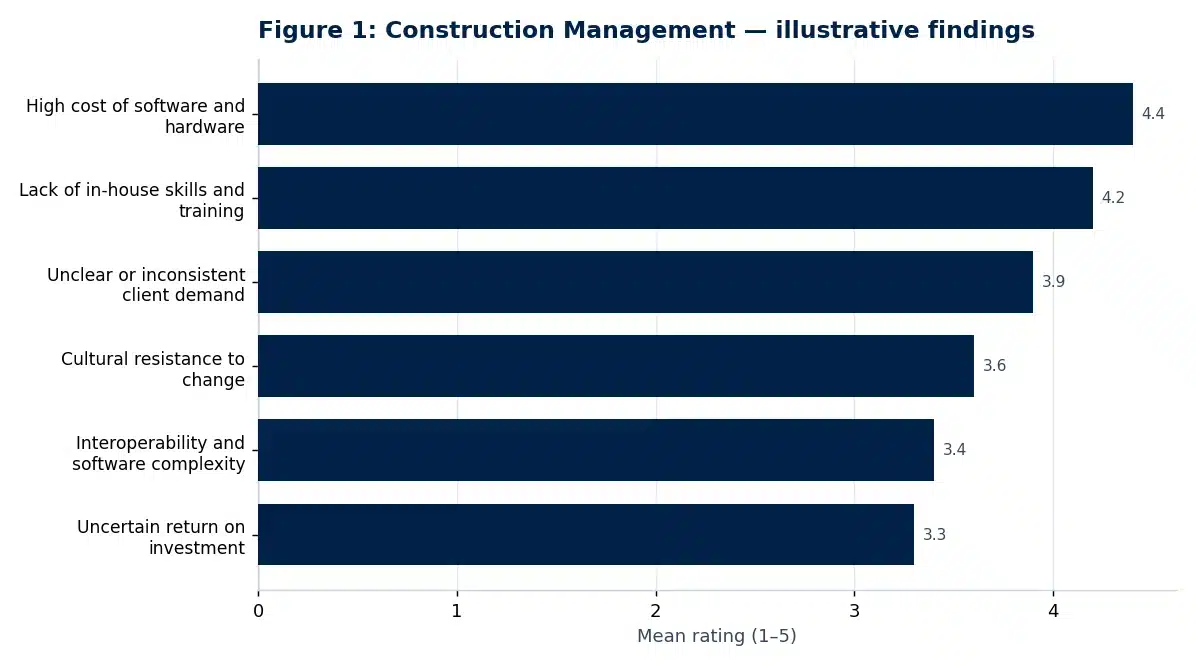
The ranking confirms that organisational constraints, particularly cost and skills, dominate SME concerns. Both barriers attracted high-significance ratings from more than three-quarters of respondents, underscoring their practical weight.
Environmental factors followed closely. Unclear client demand attracted strong agreement, reflecting frustration that mandates apply inconsistently and that private clients frequently do not require BIM despite public sector expectations.
Technological barriers, though present, ranked lower. This suggests that software capability is no longer the primary obstacle; the challenge lies instead in affording, resourcing and justifying its adoption within small firms.
Regarding drivers, respondents most frequently identified improved coordination and clash detection as tangible benefits. Meeting client or tender requirements ranked second, confirming the persistence of coercive, mandate-driven adoption.
Cross-tabulation revealed a size effect. Firms nearer the upper SME threshold reported higher maturity and greater confidence, whereas micro-firms disproportionately cited cost and skills as prohibitive, indicating uneven capacity within the SME category itself.
Thematic analysis of open comments reinforced these patterns. One respondent observed that training smaller teams was difficult because releasing staff meant lost billable time, capturing the compounding relationship between cost and capability.
Another recurring theme concerned demand uncertainty. Several respondents indicated they would invest more readily if private clients consistently required BIM, illustrating how environmental ambiguity suppresses otherwise willing adopters.
Collectively, the findings depict adoption as broad but immature, driven partly by external mandate and partly by recognised operational value, yet persistently constrained by interlocking organisational and environmental barriers.
The findings align closely with existing literature while offering nuanced insight into how barriers interact. The dominance of cost and skills confirms Vidalakis et al. (2020), who identified financial and capability constraints as decisive for smaller firms.
Interpreted through the TOE framework, the results demonstrate that organisational readiness is the pivotal determinant. Technology is available and its advantages recognised, yet firms lack the internal capacity to absorb and exploit it fully (Tornatzky and Fleischer, 1990).
The prominence of mandate-driven adoption supports Papadonikolaki’s (2018) emphasis on coercive institutional pressure. However, the findings extend this by showing that inconsistent private-sector demand undermines the momentum public mandates create.
This tension illuminates a policy limitation. The 2016 mandate successfully stimulated adoption among firms pursuing public work, but its influence dissipates across a supply chain where much activity remains privately procured and unregulated (NBS, 2020).
Applying diffusion theory, BIM’s high relative advantage should encourage uptake, yet its perceived complexity and poor trialability for resource-constrained firms slow diffusion (Rogers, 2003). SMEs cannot easily experiment incrementally when entry costs are substantial and indivisible.
The observed size effect within the SME category is theoretically significant. Treating SMEs as homogeneous obscures the acute disadvantage of micro-firms, suggesting that proportionate, tiered interventions are more appropriate than uniform expectations.
The shallow maturity revealed also matters. If most firms use BIM merely for visualisation, the collaborative, data-driven benefits underpinning the policy rationale remain largely unrealised, echoing Dainty et al.’s (2017) scepticism about superficial adoption.
The implications for practice are considerable. Improving genuine adoption requires more than software access; it demands affordable training pathways, clearer contractual demand signals and cultural change led by demonstrable, sector-specific evidence of value.
For policymakers, the findings imply that mandates alone are insufficient. Complementary support, including financial assistance and standardised entry-level protocols, is needed to convert nominal adoption into meaningful, value-generating practice across the wider supply chain.
The discussion therefore reframes the adoption challenge. It is less a problem of technological persuasion and more a problem of organisational enablement within an environment sending inconsistent and often contradictory demand signals to smaller firms.
This study set out to examine the factors influencing BIM adoption among UK construction SMEs and to identify proportionate measures to support wider implementation. Its findings offer a coherent, theoretically grounded account of persistent adoption difficulties.
The research confirms that adoption is broad but shallow. Most sampled firms use BIM in some form, yet few operate at the collaborative maturity levels that deliver the sector-wide productivity benefits envisaged by national strategy.
Cost and in-house skills emerged as the most significant barriers, followed closely by inconsistent client demand. These findings validate existing scholarship while highlighting the compounding interaction between financial and capability constraints within smaller firms.
Theoretically, the study demonstrates the explanatory strength of the TOE framework, showing that organisational readiness, mediated by environmental demand signals, is the decisive determinant of meaningful adoption rather than technological availability alone.
The principal contribution lies in situating SME adoption behaviour within established theory and in disaggregating the SME category, revealing that micro-firms face disproportionate disadvantage requiring tailored, tiered support rather than uniform expectation.
Several recommendations follow from the analysis:
These measures address the organisational and environmental barriers most strongly evidenced, aiming to convert nominal adoption into genuine, data-driven collaboration that realises the efficiency gains long promised for the sector.
Future research should pursue longitudinal designs to track maturity progression over time and employ larger probability samples to strengthen generalisability. Comparative studies across regions or procurement types would further illuminate contextual influences.
In conclusion, BIM adoption among UK construction SMEs remains constrained less by technology than by capacity and demand. Addressing these interlocking constraints through proportionate, coordinated intervention is essential to achieving inclusive digital transformation across the industry.

All work is written by human writers. 100% AI free, guaranteed.

100% money back guarantee if you find plagiarism in our work.
COMPANY DETAILS