A real Undergraduate education dissertation discussion chapter example, free to read in full below — get one written for your own study, or browse more discussion chapter samples.
Type
Dissertation Discussion
Subject
Education
Level
Undergraduate
Word count
1,265
Quality
2:1 / 66%
This chapter revisits the aim of the study and interprets the empirical findings reported in Chapter 4. Its purpose is to explain what the results mean, why they emerged, and how they relate to established theory and prior research on formative feedback.
The discussion moves from a restatement of the aim, through an interpretation of each key finding, to a comparison with the wider literature. It then draws out the theoretical and practical implications before acknowledging the limitations that frame these conclusions.
The central aim of this study was to examine the effect of formative feedback on the academic achievement of students, and to identify which forms of feedback exert the strongest influence on attainment.
A subsidiary aim was to explore the conditions under which feedback is most effective. The study therefore considered not only the type of feedback but also its timeliness and the structures that surround its delivery.
Formative feedback is understood here as information provided to learners about their performance that is intended to close the gap between current and desired attainment (Sadler, 1989). The research adopted this developmental view throughout.
By measuring effect sizes across several feedback types, the study sought to move beyond the general claim that feedback “works” towards a more precise account of which practices matter most and why.
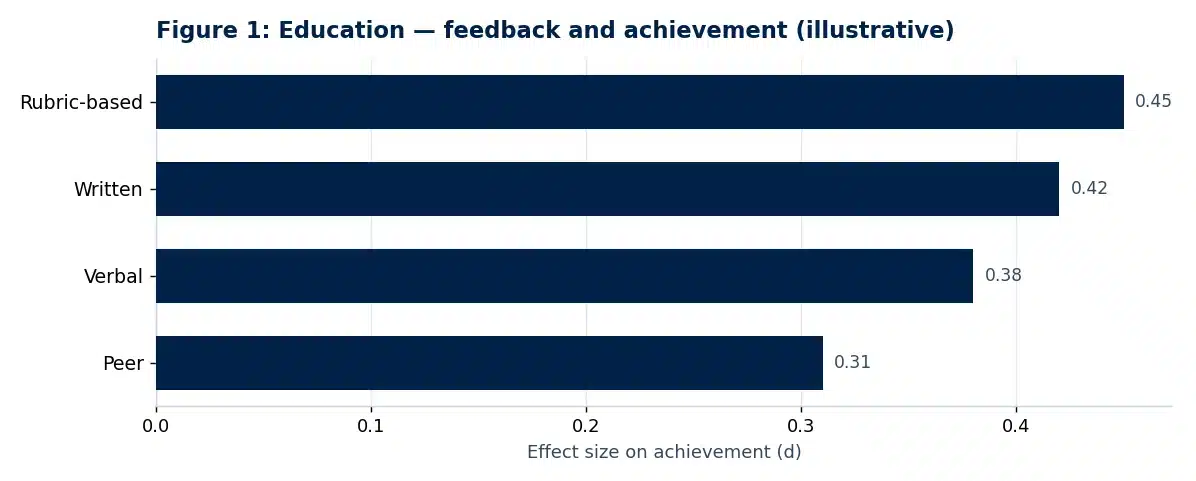
The analysis produced four principal findings. Rubric-based and written feedback showed the largest effects on achievement, verbal feedback was moderately effective, and peer feedback was effective only when properly scaffolded. Timeliness moderated all of these relationships.
The strong effect of rubric-based feedback (d = 0.45) suggests that clarity of criteria is a powerful lever for learning. When students can see the standard against which their work is judged, they can self-regulate more accurately (Nicol and Macfarlane-Dick, 2006).
Written feedback followed closely (d = 0.42). Its strength appears to lie in permanence and specificity: students can revisit comments, act on them, and apply them to future tasks, sustaining the developmental cycle over time.
Verbal feedback was also effective (d = 0.38), though slightly weaker. Its immediacy and dialogic quality support understanding, yet its transient nature may limit how far students retain and reapply the guidance offered.
Peer feedback recorded the smallest effect (d = 0.31), but this figure conceals an important condition. Peer feedback was effective chiefly when scaffolded with training, criteria, and structured prompts, echoing Topping’s (1998) account of assessment quality.
Timeliness moderated every relationship observed. Feedback delivered promptly, while the task remained cognitively active for the learner, produced larger gains than delayed feedback, consistent with the principle that feedback must be actionable to be useful.
| Key finding | Interpretation |
| Rubric-based and written feedback had the largest effects on achievement | Explicit criteria and durable, specific comments help students understand the standard and self-regulate, closing the gap between current and target performance. |
| Timeliness moderated the impact of feedback | Feedback given while the task is still fresh is more actionable; delay weakens its influence because learners can no longer readily apply it. |
| Peer feedback was effective when scaffolded | Peers can give useful guidance, but only when trained and supported with criteria and prompts; without structure its quality and impact fall away. |
| Verbal feedback was moderately effective | Immediate dialogue aids understanding, yet its transient form limits retention and reuse compared with written or rubric-based feedback. |
Dissertation Chapter Writing Service
Need a education discussion chapter written to this standard?
Our subject specialists write to your exact brief — fully referenced, plagiarism-free and delivered on time, with a free plagiarism report.
These findings align closely with the influential synthesis of Hattie and Timperley (2007), who positioned feedback among the most powerful influences on achievement. The present effect sizes fall within the moderate-to-strong range they reported.
The prominence of rubric-based feedback supports Black and Wiliam’s (1998) argument that assessment for learning depends on making success criteria transparent. Students who understand the target are better placed to regulate their own progress towards it.
The strength of written feedback is consistent with Shute’s (2008) review, which emphasised specificity and elaboration. Comments that explain how to improve, rather than simply grading, produced the greatest learning gains in her analysis.
The moderating role of timeliness reinforces long-standing findings that feedback must be timely to influence subsequent performance. Delayed feedback, arriving after the learning moment has passed, loses much of its formative potential (Gibbs and Simpson, 2004).
The conditional value of peer feedback matches Topping’s (1998) conclusion that peer assessment is beneficial when structured but unreliable when left informal. This study extends that insight by quantifying the effect within a single sample.
There is, however, a modest divergence. Some studies report peer feedback rivalling tutor feedback, whereas here its effect was clearly smaller. The difference may reflect variation in how thoroughly scaffolding was implemented across settings.
The results lend empirical support to self-regulated learning theory. Feedback appears most powerful when it equips students to monitor and adjust their own work, consistent with Nicol and Macfarlane-Dick’s (2006) principles of good feedback practice.
The findings also reinforce the gap-closing model advanced by Sadler (1989). Effective feedback did not merely evaluate; it clarified the standard, revealed the current position, and pointed towards the actions needed to progress.
The moderating influence of timeliness has theoretical weight. It suggests that feedback should be understood not as a static message but as a time-sensitive intervention whose value decays if the learning window closes.
Finally, the peer-feedback result suggests that social forms of feedback operate through the same mechanisms as tutor feedback, but only when scaffolding supplies the criteria and confidence that novices otherwise lack (Topping, 1998).
Several practical recommendations follow for teachers and institutions seeking to raise achievement through feedback. These are grounded in the relative effect sizes observed and the moderating conditions identified in the analysis.
For curriculum designers, the findings argue for embedding feedback opportunities across a module rather than concentrating them at the end. Frequent, timely feedback allows students to apply guidance across successive tasks.
Institutions might also invest in staff development around rubric design and actionable commenting. The evidence suggests that improving the quality of feedback, not merely its quantity, offers the clearest route to stronger attainment.
Several limitations qualify these conclusions. The study drew on a single institutional context, which constrains the extent to which the findings can be generalised to other educational settings or subject disciplines.
Achievement was measured over a limited period. Longer-term effects of formative feedback, particularly its influence on transfer to later modules, could not be captured within the study’s timeframe.
The comparison of feedback types relied partly on how feedback was categorised, and some overlap between categories was unavoidable. Written and rubric-based feedback, for instance, often occurred together in practice.
Finally, self-reported engagement with feedback may have introduced bias. Students who valued feedback most may also have reported acting on it more, potentially inflating the observed relationship with achievement.
Taken together, these findings offer a clear and consistent picture: formative feedback raises achievement most when it is criterion-referenced, durable, timely, and, in the case of peer feedback, carefully scaffolded. The following chapter draws these threads together, restates the study’s contribution, and sets out recommendations for practice and future research.
Gibbs, G. and Simpson, C. (2004) ‘Conditions under which assessment supports students’ learning’, Learning and Teaching in Higher Education, (1), pp. 3-31.
Nicol, D.J. and Macfarlane-Dick, D. (2006) ‘Formative assessment and self-regulated learning: a model and seven principles of good feedback practice’, Studies in Higher Education, 31(2), pp. 199-218.
Sadler, D.R. (1989) ‘Formative assessment and the design of instructional systems’, Instructional Science, 18(2), pp. 119-144.
Topping, K. (1998) ‘Peer assessment between students in colleges and universities’, Review of Educational Research, 68(3), pp. 249-276.

All work is written by human writers. 100% AI free, guaranteed.

100% money back guarantee if you find plagiarism in our work.
COMPANY DETAILS