A real Masters public health dissertation discussion chapter example, free to read in full below — get one written for your own study, or browse more discussion chapter samples.
Type
Dissertation Discussion
Subject
Public Health
Level
Masters
Word count
1,188
Quality
Distinction / 74%
This chapter interprets the findings presented in the previous chapter and situates them within the wider evidence base. Its purpose is to revisit the study’s aim, explain what the results mean, and consider their significance for public health.
The discussion moves from a restatement of the aim to a structured interpretation of each key finding. It then compares the results with existing literature, before drawing out theoretical and practical implications and acknowledging the study’s limitations.
The study set out to identify and understand the barriers that discourage older adults from engaging in regular physical activity. It sought to move beyond describing inactivity towards explaining the reasons behind it.
Physical activity in later life is strongly associated with reduced morbidity, better mental wellbeing, and greater independence (Bauman, 2016). Yet older adults remain among the least active groups in most populations, making the barriers worth close examination.
The aim was therefore practical as well as academic. By clarifying which barriers matter most, the study intended to inform how services, environments, and messaging might be adjusted to support activity in this age group.
The findings revealed that health concerns were the most frequently reported barrier, cited by 58% of respondents. This suggests that ill health, pain, and fear of injury act as a first-order deterrent to activity.
Importantly, health concerns appeared to operate in two directions. Some respondents avoided activity because of existing conditions, while others feared that exertion would worsen their health or cause falls.
Low motivation was the second most common barrier, reported by 47% of respondents. This points to a psychological dimension of inactivity that is distinct from physical capacity or external constraints.
Motivation appeared linked to perceived relevance and enjoyment. Where activity was seen as tiring or purposeless, respondents were less inclined to begin or sustain it, echoing self-determination theory (Deci and Ryan, 2000).
Facility access and cost also mattered, cited by 44% and 39% of respondents respectively. These structural barriers indicate that even willing individuals may be constrained by their surroundings and resources.
Distance to facilities, limited transport, and membership fees combined to make organised activity feel out of reach. For those on fixed incomes, cost was a decisive rather than marginal concern.
Safety concerns emerged as a factor shaping outdoor activity specifically. Fear of traffic, uneven pavements, and personal security influenced whether respondents walked or exercised outside.
This finding suggests that the physical environment can either enable or suppress activity. Where neighbourhoods felt unsafe, activity was displaced indoors or abandoned altogether (Yen, 2009).
| Key finding | Interpretation |
| Health concerns were the most reported barrier (58%) | Existing illness and fear of injury act as a primary deterrent, discouraging activity even before external factors are considered. |
| Low motivation was widely reported (47%) | Inactivity has a strong psychological component; activity that lacks enjoyment or perceived purpose is rarely sustained. |
| Facility access mattered (44%) | Distance, transport, and availability limit participation even among those who are willing and able to be active. |
| Cost mattered (39%) | Fees and associated expenses exclude older adults on limited incomes, making affordability a decisive constraint. |
| Safety concerns shaped outdoor activity | Perceived risk in the local environment displaces or suppresses walking and outdoor exercise. |
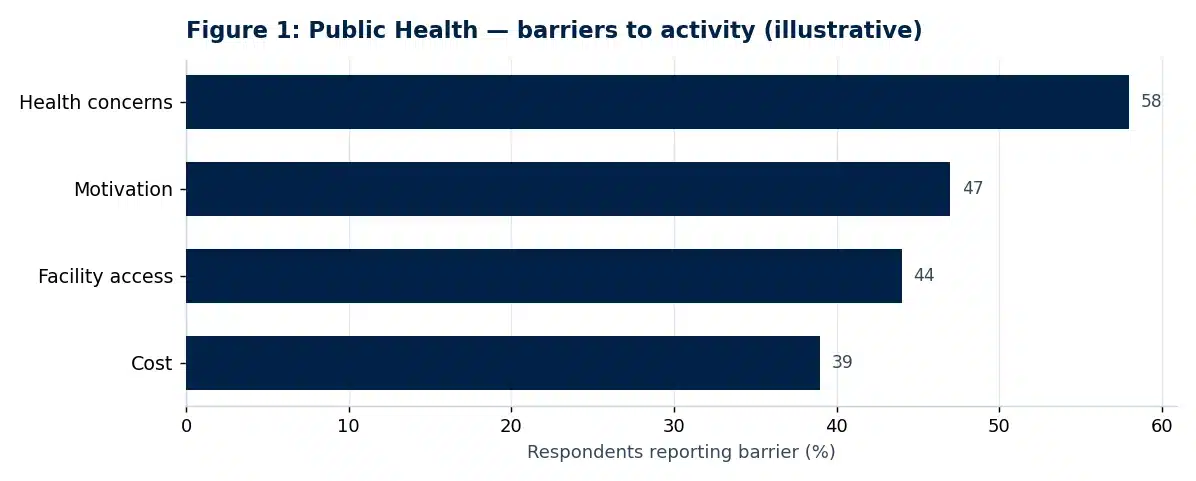
Taken together, these findings show that barriers to activity are layered. Personal, psychological, structural, and environmental factors overlap rather than acting in isolation.
Dissertation Chapter Writing Service
Need a public health discussion chapter written to this standard?
Our subject specialists write to your exact brief — fully referenced, plagiarism-free and delivered on time, with a free plagiarism report.
The prominence of health concerns aligns closely with earlier research. Studies have long identified poor health and fear of falling as leading deterrents to activity in older populations (Schutzer and Graves, 2004).
The present findings extend this by showing that health concerns outrank all other barriers in frequency. This reinforces the view that health perceptions, not only actual capacity, govern behaviour.
The importance of motivation is consistent with the broader behavioural literature. Previous work has stressed that intention and self-efficacy strongly predict activity in later life (McAuley, 1993).
However, some studies treat motivation as secondary to physical constraints. The present results suggest it deserves equal weight, given how frequently respondents cited it.
Findings on facility access and cost support the socio-ecological perspective. Prior research has consistently linked environmental and economic factors to participation levels (Sallis, 2006).
The safety finding likewise echoes evidence that neighbourhood conditions shape walking behaviour among older adults. Perceived safety has repeatedly been associated with outdoor activity (Yen, 2009).
Where the study diverges is in the relative ranking of barriers. By quantifying and comparing them directly, it offers a clearer hierarchy than much of the descriptive literature.
The findings lend support to the socio-ecological model of health behaviour. Barriers spanned individual, social, and environmental levels, matching the model’s central claim that behaviour is multiply determined (Sallis, 2006).
No single level accounted for inactivity on its own. Instead, health, motivation, access, cost, and safety interacted, consistent with the model’s emphasis on nested influences.
The salience of motivation also strengthens self-determination theory. Activity appeared more likely where it satisfied needs for competence and autonomy rather than being externally imposed (Deci and Ryan, 2000).
Together these frameworks suggest that theory should treat older adults’ inactivity as an interaction effect. Explanations resting on a single dominant cause are unlikely to capture the phenomenon fully.
The results carry several practical lessons for public health practitioners and service designers. Because barriers are layered, interventions are likely to succeed only when they address more than one level.
Specific implications include:
These measures suggest that responsibility does not rest with individuals alone. Environmental and structural change is needed to make the active choice the easier one (Bauman, 2016).
Practitioners might also prioritise the most frequently cited barriers first. Addressing health fears and motivation could yield the widest reach given their prevalence in the sample.
Several limitations should temper the interpretation of these findings. The study relied on self-reported barriers, which may reflect perception rather than objective constraint.
Self-report can also introduce social desirability bias. Respondents may have emphasised acceptable barriers, such as cost, over less comfortable admissions about motivation.
The cross-sectional design captures barriers at a single point in time. It cannot establish how these factors change with age, season, or health status.
The sample, drawn from a limited geographical area, may not represent all older adults. Rural, urban, and culturally diverse populations could report different barrier profiles.
Finally, the study measured the frequency of barriers but not their intensity. A barrier reported by fewer respondents might still be more decisive for those who experience it.
Despite these limitations, the study offers a clear and consistent picture of why older adults remain inactive. The concluding chapter draws these threads together, restates the study’s contribution, and sets out recommendations for practice and future research.
Bauman, A.E., Merom, D., Bull, F.C., Buchner, D.M. and Fiatarone Singh, M.A. (2016) ‘Updating the evidence for physical activity: summative reviews of the epidemiological evidence, prevalence, and interventions to promote “Active Aging”‘, The Gerontologist, 56(Suppl. 2), pp. S268-S280.
Deci, E.L. and Ryan, R.M. (2000) ‘The “what” and “why” of goal pursuits: human needs and the self-determination of behavior’, Psychological Inquiry, 11(4), pp. 227-268.
McAuley, E. (1993) ‘Self-efficacy and the maintenance of exercise participation in older adults’, Journal of Behavioral Medicine, 16(1), pp. 103-113.
Sallis, J.F., Cervero, R.B., Ascher, W., Henderson, K.A., Kraft, M.K. and Kerr, J. (2006) ‘An ecological approach to creating active living communities’, Annual Review of Public Health, 27, pp. 297-322.
Schutzer, K.A. and Graves, B.S. (2004) ‘Barriers and motivations to exercise in older adults’, Preventive Medicine, 39(5), pp. 1056-1061.
Yen, I.H., Michael, Y.L. and Perdue, L. (2009) ‘Neighborhood environment in studies of health of older adults: a systematic review’, American Journal of Preventive Medicine, 37(5), pp. 455-463.

All work is written by human writers. 100% AI free, guaranteed.

100% money back guarantee if you find plagiarism in our work.
COMPANY DETAILS