A real Undergraduate management research paper sample, free to read in full below — get one written for your own title, or browse more research paper samples.
Type
Research Paper
Subject
Management
Level
Undergraduate
Word count
3,051
Quality
2:1 / 67%
Organisational change has become a defining feature of contemporary management, driven by technological disruption, competitive pressure and shifting workforce expectations. Yet a substantial proportion of change programmes fail to achieve their intended outcomes, frequently because of inadequate leadership.
This paper examines the role of transformational leadership in managing organisational change. It explores how the four behavioural dimensions identified by Bass, namely idealised influence, inspirational motivation, intellectual stimulation and individualised consideration, shape employee responses to change.
Adopting an interpretivist stance, the study employs an illustrative qualitative design based on semi-structured interviews with fifteen middle managers across three service-sector organisations. Thematic analysis was used to interpret the data and identify recurring patterns.
The findings suggest that transformational leadership reduces resistance, strengthens commitment and builds the psychological safety necessary for change adoption. Vision articulation and individualised support emerged as the most influential behaviours. However, the analysis also indicates important boundary conditions relating to trust and organisational context.
The paper concludes that transformational leadership is a valuable but not sufficient enabler of successful change, and that it operates most effectively when combined with procedural fairness and authentic communication. Practical recommendations and directions for future research are offered.
Keywords: transformational leadership, organisational change, change management, employee resistance, vision, commitment
Change is now a permanent condition of organisational life. Globalisation, digital transformation and volatile markets compel firms to restructure, adopt new technologies and revise their strategies with increasing frequency (By, 2005). Managing these transitions effectively has become a central leadership challenge.
Despite decades of research, change initiatives continue to disappoint. Widely cited estimates suggest that a majority of large-scale change efforts fail to deliver their objectives (Kotter, 1996; Hughes, 2011). Employee resistance, poor communication and weak leadership are consistently identified as principal causes.
Leadership sits at the heart of this problem. The manner in which leaders frame, communicate and support change strongly influences whether employees engage with or reject it (Herold et al., 2008). Among leadership theories, transformational leadership has attracted particular attention in this context.
Transformational leadership describes leaders who inspire followers to transcend self-interest for a collective vision, stimulating higher performance and personal development (Bass, 1985). Its emphasis on vision, motivation and individual support appears well suited to the uncertainty that accompanies change.
However, the relationship between transformational leadership and change outcomes is not straightforward. Some scholars question whether its effects are universal or contingent on context, trust and the type of change involved (van Knippenberg and Sitkin, 2013). This debate warrants closer examination.
The aim of this paper is to critically examine the role of transformational leadership in managing organisational change, and to identify the mechanisms through which it influences employee responses. The study pursues the following objectives.
Accordingly, the research is guided by two questions. First, how does transformational leadership influence employee responses to organisational change? Second, what contextual factors moderate its effectiveness? These questions frame the analysis that follows.
This section critically reviews the literature underpinning the study. It examines the concept of organisational change, the development of transformational leadership theory, the mechanisms linking the two, and the criticisms that temper enthusiastic accounts of transformational approaches.
Organisational change refers to the deliberate alteration of an organisation’s structure, processes, culture or strategy (By, 2005). Classic models conceptualise change as a staged process, most famously Lewin’s (1947) sequence of unfreezing, moving and refreezing.
Kotter’s (1996) eight-step model extends this logic, emphasising urgency, coalition-building and vision. While influential among practitioners, such linear models have been criticised for underplaying the messy, political and emergent nature of real change (Burnes, 2004).
Resistance is a recurring theme. Employees may resist change for cognitive, emotional or political reasons, including fear of loss and distrust of management (Oreg, 2006). Contemporary scholarship treats resistance not merely as an obstacle but as a signal requiring leadership attention.
Transformational leadership originated with Burns (1978), who distinguished transactional exchanges from transforming relationships that elevate both leader and follower. Bass (1985) operationalised the concept, making it amenable to empirical measurement.
Bass identified four dimensions, often termed the four I’s. Idealised influence positions the leader as a role model; inspirational motivation communicates a compelling vision; intellectual stimulation encourages innovative thinking; and individualised consideration attends to individual needs and development.
These behaviours contrast with transactional leadership, which relies on contingent rewards and corrective action. Bass argued the two are complementary rather than opposed, with transformational leadership augmenting transactional foundations (Bass and Riggio, 2006).
Meta-analytic evidence broadly supports positive associations between transformational leadership and outcomes such as commitment, satisfaction and performance (Judge and Piccolo, 2004). This body of work established transformational leadership as a dominant paradigm within leadership studies.
Several mechanisms connect transformational leadership to successful change. By articulating an inspiring vision, leaders provide meaning and direction amid uncertainty, helping employees interpret change as an opportunity rather than a threat (Herold et al., 2008).
Individualised consideration builds the trust and psychological safety needed for people to experiment and voice concerns (Carter et al., 2013). Intellectual stimulation, meanwhile, encourages employees to question established routines and contribute to solutions.
Empirical studies reinforce these arguments. Herold et al. (2008) found that transformational leadership was more strongly related to commitment to change than change-specific leadership behaviours, particularly where personal impact was high.
Trust functions as a central intervening variable. Where leaders are perceived as credible and consistent, employees are more willing to accept the short-term costs of change in anticipation of longer-term benefits (Michaelis et al., 2009).
The transformational paradigm is not without critics. van Knippenberg and Sitkin (2013) argue that the construct is poorly defined, conflates leader behaviours with their effects, and lacks a clear causal model, undermining confidence in reported findings.
Others caution against a heroic view of leadership that overstates the individual leader and neglects context, followers and collective processes (Alvesson and Spicer, 2012). Change is a distributed accomplishment rather than the product of a single charismatic figure.
There are also ethical concerns. The inspirational, emotive quality of transformational leadership can shade into manipulation, particularly where vision is used to secure compliance rather than genuine engagement (Yukl, 1999). Authenticity therefore matters.
In synthesis, the literature suggests transformational leadership is a powerful but conditional resource for change. Its benefits depend on trust, context and ethical intent, points that the present study explores empirically.
Research Paper Writing Service
Need a management research paper written to this standard?
Our subject specialists write to your exact brief — fully referenced, plagiarism-free and delivered on time, with a free plagiarism report.
This section outlines the research design and methods used to investigate transformational leadership in the context of organisational change. It also addresses ethical considerations and limitations. The methodology is illustrative, designed to demonstrate a rigorous qualitative approach.
The study adopts an interpretivist philosophy, appropriate for exploring the subjective meanings that employees attach to leadership and change (Saunders et al., 2019). Understanding lived experience requires attention to perception rather than objective measurement alone.
An inductive approach was employed, allowing themes to emerge from the data rather than testing predefined hypotheses. This is consistent with the exploratory aim of understanding how transformational behaviours shape responses to change.
A qualitative, multiple-case design was used, drawing on three service-sector organisations undergoing structural change. Qualitative methods are well suited to capturing the nuance of leadership relationships (Bryman and Bell, 2015).
Data were collected through fifteen semi-structured interviews with middle managers, each lasting approximately forty-five minutes. Semi-structured interviews balance consistency with flexibility, enabling participants to elaborate on their experiences.
An interview guide was developed from the literature, covering perceptions of leadership behaviour, communication, trust and reactions to change. Interviews were recorded with consent and transcribed verbatim for analysis.
Purposive sampling was used to select participants with direct experience of leading and implementing change. Middle managers were chosen because they occupy a pivotal position, translating senior vision into operational reality (Balogun, 2003).
The sample of fifteen reflects the depth-oriented logic of qualitative research, where richness of insight takes precedence over statistical representativeness. Data collection continued until thematic saturation was approached.
Data were analysed using Braun and Clarke’s (2006) six-phase thematic analysis. This involved familiarisation, coding, searching for themes, reviewing, defining and reporting. The process moved iteratively between data and emerging interpretation.
Initial codes were grouped into broader themes reflecting the four transformational dimensions and cross-cutting factors such as trust and communication. A coding framework enhanced consistency and transparency throughout.
The study followed established ethical principles. Participation was voluntary, informed consent was obtained, and participants could withdraw at any time. Anonymity and confidentiality were protected by removing identifying details from transcripts.
Data were stored securely in accordance with data-protection requirements. As the research involved organisational members discussing their leaders, care was taken to minimise any risk of harm or discomfort.
Several limitations should be acknowledged. The small, purposive sample limits generalisability, and reliance on self-report introduces potential bias. Findings are illustrative and context-specific rather than definitive.
The cross-sectional design captures perceptions at a single point, whereas change unfolds over time. A longitudinal approach might reveal how leadership effects evolve across the phases of a change programme.
This section presents the illustrative findings organised around the principal themes identified in the analysis. The data are used to interpret how transformational behaviours influenced employee responses to change within the participating organisations.
Four dominant themes emerged from the thematic analysis, corresponding closely to the transformational dimensions, alongside trust as a cross-cutting condition. The table below summarises their prevalence and illustrative emphasis across the fifteen interviews.
| Theme | Related dimension | Participants referencing (of 15) | Reported effect on change response |
| Vision and meaning | Inspirational motivation | 13 | Strong positive |
| Personal support | Individualised consideration | 12 | Strong positive |
| Role modelling | Idealised influence | 10 | Moderate positive |
| Encouraging new ideas | Intellectual stimulation | 8 | Moderate positive |
| Trust in leadership | Cross-cutting condition | 14 | Enabling / moderating |
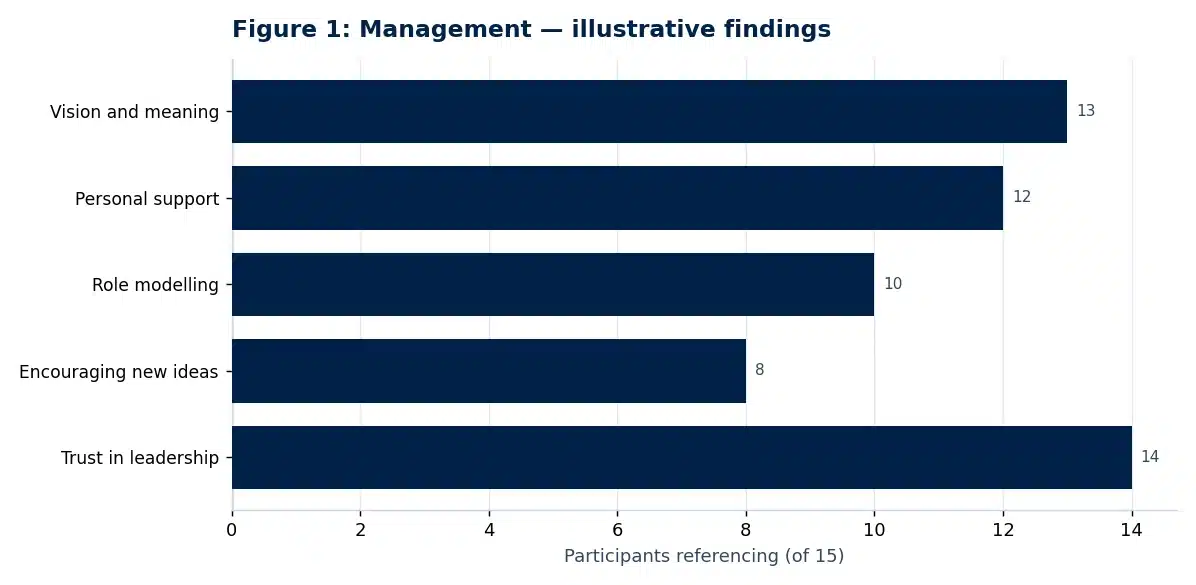
The figures are illustrative but reveal a clear pattern. Vision and personal support were the most frequently cited and most strongly associated with positive responses, while trust underpinned the effectiveness of all other behaviours.
Participants repeatedly emphasised the importance of a clear, compelling vision. Where leaders explained why change was necessary and painted a credible picture of the future, employees reported greater willingness to engage.
One manager observed that uncertainty diminished once the destination became clear. This aligns with inspirational motivation, whereby leaders reduce ambiguity and frame change as purposeful rather than arbitrary (Herold et al., 2008).
Conversely, where vision was vague or inconsistent, participants described confusion and scepticism. The finding underscores that vision must be both articulated and repeated to sustain momentum through disruption.
Individualised consideration featured prominently. Managers who acknowledged personal concerns, offered coaching and remained accessible were credited with easing anxiety and building confidence during transition.
This support appeared to generate psychological safety, encouraging employees to voice concerns and adapt. The pattern echoes Carter et al. (2013), who link relational leadership behaviours to constructive change reactions.
Where support was absent, employees reported feeling like resources to be reorganised rather than people to be developed. Such perceptions were associated with disengagement and quiet resistance.
Idealised influence mattered where leaders visibly enacted the change themselves. Consistency between words and actions enhanced credibility, whereas perceived hypocrisy rapidly eroded willingness to follow.
Intellectual stimulation was less frequently emphasised but valued where present. Inviting employees to contribute ideas fostered ownership, though several participants noted this was often constrained by time pressure during implementation.
Trust emerged as the pivotal cross-cutting theme. Almost all participants indicated that transformational behaviours only translated into acceptance when the leader was already trusted and perceived as credible.
Where trust was lacking, inspirational rhetoric was interpreted with suspicion, sometimes as manipulation. This supports the argument that trust mediates the relationship between leadership and change commitment (Michaelis et al., 2009).
The findings offer several insights when related to the existing literature. This section interprets the results, considers their theoretical significance and draws out implications for the management of organisational change.
First, the prominence of vision confirms the centrality of inspirational motivation in change contexts. Consistent with Kotter (1996) and Herold et al. (2008), a credible vision provided meaning that reduced uncertainty and mobilised effort.
However, the study extends this insight by showing that vision alone was insufficient. Its impact depended on repetition, consistency and, crucially, the trustworthiness of the leader articulating it. Rhetoric without credibility failed to persuade.
Second, the salience of individualised consideration highlights the relational foundations of change. Support and accessibility fostered psychological safety, corroborating research that links relational leadership to reduced resistance (Carter et al., 2013).
This finding challenges purely heroic interpretations of transformational leadership. Effective change leadership appeared less about charismatic performance and more about attentive, everyday interactions, echoing critiques of the heroic model (Alvesson and Spicer, 2012).
Third, the centrality of trust supports van Knippenberg and Sitkin’s (2013) call to specify the mechanisms through which transformational leadership operates. Trust functioned as a boundary condition, determining whether transformational behaviours were welcomed or resisted.
The ethical dimension identified by Yukl (1999) is also relevant. Where employees suspected that vision masked hidden agendas, transformational appeals backfired. Authenticity and procedural fairness therefore appear essential complements to transformational behaviour.
Taken together, the results suggest an integrated view. Transformational leadership enables change most effectively when embedded in trusting relationships, fair processes and consistent action, rather than operating as a standalone technique.
The practical implications are significant. Organisations should develop leaders’ relational and communicative capabilities, not merely their capacity for inspiration, and should invest in building trust before major change is attempted.
Managers should also recognise the limits of vision. Communicating a compelling future is necessary but must be matched by visible commitment, individual support and opportunities for genuine participation to convert intention into acceptance.
This paper set out to examine the role of transformational leadership in managing organisational change and to identify the mechanisms and conditions shaping its effectiveness. It addressed two questions concerning influence and moderating factors.
The study found that transformational leadership can meaningfully reduce resistance and strengthen commitment to change. Inspirational vision and individualised support emerged as the most influential behaviours, working chiefly by creating meaning and psychological safety.
Critically, however, these effects were conditional. Trust operated as an essential enabling factor, and transformational appeals proved counterproductive where credibility or authenticity was in doubt. Leadership thus functions within a relational and ethical context.
The paper makes a modest contribution by integrating transformational leadership with the roles of trust and fairness in change. It supports calls to move beyond heroic accounts towards a more relational and contingent understanding.
Several recommendations follow for practitioners.
The study’s limitations point to avenues for future research. Longitudinal designs could trace how leadership effects evolve across change phases, while larger and more diverse samples would enhance generalisability across sectors and cultures.
Further work might also examine the interaction between transformational and other leadership styles, such as authentic or shared leadership, and explore how distributed leadership shapes change in increasingly networked organisations.
In conclusion, transformational leadership remains a valuable but not sufficient enabler of successful organisational change. Its promise is realised only when inspiration is grounded in trust, authenticity and sustained relational engagement.

All work is written by human writers. 100% AI free, guaranteed.

100% money back guarantee if you find plagiarism in our work.
COMPANY DETAILS