A real Undergraduate business research paper sample, free to read in full below — get one written for your own title, or browse more research paper samples.
Type
Research Paper
Subject
Business
Level
Undergraduate
Word count
2,798
Quality
2:1 / 66%
Remote working has transformed employment practices across the United Kingdom, particularly following the COVID-19 pandemic. This paper examines the impact of remote working on employee productivity within small and medium-sized enterprises (SMEs), a sector that employs the majority of the UK workforce.
Drawing on established management theory, the study adopts a mixed-methods design combining an illustrative survey of employees with semi-structured interviews of SME managers. The research investigates how remote arrangements influence output, engagement and communication in resource-constrained organisations.
The illustrative findings suggest that remote working modestly improves self-reported productivity, chiefly through reduced commuting, greater autonomy and fewer workplace interruptions. However, benefits are unevenly distributed and are moderated by managerial trust, digital infrastructure and the nature of the role.
Challenges including isolation, blurred work-life boundaries and weakened informal communication temper these gains. The paper argues that productivity outcomes depend less on location than on the quality of management practice. Recommendations are offered for SMEs seeking to embed sustainable hybrid models.
Keywords: remote working, employee productivity, UK SMEs, hybrid working, management practice, autonomy
The organisation of work in the United Kingdom has undergone rapid change over the past decade. What was once a peripheral arrangement, remote working has become a mainstream feature of employment following the disruption caused by the COVID-19 pandemic.
Small and medium-sized enterprises (SMEs) sit at the centre of this transition. According to the Federation of Small Businesses (2022), SMEs account for around 99.9 per cent of the UK business population and employ approximately three-fifths of the private sector workforce.
Their productivity therefore carries substantial macroeconomic significance. Yet SMEs typically operate with tighter budgets, leaner management structures and less sophisticated technology than large corporations, making the shift to remote working particularly consequential for them.
The relationship between remote working and productivity remains contested. Early enthusiasm framed home working as a route to efficiency and cost savings (Bloom et al., 2015). More cautious commentators highlight isolation, coordination difficulties and the erosion of organisational culture (Waizenegger et al., 2020).
This ambiguity presents a genuine problem for SME owners and managers. Without the resources of larger firms, they must decide whether to invest in remote or hybrid arrangements on the basis of limited and often conflicting evidence.
The aim of this paper is to examine how remote working affects employee productivity in UK SMEs and to identify the conditions under which any productivity gains are realised. The study seeks to move beyond a simple positive-or-negative verdict.
To achieve this aim, the research addresses the following questions:
The corresponding objectives are to review the relevant literature critically, to gather illustrative primary evidence from employees and managers, to analyse this evidence against theory, and to develop practical recommendations for the SME sector.
The literature on remote working and productivity spans economics, organisational behaviour and human resource management. This review synthesises the principal debates thematically, rather than cataloguing studies in isolation, to establish the conceptual foundation for the present research.
Remote working refers to any arrangement in which employees perform their duties away from a central workplace, using digital technology to coordinate with colleagues (Felstead and Henseke, 2017). It encompasses fully remote, hybrid and occasional home-working models.
Productivity is a similarly contested concept. At firm level it denotes output per unit of input, but at individual level it is frequently measured through self-report, managerial appraisal or task completion (Grote and Guest, 2017). Each measure carries limitations that shape research findings.
A prominent strand of research associates remote working with improved productivity. Bloom et al. (2015), in a widely cited experiment with a Chinese travel firm, found a 13 per cent performance increase among home workers, attributed to a quieter environment and fewer breaks.
Subsequent studies echo these findings. Reduced commuting returns time and energy to employees, while autonomy over scheduling can raise motivation and engagement (Gajendran and Harrison, 2007). Self-determination theory supports this, linking autonomy to intrinsic motivation and effort.
For SMEs specifically, remote working can reduce overheads such as office rent and utilities. These savings may be reinvested, and the ability to recruit beyond a local labour market can widen access to skilled staff (Anderson and Kelliher, 2020).
A competing body of work questions these gains. Physical distance weakens the spontaneous communication and knowledge-sharing that underpin innovation, particularly the informal exchanges that occur in shared workspaces (Waizenegger et al., 2020).
Isolation and reduced visibility can also harm wellbeing and belonging. Employees may struggle to separate work from home life, leading to longer hours, fatigue and eventual burnout that undermines sustained performance (Wang et al., 2021).
For SMEs, the absence of robust IT infrastructure and formal HR support compounds these risks. Larger firms can invest in collaboration platforms and cybersecurity, whereas smaller enterprises may lack the capacity to manage remote workforces effectively.
Increasingly, scholars argue that location alone does not determine productivity; rather, contextual and managerial factors mediate the outcome. Task interdependence, job design and the nature of the work influence how well remote arrangements function (Golden and Gajendran, 2019).
Managerial trust emerges as pivotal. Where managers monitor staff intrusively, remote working can breed anxiety and resentment. Where managers emphasise outcomes over presence, autonomy translates into engagement (Kelliher and Anderson, 2010).
This aligns with theories of high-commitment human resource management, which hold that employee performance flows from trust, support and clear expectations. The literature thus points towards management practice as the decisive variable.
Taken together, the evidence is genuinely mixed rather than contradictory. Remote working can raise or lower productivity depending on how it is implemented and by whom. The debate has matured from whether it works to under what conditions it works.
Yet much of the evidence derives from large firms or controlled experiments. The specific circumstances of UK SMEs, with their constrained resources and informal structures, remain comparatively underexplored. This paper addresses that gap through illustrative primary research.
Research Paper Writing Service
Need a business research paper written to this standard?
Our subject specialists write to your exact brief — fully referenced, plagiarism-free and delivered on time, with a free plagiarism report.
This section sets out the methodological choices underpinning the study. As an undergraduate example paper, it presents an illustrative design demonstrating how such research might be conducted rigorously within realistic constraints.
The study adopts a pragmatist philosophy, which prioritises the research questions over allegiance to a single paradigm. Pragmatism justifies combining quantitative and qualitative evidence to develop a fuller understanding of a complex phenomenon (Saunders et al., 2019).
An abductive approach is used, moving iteratively between existing theory and collected data. This permits the study to test established propositions about autonomy and trust while remaining open to unexpected themes arising from participants.
A mixed-methods design was selected. A structured questionnaire captured breadth through standardised, comparable responses, while semi-structured interviews provided depth and contextual explanation. The two strands were designed to complement and cross-validate one another.
This convergent design suits the research questions, which require both measurement of self-reported productivity and interpretation of the reasons behind it. Relying on a single method would risk a partial and potentially misleading picture.
The illustrative sample comprised 60 employees across eight UK SMEs drawn from professional services, marketing and technology sectors. Purposive sampling ensured participants had at least six months of remote or hybrid working experience.
The questionnaire used five-point Likert scales measuring perceived productivity, autonomy, communication quality and wellbeing. In addition, ten managers were interviewed to explore organisational perspectives, using an interview guide informed by the literature review.
Questionnaires were distributed electronically to maximise reach and convenience. Interviews were conducted via video call, recorded with consent and transcribed for analysis. This combination balanced practicality with methodological robustness.
Quantitative data were analysed using descriptive statistics, reporting means and percentages to summarise patterns in perceived productivity and its correlates. This level of analysis is appropriate for an illustrative undergraduate study.
Qualitative data were examined through thematic analysis following Braun and Clarke (2006). Transcripts were coded, codes grouped into themes, and themes refined against the dataset. This structured process supports transparency and credibility in interpretation.
The study was designed in accordance with standard ethical principles. Participation was voluntary, informed consent was obtained, and participants could withdraw at any time. All data were anonymised, and no individual or organisation is identifiable.
Care was taken to store data securely and to use it solely for the stated research purpose. Because the topic touches on wellbeing, questions were framed sensitively to avoid distress.
Several limitations should be acknowledged. The sample is small and illustrative, limiting generalisability. Self-reported productivity may be subject to bias, as respondents can overstate their performance or interpret productivity differently.
Furthermore, the cross-sectional design captures a single moment rather than change over time. These constraints are typical of undergraduate research and are noted transparently to contextualise the findings that follow.
This section presents the illustrative findings from the questionnaire and interviews. The figures are indicative and serve to demonstrate analysis rather than to report actual organisational data. Patterns are interpreted in light of the research questions.
The majority of respondents reported that remote working had a positive or neutral effect on their productivity. Some 58 per cent felt more productive at home, 27 per cent perceived no change, and 15 per cent felt less productive.
The table below summarises the principal survey results across four dimensions, reporting the share of respondents agreeing with each statement alongside the mean Likert score on a five-point scale.
| Dimension | Agree / Strongly agree (%) | Mean score (out of 5) |
| Feel more productive when working remotely | 58 | 3.6 |
| Value greater autonomy over the working day | 74 | 4.1 |
| Communication with colleagues has worsened | 46 | 3.2 |
| Experience difficulty separating work and home life | 52 | 3.4 |
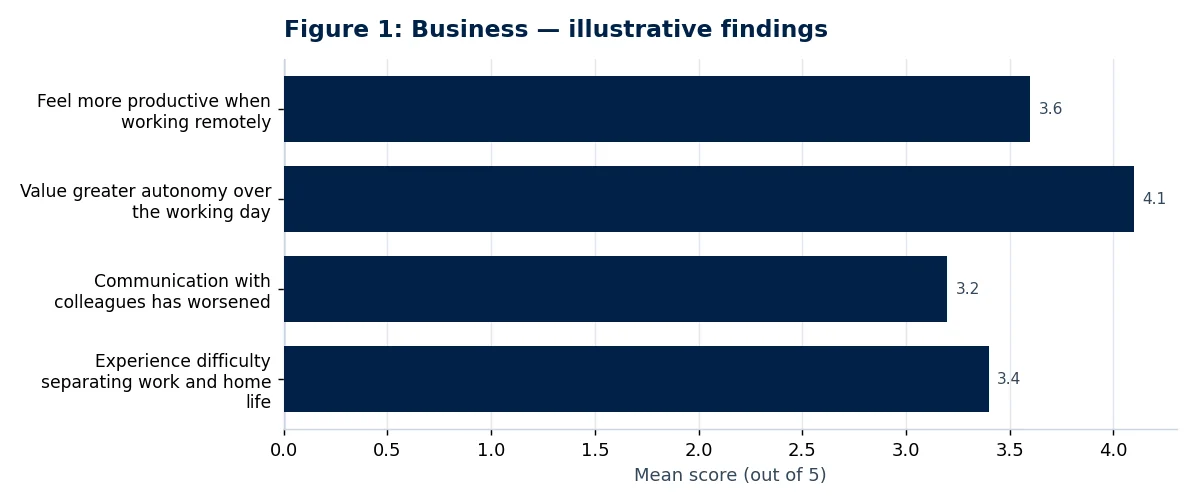
Autonomy recorded the strongest positive response, with 74 per cent valuing greater control over their working day. This supports self-determination theory and echoes Gajendran and Harrison (2007), who linked autonomy to engagement and effort.
Interview data reinforced this. Managers observed that employees given flexibility over when they worked often delivered comparable or better output. One manager noted that staff appeared more focused when free from a rigid office schedule.
The findings were more equivocal regarding communication. Almost half of respondents felt that communication had deteriorated, and interviewees repeatedly described the loss of informal exchanges that previously occurred in the office.
This mirrors Waizenegger et al. (2020), who warned of weakened spontaneous interaction. Several managers reported introducing regular virtual check-ins to compensate, suggesting that communication problems are manageable but require deliberate effort.
More than half of respondents struggled to separate work from home life. This finding tempers the productivity narrative, since blurred boundaries can extend working hours and contribute to fatigue, consistent with Wang et al. (2021).
Interviews indicated that the most productive teams were those whose managers actively discouraged out-of-hours contact. Where boundaries were respected, employees reported sustainable rather than intensified effort.
Across both data strands, management practice emerged as the recurring theme. Positive productivity outcomes clustered in organisations where managers emphasised trust, clear objectives and outcome-based evaluation rather than surveillance.
This suggests that the productivity effect of remote working is not fixed but conditional. The evidence points less to location and more to the quality of leadership as the determining factor, a theme developed in the following discussion.
The findings can now be related to the wider literature. The illustrative evidence supports a nuanced conclusion: remote working modestly enhances self-reported productivity in UK SMEs, but only where enabling conditions are present.
The strong association between autonomy and perceived productivity confirms established theory. It suggests that SMEs, often characterised by flatter hierarchies, may be well placed to grant the flexibility that fosters engagement (Kelliher and Anderson, 2010).
At the same time, the communication and boundary challenges echo the more cautious literature. These findings caution against uncritical enthusiasm and indicate that productivity gains are fragile and easily undermined if left unmanaged.
The most significant theme is the mediating role of management. This aligns with Golden and Gajendran (2019) and with high-commitment HRM theory, reinforcing the argument that implementation matters more than the arrangement itself.
For SMEs, this carries particular weight. Lacking the infrastructure of large firms, smaller enterprises cannot rely on systems and policies to compensate for weak management. The manager becomes the primary mechanism through which remote productivity is secured or lost.
The implications are therefore practical rather than merely theoretical. SMEs need not view remote working as inherently risky, but they must invest in managerial capability, digital tools and clear expectations to realise its potential.
There is also a strategic dimension. The ability to recruit beyond a local area and to reduce overheads may offer SMEs competitive advantages, provided the accompanying human challenges are addressed thoughtfully (Anderson and Kelliher, 2020).
Finally, the discussion highlights heterogeneity. Productivity effects varied by role, individual circumstance and organisational context, cautioning against one-size-fits-all policy. Hybrid models may offer a pragmatic balance between flexibility and cohesion.
This paper set out to examine the impact of remote working on employee productivity in UK SMEs and to identify the conditions shaping that impact. The illustrative research and literature together support a conditional conclusion.
Remote working can modestly improve self-reported productivity, principally through autonomy, reduced commuting and fewer interruptions. However, these gains are neither automatic nor evenly distributed across employees and organisations.
The study’s central contribution is to reframe the debate. Productivity outcomes depend less on where work occurs than on how remote work is managed. Management practice, trust and clear boundaries are the decisive mediating factors.
This conclusion is significant for the SME sector, whose resource constraints make managerial quality especially important. The findings suggest that investment in leadership capability may yield greater returns than investment in monitoring or restriction.
Several recommendations follow for SME owners and managers:
The study’s limitations, notably its small illustrative sample and cross-sectional design, indicate avenues for further research. Larger, longitudinal studies would clarify how productivity effects evolve as remote working matures.
Future research might also compare sectors and firm sizes, or examine the wellbeing consequences of remote work over time. Such work would strengthen the evidence base on which SMEs make consequential organisational decisions.
In conclusion, remote working is neither a panacea nor a threat to SME productivity. It is a management challenge whose outcome rests firmly in the hands of those who lead it.

All work is written by human writers. 100% AI free, guaranteed.

100% money back guarantee if you find plagiarism in our work.
COMPANY DETAILS