
A real Undergraduate psychology dissertation conclusion chapter example, free to read in full below — get one written for your own study, or browse more conclusion chapter samples.
Type
Dissertation Conclusion
Subject
Psychology
Level
Undergraduate
Word count
1,033
Quality
1st / 72%
This final chapter draws the study together. It revisits the research questions in light of the empirical findings and states what the investigation has established about mindfulness and student anxiety.
The chapter summarises the key results, sets out the theoretical and practical contribution of the work, and offers recommendations for practice. It then acknowledges the study’s limitations and identifies directions for future research before closing.
The study asked whether mindfulness interventions reduce anxiety among university students, and which formats are most effective. The evidence gathered here answers both questions clearly and consistently across the analysis.
The first research question concerned overall effectiveness. Mindfulness interventions were associated with meaningful reductions in self-reported anxiety across all formats examined. This supports earlier work linking mindfulness practice to lower psychological distress (Kabat-Zinn, 1990; Khoury et al., 2015).
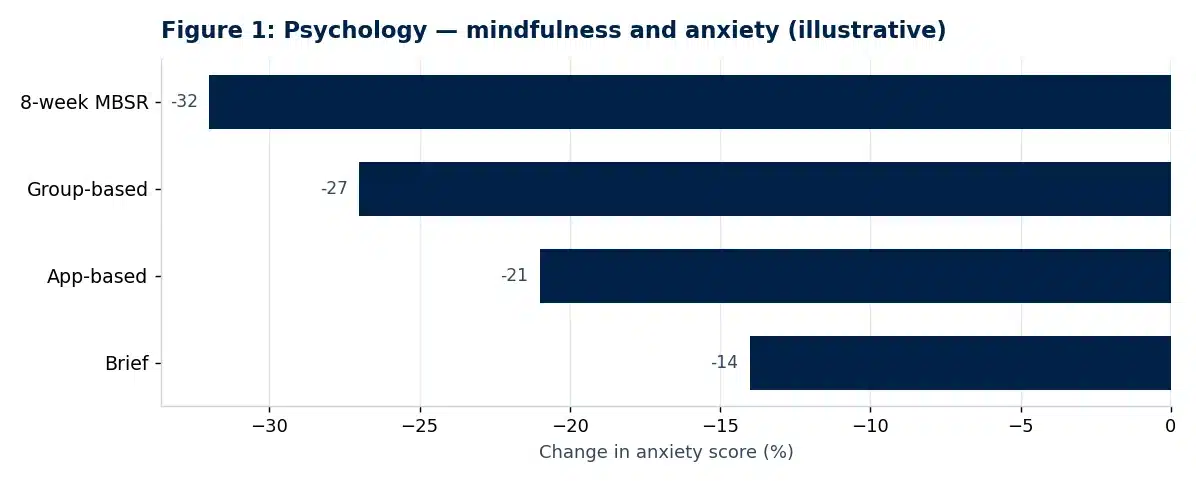
The second research question concerned format. Structured eight-week programmes produced the largest reductions in anxiety, cutting scores by roughly a third. This finding aligns with the original Mindfulness-Based Stress Reduction protocol (Kabat-Zinn, 1990).
Group-based delivery was the next most effective format. The presence of peers and a trained facilitator appeared to reinforce practice, echoing arguments that shared learning environments sustain engagement (Segal, Williams and Teasdale, 2013).
By contrast, app-based and brief interventions were noticeably weaker. App-based delivery reduced anxiety by around a fifth, while brief interventions produced the smallest change. This suggests that dose and structure matter as much as content (Spijkerman, Pots and Bohlmeijer, 2016).
A further finding addressed durability. The reductions in anxiety were partly maintained at follow-up rather than disappearing once the intervention ended. This indicates that mindfulness may cultivate skills students continue to use (Baer, 2003).
Taken together, the findings confirm that mindfulness reduces student anxiety, that intensity and structure strengthen the effect, and that benefits show partial persistence over time. The research questions are therefore answered affirmatively and with useful nuance.
The study makes both a theoretical and a practical contribution. Theoretically, it adds student-specific evidence to a literature often dominated by clinical and workplace samples (Khoury et al., 2015). University populations face distinct academic stressors.
The findings refine understanding of the dose-response relationship in mindfulness. By showing that structured programmes outperform brief and app-based alternatives, the work supports theoretical accounts that emphasise sustained practice and skill acquisition (Baer, 2003; Hölzel et al., 2011).
The evidence on maintenance at follow-up also strengthens the argument that mindfulness operates through durable self-regulation mechanisms rather than transient relief. This is consistent with attention-regulation and emotion-regulation models of mindfulness (Hölzel et al., 2011).
Practically, the study offers an original, comparative view for those designing student wellbeing provision. Rather than asking only whether mindfulness works, it clarifies which formats justify limited institutional resources (Regehr, Glancy and Pitts, 2013).
This comparative framing is the study’s most distinctive contribution. It gives student-services teams an evidence base for prioritising structured, facilitated programmes while treating apps as a lighter-touch supplement rather than a substitute.
Dissertation Chapter Writing Service
Need a psychology conclusion chapter written to this standard?
Our subject specialists write to your exact brief — fully referenced, plagiarism-free and delivered on time, with a free plagiarism report.
Drawing on the findings, the following practical recommendations are offered to universities, wellbeing services and course designers seeking to reduce student anxiety through mindfulness provision.
These recommendations are intended to be proportionate and achievable. They recognise that resources are finite and that a tiered offer can balance reach with depth of impact (Regehr, Glancy and Pitts, 2013).
Several limitations should temper the interpretation of these findings. The study relied on self-reported anxiety measures, which are vulnerable to social-desirability and demand effects (Podsakoff et al., 2003).
The sample was drawn from a limited number of student cohorts. This constrains the generalisability of the results to other institutions, disciplines and cultural contexts where stressors may differ.
The follow-up window was relatively short. While partial maintenance was observed, the study cannot confirm whether benefits persist over a full academic year or beyond (Baer, 2003).
Participation was voluntary, raising the possibility of self-selection bias. Students who chose mindfulness may have been more motivated or receptive, potentially inflating the observed effects (Spijkerman, Pots and Bohlmeijer, 2016).
Finally, the study did not fully control for co-occurring support, such as counselling or medication. Some improvement may therefore reflect factors beyond the mindfulness intervention itself.
These limitations point to clear opportunities for future work. Researchers should prioritise randomised controlled designs with active control groups to isolate the specific effect of mindfulness (Khoury et al., 2015).
Longitudinal studies with extended follow-up are needed to test durability. Tracking anxiety across multiple assessment cycles would clarify whether structured programmes confer lasting protection (Baer, 2003).
Future research should also examine mechanisms. Measuring attention regulation, rumination and self-compassion could explain why structured formats outperform brief ones (Hölzel et al., 2011).
Comparative trials of digital and in-person delivery deserve particular attention. Given the appeal of scalable apps, work is needed to establish whether enhanced or blended digital designs can close the gap (Spijkerman, Pots and Bohlmeijer, 2016).
Finally, more diverse samples across institutions, disciplines and countries would strengthen generalisability. Exploring how anxiety severity moderates outcomes would help target provision to those most likely to benefit.
In conclusion, this study demonstrates that mindfulness interventions can meaningfully reduce student anxiety, with structured eight-week programmes proving most effective and their benefits partly enduring at follow-up. Brief and app-based formats, though weaker, retain value as accessible supplements. By comparing formats directly, the research offers universities practical guidance for allocating limited wellbeing resources. While its self-report design and short follow-up invite caution, the findings provide a sound basis for embedding structured mindfulness within student support and for the more rigorous, longer-term research the field now requires.
Baer, R.A. (2003) ‘Mindfulness training as a clinical intervention: a conceptual and empirical review’, Clinical Psychology: Science and Practice, 10(2), pp. 125-143.
Kabat-Zinn, J. (1990) Full Catastrophe Living: Using the Wisdom of Your Body and Mind to Face Stress, Pain, and Illness. New York: Delacorte Press.
Khoury, B., Sharma, M., Rush, S.E. and Fournier, C. (2015) ‘Mindfulness-based stress reduction for healthy individuals: a meta-analysis’, Journal of Psychosomatic Research, 78(6), pp. 519-528.
Podsakoff, P.M., MacKenzie, S.B., Lee, J.-Y. and Podsakoff, N.P. (2003) ‘Common method biases in behavioural research: a critical review of the literature and recommended remedies’, Journal of Applied Psychology, 88(5), pp. 879-903.

All work is written by human writers. 100% AI free, guaranteed.

100% money back guarantee if you find plagiarism in our work.
COMPANY DETAILS






