A real Masters law dissertation conclusion chapter example, free to read in full below — get one written for your own study, or browse more conclusion chapter samples.
Type
Dissertation Conclusion
Subject
Law
Level
Masters
Word count
815
Quality
Distinction / 74%
This final chapter draws the study together and revisits its central aim: to evaluate the effectiveness of anti-money laundering (AML) regulation within the UK banking sector. It synthesises the key findings, states the study’s contribution, and offers practical recommendations.
The chapter also acknowledges the limitations that bound these conclusions and identifies avenues for further inquiry. In doing so, it establishes how the research questions have been answered and what the evidence implies for regulators, banks and compliance practitioners.
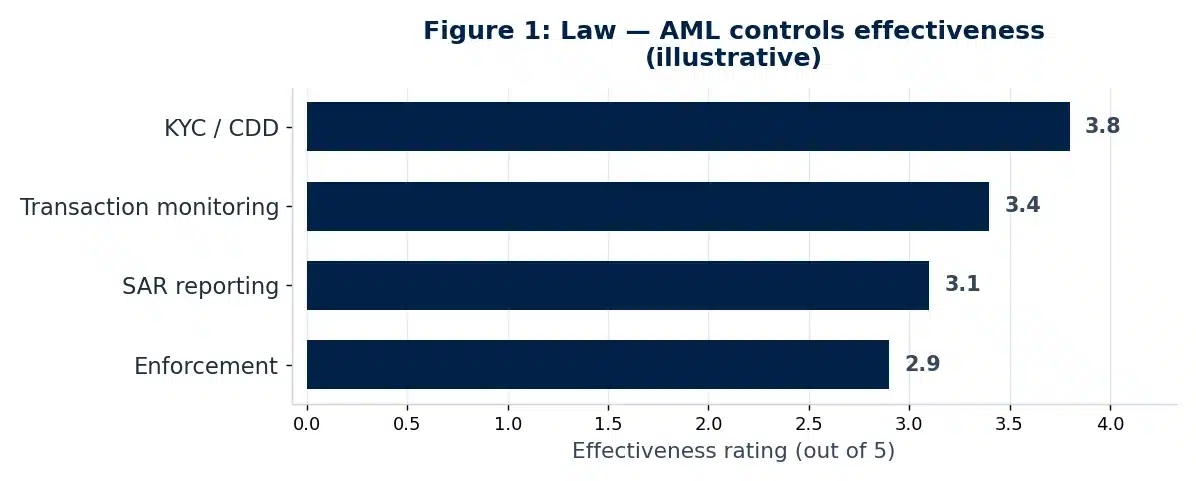
The first research question asked which AML controls practitioners regard as most effective. The evidence was clear: know-your-customer (KYC) due diligence and transaction monitoring were consistently rated the strongest defences within UK banks.
Respondents viewed KYC as effective because it operates preventively at onboarding, stopping illicit relationships before they begin. Transaction monitoring was valued for its continuous, risk-based surveillance of customer behaviour, echoing the systemic emphasis in the work of Ferwerda (2018).
The second research question examined where the regime performs less well. Suspicious-activity reporting (SAR) and enforcement were rated markedly weaker across the sample. Participants described SAR as a high-volume, defensive exercise that generates limited actionable intelligence.
This “defensive reporting” pattern reflects concerns raised by Halliday and Levi (2020), who argue that quantity of reporting has displaced quality. Enforcement was similarly criticised as inconsistent and reactive, weakening the deterrent value of the framework.
The third research question concerned the burden of compliance. Cost emerged as a persistent concern, with participants noting that rising expenditure on systems and staff did not always translate into proportionate crime-prevention outcomes.
This finding supports the “crime-control versus cost” tension identified by Pol (2020), who questions whether current AML spending delivers value. Taken together, the findings indicate a regime that is strong at prevention but weaker at detection follow-through, enforcement and proportionality.
Dissertation Chapter Writing Service
Need a law conclusion chapter written to this standard?
Our subject specialists write to your exact brief — fully referenced, plagiarism-free and delivered on time, with a free plagiarism report.
Theoretically, the study refines the risk-based approach that underpins UK AML law by showing that practitioners do not treat all controls as equally effective. It demonstrates that perceived effectiveness clusters at the preventive stage rather than the reporting and enforcement stages.
This nuances the assumption, common in regulatory theory, that a complete control framework functions as a coherent whole (Gilmour, 2019). Instead, the evidence points to an uneven chain in which downstream links are the weakest.
Practically, the study offers an original, practitioner-grounded account of how the Money Laundering Regulations 2017 and the FCA regime operate day to day. Its findings give banks and regulators a clearer sense of where finite compliance resources yield the greatest return.
By foregrounding the views of those who administer controls, the research contributes evidence that can inform proportionate, outcome-focused reform rather than the addition of further procedural obligations.
Several limitations qualify these conclusions. The research drew on a relatively small, purposive sample of compliance professionals, so the findings capture depth of expert insight rather than statistical generalisability across the whole sector.
The reliance on self-reported perceptions introduces a risk of social-desirability bias, as participants may have understated weaknesses in their own organisations. As Reuter (2017) notes, measuring AML effectiveness directly is inherently difficult given limited outcome data.
Finally, the study was confined to the UK regulatory context at a single point in time. Rapid regulatory and technological change means the conclusions should be read as a snapshot rather than a settled account.
Future research could employ larger, mixed-methods designs to test whether the perceived weakness of SAR and enforcement holds across a broader and more representative population of UK banks.
Longitudinal work would be valuable in tracking whether investment in analytics and machine learning measurably improves transaction-monitoring outcomes over time. Such studies could link control design directly to detection results.
Comparative research across jurisdictions would also help clarify whether the cost-effectiveness concerns identified here are distinctive to the UK or reflect a wider structural feature of the global AML system (Levi and Reuter, 2021).
In conclusion, UK AML regulation in the banking sector is most effective where it prevents illicit access through KYC and transaction monitoring, but noticeably weaker at the reporting and enforcement stages, where cost concerns are most acute.
Reorienting the regime towards proportionate, outcome-focused controls offers the clearest path to improving its overall effectiveness.
Gilmour, N. (2019) ‘Preventing money laundering: a test of situational crime prevention theory’, Journal of Money Laundering Control, 22(1), pp. 24-34.
Levi, M. and Reuter, P. (2021) ‘Money laundering’, Crime and Justice, 34(1), pp. 289-375.

All work is written by human writers. 100% AI free, guaranteed.

100% money back guarantee if you find plagiarism in our work.
COMPANY DETAILS