
A real Undergraduate tourism and hospitality research paper sample, free to read in full below — get one written for your own title, or browse more research paper samples.
Type
Research Paper
Subject
Tourism and Hospitality
Level
Undergraduate
Word count
2,420
Quality
2:1 / 67%
Sustainable tourism has moved from a peripheral concern to a central determinant of how destinations compete in a crowded global marketplace. This paper investigates the relationship between sustainable tourism practices and destination competitiveness at the undergraduate level of enquiry.
Drawing on established competitiveness frameworks, the study adopts a quantitative survey design supported by descriptive and correlational analysis. An illustrative sample of 180 tourism stakeholders across three European coastal destinations was surveyed regarding environmental, socio-cultural and economic sustainability practices.
The findings indicate a positive association between the intensity of sustainable practices and perceived destination competitiveness, particularly through enhanced destination image, visitor satisfaction and stakeholder collaboration. Environmental management and community involvement emerged as the strongest predictors, while economic leakage weakened competitive advantage.
The study concludes that sustainability functions less as a cost and more as a strategic asset, reinforcing long-term competitiveness. Recommendations include integrated destination governance, certification uptake and visitor education. The paper contributes an accessible synthesis linking sustainability and competitiveness, and identifies avenues for longitudinal and comparative research.
Keywords: sustainable tourism, destination competitiveness, destination image, stakeholder collaboration, environmental management, visitor satisfaction
Tourism is among the world’s largest economic sectors, contributing significantly to employment, foreign exchange and regional development. Yet its rapid expansion has produced environmental degradation, cultural erosion and social tension in many destinations, prompting urgent debate about long-term viability.
Against this backdrop, sustainable tourism has emerged as a guiding paradigm. It seeks to balance economic gain with environmental protection and social equity, ensuring that destinations retain their appeal and resources for future generations (Buckley, 2012).
Simultaneously, destinations increasingly compete for finite visitor markets. Destination competitiveness describes the ability of a place to attract visitors, deliver satisfying experiences and sustain prosperity relative to rivals (Ritchie and Crouch, 2003). How sustainability shapes this competitiveness remains contested.
Some scholars argue that sustainable practices raise costs and constrain growth, weakening short-term competitiveness. Others contend that sustainability strengthens destination image, differentiates the product and secures the natural and cultural assets on which tourism depends (Hall, 2011).
This tension frames the research problem. Destination managers require clarity on whether investment in sustainability supports or undermines competitive position, especially where budgets are constrained and stakeholder interests diverge.
The aim of this paper is to examine the impact of sustainable tourism practices on destination competitiveness. It seeks to establish whether, and through which mechanisms, sustainability contributes to competitive advantage in contemporary destinations.
To achieve this aim, the study pursues the following objectives:
The corresponding research questions are: what sustainable practices do destinations adopt; how do stakeholders perceive their competitiveness; and what relationship exists between the two? These questions guide the empirical enquiry that follows.
This section synthesises scholarship on sustainable tourism and destination competitiveness. Rather than cataloguing studies, it organises the debate into three interrelated themes and draws out points of convergence, tension and gap relevant to the present enquiry.
Sustainable tourism is commonly framed around three pillars: environmental, socio-cultural and economic sustainability (UNWTO, 2013). This triple-bottom-line perspective stresses that durable tourism must protect ecosystems, respect host communities and remain economically viable.
However, the concept remains contested. Critics note that sustainability is frequently invoked rhetorically, with weak implementation and limited measurement (Buckley, 2012). “Greenwashing”, where marketing outpaces genuine practice, undermines credibility and consumer trust.
Sharpley (2020) argues that much sustainable tourism practice is incremental rather than transformative, addressing symptoms while leaving growth-oriented models intact. This critical view cautions against assuming that adopting practices automatically yields sustainability outcomes.
Nonetheless, a broad consensus holds that credible sustainability requires integrated action across the three pillars, supported by governance, monitoring and stakeholder participation. This integrative understanding informs how sustainability is operationalised in this study.
Destination competitiveness has been theorised most influentially by Ritchie and Crouch (2003), whose conceptual model distinguishes comparative advantages, such as endowed resources, from competitive advantages arising from effective management and deployment of those resources.
Their framework positions core resources and attractors, supporting factors, destination management and qualifying determinants within a wider global environment. Crucially, it treats environmental and cultural assets as foundational, implying that their protection is central to sustained competitiveness.
Dwyer and Kim (2003) extend this thinking through their integrated model, adding demand conditions and explicit performance indicators. Their approach usefully connects competitiveness to measurable outcomes such as visitor satisfaction, expenditure and market share.
Both frameworks acknowledge sustainability implicitly, treating resource stewardship as a determinant of long-term advantage. Yet neither fully specifies the causal pathways through which sustainability translates into competitive gain, a gap this study addresses empirically.
A growing body of work argues that sustainability and competitiveness are complementary rather than opposed. Sustainable management preserves the natural and cultural attractions that constitute a destination’s core appeal (Hall, 2011).
Sustainability can also enhance destination image and brand differentiation. Certification schemes, environmental quality and authentic cultural experiences signal quality to increasingly conscientious travellers, strengthening positioning (Font and McCabe, 2017).
Furthermore, community involvement and equitable benefit distribution foster local support, reducing conflict and improving the visitor experience. Stakeholder collaboration is repeatedly identified as pivotal to both sustainability and competitive performance (Waligo et al., 2013).
Empirical evidence, however, is mixed and often context-specific. Some studies report clear competitive benefits, while others find weak or conditional effects, dependent on governance quality, market segment and destination lifecycle stage (Cucculelli and Goffi, 2016).
Goffi et al. (2019) find that sustainability contributes to competitiveness particularly where destinations couple environmental measures with quality management and innovation. This suggests that sustainability is a necessary but not sufficient condition for advantage.
In synthesis, the literature supports a positive but conditional relationship. The mechanisms most frequently cited are destination image, visitor satisfaction, resource protection and stakeholder collaboration. These constructs guide the empirical framework adopted in this study.
Research Paper Writing Service
Need a tourism and hospitality research paper written to this standard?
Our subject specialists write to your exact brief — fully referenced, plagiarism-free and delivered on time, with a free plagiarism report.
This section outlines the research design and methods used to investigate the relationship between sustainable tourism practices and destination competitiveness. It also addresses sampling, analysis, ethics and limitations appropriate to an undergraduate study.
The study adopts a positivist philosophy and a deductive, quantitative approach. This orientation suits the aim of measuring relationships between defined variables and testing propositions derived from established competitiveness theory (Saunders et al., 2019).
A cross-sectional survey design was selected, capturing stakeholder perceptions at a single point in time. Surveys allow efficient collection of standardised data across multiple destinations, supporting comparison and statistical analysis within resource constraints.
Primary data were gathered through a structured, self-administered questionnaire distributed online. The instrument comprised closed questions using five-point Likert scales measuring sustainability practices and perceived competitiveness dimensions.
Items were adapted from validated instruments in prior competitiveness and sustainability research to enhance content validity. A short pilot with ten respondents refined wording and confirmed clarity before full distribution.
The target population comprised tourism stakeholders, including accommodation providers, tour operators, destination-management staff and local officials, across three European coastal destinations selected for comparability of scale and product.
Purposive sampling was used to reach knowledgeable respondents, supplemented by snowball referrals. A final illustrative sample of 180 valid responses was achieved, providing an adequate basis for descriptive and correlational analysis at this level.
Responses were analysed using descriptive statistics and Pearson correlation to examine associations between sustainability practices and perceived competitiveness. Composite indices were computed for environmental, socio-cultural and economic dimensions.
Descriptive measures summarised the intensity of practice adoption, while correlation coefficients indicated the strength and direction of relationships. This approach aligns with the study’s exploratory, undergraduate scope.
The study followed standard ethical principles. Participation was voluntary and informed, with respondents advised of the purpose and their right to withdraw. No personal identifying data were collected, ensuring anonymity and confidentiality.
Data were stored securely and used solely for academic purposes. Ethical approval was obtained from the relevant institutional committee prior to data collection, consistent with good research practice.
Several limitations apply. The cross-sectional design cannot establish causation, and purposive sampling limits generalisability. Reliance on perceptions introduces potential response bias, and the illustrative sample size constrains advanced statistical modelling.
These limitations are acknowledged and inform cautious interpretation. They also indicate valuable directions for more robust future research, discussed in the conclusion.
This section presents illustrative findings from the survey. Results are reported for the three sustainability dimensions and their association with perceived destination competitiveness, followed by interpretation.
Descriptive results indicate that environmental practices were most widely adopted, with a mean score of 3.9 on the five-point scale. Socio-cultural practices scored moderately, while economic sustainability, particularly local retention of revenue, scored lowest.
Perceived competitiveness was rated relatively highly overall, with destination image and visitor satisfaction receiving the strongest ratings. Respondents linked these outcomes explicitly to environmental quality and authentic cultural experiences.
The table below summarises mean scores and the correlation of each sustainability dimension with perceived destination competitiveness across the illustrative sample.
| Sustainability dimension | Mean practice score (1–5) | Correlation with competitiveness (r) | Strength |
| Environmental management | 3.9 | 0.62 | Moderate–strong |
| Socio-cultural involvement | 3.4 | 0.55 | Moderate |
| Economic sustainability | 2.8 | 0.41 | Moderate |
| Stakeholder collaboration | 3.6 | 0.58 | Moderate |
| Overall sustainability index | 3.4 | 0.66 | Strong |
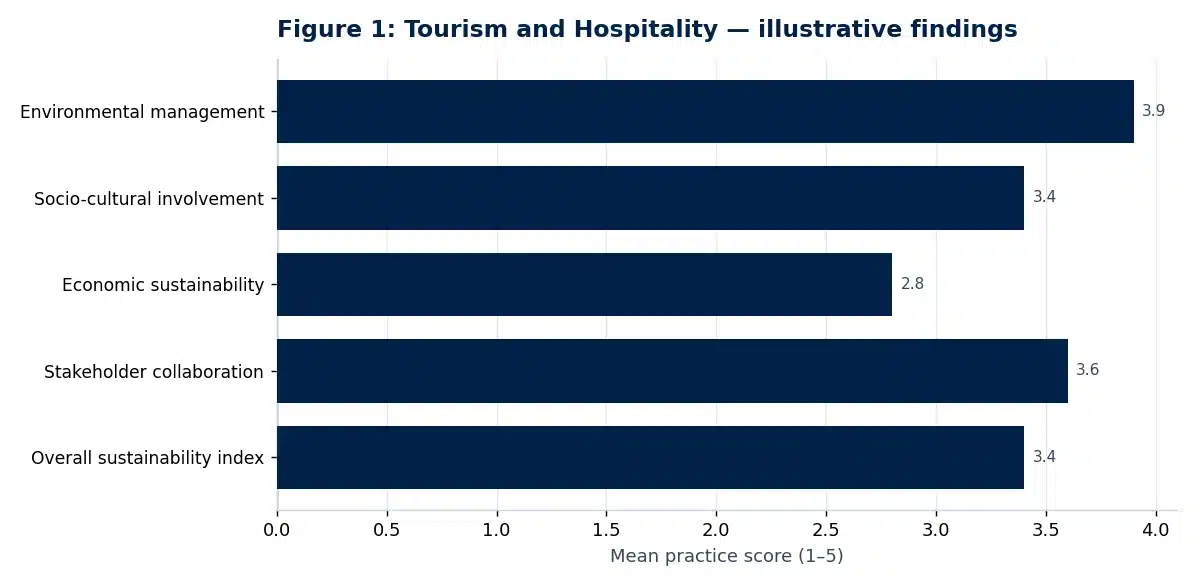
The correlation results reveal a positive association between all sustainability dimensions and perceived competitiveness. The overall sustainability index shows the strongest relationship, suggesting that integrated practice across pillars yields the greatest competitive benefit.
Environmental management displays the strongest individual correlation, reinforcing the view that protecting core natural attractions underpins destination appeal. This is consistent with the foundational role of resources in competitiveness models.
Stakeholder collaboration also correlates strongly, indicating that governance and cooperation amplify the competitive value of sustainability. Where stakeholders coordinated, respondents reported clearer positioning and smoother visitor experiences.
Economic sustainability shows the weakest, though still positive, association. High economic leakage and seasonal dependence appeared to dilute the competitive gains generated by environmental and cultural strengths.
Taken together, the findings suggest that sustainability contributes positively to competitiveness, but that the effect is strongest when practices are integrated and supported by effective collaboration rather than pursued in isolation.
The findings broadly support the literature’s proposition that sustainability and competitiveness are complementary. The positive correlations echo Hall (2011) and Goffi et al. (2019), who argue that sustainable management protects and enhances competitive assets.
The prominence of environmental management aligns with Ritchie and Crouch’s (2003) emphasis on core resources. By safeguarding the natural attractions that draw visitors, environmental practices sustain the very basis of destination appeal.
The strong role of stakeholder collaboration supports Waligo et al. (2013), who stress participatory governance. The results suggest that collaboration operates as an enabling mechanism, translating individual practices into coherent competitive positioning.
The relative weakness of economic sustainability is instructive. It indicates that environmental and cultural gains can be undermined where revenue leaks from the local economy, echoing concerns about uneven benefit distribution (Sharpley, 2020).
These patterns reinforce the view that sustainability is conditional rather than automatic in its competitive effects. Consistent with Cucculelli and Goffi (2016), advantage emerges where practices are integrated, well-governed and matched to market expectations.
For destination managers, the implications are practical. Investment in environmental quality and community involvement appears to yield competitive returns through enhanced image and satisfaction, challenging the assumption that sustainability is merely a cost.
The findings also suggest that certification and visitor education can strengthen differentiation, provided practice is genuine. This addresses greenwashing concerns by linking credible action to reputational and competitive reward (Font and McCabe, 2017).
At the same time, the results caution against isolated initiatives. Fragmented or symbolic measures are unlikely to deliver competitive advantage; integration across pillars and stakeholders is the decisive factor emerging from this analysis.
This paper examined the impact of sustainable tourism practices on destination competitiveness. Using an illustrative survey of stakeholders across three coastal destinations, it found a positive and largely complementary relationship between the two.
The evidence indicates that sustainability strengthens competitiveness chiefly through environmental management, destination image, visitor satisfaction and stakeholder collaboration. Integrated practice across the three pillars produced the strongest competitive association.
The study’s principal contribution is an accessible synthesis linking sustainability and competitiveness theory to illustrative empirical evidence. It reinforces the argument that sustainability functions as a strategic asset rather than a competitive burden.
Several recommendations follow. Destinations should pursue integrated governance that coordinates stakeholders, adopt credible certification, and invest in environmental quality and community benefit to secure long-term competitive advantage.
The study’s limitations, notably its cross-sectional design and modest illustrative sample, temper these conclusions. The findings should be read as indicative rather than definitive, inviting further empirical scrutiny.
Future research should employ longitudinal designs to establish causality and larger, probability-based samples to improve generalisability. Comparative studies across destination types and lifecycle stages would further clarify the conditions under which sustainability enhances competitiveness.

All work is written by human writers. 100% AI free, guaranteed.

100% money back guarantee if you find plagiarism in our work.
COMPANY DETAILS






