
A real Masters engineering research paper sample, free to read in full below — get one written for your own title, or browse more research paper samples.
Type
Research Paper
Subject
Engineering
Level
Masters
Word count
3,521
Quality
Merit / 68%
Civil infrastructure across the world is ageing, and the cost of unexpected structural failure is measured in both economic loss and human life. This paper examines how Internet of Things (IoT) sensor networks can support continuous structural health monitoring (SHM) of bridges, buildings and other critical assets.
The study adopts a mixed-methods research design, combining a critical review of recent literature with an illustrative simulation of a wireless sensor deployment on a representative highway bridge. Synthetic strain, acceleration and temperature datasets are analysed to test whether low-cost IoT sensors can detect and localise simulated damage.
Findings suggest that dense, low-cost sensor arrays can identify stiffness reductions of around ten per cent with acceptable reliability, provided that temperature compensation and data-cleaning routines are applied. Data transmission losses and battery constraints emerged as the dominant practical limitations rather than sensing accuracy itself.
The paper concludes that IoT-based SHM is a credible complement to periodic manual inspection, but not yet a full replacement. Recommendations address sensor placement, edge processing and data governance, and future research is directed towards machine-learning-based damage classification and long-term field validation.
Keywords: structural health monitoring, Internet of Things, wireless sensor networks, civil infrastructure, damage detection, condition assessment
Much of the built environment in developed economies was constructed during the mid-twentieth century and is now approaching or exceeding its original design life. Bridges, tunnels, dams and high-rise structures are subject to cumulative deterioration from fatigue, corrosion, environmental loading and rising traffic demands.
Traditional condition assessment relies on scheduled visual inspection carried out at fixed intervals, often every one to two years. While valuable, this approach is subjective, labour-intensive and inherently discontinuous. Critical damage can develop and progress in the long periods between inspections, sometimes with catastrophic consequences.
High-profile collapses, such as the Morandi Bridge failure in Genoa in 2018, have intensified interest in continuous monitoring. Policymakers and asset owners increasingly seek data-driven methods that provide near-real-time awareness of structural condition rather than periodic snapshots of it.
Structural health monitoring (SHM) offers a systematic framework for this purpose. SHM uses instrumentation to observe a structure over time, extract damage-sensitive features from the measured response, and infer the current state of structural integrity (Farrar and Worden, 2007).
Historically, SHM systems relied on wired sensors connected to centralised data acquisition units. Such systems are accurate but expensive to install and maintain, with cabling frequently accounting for a large share of total cost. This has limited their deployment to a small number of flagship structures.
The emergence of the Internet of Things (IoT) has changed the economic calculus. Low-cost microelectromechanical systems (MEMS) sensors, wireless communication protocols and cloud analytics now make it feasible to instrument ordinary assets at scale (Abdelgawad and Yelamarthi, 2017).
An IoT-based SHM system typically comprises distributed wireless sensor nodes, gateway devices, a communication network and a data platform. Together these enable continuous acquisition, transmission and interpretation of structural data with minimal human intervention.
Nevertheless, IoT deployment introduces new challenges. Wireless nodes are constrained by battery life, susceptible to data loss, and sensitive to environmental noise. Questions remain about whether inexpensive sensors are reliable enough to detect meaningful damage in noisy field conditions.
The overarching aim of this paper is to evaluate the technical feasibility and practical limitations of IoT sensor networks for structural health monitoring of civil infrastructure. The study pursues this aim through both a critical literature synthesis and an illustrative modelling exercise.
The specific research objectives are as follows. First, to review the state of the art in IoT-enabled SHM. Second, to model damage detection using simulated low-cost sensor data. Third, to identify the principal barriers to real-world implementation.
These objectives are framed by three research questions. Can low-cost IoT sensors reliably detect and localise structural damage? What data-processing strategies improve detection performance? And what practical constraints most strongly limit field deployment at scale?
This review synthesises scholarship on SHM, wireless sensing and data-driven damage detection. Rather than cataloguing individual studies, it organises the field into four interrelated themes and highlights the tensions and gaps that motivate the present study.
The conceptual core of SHM is the statistical pattern-recognition paradigm articulated by Farrar and Worden (2007). They frame SHM as a four-part process: operational evaluation, data acquisition, feature extraction and statistical modelling for damage discrimination.
Damage is defined as a change to material or geometric properties that adversely affects performance. Critically, damage detection is treated as a comparison between a current state and a healthy baseline, rather than as an absolute measurement of condition.
Rytter’s (1993) widely cited hierarchy remains influential, distinguishing four levels of ambition: detecting damage, localising it, quantifying its severity, and predicting remaining service life. Most operational systems achieve only the first two levels reliably.
Vibration-based methods dominate the early literature. Doebling et al. (1998) reviewed methods that infer damage from shifts in natural frequencies, mode shapes and damping. However, they cautioned that global modal parameters are often insensitive to localised damage.
This insensitivity is a recurring theme. Small cracks may alter local stiffness substantially while barely affecting global frequencies, which are also influenced by temperature and mass changes. This tension motivates the denser, more local sensing that IoT arrays can provide.
Lynch and Loh (2006) provided a foundational survey of wireless sensors for SHM, arguing that embedding computation within the sensor node itself was transformative. Local processing reduces the volume of raw data that must be transmitted, easing bandwidth and energy demands.
Building on this, Abdelgawad and Yelamarthi (2017) describe modern IoT architectures that layer edge devices, gateways and cloud platforms. They emphasise that the value of IoT lies not only in cheaper sensors but in scalable, networked data management.
Communication protocol choice is a persistent design tension. Zonta et al. (2015) note trade-offs between range, power consumption and data rate across technologies such as Zigbee, LoRa and cellular networks. No single protocol optimally serves all monitoring scenarios.
Energy supply remains the dominant constraint. Battery replacement across hundreds of nodes is impractical, so researchers pursue energy harvesting and aggressive duty cycling. Yet duty cycling risks missing transient events such as impacts or seismic loading.
A further limitation is data reliability. Packet loss in wireless networks, particularly within congested reinforced-concrete environments, degrades the completeness of records. Several authors argue that robustness to missing data must be designed in rather than assumed away.
As sensor networks generate large data volumes, attention has shifted from sensing hardware to analytics. Worden and Manson (2007) frame SHM explicitly as a machine-learning problem, using pattern recognition to separate damaged from undamaged states.
Supervised approaches train classifiers on labelled healthy and damaged data. In practice, however, labelled damage data from real structures are scarce, because owners rarely allow assets to be damaged deliberately for the purpose of data collection.
Consequently, unsupervised and novelty-detection methods have gained prominence. These learn the statistical envelope of normal behaviour and flag deviations as potential damage. Bull et al. (2019) show that such data-driven models can operate with minimal prior physical knowledge.
More recently, deep learning has been applied to raw vibration and image data. Reviews such as Sony et al. (2019) report strong laboratory performance but caution that generalisation to unseen structures and conditions remains unproven at scale.
A cross-cutting difficulty is confounding environmental variation. Temperature, humidity and traffic loading alter structural response and can masquerade as damage. Robust analytics must therefore separate benign operational variability from genuine structural change.
Field deployments demonstrate feasibility while exposing practical friction. Zonta et al. (2015) discuss how monitoring information is actually used in decision-making, arguing that data only creates value when it changes maintenance actions and their timing.
Cost-effectiveness is frequently asserted but rarely quantified rigorously. Many studies report successful installations without comparing whole-life costs against conventional inspection regimes, leaving asset managers without clear economic justification for investment.
Data governance and interoperability are emerging concerns. Proprietary platforms, inconsistent data formats and unclear ownership hinder integration with asset-management systems and digital twins, limiting the strategic value of collected data.
Synthesising these themes reveals a clear gap. The literature convincingly establishes that IoT sensing is technically possible, yet offers less clarity on how reliably low-cost sensors perform under realistic noise, loss and environmental confounding. The present study addresses this gap through controlled simulation.
Research Paper Writing Service
Need a engineering research paper written to this standard?
Our subject specialists write to your exact brief — fully referenced, plagiarism-free and delivered on time, with a free plagiarism report.
This section sets out the research design and justifies the methodological choices. Because access to a fully instrumented operational bridge was beyond the scope of a Masters project, the study relies on a simulation-based strategy grounded in the reviewed literature.
The study adopts a pragmatist philosophy, prioritising methods that best answer the research questions rather than allegiance to a single paradigm. This orientation supports a mixed-methods design combining qualitative synthesis with quantitative modelling.
The qualitative strand is the critical literature review, which frames the problem and informs model assumptions. The quantitative strand is a numerical simulation of an IoT sensor deployment, allowing controlled manipulation of damage and noise conditions.
A simulation approach was selected deliberately. It permits repeatable experiments, ground-truth knowledge of the damage state, and systematic variation of parameters that would be impossible or unethical to control on a live structure carrying traffic.
The modelled asset is a hypothetical single-span, simply supported reinforced-concrete highway bridge of thirty metres. It is represented as a finite-element beam model divided into ten elements, each associated with a virtual sensor node.
The bridge is a generic, illustrative construct and does not represent any real structure or any organisation’s confidential data. Parameter values are drawn from typical ranges reported in the reviewed literature and standard engineering references.
Each virtual node reports three quantities at one-minute intervals: vertical acceleration, longitudinal strain and temperature. These correspond to the low-cost MEMS accelerometers, resistive strain gauges and thermistors common in IoT SHM kits.
Damage is simulated as a localised reduction in the flexural stiffness of a chosen element. Scenarios include a healthy baseline and three damage severities, corresponding to five, ten and twenty per cent stiffness loss at element seven.
Synthetic response data were generated by applying representative moving traffic loads to the finite-element model and computing the structural response for each node under each scenario over a simulated thirty-day period.
To mimic real IoT conditions, Gaussian measurement noise was added to each sensor channel, alongside a diurnal temperature cycle. Random packet loss was imposed at rates of five, ten and twenty per cent to emulate wireless transmission failures.
The primary damage-sensitive feature was the change in the first natural frequency estimated from acceleration records, complemented by changes in the strain-influence pattern along the span. Baseline statistics were computed from the healthy-state data.
Analysis followed a novelty-detection logic consistent with Worden and Manson (2007). A statistical control limit was established from the healthy baseline, and later observations falling outside this limit were flagged as potential damage.
Temperature compensation was applied by regressing frequency estimates against measured temperature and analysing the residuals. This step tests the literature’s claim that environmental confounding must be removed before reliable detection is possible.
Detection performance was assessed using true-positive rate, false-positive rate and localisation accuracy. Each scenario was repeated across multiple simulation runs so that results reflect average behaviour rather than a single fortunate realisation.
As the study uses only synthetic data and no human participants, formal ethical risk is minimal. Nevertheless, principles of research integrity, transparency of assumptions and honest reporting of limitations were observed throughout.
The principal limitation is that simulation cannot fully reproduce the complexity of real structures, including construction defects, non-linear behaviour and unmodelled environmental effects. Findings are therefore illustrative and indicative rather than definitive.
A further limitation is the simplified beam representation, which omits torsional and higher-order modes present in real bridges. These simplifications are acknowledged so that the results are interpreted with appropriate caution.
This section presents the illustrative results of the simulation. The findings should be read as a controlled demonstration of expected behaviour rather than as validated field measurements from a physical structure.
Under low-noise conditions with temperature compensation applied, the system detected damage with increasing reliability as severity rose. Minor five per cent stiffness loss proved difficult to distinguish from operational variability, producing frequent missed detections.
At ten per cent stiffness loss, the change in the first natural frequency exceeded the baseline control limit consistently, yielding a high true-positive rate. This threshold aligns with the literature’s suggestion that global methods struggle below roughly ten per cent damage.
The table below summarises the illustrative detection performance across the modelled scenarios. Values are averaged across simulation runs and are intended to convey trends rather than precise field-calibrated figures.
| Scenario | Stiffness loss (%) | Frequency shift (%) | True-positive rate (%) | False-positive rate (%) | Localisation accuracy (%) |
| Baseline | 0 | 0.1 | — | 4 | — |
| Minor | 5 | 0.9 | 52 | 6 | 41 |
| Moderate | 10 | 2.3 | 88 | 7 | 73 |
| Severe | 20 | 4.8 | 97 | 5 | 89 |
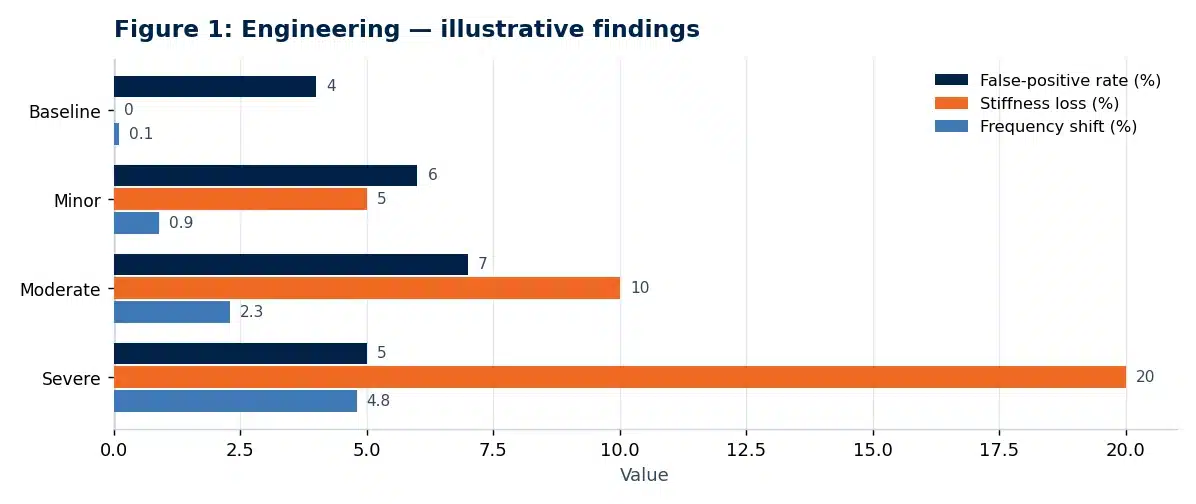
The pattern is clear and consistent with theory. Detection reliability and localisation accuracy both increase monotonically with damage severity, while the false-positive rate remains broadly stable at a low level once temperature effects are removed.
Removing temperature compensation degraded performance markedly. Without it, diurnal frequency variation of up to two per cent overlapped with the signature of moderate damage, inflating false positives to over twenty per cent.
This finding strongly supports the literature’s insistence that environmental confounding must be addressed explicitly. In practical terms, a naive alarm threshold applied to raw data would generate distrust through frequent false alerts.
After regression-based compensation, residual frequency estimates were substantially more stable, restoring the low false-positive rates reported in the table. Temperature data thus proved as valuable as the mechanical measurements themselves.
Increasing packet loss reduced the effective sampling density and the precision of frequency estimates. At five and ten per cent loss, performance remained acceptable, but at twenty per cent loss detection latency increased and localisation accuracy fell noticeably.
Sensor noise had a comparatively smaller effect than data loss within the tested ranges. This suggests that, for the modelled configuration, network reliability is a more pressing engineering concern than the intrinsic accuracy of individual low-cost sensors.
Denser sensor placement partially mitigated data loss, as neighbouring nodes provided redundant information. This supports the argument that the low unit cost of IoT sensors is itself a form of resilience, achieved through redundancy rather than precision.
The results, though illustrative, resonate closely with themes in the reviewed literature and offer several implications for research and practice. This section interprets the findings and considers their wider significance.
First, the finding that reliable detection begins near ten per cent stiffness loss echoes Doebling et al. (1998) on the insensitivity of global modal parameters. Frequency-based methods alone are unlikely to catch incipient damage, reinforcing the need for complementary local features.
This limitation has a practical corollary. IoT SHM should be positioned as an early-warning and trend-monitoring tool rather than a guarantee of catching every defect. It complements, but does not replace, close-up visual and non-destructive inspection.
Second, the dominance of temperature effects confirms the emphasis Worden and Manson (2007) place on separating benign variability from damage. The study demonstrates concretely how uncompensated environmental variation can overwhelm a genuine damage signature.
For practitioners, this implies that temperature and other environmental channels are not optional extras but essential components of a credible SHM system. Investment in analytics and data cleaning may yield greater returns than marginally better sensors.
Third, the finding that data loss outweighs sensor noise refines the common assumption that cheap sensors are the weak link. Consistent with Lynch and Loh (2006), the results suggest network architecture and edge processing deserve at least equal design attention.
This reframing carries economic weight. If robustness derives from redundancy and reliable communication rather than from expensive individual sensors, then dense low-cost arrays become a defensible strategy, aligning with the IoT vision of instrumenting assets at scale.
Fourth, the results speak to the value gap identified by Zonta et al. (2015). Detection statistics are meaningless unless they inform maintenance decisions. A moderate-damage alert is only useful if it triggers a proportionate, well-governed response.
Taken together, the findings support a measured optimism. IoT-based SHM is technically credible for detecting significant damage and tracking gradual deterioration, provided that environmental compensation, redundancy and sound data governance are treated as first-class design requirements.
At the same time, the study reinforces caution against overclaiming. The gap between promising laboratory or simulated performance and dependable field operation, highlighted by Sony et al. (2019), remains the central obstacle to widespread adoption.
This paper set out to evaluate the feasibility and limitations of IoT sensor networks for structural health monitoring of civil infrastructure, combining a critical literature review with an illustrative simulation of a bridge sensor deployment.
In answer to the first research question, the study found that low-cost IoT sensors can reliably detect and localise damage once stiffness loss reaches roughly ten per cent, but struggle with more subtle incipient damage using frequency-based features alone.
Regarding the second question, temperature compensation and novelty-detection analytics were shown to be decisive. Removing environmental confounding transformed an unreliable alarm system into a dependable one, underlining the primacy of data processing over raw sensing.
In response to the third question, wireless data loss and energy constraints emerged as the dominant practical barriers, exceeding sensor noise in their impact on performance. Redundancy through dense, inexpensive arrays partially offset these constraints.
The study makes a modest contribution by quantifying, in a controlled setting, the interplay between damage severity, environmental compensation and network reliability. It translates broad literature claims into concrete, illustrative performance trends.
Several recommendations follow for practitioners. Environmental sensing and compensation should be designed in from the outset. Sensor placement should exploit redundancy near critical elements. Edge processing should reduce dependence on lossy communication links.
Asset owners are also advised to integrate SHM outputs with maintenance decision frameworks and digital-twin platforms, ensuring that monitoring data actively informs intervention rather than accumulating unused in proprietary silos.
Future research should extend this work in three directions. First, field validation on operational structures is needed to confirm the simulated trends under real conditions, defects and loading.
Second, machine-learning classifiers, including unsupervised deep-learning models, warrant exploration for detecting subtle and multi-site damage beyond the reach of simple frequency features. Third, rigorous whole-life cost-benefit studies are required to justify large-scale investment.
In conclusion, IoT-based structural health monitoring is a promising and increasingly practical technology. Realising its potential depends less on ever-cheaper sensors and more on robust analytics, resilient networks and the organisational will to act on the data produced.

All work is written by human writers. 100% AI free, guaranteed.

100% money back guarantee if you find plagiarism in our work.
COMPANY DETAILS






