A worked Undergraduate environmental science field study report example, free to read in full below — get one written for your own brief, or browse more report samples.
Type
Field Study Report
Discipline
Environmental Science
Level
Undergraduate
Word count
1,116
Quality
2:1 / 67%
The aim of this field study was to assess how water quality in the River Colne varies along its course, and to test the hypothesis that quality deteriorates downstream of an urban wastewater discharge point, indicated by raised nitrate concentrations and reduced dissolved oxygen.
Rivers are dynamic ecosystems whose chemical and biological condition reflects the surrounding catchment and human activity within it. Water quality is a measure of the physical, chemical and biological characteristics that determine a river’s suitability for aquatic life and human use (Chapman, 1996).
Urban areas exert considerable pressure on watercourses. Treated and untreated effluent from wastewater works introduces nutrients, organic matter and suspended solids that alter the receiving water downstream of the outfall (Mason, 2002). Understanding these effects is central to environmental management and regulation.
Two variables are particularly informative. Dissolved oxygen (DO) is essential for aerobic organisms, and its concentration falls when microbial decomposition of organic pollution consumes oxygen faster than it is replenished. This process is quantified by biochemical oxygen demand (Hynes, 1960).
Nitrate is a soluble nutrient derived from sewage effluent, agricultural runoff and the nitrification of ammonia. Elevated nitrate promotes eutrophication, encouraging excessive algal growth that further depletes oxygen and reduces biodiversity (Moss, 2010). Together, DO and nitrate provide a sensitive indication of organic and nutrient enrichment.
This investigation matters because many urban rivers remain classified below good ecological status under the Water Framework Directive. Field sampling that links a discharge point to measurable change in water chemistry supports evidence-based decisions about effluent treatment and catchment protection.
Sampling was carried out along a 1.5 kilometre reach of the River Colne on a single dry day to minimise the influence of variable rainfall.
Three sites were selected: an upstream control (Site 1), a point immediately below the urban wastewater outfall (Site 2), and a downstream location 500 metres further on (Site 3).
At each site, three replicate water samples were collected in acid-washed 500 millilitre polyethylene bottles. Bottles were rinsed with river water before being filled below the surface, sealed without air bubbles, and stored in a cool box to limit chemical change before analysis.
Temperature was recorded in situ using a mercury thermometer. Dissolved oxygen was measured with a calibrated electronic DO meter, with the probe held in the flow until the reading stabilised. Values were expressed in milligrams per litre.
Nitrate concentration was determined in the laboratory using a colorimetric test kit, in which the colour developed was compared against a calibrated scale and read on a spectrophotometer. The pH of each sample was measured with a calibrated pH meter.
All measurements were repeated three times per site and the mean was calculated. Equipment was rinsed with distilled water between samples to prevent cross-contamination, following standard procedures for freshwater monitoring (Bartram and Ballance, 1996).
The results showed a clear decline in water quality downstream of the discharge point. Dissolved oxygen fell sharply between Site 1 and Site 2, while nitrate concentration rose more than threefold over the same interval. A slight recovery in dissolved oxygen was observed by Site 3.
The mean values recorded for each site are presented in the table below. The same trend is displayed graphically in Figure 1, which plots dissolved oxygen and nitrate against distance downstream.
| Sampling site | Dissolved oxygen (mg/l) | Nitrate (mg/l) | pH | Temperature (°C) |
| Site 1 — upstream control | 9.2 | 3.1 | 7.6 | 13.4 |
| Site 2 — below outfall | 5.1 | 11.8 | 7.2 | 14.9 |
| Site 3 — 500 m downstream | 6.4 | 9.7 | 7.3 | 14.5 |
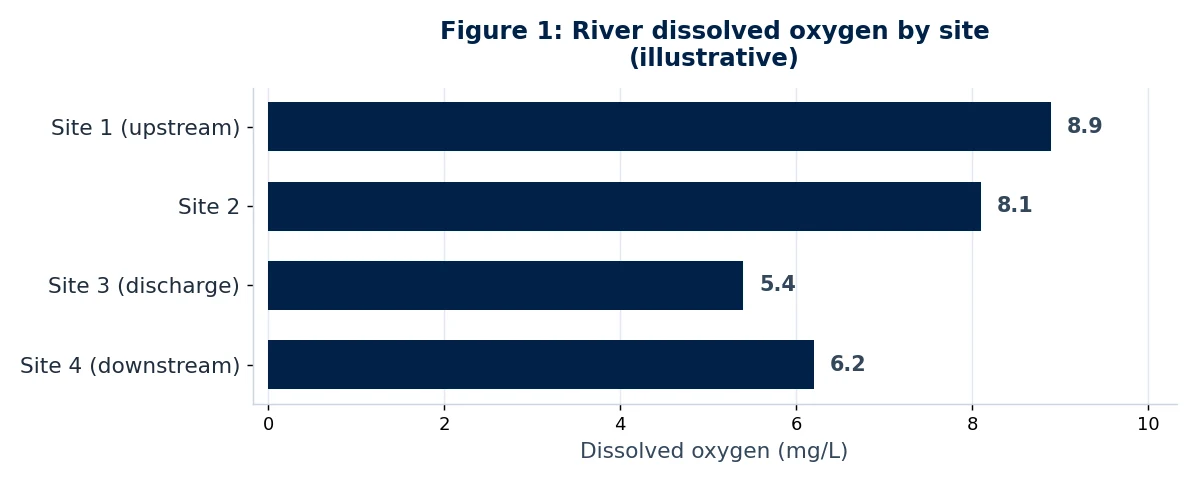
Dissolved oxygen decreased from 9.2 milligrams per litre at the control to 5.1 milligrams per litre immediately below the outfall, a fall of 45 per cent. Nitrate rose from 3.1 to 11.8 milligrams per litre over the same reach.
By Site 3, dissolved oxygen had partially recovered to 6.4 milligrams per litre and nitrate had declined to 9.7 milligrams per litre. Water temperature was slightly higher at the two downstream sites, and pH fell marginally below the outfall.
Report Writing Service
Need a environmental science field study report written to this standard?
Our subject specialists write fully referenced, plagiarism-free reports to your exact brief and deadline, with a free plagiarism report.
The findings support the hypothesis that water quality declines downstream of the urban discharge point. The sharp drop in dissolved oxygen at Site 2 is consistent with the input of organic-rich effluent, which raises biochemical oxygen demand as microbes decompose the added material (Hynes, 1960).
The more than threefold rise in nitrate at Site 2 reflects the nutrient load typical of wastewater effluent. These enriched conditions are known to drive eutrophication and secondary oxygen depletion in receiving waters (Moss, 2010), reinforcing the link between the outfall and reduced ecological quality.
The control value of 9.2 milligrams per litre lies close to oxygen saturation for freshwater at this temperature, whereas 5.1 milligrams per litre approaches the threshold below which sensitive species such as salmonids are stressed. The measured values therefore agree with expected ranges reported for polluted lowland rivers (Mason, 2002).
The partial recovery at Site 3 illustrates the river’s natural capacity for self-purification, as reaeration and dilution gradually restore oxygen with distance from the source. This gradient, from impact to recovery, is a well-documented feature of organic pollution downstream of point sources.
Several sources of error should be acknowledged:
Future work could address these limitations by sampling repeatedly across seasons, adding biological indicators such as macroinvertebrate indices, and using more precise analytical instruments to confirm the chemical trends observed here.
The investigation met its aim and confirmed the hypothesis. Water quality declined markedly downstream of the urban discharge point, with dissolved oxygen falling by 45 per cent and nitrate rising more than threefold at the outfall.
The partial recovery further downstream demonstrates natural self-purification, but the results clearly show that the urban effluent degrades the chemical quality of the receiving river.
Bartram, J. and Ballance, R. (eds.) (1996) Water Quality Monitoring: A Practical Guide to the Design and Implementation of Freshwater Quality Studies and Monitoring Programmes. London: E & FN Spon.
Chapman, D. (ed.) (1996) Water Quality Assessments: A Guide to the Use of Biota, Sediments and Water in Environmental Monitoring. 2nd edn. London: E & FN Spon.
Hynes, H.B.N. (1960) The Biology of Polluted Waters. Liverpool: Liverpool University Press.
Mason, C.F. (2002) Biology of Freshwater Pollution. 4th edn. Harlow: Prentice Hall.
Moss, B. (2010) Ecology of Fresh Waters: A View for the Twenty-First Century. 4th edn. Chichester: Wiley-Blackwell.

All work is written by human writers. 100% AI free, guaranteed.

100% money back guarantee if you find plagiarism in our work.
COMPANY DETAILS