A model UCAS-style psychology personal statement example, free to read in full below — get help writing your own, or browse more personal statement samples.
Type
Personal Statement
Subject
Psychology
Level
Undergraduate
Word count
582
Standard
UCAS offer-holder standard
The moment I realised that two people could witness the identical event and walk away with contradictory memories of it, I became fascinated by the machinery of the human mind.
Why does perception bend so readily? Studying Psychology offers me the tools to interrogate questions I have puzzled over for years about how we think, feel and behave.
My A-level studies have laid firm foundations for this ambition. Biology introduced me to the nervous system and the biochemical basis of behaviour, while the statistics component of Mathematics taught me to handle data with precision.
Studying English sharpened my ability to analyse arguments critically and to communicate complex ideas with clarity and nuance.
Wider reading has deepened this interest considerably. Kahneman’s work on cognitive biases reframed how I understand everyday decision-making, and I found myself recognising his heuristics in my own reasoning.
Reading about Milgram’s obedience experiments prompted me to reflect seriously on research ethics and the responsibilities that psychologists carry towards their participants.
To test my interest against reality, I sought relevant experience. While volunteering at a local care home, I supported residents living with dementia, adapting how I communicated as their needs changed through the day. Observing the fluctuating nature of memory loss made abstract textbook concepts suddenly tangible and profoundly human.
That experience taught me patience and the importance of dignity in care. It also raised questions I could not answer, driving me to read further into cognitive decline and the neuroscience underpinning it. I came to appreciate how rigorous research ultimately translates into compassionate, evidence-based practice for vulnerable people.
A part-time retail role has developed complementary skills. Handling difficult customers taught me to regulate my own responses and to read behaviour quickly under pressure. Balancing these shifts alongside demanding coursework has strengthened my time management and resilience, qualities I know a rigorous degree programme will continue to demand.
Beyond academic work, I organise a peer study group, where explaining concepts to others has consolidated my own understanding and honed my leadership. Playing team sport has taught me collaboration and how individuals behave within group dynamics, an observation that only deepened my curiosity about social psychology and conformity.
I am particularly drawn to this course because of its emphasis on research methods and the opportunity to specialise in cognitive and clinical modules later in the programme.
The prospect of conducting my own supervised research genuinely excites me, as does training in the statistical techniques that give psychological claims their credibility.
Ultimately, I hope to pursue a career in clinical or research psychology, contributing to a discipline that improves lives through evidence rather than assumption. I am ready to commit fully to the challenge of studying Psychology at degree level, and I am confident I will thrive within it.
Personal Statement Writing Service
Need help writing your psychology personal statement?
Our advisers help you craft an original, authentic statement that reflects your own experience — structured, proofread and tailored to your chosen course.
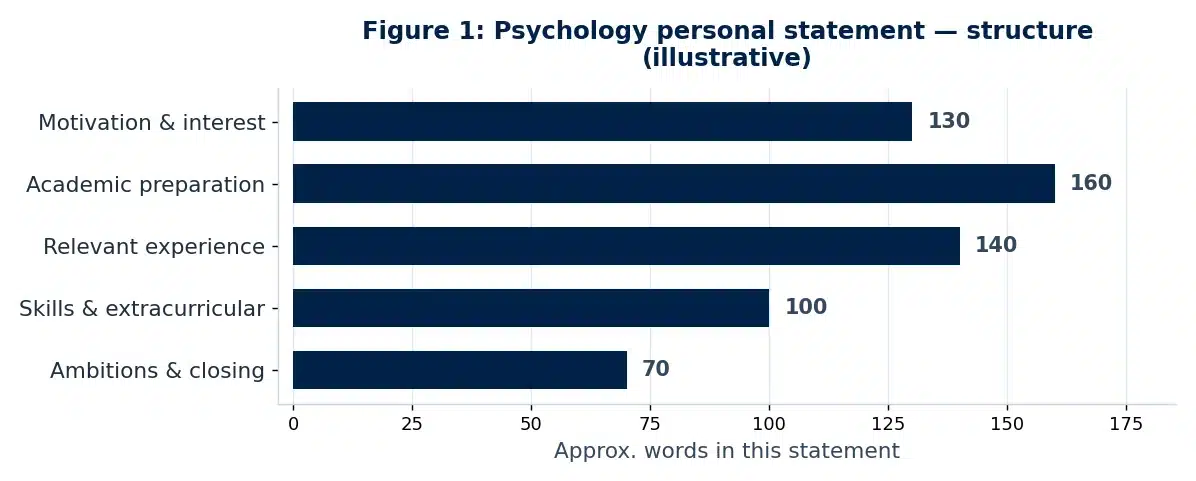
Notice how the statement favours specificity over cliché. Rather than stating a vague love of Psychology, it opens with a concrete observation about unreliable memory, then names particular thinkers such as Kahneman and Milgram to evidence genuine engagement with the discipline.
Crucially, experience is reflected upon, not merely listed. The care home paragraph does not just record volunteering; it explains what the applicant learned about memory, ethics and compassionate practice, demonstrating maturity and self-awareness that admissions tutors consistently reward.
Finally, every example is tied back to the course itself. Wider reading, work and extracurricular involvement each connect to specific ambitions, research methods and modules, showing the applicant understands what studying Psychology at degree level genuinely involves.

All work is written by human writers. 100% AI free, guaranteed.

100% money back guarantee if you find plagiarism in our work.
COMPANY DETAILS