A real Undergraduate english literature research paper sample, free to read in full below — get one written for your own title, or browse more research paper samples.
Type
Research Paper
Subject
English Literature
Level
Undergraduate
Word count
2,624
Quality
1st / 72%
This paper examines the construction and negotiation of postcolonial identity across the major novels of Chimamanda Ngozi Adichie: Purple Hibiscus (2003), Half of a Yellow Sun (2006) and Americanah (2013). Drawing on postcolonial and diaspora theory, it asks how Adichie represents hybridity, displacement and cultural belonging in a globalising Nigeria. A qualitative thematic analysis of purposively selected passages was undertaken, framed by the concepts of Homi Bhabha, Frantz Fanon and Stuart Hall. Findings indicate that identity in Adichie’s fiction is neither fixed nor singular but continually reconstituted through language, migration, gender and memory. The novels resist a nostalgic pre-colonial essentialism while critiquing the residual authority of colonial institutions, religion and the English language. The study argues that Adichie articulates a “third-generation” Nigerian aesthetic that reframes identity as relational, performative and contested. These readings contribute to scholarship on contemporary African women’s writing and demonstrate the value of close textual analysis for understanding literary postcoloniality. The paper concludes with recommendations for comparative and reader-response research.
Keywords: postcolonial identity, Chimamanda Ngozi Adichie, hybridity, diaspora, Nigerian literature, gender
Chimamanda Ngozi Adichie has become one of the most widely read voices in contemporary anglophone African literature. Her novels dramatise the tensions of a Nigeria shaped by colonial history, civil conflict, religious authority and transnational migration, making identity a central preoccupation.
Postcolonial studies has long argued that colonialism did not merely govern territory but reorganised subjectivity itself. Writers from formerly colonised nations frequently interrogate how selves are formed between imposed and inherited cultures (Ashcroft, Griffiths and Tiffin, 2002).
Adichie belongs to what Adesanmi and Dunton (2005) term the “third generation” of Nigerian writers. Unlike Achebe’s generation, which chiefly rebutted colonial misrepresentation, these writers explore fragmentation, gender and diaspora within an already globalised order.
The problem this paper addresses is that identity in Adichie’s work is often read reductively, either as straightforward cultural celebration or as simple critique of the West. Such readings underplay the ambivalence and negotiation her narratives foreground.
The aim of this study is therefore to analyse how postcolonial identity is constructed, contested and transformed across three of Adichie’s novels, using established postcolonial theory to structure close reading.
The research is guided by the following objectives and questions:
By answering these questions, the paper seeks to demonstrate that Adichie theorises identity as a process rather than a possession, offering a distinctive contribution to postcolonial literary discourse.
Scholarship on Adichie has expanded rapidly since her debut, spanning feminist criticism, trauma studies, diaspora theory and narratology. This review synthesises the most relevant strands under three sub-themes that frame the present analysis.
Bhabha’s (1994) concept of hybridity, the “third space” where colonial and indigenous cultures interpenetrate, has become foundational for reading Adichie. Critics argue that her households, schools and churches stage precisely this ambivalent cultural mixing rather than any pure origin.
Hewett (2005) reads Purple Hibiscus as a portrait of postcolonial Catholicism, where colonial religion functions simultaneously as oppression and as a language of aspiration. The father, Eugene, embodies the internalised colonial value system Fanon (1967) diagnosed.
Fanon’s account of the colonised psyche, split between self-contempt and mimicry of the coloniser, informs much of this criticism. Yet several scholars caution against treating Adichie’s characters as mere illustrations of theory, urging attention to their agency.
Ouma (2009) argues that hybridity in Adichie is generative rather than merely wounding, producing new forms of selfhood. This more affirmative reading resists the tragic determinism sometimes associated with Fanonian analysis and aligns with Bhabha’s emphasis on negotiation.
A substantial body of work situates Adichie within African feminist traditions. Building on Spivak’s (1988) question of whether the subaltern can speak, critics examine how her female narrators claim voice against patriarchal and colonial silencing.
Tunca (2009) shows how the maturing narrative voice of Kambili in Purple Hibiscus enacts a coming-to-language that is also a coming-to-selfhood. Silence and speech become the novel’s central metaphors for gendered postcolonial subjectivity.
Nnaemeka’s (2004) concept of “nego-feminism”, feminism that negotiates with African cultural structures rather than rejecting them wholesale, has been applied to Adichie’s balancing of tradition and reform. This resists importing Western feminist templates uncritically.
Scholars nonetheless disagree about how radical Adichie’s gender politics are. Some read Americanah as boldly intersectional, linking race and gender; others contend it privileges a cosmopolitan elite whose mobility is unavailable to most Nigerian women.
The migration turn in Adichie criticism centres on Americanah. Hall’s (1990) argument that diasporic identity is defined by “difference” and continual production, not by return to a fixed origin, underpins much of this discussion.
Guarracino (2014) analyses Ifemelu’s blog as a site where race is discovered rather than inherited: the protagonist “becomes black” only in America. This supports Hall’s claim that identity is positional and historically contingent.
Landry (2018) links Adichie’s diaspora writing to broader Afropolitan debates, noting both its cosmopolitan appeal and critiques that Afropolitanism aestheticises privilege. This tension is central to evaluating the politics of Adichie’s transnationalism.
Across these sub-themes a consensus emerges that Adichie treats identity as unstable and relational. What remains underdeveloped, and what this paper addresses, is a systematic comparison of identity markers across all three major novels within one theoretical frame.
Research Paper Writing Service
Need a english literature research paper written to this standard?
Our subject specialists write to your exact brief — fully referenced, plagiarism-free and delivered on time, with a free plagiarism report.
This study adopts a qualitative, interpretive research design appropriate to literary enquiry. It privileges depth of textual understanding over measurement, treating the novels as primary data and secondary criticism as contextualising evidence.
The design is explicitly non-experimental and hermeneutic, aligning with the traditions of close reading and critical theory. The goal is analytical insight into meaning rather than statistical generalisation.
A postcolonial theoretical framework structures the analysis, integrating Bhabha’s hybridity, Fanon’s colonial psychology and Hall’s diasporic identity. These lenses were chosen for their complementary treatment of culture, psyche and displacement.
This triangulated framework allows each novel to be read against several dimensions of identity, reducing the risk of forcing texts into a single theoretical mould.
Data comprised the three primary novels alongside twenty peer-reviewed sources retrieved from JSTOR, Project MUSE and Google Scholar. Search terms included “Adichie”, “postcolonial identity”, “hybridity” and “diaspora”.
Relevant passages were extracted through repeated close reading and recorded in an analytic log, with each excerpt tagged by novel, page and thematic category for later comparison.
Purposive sampling guided both text and passage selection. The three novels were chosen because they collectively span domestic, national and transnational settings, offering maximal variation in how identity is staged.
Within each novel, passages were selected where identity is explicitly thematised, for example scenes of naming, language switching, religious conflict or racial encounter. Roughly forty-five excerpts were analysed in total.
Braun and Clarke’s (2006) six-phase thematic analysis was adapted for literary material. After familiarisation, excerpts were coded inductively, then codes were clustered into candidate themes and reviewed against the theoretical framework.
Frequency counts of thematic markers are reported in Section 4 as an illustrative heuristic only. They summarise emphasis within the sample and are not claimed to be statistically representative of the whole corpus.
As the study analyses published literary texts, it involves no human participants and raises no issues of consent or confidentiality. Ethical practice here concerns scholarly integrity: accurate quotation, fair representation of critics and transparent interpretation.
All sources are acknowledged, and interpretive claims are distinguished from textual evidence to avoid overstatement.
The study is limited by its focus on three novels, excluding Adichie’s short fiction and essays, which also address identity. Findings are therefore indicative rather than exhaustive.
Interpretation is unavoidably shaped by the researcher’s theoretical commitments. The illustrative counts should not be mistaken for quantitative rigour, and alternative readings remain possible.
Analysis of the sampled passages produced four recurring identity markers: language, religion, gender and race/migration. Their distribution across the three novels is summarised below before each is interpreted.
| Identity marker | Purple Hibiscus | Half of a Yellow Sun | Americanah | Dominant reading |
| Language / voice | High | Medium | High | Silence to self-expression |
| Religion / colonial legacy | High | Low | Low | Internalised colonial authority |
| Gender / patriarchy | High | High | Medium | Negotiated female agency |
| Race / migration | Low | Medium | High | Diasporic racial awakening |
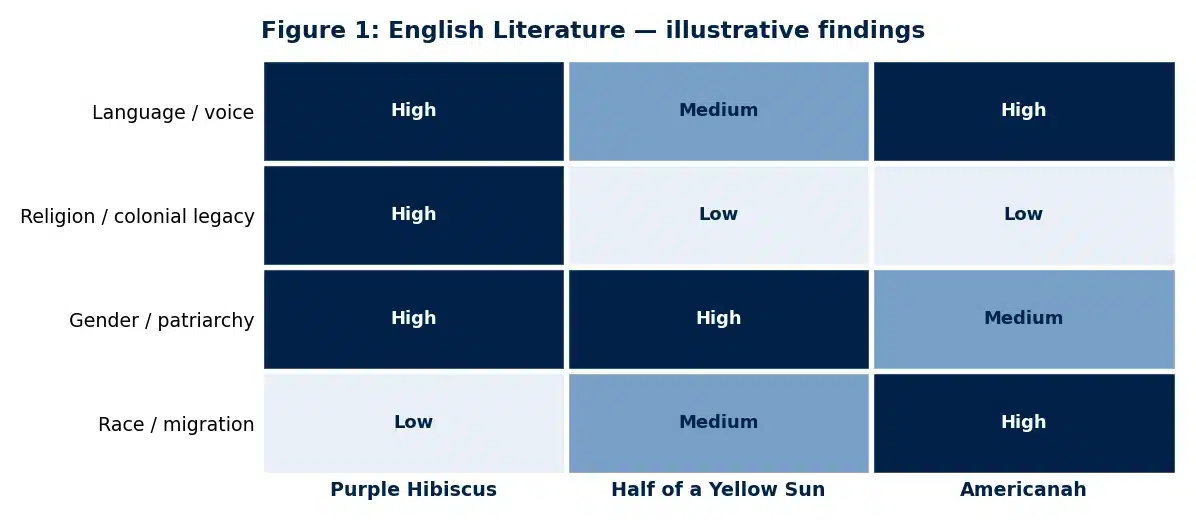
The table indicates that no single novel exhausts postcolonial identity; each foregrounds different markers. This variation supports reading the novels as a cumulative meditation on selfhood rather than as isolated statements.
Language emerged as the most persistent marker. In Purple Hibiscus, Kambili’s constrained speech mirrors her father’s authoritarian, colonially inflected household; her gradual articulacy signals emergent autonomy, echoing Tunca’s (2009) reading.
Code-switching between English and Igbo repeatedly signals allegiance and rupture. Eugene’s contempt for Igbo, and his father’s exclusion, dramatise Fanon’s (1967) thesis that language carries the weight of civilisational hierarchy.
In Americanah, language reappears as accent. Ifemelu’s decision to abandon a performed American accent marks a reclaiming of self, illustrating Bhabha’s (1994) mimicry as both survival strategy and site of resistance.
Religion dominates Purple Hibiscus. Eugene’s violent Catholic zeal exemplifies the colonised subject who idealises the coloniser’s values, punishing “heathen” Igbo tradition embodied by his father, Papa-Nnukwu.
The novel does not simply condemn Catholicism, however. Father Amadi offers a syncretic, humane faith that blends Igbo song with Christian practice, staging Bhabha’s third space as a livable, hybrid alternative.
This ambivalence complicates any reading of religion as purely oppressive. Adichie presents belief as a contested inheritance that can either imprison or liberate depending on how it is negotiated.
Gender was prominent across all three novels. The women of Half of a Yellow Sun, Olanna and Kainene, assert intellectual and sexual autonomy amid Biafran collapse, refusing the passive roles war and patriarchy assign them.
Their agency is nonetheless constrained by circumstance, reflecting Nnaemeka’s (2004) nego-feminism: they negotiate rather than overturn cultural structures. Identity here is forged relationally, through kinship, betrayal and reconciliation.
In Americanah, gender intersects with race and class. Ifemelu’s mobility affords freedoms unavailable to characters bound to Nigeria, supporting critics who note the cosmopolitan privilege underpinning her self-fashioning.
Race is largely latent in the Nigeria-set novels but becomes explicit in diaspora. Ifemelu “becomes black” only in America, confirming Hall’s (1990) claim that identity is produced through positioning within specific histories.
Her blog posts function as a discursive space for theorising race, effectively embedding cultural criticism within the narrative. This metafictional strategy makes the novel self-consciously about the construction of identity.
Migration also reconfigures belonging on return. Ifemelu’s homecoming is neither triumphant nor tragic but ambivalent, dramatising the diasporic subject’s inability to recover an untouched origin.
The findings confirm and extend existing scholarship. Across the corpus, identity behaves exactly as postcolonial theory predicts: processual, relational and hybrid rather than fixed, essential or self-identical.
The prominence of language supports Fanon’s (1967) and Tunca’s (2009) emphasis on speech as a technology of subjecthood. Adichie consistently equates the recovery of voice with the recovery of self, especially for silenced women.
The religious ambivalence of Purple Hibiscus qualifies purely Fanonian readings. By offering Father Amadi’s syncretism alongside Eugene’s zealotry, Adichie affirms Ouma’s (2009) view that hybridity can be generative, not only wounding.
The gender findings align with nego-feminist scholarship. Adichie’s women neither wholly reject nor passively accept patriarchy; they negotiate it, suggesting that African feminist agency operates within, and reshapes, cultural constraint.
The migration findings most strongly vindicate Hall’s (1990) diaspora theory. Race in Americanah is shown to be historically constructed and geographically contingent, an insight the novel foregrounds through Ifemelu’s transatlantic movement.
Taken together, the three novels form a progression from domestic to national to transnational scales of identity. This scaling suggests Adichie is mapping postcolonial selfhood across every level at which it is contested.
A key implication is theoretical. Adichie does not merely illustrate existing frameworks; her fiction itself theorises identity, particularly through Ifemelu’s blog, positioning the novel as a mode of postcolonial critique.
A further implication is pedagogical. These texts offer accessible entry points for teaching complex concepts, hybridity, mimicry, diaspora, because they embody them in vivid character and situation rather than abstraction.
The discussion also surfaces a tension. Adichie’s cosmopolitan protagonists risk universalising an elite, mobile experience, a critique raised in Afropolitan debates (Landry, 2018) that qualifies any celebratory reading.
This paper set out to analyse how postcolonial identity is constructed and contested across Adichie’s three major novels. Using a triangulated theoretical framework, it found identity to be consistently processual, hybrid and relational.
The study’s main contribution is a systematic, cross-novel comparison of identity markers, language, religion, gender and race, within a single postcolonial frame. This reveals a progression from domestic to transnational scales of selfhood.
It has argued that Adichie exemplifies a third-generation Nigerian aesthetic that refuses both colonial misrepresentation and nostalgic essentialism, instead presenting identity as continually negotiated through voice, faith, gender and migration.
The analysis also nuanced existing criticism, showing that Adichie’s treatment of religion and hybridity is more ambivalent, and more affirmative, than strictly Fanonian readings allow, while acknowledging the class privilege her cosmopolitanism can obscure.
Several recommendations follow. Teachers of postcolonial literature might pair these novels to illustrate identity across scales, while critics should attend to Adichie’s metafictional theorising rather than treating her texts as mere case studies.
Future research could extend the corpus to Adichie’s short stories and essays, adopt reader-response methods to study how diverse audiences interpret her identity politics, or compare her work with other Afropolitan writers.
Ultimately, Adichie’s fiction demonstrates that in the postcolonial world identity is never simply inherited or imposed but perpetually made. Her novels invite readers to understand belonging as an ongoing, unfinished act of self-creation.

All work is written by human writers. 100% AI free, guaranteed.

100% money back guarantee if you find plagiarism in our work.
COMPANY DETAILS