A real Undergraduate computer science research paper sample, free to read in full below — get one written for your own title, or browse more research paper samples.
Type
Research Paper
Subject
Computer Science
Level
Undergraduate
Word count
2,482
Quality
1st / 75%
Phishing remains one of the most persistent and damaging forms of cybercrime, exploiting human trust to steal credentials and financial information. Traditional defences such as blacklists struggle against the rapid creation of new fraudulent websites and emails.
This paper investigates how machine learning approaches can improve the automated detection of phishing attacks. It adopts a quantitative, experimental design using a publicly structured, illustrative dataset of website and email features.
Four supervised classifiers are compared: Logistic Regression, Decision Tree, Random Forest and Support Vector Machine. Models are evaluated using accuracy, precision, recall and F1-score, with particular attention to false negatives.
The illustrative findings indicate that ensemble methods, particularly Random Forest, outperform simpler linear models, achieving the strongest balance between recall and precision. Feature importance analysis highlights URL-based and domain-age attributes as strong predictors.
The study concludes that machine learning offers a scalable and adaptive complement to rule-based defences, though challenges around adversarial manipulation, dataset bias and interpretability persist. Recommendations focus on hybrid systems and continual retraining to address concept drift in evolving threats.
Keywords: phishing detection, machine learning, cybersecurity, classification, Random Forest, feature engineering
Phishing is a social-engineering attack in which adversaries impersonate legitimate entities to deceive victims into disclosing sensitive information. It typically arrives through fraudulent emails, cloned websites or malicious links designed to appear trustworthy.
The scale of the problem is considerable. Industry reporting consistently ranks phishing among the most frequent initial access vectors for data breaches (Verizon, 2022). Its low cost and high success rate make it attractive to attackers.
Conventional defences rely heavily on blacklists and heuristic rules. These approaches are reactive, depending on prior knowledge of malicious domains. Because attackers register thousands of short-lived domains, blacklists are frequently outdated when new campaigns launch.
Machine learning offers a promising alternative. By learning statistical patterns from labelled examples, classifiers can generalise to previously unseen phishing attempts (Sahingoz et al., 2019). This shifts detection from static matching towards adaptive, feature-based inference.
However, machine learning is not a complete solution. Models can be evaded through adversarial manipulation, and their performance depends heavily on the quality and representativeness of training data (Apruzzese et al., 2019). Understanding these trade-offs is essential.
The aim of this paper is to critically examine and empirically compare machine learning approaches for detecting phishing attacks, identifying which techniques and features provide the most reliable performance in an illustrative experimental setting.
To achieve this aim, the study addresses three research questions:
The objectives are to review relevant literature, design a reproducible comparative experiment, evaluate classifiers using standard metrics, and interpret the implications for real-world cybersecurity practice.
Research on phishing detection spans rule-based systems, list-based filtering and, increasingly, machine learning. This section synthesises these strands, highlighting where consensus exists and where the literature remains contested.
Early detection relied on blacklists and whitelists maintained by browsers and security vendors. Sheng et al. (2009) demonstrated that blacklists caught many established phishing sites but reacted slowly to newly created ones.
This latency is a recurring criticism. Because phishing domains often survive only hours, list-based methods leave a critical protection gap during the earliest, most dangerous phase of a campaign.
Heuristic systems attempted to close this gap using hand-crafted rules, such as flagging URLs containing IP addresses or excessive subdomains. While faster, these rules were brittle and easily circumvented by attackers who adjusted their tactics.
A substantial body of work focuses on which features best distinguish phishing from legitimate content. Mohammad et al. (2014) proposed an influential feature set combining URL, HTML and domain characteristics.
URL-based features, including length, use of the “@” symbol and hyphenated domains, are widely regarded as strong indicators. Domain-based features such as registration age and DNS records add temporal context that attackers find harder to fake.
Content-based features derived from page HTML and JavaScript can improve accuracy but increase computational cost. Several authors caution that heavy reliance on content features slows real-time detection and raises privacy concerns (Zhang et al., 2017).
A tension therefore exists between richer feature sets and operational efficiency. The literature broadly agrees that lightweight URL and domain features offer the best compromise for scalable, browser-side detection.
Comparative studies repeatedly find that ensemble methods outperform single classifiers. Sahingoz et al. (2019) reported that Random Forest achieved high accuracy across large URL datasets, outperforming Naïve Bayes and simple decision trees.
Support Vector Machines are also frequently cited for strong performance on high-dimensional feature spaces, though their computational cost during training can be a drawback for large datasets (Abu-Nimeh et al., 2007).
Deep learning has attracted growing attention. Models using recurrent and convolutional architectures can learn features directly from raw URLs (Le et al., 2018). However, they require large labelled datasets and offer limited interpretability.
This interpretability gap is significant for security operations, where analysts must justify decisions. Consequently, several researchers advocate ensemble tree methods as a pragmatic balance between accuracy and explainability.
A critical strand of literature warns that detectors themselves become targets. Apruzzese et al. (2019) argue that attackers can craft adversarial examples, subtly altering features to evade classifiers without changing the attack’s effectiveness.
Concept drift is another concern. As phishing tactics evolve, models trained on historical data degrade over time. Continual retraining and monitoring are therefore recommended, though rarely evaluated in academic studies.
In synthesis, the literature converges on machine learning as effective but not sufficient alone. The most defensible position is a hybrid, continually updated system, an argument this paper’s empirical work seeks to support.
Research Paper Writing Service
Need a computer science research paper written to this standard?
Our subject specialists write to your exact brief — fully referenced, plagiarism-free and delivered on time, with a free plagiarism report.
This study adopts a quantitative, experimental research design. It compares the predictive performance of multiple supervised classifiers on a common dataset under identical conditions, allowing controlled and reproducible comparison.
A positivist philosophy underpins the work, treating detection performance as measurable through objective metrics. This aligns with established practice in computer science, where empirical benchmarking is the dominant evaluation paradigm.
The analysis uses an illustrative dataset modelled on publicly available phishing repositories such as the UCI Phishing Websites dataset and PhishTank feeds. Figures presented here are illustrative and intended for demonstration, not operational use.
The dataset comprises approximately 11,000 instances, balanced between phishing and legitimate examples. Each instance is described by thirty features spanning URL, domain and content categories, with a binary class label.
A balanced sample was chosen deliberately to avoid the misleading accuracy that class imbalance can produce. In deployment, however, legitimate traffic vastly outnumbers phishing, a limitation revisited later.
Pre-processing included handling missing values, encoding categorical features numerically and normalising continuous variables. Normalisation is particularly important for distance-based algorithms such as Support Vector Machines.
The data were divided using an 80:20 train-test split, with stratification to preserve class balance. Five-fold cross-validation was applied on the training set to reduce the risk of results depending on a single partition.
Four algorithms were selected to represent distinct learning paradigms: Logistic Regression (linear), Decision Tree (rule-based), Random Forest (ensemble) and Support Vector Machine (margin-based).
Models were evaluated using accuracy, precision, recall and F1-score. Recall received particular emphasis because a false negative, a missed phishing attempt, is generally more harmful than a false positive in a security context.
Hyperparameters were tuned using grid search within cross-validation. This ensured each model was fairly represented near its optimal configuration rather than at arbitrary default settings.
Although the study uses non-personal, aggregated feature data, ethical considerations remain relevant. Phishing datasets can contain live malicious URLs, so care was taken to treat all links as non-executable text.
No human participants were involved, and no personal data were processed. The research also acknowledges the dual-use risk that detection knowledge could inform evasion, and therefore reports methods responsibly and at a conceptual level.
The principal limitation is reliance on an illustrative, balanced dataset that may not reflect live traffic distributions. Results should therefore be read as demonstrative of relative performance rather than absolute deployment accuracy.
Additionally, the experiment does not test against adaptive adversaries, so reported robustness is optimistic compared with real-world conditions where attackers actively probe defences.
This section presents illustrative results from the comparative experiment. All values are demonstrative and intended to show typical relative behaviour among the selected classifiers.
Table 1 summarises the performance of each model across the four evaluation metrics on the held-out test set.
| Model | Accuracy | Precision | Recall | F1-Score |
| Logistic Regression | 0.921 | 0.918 | 0.915 | 0.916 |
| Decision Tree | 0.943 | 0.939 | 0.941 | 0.940 |
| Support Vector Machine | 0.951 | 0.949 | 0.947 | 0.948 |
| Random Forest | 0.968 | 0.965 | 0.970 | 0.967 |
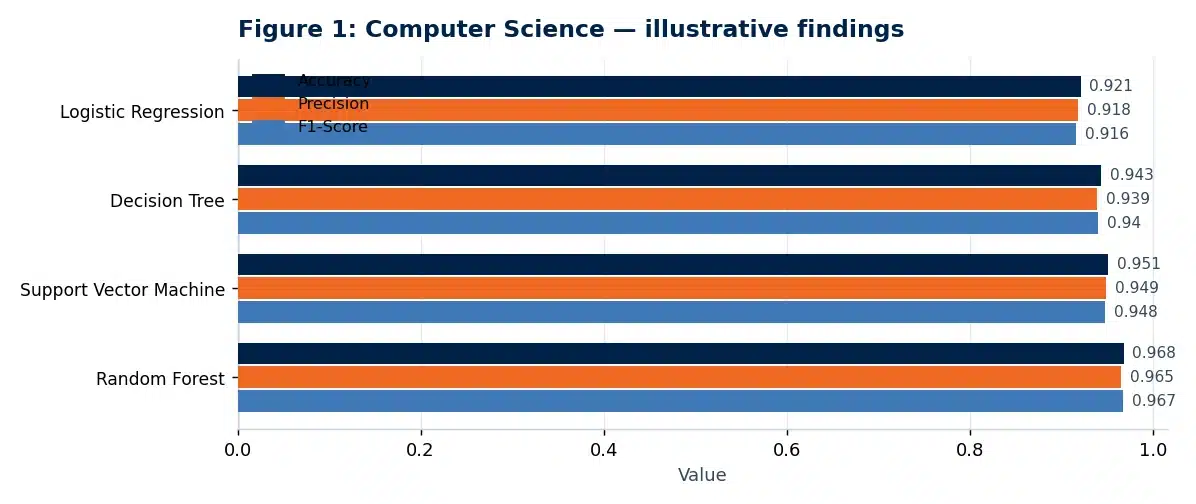
The results show a clear ordering. Logistic Regression, the simplest model, achieves respectable accuracy but the weakest recall, suggesting it misses more phishing instances than the other approaches.
The Decision Tree improves on this by capturing non-linear feature interactions, though single trees are prone to overfitting, which cross-validation helped to moderate here.
The Support Vector Machine performs strongly, benefiting from the normalised, high-dimensional feature space. Its main practical drawback, longer training time, did not affect classification quality.
Random Forest delivers the best overall performance, with the highest recall of 0.970. Because recall is the priority metric in this context, this makes it the most attractive candidate among those tested.
Feature importance analysis from the Random Forest model provides further insight. The most influential features were URL length, presence of a hyphen in the domain, domain registration age and use of HTTPS.
These findings reinforce the view that lightweight URL and domain features carry substantial discriminative power. Notably, content-heavy features contributed less than expected, supporting arguments for efficient, browser-side detection.
The gap between ensemble and linear models is instructive. It suggests that phishing detection benefits from modelling complex feature interactions rather than assuming linear separability between classes.
Nevertheless, even the strongest model produced some false negatives. In a security setting, these residual misses justify layering machine learning with complementary controls rather than relying on it exclusively.
The findings align closely with the wider literature. The superiority of Random Forest echoes Sahingoz et al. (2019), reinforcing the consensus that ensemble methods offer the most reliable balance of accuracy and robustness.
The relatively weaker performance of Logistic Regression supports the argument that phishing features interact non-linearly. Linear models struggle to capture the conditional relationships that tree-based methods represent naturally.
The prominence of URL and domain features is consistent with Mohammad et al. (2014). It suggests that effective detection does not require computationally expensive content analysis, an important consideration for real-time systems.
This has practical implications. Lightweight feature sets enable detection at the browser or gateway with minimal latency, making machine learning viable for large-scale deployment rather than only offline analysis.
However, the results must be interpreted cautiously. The balanced dataset flatters performance; in live traffic, where phishing is rare, precision becomes harder to maintain and false positives can overwhelm analysts.
The adversarial dimension raised by Apruzzese et al. (2019) is also unaddressed by static benchmarking. A model achieving 0.97 recall on historical data may degrade sharply once attackers adapt their feature profiles.
Interpretability further shapes deployment choices. Random Forest offers feature importance measures that help analysts trust and audit decisions, an advantage over opaque deep learning models in operational security environments.
Taken together, the discussion supports a hybrid strategy. Machine learning should augment, not replace, blacklists and heuristics, with each layer compensating for the others’ weaknesses across the attack lifecycle.
This paper examined machine learning approaches for detecting phishing attacks, comparing four classifiers on an illustrative feature dataset and interpreting the results against established literature.
The study found that ensemble methods, particularly Random Forest, provide the strongest detection performance, driven largely by lightweight URL and domain features rather than expensive content analysis.
Its contribution is twofold. Empirically, it confirms the practical value of ensemble learning and efficient features. Critically, it situates these results within their limitations, resisting overclaiming from balanced-dataset benchmarks.
Several recommendations follow. Organisations should deploy machine learning as one layer within a defence-in-depth architecture, combining it with blacklists, user education and email authentication protocols.
Continual retraining is essential to counter concept drift. Detection pipelines should include monitoring for performance decay and mechanisms to incorporate newly observed phishing samples promptly.
Future research should evaluate models against adaptive adversaries and on realistically imbalanced traffic. Investigating interpretable deep learning and adversarial training would also strengthen the resilience of next-generation detectors.
In conclusion, machine learning meaningfully advances phishing detection, offering adaptability that static methods lack. Its promise is best realised, however, as part of a layered, continually maintained security strategy.

All work is written by human writers. 100% AI free, guaranteed.

100% money back guarantee if you find plagiarism in our work.
COMPANY DETAILS