A real PhD psychology dissertation sample, free to read in full below — get one written for your own title.
Type
Dissertation
Subject
Psychology
Level
PhD
Word count
72,676
Quality
Doctoral standard
Parenting during the preschool period is considered one of the most stressful times of parenthood (Roxburg, 2002). Aside from the interplay between parent and child characteristics, environmental and situational life events, such as financial stress, marital conflict, and housing difficulties can also contribute to parent stress (Abidin, 1992). Importantly then, at the time of this study, the world shifted rapidly into a state of emergency as it attempted to control the infectious spread of a novel coronavirus called COVID-19. Significant changes quickly took place across society, such as the closure of non-essential businesses, schools, and daycares. Mandates to limit travel and social gatherings were also enforced (Brown et al., 2020). In response, many parents transitioned to working at home, quarantining at home with their children, and isolating themselves away from their community and supportive networks (Brown et al., 2020). As parents endured increasingly more stress during this period, the negative impact of stress may have translated to negative parenting and thus, greater internalizing and externalizing difficulties in children.
Moreover, increasingly more parents adopted the use of smartphones and tablets during the pandemic (Michelson et al., 2021). Even prior to the pandemic, the use of mobile technology was rapidly growing given their portable nature, persistent connectivity with information, social networking features, personalized content, work features (e.g., email), and various entertainment platforms. During the pandemic, mobile technology offered parents a solution to work from home, stay connected with others, and keep themselves entertained. Of concern, however, is emerging research demonstrating how mobile technology impairs parenting behaviours (see Knitter & Zemp, 2020 for a review). Moreover, many parents have previously shared that they use mobile technology to regulate their own frustration, arousal, and negative feelings (Golen & Ventura, 2015; Hiniker et al., 2015; Newsham et al., 2018; Oduor et al., 2016; Radesky, et al., 2014), as well as escape from difficult parenting demands (Oduor et al., 2016; Radesky, et al., 2016b). Therefore, it is critical to identify how parent mobile technology use may affect parenting, especially during a period of heightened stress from the pandemic.
Overall, the purpose of the current study was to explore how parent stress and mobile technology use may impact parenting behaviours, as well as children’s internalizing and externalizing difficulties during the first year of the COVID-19 pandemic. These relations were examined through two parts of the study. Part 1 of the study included cross-sectional data to examine; 1) how parent technology use and children’s mental health challenges changed before and during the onset of the pandemic, and 2) how parent stress and parent mobile technology use are related to parenting behaviours and child internalizing and externalizing difficulties. Parents’ qualitative responses regarding their perceptions of stress, their methods of mobile technology use, the impact of mobile technology use on parenting, and how their children typically responded to parents’ mobile technology use were also examined.
As parents continued to navigate the COVID-19 pandemic, their levels of stress and mobile technology use may have changed over time. Further, parenting behaviours important for adaptive child functioning, such as sensitivity, warmth, and autonomy support may have eroded over time (Doan et al., 2012). Therefore, Part 2 of the study used longitudinal data collected over the course of nine months to examine changes to parent stress, mobile technology use, parenting behaviours, and child internalizing and externalizing difficulties. Bidirectional and transactional effects (i.e., child difficulties predicting increased parent stress) amongst these associations were also explored.
First, a review of the literature on parent stress, parent mobile technology use, parenting behaviours, and children’s internalizing and externalizing difficulties will be discussed. The literature on the impact of the COVID-19 pandemic on parent stress, technology use, and parenting will also be highlighted. Secondly, the demographic information from the study sample, as well as the methods used to collect the quantitative and qualitative data will be discussed. Third, the results of the study will be reviewed to determine whether the study hypotheses were supported. Fourth, a discussion about the applied implications of the findings, as well as how they add to the existing literature is included. Finally, the limitations of the current study and directions for future research will be considered.
Parenting stress occurs when the perceived demands of parenting exceed a parent’s perceived availability of coping resources (Abidin, 1992). Demands of parenting may include stress related to daily hassles, frustrations, and meeting a child’s needs (e.g., attention, food, comfort). Additionally, responsibility and circumstances in the greater context of everyday life, as well as major life events can also be considered sources of parenting stress (Crnic & Greenberg, 1990). Decades of research has examined the associations between parenting stress and strained parent-child relationships. Consequently, parenting stress has been consistently identified as a risk factor associated with poor child outcomes and psychopathology (Cappa et al., 2011; Cherry et al., 2019; Crnic & Low; 2002; see Deater-Deckard, 2004 for a review).
Psychopathology is broadly divided into internalizing and externalizing behaviours, which are both associated with academic, social, and emotional maladjustment across the lifespan (Eisenberg et al., 2017). Internalizing behaviours are defined as difficulties that may not be overtly seen, such as anxiety, depression, withdrawal, and somatization (Rose et al., 2018). These behaviours tend to affect a child’s psychological world, and is related to an increased risk for depression, anxiety disorders, academic underachievement, and employment difficulties (Woodward & Fergusson, 2001). Externalizing behaviours are typically overtly seen and involve acting-out, disruptive behaviours, and aggression (Rose et al., 2018). They can also encompass acts that violate the rights of others and those that bring individuals into conflict with society or authority figures (American Psychiatric Association, 2013). Externalizing behaviours observed in childhood have been linked to later risk for aggression and substance abuse (Maggs et al., 2008).
The development of internalizing and externalizing problems during childhood is influenced by a variety of individual and environmental factors. In the environment, one of the most influential factors directing the developmental trajectory of children’s adaptive functioning, is the functioning of their primary caregivers (Stone et al., 2016). Therefore, increased parenting hassles and significant life events that contribute to parenting stress can undermine children’s adaptive functioning and development. Accordingly, researchers have found that increased parent stress is associated with both parent (Stone et al., 2016; Cherry et al., 2019) and teacher (Anthony et al., 2005) reports of preschool children’s internalizing difficulties. For instance, in a longitudinal study that included 1582 mothers of children aged 4 to 9 from the Netherlands, higher levels of parent stress were found to be associated with greater internalizing difficulties in children (Stone et al., 2016). These findings have also been reported in a longitudinal study of 96 children from Finland. Results indicated that greater parent stress, when children were 2 years old, predicted greater internalizing difficulties when they were 5 years old (e.g., Mäntymaa et al., 2012). In a different study, 92 school age children from New Zealand and the United States reported on their own depressive and anxious symptoms (Rodriguez, 2011). Findings revealed that greater maternal parenting stress was associated with higher levels of child reported symptoms of depression and anxiety (Rodriguez, 2011).
Similarly, greater parenting hassles, as reported by parents of preschool children, have been shown to predict more disruptive behaviour problems in children concurrently and in the future (Crnic et al., 2005; Mäntymaa et al., 2012; Stone et al., 2015). For example, in one study of 404 parents of 2 to 10-year-old children from the United States, greater parenting stress was related to higher levels of concurrent and future externalizing behaviour in children (Anthony et al., 2005). In another study of over 800 parent-child dyads, increased parenting stress when children were 1-year-old predicted greater externalizing difficulties in children at 3 years old (Cherry et al., 2019). These patterns of results have been observed in a number of studies involving both preschool (e.g., Stone et al., 2015) and school-aged children (Benzies et al., 2004; Mackler et al., 2015). Taken together, the past literature strongly suggests that higher parenting stress is associated with both increased externalizing and internalizing difficulties in young children.
As parents become more overwhelmed, they are more likely to transmit the negative impact of stress onto their children. One transmission vehicle of parent stress is parenting quality (Crnic et al., 2005; Crnic & Low, 2002; Park & Johnston, 2020). As parents experience stress, their mental and emotional resources become strained, which leads to greater use of ineffective parenting approaches (i.e., harsh parenting).
Parenting research has identified a wide variety of parenting behaviours thought to be important for adaptive functioning (e.g., sensitivity, warmth, positive regard). Yet, upon closer examination, these parenting behaviours appear remarkably similar. To address these similarities, Schaefer (1959) synthesized early parenting research and created a circumplex model of parenting behaviour to capture and organize the most prominent parenting behaviours in the field. Using factor analyses and circumplex models to examine parenting behaviours, a model emerged with two spectrums of parenting behaviour that include positive and negative dimensions of parenting (Schaefer, 1959). These two spectrums, namely “Autonomy versus Control” and “Love versus Hostility” are considered broadband domains of parenting and each encompass specific parenting behaviours. For example, affection, involvement, support, and attentiveness are examples of specific parenting behaviours that fall on the spectrum of “Love versus Hostility”. By comparison, harshness, irritability, and intrusiveness are parenting behaviours that fall on the spectrum of “Love versus Hostility” (Parent & Forehand, 2017). Although some parenting behaviours represent two conceptually opposite ends of a spectrum, the absence of one parenting behaviour does not result in the presence of another. For example, the absence of love does not necessarily equate to the presence of hostility because a parent may not express either love or hostility. These two parenting spectrums yield three important elements of parenting that are consistently emphasized in the parenting literature: warmth, hostility, and behavioural control (Parent & Forehand, 2017; see Figure 1).
Figure 1. Schaefer’s (1959) Hierarchical Model of Parenting Behaviour Depicting Two Dimensions: “Autonomy Versus Control” and “Love Versus Hostility”. Model dimensions: Autonomy, Autonomy Support, Love (Sensitivity), Hostility, Control.
The “Autonomy versus Control” spectrum captures the amount of control imposed by a parent on their child. This can range from a lack of control (autonomy), as seen in lax or permissive parenting styles, to overcontrolling behaviours, such as the use of physical punishment (Parent & Forehand, 2017). The right amount of control to optimally promote compliance and self-regulation skills is referred to as autonomy support. The theoretical pathways underlying how autonomy support contributes to adaptive functioning in children is largely informed by the scaffolding literature (see Wood, 1976).
Parents demonstrate scaffolding by taking over elements that are beyond a child’s competence. When a desired goal or behaviour is outside a child’s capacity, parents must consider the performance level of a child and offer the appropriate amount of support while also allowing autonomy. For instance, parents can help their children direct attention, guide them through problem solving, and provide explanations through verbal exchanges. Parents can also encourage their children to express their opinions, choices, decisions, and independently problem-solve (Matt-Gagne & Bernier, 2011). As parents use these parenting practices, they help children become aware of, and reflect on, their own responses by teaching them mental terms and verbal tools (Carlson, 2003; Clark, et al., 2021; Landry et al., 2002). Over time, children begin to internalize the regulatory strategies modelled by their parents, so their level of competence increases, which lead to a gradual decline in parent support. This balance of understanding child competency, respecting child autonomy, and offering parent support is characteristic of autonomy support (Grolnick & Ryan, 1989). While parents engage children in stimulating activities and offer autonomy support, children have more opportunities to experience success, self-agency, influence their external world, and understand the importance and gratification of a pursuit, which are all needed for adaptive functioning (Carlson, 2003; Diamond, 2013; Obradović et al., 2021; Valcan et al. 2017). For example, one study evaluated whether American mothers’ (N = 1,306) autonomy support over the first three years of motherhood predicted later executive functioning and academic achievement in their children (Bindman et al., 2015). Greater autonomy support during the preschool period predicted children’s academic achievement in elementary and high school (Bindman et al., 2015). A meta-analysis of 36 studies corroborated these findings by showing that greater autonomy support predicts better psychosocial functioning, competence, engagement, positive attitudes, academic achievement, and most strongly, psychological health in youth (see Pomerantz et al., 2005 for a review; Vasquez et al., 2016).
By comparison, too much parental control can interfere with a child’s ability to internalize self-regulation skills (Bindman et al., 2015; Whipple et al., 2011). For instance, in one study of 102 parents and their 2- to 6-year-old children, the dyads participated in mildly challenging laboratory tasks (Obradović et al., 2021). Parents who exhibited more controlling behaviours also had children with lower scores on measures of executive functioning skills. The authors noted that parental over engagement thereby creates fewer opportunities for children to practice self-regulation. Therefore, as children fail to effectively develop the skills needed to inhibit behavioral impulses, they may display more aggressive and externalizing behaviours (Tremblay et al., 2004). Accordingly, studies have found that children with poor self-regulation skills tend to display more physical aggression (e.g., Cummings et al., 2000; Raaijmakers et al., 2008; Tran & Menna, 2019; Willoughby et al., 2011) exhibit more externalizing problems, and are at higher risk for conduct problems (e.g., Card & Little, 2006; Hughes et al., 2000). Alternatively, drawing from the self-determination theory, externalizing or oppositional behaviours may also be a reaction to parental overcontrol because a child’s need for autonomy is being suppressed (Soenens et al., 2015).
Too much control can also undermine a child’s opportunity to experience success (Grolnick & Farkas, 2002; Obradović et al., 2021; Whipple et al., 2011). Therefore, as parents unnecessarily assist children with tasks or dominate control (e.g., rushing a child’s thinking, performing actions a child could do, making decisions for a child), they create few opportunities for children to develop a sense of mastery (Bindman et al., 2015; Vasquez et al., 2016). Children may also continually depend on their parents and develop a perception of themselves as incompetent (Bindman et al., 2015; Mcleod et al., 2007; Pinquart et al., 2019). Consequently, a lack of effective coping skills, low self-efficacy, feelings of helplessness, and/or a view of the world as out of control may increase one’s vulnerability to threat and contribute to internalizing symptoms such as anxiety or depression (Mcleod et al., 2007; McLeod et al., 2007).
Lax control, or too much autonomy, can also have negative implications for children’s adaptive functioning (Pinquart et al., 2019; Piotrowski et al., 2013; Rinaldi & Howe, 2012). Parents who fail to reign in children’s disruptive behaviours by avoiding confrontation, discipline, or punishment, as well as allow transgressions to pass may convey to their children that these disruptive behaviours are permitted and tolerated (Bandura, 1989; Baumrind, 1971; Meuwissen & Carlson, 2019). For example, in one study of 1,141 American parents of children ages 2 and 8 years old, parents completed questionnaires about their parenting styles and children’s externalizing problems (Piotrowski et al., 2014). Results indicated that mother’s permissive parenting, which was characterized by an absence of control, lack of punishment, and lack of confrontation regarding child behaviour, predicted greater child externalizing difficulties (Piotrowski et al., 2014). Furthermore, in an experimental study, 128 mothers from the United States and their 3-year-old children were asked to complete a challenging puzzle together (Meuwissen & Carlson, 2019). Mothers who were assigned to the autonomy support condition were instructed to reduce controlling behaviours; however, they did not successfully increase autonomy support, which resulted in a laissez-faire style of parenting during the structured task (Meuwiseen & Carlson, 2019). Based on these parenting styles, the study found that changes in parenting (increased permissiveness) significantly predicted concurrent decreases in child self-regulation (Meuwiseen & Carlson, 2019). Thus, parents leave children to struggle, are uninvolved, or are unable to offer an appropriate level of support, children may be left with ineffective resources to cope and problem solve. Further, they miss opportunities to learn, practice and internalize regulatory skills from their parents (Meuwissen & Carlson, 2019; Piotrowski et al., 2013; Whipple et al., 2011). Without adequate regulatory skills, children may also experience decreased feelings of mastery, self-perceptions of incompetency, and adopt views of the world as threatening and uncontrollable (Lewis & Carpendale, 2009; Matt-Gagne & Bernier, 2011), which may lead to internalizing and externalizing behaviour problems. Taken together, an appropriate level of behavioural control and autonomy appears to promote children’s adaptive functioning (see autonomy support in Figure 1). By comparison, too much or too little control is related to greater internalizing and externalizing difficulties in children.
The second spectrum captured by Schaefer’s circumplex model is the continuum of “Love versus Hostility.” Schaefer’s (1959) conceptualization of love includes parenting that is warm, affectionate, attentive, and accepting. These behaviours will be referred to as parental sensitivity or warmth in the current study. Hostility on the other hand, captures parenting that is harsh, irritable, and intrusive.
Ainsworth (1967) first defined sensitivity as a parent’s ability to notice a child’s signals, interpret these signals correctly, and promptly respond to these signals appropriately. Sensitivity is also characterized by positive affect, warmth, and the absence of hostility (Bretherton, 2013). These behaviours determine attachment quality and are considered universally important for meeting a child’s needs, protecting their safety, and promoting social development (Ainsworth, 1967). The timeliness of parents’ responses is important. During infancy, children attempt to convey their needs by eliciting reactions from their parents (Ainsworth, 1977). When their bids for attention elicit a consistent response, parents reinforce the infants’ view of relationships and the world as predictable and safe (Ainsworth, 1977; Ainsworth, et al., 1978; Bretherton, 2013). Thus, rather than looking for safety or being preoccupied with unmet needs, a child’s sense of security frees up resources for them to explore their environment and interact with parents (Ainsworth, 1977; Ainsworth et al., 1978). Through this exploration and interaction, children encounter greater opportunities to learn, practice, and internalize regulatory skills (Kopp, 1982). Conversely, when children’s needs are not adequately met due to absent or inconsistent parenting, children eventually learn to view people and the world as untrustworthy, unreliable, unpredictable, and unsafe (Ainsworth, 1967; Ainsworth et al., 1978; Spinrad et al., 2007). If children are in a state of heighted fear and helplessness, without the resources to regulate the arousal, it follows that this heightened emotional arousal may lead to increased risk of psychopathology (Spinrad et al., 2007)
From a social learning perspective, sensitive and warm parental responses model appropriate regulation skills for children (Bandura, 1986; Spinra et al., 2007). During infancy, children rely almost exclusively on their parents to reduce their level of emotional arousal (Gottman et al., 1997; Kopp, 1982,1989; Sroufe, 1996). In one study, 256 American mothers were rated based on their sensitivity and warmth, as well as how they reacted to their 18-month-old child’s negative emotions (Spinrad et al., 2007). Greater maternal sensitivity and warmth was associated with higher effortful control in children one year later, which in turn was also related to decreased externalizing difficulties, lower separation anxiety, higher inhibition to novelty, and greater social competence (Spinrad et al., 2007). When mothers responded positively by validating their child’s feelings and used effective strategies to soothe their child, they were helping their child learn how to understand emotions and modelled strategies to control emotions and behaviours (Spinrad et al., 2007). By comparison, hostile, intrusive, and punitive parenting can also by modelled by children (Bandura, 1986). Further, children may also learn to perceive others as hostile and unreliable, which may elicit, and even prematurely provoke, aggression in children (Michiels et al., 2008; Weiss et al., 1992). For instance, in a sample of 1516 American children followed from 17-months-old to 72-months-old, harsher parenting contributed to increased physical aggression in children (Vitaro et al., 2006). A meta-analysis of 48 studies also found that harsh parenting by both mothers and fathers was associated with increased relational aggression (Kawabata et al., 2011).
Given that the presence of warmth may not necessarily mean the absence of hostility, it is worth mentioning that the absence of negative parent emotions is also critical (Hoffman, 2000). When parents exhibit hostility, rejection, excessive disapproval, and criticism, this can trigger negative emotional arousal which disrupts a child’s ability to focus on learning to modulate their behaviours and emotions, as well as increase their sensitivity to anxiety, depression, and aggression (Gottman et al., 1997; Hoffman, 2000; Spinrad et al., 2007). In a study by Calkins and colleagues (2008), a community sample of 447 American children and their mothers were observed while doing several challenging tasks. The relationship quality of the parent-child dyad and vagal tone of children were measured when children were aged 2 and 5 years old. Greater parent hostility and lack of responsive behaviour when children were 2 years old was associated with poor vagal tone and lower heart rate acceleration concurrently, as well as when children were 5 years old (Calkins et al., 2008). These findings reinforce the notion that harsh parenting may interfere with a child’s ability to effectively shift their focus and draw upon strategies to regulate arousal (Calkins et al., 2008). Further, harsh parenting may elicit children’s negative feelings about themselves, increase a sense of helplessness, erode self-esteem, and contribute to the development of negative self-schemas, which are all risk factors for depressive and anxious symptomatology (Garber & Flynn, 2001; McLeod et al., 2007a; McLeod et al., 2007b; Pinquart et al., 2019).
Overall, previous studies have shown that parental warmth and responsiveness are linked to positive child outcomes, such as better social competence, better affect regulation, increased prosocial responding, lower externalizing difficulties, and lower relational aggression (Davidov & Grusec, 2006; Diamond, 2013; Pinquart et al., 2019; Spinrad et al., 2007; Weiss et al., 1992). These findings suggest that a parent who is warm (e.g., affectionate, supportive) and responsive (i.e., timely appropriate response to child) can better set the stage for child well-being compared to one who is harsh, intrusive, critical and rejecting. Therefore, in the current study, positive parenting was conceptualized as high levels of parent sensitivity, high autonomy support, and low hostility. By comparison, negative parenting was conceptualized as high levels of hostility, as well as overcontrol or permissiveness. Of note, the conceptualization of negative parenting does not necessarily encompass hostility, overcontrol, and permissiveness together. It is recognized that hostile parenting and permissiveness represent distinct styles of parenting that are both associated with children’s maladaptive functioning.
Seven meta-analyses that included studies with preschool children have examined the associations between parenting behaviours and child internalizing difficulties (i.e, Cooke et al., 2022; McLeod et al., 2007a; McLeod et al., 2007b; Pinquart et al., 2017; Rose et al., 2019; van der Bruggen et al., 2008; Yap & Jorm, 2015). In one meta-analysis of 1,015 studies of children and adolescents, with a mean age of 11 years old, greater parental warmth and autonomy support was related to lower internalizing difficulties in children both concurrently and longitudinally (Pinquart et al., 2017). By comparison, greater hostility, physical control, and over control was related to increased internalizing symptoms over time (Pinquart et al., 2017). In another meta-analysis that included 47 studies of parenting and childhood anxiety (age range 2 to 18.8 years old; McLeod et al., 2007b), parenting behaviours were divided into two categories: parental control and parental rejection. Parental control included autonomy granting and overinvolvement as parenting subdimension, whereas parental rejection included warmth, aversion, and withdrawal. Findings revealed that parental control was a significant (accounted for six percent of variance) and stronger predictor of child anxiety than parental rejection (account for four percent variance). Further examination of the five specific parenting subdimensions found that autonomy-granting and overinvolvement explained a significantly larger proportion of variance in anxiety symptoms (McLeod et al., 2007b). Parental overcontrol may therefore increase a child’s sense of helplessness, incompetence, and thus vulnerability to threat and anxiety (Bindman et al., 2015; Mcleod et al., 2007b; Vasquez et al., 2016). Nonetheless, parental rejection, characterized by low warmth, high aversion, and withdrawal was also found to have a significant impact on child anxiety (McLeod et al., 2007a). Thus, both control and sensitivity are important parenting behaviours to consider. Interestingly, in a meta-analysis of 45 studies (age range 5.10-to-18.80 years old; McLeod et al., 2007a) examining the same parenting behaviours in relation to child depressive symptoms, findings showed that parental rejection was the strongest predictor of child depression. Specifically, parental rejection accounted for eight percent of the variance in child depression, whereas parental control accounted for five percent of the variance.
When examining studies with preschool children exclusively, similar findings have been documented. For instance, 112 Australian parents reported on their parenting and children’s internalizing difficulties (Bayer et al., 2006). They were also observed interacting with their children, who were aged 2 and 4 years old. Findings revealed that lower parental warmth measured when children were 2 years old, as well as overcontrol measured at when children were 4 years old, predicted higher internalizing difficulties when children were 4 years old (Bayer et al., 2006). Parental punishment and less reassurance during anxiety provoking situations was also found to be related to more internalizing problems in both community and clinically anxious children from the Netherlands (van der Sluis et al., 2015). More recently, Rose and colleagues (2019) reviewed 19 studies of parenting and internalizing difficulties in children ranging from 3 to 12 years old. Thirteen of these studies showed that parenting behaviours, such as overinvolvement, lax parenting, or hostility were associated with greater internalizing difficulties in children. Of these studies, hostile parenting was most consistently identified as a risk factor for internalizing problems (Rose et al., 2019). By comparison, higher parental responsiveness and warmth contributed to lower levels of internalizing difficulties in children. Overall, there is strong evidence to suggest that parenting behaviours characterized by low parental sensitivity, as well as increased control, permissiveness, or hostility contribute to higher levels of internalizing symptoms in young children.
There is even stronger research to support the association between parenting and externalizing behaviours (e.g., Gershoff & Grogan-Kaylor, 2016; Pinquart, 2017). Seven meta-analyses that included studies with preschool samples have been conducted to examine the relations between parenting behaviours and externalizing problems (Cook et al., 2022; Ferguson, 2013; Gershoff, 2002; Gershoff & Grogan-Kaylor, 2016; Hoeve et al., 2009; Pinquart, 2017; Rothbaum & Weisz, 1994). These studies have found that harsh parenting, such as using physical control and punishment is related to increased externalizing behaviour (Rothbaum & Weisz, 1994), and specifically aggressive, delinquent, and antisocial behaviour; Gershoff, 2002; Gershoff & Grogan-Kaylor, 2016). Hoeve and colleagues’ (2009) meta-analysis of 161 studies also revealed that greater harsh control and overprotection was related to higher aggression and delinquency in youth. In another meta-analysis of 45 longitudinal studies, more harsh parenting was associated with later externalizing problems (Ferguson, 2013). Most recently, Pinquart (2017) reviewed 1,435 studies in a meta-analysis examining the concurrent and longitudinal association between parenting and externalizing symptoms in childhood and adolescence. Parenting behaviours such as harsh control, neglect, overcontrolling, and low control (permissive) were associated with higher externalizing problems in children. Specifically, harsh control emerged as one of the strongest parenting behaviours linked to externalizing problems (Pinquart, 2017). Whereas parenting behaviours such as parental warmth and autonomy support were associated with externalizing difficulties, these associations were weaker (Pinquart, 2017).
In one longitudinal study with 1,364 American preschool children (aged 2 through 9), mothers and teachers rated children’s externalizing behaviours at five different time points (at age 2, 3, 4, 7, and 9; Miner & Clarke-Stewart, 2008). Mothers also completed measures of their discipline style and were observed interacting with their children in play and problem-solving scenarios. Mothers who were observed to show less sensitivity (overcontrolling, hostility, lacking support) and who reported harsher attitudes towards discipline also reported significantly higher externalizing difficulties in their 9-year-old children (Miner & Clarke-Stewart, 2008). These findings are consistent with other studies that have found low parental sensitivity to predict greater externalizing behaviours in young children (e.g., see Cooke et al., 2022 for a review; Deater-Deckard et al., 2006; McCarty et al., 2005; NICHD ECCRN, 2004; Wang et al., 2013). Overall, overcontrol, lax control, hostility, and low parental sensitivity are predictors of children’s externalizing difficulties.
It is well established that parent stress strongly influences the quality of parenting and child functioning (e.g., Carapito et al., 2018; Rodriguez, 2011). First, as parents experience stress, they may respond with anxiety and react by being overprotective or overcontrolling. These behaviours may undermine the autonomy and self-efficacy of a child (Yan et al., 2019). Second, high levels of stress may also create a negative environment which reduces the capacity for parents to provide sensitive and warm parenting (Anthony et al., 2005; Conger & Donellan, 2007; Grant et al., 2003; Guajardo et al., 2009). Third, parents may withdraw, reject, and become emotionally unavailable as a means to cope with stress, which leads to less child-focused and nurturing behaviours (Conger & Donnellan, 2007; Wood et al., 2003). Fourth, stressed parents may exhibit increased hostility, become more punitive, and exert harsher discipline as they struggle to regulate their own challenges (Doan et al., 2012). Finally, parents may also vacillate between withdrawal and overcontrol, or hostility and warmth, making their parenting very inconsistent. Ultimately, parents who have considerable difficulty coping with stress may experience challenges regulating their own behaviours, increase displays of negative emotionality, decrease displays of positive emotionality, and model poor behaviours due to frustration or distress (Doan et al., 2012). In parallel, this may lead parents to be less effective at helping their children cope with stressors, less able to regulate their children’s behaviour and emotions, and be less adept at attending to their children’s needs (Doan et al., 2012).
Accordingly, decades of research have found that higher parental stress is associated with suboptimal parenting styles (Anthony et al., 2005; Carapito et al., 2018; Crnic et al., 2005; Flannery et al., 2021; Lorence et al., 2019). Several studies have found that parents who reported more stress also reported being more authoritarian (low affection and high behavioural control), less involved, and having more negative interactions with their children (Crnic et al., 2005, Crnic & Low, 2002). For example, 141 American families completed questionnaires on their stress levels and their 60-month-old child’s behaviour problems. Parents were also observed interacting with their child. Parents who reported greater cumulative stress showed decreased positive affect, lower dyadic pleasure, and more conflict when interacting with their children (Crnic et al., 2005). In another American study of 185 parents and their 3-year-old children, parents who experienced greater economic stress were more likely to use harsh discipline (Sturge-Apple et al., 2014). Further, Tucker and Rodriguez (2014) found that mothers (N = 95) of children aged 6 to 9 years old in the United States, who reported higher levels of stress, also showed greater risk of child maltreatment (Tucker & Rodriguez, 2014).
While both parenting stress and parenting behaviours have been shown to directly affect child outcomes, parents also act as the point of contact between the external environment and their children. Thus, as stressors spillover to subsequent dysfunctional parenting, parenting stress may indirectly impact child outcomes through parenting. Keeping with this, Abidin’s (1986, 1992) mediation model on parenting stress proposed that stressors from the environment indirectly contribute to problem behaviours in children by negatively impacting parenting behaviours. Following this view, stressors within the broad family and societal context, such as financial distress, lack of social support, physical illness, and death are examples of risk factors that may influence optimal parenting. This mediation model has been frequently explored in the literature (see Pinquart, 2017 for a review). For instance, a longitudinal study of 557 parents and their 3-year-old children from the United States found that parenting quality mediated the relation between risk factors, such as overcrowding, single parent status, and neighborhood quality on internalizing and externalizing child problems (Trentacosta et al., 2008). Likewise, 501 fathers of children ages 3 to 6 years old from Portugal completed questionnaires on their stress, parenting styles, and their children’s social-emotional adjustment (Carapito et al., 2018). Greater stress levels were associated with daughters’ higher internalizing and externalizing difficulties through permissive and authoritarian parenting, respectively (Carapito et al., 2018). More recently, data collected from more than 2,500 families found that greater parent stress when children were 3 years old predicted greater internalizing and externalizing difficulties in children when they were 9 years old (Flannery et al., 2021). Many studies have therefore found that a family’s exposure to stress is one of the most significant factors to influence child outcomes, making it an important risk factor to consider (Delveccio et al., 2020; Carapito et al., 2018; Flannery et al., 2021).
The majority of the parenting literature within the last decade no longer supports a unidirectional perspective of the mediation model proposed by Abidin (1986,1992). Instead, growing evidence points to a bidirectional relation between parenting stress and children’s internalizing and externalizing difficulties (e.g., see Pinquart, 2017 for a review; Hoeve et al., 2009; Moreland et al., 2016; Neece et al., 2012; Scott et al., 2018). In a study by Williford and colleagues (2007), 430 mothers from the United States participated in a longitudinal study when children were aged 2, 4, and 5 years old. Mothers completed questionnaires about parenting stress, as well as children’s externalizing behaviours. Findings indicated that the time that young children’s aggression usually declines (Alink et al., 2006) also coincides with decreased parenting stress over time. Therefore, while stress and parenting behaviours may influence child behaviours, child behaviours also have an influence on parents’ stress levels (Williford et al., 2007).
Children can also influence parenting behaviours. For instance, some researchers have proposed that internalizing symptoms might elicit insensitivity and disengagement by a parent who is rejecting of the child’s difficulties. Consistent with this, children’s depressive symptoms in girls have been found to predict subsequent decreases in parental warmth over time (Hipwell et al., 2008). Parents may also respond to children’s internalizing difficulties by being more protective and overcontrolling (Hipwell et al., 2008). Further, externalizing difficulties may evoke anger and frustration that interfere with a parent’s effective socialization, reasoning, and parenting (Yan et al., 2019) and increase more negative, harsh, intrusive (Eisenberg et al., 2015), and controlling parenting (Verhoeven et al., 2010).
To this end, these parenting behaviours may inadvertently exacerbate problem behaviours in children (Michiels et al., 2008; Yan et al., 2019). This cycle whereby child behaviour problems elicit negative parenting and stress, which in turn further exacerbates maladaptive behaviours are called transactional models. Consistent with this, in a sample of 1,364 families from the United States, Yan and colleagues (2019) sought to examine the association between stress, children’s externalizing behaviours and subsequent intrusive parenting when children were between 24 months to 7 years old. Results indicated that increased stressful life events reported by mothers (N = 209) when children were 24 months old uniquely predicted children’s externalizing behaviours at 72 months (Yan et al., 2019). Further, children’s externalizing behaviours starting at 24-months-old of age elicited more intrusive parenting over time, which then predicted more disruptive behaviour when children were 9 years old and 15 years old (Yan et al., 2019). These findings support the transactional models of parenting by demonstrating how increased harsh and intrusive parenting in response to child difficulties can further exacerbate child externalizing behaviour problems (e.g., Allmann et al., 2022; Evers et al., 2022; Neece et al., 2012; Stone et al., 2016; Wang et al., 2013; Yan et al., 2019).
Notably, research conducted in the last several years has shown that child driven effects may also influence parents’ technology use. In several studies, parents have been found to respond to parenting stress by using mobile technology to withdraw from children (e.g., Radesky., et al., 2016b; Oduor et al., 2016; Wolfers, 2021; Torres et al., 2021). Some parents have even reported pretending to be on their mobile devices to avoid interacting with their children (Oduor et al., 2016). This strategy has been referred to as “virtual escape” (Torres et al., 2021). In one longitudinal study, 183 American couples with children aged 0 to 5 years old, completed questionnaires on parenting stress, technology use (e.g., smartphones, television, computer), and their children’s internalizing and externalizing behaviour. Results revealed that parents who were stressed by their children’s behaviour increasingly withdrew from parent-child interactions by using more mobile technology at all time points (3 and 6 months later; McDaniel & Radesky, 2018). In turn, greater parent mobile technology use was associated with increased externalizing behaviours six months later (McDaniel & Radesky, 2018). In another study, McDaniel (2021) found that stressed parents, who were preoccupied with thinking about mobile technology (i.e., thinking about responding to notifications, finding it difficult to be with their child without a mobile device), reported less sensitivity and more harsh parenting. Thus, while using mobile technology may function as a coping strategy to help relieve parents from stress, it may end up reducing the quality of parenting and increasing child behaviour problems in the long run. The following section will discuss the literature on parents’ mobile technology use (also referred to as screen time) and the implications this has on parenting behaviours, and children’s internalizing and externalizing behaviours.
Over the past few years, society has rapidly adopted the use of smartphone and tablets. The use of these devices by parents has steadily increased over the years (Johnson, 2017). As of February 2021, approximately 85 percent of adults in the United States own a smartphone. Amongst adults who are in their childbearing years (ages 18 to 49 years old), smartphone ownership has increased from 35 percent in 2011 to 95 percent in 2021 (Pew Research Centre, 2022). Moreover, parents have been found to use their mobile technology for an average of four hours every day and pick up their devices 67 times a day on average (Yuan et al., 2019).
The use of mobile technology has become popularized for several reasons. First, mobile technology offers persistent connectivity with information and others in the world. Second, they represent the intersection of multiple areas of life, including social networking, education, work, and leisure. Third, the portable and convenient nature of these devices permit their use during a variety of settings and activities, such as during mealtime and playtime with children (Tran, 2018). Not surprisingly then, in interviews with parents across multiple studies, parents cited a variety of reasons for using mobile technology around their children, such as connecting with friends or family, looking up information, and responding to notifications (Oduor, et al., 2016; Palen & Hughes, 2006; Radesky et al., 2016). Parents from Canada and the United States have also expressed using mobile technology because of boredom, to decompress after a long day, relieve stress through entertainment apps, and to escape from difficult parenting (Oduor et al., 2016; Radesky et al., 2016). They explained that using mobile technology can help regulate their own frustration, arousal, and negative feelings (Golen & Ventura, 2015; Hiniker et al., 2015; Newsham et al., 2018; Oduor et al., 2016; Radesky et al., 2016; Radesky et al., 2014).
The use of mobile technology by parents is an especially important area of interest given the established importance of parenting in shaping child development during the critical preschool period. Mobile technology is a potent distractor from parenting demands as it lacks a clear stop point to prompt individuals to disengage with their devices. Accordingly, parents have indicated that the all-encompassing nature of mobile technology is more absorbing than other media devices or activities, such as reading a book (Radesky et al., 2016b). Further, parents use these portable devices in various locations in their homes, and the majority of parents reported always leaving their devices on (Wajcman et al., 2008, Tran, 2018); thus, leaving many parent-child interactions susceptible to interruptions from devices.
This interruption of daily face-to-face interactions has been termed “technoference” by McDaniel and Coyne (2016). “Technoference” was introduced as the “interruptions in interpersonal interactions or time spent together that occur due to digital and mobile devices.” Technoference can apply to any interpersonal relationship (e.g., co-parents, parent-child) and interruptions can range from blatantly engaging with a device during face-to-face conversations, to interruptions during routines (e.g., bedtime), to checking a device mid-interaction when receiving a notification (McDaniel & Coyne, 2016). McDaniel and Radesky (2017) found that parents of young children (age 5 years old or younger), who rated their mobile technology use as more problematic (e.g., unable to resist urge to check devices) also reported greater technoference in their parent-child interactions. These parents, along with Canadian parents in another study (Tran & Menna, 2019) reported experiencing technoference across numerous parenting domains, such as during mealtime, playtime, and bedtime. Alarmingly, as parents continue to use these technologies, they contribute to a parenting culture that is characterized by distracted parenting, as well as frequent disruptions from parenting due to technology, which may ultimately threaten parenting quality.
The implications of parent mobile technology use on parenting has received greater scientific attention in the last few years (see Kildare and Middlemiss, 2017 & Knitter & Zemp, 2020 for reviews). McDaniel (2019) summarized three main reasons why parent screen time during parent-child interactions may impact parenting. First, as parents spend time using mobile technology, parenting quality (i.e., autonomy support, sensitivity) may get displaced, which leads to fewer opportunities to interact, socialize, and respond to children in a supportive and sensitive manner. Second, parents’ engagement with their children may decrease when they are multitasking between childcare and technology use. Third, technology use may induce various emotions in parents that may influence their parenting. The following section expands on these three reasons.
Autonomy Versus Control. Mobile technology can decrease opportunities for parents to offer autonomy support. In a study with 174 Canadian parents of children ages 2 to 5 years old, Tran (2018) found that greater mobile technology use by parents was associated with fewer opportunities for children to participate in their daily activities. The author concluded that at such a young age, preschool children rely on their parents to initiate learning opportunities for them. Yet parents who spend more time preoccupied with mobile technology may be less inclined to take this initiative (Tran, 2018). Even when children are playing alone, or when parents and children participate in an activity together, the level of parent engagement has been shown to drastically decrease if parents are using mobile technology. In one study, 54 parents of children 12 years old and under were observed. Parents who used mobile technology around their children were less likely to join in on play and interact with their children (Ewin et al., 2021).
Another important aspect of autonomy support is the verbal exchange between parent and child. There is strong evidence to suggest that more verbal exchanges between the dyad is associated with more adaptive outcomes in children (e.g., Carlson, 2003; Clark, et al., 2021; Landry, et al., 2002). Several studies, however, have found that when parents are using mobile technology, they initiate fewer conversations with their children (Ewin et al., 2021; Wood & Lee, 2021) and there is a significantly greater reduction in verbal and nonverbal exchanges between parents and children compared to dyads of parents not using mobile technology (Kildare & Middlemiss, 2017; Radesky et al., 2015a; Wood & Lee, 2021). For instance, 45 parents were observed eating with their children at a fast-food restaurant in the United States (Radesky et al., 2014). Parents who used mobile technology while eating at the restaurant with their children were also less likely to engage in conversation with them.
Parent screen time may also be associated with greater lax control. Several studies have found that when parents are using mobile technology, they become more permissive and inadvertently allow children to become more disruptive or engage in risky behaviours (Ewin et al., 2021). For instance, in several observational studies, children have been observed to compete for their parent’s attention by acting more provocatively or risky, such as by being more silly, raising their voices (Radesky et al., 2014), crawling under tables at fast food restaurants, and standing on chairs (Hiniker et al, 2015; Oduor et al., 2016; Radesky et al., 2014). In a different study, parents being observed on a playground missed opportunities to provide physical or verbal interventions to prevent their child from injury because they were looking down at their devices (Ewin et al., 2021).
Sensitivity Versus Hostility. Mobile technology may also interfere with a parent’s ability to attend and respond sensitively to children. This occurs because they are less aware of their child’s cues, might misinterpret cues, and may respond inappropriately. Earlier studies showed that parental awareness of children’s social cues significantly decreased in the presence of electronic based toys (Sosa, 2015). Further, studies have also shown that parents who watched television, used a computer, or talked on the phone were less visually attentive to their children (Boles & Roberts, 2008; Golen & Ventura, 2015). These findings have generalized to mobile technology. Observational studies have consistently observed a reduction in parent’s responsiveness when they use mobile technology around their young children. One of the earliest studies by Golen and Ventura (2015) observed 28 mothers from the United States breast feeding their infants. They observed the degree to which parents were able to respond appropriately and in a timely manner to their children’s cues (Golen & Ventura, 2015). They found that mothers who were distracted by their use of mobile technology were less attuned to their infant’s cues, which put them at risk for overfeeding compared to non-distracted mothers (Golen & Ventura, 2015). Similarly, subsequent studies taking place at fast food restaurants (Radesky et al., 2014), at beaches (Moran, 2010), in lab settings (Radesky et al., 2015a), and in home settings (Boles & Roberts, 2008) have also found that parents who use, or are interrupted, by mobile technology are less responsive to their children.
In a recent study, Wolfers and colleagues (2020) examined maternal sensitivity towards their children at a playground in Germany. Of the 89 mothers (supervising children under 36-months-old) who were observed for ten minutes, 48% of them used a smartphone at least once. Mothers who used their smartphones for longer periods of time received lower sensitivity ratings because they were more likely to miss interaction opportunities and often misread their child’s signals (Wolfers et al., 2020). They also responded less frequently and in a less timely manner to their children’s bids for attention. These results are largely consistent with previous findings (e.g., Abels et al., 2018; Lemish et al., 2019; Mangan et al., 2017; Radesky et al., 2016; Radesky et al., 2015a). For instance, observations of 25 parents and their children aged 5 years old or younger from the Netherlands revealed that parental responsiveness reduced significantly when parents were occupied with mobile technology (Abels et al. 2018). This study also examined children’s bids for attention in more detail (Abel et al. 2018) and found that parents who did not use mobile technology responded to more subtle bids for attention by their children, whereas children of preoccupied parents had to work harder and produce more bids to elicit a response (Abels et al., 2018). Notably, parents have also been observed to outright ignore their children’s bids for attention while distracted with mobile technology (Radesky et al., 2014). An alarming 56 percent (n = 32) of mothers in one American study ignored their child’s bids for attention by not speaking or looking away from their phones (Hiniker et al., 2015).
With respect to hostility, parents have been observed scolding or raising their voices with their children (Radesky et al., 2014) when they are interrupted from their phone use. In some instances, parents even physically hurt their child (e.g., pushing child away or kick child’s foot under table; Radesky et al., 2014). These observations suggest that parents often feel frustrated when their device use is delayed (Radesky et al., 2016a) which can heighten conflict and hostility.
The second way in which parent screen time can translate to altered parenting is through multitasking (McDaniel, 2019). When parents switch their attentional focus between technology and children, they have been found to lower their engagement with children, lower their responsiveness, and/or increase their hostility due to frustration (Kushlev & Dunn, 2019; McDaniel, 2019). Consistent with these observations, when the amount of technology use by 200 parents was experimentally manipulated, parents who increased their technology use reported more difficulty paying attention to their children (Kushlev & Dunn, 2019).
Given the perpetual connectivity of mobile technology, parents have expressed difficulties dividing their attention between childcare and being “always on” for work or for social upkeep (Palen & Hughes, 2007; Radesky, et al., 2016). Parents have expressed that the continuous connectivity is accompanied with the fear that they are missing out on work related matters, as well as the pressure to be instantly available to be seen as “good employees” (Oduor et al., 2016; Radesky et al., 2016). Similar fears were also found for social interactions (Oduor et al., 2016; Radesky et al., 2016). As a result, technology appears to create blurred boundaries between home, work, and social life for parents, which may be perceived as stressful and frustrating. Not surprisingly, many parents have voiced feeling guilt, stressed, and frustrated about multi-tasking between technology use and childcare (Oduor et al., 2016; Radesy et al., 2016; Tran & Menna, 2019)
Little is known about how parents multitask between using technology and caring for their children. Observations have revealed that parents will frequently glance from their phones to their children when supervising them at the playground (Hiniker et al., 2015). Some families with older children have shared using a “talk aloud” strategy whereby they announce to family members when they are about to use mobile technology before disengaging from social interactions.
interactions (Oduor et al., 2016). Alternatively, some parents set limits on their mobile technology use to prioritize the time they spend with their family in person (Oduor et al., 2016). A few parents stated that they put their phones in locations that are hard to reach; however, most parents did not have any strategies to manage technology and family time (Oduor et al., 2016). Together, the competing demands and negatives feelings that arise from multitasking may increase the risk of negative parenting.
Lastly, McDaniel (2019) proposed that the various activities (e.g., texting, reading news, engaging in social media) that parents engage in may induce various emotions, which then reduce parents’ emotional availability and influence parenting interactions. Parents who self-reported more technology use showed fewer positive emotions and looked at their children less frequently (Khouroschivili, 2017), suggesting that parent screen time reduces emotional availability. With respect to specific content however, very little research has explored how various content or activities influence parenting. One study that examined this revealed that the type of self-reported content mothers accessed while supervising their children at the playground did not significantly impact parental sensitivity (Wolfers et al., 2020).
Interestingly though, parents who reported texting or chatting with friends or family were observed to show more sensitivity with their children than parents who reported texting or chatting less. These findings may suggest that communicating with friends or family through mobile technology may increase a parent’s sense of social support and therefore, be associated with increased sensitivity towards children (Wolfers et al., 2020). Nonetheless, the activities parents partake in on their mobile devices may evoke specific emotions that can spillover to interactions with children or reduce a parent’s emotional availability (McDaniel, 2019).
Considering the impact parent screen time has on parenting quality, it follows that parent screen time may also influence children’s behaviour (see McDaniel, 2019 for a review; McDaniel & Radesky, 2018; Radesky et al., 2018; Sundqvist et al., 2020; Tran, 2018). Tran and Menna (2018) found that greater parent mobile technology use predicted greater self-regulation difficulties and aggression in a Canadian sample of 174 parents and their 2 to 5 year old children. Similarly, 195 parents from the United States who reported using mobile technology during mealtime with their children, as well as in a laboratory setting, also perceived their children to be more difficult (Radesky et al., 2018). In another study of 183 mother-father pairs of children under the age of 5 years old, McDaniel & Radesky (2017) examined self-reported problematic technology use (e.g., cellphone, television, computer), technoference in the parent-child relationship, and children’s externalizing and internalizing behaviours. Greater technoference in the mother-child relationship predicted greater child externalizing and internalizing behaviours reported by both mothers and fathers (McDaniel & Radesky, 2017). When examining only mobile technoference (e.g., tablets and cellphones), the results remained consistent. These findings also generalized to a longitudinal study with 183 couples (McDaniel & Radesky, 2018).
Specifically, greater technoference (from mobile technology, television, computer, and videogames) in the parent-child relationships predicted increased externalizing and internalizing behaviours in children across all time points (McDaniel & Radesky, 2018).
The negative impact of parent screen time on child behaviours has also been documented in observational studies. In several studies, mothers were instructed to interact with their infants, and then withdraw their interactions by using their mobile devices while maintaining a neutral facial expression (Khourochvili et al., 2017; Kildare et al., 2017; Myruski et al., 2017). Results consistently found that when mothers withdrew from their children, infants displayed greater distress, higher negative affect, and lower positive affect compared to when mothers were interacting with their infants (Kildare et al., 2017; Khourochvili et al., 2017; Myruski et al., 2017). Interestingly, during reunion, infants of mothers who reported higher mobile technology use displayed greater negative affect, fussiness, and crying (Myruski et al., 2017). Laboratory and naturalistic studies of parents using mobile technology have also observed increased externalizing behaviour in young children (e.g., Abels et al., 2018; Radesky et al., 2014; Wolfers et al., 2020). Children have been observed to yell, limit-testing, and start conflict to get attention (McDaniel & Radesky, 2018).
In sum, the literature suggests that parent screen time may alter the quality of parenting behaviours by displacing important aspects of parenting, such as autonomy support and sensitivity, increase hostile interactions, decrease parents’ engagement and attentional capacity as they multitask between technology and childcare, and evoke various emotions that may spillover to their parenting interactions. Parents may also be using technology as a means to escape from parenting demands. Together, these implications may lead to increased internalizing and externalizing difficulties in children.
In December of 2019, a local outbreak of pneumonia like symptoms spread throughout Wuhan, China. On January 7, 2020, it was identified as a novel coronavirus named severe acute respiratory syndrome coronavirus 2 (SARS-CoV-2; World Health Organization, 2020) or COVID-19. What started as a local outbreak, rapidly spread to several provinces in China, and eventually countries worldwide by human-to-human transmission. On January 23, 2020, Canada confirmed its first case of COVID-19 (Silverstein et al., 2020). and a number of additional cases were confirmed from January to late February as travelers from countries where COVID-19 was spreading returned to Canada (Marchand-Senécal, 2020). This silent threat resulted in a significant influx of COVID-19 cases.
By mid-March 2020 Ontario declared a state of emergency. To reduce community transmission of the virus, people around the globe were encouraged to stay at home, large social gatherings were prohibited, people were instructed to wear medical masks, and people practiced social distancing by standing no less than two meters apart from each other. Essential and non-essential businesses were also shut down. These measures had a significant impact on the economy, and many people transitioned to working from home, lost their jobs, or adjusted to a reduced income. As a result, many individuals felt financially stressed due to lost or reduced work hours (Griffith, 2022). Stress also came from changing routines (e.g., changes to working hours, working from home, etc.), loss of contact with support networks, the threat of exposure to the virus, limited access to healthcare, being confined in one place with other people (i.e., family members, roommates) and transitioning in and out of lockdown.
The American Psychology Association (2020) found that parents reported significantly higher rates of stress during the COVID-19 pandemic compared to non-parents. Aside from coping with the COVID-19 related stressors, Ontario also witnessed the closure of schools and childcare centres, as well as the termination of all leisure and community activities. Many families had to help their children transition and adapt to virtual schooling. Families also lost childcare support, as well as employee coverage for child care (Patrick et al., 2021). Further, children did not have any access to group and outdoor activities, team sports, playgrounds, or supportive figures (e.g., teachers, coaches; Cluver et al., 2020). As a consequence, children were forced to stay at home, which created a collision of multiple roles, expectations, and responsibilities for parents during the COVID-19 pandemic (Coyne, 2020).
In particular, they had to care for young, active children fulltime, while also multitasking between their personal lives, work, and COVID-19 (and potentially virtual schooling). The increased stress parents experienced due to the COVID-19 pandemic has been documented in studies of parents living in India (Br et al., 2020), Italy (Marchetti, Mazza, Fontanesi, & Giandomenico, 2020), the United States (Brown et al., 2020), and Canada (Carroll et al., 2020). Areas of parent stress included financial stress, interpersonal difficulties with family members during COVID-19 lockdowns, having limited options for leisure or recreation, social isolation, feelings of helplessness, negotiating the function of shared spaces, and transitioning in and out of lockdowns (Michelson et al., 2021). These added stressors are particularly concerning for parents of preschool children because this period has already been considered one of the most stressful periods of parenthood before accounting for a distressing event, such as a pandemic (Roxburg, 2002). Consistent with this, parents of younger children reported more parenting stress during COVID-19 than parents of older children (Marchetti et al., 2020).
Research on the impact that disasters can have on parent stress and child well-being, such as economic recession (Brooks-Gunn et al., 2013), wars (Eltanamly et al., 2019), natural disasters (Scaramlla et al., 2008), and terrorism (Chemtob et al., 2010) clearly demonstrate that stressful events lead to greater child mental health challenges. The pandemic is no exception. Emerging literature from studies conducted during the COVID-19 pandemic has found that increased parenting stress during the pandemic, predicted lower parent-child mental health (Patrick et al., 2020) cross-sectionally, as well as longitudinally (Feinberg et al., 2022; Rappaport et al., 2022). With preschool children in particular, increased parent stress was a risk factor for greater internalizing and externalizing behaviour in children over the course of the COVID-19 pandemic (Jarvers et al., 2023).
The disaster research also demonstrates that stressful events, such as war, natural disasters, and recession events can threaten parenting quality. Consistent with this, a few studies from the COVID-19 pandemic literature have found that parenting was negatively impacted during the pandemic. In one study of 227 parents in India, parents reported having a difficult time focusing on parenting and disciplining children (Br et al., 2020). Perceived stress and parent stress predicted more shouting, yelling, screaming, spanking, and slapping children (Br et al., 2020). In another study of 258 parents living in Singapore during the COVID-19 pandemic, higher perceived impact of COVID-19 was associated with more spanking and yelling, and this relation was mediated through greater parent stress (Chung et al., 2022).
The negative impact of the COVID-19 pandemic on parent stress and the quality of parenting may therefore threaten children’s emotional and behavioural well-being (i.e., Achterberg et al., 2021, Khoury et al., 2021, Penner et al., 2022). In a study of 68 Canadian mothers, children were followed from age 5 to 9 years old during the COVID-19 pandemic (Khoury et al., 2021). This longitudinal study found that children’s internalizing and externalizing difficulties significantly increased during the pandemic, compared to before the pandemic. In particular, parent hostility significantly predicted greater changes in children’s externalizing difficulties (Khoury et al., 2021). Another cross-sectional study of almost 800 American parents found that COVID-19 related stress was related to greater parent hostility, inconsistent discipline, and less parental support, which contributed to more internalizing and externalizing problems in children 5 to 16 years old (Penner et al., 2022).
Importantly during the pandemic, the world also went through a rapid technological evolution as many workplaces and schools rushed to implement technology-based solutions to physical distancing and closures (Michelson et al., 2021). This shift allowed people instant access to work-related information and communication with colleagues outside of the office (Michelson et al., 2021). People also used their mobile technology to access contact tracing apps that helped monitor exposure to the virus (Shahroz et al., 2021), as well as intensified their monitoring of news and social media sites for updates regarding the pandemic (Ytre-Arne & Moe, 2021). Moreover, families were more reliant on their technologies to keep themselves entertained, and to socialize and communicate with others while under lockdown at home (Carroll et al., 2020). Consequently, many parents increased their use of mobile technology during the pandemic (Carroll et al., 2020; Sun et al., 2020).
This increase was evident in one study of 254 Canadian parents of young children. Seventy-four percent of mothers and 61% of fathers reported increasing their mobile technology use (Carroll et al., 2020) since the COVID-19 pandemic started. In another study, parents of adolescent children also reported increasing their screen time, especially to use social media for information seeking and support (Drouin et al., 2020). Parents who experienced greater anxiety during the COVID-19 pandemic also spent more time using mobile technology than those who reported less anxiety. Therefore, the COVID-19 pandemic may have increased parents’ technology use due to logistical changes to workplaces (i.e., working from home) and schools (i.e., online school) but also to cope with distress.
Interestingly, many studies found that the impact of COVID-19 did not have direct effects on child well-being when other variables, such as parent stress and parenting quality were considered. For instance, in a study of 854 parents of children 2 to 14 years old, the negative impact of lockdown on children’s emotional and behavioural problems was mediated by parents perceived stress (Spinelli et al., 2020). In another study of 183 parents of children aged 18 years old and younger, those who reported greater perceived control over the pandemic mitigated the negative impact of COVID-19 on parent stress and child abuse potential (Brown et al., 2020). Several authors concluded that parents therefore play an important role in exacerbating or buffering the impact of disaster on child well-being by introducing or mitigating different risk factors.
Prime and colleagues (2022) proposed an interesting conceptual framework of cumulative risk during the COVID-19 pandemic. Like Abidin (1986, 1992), Prime and colleagues (2020) positioned parents as a point of contact between the environment (COVID-19 pandemic) and their children. The authors noted that COVID-19 can influence child well-being through a cascading fashion that starts with heightened parent stress, which then undermines the quality of relationships amongst family members, and then ultimately affects child well-being (Prime et al., 2020). Given that the COVID-19 pandemic has been associated with many parent risk factors, such as their stress, negative parenting behaviours, and technology use, these variables were examined to explore whether they buffer or exacerbated the impact of the COVID-19 pandemic on child internalizing and externalizing behaviours.
It is evident from the literature that parent stress has a negative impact on both parenting behaviours and child well-being. Parent stress also appears to increase parent mobile technology use, which may impair parenting behaviours. Given that both parent stress and mobile technology use may feed into each other, as well as impact parenting behaviours, it is important to examine whether these relations may impact child outcomes, specifically internalizing and externalizing behaviour problems. Furthermore, the recent COVID-19 pandemic literature suggests that the pandemic has had a significant impact on families’ stress levels, parenting, and technology use. Therefore, the pandemic’s impact on parents and children was an important factor to consider.
The current study consists of two parts and four research objectives and hypotheses for each objective. The purpose of Part 1 of the study was to examine cross-sectional data collected during Time 1 (this data also includes baseline data, which consists of parents’ reporting on measures of their retrospective perceptions of their own technology use and their child’s mental health three months before the COVID-19 pandemic) to 1) determine how parent technology use and children’s mental health changed over time (baseline data compared to Time 1 data); 2) determine how parent stress and parent mobile technology use are related to parenting behaviours and children’s internalizing and externalizing difficulties, and 3) explore parents’ qualitative responses to structured questions regarding their perceptions of stress, methods of mobile technology use, impact of mobile technology use on their parenting, and how their children typically responded to parents’ mobile technology use.
Specifically, the first objective of Part 1 of the study was to establish a baseline for parent screen time and child well-being. To this purpose, parents reported on their retrospective perceptions of their children’s level of worry, happiness, enjoyment in activities, anxiety, restlessness, fatigue, concentration, irritability, and loneliness three months before the onset of the COVID-19 pandemic. Parents also reported on their retrospective amount of mobile technology use three months before the onset of the COVID-19 pandemic. Changes to parent screen time and child well-being three months before the COVID-19 pandemic (baseline data) compared to parent screen time and child well-being during the COVID-19 pandemic (Time 1 data) were examined.
The second objective of Part 1 of the study was to identify if parent stress and parent screen time/technoference are risk factors for negative parenting, as well as children’s internalizing and externalizing problems. With respect to parent stress, there is some preliminary evidence to support the hypothesis that parent stress predicts increased parent screen time/technoference, which in turn negatively impacts child well-being. For instance, McDaniel and Radesky (2018) found that highly stressed parents reported greater internalizing and externalizing difficulties in children and this relation was mediated through greater use of technoference. Yet, this study did not examine whether this coping strategy is associated with specific parenting behaviours. Therefore, the study will add to the existing literature by exploring whether parent stress is associated with parent mobile technology use and if so, what specific parenting behaviours are associated with this coping strategy, as well as how this may impact child well-being.
With respect to parent screen time, the research to date has primarily focused on two questions: (1) how does parent mobile technology use alter parenting and (2) how is mobile technology use associated with child functioning? Few studies have combined these two lines of research. Therefore, little is known about how parent mobile technology use influences specific parenting behaviours and whether this may influence children’s internalizing and externalizing behaviour problems. The current study aims to address this gap in the literature by examining whether mobile technology use by parents is related to specific parenting behaviours and whether these behaviours influence children’s internalizing and externalizing difficulties.
The third objective of Part 1 of the present study was to ask parents structured questions to explore whether their reported stress and technology use has changed due to the COVID-19 pandemic, the strategies parents used to multitask between mobile technology use while parenting, and whether they are aware of, or hold any assumptions, about how technology use may affect their parenting and their children’s behaviours.
Part 2 of the study was to examine the longitudinal data (three time points; Time 1, Time 2, and Time 3) collected over a nine-month period during the COVID-19 pandemic. As families adapted to changing public health measures throughout the course of the COVID-19 pandemic, parent stress and technology use may have also changed. Parents may have experienced varying degrees of stress from being in lockdown with young children, navigating financial stress due to terminated or reduced work, and worrying about the health and safety of themselves and their loved ones as the COVID-19 virus evolved. In a similar vein, parents’ mobile technology use may have also changed in order to entertain themselves at home, keep up to date with news surrounding the evolving pandemic, work from home, and socialize with others while physically distancing. Therefore, the fourth study objective was to examine the longitudinal, bidirectional, and transactional relations within and between parent stress, parent screen time, parenting behaviours, and children’s internalizing and externalizing while considering the COVID-19 pandemic’s impact on families.
Parent screen time during the COVID-19 pandemic will be higher compared to parents’ retrospective perceptions of their screen time three months before the COVID-19 pandemic (baseline).
Children’s overall mental health challenges (see COVID-19 background measures) during the COVID-19 pandemic will be higher compared to parents’ retrospective perceptions of their child’s mental health three months before the COVID-19 pandemic (baseline).
Higher reported levels of parent stress, higher parent screen time/technoference, greater negative parenting (hostility, physical control, and lax control), as well as lower positive parenting (proactive parenting, positive reinforcement, warmth, and supportiveness) will be related to greater internalizing and externalizing problems in children.
Higher reported levels of parent stress and parent screen time/technoference will be related to greater negative parenting (hostility, physical control, and lax control), as well as lower positive parenting (proactive parenting, positive reinforcement, warmth, and supportiveness).
Lower reported levels of positive parenting (proactive parenting, positive reinforcement, warmth, and supportiveness), increased negative parenting (hostility and physical control), and higher parent screen time/technoference will mediate the relation between parent stress and child internalizing and externalizing problems (see Figure 2).
Figure 2. Hypothesis 2c Multiple Mediation Model
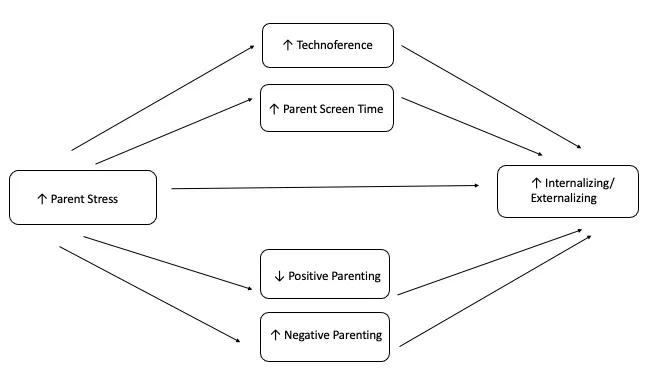
Lower positive parenting (proactive parenting, positive reinforcement, warmth, supportiveness), increased negative parenting (hostility and physical control, and more parent stress) will mediate the relation between parent screen time/technoference and child internalizing and externalizing difficulties; see Figure 3).
Figure 3. Hypothesis 2d Multiple Mediation Model
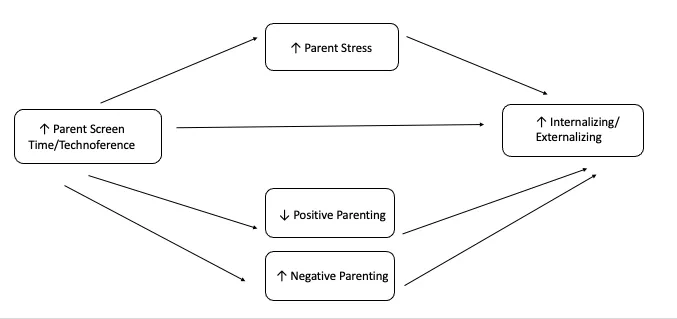
A content analysis of responses to structured questions provided an opportunity to uncover converging, or distinct themes, related to parenting and mobile technology use, as well as provide richer data about the quantitative associations between parent stress, mobile technology use, and parenting that would otherwise be missed (Hanson et al., 2005). Specifically, participants were asked questions related to:
The fourth objective of the current study was to examine changes within and between parent stress, parent technology use, parenting behaviours, and child internalizing and externalizing behaviours over a nine-month period during the COVID-19 pandemic. Analysis of Variance (ANOVA) models were examined to explore changes across time. Cross-lagged panel models were explored to examine the temporal sequence, bidirectional associations, and transactional effects between study variables.
Parents of children aged 3 to 5 years old were recruited from Southwestern Ontario from February 2021 to November 2021 during the COVID-19 pandemic. The study aimed to collect data across three time points (Time 1, 2 and 3). Time 1 data collection also includes baseline measures that asked participants to report on their retrospective perceptions of their own technology use and their child’s mental health three months before the COVID-19 pandemic. The study aimed to include an equal number of mothers and fathers. Only one parent from each household was eligible to participate in the study. Primary caregivers (e.g., parents, grandparents, guardians) who met screening criteria (provided an appropriate answer to questions about how they heard of the study, eligibility characteristics required to participate, what the study is about, and what city they live in) were eligible to participate in the study and are referred to as parents in the current study.
A power analysis was conducted using G*Power 3.1 (Faul et al., 2007) to determine the recommended minimum sample size for the analyses with the largest number of estimated predictors. To detect a medium effect size (f2 = .15) for a hierarchical multiple regression with a power of .80, Type I error rate of α = .05, nine predictors, and up to six covariates (e.g., child gender, child age, social economic status, family structure, and parent education), 139 participants were required. Alternatively, using Tabachnick and Fidell (2013)’s simple formula, N > 50 + 8m (m = number of independent variables), the regression analyses with the largest number of predictors required approximately 186 participants. For path modelling, a minimum of 200 participants is recommended (Kline, 2009). Accordingly, no fewer than 250 participants were sought for the study. Given the risk of attrition that can occur with longitudinal studies, oversampling is recommended to account for the loss of participants during subsequent phases of data collection (Wang et al., 2017).
Two hundred and twenty four caregivers participated in the study (mothers, n = 178; fathers, n = 44; grandparents, n = 2). Most participants were female (n = 180), whereas the majority of children were boys (n = 123). Parents ranged in age from 23 to 53 years old (M = 33.95; SD = 5.07) and children ranged in age from 3 to 5 years old (M = 3.77; SD = .77). Parents (71.9%) and children (62.9%) were primarily Caucasian and came from two-parent homes (78.6%). Most parents graduated from College or University (61.2%) with approximately a quarter obtaining a graduate or professional degree (23.2%). Approximately half of the sample were upper middle class (48.7%; income ranging from $81K to over $250K).
Of the N = 224 who participated in the study, 85 (37.6%) indicated that they were living with someone who was an essential worker (i.e., healthcare, delivery worker, store working, security, building maintenance). Of these 85 essential workers, 24 (10.6%) were either a first responder, healthcare provider, or working in a facility treating patients with COVID-19.
All parents reported having a smartphone (100%) and approximately two thirds reported having a tablet (66.5%). Participant demographic characteristics, demographics related to COVID-19, and their technology ownership for Times 1, 2 and 3 are presented in Table 1 and Table 2.
Table 1. Descriptive Statistics for Time 1 (N = 224), Time 2 (N = 157) and Time 3 (N = 111)
| Time 1 N (N = 224) | Time 1 % (N = 224) | Time 2 N (N = 157) | Time 2 % (N = 157) | Time 3 N (N = 111) | Time 3 % (N = 111) | |
|---|---|---|---|---|---|---|
| Parent Gender | ||||||
| Female | 180 | 79.5 | 126 | 80.2 | 83 | 74.8 |
| Male | 44 | 19.6 | 31 | 19.7 | 28 | 25.2 |
| Child Gender | ||||||
| Female | 101 | 45.1 | 79 | 50.3 | 54 | 48.6 |
| Male | 123 | 54.9 | 78 | 49.7 | 57 | 51.4 |
| Parent Ethnic Background | ||||||
| Caucasian | 161 | 71.9 | 117 | 74.5 | 87 | 78.4 |
| South Asian | 19 | 8.5 | 15 | 9.6 | 11 | 9.9 |
| East Asian | 12 | 5.4 | 7 | 4.5 | 4 | 3.6 |
| African Canadian | 1 | .4 | 1 | .6 | 0 | 0 |
| Caribbean | 2 | .9 | 2 | 1.3 | 0 | 0 |
| Hispanic | 9 | 4 | 4 | 2.5 | 2 | 1.8 |
| Native Canadian | 13 | 5.8 | 5 | 3.2 | 3 | 2.7 |
| Biracial or Multiracial | 2 | .9 | 2 | 1.3 | 2 | 1.8 |
| Other | 5 | 2.2 | 4 | 2.5 | 2 | 1.8 |
| Child Ethnic Background | ||||||
| Caucasian | 141 | 62.9 | 106 | 67.5 | 81 | 72.3 |
| South Asian | 17 | 7.6 | 13 | 8.3 | 8 | 7.1 |
| East Asian | 6 | 2.7 | 2 | 1.3 | 2 | 1.8 |
| African Canadian | 3 | 1.3 | 2 | 1.3 | 1 | .9 |
| Caribbean | 3 | 1.3 | 2 | 1.3 | 1 | .9 |
| Hispanic | 9 | 4 | 3 | 1.9 | 0 | 0 |
| Native Canadian | 12 | 5.4 | 6 | 3.8 | 4 | 3.6 |
| Biracial or Multiracial | 27 | 15.8 | 20 | 12.6 | 14 | 12.5 |
| Other | 4 | 1.8 | 3 | 1.9 | 1 | .9 |
| Marital Status | ||||||
| Married | 176 | 78.6 | 119 | 75.8 | 87 | 78.4 |
| Remarried | 1 | .4 | 1 | .6 | 1 | .9 |
| Living Together | 24 | 10.7 | 19 | 12.1 | 12 | 10.8 |
| Divorced | 4 | 1.8 | 4 | 2.5 | 3 | 2.7 |
| Separated | 6 | 2.7 | 4 | 2.5 | 2 | 1.8 |
| Single | 13 | 5.8 | 9 | 5.7 | 6 | 5.4 |
| Parent Education | ||||||
| Some High School | 4 | 1.8 | 3 | 1.9 | 1 | .9 |
| Graduated High School | 14 | 6.3 | 11 | 7.0 | 6 | 5.4 |
| Some College or University | 15 | 6.7 | 10 | 6.4 | 7 | 6.3 |
| Graduate College or University | 137 | 61.2 | 96 | 51.1 | 72 | 64.9 |
| Graduate or Professional School | 52 | 23.2 | 35 | 22.3 | 24 | 21.6 |
| Other | 2 | .9 | 2 | 1.3 | 1 | .9 |
| Education of Partner (if applicable) | ||||||
| Some Grade School | 2 | .9 | 1 | .6 | 1 | .9 |
| Some High School | 10 | 4.5 | 6 | 3.8 | 4 | 3.6 |
| Graduated High School | 24 | 10.7 | 19 | 12.1 | 13 | 11.8 |
| Some College or University | 19 | 8.5 | 14 | 8.9 | 10 | 9.1 |
| Graduate College or University | 121 | 54.0 | 85 | 54.1 | 63 | 57.3 |
| Graduate or Professional School | 41 | 18.3 | 27 | 17.2 | 17 | 15.5 |
| Other | 4 | 1.8 | 3 | 1.9 | 2 | 1.8 |
| Household Income | ||||||
| Under $30K | 11 | 4.9 | 8 | 5.1 | 4 | 3.6 |
| $30K to $45K | 16 | 7.1 | 11 | 7.0 | 6 | 5.4 |
| $46K to $60K | 19 | 8.5 | 12 | 7.6 | 7 | 6.3 |
| $61K to $80K | 47 | 21.0 | 37 | 23.6 | 33 | 29.7 |
| $81K to $100K | 31 | 13.8 | 18 | 11.5 | 14 | 12.6 |
| $101K to $150K | 40 | 17.9 | 27 | 17.2 | 17 | 15.3 |
| $151K to $250K | 32 | 14.3 | 20 | 12.7 | 15 | 13.5 |
| Over $250K | 6 | 2.7 | 4 | 2.5 | 2 | 1.8 |
| Prefer not to answer | 22 | 9.8 | 20 | 12.7 | 13 | 11.7 |
Note. Some High School = Grade 10 or 11; Some College or University = at least one year.
Table 2. Descriptive Statistics for Technology Ownership for Time 1 (N = 224), Time 2 (N = 157) and Time 3 (N = 111)
| Variable | Time 1 Yes (%; N = 224) | Time 1 No (%; N = 224) | Time 2 Yes (%; N = 157) | Time 2 No (%; N = 157) | Time 3 Yes (%; N = 111) | Time 3 No (%; N = 111) |
|---|---|---|---|---|---|---|
| Parent Personally Owns: | ||||||
| Cell phone (Smartphone) | 224 (100) | 0 (0) | 157 (100) | 0 (0) | 111 (100) | 0 (0) |
| iPod | 41 (18.3) | 183 (81.7) | 23 (14.6) | 134 (85.4) | 12 (10.8) | 99 (89.2) |
| Educational Game Player | 52 (23.2) | 172 (76.8) | 37 (23.6) | 120 (76.4) | 21 (18.9) | 90 (81.1) |
| Hand-Held Game Player | 63 (28.1) | 161 (71.9) | 42 (26.8) | 115 (73.2) | 26 (23.4) | 85 (76.6) |
| Tablet | 149 (66.5) | 75 (33.5) | 101 (64.3) | 56 (35.7) | 66 (59.5) | 45 (40.5) |
| Child Personally Owns: | ||||||
| Cell phone (smartphone) | 16 (7.1) | 208 (92.9) | 14 (8.9) | 143 (91.1) | 9 (8.1) | 102 (91.9) |
| iPod | 11 (4.9) | 213 (95.1) | 9 (5.7) | 148 (94.3) | 6 (5.4) | 105 (94.6) |
| Educational Game Player | 55 (24.6) | 169 (75.4) | 38 (24.2) | 119 (75.8) | 25 (22.5) | 86 (77.5) |
| Hand-Held Game Player | 24 (10.7) | 200 (89.3) | 21 (13.4) | 136 (88.5) | 14 (12.6) | 97 (87.4) |
| Tablet | 82 (36.6) | 142 (63.4) | 66 (42.0) | 91 (58.0) | 42 (37.8) | 69 (62.2) |
A total of 157 participants (from the 224 who completed Time 1) were included in Time 2 data collection (mothers, n = 125; fathers, n = 31; grandparent, n = 1). Most participants were female (n = 126) and approximately half of the children were boys (n = 78). Parents ranged in age from 23 to 53 years old (M = 34.34; SD = 5.32) and children ranged in age from 3 to 5 years old (M = 3.75; SD = .81). The majority of parents (74.5%) and children (67.5) were Caucasian and from two-parent homes (75.8%). Approximately half of the sample graduated from College or University (51.1%) and almost a quarter (22.3%) obtained a graduate or professional degree.
Fifty-six participants (35.7%) reported that they were living with someone who was an essential worker. Of these 56 essential workers, 14 (23.7%) were a first responder, healthcare provider, or working in a facility treating patients with COVID-19.
All parents reported having a smartphone (100%) and more than half reported having a tablet (62.4%).
A total of 111 participants were included in Time 3 data collection (mothers, n = 83; fathers, n = 28; grandparent, n = 1). The majority of participants were mothers (n = 83) and the majority of children were boys (n = 57). Participants ranged from 23 to 53 years old (M = 34.40; SD = 5.47) and children ranged in age from 3 to 5 years old (M = 2.68; SD = .77). Parents (78.4%) and children (72.3%) were primarily Caucasian and came from two-parent homes (78.4%). The majority of parents graduated from College or University (64.9%) with approximately a quarter obtaining a graduate or professional degree (21.6%). Approximately half of the sample were upper middle class (54.9%).
Of the N = 111 included in the final longitudinal sample, 34 (30.6%) indicated that they were living with someone who was an essential worker (i.e., healthcare, delivery worker, store working, security, building maintenance). Of these 34 essential workers, nine (8.1%) were either a first responder, healthcare provider, or working in a facility treating patients with COVID-19.
All parents reported having a smartphone (100%) and approximately half reported having a tablet (59.5%).
Participants who dropped out of the subsequent phases of data collection were still included in the analyses. Of the 224 participants included in Time 1 of the study, 157 participants completed Time 2, which resulted in an attrition rate of 29.9% (67 participants). A total of 121 participants completed Time 3. Thirty-six participants were lost between Time 2 and Time 3 of data collection, which resulted in an attrition rate of 29.8%. While merging data sets however, 10 participants were not matched across data sets due to missing or unique (e.g., provided a new email address that was not found in previous data set) information. Therefore, an additional 10 participants were removed, resulting in an overall sample of N = 111 for the final longitudinal data set (examined in Part 2 of the study) and an attrition rate of 38.0%.
All participants completed a four-item screening questionnaire to determine eligibility for the study. They were asked if they are the primary caregiver for the child (spends the most time with child; lives with the child at least 5 days per week), and if they own a smartphone or tablet. Participants were also asked whether they have previously completed the study or if anyone in their household (e.g., spouse) had previously completed the study to ensure independence of informants. The goal of the current study was to collect cross-sectional data for Part 1 of the study and longitudinal data, across three different time points over a nine-month period, for Part 2 of the study. Therefore, participants were also asked if they were willing to participate in the study at Time 1 (which included baseline measures of participants’ retrospective perceptions three months before the COVID-19 pandemic), Time 2, and Time 3 of data collection that took place approximately two months (± two weeks) apart. Participants who wished to be excluded from subsequent phases of data collection were still eligible to participate in the study. Participants that were not matched across data sets were excluded from the analyses. All participants were required to be fluent in English (reading and comprehension).
Participants were asked to complete a background questionnaire related to the demographics of the parent (gender, marital status, level of education, and ethnicity) child’s age, gender, and their family structure (Appendix A). To get a clear picture of the technological landscape of participants’ homes, eights items adapted from Wartella and colleagues (2014) asked various questions about media ownership by families (e.g., whether the child owns their own media device). Responses for question one, and four to six, listed various technology devices (e.g., television set, hand-held game player). Response options on these items were randomized. A shortened version of the background questionnaire that excluded questions about demographic information and technology ownership, was administered during the Time 2 and Time 3 questionnaire.
Participants were asked several questions about COVID-19 to gain a better understanding of participants’ life changes, and children’s mental health related to COVID-19. The CoRonavIruS health Impact Survey (CRISIS, Version Three; Merikangas et al., 2021): Parent Caregiver Form, is a 63-item questionnaire that asked parents to report on their children in the following domains: exposure to the COVID-19 virus, life changes due to COVID-19, daily behaviours during the pandemic (e.g., sleep, physical activity, time outdoors), emotions/worries (child mental health), media use (e.g., mobile devices), and substance use (e.g., tobacco, alcohol). The questionnaire includes a section that asks participants to complete the questionnaire while reporting on their retrospective accounts of the aforementioned domains three months before the COVID-19 pandemic started. The questionnaire also includes a section that asks participants to complete the questionnaire while reporting on the aforementioned domains within the past two weeks. Two domains from the CRISIS questionnaire (life changes due to COVID-19, child mental health) were included in the current study.
Life Changes. The life changes domain consists of 15 questions that asked parents to report on how disruptive life changes due to COVID-19 have been for their child. The items are rated on a 5-point Likert scale with various anchors (e.g., ranging from 1 (A little worse) to 5 (A lot better); 1 (Not at all) to 5 (Extremely)). In this study, parents were asked to respond to nine questions from the life changes domain. Cronbach’s alpha for this measure across the three time points were .63, .60, and .56, respectively, indicating questionable reliability. Reliability analysis across the three data sets (Time 1, Time 2, and Time 3 data) suggested that reliability would improve if three items were removed from the measure. Namely, items asking parents about the number of days their child left the home, how much the cancellation of important events have been difficult for their child, and the degree of financial difficulty families experienced were removed from the measure. After these three items were removed, six questions remained and were included in the study (see Appendix B) after reliability for the domain was determined. Items were summed together to create an overall COVID-19 Life Change score, with higher scores representing greater life changes and disruptions due to COVID-19.
The CRISIS measure has demonstrated good construct validity and test-retest reliability in a large sample of caregivers from the United States and United Kingdom (Nikolaidis et al., 2021). However, the psychometric properties for the COVID-19 Life Change domain are less clear. For instance, in one study, the internal consistency was reported as .88 (Cronbach’s alpha; Brotto et al., 2021). The study by Brotto and colleagues (2021) used a version of the CRISIS measure that asked participants to report on themselves, not their children, and it is unclear which items from the life changes domain were included in the study. A few other studies have referenced their use of the CRISIS survey; however, these studies were unclear about whether the COVID-19 Life Change domain was included in the overall measure, used in isolation, or shortened/modified. These studies also did not report on the psychometric properties for the CRISIS measure or life changes domain (Cost et al., 2021; Sciberras et al., 2021). In a longitudinal Canadian study, the reported internal consistency of the COVID-19 Life Change domain ranged from .77 to .90 over the course of six months (Rappaport et al., 2022). The study included samples of children between the age of 8 to 13 years old and used four items from the life changes domain. The current study included parents with younger children and used six items from the life changes domain. Cronbach’s alpha for COVID-19 Life Change in the current study across the three time points were .78, .73, and .72, for Time 1, Time 2, and Time 3, respectively and indicated acceptable internal consistency.
Child Mental Health. The children’s emotions and worries domain in the CoRonavIruS health Impact Survey (CRISIS, Version Three; Merikangas et al., 2021) was used to assess child mental health. The domain included eight items that asked parents to rate their child’s mental health. Parents were asked about their child’s level of worry, happiness, enjoyment in activities, anxiety, restlessness, fatigue, concentration, irritability, and loneliness. These items were rated on a 5-point Likert scale with various anchors (e.g., ranging from 1 (Not worried at all) to 5 (Extremely worried); 1 (Very focused/attentive) to 5 (Very unfocused/distracted; see Appendix C). Items were summed together to create an overall Child Mental Health index for baseline (thinking about their child three months before the COVID-19 pandemic started) and for Time 1 (thinking about their child over the past two weeks). Cronbach’s alpha was .83 for baseline (retrospective reporting), and .90, .88, and .84 for Time 1, Time 2, and Time 3, respectively, indicating good internal consistency.
Externalizing and Internalizing Behaviour. Children’s internalizing and externalizing behaviours was measured using the Child Behavior Checklist- Preschool Version (CBCL 1½ – 5; Achenbach & Rescorla, 2001). The CBCL 1½ – 5 is a 99-item measure yielding six subscales (emotionally reactive, anxious/depressed, somatic complains, withdrawn, attention problems, and aggressive behaviour). Together, these subscales create a global Total Problems score, as well as two index scores called Internalizing and Externalizing Problems. Parents were asked to rate how true each item has been over the past two months from 0 (Not true), 1 (Somewhat or sometimes true), to 2 (Very true). Sample items from the CBCL 1½ – 5 include “Destroys things belonging to his/her family or other children” and “Hurts animals or people without meaning to”. The CBCL 1½ – 5 has demonstrated good psychometric properties (Achenbach & Roscorla, 2001), including good discriminant validity, construct validity (e.g., Ha et al., 2011; Pandolfi, Magyar, & Dill, 2009), and criterion validity (Muratori et al., 2011). Good psychometric properties have been documented with the CBCL 1½ – 5 across 23 diverse samples (Ivanova et al., 2010). Scores were calculated using age and gendered norms to create index scores for internalizing and externalizing behaviour problems. Cronbach’s alpha scores across all the CBCL 1½ – 5 subscales across all three time points ranged from .72 to .94. Specifically, Cronbach’s alpha for Internalizing and Externalizing Problems were .94 and .95, for Time 1, .92 and .95 for Time 2, and .92 and .93 for Time 3, indicating strong internal consistency.
Parenting Stress. The Parenting Stress Index, Fourth Edition Short Form (PSI-4/SF; Abidin, 2012) is a 36-item self-report measure that assesses three domains: parental distress, parent-child dysfunctional interactions, and difficult child, which combine to form a Total Stress Index. The PSI-4/SF is rated on a 5-point Likert scale ranging from 1 (Strongly Agree) to 5 (Strongly Disagree). Higher scores on the PSI-4/SF represent greater perceived stress. The PSI-4/SF has demonstrated good internal consistency, test-retest reliability, and construct validity with similar measures (Abidin, 1995; Johnson, 2015). In this study, the Cronbach’s alpha for the subscales from all time points ranged from .80 to .92, with the alpha for the Total Stress Index at .91 at Time 1, .88 at Time 2, and .91 at Time 3, indicating good internal consistency.
Parenting Behaviour. The Multidimensional Assessment of Parenting Scale (MAPS; Parent & Forehand, 2017; Appendix D) was developed using items from previously established parenting measures (e.g., The Alabama Parenting Questionnaire, Shelton et al., 1996; Parent Behaviour Inventory, Lovejoy et al., 1999). The MAPS measures both positive and negative dimensions of parenting in children aged 3 to 17 years old. The MAPS includes 34 items rated on a 5-point Likert scale ranging from 1 (Never) to 5 (Always). The measure yields a broadband Positive Parenting index score that includes the subscales: proactive parenting (i.e., “I tell my child my expectations regarding behavior before my child engages in an activity”), positive reinforcement (i.e., “If my child cleans their room, I will tell him/her how proud I am”), warmth (i.e., “My child and I hug and/or kiss each other”), and supportiveness (i.e., “I show respect for my child’s opinions by encouraging him/her to express them”). The Negative Parenting index includes the subscales: hostility (i.e., “The punishment I give my child depends on my mood”), lax control (i.e., “I feel that getting my child to obey is more trouble than it’s worth”), and physical control (i.e., “I spank my child when I am extremely angry”). Items from respective parenting index scores were averaged together to create a positive parenting and negative parenting index. The MAPS has demonstrated strong reliability and good validity (Parent & Forehand, 2017). For this study, Cronbach’s alpha across subscales ranged from .78 to .92 at Time 1, .80 to .93 at Time 2, and .84 to .91 at Time 3. Further, the Cronbach’s alpha for Negative Parenting and Positive Parenting indexes were .92 and .84, respectively for Time 1, .93 and .87 respectively for Time 2, and .93 and .89 respectively for Time 3, indicating strong internal consistency.
Technoference. Perceived technoference in the parent-child relationship was measured using 14 items adapted from the Technology Interference in Parenting Scale (TIPS; McDaniel & Coyne, 2016b). The original measure (Technology Device Interference Scale; TDIS) was created to measure technoference across different types of digital media (e.g., tablets, television, video games etc.) within romantic relationships (McDaniel & Coyne, 2016a). McDaniel and Coyne, (2016b) adapted the TDIS to create the TIPS by rewording items that previously focused on romantic relationships to focus on co-parenting relationships. They also inquired about the amount of technoference in co-parenting relationships across 14 different parenting domains (e.g., mealtime, playtime etc.). Parents were asked to think only about times when these domains occurred and report technoference during these occurrences (McDaniel & Coyne, 2016b). The wording of these instructions eliminated differences in the frequency of certain domains occurring in different families and allows for comparison across domains (McDaniel & Coyne, 2016b).
The TIPS was further adapted to measure perceptions of technoference across different types of digital media within parent-child relationships (McDaniel & Radesky, 2017). For example, parents were asked: “On a typical day, about how many times do the following devices interrupt a conversation or activity you are engaged in with your child?” Parents responded to each item on a scale ranging from 0 (None), to 6 (More than 20 times). Following suit, the present study used an adapted version of the TIPS (McDaniel & Coyne, 2016b) by asking parents to report how many times mobile technology (smartphones or tablets) interrupted 14 different parenting domains with their child. Wording of the items were based on the adapted TIPS by McDaniel and Coyne (2016b), as well as McDaniel & Radesky (2017). Specifically, parents were asked: “Thinking only about the times you and your child [activity], on a typical day, how often do smartphones or tablets interfere during [activity]?” Items were measured on an 8-point scale ranging from 0 (Never) to 8 (10 or more times a day; Appendix E). The order of the 14 items were randomized and higher scores represented greater technoference.
Items were averaged together for a total technoference score. The adapted version of the TIPS demonstrated good internal consistency (Chronbach’s alpha = .84) in another study with preschool children (Tran, 2018; Tran & Menna, 2020); otherwise, no other known studies have evaluated the psychometric properties of this new scale. Given that parents may use mobile technology outside of the time they are with their children (e.g., while children are asleep), measuring the amount of interruptions due to mobile technology that occur specifically during parent-child interactions (i.e., technoference) may yield stronger associations between parent screen time, parenting, and child outcomes. Therefore, an analysis of technoference was included in the study to determine whether technoference will serve as a better variable to include in the study over the measure of parent screen time. Cronbach’s alpha at Time 1, Time 2, and Time 3 was .93, .92, and .95 respectively, indicating strong internal consistency.
Parent Screen Time. Global estimates are the most common method of measuring technology use and moderate correlations (.40) between global estimates of technology use and time diaries have been observed (Anderson et al., 1985). Global estimates, however, tend to be underestimated (Yuan et al., 2019) because they require participants to make retrospective estimates about technology use, which likely yields inaccurate answers (Vanderwater & Lee, 2009). Using a heuristic template by dividing the day into three distinct periods (morning, afternoon, and evening) may improve the accuracy of recall (Vanderwater & Lee, 2009). Following suit, four items from The Adult Involvement in Media Scale (AIM; Anderson et al., 2007) were used to measure parents’ television and video game use, along with adapted versions to measure computers, smartphones, and tablet use. All screen based media (e.g., video games) was measured to gain descriptive information about participants; however, the current study focused on the amount of mobile technology (smartphones and tablets) used by parents.
The 10 items asked parents to report how many hours they spend using screen-based media during the morning (6am to afternoon), afternoon (afternoon to 6pm) and evening (6pm to midnight) on a typical weekday and weekend (Appendix F). Total screen time for each device was calculated by using a weighted average of screen time by multiplying the total daily hours for a typical weekday by five, multiplying the total daily hours for a typical weekend by two, and summing together the weekday and weekend hours. To calculate the total amount of mobile technology use by parents, the weighted averages of total smartphone and tablet use were summed together. Parents were asked to complete this measure while retrospectively thinking about their screen time three months before the COVID-19 pandemic started, in order to establish a baseline. Parents were then asked to complete this measure again while thinking about the past two weeks, as well as during subsequent questionnaires (i.e., Time 2 and Time 3). Responses to these items were frequency counts (length of time) and therefore, Cronbach’s alpha was not calculated. In an alternative attempt to gain more accurate reports of parent screen time, parents who track their screen-time on their mobile technology were asked to refer to these data while filling out the questionnaire. Instructions on how to access these data were included in the questionnaire (Appendix G).
Table 3. Summary of Measures and Transformed Variables
| Variable | Questionnaire | Transformed? |
|---|---|---|
| COVID-19 Life Changes | CoRonavIruS health Impact Survey (CRISIS; Merikangas et al., 2021; modified) | No |
| Child Mental Health | CoRonavIruS health Impact Survey (CRISIS; Merikangas et al., 2021) | No |
| Child Externalizing Behaviour | Child Behavior Checklist- Preschool Version (CBCL 1½ – 5; Achenbach & Rescorla, 2001) | No |
| Child Externalizing Behaviour | Child Behavior Checklist- Preschool Version (CBCL 1½ – 5; Achenbach & Rescorla, 2001) | No |
| Parent Stress | The Parenting Stress Index, Fourth Edition Short Form (PSI-4/SF; Abidin, 2012) | No |
| Parenting Behaviour (specific subscales) | The Multidimensional Assessment of Parenting Scale (MAPS; Parent & Forehand, 2017) | Physical control subscale |
| Technoference | Technology Interference in Parenting Scale (TIPS; McDaniel & Coyne, 2016b; adapted) | No |
| Parent screen time (specific subscales include: total mobile technology, smartphone, tablet, videogame, computer) | The Adult Involvement in Media Scale (AIM; Anderson et al., 2007; adapted) | All subscales |
Parents of children ages 3 to 5 years old were recruited through a multi-method approach. A snowball recruitment technique was employed by asking participants to share information about the study to eligible participants whom they think may be interested in participating. Most of the recruitment occurred online. A Facebook page dedicated to the study was created to host a brief description of the study’s details and an electronic copy of the flyer. Organizations (e.g., Mom2Mom groups) on Facebook were contacted through private messages to ask for assistance with recruitment. They were encouraged to “share” the study’s page or post the study’s flyer on their own wall. Using a snowball technique, Facebook users were encouraged to share the study’s page within their own social networks. Instagram was also used in a similar way by “direct messaging” accounts and encouraging them to “share” the study’s post.
Multiple strategies were employed to prevent fraudsters (e.g., robots, participants completing the study multiple times) from completing the survey (Teitcher et al., 2015). By sending participants a unique link, fraudsters were prevented from completing the study numerous times. To further prevent robots from completing the study, a CAPTCHA (e.g., “Completely Automated Public Test to tell Computers and Humans Apart”) was added to the first page of the study.
All interested participants emailed the researcher for a unique link to the online survey. Potential participants were asked four screening questions (e.g., where they heard of the study, what eligibility characteristics are required, what the study is about, what city they live in) before being sent a unique link. Emails that were received in close proximity to each other and who shared similar characteristics regarding their email address, subject line, or body of text were likely sent from an automated computer program and flagged as suspicious. Other characteristics of suspect included similarities across multiple emails, matching IP addresses across participants, and consistency of responses (e.g., birth year). Attention to the combination of these suspicious characteristics, as well as the researcher’s judgement were used to identify potentially fraudulent participants. These participants were subsequently removed from the study and their data were removed from the analyses.
The study’s advertisement directed interested participants to e-mail the researcher to receive a unique link to the study. All participants were required to answer the screening questions (mentioned above) emailed to them before receiving their unique link as an additional layer of security.
Once participants accessed the link, they completed a consent form which included stipulations that parents will not receive compensation for their participation if they do not meet eligibility requirements for the study, if they complete the survey in an atypically short amount of time, or if more than 80% of their responses are missing or invalid. Following obtained consent, participants answered additional screening questions to assess their eligibility to participate in the survey. Ineligible participants were redirected to a page where they were thanked and informed about their ineligibility to complete the study. Eligible participants continued with the survey, during which they were presented with instructions about how to answer the questionnaire. In each section, participants were instructed to answer the questions by either answering the questions about themselves while thinking about themselves or answering questions about their child while thinking about their child. Parents who have multiple children were instructed to answer the questions by thinking only about their child between the age of 3 to 5 years old. If they had more than one child between this age range, they were instructed to think about the oldest child who is between 3 to 5 years old while answering the questions.
The online questionnaire began by asking participants to answer demographic questions, followed by the rest of the questionnaires presented in a counterbalanced order. A series of structured questions were included at the end of the questionnaire to capture participants’ qualitative responses. Upon completion, participants were informed that an e-mail with a unique link to the study would be sent to them in approximately two months for the Time 2 and Time 3 questionnaires. Participants were prompted for their email address so they could receive compensation. They had the option to redeem a $5 electronic gift-card or deny compensation.
Participants were asked seven structured questions to explore parents’ experiences related to their mobile technology use. Specifically, questions asked parents about the time they spend using mobile technology, the way they used mobile technology, and the types of activities they are doing on mobile technology has changed since the beginning of the COVID-19 pandemic (around March 2020). Parents were asked to reflect on how their mobile technology use had changed. Parents were also asked how their use of mobile technology may have impacted their parenting and how their children responded to parents’ use of mobile technology. The questions were as follows:
Coding of structured questions were guided by a content analysis to systematically organize and summarize key results (Hsiu-Fang & Shannon, 2005). A conventional approach to content analysis was used since existing research and theory related to the research questions was limited, as well as to avoid using preconceived codes (Kondracki & Wellman, 2002).
First, the responses were read multiple times to become familiar with the overall content of responses. Second, text capturing key thoughts or concepts were identified. Third, the author made note of impressions and thoughts related to the initial text to identify meaning. Fourth, texts that captured similar meaning were grouped together and made up an initial coding scheme. Fifth, codes were sorted based on their differences or similarities with each other. Six, definitions for each code were created. Finally, a quantification system was developed. Specifically, a frequency count for each code was recorded, insofar that responses that aligned with the code’s description were each given one count. Both the research supervisor and the author coded a sample of responses based on the coding scheme. The author met with the research supervisor to review the coding scheme and responses. Revisions to the coding scheme were made based on supervisor feedback to add or combine codes.
Three research assistants were trained to code the responses. The research assistants were two recent undergraduate students majoring in psychology, as well as one first year graduate student in psychology. A small subset of responses (20%) for each question was coded to establish inter-rater agreement and reliability. Percent agreement ranged from 46% to 100% across all four coders (research assistants and author). The research assistants and the author reviewed the discrepancies in coding. After reviewing discrepancies, the author concluded that descriptions for several codes with low inter-rater agreement were not distinct enough from other codes and often shared underlying themes with more reliable codes. For instance, the code Joint Use was defined as sharing the use of a tablet with a child or allowing a child to hold the phone while the parent is talking. This code was later combined with the code Multitasking, which was defined as a parent combining their interaction, caring, or playing with a child and using technology at the same time.
Following suit, codes with low reliabilities were combined with codes with stronger reliabilities based on feedback from the research assistants (Fink & Gantz, 1996). Following the combination of codes, all discrepancies were resolved to obtain 100% percent agreement by having a discussion and coming to a consensus. Once the coding scheme was revised, each research assistant (a total of four coders for each question) coded the first 20 responses for each question. Intercoder reliability for these samples of 20 codes were calculated using Krippendorf’s kappa. Krippendorf (1980) proposed that variables with reliabilities above .80 are considered an indicator of high reliability while variables with reliabilities ranging from .67 to .80 are acceptable. Krippendorf’s kappa ranged from .74 to .89 within Question One, 1.00 for all the codes within Question Two, ranged from .68 to 1.00 for codes within Question Three, ranged from .86 to .94 for codes within Question Four, ranged from .79 to 1.00 for codes within Question Five, ranged from .73 to 1.00 for codes within Question Six, and ranged from .73 to 1.00 for the codes within Question Seven. Intercoder reliabilities for the qualitative questions were considered acceptable; therefore, the coding scheme was finalized (see Tables 4 to 10).
The research assistants proceeded to independently code the final sample of responses. Specifically, each question had one research assistant who coded all the answers, and a second research assistant who coded twenty five percent of the answers. Once coding was completed by all research assistants, Cohen’s kappa was calculated. Cohen’s Kappa ranged from .79 to 1.00 for the codes within Question One, .72 to 1.00 for the codes within Question Two, .66 to 1.00 for the codes within Question Three, .66 to 1.00 for the codes within Question Four, .78 to 1.00 for the codes within Question Five, .73 to 1.00 for Question Six, and .67 to 1.00 for the codes within Question Seven. Cohen’s kappa values that range from .60 to .79 are considered moderate, while kappa values exceeding .80 are considered strong (McHugh, 2012). Most codes yielded a Kappa of 1.00.
Table 4. List of Codes for Question One: Please Tell Us About the Added Stress You Have Experienced Since the Start of COVID-19
| Code | Description (Added stress due to …) |
|---|---|
| Job transition | New, lost, or changed job |
| Decreased income | Financial worries due to decreased income |
| Inflation | Financial worries due to increased expenses |
| Working from home/Work stress | Adapting to work from home policies, work burden, workload, managing colleagues |
| School stress | Navigating school closures, learning how to attend online classes, needing to homeschool children |
| Lifestyle lockdown/Change in routine | Not being able to participate in the community (e.g., gyms shut down, trips cancelled), boredom, being at home |
| Parenting responsibilities/no childcare/no child activities | More work watching children, lack of external help, daycares closed, kids bored at home, difficulties keeping child occupied |
| Increased child dysfunction | Increased disruptive behaviour, fighting, and tantrums in children |
| Household chores | More domestic work responsibilities |
| Mental health concerns | Psychological distress, fatigue, irritability from quarantining with family |
| Loneliness/less socializing | Loneliness from lack of social interactions |
| Decreased social support | Lack of supports |
| Healthcare | Working in the healthcare industry |
| Fear | Fear of health and safety (e.g., social distancing, catching the virus), fear of economic impact of COVID-19, unspecified fear |
| Legal concerns | Navigating legal issues |
Table 5. List of Codes for Question Two: Has the Amount of Time You Spend Using Technology Changed?
| Code | Description |
|---|---|
| Increase (no mention of COVID-19) | Increase in screen time without attributing increase to COVID-19 |
| Decrease (no mention of COVID-19) | Decrease in screen time without attributing decrease to COVID-19 |
| Stopped | Stopped using mobile technology |
| Increase because COVID-19 | Increase of screen time due to COVID-19 (e.g., being home, lockdowns, restriction) |
| Decrease because COVID-19 | Decrease of screen time due to COVID-19 |
| Increase because news | Increase of screen time to keep up with the news |
| Increase because of social media | Increase of screen time to use social media |
| Increase because of work/school | Increase of screen time due to work or school |
| Increase because of communication | Increase of screen time to communicate or keep connected with other people |
| Increase because of online shopping | Increase in screen time for online shopping |
| Increase because of child care demands | Increase in screen time due to child care demands |
| Boredom | Changes in screen time due to boredom |
Table 6. List of Codes for Question Three: How has the Way You Use Mobile Technology Changed?
| Code | Description |
|---|---|
| Increase | Increase in screen time with no specific reasons stated |
| Decrease | Decrease in screen time with no specific reasons stated |
| Virtual meetings | Any mention of video calls, zoom, facetime, other video conferencing platforms |
| Communication | Using mobile technology for talking, connecting, and/or messaging |
| School | Using mobile technology to attend online school or use apps such as Teams, Brightspace, and/or other apps for school |
| Work | Using mobile technology for work |
| Social media | Using social media |
| Entertainment | Using mobile technology for entertainment (e.g., streaming movies) |
| Cope with Anxiety | Using mobile technology to cope with anxiety |
| Health screening | Using mobile technology to conduct health screenings (e.g., submitting COVID-19 rapid tests, submitting vaccine status, symptom checking) |
| Shopping | Using mobile technology to shop |
| Therapy | Using mobile technology for teletherapy |
| Learning/Teaching | Using mobile technology outside of school for learning or to teach (e.g., parent teaching child concepts) |
Table 7. List of Codes for Question Four: What Types of Activity (e.g., texting, reading news, engaging in social media) Did You Do on Your Mobile Technology Around Your Child(ren)?
| Code |
|---|
| Texting |
| Audio call |
| Video call |
| Work |
| Video/Audio media |
| Social media |
| Online shopping |
| Reading |
| Playing games |
Table 8. List of Codes for Question Five: How Does Your Engagement with Specific Activities or Mobile Technology Impact Your Parenting?
| Code | Description |
|---|---|
| No change | No change specified |
| Parent-child quality time decreases | Parent specifies a decrease in the quality of interactions/times spent together with child |
| Disconnection | A sense of physical or emotional disconnection between parent and child |
| Decrease attention/focus/distracted | Either parent and/or child exhibits decreased attention (e.g., greater distractibility, less mindful, less effective in their parenting) |
| Increase irritability/frustration/dysregulation | Either parent and/or child exhibits increased irritability (e.g., more impatient, frustrated, when interrupted) |
| Positive impact | Parent noted mobile technology had a positive impact |
| Negative perspective towards self/as a parent | Parent reports negative feelings towards themselves or commenting on parenting ineffectiveness |
| Increased flexibility and adaptability | Parent reports engagement with mobile technology increased their flexibility |
| Parenting tool | Mobile technology is a parenting tool used to distract/occupy child |
Table 9. List of Codes for Question Six: How Did You Multitask Between Using Mobile Technology and Taking Care of or Interacting with Your Children?
| Code | Description (if applicable) |
|---|---|
| No strategy | No strategy described |
| No multitasking | Parent states they did not multitask |
| Both use screens separately | Both parent and child use technology but on their own |
| Combined multitasking | Parent describes combining using technology with interacting with their child (e.g., switching back and forth) |
| When kids are occupied | Parent report using technology when children are occupied (i.e., sleeping) |
| Tool to occupy | Parent provides child with technology to use |
| Boundary setting | Parents set limits on technology use (e.g., putting phone away when around children) |
| Check in with child | Parents describe asking children question about their technology use |
| Communicating with child about technology use | Parents let children know they are using their technology |
| Educational purposes | Parents described using technology for educational purposes (e.g., reading together) |
Table 10. List of Codes for Question Seven: How Has Your child(ren) Acted Differently While You Are Using Mobile Technology Around Them?
| Code | Description (if applicable) |
|---|---|
| No difference noted | No difference noted |
| Child wants more attention | Parent describes child wanting more attention (e.g., needy) |
| Increase whining/dysregulation/disobedience (physical, noise, emotions) | Parent describes child becoming more disruptive, angry, acting out, or being less disciplined |
| More fighting/arguments | Parent reports more fighting or arguments between people in the household |
| Curiosity/checking on parent | Parent describes child being more curious about what the parent is doing |
| Want to use technology | Parent reports child wanting to use more technology |
| Increase obedience | Parent reports child being more obedient or happier |
Data collection for Time 2 and Time 3 of the study took place approximately two months (± two weeks) after participants completed the prior questionnaire. Aside from shortening the background measure (i.e., characteristics thought to be relatively stable over time, such as ethnicity were removed), and removing the measure of child mental health and parent screen time three months before the pandemic started, the follow-up questionnaire for Time 2 and Time 3 were the same questionnaire as the one completed during Time 1. An email with a unique link
was sent to all eligible participants for subsequent questionnaires. They had two weeks to complete the study and were emailed a reminder email in one week (up to three reminder emails in total) if they had not completed the questionnaire. Participants were asked to provide consent and then complete the questionnaire. After completing the questionnaire, participants were directed to a thank you page and prompted for their email address to receive their choice of compensation.
A total of 368 responses from Time 1 was collected. Time 1 data also includes baseline measures of parents’ retrospective reporting three months before COVID-19 but will be referred to as Time 1 for brevity. A total of 67 participants were deemed to be fraudulent after identifying duplicate IP addresses and removed from the study. This left an initial sample of N = 301 for Time 1. All descriptive and statistical analyses were conducted using Statistical Package for the Social Sciences, Version 25 (IBM, 2017). A total of 63 collected responses were not complete or did not pass the screening questions. These cases were removed and left a subsequent sample of N = 238 which were subsequently examined for data entry errors, missing data, and outliers.
Missing data were analyzed using Missing Value Analysis (MVA) to reveal very little missing data. The summary of missing values in the Time 1 sample indicated that 28.2% of the variables had some missing data, and across all variables and participants, 2.4% of total data was absent. The percentage of missing data across all variables in the data set ranged from 0% to 9.6%, with most missing variables missing only 0% to 1.3% of responses.
Little’s MCAR test was conducted to determine whether the pattern of missing data across all samples was considered MCAR (Missing Completely at Random) or MAR (Missing at Random; Tabachnick & Fidell, 2013). Little’s MCAR revealed that the data (X2 (18665) = 16230.23, p > .999) were MCAR. These results suggest that the pattern of missing data was unrelated to other variables in the data set.
When the pattern of missing data is determined to be MCAR, and missing data across each variable falls under 5% to 10%, the conditions for any imputation method is satisfied (Hair et al., 2010; Tabachnick & Fidell, 2013). Therefore, multiple imputation, which is considered a respectable and reliable method of dealing with missing data, was computed at the composite level with five iterations (Tabachnick & Fidell, 2013).
The sample (N = 238) was examined for univariate outliers on the independent and dependent variables by inspecting standardized residuals +/- 3.29 as potential outliers. The presence of outliers was further corroborated with skewness and kurtosis values, as well as a visual inspection of histograms, boxplots, and scatterplots.
Standardized values of variables exceeding the acceptable value of +/- 3.29 were found on the following variables: Proactive Parenting, Warmth, Supportiveness, Hostility, Physical Control, Internalizing Problems (CBCL Int) Externalizing Problems (CBCL Ext), Parent Technology use before COVID-19 (Mobile Technology, Smartphone, Tablet, Television, Videogames, Computer), and Parent Technology use after COVID-19 (Smartphone, Tablet, Television, Videogames, Computer).
Assumptions of normality were assessed by reviewing the distribution of histograms, Q-plots, and boxplots, along with kurtosis and skewness values. Skewness values for Parent Technology use before COVID-19 (Tablet, Videogames) and Parent Technology use after COVID-19 (Tablet, Videogames) fell outside the acceptable range of -/+ 2. Kurtosis values for scales measuring: Physical Control and Parent Technology use before COVID-19 (Mobile Technology, Smartphone, Tablet, Videogames) and Parent Technology use after COVID-19 (Tablet, Videogames) fell outside the acceptable range of -/+ 3.
After screening for both outliers and non-normality across variables, outliers that were detected on variables without violations of normality were winsorized in the interest of preserving sample size. After winsorizing, the assumptions of normality for these variables were met and all standardized residuals were within acceptable limits.
With respect to variables with both outliers and violations of normality, before deleting or modifying any cases, an inspection of the number of outliers and severity of non-normality was conducted (Tabachnick & Fidell, 2013). Skewness values greater than the absolute value of three are considered extreme (Kline, 2009). Kurtosis values greater than the absolute value of 10 are considered problematic and are more serious when they exceed 20 (Kline, 2009). The maximum skew and kurtosis values for variables with few outliers and mild threats to normality fell at 2.82 and 7.42, respectively (all positively skewed). These variables were winsorized to yield a normal distribution without requiring transformations to the data (Tabachnick & Fidell, 2013). After these variables were winsorized, the assumptions of normality were met.
With respect to variables with severe violations of normality and with many outliers, the transformation of variables prior to deleting or modifying scores is preferable since the likelihood of reducing outliers and producing normality increases following transformation (Tabachnick & Fidell, 2013). It is also recommended that transformations be undertaken prior to searching for any multivariate outliers because many statistics used to detect them are sensitive to failures of normality (Tabachnick & Fidell, 2013). The following variables severely violated normality (maximum skewness and kurtosis at 11.93 and 33.47, respectively; all positively skewed) and many outliers were identified: Parent Technology use before COVID-19 (Videogames, Tablet, Computer), Parent Technology use during COVID-19 (Videogames, Tablet), and physical control.
Logarithmic transformations were applied on the variables to overcome skewness and bring them into compliance with normality prior to any data modification. This method is preferable since the likelihood of reducing outliers and producing normality increases following transformation (Tabachnick & Fidell, 2013). Since the smallest value across these variables was zero, a value of one was added to the logarithmic transformation as a constant (Tabachnick & Fidell, 2013). Univariate outliers and normality were assessed on the transformed variables. Skewness and kurtosis values all fell within acceptable limits after transformations.
Multivariate outliers and influential data points were detected using Mahalanobis distance with a probability of p < 0.001 based on a cumulative chi square distribution (Tabachnick & Fidell, 2013). A total of 14 cases were identified as multivariate outliers (p values lower than 0.001) and therefore removed from the data set, leaving a remaining sample of N = 224.
A scatterplot matrix between the residuals of all variables confirmed linear relationships between the predictor and outcome variables in both data sets thereby meeting the assumption of linearity. To assess the assumption of homoscedasticity, scatter plots of standardized residuals by standardized predicted values were examined for all primary analyses. The spread of the baseline data within scatterplots across all primary analyses did not represent a funnel shape, suggesting that the assumption of homoscedasticity was met.
The assumptions of multicollinearity and singularity were tested to ensure highly interrelated variables were not a source of interference to the data. These assumptions were tested by examining the VIF and tolerance values. VIF values over 10 and tolerance values under 0.1 are considered problematic (Field, 2009). The assumption of multicollinearity was met, with VIF values ranging from 1.19 to 4.34 and tolerance values ranging from .23 to .84. Furthermore, an examination of a correlation matrix revealed no correlations approaching or exceeding r = .90, which further corroborates the absence of multicollinearity.
Finally, the assumptions of independence of errors were tested using the Durbin-Watson statistic and met. The Durbin-Watson value across primary analyses sample fell within normal limits (between 1 and 3; Field, 2009) and ranged between 1.48 and 1.36.
The associations between demographic and COVID-19 variables and the main independent and dependent variables of the primary analyses, namely technoference, parent stress, positive parenting (proactive parenting, positive reinforcement, warmth, and supportiveness), negative parenting (hostility, lax Control, physical control), internalizing problems, externalizing problems, and parent screen time (MT Total, Smartphones and Tablets) were examined to identify potential covariates (See Table 11).
Columns: Child Age; Child Gender; Parent Education; Total Annual Family Income (of participant); Family Structure.
TIPS .06 .18** -.01 .03 .07; PSI -.04 .06 -.03 -.19** .09; Proactive Parenting .01 -.03 .06 -.01 .03; Positive Reinforcement .04 -.04 .14* .10 .11; Warmth .01 -.01 .15 .09 .07; Supportiveness .12 -.08 .12 .08 .18**; Hostility .17* .14* .07 .04 .04; Lax Control -.14* .03 .14 .12 -.05; Physical Control (T) .07 .15* -.04 .04 -.07; CBCL Int .18** .13 -.04 -.09 .16*; CBCL Ext .17* .13 -.05 -.08 .18; BC MT Total -.02 .12 -.07 -.05 .02; BC Smartphone -.10 .06 .03 -.05 .01; BC Tablet (T) .04 .19** -.10 -.00 -.02; BC Television .06 .07 -.07 -.09 .05; BC Computer (T) -.04 .14* .13* .01 -.12; BC Videogame (T) .07 .13 -.07 -.08 -.05; MT Total (T) .07 .08 -.04 .03 .13; Smartphone (T) -.04 .03 .09 .01 .13; Tablet (T) .02 .14* -.08 .03 -.00; Television (T) .12 .03 -.08 .05 .03; Computer (T) -.01 .04 .15* .00 -.06; Videogame (T) .14* .17* -.07 .02 .07; COVID-19 LC -.02 -.04 -.15* -.17** .06; COVID-19 MH 3 Months .10 .16* -.17* -.15* .07; COVID-19 MH 2 Weeks .09 .08 -.14 -.15* .13.
Note. TIPS = Technology Interference in Parenting Scale (Total Technoference); PSI = Parenting Stress Index (Total parenting stress); CBCL Int = Child Behaviour Checklist – Preschool Version Internalizing Problems; CBCL Ext = Child Behaviour Checklist – Preschool Version Externalizing Problems; BC MT Total = Total Parent Screen Time (Smartphone and Tablet combined) Three Months before COVID-19; BC Smartphone = Total Parent Smartphone Use Three Months before COVID-19; BC Tablet = Total Parent Tablet Use Three Months before COVID-19; BC Television = Total Parent Television Use Three Months before COVID-19; BC Computer = Total Parent Computer Use Three Months before COVID-19; BC Videogame = Total Parent Videogame use Three Months before COVID-19; MT Total = Total Parent Screen Time (Smartphone and Tablet combined); Smartphone = Total Parent Smartphone Use; Tablet = Total Parent Tablet Use; Television = Total Parent Television Use; Computer = Total Parent Computer Use; Videogame = Total Parent Videogame Use; COVID-19 LC = Total COVID-19 Life Changes; COVID-19 MH 3 Months = Child Mental Health 3 Months Prior to COVID-19; COVID-19 MH 2 Weeks = Child Mental Health 2 Weeks Prior to COVID-19 Pandemic. (T) = transformed variable. *p < .05. **p < .01.
With respect to child characteristics, children’s age (i.e., older children) was significantly related to greater internalizing and externalizing difficulties, as well as increased hostility and decreased lax control. Independent samples t-test revealed that boys were significantly more likely than girls to receive hostile parenting and experience technoference in the parent-child relationship. Gender differences between boys and girls’ experiences of lax control were not significant. See Table 12.
| Group | M | SD | t(df) | p |
|---|---|---|---|---|
| Technoference | ||||
| Boys | 3.03 | 1.34 | -2.80 (221) | .01 |
| Girls | 2.57 | 1.15 | – | – |
| Hostility | ||||
| Boys | 2.31 | .63 | -2.17 (216.77) | .03 |
| Girls | 2.13 | .61 | – | – |
| Lax Control | ||||
| Boys | 2.32 | .66 | -.50 (212) | .13 |
| Girls | 2.27 | .65 | – | – |
With respect to parent characteristics, significantly more mothers (n = 178) participated in the study than fathers (n = 46; a ratio of approximately four mothers for every one father). Therefore, parent age and sex were not included as a covariate for any subsequent analyses. The age of mothers ranged from 23 to 53 years old (M = 34.10), while the age of fathers ranged from 28 to 53 years old (M = 33.55). See Table 13 for descriptive statistics for study variables amongst mother and fathers.
Columns per variable: M_Mothers (SD), Min_Mothers, Max_Mothers, M_Fathers (SD), Min_Fathers, Max_Fathers.
TIPS 2.73 (1.20) .54 6.14 3.13 (1.51) 1.07 6.00; PSI 87.68 (20.09) 47.00 139.00 89.67 (15.90) 54.00 138.00; Proactive Parenting 4.01 (.54) 2.50 5.00 3.63 (.60) 2.50 5.00; Positive Reinforcement 4.38 (.58) 2.25 5.00 3.78 (.78) 2.00 5.00; Warmth 4.52 (.54) 3.00 5.00 4.10 (.60) 3.00 5.00; Supportiveness 4.33 (.68) 2.00 5.00 3.77 (.80) 2.00 5.00; Hostility 2.23 (.63) 1.00 4.45 2.22 (.61) 1.00 4.29; Lax Control 2.23 (.68) 1.00 3.86 2.57 (.46) 1.43 3.83; Physical Control (T) .10 (.15) .00 .51 .16 (.17) .00 .51; CBCL Int 49.79 (14.38) 29.00 91.00 46.68 (14.24) 29.00 86.00; CBCL Ext 48.30 (13.05) 28.00 88.00 40.72 (10.02) 28.00 79.00; BC MT Total 1.56 (.33) .54 2.19 1.52 (.35) .54 2.08; BC Smartphone 1.44 (.38) .48 2.12 1.42 (.30) .48 2.03; BC Tablet (T) .53 (.65) .00 1.86 .61 (.68) .00 1.75; BC Television 23.44 (17.05) .00 82.00 20.29 (12.63) .00 56.00; BC Computer (T) 1.04 (.69) .00 1.96 1.36 (.44) .00 1.96; BC Videogame (T) .38 (.58) .00 1.87 .61 (.69) .00 1.76; MT Total (T) 1.61 (.32) .00 2.38 1.53 (.42) .00 2.14; Smartphone (T) 1.51 (.39) .00 2.06 1.44 (.38) .00 2.04; Tablet (T) .51 (.65) .00 1.98 .64 (.69) .00 1.76; Television (T) 25.10 (18.03) .00 84.00 21.41 (15.60) .00 85.00; Videogame (T) 1.12 (.65) .00 1.94 1.46 (.27) .78 1.93; Computer (T) .35 (.57) .00 2.03 .60 (.67) .00 1.51; COVID-19 LC 17.87 (4.29) 6.00 30.00 16.82 (3.75) 10.00 27.00; COVID-19 MH 3 Months 16.64 (5.63) 9.00 35.00 17.67 (5.23) 9.00 31.00; COVID-19 MH 2 Weeks 21.73 (7.19) 9.00 45.00 20.69 (5.16) 9.00 35.00.
Note. Females assigned coding of 1. Males assigned coding of 2. TIPS = Technology Interference in Parenting Scale (Total Technoference); PSI = Parenting Stress Index (Total parenting stress); CBCL Int = Child Behaviour Checklist – Preschool Version Internalizing Problems; CBCL Ext = Child Behaviour Checklist – Preschool Version Externalizing Problems; BC MT Total = Total Parent Screen Time (Smartphone and Tablet combined) Three Months before COVID-19; BC Smartphone = Total Parent Smartphone Use Three Months before COVID-19; BC Tablet = Total Parent Tablet Use Three Months before COVID-19; BC Television = Total Parent Television Use Three Months before COVID-19; BC Videogame = Total Parents Videogame use Three Months before COVID-19; BC Computer = Total Parent Computer Use Three Months before COVID-19; MT Total = Total Parent Screen Time (Smartphone and Tablet combined); Smartphone = Total Parent Smartphone Use; Tablet = Total Parent Tablet Use; Television = Total Parent Television Use; Videogame = Total Parents Videogame use; Computer = Total Parent Computer Use; COVID-19 LC = Total COVID-19 Life Changes; COVID-19 MH 3 Months = Child Mental Health 3 Months Prior to COVID-19; COVID-19 MH 2 weeks = Child Mental Health 2 Weeks Prior to COVID-19 Pandemic. (T) = transformed variable. *p < .05. **p < .01.
Parents from families with higher levels of education reported significantly greater use of positive reinforcement and lax control. Parents with higher total incomes reported significantly lower parenting stress. Parents from two family households reported significantly greater use of supportiveness and more internalizing difficulties in children. Taken together, child age, child sex, family education (of the participant), family income, and family structure were included as controls in the subsequent analyses when the variables were significantly related to the dependent variable in regression analyses, or the mediators and dependent variable in the mediation analyses.
Prior to the start of data collection, the province experienced the onset of a global pandemic. During this time the province underwent a series of significant changes, such as: openings and closures of schools and essential business, physical distancing measures, and travel restrictions and lockdowns (i.e., stay at home orders). A non-exhaustive list of major COVID-19 related changes and mandates prior to data collection in the current study are outlined in Appendix H. Data collection for Time 1 of this current study began February of 2021.
To establish a baseline of parent’s mobile technology use and children’s mental health prior to the pandemic, participants were asked to report on their children’s mental health and how much time they spent using various technologies (e.g., tablet, computer, etc.) about three months before the start of the COVID-19 pandemic. Parents were also asked to report on these variables while thinking about the past two weeks. Descriptive statistics for these variables are presented in Table 14.
| BC MT Total | BC Smartphone | BC Tablet | COVID-19 MH 3 Months | |
|---|---|---|---|---|
| Baseline | ||||
| M | 1.55 | 1.44 | .56 | 16.87 |
| SD | .33 | .37 | .65 | 5.57 |
| Min. | .54 | .48 | .00 | 9.00 |
| Max. | 2.19 | 2.12 | 1.86 | 35.00 |
| Time 1 | ||||
| MT Total | Smartphone | Tablet | COVID-19 MH 2 Weeks | |
| M | 1.60 | 1.50 | .54 | 21.53 |
| SD | .34 | .39 | .66 | 6.85 |
| Min. | .00 | .00 | .00 | 9.00 |
| Max. | 2.38 | 2.06 | 1.98 | 45.00 |
Note. MT Total = Total Parent Screen Time (Smartphone and Tablet combined); BC Smartphone = Total Parent Smartphone Use Three Months before COVID-19; Smartphone = Total Parent Smartphone Use; BC Tablet = Total Parent Tablet Use Three Months before COVID-19; Tablet = Total Parent Tablet Use; COVID-19 MH 3 Months = Child Mental Health 3 Months Prior to COVID-19; COVID-19 MH 2 Weeks = Child Mental Health 2 Weeks Prior to COVID-19 Pandemic.
The hypothesis that parents’ amount of mobile technology use would significantly increase was supported. Parents’ self-reported amount of mobile technology use at baseline (smartphones and tablets; BC MT Total: M = 1.55, SD = .33; parent retrospective reporting of their screen time three months before the pandemic) significantly increased following the declaration of the COVID-19 pandemic (MT Total: M = 1.60, SD = .34; parent screen time reported in the past two weeks), t(223) = -2.46, p < .05.
The hypothesis that children’s mental health concerns would significantly increase was supported. A paired samples t-test indicated that children’s mental health concerns at baseline (parent retrospective reporting of child mental health three months before COVID-19; COVID MH 3 Months: M = 16.03, SD = 5.18) significantly increased following the declaration of the COVID-19 pandemic (COVID MH 2 Weeks: M = 21.58, SD = 6.89; child mental health in the past two weeks), t(180) = 10.86, p < .001.
Correlations. Objective two included data from Time 1. Descriptive statistics for the main study variables are presented in Table 15. The relations between main study variables and COVID-19 variables were examined with bivariate correlations and presented in Table 16. Only the associations between the independent and dependent variables in the primary analyses, as well as potential covariates will be discussed.
First, greater parenting stress (PSI) was significantly associated with more technoference (TIPS), less positive parenting (proactive parenting, positive reinforcement, warmth, and supportiveness), more negative parenting (hostility, lax control, and physical control), and more internalizing difficulties in children (CBCL Int). More technoference (TIPS) was significantly related to less positive parenting behaviours (proactive parenting, positive reinforcement, warmth, and supportiveness), more negative parenting behaviours (hostility, lax control, and physical control), greater internalizing (CBCL Int) and externalizing difficulties (CBCL Ext), and greater parent screen time (MT Total). Greater parent screen time (MT Total) was significantly related to more technoference (TIPS), negative parenting (physical control), and internalizing (CBCL Int) and externalizing difficulties (CBCL Ext).
With respect to specific parenting variables, aside from the aforementioned relations, greater internalizing difficulties (CBCL Int) was significantly related to lower positive parenting (proactive parenting, positive reinforcement, warmth, and supportiveness), as well as higher negative parenting (hostility, lax control, physical control). Greater externalizing difficulties (CBCL Ext) was significantly related to higher negative parenting (hostility and physical control) but not positive parenting.
With respect to potential covariates, lower scores on the defensive responding scale from the Parenting Stress Index (PSI Defensive) reflect biased responses that may be attempting to present oneself in a more favourable impression (i.e., scores lower than 10 are considered extremely low; Abidin, 2012). More defensive responding (PSI Defensive) on the Parenting Stress Index was significantly related to greater positive parenting behaviours (proactive parenting, warmth, and supportiveness). Despite this significant relation however, low scores may not always reflect a parent who is trying to portray themselves as free of emotional stress from parenting or reflect a parent who is not invested in the role of the child (Abidin, 2012). Instead, low scores may reflect parents with higher economic resources, who are effectively handling parenting responsibilities (Abidin, 2012). Along these lines, not only was the strength of correlation between defensive responding and positive parenting small, but more defensive responding (lower scores) was significantly related to higher total annual income of parents in the family (r = -.25, p < .01) and higher education of the parent (r = .39, p < .01). Therefore, it was concluded that defensive responding would be excluded as a significant covariate in subsequent analyses.
In terms of COVID-19 variables, participants completed a measure that assessed the amount of life change they experienced due to COVID-19. More life changes due to COVID-19 (COVID-19 LC) was significantly related to greater parenting stress (PSI), proactive parenting, positive reinforcement, as well as children’s internalizing (CBCL Int) and externalizing (CBCL Ext) difficulties. Given the significant and widespread impact the pandemic had on people, COVID-19 life changes (COVID-19 LC) was included as a covariate in the cross-sectional analyses to minimize history threats to internal validity.
| Variable | M | SD | Min. | Max. |
|---|---|---|---|---|
| TIPS | 2.82 | 1.28 | .54 | 6.14 |
| PSI | 88.18 | 19.31 | 47.00 | 139.00 |
| Proactive Parenting | 3.92 | .58 | 2.50 | 5.00 |
| Positive Reinforcement | 4.24 | .67 | 2.00 | 5.00 |
| Warmth | 4.43 | .59 | 3.00 | 5.00 |
| Supportiveness | 4.21 | .74 | 2.00 | 5.00 |
| Hostility | 2.23 | .63 | 1.00 | 4.45 |
| Lax Control | 2.30 | .65 | 1.00 | 3.86 |
| Physical Control (T) | .11 | .16 | .00 | .51 |
| CBCL Int | 49.26 | 14.37 | 29.00 | 91.00 |
| CBCL Ext | 46.81 | 12.84 | 28.00 | 88.00 |
| MT Total (T) | 1.60 | .34 | .00 | 2.38 |
| Smartphone (T) | 1.50 | .39 | .00 | 2.06 |
| Tablet (T) | .54 | .66 | .00 | 1.98 |
| COVID LC | 17.65 | 4.19 | 6.00 | 30.00 |
| COVID MH 2 Weeks | 21.53 | 6.85 | 9.00 | 45.00 |
Note. TIPS = Technology Interference in Parenting Scale (Total Technoference); PSI = Parenting Stress Index (Total parenting stress); CBCL Int = Child Behaviour Checklist – Preschool Version Internalizing Problems; CBCL Ext = Child Behaviour Checklist – Preschool Version Externalizing Problems; MT Total = Total Parent Screen Time (Smartphone and Tablet combined); Smartphone = Total Parent Smartphone Use; Tablet = Total Parent Tablet Use; COVID LC = Total COVID-19 Life Changes; COVID MH 2 Weeks = Child Mental Health 2 Weeks Prior to COVID-19 Pandemic. (T) = transformed variable. *p < .05. **p < .01.
Variables (numbered columns 1–17): 1. PSI; 2. TIPS; 3. Proactive Parenting; 4. Positive Reinforcement; 5. Warmth; 6. Supportiveness; 7. Hostility; 8. Lax Control; 9. Physical Control (T); 10. CBCL Int; 11. CBCL Ext; 12. MT Total (T); 13. Smartphone (T); 14. Tablet (T); 15. PSI Defensive; 16. COVID-19 LC; 17. COVID MH 2 Weeks.
1. PSI: – .35** -.30** -.25** -.31** -.29** .41** .32** .26** .62** .61** .07 .05 .08 .81** .23** .55**
2. TIPS: – – -.27** -.19** -.20** -.22* .27** .30** .31** .51** .37** .19** .08 .44** .11 .08 .17*
3. Proactive Parenting: – – – .66** .56** .65** -.21** -.36** -.24** -.21** -.11 .05 .05 -.09 -.16* .14* .18
4. Positive Reinforcement: – – – – .65** .75** -.09 -.23** -.31** -.14* .01 .03 .05 -.12 -.12 .15* .01
5. Warmth: – – – – – .72** -.21** -.32** -.36** -.15* -.01 .03 .03 -.08 -.18** .12 .07
6. Supportiveness: – – – – – – -.27** -.38** -.37** -.17* -.05 .06 .04 -.12 -.17* .11 -.02
7. Hostility: – – – – – – – .26** .38** .34** .42** .11 .08 .08 .33** -.00 .19*
8. Lax Control: – – – – – – – – .39** .24** .08 .12 .08 .29** .21* -.11 .01
9. Physical Control (T): – – – – – – – – – .35** .19** .18** .06 .34** .13 -.05 -.02
10. CBCL Int: – – – – – – – – – – .83** .23** .17* .27** .39** .28** .62**
11. CBCL Ext: – – – – – – – – – – – .18** .13 .09 .40** .34** .62**
12. MT Total (T): – – – – – – – – – – – – .83** .42** .01 -.01 .17*
13. Smartphone (T): – – – – – – – – – – – – – .02 .05 -.02 .19*
14. Tablet (T): – – – – – – – – – – – – – – -.05 -.11 .02
15. PSI Defensive: – – – – – – – – – – – – – – – .19** .42**
16. COVID-19 LC: – – – – – – – – – – – – – – – – .60**
17. COVID MH 2 Weeks: – – – – – – – – – – – – – – – – –
Note. PSI = Parenting Stress Index (Total parenting stress); TIPS = Technology Interference in Parenting Scale (Total Technoference); CBCL Int = Child Behaviour Checklist – Preschool Version Internalizing Problems; CBCL Ext = Child Behaviour Checklist – Preschool Version Externalizing Problems; MT Total = Total Parent Screen Time (Smartphone and Tablet combined); Smartphone = Total Parent Smartphone Use; Tablet = Total Parent Tablet Use; PSI Defensive = Parent Stress Defensive Responding; COVID-19 LC = Total COVID-19 Life Changes; COVID MH 2 Weeks = Child Mental Health 2 Weeks Prior to COVID-19 Pandemic. (T) = transformed variable. *p < .05. **p < .01.
Internalizing Difficulties. It was hypothesized that higher parent stress (PSI), higher parent screen time (MT Total), greater technoference (TIPS), higher negative parenting (hostility, lax control, physical control), and lower positive parenting (proactive parenting, positive reinforcement, warmth, supportiveness), would be related to greater internalizing (CBCL Int) problems in children. A hierarchical multiple regression model was tested by entering confounding demographic variables, namely child age and family structure, into step one. Next, COVID-19 life changes (COVID-19 LC) was entered into step two. Parent stress (PSI), parent screen time (MT Total), positive parenting behaviours (proactive parenting, positive reinforcement, warmth, and supportiveness) and negative parenting behaviours (hostility, lax control, and physical control) were entered in the final step. The overall model for the hierarchical multiple regression analysis was significant (R2 = .55, F(13, 206) = 21.27, p < .001), with the set of predictors accounting for 55% of the overall variance. Specifically, parent stress, technoference and physical control significantly accounted for 20% of unique variance above and beyond child age, family structure, and COVID-19 life changes. See Table 17.
| Predictor | B | SE B | β | p | 95% CI Lower | 95% CI Upper | sr² |
|---|---|---|---|---|---|---|---|
| Step 1 | |||||||
| Child Age | 3.19 | 1.25 | .17 | .01 | .72 | 5.66 | .03 |
| Family Structure | 5.29 | 3.22 | .11 | .10 | -1.06 | 11.65 | .01 |
| Step 2 | |||||||
| Child Age | 3.37 | 1.21 | .18 | .01 | 1.00 | 5.75 | .03 |
| Family Structure | 4.77 | 3.10 | .10 | .13 | -1.34 | 10.89 | .01 |
| COVID-19 LC | .95 | .22 | .28 | .00 | .52 | 1.38 | .08 |
| Step 3 | |||||||
| Child Age | 2.95 | .91 | .16 | .00 | 1.16 | 4.75 | .00 |
| Family Structure | 2.87 | 2.29 | .06 | .21 | -1.64 | 7.38 | .02 |
| COVID-19 LC | .52 | .17 | .15 | .00 | .19 | .85 | .02 |
| PSI | .33 | .04 | .45 | .00 | .25 | .42 | .13 |
| TIPS | 3.07 | .59 | .27 | .00 | 1.91 | 4.22 | .06 |
| MT Total (T) | 3.97 | 1.99 | .10 | .05 | .05 | 7.89 | .01 |
| Proactive Parenting | -.19 | 1.70 | -.01 | .91 | -3.54 | 3.16 | .00 |
| Positive Reinforcement | -.01 | 1.67 | .00 | .99 | -3.30 | 3.28 | .00 |
| Warmth | 2.48 | 1.69 | .10 | .14 | -.85 | 5.82 | .00 |
| Supportiveness | -.89 | 1.68 | -.05 | .60 | -4.21 | 2.43 | .00 |
| Hostility | .56 | 1.29 | .03 | .66 | -1.98 | 3.12 | .00 |
| Lax | .04 | 1.23 | .01 | .97 | -2.39 | 2.48 | .00 |
| Physical Control (T) | 13.08 | 4.97 | .15 | .01 | 3.27 | 22.88 | .01 |
Note. COVID-19 LC = Covid Life Change; PSI = Parenting Stress Index (Total parenting stress); TIPS = Technology Interference in Parenting Scale (Total Technoference); MT Total = Total Parent Screen Time (Smartphone and Tablet combined); (T) = transformed variable.
Externalizing Difficulties. It was hypothesized that higher parent stress (PSI), higher parent screen time (MT Total), greater technoference (TIPS), higher negative parenting (hostility, lax control, physical control), and lower positive parenting (proactive parenting, positive reinforcement, warmth, supportiveness) would be related to greater externalizing (CBCL Ext) problems in children. A hierarchical multiple regression model was tested by entering confounding demographic variables, namely child age, into step one. Next, COVID-19 life changes (COVID-19 LC) was entered into step two. Parent stress (PSI), parent screen time (MT Tot), positive parenting behaviours (proactive parenting, positive reinforcement, warmth, and supportiveness) and negative parenting behaviours (hostility, lax control, and physical control) were entered in the final step. The overall model for the hierarchical multiple regression analysis was significant (R2 = .53, F(12, 207) = 21.18, p < .001), with the set of predictors accounting for 53% of the overall variance. Specifically, parenting stress, technoference, warmth, and hostility accounted for 22% of unique variance above and beyond child age, and COVID-19 life changes. See Table 18.
| Predictor | B | SE B | β | p | 95% CI Lower | 95% CI Upper | sr² |
|---|---|---|---|---|---|---|---|
| Step 1 | |||||||
| Child Age | 3.00 | 1.13 | .18 | .01 | .79 | 5.22 | .03 |
| Step 2 | |||||||
| Child Age | 3.20 | 1.06 | .19 | .00 | 1.12 | 5.28 | .04 |
| COVID-19 LC | 1.06 | .19 | .35 | .00 | .68 | 1.44 | .12 |
| Step 3 | |||||||
| Child Age | 2.32 | .84 | .14 | .01 | .67 | 3.96 | .02 |
| COVID-19 LC | .57 | .15 | .19 | .00 | .27 | .87 | .03 |
| PSI | .34 | .04 | .51 | .00 | .26 | .41 | .17 |
| TIPS | 1.36 | .54 | .14 | .01 | .31 | 2.42 | .01 |
| MT Total (T) | 2.95 | 1.82 | .08 | .12 | -.64 | 6.54 | .00 |
| Proactive Parenting | -.84 | 1.56 | -.04 | .59 | -3.91 | 2.23 | .01 |
| Positive Reinforcement | 1.43 | 1.53 | .08 | .35 | -1.59 | 4.45 | .00 |
| Warmth | 3.49 | 1.55 | .16 | .03 | .44 | 6.54 | .01 |
| Supportiveness | -.75 | 1.52 | -.04 | .62 | -3.74 | 2.24 | .00 |
| Hostility | 4.19 | 1.18 | .20 | .00 | 1.87 | 6.51 | .03 |
| Lax Control | -2.03 | 1.13 | -.10 | .08 | -4.25 | .20 | .01 |
| Physical Control (T) | 2.06 | 4.55 | .03 | .65 | -6.91 | 11.02 | .00 |
Note. COVID-19 LC = Covid Life Change; PSI = Parenting Stress Index (Total parenting stress); TIPS = Technology Interference in Parenting Scale (Total Technoference); MT Total = Total Parent Screen Time (Smartphone and Tablet combined); (T) = transformed variable.
Consistency in parent-child interactions communicate clear boundaries for appropriate behaviour, help children begin to understand what is expected of them, and help them identify which feelings or behaviours to regulate (Deyuan et al., 2022). For instance, inconsistent parents may react negatively towards a child who acts inappropriately during one instance, but not again during another instance. This volatility can make it challenging for children to internalize what behaviours are expected of them. In other instances, inconsistent parenting may send the message to children that their needs cannot be consistently met. Further, children may also begin to associate their parent figure as both a source of safety and fear. Together, inconsistent parenting can threaten a child’s sense of security and safety, which leads to a greater risk of internalizing and externalizing difficulties (Dayuan et al., 2022).
Parental warmth has typically been theorized as a protective factor for children’s externalizing difficulties. Yet, parents with high levels of stress have reported fluctuating between displays of warmth and hostility (Maccoby & Martin, 1983; Simons & Conger, 2007). For instance, in a study of 178 mothers of children aged 5 to 8 years old, mothers who reported experiencing higher levels of stress, also reported more inconsistent parenting, which ultimately lead to greater internalizing and externalizing difficulties (Deyuan et al., 2022). Thus, it is possible that parental warmth emerged as a significant predictor of externalizing difficulties due to inconsistent parenting (i.e., parents wavering between warmth and hostility) from highly stressed parents. Additional analyses were therefore conducted using a median split of the sample into low and high stress.
Low Stress. A hierarchical multiple regression model tested whether hostility would predict warmth within the low parent stress sample. COVID life change (COVID-19 LC) was entered into step one. Hostility was entered in the final step. The overall model for the hierarchical multiple regression analysis was significant (R2 = .05, F(2, 104) = 3.41, p < .05), with the set of predictors accounting for five percent of the overall variance. Specifically, greater hostility predicted lower warmth, and accounted for six percent of unique variance over and above COVID-19 life changes (see Table 19).
| Predictor | B | SE B | β | p | 95% CI Lower | 95% CI Upper | sr² |
|---|---|---|---|---|---|---|---|
| Step 1 | |||||||
| COVID-19 LC | .01 | .01 | .11 | .26 | -.01 | .04 | .01 |
| Step 3 | |||||||
| COVID-19 LC | .01 | .01 | .09 | .35 | -.01 | .04 | .01 |
| Hostility | -.21 | .08 | -.24 | .01 | -.38 | -.05 | .06 |
Note. COVID-19 LC = Covid Life Change.
High Stress. A hierarchical multiple regression model tested whether hostility would predict warmth within the high parent stress sample. COVID-19 life changes (COVID-19 LC) was entered into step one. Hostility was entered in the final step. The overall model for the hierarchical multiple regression analysis was not significant (R2 = .03, F(2, 110) = 2.76, p > .05) indicating that hostility did not uniquely predict warmth (see Table 20).
| Predictor | B | SE B | β | p | 95% CI Lower | 95% CI Upper | sr² |
|---|---|---|---|---|---|---|---|
| Step 1 | |||||||
| COVID LC | .03 | .01 | .22 | .02 | .01 | .06 | .05 |
| Step 3 | |||||||
| COVID LC | .03 | .01 | .22 | .02 | .01 | .06 | .05 |
| Hostility | -.01 | .10 | -.01 | .93 | -.21 | .19 | .00 |
Note. COVID LC = Covid Life Change.
It was hypothesized that lower parent stress (PSI), lower parent screen time (MT Total), and less technoference (TIPS) would be related to positive parenting behaviours (proactive parenting, positive reinforcement, warmth, and supportiveness as outcome variables), as well as negative parenting (hostility, lax control, and physical control as outcome variables).
Proactive Parenting. A hierarchical multiple regression model was tested by entering COVID-19 life changes (COVID-19 LC) into step one. Parenting stress (PSI), parent screen time (MT Tot) and technoference (TIPS) were entered into the final step. The overall model for the hierarchical multiple regression analysis exploring proactive parenting was significant (R2 = .18, F(4, 215) = 11.40, p < .001), with the set of predictors accounting for 18% of the overall variance. Specifically, parenting stress and technoference significantly accounted for 10 percent of unique variance over and above COVID-19 life changes (see Table 21).
| Predictor | B | SE B | β | p | 95% CI Lower | 95% CI Upper | sr² |
|---|---|---|---|---|---|---|---|
| Step 1 | |||||||
| COVID-19 LC | .02 | .01 | .14 | .04 | .00 | .04 | .02 |
| Step 2 | |||||||
| COVID-19 LC | .03 | .01 | .22 | .01 | .01 | .05 | .05 |
| PSI TOT | -.01 | .00 | -.29 | .00 | -.01 | -.01 | .07 |
| TIPS | -.09 | .03 | -.20 | .00 | -.15 | -.03 | .03 |
| MT Total (T) | .21 | .11 | .12 | .05 | -.00 | .42 | .01 |
Note. COVID-19 LC = Covid Life Change; PSI = Parenting Stress Index (Total parenting stress); TIPS = Technology Interference in Parenting Scale (Total Technoference); MT Total = Total Parent Screen Time (Smartphone and Tablet combined); (T) = transformed variable.
Positive Reinforcement. A hierarchical multiple regression model was tested by entering parent education into step one as a covariate. COVID-19 life changes (COVID LC) was entered as a covariate in the second step. Parenting stress (PSI), parent screen time (MT Tot) and technoference (TIPS) were entered into the final step. The overall model for the hierarchical multiple regression analysis exploring positive reinforcement was significant (R2 = .13, F(5, 214) = 7.48, p < .001), with the set of predictors accounting for 13 percent of the overall variance. Parent stress accounted for six percent of unique variance over and above parent education and COVID-19 life changes (see Table 22).
| Predictor | B | SE B | β | p | 95% CI Lower | 95% CI Upper | sr² |
|---|---|---|---|---|---|---|---|
| Step 1 | |||||||
| Parent Education | .12 | .05 | .14 | .03 | .01 | .22 | .02 |
| Step 2 | |||||||
| Parent Education | .13 | .05 | .16 | .02 | .03 | .24 | .03 |
| COVID-19 LC | .03 | .01 | .17 | .01 | .01 | .05 | .03 |
| Step 3 | |||||||
| Parent Education | .14 | .05 | .17 | .01 | .04 | .24 | .03 |
| COVID-19 LC | .04 | .01 | .24 | .00 | .02 | .06 | .05 |
| PSI TOT | -.01 | .00 | -.26 | .00 | -.01 | -.00 | .06 |
| TIPS | -.07 | .04 | -.13 | .07 | -.14 | .01 | .01 |
| MT Total (T) | .17 | .13 | .09 | .17 | -.08 | .42 | .01 |
Note. COVID-19 LC = Covid Life Change; PSI = Parenting Stress Index (Total parenting stress); TIPS = Technology Interference in Parenting Scale (Total Technoference); MT Total = Total Parent Screen Time (Smartphone and Tablet combined); (T) = transformed variable.
Warmth. A hierarchical multiple regression model was tested by entering parent education into step one as a covariate. COVID-19 life changes (COVID-19 LC) was entered as covariate in the second step. Parenting stress (PSI), parent screen time (MT Tot) and technoference (TIPS) were entered into the final step. The overall model for the hierarchical multiple regression analysis exploring warmth was significant (R2 = .17, F(5, 214) = 10.03, p < .001), with the set of predictors accounting for 17% of the overall variance. As seen in Table 23, parent stress and technoference significantly accounted for 10% of unique variance above and beyond parent education and COVID-19 life changes.
| Predictor | B | SE B | β | p | 95% CI Lower | 95% CI Upper | sr² |
|---|---|---|---|---|---|---|---|
| Step 1 | |||||||
| Parent Education | .12 | .05 | .17 | .01 | .03 | .21 | .03 |
| Step 2 | |||||||
| Parent Education | .13 | .05 | .19 | .01 | .04 | .22 | .03 |
| COVID-19 LC | .02 | .01 | .14 | .03 | .00 | .04 | .02 |
| Step 3 | |||||||
| Parent Education | .14 | .04 | .20 | .00 | .05 | .22 | .04 |
| COVID-19 LC | .03 | .01 | .23 | .00 | .02 | .05 | .05 |
| PSI TOT | -.01 | .00 | -.32 | .00 | -.01 | -.01 | .08 |
| TIPS | -.06 | .03 | -.14 | .04 | -.13 | -.00 | .02 |
| MT Total (T) | .14 | .11 | .08 | .19 | -.08 | .35 | .01 |
Note. COVID-19 LC = Covid Life Change; PSI = Parenting Stress Index (Total parenting stress); TIPS = Technology Interference in Parenting Scale (Total Technoference); MT Total = Total Parent Screen Time (Smartphone and Tablet combined); (T) = transformed variable.
Supportiveness. A hierarchical multiple regression model was tested by entering family structure into step one as a covariate. COVID-19 life change (COVID-19 LC) was entered as a covariate in the second step. Parenting stress (PSI), parent screen time (MT Tot) and technoference (TIPS) were entered into the final step. The overall model for the hierarchical multiple regression analysis exploring supportiveness was significant (R2 = .16, F(5, 214) = 9.34, p < .001), with the set of predictors accounting for 16% of the overall variance. Parent stress and technoference significantly accounted for 9% of unique variance above and beyond family structure and COVID-19 life changes (see Table 24).
| Predictor | B | SE B | β | p | 95% CI Lower | 95% CI Upper | sr² |
|---|---|---|---|---|---|---|---|
| Step 1 | |||||||
| Family Structure | .43 | .17 | .17 | .01 | .10 | .76 | .03 |
| Step 2 | |||||||
| Family Structure | .42 | .17 | .17 | .01 | .10 | .75 | .03 |
| COVID-19 LC | .02 | .01 | .10 | .16 | -.01 | .04 | .01 |
| Step 3 | |||||||
| Family Structure | .50 | .16 | .20 | .00 | .19 | .80 | .04 |
| COVID-19 LC | .03 | .01 | .18 | .01 | .01 | .05 | .03 |
| PSI TOT | -.01 | .00 | -.30 | .00 | -.02 | -.01 | .07 |
| TIPS | -.09 | .04 | -.16 | .02 | -.17 | -.02 | .02 |
| MT Total (T) | .22 | .14 | .10 | .11 | -.06 | .48 | .01 |
Note. COVID-19 LC = Covid Life Change; PSI = Parenting Stress Index (Total parenting stress); TIPS = Technology Interference in Parenting Scale (Total Technoference); MT Total = Total Parent Screen Time (Smartphone and Tablet combined); (T) = transformed variable.
Hostility. A hierarchical multiple regression model was tested by entering confounding demographic variables, namely child age and child gender into step one. COVID-19 life changes (COVID-19 LC) was entered as covariate in the second step. Parenting stress (PSI), parent screen time (MT total) and technoference (TIPS) were entered into the final step. The overall model for the hierarchical multiple regression analysis exploring hostility was significant (R2 = .22, F(6, 213) = 11.40, p < .001), with the set of predictors accounting for 22% of the overall variance. Parent stress and technoference significantly accounted for 14% of unique variance over and above child age, child gender, and COVID-19 life changes (see Table 25).
| Predictor | B | SE B | β | p | 95% CI Lower | 95% CI Upper | sr² |
|---|---|---|---|---|---|---|---|
| Step 1 | |||||||
| Child Age | .14 | .06 | .17 | .01 | .03 | .24 | .03 |
| Child Gender | .16 | .08 | .13 | .06 | -.01 | .32 | .02 |
| Step 2 | |||||||
| Child Age | .14 | .06 | .17 | .01 | .03 | .25 | .03 |
| Child Gender | .16 | .08 | .13 | .06 | -.01 | .32 | .02 |
| COVID-19 LC | .00 | .01 | -.00 | .77 | -.02 | .02 | .00 |
| Step 3 | |||||||
| Child Age | .14 | .05 | .17 | .01 | .04 | .23 | .03 |
| Child Gender | .09 | .08 | .07 | .22 | -.06 | .24 | .01 |
| COVID-19 LC | -.01 | .01 | -.08 | .19 | -.03 | .00 | .01 |
| PSI TOT | .01 | .00 | .39 | .00 | .01 | .02 | .13 |
| TIPS | .06 | .03 | .12 | .06 | -.00 | .13 | .01 |
| MT Total (T) | .12 | .11 | .07 | .27 | -.10 | .34 | .00 |
Note. COVID-19 LC = Covid Life Change; PSI = Parenting Stress Index (Total parenting stress); TIPS = Technology Interference in Parenting Scale (Total Technoference); MT Total = Total Parent Screen Time (Smartphone and Tablet combined); (T) = transformed variable.
Lax Control. A hierarchical multiple regression model was tested by entering child age as a confounding demographic into step one. COVID-19 life change (COVID-19- LC) was entered in the second step. Parenting stress (PSI), parent screen time (MT Tot) and technoference (TIPS) were entered into the final step. The overall model for the hierarchical multiple regression analysis exploring lax control was significant (R2 = .18, F(5, 214) = 10.81, p < .001), with the set of predictors accounting for 18% of the overall variance. As seen in Table 26, parent stress and technoference significantly accounted for 10% of unique variance above and beyond child age and COVID-19 life changes.
| Predictor | B | SE B | β | p | 95% CI Lower | 95% CI Upper | sr² |
|---|---|---|---|---|---|---|---|
| Step 1 | |||||||
| Child Age | -.12 | .06 | -.14 | .04 | -.23 | -.01 | .02 |
| Step 2 | |||||||
| Child Age | -.12 | .06 | -.14 | .04 | -.24 | -.01 | .02 |
| COVID-19 LC | -.01 | .01 | -.11 | .12 | -.04 | .01 | .01 |
| Step 3 | |||||||
| Child Age | -.13 | .05 | -.16 | .01 | -.24 | -.03 | .02 |
| COVID-LC | -.02 | .01 | -.19 | .00 | -.05 | -.01 | .03 |
| PSI TOT | .01 | .00 | .27 | .00 | .01 | .01 | .06 |
| TIPS | .12 | .03 | .23 | .00 | .05 | .19 | .04 |
| MT Total (T) | .10 | .12 | .05 | .41 | -.14 | .33 | .00 |
Note. COVID-19 LC = Covid Life Change; PSI = Parenting Stress Index (Total parenting stress); TIPS = Technology Interference in Parenting Scale (Total Technoference); MT Total = Total Parent Screen Time (Smartphone and Tablet combined); (T) = transformed variable.
Physical Control. A hierarchical multiple regression model was tested by entering child gender as a confounding demographic into step one. COVID-19 life change (COVID-19 LC) was entered in the second step. Parenting stress (PSI), parent screen time (MT Tot) and technoference (TIPS) were entered into the final step. The overall model for the hierarchical multiple regression analysis exploring physical control was significant (R2 = .15, F(5, 214) = 8.60, p < .001), with the set of predictors accounting for 15% of the overall variance. As shown in Table 27, parent stress and technoference significantly accounted for 7% of unique variance above and beyond child gender and COVID-19 life change.
| Predictor | B | SE B | β | p | 95% CI Lower | 95% CI Upper | sr² |
|---|---|---|---|---|---|---|---|
| Step 1 | |||||||
| Child Gender | .05 | .02 | .14 | .04 | .00 | .09 | .02 |
| Step 2 | |||||||
| Child Gender | .05 | .02 | .14 | .04 | .00 | .09 | .02 |
| COVID-19 LC | -.00 | .00 | -.04 | .53 | -.01 | .01 | .00 |
| Step 3 | |||||||
| Child Gender | .03 | .02 | .08 | .23 | -.02 | .07 | .01 |
| COVID-19 LC | -.00 | .00 | -.12 | .09 | -.01 | .00 | .01 |
| PSI TOT | .00 | .00 | .20 | .00 | .00 | .00 | .03 |
| TIPS | .03 | .01 | .22 | .00 | .01 | .05 | .04 |
| MT Total (T) | .06 | .03 | .14 | .05 | -.05 | .12 | .02 |
Note. COVID-19 LC = Covid Life Change; PSI = Parenting Stress Index (Total parenting stress); TIPS = Technology Interference in Parenting Scale (Total Technoference); MT Total = Total Parent Screen Time (Smartphone and Tablet combined); (T) = transformed variable.
Based on results of the hierarchical multiple regression models, multiple mediation models were explored to construct the most parsimonious model that captured influential variables theoretically and empirically related to child functioning. Physical control, hostility, and warmth were significant predictors of child outcomes; therefore, these parenting behaviours were included in the multiple mediation models. Multiple mediation models were tested using the PROCESS macro (Preacher & Hayes, 2008). Bias-correct bootstrap analyses (k = 5,000) tested indirect effects. COVID life change was included as a covariate on the mediating(s) and outcome variable.
Internalizing Difficulties. The first mediation model tested whether technoference (TIPS, M1), parent screen time (MT Tot, M2; transformed variable), and physical control (M3; transformed variable) mediated the relation between parenting stress (PSI, IV) and children’s internalizing difficulties (CBCL Int, DV). COVID-19 life changes (COVID-19 LC) was included as a covariate in the model. The total indirect effect of parenting stress on internalizing difficulties through the set of mediators was significant (B = .11, SE = .03, 95% CI [.06, .18]). Technoference (B = .07, SE = .02, 95% CI [.04, .13]) and physical control (B = .03, SE = .02, 95% CI [.01, .07]) emerged as significant partial mediators. As depicted in Figure 4, the total effect of parenting stress on internalizing difficulties was significant, but after parsing out the effect of the mediators, the strength of the direct effect was reduced; thus, representing a partial mediation with technoference and physical control as significant partial mediators.
Figure 4. Hypothesis 2c Multiple Mediation Model with Internalizing Difficulties
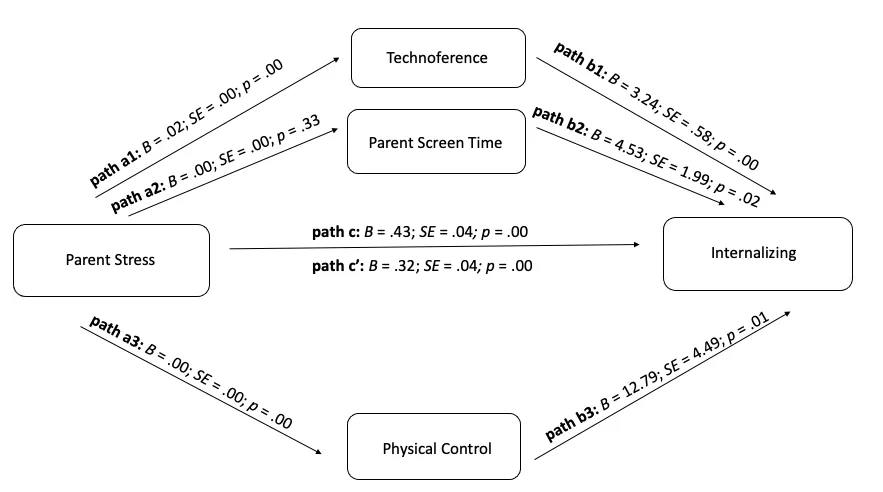
Externalizing Difficulties. A multiple mediation model tested whether technoference (TIPS, M1), parent screen time (MT Tot, M2; transformed variable), warmth (M3), and hostility (M4) mediated the relation between parenting stress (PSI, IV) and children’s externalizing difficulties (CBCL Ext, DV). COVID-19 life changes (COVID-19 LC) was included as covariate in the model. The total indirect effect of parenting stress on externalizing difficulties through the set of mediators was significant (B = .06, SE = .03, 95% CI [.00, .13]). Technoference (B = .03, SE = .02, 95% CI [.01, .07]) and hostility (B = .07, SE = .02, 95% CI [.03, .12]), emerged as significant partial mediators. As depicted in Figure 5, the total effect of parent screen time on externalizing difficulties was significant, but after parsing out the effect of the mediators, the strength of the direct effect was reduced; thus, representing a partial mediation with technoference and hostility as significant partial mediators.
Figure 5. Hypothesis 2c Multiple Mediation Model with Externalizing Difficulties
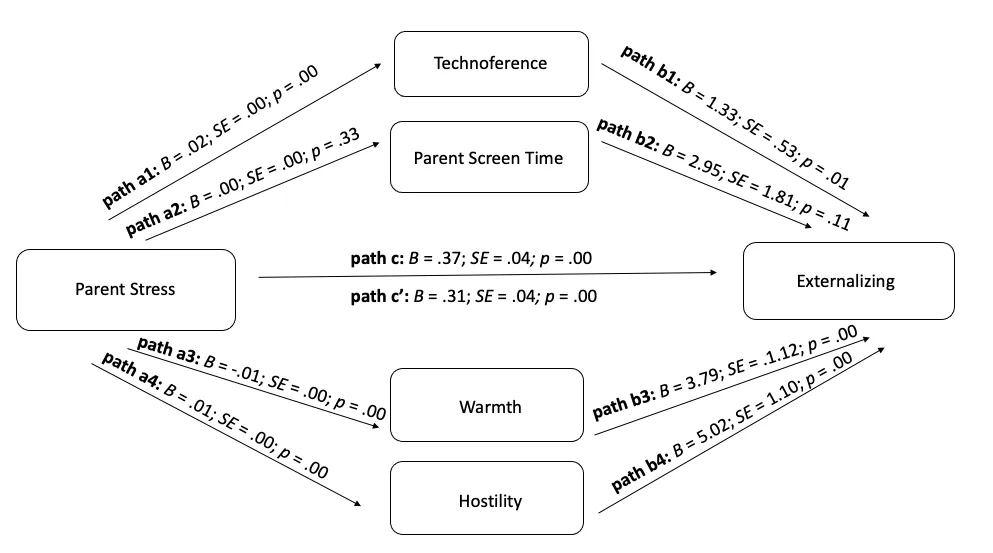
Internalizing Difficulties. Given that technoference emerged as a significant mediator in the mediation model, subsequent multiple mediation models explored the impact of technoference on parenting (rather than parent screen time on parenting). A multiple mediation model tested whether parent stress (PSI, M1) and physical control (M2; transformed variable) mediated the relation between technoference (TIPS, IV) and children’s internalizing difficulties (CBCL Int, DV). COVID-19 life change (COVID-LC) was included as covariate in the model. The total indirect effect of technoference on internalizing difficulties through the set of mediators was significant (B = 2.19, SE = .45, 95% CI [1.31, 3.10]). Parent stress (B = 1.60, SE = .41, 95% CI [.84, 2.44]) and physical control (B = .59, SE = .27, 95% CI [.17, 1.25]) emerged as significant partial mediators. As shown in Figure 6, the total effect of technoference on internalizing difficulties was significant; however, after parsing out the effect of the mediators, the strength of the direct effect was reduced. Together, these results represent a partial mediation with parent stress and physical control as significant partial mediators.
Figure 6. Hypothesis 2d Multiple Mediation Model with Internalizing Difficulties
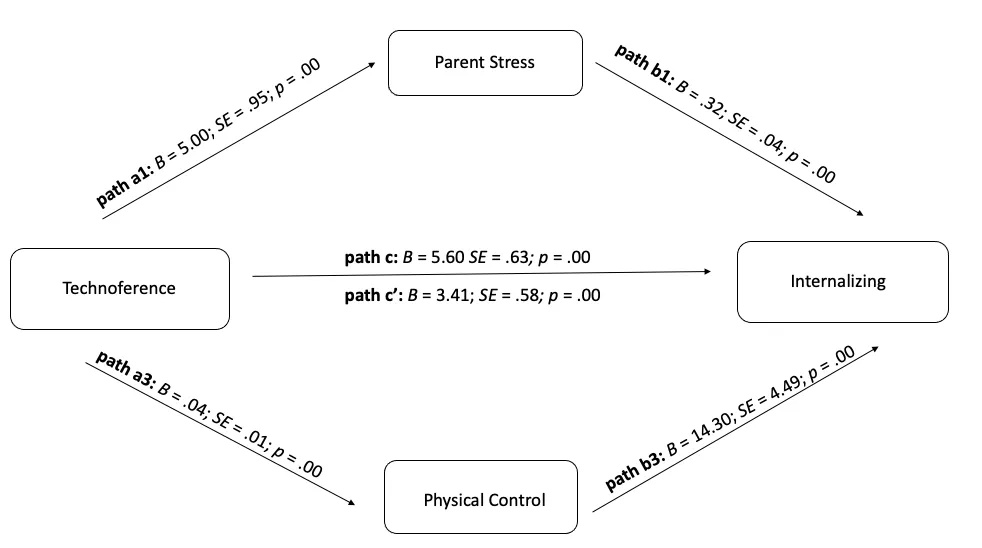
Externalizing Difficulties. A multiple mediation model tested whether parent stress (PSI, M1), warmth (M2), and hostility (M3) mediated the relation between technoference (TIPS, IV) and children’s externalizing difficulties (CBCL Ext, DV). COVID-19 life change (COVID-19 LC) was included as covariate in the model. The total indirect effect of technoference on externalizing difficulties through the set of mediators was significant (B = 1.87, SE = .40, 95% CI [1.08, 2.68]). Parent stress (B = 1.55, SE = .40, 95% CI [.82, 2.39]) and hostility (B = .73, SE = .28, 95% CI [.30, 1.45]) emerged as significant mediators. As depicted in Figure 7, the total effect of technoference on externalizing difficulties was significant, but after parsing out the effect of the mediators, the strength of the direct effect was reduced; thus, this represents a partial mediation with parent stress and hostility as significant partial mediators.
Figure 7. Hypothesis 2d Multiple Mediation Model with Externalizing Difficulties
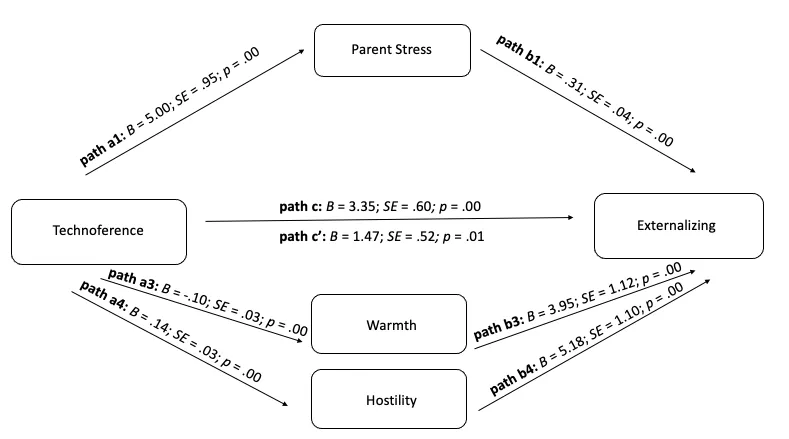
(1a) Parent screen time at Time 1 significantly increased compared to parent screen time at baseline (three months before the COVID-19 pandemic). Analysis: Paired sample t-test. DV: Parent screen time. Summary: Supported. Parent screen time during the past two weeks was greater than parents’ retrospective reporting of their screen time three months before COVID-19.
(1b) Child overall mental health challenges at Time 1 significantly increased compared to child overall mental health at baseline (three months before the COVID-19 pandemic). Analysis: Paired sample t-test. DV: Child mental health. Summary: Supported. Child mental health challenges during the past two weeks was greater than parents’ retrospective reporting of their child’s mental health challenges three months before COVID-19.
(2a) Higher parent stress, screen time/technoference, negative parenting, and lower positive parenting will predict more internalizing difficulties. Analysis: Hierarchical multiple regressions. IV: Parent stress, parent screen time, technoference, negative parenting, positive parenting. DV: Internalizing difficulties. Summary: Supported. Greater parent stress, technoference, and physical control predicted 20% of unique variance.
(2a) Higher parent stress, screen time/technoference, negative parenting, and lower positive parenting will predict more externalizing difficulties. Analysis: Hierarchical multiple regressions. IV: Parent stress, parent screen time, technoference, negative parenting, positive parenting. DV: Externalizing difficulties. Summary: Supported. Greater parent stress, technoference, hostility, and lower warmth predicted 24% of unique variance.
(2b) Higher parent stress and screen time/technoference will predict lower positive parenting. Analysis: Hierarchical multiple regressions. IV: Parent stress, parent screen time, technoference. DV: Proactive parenting. Summary: Supported. Parent stress and technoference accounted for 10% of unique variance.
(2b) Higher parent stress and screen time/technoference will predict lower positive parenting. Analysis: Hierarchical multiple regressions. IV: Parent stress, parent screen time, technoference. DV: Positive reinforcement. Summary: Supported. Parent stress accounted for 6% of unique variance.
(2b) Higher parent stress and screen time/technoference will predict lower positive parenting. Analysis: Hierarchical multiple regressions. IV: Parent stress, parent screen time, technoference. DV: Warmth. Summary: Supported. Parent stress and technoference accounted for 10% of unique variance.
(2b) Higher parent stress and screen time/technoference will predict lower positive parenting. Analysis: Hierarchical multiple regressions. IV: Parent stress, parent screen time, technoference. DV: Supportiveness. Summary: Supported. Parent stress and technoference accounted for 9% of unique variance.
(2b) Higher parent stress and screen time/technoference will predict higher negative parenting. Analysis: Hierarchical multiple regressions. IV: Parent stress, parent screen time, technoference. DV: Hostility. Summary: Supported. Parent stress and technoference accounted for 14% of unique variance.
(2b) Higher parent stress and screen time/technoference will predict higher negative parenting. Analysis: Hierarchical multiple regressions. IV: Parent stress, parent screen time, technoference. DV: Lax control. Summary: Supported. Parent stress and technoference accounted for 10% of unique variance.
(2b) Higher parent stress and screen time/technoference will predict higher negative parenting. Analysis: Hierarchical multiple regressions. IV: Parent stress, parent screen time, technoference. DV: Physical control. Summary: Supported. Parent stress and technoference accounted for 7% of unique variance.
(2c) Relation between parent stress and child functioning will be mediated by lower positive parenting and higher negative parenting. Analysis: Multiple mediation. IV: Parent stress. DV: Internalizing difficulties. M: Physical control, technoference, parent screen time. Summary: Partially supported. Partial mediation. Indirect effect of technoference and physical control significant.
(2c) Relation between parent stress and child functioning will be mediated by lower positive parenting and higher negative parenting. Analysis: Multiple mediation. IV: Parent stress. DV: Externalizing difficulties. M: Hostility, warmth, technoference, parent screen time. Summary: Partially supported. Partial mediation. Indirect effect of technoference and hostility significant.
(2d) Relation between technoference and child functioning will be mediated by parent stress, lower positive parenting and higher negative parenting. Analysis: Multiple mediation. IV: Technoference. DV: Internalizing difficulties. M: Physical control, parent stress. Summary: Partially supported. Partial mediation. Indirect effect of physical control and parent stress significant.
(2d) Relation between technoference and child functioning will be mediated by parent stress, lower positive parenting and higher negative parenting. Analysis: Multiple mediation. IV: Technoference. DV: Externalizing difficulties. M: Hostility, warmth, parent stress. Summary: Partially supported. Partial mediation. Indirect effect of hostility and parent stress significant.
Dissertation Writing Service
Need a psychology dissertation written to this standard?
Our subject specialists write to your exact brief — fully referenced, plagiarism-free and delivered on time, with a free plagiarism report.
A manifest analysis of the collected qualitative responses was conducted to examine the surface structure of participant responses to structured questions. A manifest analysis focuses on what parents reported and remains close to the original text to describe what is obvious within the text rather than making broader interpretations to the data (Bengtsson, 2016).
Added stress. Of the N = 224 parents who participated in the study, N = 108 (48.2%) provided a response to the first question. Reported descriptions of the added stress parents experienced since COVID-19 can be found in Table 29. The most common reason for additional stress was the burden of additional parenting responsibilities since childcare centres were closed and community activities were shut down (n = 26). A mother of a 4-year-old girl (participant 71) noted that “trying to parent and work simultaneously every day without any break in childcare from grandparents/relatives” was stressful. Similarly, another parent indicated that “working from home with a toddler for 6 months [with] no childcare [was] stressful and finding childcare after daycare closed” (mother of 3-year-old boy; participant 80).
The second most common reason for additional stress was fear (n = 25). Many parents identified fears about whether they could keep their family safe. Common language used by parents to describe this stress included “stress of getting sick, teaching social distancing (mother of 5-year-old girl; participant 78),” worries about “child getting COVID or family getting COVID (mother of 4-year-old boy)”, “avoiding getting sick (mother of 4-year-old girl; participant 90),” and feeling “nervous when out and keeping distances” (mother of 4-year-old boy; participant 141). Some parents also expressed fear about the economy (i.e., “the rental crisis,” mother of 5-year-old girl, participant 8; “increased debt,” father of 3-year-old girl, participant 82 and “the economy is depressed,” mother of 3-year-old boy, participant 204).
Many parents also attributed their stress to lockdown or quarantine (n = 24). Parents described lockdown being a significant hindrance to their lifestyles, and therefore a major source of stress. For instance, a mother of a 3-year-old boy (participant 95) noted that “having kids home and being stuck inside the house 24/7 is hard on all of us – more fighting and everyone is so high strung and bored.” Another mother of a 3-year-old boy (participant 37) reported “having no break or time to myself has added a lot of stress, as well as having no support from others and no options of places to go.”
The stress from working from home (n = 16) and navigating online school (n = 16) was also evident. For instance, one parent indicated that “we have no outside support and we are both working from home and schooling our child at the same time off and on since [the pandemic] began” (mother of 5-year-old girl, participant 66). Another mother of a 3-year-old boy (participant 91) expressed that “COVID has made it impossible to do my job and care for my children.”
Other areas of stress included decreased family income (n = 7). One father of a 3-year-old girl (participant 5) noted that the stress was “mainly due to financial pressure, our income has declined.” Parents also reported being lonely (n = 12; “suffering from loneliness,” father of 4-year-old boy, participant 68) and having decreased social supports (n = 10). For example, one 3-year-old boy’s mother (participant 7) noted that the “few supports we had are now unable to assist us even if they wanted to,” whereas another parent stated that “The mental fatigue and nonstop caring for kids without breaks but without family or friends support has been hard” (mother of 4-year-old boy, participant 118).
Parents were also stressed about their physical health (n = 7) and mental health (n = 6). For instance, a 4-year-old girl’s mother (participant 58) cited that the “closure of additional medical supports that I used to help manage my discomfort was extremely difficult.” Another parent noted “there is no option for respite, or in person therapy – I don’t ever get a break from my child” (mother of 3-year-old girl, participant 214).
Less common, but notable stressors included changes to jobs (n = 7; “I had to close my small business to stay home,” mother of 5-year-old girl, participant 24), worries about inflation (n = 5; “rising costs,” mother of 4-year-old girl, participant 21), legal concerns that were not specified (n = 2), and increases in difficult child behaviours (n = 2; “there is a lot of screaming, thrown toys, hitting, and tantrums,” mother of 3-year-old boy, participant 77).
| Code | Frequency | Percent | Example |
|---|---|---|---|
| Job transition | 7 | 6.5% | “I went back to work early” |
| Decreased income | 14 | 13.0% | “Declining revenue” |
| Inflation | 5 | 4.6% | “Rising costs” |
| Working from home/Work stress | 16 | 14.8% | “Trying to parent and work simultaneously” |
| School stress | 16 | 14.8% | “Home schooling two kids” |
| Lifestyle lockdown/Change in routine/Quarantine | 24 | 22.2% | “Not being able to go out and see others” |
| Parenting responsibilities/no childcare/no child activities | 26 | 24.1% | “Kids with nothing to do at home all the time” |
| Increased child dysfunction | 2 | 1.9% | “Spend almost all the time with my son ….led to some conflict” |
| Mental health concerns | 6 | 5.6% | “I have anxiety …anxiety has been quite high” |
| Loneliness/less socializing | 12 | 11.1% | “Suffering from loneliness” |
| Decreased social support | 10 | 9.3% | “Lack of help from family members” |
| Healthcare | 7 | 6.5% | “Caring for COVID and ICU patients” |
| Fear | 25 | 23.1% | “Very anxious about going into stores” |
| Legal concerns | 2 | 1.9% | “Legal issues” |
Changes to Screen Time. Of the N = 224 parents who participated in the study, N = 73 (32.6%) provided a response to the second question. Reported descriptions of whether the amount of technology use has changed since COVID-19 can be found in Table 30. Many (n = 28) parents described an increase in their technology use rather than a reduction in use. Almost half of them cited COVID-19 as a reason for this change. For instance, a mother of a 3-year-old girl (participant 22) explained “I spend more time on it now because I am home more,” while another noted that “it has increased as things I used to do in person I now do online” (mother of 4-year-old boy, participant 118). A fewer number of parents (n = 4) reported a decrease in technology use while only one parent described stopping altogether. COVID-19 was never cited as a reason that technology use decreased.
The most prominent reasons why technology use increased during the pandemic was due to work or school (n = 11). For instance, a mother of a 4-year-old girl (participant 180) cited that “the kids did not use computers or tablets before virtual school” and another mother of a 3-year-old daughter (participant 234) attributed the increase to “more time spent due to working from home.”
Other reasons parents increased their technology use included to: adapt to increasing child care demands (n = 3), communicate with others (n = 3; “constantly on talking to family,” mother of 3-year-old girl, participant 28), shop online (n = 3; “in person shopping has changed to online shopping on mobile device,” mother of 4-year-old boy, participant 118), stay updated with the news (n = 2; “reading articles on the Internet more and news,” mother of 4-year-old boy, participant 190), and to use social media (n = 1; “I feel I spend more time than I did before browsing social media,” mother of 3-year-old girl, participant 22).
| Code | Frequency | Percent | Example |
|---|---|---|---|
| Increase (no mention of COVID-19) | 28 | 38.4% | “Increased” |
| Decrease (no mention of COVID-19) | 4 | 5.4% | “A lot less” |
| Stopped | 1 | 1.3% | “Stopped” |
| Increase because COVID-19 | 11 | 15.1% | “More screentime during the pandemic” |
| Decrease because COVID-19 | 0 | 0% | “Back to work … so use my phone less” |
| Increase because news | 2 | 2.7% | “Constantly checking news” |
| Increase because of social media | 1 | 1.3% | “More time … browsing social media” |
| Increase because of work/school | 11 | 15.1% | “More frequently while working from home” |
| Increase because of communication | 3 | 4.1% | “Constantly on talking to family” |
| Increase because of online shopping | 3 | 4.1% | “More online shopping than in store” |
| Increase because of child care demands | 3 | 4.1% | “Too much time with the child” |
| Boredom | 0 | 0% | “Increased use due to boredom” |
Changes to Activities on Mobile Technology. Of the N = 224 parents who participated in the study, N = 40 (17.8%) parents provided a response to the third question. Reported descriptions regarding how the use of technology use has changed since COVID-19 appear in Table 31. Most common responses (n = 9) indicated that parents changed the way they use mobile technology to adapt to taking virtual meetings as well attend online school. One mother of a 3-year-old boy (participant 95) “use[d] zoom meetings now for kid’s classes, workouts, information … etc.,” while another parent used “Zoom for extended family functions” (mother of 3-year-old girl, participant 115). Parents also adopted new software as they transitioned to online school: “with online learning we needed to use Microsoft teams and brightspace” (mother of 5-year-old girl, participant 26).
The second most frequently cited change to technology use involved entertainment (n = 5). Parents reported using technology to entertain themselves: “I used to be able to use my laptop for work now I’m not working and use my phone for entertainment” (mother of 3-year-old boy, participant 144). Other parents allowed their children to use technology for entertainment: “I’ve adopted parental controls on my smartphone and downloaded games for him to enjoy when he’s bored due to lockdown” (mother of 4-year-old boy, participant 139).
Other changes to technology use included: for work (n = 4; “using it more for work instead of personal only,” mother of 3-year-old boy, participant 89), shopping (n = 4; “prefer online shopping over physically visiting stores,” mother of 3-year-old girl, participant 143), to use social media (n = 3; “engage in conversation on social media,” mother of 3-year-old girl, participant 70), communicate with others (n = 2; “talk to family,” mother of 3-year-old boy, participant 133), and learn or teach (n = 3; “more creative … looking for more ideas to do from home,” mother of 3-year-old boy, participant 83). Less common reasons cited included to attend virtual therapy, to complete health screenings, and to cope; “I scroll more mindlessly also to deal with the anxiety I feel working in healthcare,” mother of 3-year-old girl, participant 58).
| Code | Frequency | Percent | Example |
|---|---|---|---|
| Increase | 5 | 12.5% | “Use it for more purposes” |
| Decrease | 1 | 2.5% | “I don’t frequently use mobile technology as much anymore” |
| Virtual meetings | 9 | 22.5% | “Zoom calls” |
| Communication | 2 | 5% | “To communicate with physician colleagues” |
| School | 8 | 20% | “Online learning we needed to use [apps]” |
| Work | 4 | 10% | “Using it more for work” |
| Social media | 3 | 7.5% | “Engage in conversations on social media” |
| Entertainment | 5 | 12.5% | “Netflix” |
| Cope | 1 | 2.5% | “I scroll more mindlessly to deal with the anxiety” |
| Health screening | 1 | 2.5% | “Smartphone health screening” |
| Shopping | 4 | 10% | “Shopping” |
| Therapy | 1 | 2.5% | “Online therapy” |
| Learning/Teaching | 3 | 7.5% | “Looking for more ideas to do from home” |
Of the N = 224 who participated in the study, N = 170 (75.9%) provided a response to the fourth question. Reported descriptions about the types of activity parents engaged in on their mobile technology around their children appear in Table 32. Parents most commonly reported texting (n = 92; “chatting with friends,” mother of 3-year-old girl, participant 12) or using social media (n = 99; “check Facebook…while children are in the background,” mother of 3-year-old girl, participant 73) on their mobile technology around their children. Around one-third of parents read on their mobile devices around their children (n = 58). One mother of a 4-year-old girl (participant 58) shared that they “might try to read news or social media but it’s easily put away.”
Some parents also shared that they used mobile technology to take audio calls (n = 11), video calls (n = 14), work (n = 11; “attending to my clients on my company’s portal,” father of 5-year-old boy, participant 44), answer or send emails (n = 23), view video or audio media (n = 25; “listening to music,” father of 3-year-old boy, participant 193), do online shopping (n = 15), and play games (n = 21; “crosswords,” mother of 5-year-old girl, participant 24).
| Code | Frequency | Percent | Example |
|---|---|---|---|
| Texting | 92 | 54.1% | “Responding to texts” |
| Audio call | 11 | 6.5% | “Phone calls” |
| Video call | 14 | 8.2% | “Video calls” |
| Work | 11 | 6.5% | “Emailing for work” |
| 23 | 13.5% | “Usually emails” | |
| Video/audio media | 25 | 14.7% | “Watching videos” |
| Social media | 99 | 58.2% | “Engaging in social media” |
| Online shopping | 15 | 8.8% | “Shopping” |
| Reading | 58 | 34.1% | “Reading news” |
| Playing games | 21 | 12.4% | “Phone games” |
Of the N = 224 parents who participated in the study, N = 82 (36.6%) parents provided a response to the fifth question. Reported descriptions of how mobile technology use impacted parent’s parenting can be found in Table 33. Many parents cited that their attention and focus decreased, and they were more easily distracted (n = 25). For example, a 4-year-old boy’s mother (participant 19) noted that “I get distracted sometimes when I would like to focus better on my children.”
Interestingly, the second most common impact of parent mobile technology use on parenting was that parents reported using mobile technology as a parenting tool (n = 13). For instance, a mother of a 4-year-old boy (participant 139) mentioned that “my phone allows me to find activities for me kids to do in the community.” Another parent noted that it “helps me be a better parent at times as it provides strategies and lets me know that I am not alone.” (mother of 3-year-old boy, participant 151). A few parents indicated that using technology “helps reducing stress” (mother of 4-year-old boy, participant 45) and “gives me a moment to have a mental break” (mother of 4-year-old girl, participant 118).
Some parents shared that the quality of their relationship with their child decreased (n = 5) while others noticed a disconnection with their child (n = 3). For example, a mother of a 3-year-old girl (participant 50) shared that “I might miss important moments with the kids,” while another cited that technology use leads to “decreased engagement with [their] kids” (mother of a 4-year-old girl, participant 139).
Some parents also expressed having more feelings of irritability, frustration, and dysregulation (n = 5). A mother of a 4-year-old boy (participant 51) shared that “I find I get frustrated with my children if they interrupt me while I am in the middle of a task on my phone or computer.” A few parents (n = 3) described holding a negative perspective of themselves as a parent (“Can’t take better care of children,” mother of 4-year-old boy, participant 149).
Some parents (n = 5) noted that their use of mobile technology does not have a perceived impact on their parenting. A mother of a 3-year-old boy (participant 203) commented that their technology use “doesn’t matter. My child is still very good.”
| Code | Frequency | Percent | Example |
|---|---|---|---|
| No change | 5 | 6.2% | “Not in anyways affected my parenting style” |
| Parent-child quality time decreases | 5 | 6.2% | “Doesn’t allow me to be as present as I would like: |
| Disconnection | 3 | 3.7% | “Limited my involvement” |
| Decrease attention/focus/distracted | 25 | 30.5% | “Less … attentive” |
| Increase irritability/frustration/dysregulation | 5 | 6.2% | “Get frustrated when they are being too loud” |
| Positive impact | 0 | 0% | “We spend more time together” |
| Negative perspective towards self/as a parent | 3 | 3.7% | “I feel like a crappy parent” |
| Increased flexibility and adaptability | 1 | 1.2% | “Made me time manage better and respond more” |
| Parenting tool | 13 | 15.9% | “Helps me keep her occupied while I get chores done” |
Of the N = 224 who participated in the study, N = 92 (41.07%) parents provided a response to the sixth question. See Table 34 for reported descriptions of how parents multitasked between mobile technology and parenting demands Almost half (n = 41) of the participants described multitasking by switching back and forth between technology and their children, or jointly using technology. For instance, a mother of a 3-year-old boy (participant 12) described “checking [my] phone, [and] listening to podcasts while feeding or showering.” Another mother of a 3-year-old boy (participant 95) reported being “on zoom meetings while making dinner, feeding them, helping them with online school.”
More common strategies employed by parents included using technology when kids were occupied with something else (n = 8). For example, one mother of a 5-year-old girl (participant 8) shared that she entertains herself with “music on Spotify and Netflix while sitting outside while they play.” Some parents (n = 7) described using mobile technology as a tool to occupy children as well as for educational purposes. A mother of a 3-year-old girl (participant 73) “put videos on for [her children] to watch while working” while another mother of a 4-year-old boy (participant 180) shared that she “would watch videos to learn about the kids’ lessons.” Some parents recalled using technology alongside their children but while using separate devices.
A few parents described setting boundaries (n = 3; “put down device” mother of 5-year-old boy, participant 170), having technology on in the background (n = 1), and communicating with the child about technology use (n = 1). For instance, a mother of a 4-year-old boy (participant 90) shared that she “watch[es] videos on my phone in the background while playing” while a mother of a 3-year-old boy (participant 203) shared that she “usually tell[s] him about using these devices.” Only two parents indicated using no strategy, while five parents noted that they did not multitask between mobile technology use and parenting.
| Code | Frequency | Percent | Example |
|---|---|---|---|
| No strategy | 2 | 2.2% | “N/A” |
| No multitasking | 5 | 5.4% | “Take care of the child first” |
| Both use screens separately | 5 | 5.4% | “We each use our separate technology” |
| Combined multitasking | 41 | 44.6% | “Trying to get things done while also playing” |
| When kids are occupied | 8 | 8.7% | “I will browse reddit etc. while my kids are playing” |
| Tool to occupy | 7 | 7.6% | “Put videos on for them to watch” |
| Boundary setting | 3 | 3.3% | “Scheduled screen times or quick checks” |
| Technology in the background | 1 | 1.1% | “I watch videos on my phone in the background while playing” |
| Check in with child | 0 | 0% | “Take breaks to check in with child” |
| Communicating with child about technology use | 1 | 1.1% | “I usually tell him about using these devices as a reward” |
| Educational purposes | 3 | 3.3% | “Used … to educating my kid” |
Of the N = 224 who participated in the study, N = 84 (37.5%) parents provided a response to the seventh question. Reported descriptions of how children acted differently when parents were using mobile technology appear in Table 35. A large number of parents noticed that their child wanted more attention (n = 35). For instance, a mother of a 3-year-old boy (participant 37) noted that her son “will try to get my attention and be more needy” and another mother of a 4-year-old girl (participant 73) mentioned that “in meetings they want my attention so they tend to sit on my lap, overreact, become louder and annoying.” In a similar vein, many parents also reported that their child became more dysregulated, disobedient, or increased their whining (n = 27). For instance, a father of a 5-year-old boy (participant 179) expressed that his son is “more tough to deal with,” while a mother of a 3-year-old boy shared that her “child gets angry when attention is on the phone and not him.” Only one parent noted that their child would start “occasional[ly] fighting” and became more aggressive (mother of 4-year-old boy, participant 118).
Some parents (n = 7) noticed that their children were curious about their parent’s activities and eager to check in on their parents, while some wanted to use the technology themselves (n = 8). A 3-year-old girl’s mother noted that “she showed more interest and wanted to be involved in whatever I was doing” and another noted “he will be more interested in my mobile technology and try to use it” (mother of 3-year-old boy, participant 216). Interestingly, a few parents (n = 7) indicated that their children’s obedience increased when parents were using mobile technology “more well behaved,” mother of 5-year-old girl, participant 132). Seven parents did not notice any differences in their children’s behaviour.
| Code | Frequency | Percent | Example |
|---|---|---|---|
| No difference noted | 7 | 8.3% | “Didn’t find [a difference] |
| Child wants more attention | 35 | 41.7% | “Wanting more attention” |
| Increase whining/dysregulation/disobedience (physical, noise, emotions) | 27 | 21.1% | “Child gets angry when attention is on the phone and not him” |
| More fighting/arguments | 1 | 1.2% | “Occasional fighting” |
| Curiosity/checking on parent | 7 | 8.3% | “Sometimes he wants to see what I’m doing” |
| Want to use technology | 8 | 9.5% | “Showed more interest and wanted to be involved in whatever I was doing” |
| Increase obedience | 7 | 8.3% | “More well behaved” |
One hundred and ninety-five responses were collected for Time 2, while N = 152 responses were collected for Time 3. Fraudulent participants who also completed Time 2 (total of N = 23) and Time 3 data of the study (total of N = 20) were removed from the data set. This left an initial sample of N = 172 and N = 132 for Time 2 and Time 3, respectively.
Descriptive and statistical analyses were conducted using Statistical Package for the Social Sciences, Version 25 (IBM, 2017). A total of 8 and 6 collected responses did not pass the screening questions in the Time 2 and Time 3 sample, respectively. These cases were removed from the data set therefore leaving a subsequent sample of N = 164 at Time 2 and N = 126 at Time 3, which were examined for data entry errors, missing data, and outliers.
Missing data were analyzed using Missing Value Analysis (MVA) revealed very little missing data across the two samples. Within the Time 2 sample, the summary of missing values indicated that 21.8% of the variables had some missing data, and across all variables and participants, only 1.6% of total data were absent. The percentage of missing data across all variables in the data set ranged from 0% to 3.1%, with most missing variables missing 0% of responses.
Within the Time 3 sample, the summary of missing values indicated that 5.71% of the variables had some missing data, and across all variables and participants, 3.22% of total data was absent. The percentage of missing data across all variables in the data set ranged from 0% to 9.2%, with the majority of missing variables missing 0% of responses.
Little’s MCAR test was conducted to determine whether the pattern of missing data across all samples were considered MCAR (Missing Completely at Random) or MAR (Missing at Random; Tabachnick & Fidell, 2013). Little’s MCAR revealed that data collected during Time 2 (X2 (6393) = 4472.34, p > .999), and Time 3 (X2 (4183) = 2276.62, p > .999) were MCAR. Multiple imputation was computed at the composite level with five iterations for all data sets (Tabachnick & Fidell, 2013).
Time 2 data (N = 164) was examined for univariate outliers on the independent and dependent variables. Standardized values exceeding the acceptable value of +/- 3.29 were found on the following variables: Technoference (TIPS), COVID-19 Total Life Changes (COVID LC), Parenting Stress (PSI), Parenting Stress Defensive Responding (PSI Defensive), Proactive Parenting, Positive Reinforcement, Warmth, Supportiveness, Physical Control, and Parent Technology use (Mobile Technology, Smartphone, Television, Computer).
Skewness values for Proactive Parenting and Parent Technology (Mobile Technology, Computer) fell outside the acceptable range of -/+ 2. Kurtosis values for scales measuring: Proactive Parenting, Physical Control, Internalizing Problems (CBCL 11/2 – 5), and Parent Technology (Mobile Technology, Smartphone, Television, Computer) fell outside the acceptable range of -/+ 3. Outliers that were detected on variables without severe violations of normality were winsorized. The maximum skew and kurtosis values in this data set fell at 2.51 and 4.32, respectively. After winsorizing, the assumptions of normality for these variables were met and all standardized residuals were within acceptable limits.
For variables with more severe violations of normality or with numerous outliers, logarithmic transformations were applied to bring them into compliance with normality. Of note, when assessing change in variables over time, transformation of all variables across time must be applied given that transformation of data changes the form of relationship between variables, while relative difference between cases within variables remain the same. Therefore, all data sets (Time 1, 2, and 3) were assessed for variables with significant violations of normality, as well as with multiple outliers, and these variables were transformed across all data sets. In other words, variables transformed in the Time 1 data set were also transformed in the Time 2 and 3 data set and vice versa. Within the Time 2 sample, maximum skewness and kurtosis values fell at 3.56 and 18.68, respectively (all positively skewed) for the Parent Technology (Smartphone, Computer) variables. Within the Time 3 sample, maximum skewness and kurtosis values fell at 3.48 and 16.82, respectively (all positively skewed) for the Parent Technology (Mobile Technology, Smartphone, Tablet, Video Game, Computer) variables. These variables were transformed across all data sets to bring them into compliance with normality.
A total of 7 cases were identified as multivariate outliers (p values lower than 0.001) and therefore removed from the data set, leaving a remaining sample of N = 157. To assess the assumption of homoscedasticity, scatter plots of standardized residuals by standardized predicted values examined for all primary analyses revealed a spread indicative of homoscedasticity. The assumptions of multicollinearity and singularity were tested by examining the VIF and tolerance values. VIF values ranged from 1.11 to 8.50 and tolerance values ranged from 0.12 to .90. Furthermore, an examination of a correlation matrix revealed no correlations approaching or exceeding r = .90. The Durbin-Watson value across primary analyses sample fell within normal limits (between 1 and 3; Field, 2009) and ranged between 1.54 and 1.79, confirming the assumption of independence of errors.
Time 3 data (N = 126) was examined for univariate outliers on the independent and dependent variables. Standardized values exceeding the acceptable value of +/- 3.29 were found on the following variables: Parent Stress (PSI), Parent Stress Defensive Responding (PSI Defensive), Physical Control, COVID-19 Total Life Changes (COVID-19 LC), and Parent Technology (Mobile Technology, Smartphone, Television).
The skewness values for Physical Control fell outside the acceptable range of -/+ 2. Kurtosis values for scales measuring: Physical Control and Parent Technology (Mobile Technology, Smartphone) fell outside the acceptable range of -/+ 3.
Outliers that were detected on variables without severe violations of normality were winsorized. The maximum skew and kurtosis values in this data set fell at 4.82 and 7.89, respectively (all positively skewed). After winsorizing, the assumptions of normality for these variables were met and all standardized residuals were within acceptable limits. For variables with more severe violations of normality or with numerous outliers, logarithmic transformations were applied to bring them into compliance with normality (see above).
A total of 5 cases were identified as multivariate outliers (p values lower than 0.001) and therefore removed from the data set, leaving a sample of N = 121. Ten participants were not matched across data sets due to missing or unique (e.g., provided a new email address that was not found in previous data set) information and therefore removed, resulting in an overall sample of N = 111 for Time 3.
To assess the assumption of homoscedasticity, scatter plots of standardized residuals by standardized predicted values examined for all primary analyses revealed a spread indicative of homoscedasticity. The assumptions of multicollinearity and singularity were tested by examining the VIF and tolerance values. VIF values ranged from .30 to .82 and tolerance values ranged from 1.40 to 2.86. Furthermore, an examination of a correlation matrix revealed no correlations approaching or exceeding r = .90. The Durbin-Watson value across primary analyses sample fell within normal limits (between 1 and 3; Field, 2009) and ranged between 1.86 and 1.92, confirming the assumption of independence of errors.
During the nine-month period of data collection from February 2021 to November 2021, the province underwent several additional changes due to the pandemic. Details regarding COVID-19 related changes and mandates, as well as daily new confirmed COVID-19 cases per million people during the longitudinal study are outlined in Appendix I.
To explore how COVID-19 impacted families over time, as well as how parent stress, parent screen time, technoference, parenting behaviours, and children’s internalizing and externalizing difficulties changed throughout the nine-month study period, one-way repeated measures analysis of variances (ANOVA), with Bonferroni corrections to correct for multiple comparisons were conducted. Descriptive statistics for these variables are presented in Table 36. Demographic covariates were only included in the analyses as a covariate if they were significantly related to the variable being explored at all three time points. See Appendix J and K.
| Variable | M_T1 (SD) | Min_T1 | Max._T1 | M_T2 (SD) | Min_T2 | Max._T2 | M_T3 (SD) | Min_T3 | Max._T3 |
|---|---|---|---|---|---|---|---|---|---|
| TIPS | 2.82 (1.28) | .54 | 6.14 | 2.51 (1.08) | 1.00 | 6.21 | 2.53 (1.23) | 1.00 | 6.57 |
| PSI | 88.18 (19.31) | 47.00 | 139.00 | 88.55 (18.49) | 44.00 | 140.00 | 86.52 (17.63) | 45.00 | 132.00 |
| Physical Control (T) | .11 (.16) | .11 | .13 | .10 (.14) | .00 | .51 | .00 (.48) | .00 | .48 |
| Hostility | 2.23 (.63) | 2.23 | .62 | 2.23 (.62) | 1.00 | 4.45 | 1.00 (3.86) | 1.00 | 4.00 |
| Warmth | 4.43 (.59) | 4.34 | .59 | 4.35 (.60) | 3.00 | 6.00 | 3.00 (5.00) | 3.00 | 5.00 |
| CBCL Int | 49.26 (14.37) | 29.00 | 91.00 | 46.91 (13.25) | 29 | 85.00 | 45.62 (13.61) | 29.00 | 85.00 |
| CBCL Ext | 46.81 (12.84) | 28.00 | 88.00 | 44.93 (12.23) | 28 | 80.00 | 43.21 (11.59) | 28.00 | 79.00 |
| MT Total (T) | 1.60 (.34) | .00 | 2.38 | 1.51 (.36) | .54 | 2.45 | 1.54 (.27) | 1.00 | 2.33 |
| Smartphone (T) | 1.50 (.39) | .00 | 2.06 | 1.38 (.49) | .00 | 2.05 | 1.46 (.29) | .48 | 2.10 |
| Tablet (T) | .54 (.66) | .00 | 1.98 | .41 (.63) | .00 | 2.15 | .43 (.62) | .00 | 1.95 |
| COVID-19 LC | 17.65 (4.19) | 6.00 | 30.00 | 17.82 (4.40) | 7.00 | 32.00 | 16.02 (3.93) | 8.00 | 28.00 |
| COVID MH 2 Weeks | 21.92 (6.35) | 9.00 | 45.00 | 25.06 (3.50) | 18.00 | 37.00 | 26.16 (3.44) | 18.00 | 36.00 |
Note. TIPS = Technology Interference in Parenting Scale (Total Technoference); PSI = Parenting Stress Index (Total parenting stress); MAPS Pos = Multidimensional Assessment of Parenting Scale – Broadband Positive Parenting; MAPS Neg = Multidimensional Assessment of Parenting Scale – Broadband Negative Parenting; CBCL Int = Child Behaviour Checklist – Preschool Version Internalizing Problems; CBCL Ext = Child Behaviour Checklist – Preschool Version Externalizing Problems; MT Total = Total Parent Mobile Technology Use (Smartphone and Tablet combined); Smartphone = Parent Total Smartphone Use; Tablet = Parent Total Tablet Use; COVID-19 LC = Total COVID-19 Life Changes; COVID-19 MH 2 Weeks = Child Mental Health in past two weeks; (T) = transformed variable.
A one-way repeated measures ANOVA was examined with COVID life change (COVID-19 LC) as the dependent variable across three time points. Mauchly’s test indicated that the assumption of sphericity had been violated, X2 (2) = 6.01 p < .05. Greenhouse-Geisser corrected tests exceeded the recommended value of e = .75 (e = .96, Field, 2013); therefore, multivariate tests were reported. The results showed that life changes due to COVID-19 significantly changed over time V = .16, F(2, 109) = 10.69, p < .001. Post hoc analysis with a Bonferroni adjustment revealed that life changes did not significantly differ between Time 1 and Time 2, or Time 1 and Time 3. Life changes significantly decreased between Time 2 and Time 3. See Table 37 for a summary of pairwise comparisons.
| 95% CI | |||||||
|---|---|---|---|---|---|---|---|
| Time | M (SE) | Time | Mean Difference | SE | p | Lower | Upper |
| 1 | 17.65 (.41) | 2 | -1.02 | .62 | .31 | -2.53 | .49 |
| 3 | 1.00 | .50 | .15 | -.22 | 2.22 | ||
| 2 | 17.82 (.44) | 1 | 1.02 | .62 | .31 | -.49 | 2.53 |
| 3 | 2.02 | .56 | .00 | .66 | 3.38 | ||
| 3 | 16.02 (.39) | 1 | -1.00 | .50 | .15 | -2.22 | .22 |
| 2 | -2.02 | .56 | .00 | -3.38 | -.66 | ||
A one-way repeated measures ANOVA was examined with child mental health (COVID-19 MH 2 Weeks) as the dependent variable across three time points. Mauchly’s test indicated that the assumption of sphericity had been violated, X2 (2) = 19.30 p < .001. Greenhouse-Geisser corrected tests exceeded the recommended value of e = .75 (e = .85, Field, 2013); therefore, multivariate tests were reported. The results showed that child mental health significantly changed over time, V = .62, F(2, 96) = 29.30, p < .001. Post hoc analysis with a Bonferroni adjustment revealed that child mental health challenges significantly differed, and increased, between Time 1 and Time 2, as well as Time 1 and Time 3. See Table 38 for a summary of pairwise comparisons.
| 95% CI | |||||||
|---|---|---|---|---|---|---|---|
| Time | M (SE) | Time | Mean Difference | SE | p | Lower | Upper |
| 1 | 20.92 (.64) | 2 | -5.14 | .69 | .00 | -6.81 | -3.47 |
| 3 | -5.25 | .77 | .00 | -7.13 | -3.36 | ||
| 2 | 26.06 (.35) | 1 | 5.14 | .69 | .00 | 3.47 | 6.81 |
| 3 | -.10 | .52 | 1.00 | -1.37 | 1.17 | ||
| 3 | 26.16 (.35) | 1 | 5.25 | .77 | .00 | 3.36 | 7.13 |
| 2 | .10 | .52 | 1.00 | -1.17 | 1.37 | ||
A one-way repeated measures ANOVA was examined with parent stress (PSI) as the dependent variable across three time points. Mauchly’s test indicated that sphericity was assumed, X2 (2) = 5.14 p > .05. Results indicated that parent stress significantly changed over time, F(2, 220) = 4.88 p < .01. As seen in Table 39, post hoc analysis with a Bonferroni adjustment revealed that parent stress significantly decreased between Time 2 and Time 3.
| 95% CI | |||||||
|---|---|---|---|---|---|---|---|
| Time | M (SE) | Time | Mean Difference | SE | p | Lower | Upper |
| 1 | 88.12 (1.85) | 2 | -1.28 | 1.44 | 1.00 | -4.77 | 2.21 |
| 3 | 2.86 | 1.42 | .14 | -.59 | 6.30 | ||
| 2 | 89.40 (1.66) | 1 | 1.28 | 1.44 | 1.00 | -2.21 | 4.77 |
| 3 | 4.14 | 1.20 | .00 | 1.22 | 7.06 | ||
| 3 | 85.26 (1.61) | 1 | -2.86 | 1.42 | .14 | -6.30 | .59 |
| 2 | -4.14 | 1.20 | .00 | -7.06 | -1.22 | ||
A one-way repeated measures ANOVA was examined with hostility as the dependent variable across three time points. Mauchly’s test indicated that sphericity was assumed, X2 (2) = 3.86 p > .05. Results indicated that hostility did not significantly change over time. See Table 40 for a summary of pairwise comparisons.
| 95% CI | |||||||
|---|---|---|---|---|---|---|---|
| Time | M (SE) | Time | Mean Difference | SE | p | Lower | Upper |
| 1 | 2.21 (.05) | 2 | .02 | .04 | 1.00 | -.07 | .12 |
| 3 | .01 | .04 | 1.00 | -.09 | .11 | ||
| 2 | 2.19 (.05) | 1 | -.02 | .04 | 1.00 | -.12 | .07 |
| 3 | -.01 | .04 | 1.00 | -.09 | .08 | ||
| 3 | 2.20 (.06) | 1 | -.01 | .04 | 1.00 | -.11 | .09 |
| 2 | .01 | .04 | 1.00 | -.08 | .09 | ||
A one-way repeated measures ANOVA was examined with warmth as the dependent variable across three time points. Mauchly’s test indicated that sphericity was assumed, X2 (2) = 3.57 p > .05. Results indicated that warmth significantly changed over time, F(2, 220) = 4.76 p = .01. Post hoc analysis with a Bonferroni adjustment revealed that warmth significantly decreased between Time 1 and Time 2. See Table 41.
| 95% CI | |||||||
|---|---|---|---|---|---|---|---|
| Time | M (SE) | Time | Mean Difference | SE | p | Lower | Upper |
| 1 | 4.42 (.05) | 2 | .13 | .04 | .01 | .03 | .22 |
| 3 | .04 | .04 | 1.00 | -.06 | .13 | ||
| 2 | 4.30 (.05) | 1 | -.13 | .04 | .01 | -.22 | -.03 |
| 3 | -.09 | .05 | .15 | -.20 | .02 | ||
| 3 | 4.39 (.06) | 1 | -.04 | .04 | 1.00 | -.13 | .06 |
| 2 | .09 | .05 | .15 | -.02 | .20 | ||
A one-way repeated measures ANOVA was examined with physical control (transformed variable) as the dependent variable across three time points. Mauchly’s test indicated that the assumption of sphericity had been violated, X2 (2) = 7.13 p < .05. Greenhouse-Geisser corrected tests exceeded the recommended value of e = .75 (e = .94, Field, 2013); therefore, multivariate tests were reported. The results showed that physical control significantly changed over time, V = .07, F(2, 109) = 3.89, p < .02. As seen in Table 42, post hoc analysis with a Bonferroni adjustment revealed that physical control significantly increased between Time 1 and Time 2.
| 95% CI | |||||||
|---|---|---|---|---|---|---|---|
| Time | M (SE) | Time | Mean Difference | SE | p | Lower | Upper |
| 1 | .09 (.01) | 2 | -.02 | .01 | .05 | -.04 | .00 |
| 3 | -.00 | .01 | 1.00 | -.03 | .02 | ||
| 2 | .11 (.01) | 1 | .02 | .01 | .05 | .00 | .04 |
| 3 | .02 | .01 | .12 | -.00 | .03 | ||
| 3 | .09 (.01) | 1 | .01 | .01 | 1.00 | -.02 | .03 |
| 2 | -.02 | .01 | .12 | -.03 | .00 | ||
Note. Physical control is a transformed variable.
A one-way repeated measures ANOVA was examined with parent screen time (MT Total; transformed variable) as the dependent variable across three time points. Mauchly’s test indicated that the assumption of sphericity had been violated, X2 (2) = 7.11 p < .05. Greenhouse-Geisser corrected tests exceeded the recommended value of e = .75 (e = .94, Field, 2013); therefore, multivariate tests were reported. As shown in Table 43, the results showed that parent screen time did not significantly change over time V = .04, F(2, 109) = 2.16, p > .05.
| 95% CI | |||||||
|---|---|---|---|---|---|---|---|
| Time | M (SE) | Time | Mean Difference | SE | p | Lower | Upper |
| 1 | 1.53 (.03) | 2 | .07 | .04 | .18 | -.02 | .16 |
| 3 | .00 | .03 | 1.00 | -.07 | .07 | ||
| 2 | 1.46 (.04) | 1 | -.07 | .04 | .18 | -.16 | .02 |
| 3 | -.07 | .04 | .18 | -.16 | .02 | ||
| 3 | 1.53 (.03) | 1 | -.00 | .03 | 1.00 | -.07 | .07 |
| 2 | .07 | .04 | .18 | -.02 | .16 | ||
Note. Parent screen time is a transformed variable.
A one-way repeated measures ANOVA was examined with technoference (TIPS) as the dependent variable across three time points. Mauchly’s test indicated that the assumption of sphericity had been violated, X2 (2) = 12.73 p = .001. Greenhouse-Geisser corrected tests exceeded the recommended value of e = .75 (e = .90, Field, 2013); therefore, multivariate tests are reported. The results showed that technoference significantly changed over time, V = .12, F(2, 109) = 7.58, p < .001. Post hoc analysis with a Bonferroni adjustment revealed that technoference significantly decreased between Time 1 and Time 2, as well as Time 1 and Time 3 (see Table 44).
| 95% CI | |||||||
|---|---|---|---|---|---|---|---|
| Time | M (SE) | Time | Mean Difference | SE | p | Lower | Upper |
| 1 | 2.77 (.11) | 2 | .29 | .08 | .00 | .13 | .45 |
| 3 | .33 | .09 | .00 | .15 | .51 | ||
| 2 | 2.48 (.10) | 1 | -.29 | .08 | .00 | -.45 | -.13 |
| 3 | .04 | .07 | .54 | -.09 | .17 | ||
| 3 | 2.44 (.11) | 1 | -.33 | .09 | .00 | -.51 | -.15 |
| 2 | -.04 | .07 | .54 | -.17 | .09 | ||
A one-way repeated measures ANOVA was examined with internalizing difficulties (CBCT Int) as the dependent variable across three time points. Mauchly’s test indicated that the assumption of sphericity had been violated, X2 (2) = 10.25 p < .001. Greenhouse-Geisser corrected tests exceeded the recommended value of e = .75 (e = .92, Field, 2013); therefore, multivariate tests were reported. The results showed that internalizing difficulties significantly changed over time, V = .04, F(2, 109) = 2.27, p > .05; however, pairwise comparisons were not significant (see Table 45).
| 95% CI | |||||||
|---|---|---|---|---|---|---|---|
| Time | M (SE) | Time | Mean Difference | SE | p | Lower | Upper |
| 1 | 47.10 (1.24) | 2 | .96 | 1.22 | 1.00 | -2.02 | 3.93 |
| 3 | 2.01 | .94 | .11 | -.28 | 4.30 | ||
| 2 | 46.14 (1.21) | 1 | -.96 | 1.22 | 1.00 | -3.93 | 2.02 |
| 3 | 1.05 | 1.18 | 1.00 | -1.82 | 3.93 | ||
| 3 | 45.09 (1.23) | 1 | -2.01 | .94 | .11 | -4.30 | .28 |
| 2 | -1.05 | 1.18 | 1.00 | -3.92 | 1.82 | ||
A one-way repeated measures ANOVA was examined with externalizing difficulties (CBCL Ext) as the dependent variable across three time points. Mauchly’s test indicated that the assumption of sphericity had been violated, X2 (2) = 11.73 p < .001. Greenhouse-Geisser corrected tests exceeded the recommended value of e = .75 (e = .91, Field, 2013); therefore, multivariate tests were reported. The results showed that externalizing difficulties significantly changed over time, V = .05, F(2, 109) = .3.09, p < .05. As seen in Table 46, post hoc analysis with a Bonferroni adjustment revealed that externalizing difficulties decreased from Time 1 to Time 3.
| 95% CI | |||||||
|---|---|---|---|---|---|---|---|
| Time | M (SE) | Time | Mean Difference | SE | p | Lower | Upper |
| 1 | 44.82 (1.15) | 2 | .76 | 1.11 | 1.00 | -1.95 | 3.46 |
| 3 | 2.09 | .85 | .05 | .04 | 4.15 | ||
| 2 | 44.06 (1.09) | 1 | -.76 | 1.11 | 1.00 | -3.46 | 1.95 |
| 3 | 1.33 | 1.09 | .67 | -1.32 | 3.99 | ||
| 3 | 42.73 (1.05) | 1 | -2.09 | .85 | .05 | -4.15 | -.04 |
| 2 | -1.33 | 1.09 | .67 | -3.99 | 1.32 | ||
To further explore the temporal sequence of parent stress (PSI), infer reciprocal effects, and explore transactional effects between parent technoference (TIPS), and parenting behaviours on children’s internalizing (CBL Int) and externalizing (CBCL Ext) difficulties, a cross-lagged panel model (CLPM) was conducted using longitudinal data (Selig & Little, 2012). The data used in the analyses included 111 participants who provided complete responses at all three study time points. See Table 47 for descriptive statistics across all three time points.
| Variable | M_T1 | SD_T1 | Min_T1 | Max._T1 | M_T2 | SD_T2 | Min_T2 | Max._T2 | M_T3 | SD_T3 | Min_T3 | Max._T3 |
|---|---|---|---|---|---|---|---|---|---|---|---|---|
| TIPS | 2.78 | 1.18 | 1.07 | 6.00 | 2.49 | 1.04 | 1.00 | 5.86 | 2.44 | 1.14 | 1.00 | 6.36 |
| PSI | 88.88 | 19.10 | 47.00 | 138.00 | 89.56 | 17.38 | 45.00 | 140.00 | 85.40 | 16.69 | 45.00 | 128.00 |
| Physical Control (T) | 1.34 | .47 | 1.00 | 3.00 | 1.32 | .52 | 1.00 | 3.00 | 2.22 | .52 | 1.00 | 3.50 |
| Hostility | 2.22 | .52 | 1.00 | 3.50 | 2.19 | .53 | 1.00 | 3.86 | 2.18 | .58 | 1.00 | 3.71 |
| CBCL Int | 45.08 | 11.98 | 28.00 | 77.00 | 44.05 | 11.46 | 28.00 | 77.00 | 42.46 | 10.48 | 28.00 | 76.00 |
| CBCL Ext | 47.35 | 12.95 | 29.00 | 79.00 | 45.89 | 12.39 | 29.00 | 85.00 | 44.80 | 12.38 | 29.00 | 85.00 |
| MT Total (T) | 1.54 | .32 | .00 | 2.13 | 1.47 | .35 | .54 | 2.45 | 1.53 | .26 | 1.00 | 2.10 |
| COVID LC | 17.57 | 3.87 | 10.00 | 30.00 | 17.52 | 4.57 | 7.00 | 32.00 | 15.99 | 4.75 | 6.31 | 31.00 |
Note. TIPS = Technology Interference in Parenting Scale (Total Technoference); PSI = Parenting Stress Index (Total parenting stress); CBCL Int = Child Behaviour Checklist – Preschool Version Internalizing Problems; CBCL Ext = Child Behaviour Checklist – Preschool Version Externalizing Problems; MT Total = Total Parent Mobile Technology Use (Smartphone and Tablet combined); COVID LC = Covid Life Change; (T) = transformed variable.
The data were imported into Analysis of the Moment Structures, Version 26 (Arbuckle, 2019) to analyze cross- lagged panel models (CLPM). Specifically, two models were specified, with one including internalizing difficulties and the other including externalizing difficulties. The assumption of correct specification involves variables to be identified based on theory and previous research (Baribeau et al., 2022; Kline, 2012). Therefore, the models were specified based on associations identified in Part 1 of the current study. To ensure proper model specification, the number of known elements (moments) was compared to the number of parameters to be estimated. In both CLPMs, the number of known elements (153) exceeded the number of estimated parameters (110), meaning the models was properly identified.
A CLPM was constructed to examine parent stress (PSI), technoference (TIPS), physical control (transformed variable), and COVID life change (COVID-19 LC), as predictors of internalizing (CBCL Int) across and within the three study time points. To examine these relationships over time, all variables were fully cross lagged between time points, meaning that all variables at Time 1 were modeled as predictors of all variables at Time 2, and all variables at Time 2 were modeled as predictors of all variables at Time 3. Covariances (correlations) between parent stress, technoference, physical control, and COVID life change were estimated at Time 1, and at Times 2 and 3. The covariances between the residual variances of these variables were estimated.
The chi-square test of model fit was significant, χ2(25) = 127.91, p < .001, CFI = .91, RMSEA = .19, indicating statistically significant deviation of the estimated model from the observed data. There was acceptable model fit based on the CFI, but poor model fit based on the RMSEA. However, some model fit indices, such as the RMSEA are less suitable for models without latent variables, and individual effects were of greater interest to the current study rather than overall model fit (Kline, 2009). The CFI statistic is also least affected by small sample sizes (Baribeau, 2022). Cross-lagged effects between variables are reported herein. Table 48 contains the standardized model results.
With respect to cross-lagged effects between Time 1 and Time 2, higher COVID life change at Time 1 predicted more parent stress at Time 2 (β = .17, p < .05). Higher parent stress at Time 1 significantly predicted lower internalizing difficulties at Time 2 (β = -.35, p < .01). Increased physical control at Time 1 predicted lower stress (β = -.14, p < .05) and greater COVID life change at Time 2 (β = -.21, p < .001). Finally, greater internalizing difficulties at Time 1 significantly predicted more COVID-19 life change (β = .41, p < .001) and physical control (β =.33, p < .001) at Time 2.
With respect to cross-lagged effects between Time 2 and Time 3, higher COVID-19 life change at Time 2 was a significant positive predictor of greater internalizing difficulties at Time 3 (β = .11, p < .05). Greater parent stress at Time 2 predicted lower physical control at Time 3 (β = -.10, p < 05). Greater technoference at Time 2 predicted more physical control at Time 3 (β = .14, p < 05), whereas greater physical control at Time 2 predicted more technoference at Time 3 (β = .20, p <.001). Finally, greater internalizing difficulties at Time 2 predicted more parent stress at Time 3 (β = .07, p <.05).
Figure 8
Simplified Internalizing Difficulties Cross-lagged Panel Model (N=111)
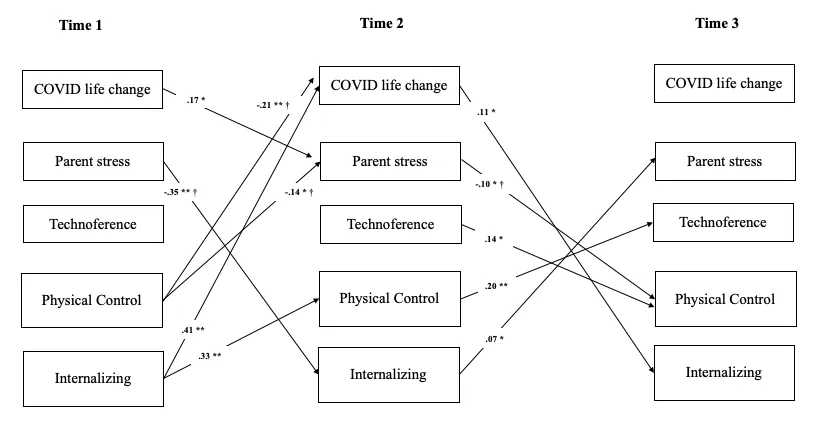
Note. *p < .05. **p < .01
| 95% CI | |||||
|---|---|---|---|---|---|
| From | To | Estimate | p | Lower | Upper |
| Time 1 Prediction of Internalizing | |||||
| Stress 1 | Internalizing 1 | .57 | < .001 | .40 | .70 |
| Technoference 1 | Internalizing 1 | .13 | .08 | -.03 | .30 |
| Physical control 1 | Internalizing 1 | .07 | .34 | -.09 | .20 |
| COVID life change 1 | Internalizing 1 | .16 | .02 | .02 | .33 |
| Cross Lags Between Time 1 and Time 2 | |||||
| COVID life change 1 | COVID life change 2 | .55 | < .001 | .35 | .68 |
| Internalizing 1 | COVID life change 2 | .41 | < .001 | .21 | .56 |
| Stress 1 | COVID life change 2 | -.14 | .03 | -.32 | -.03 |
| Technoference 1 | COVID life change 2 | .09 | .24 | -.07 | .26 |
| Physical control 1 | COVID life change 2 | -.21 | .00 | -.37 | -.06 |
| Internalizing 1 | Internalizing 2 | .52 | < .001 | .24 | .77 |
| Stress 1 | Internalizing 2 | -.35 | .01 | -.71 | -.01 |
| Technoference 1 | Internalizing 2 | -.04 | .70 | -.25 | .26 |
| Physical control 1 | Internalizing 2 | .11 | .37 | -.14 | .50 |
| COVID life change 1 | Internalizing 2 | -.02 | .88 | -.23 | .22 |
| Physical control 1 | Physical control 2 | .72 | < .001 | .53 | .86 |
| Internalizing 1 | Physical control 2 | .33 | < .001 | .15 | .54 |
| Stress 1 | Physical control 2 | -.15 | .08 | -.37 | .06 |
| Technoference 1 | Physical control 2 | -.09 | .16 | -.24 | .07 |
| COVID life change 1 | Physical control 2 | -.11 | .12 | -.26 | .03 |
| Stress 1 | Stress 2 | .72 | < .001 | .50 | .86 |
| Internalizing 1 | Stress 2 | -.01 | .95 | -.24 | .19 |
| Technoference 1 | Stress 2 | -.12 | .12 | -.28 | .06 |
| Physical control 1 | Stress 2 | -.14 | .04 | -.30 | -.02 |
| COVID life change 1 | Stress 2 | .17 | .02 | .01 | .38 |
| Technoference 1 | Technoference 2 | .62 | < .001 | .41 | .76 |
| Internalizing 1 | Technoference 2 | .04 | .67 | -.18 | .25 |
| Stress 1 | Technoference 2 | .13 | .16 | -.05 | .38 |
| Physical control 1 | Technoference 2 | .05 | .49 | -.15 | .22 |
| COVID life change 1 | Technoference 2 | .07 | .28 | -.12 | .23 |
| Time 2 Prediction of Internalizing | |||||
| Stress 2 | Internalizing 2 | .42 | < .001 | .23 | .65 |
| Technoference 2 | Internalizing 2 | .16 | .15 | -.09 | .39 |
| Physical control 2 | Internalizing 2 | .04 | .73 | -.31 | .32 |
| COVID life change 2 | Internalizing 2 | -.06 | .60 | -.28 | .17 |
| Cross Lags Between Time 2 and Time 3 | |||||
| COVID life change 2 | COVID life change 3 | .41 | < .001 | .19 | .56 |
| Internalizing 2 | COVID life change 3 | .13 | .18 | -.03 | .38 |
| Stress 2 | COVID life change 3 | .05 | .62 | -.21 | .32 |
| Technoference 2 | COVID life change 3 | .04 | .66 | -.24 | .28 |
| Physical control 2 | COVID life change 3 | .04 | .66 | -.16 | .25 |
| Internalizing 2 | Internalizing 3 | .27 | < .001 | .07 | .52 |
| Stress 2 | Internalizing 3 | .15 | .12 | -.05 | .34 |
| Technoference 2 | Internalizing 3 | -.14 | .20 | -.36 | .12 |
| Physical control 2 | Internalizing 3 | .19 | .10 | -.14 | .51 |
| COVID life change 2 | Internalizing 3 | .11 | .05 | .06 | .30 |
| Physical control 2 | Physical control 3 | .81 | < .001 | .70 | .90 |
| Internalizing 2 | Physical control 3 | .08 | .20 | -.02 | .18 |
| Stress 2 | Physical control 3 | -.10 | .05 | -.22 | -.04 |
| Technoference 2 | Physical control 3 | .14 | .01 | -.03 | .26 |
| COVID life change 2 | Physical control 3 | -.10 | .04 | -.21 | -.02 |
| Stress 2 | Stress 3 | .70 | < .001 | .53 | .84 |
| Internalizing 2 | Stress 3 | .07 | .04 | -.24 | -.08 |
| Technoference 2 | Stress 3 | -.04 | .59 | -.18 | .11 |
| Physical control 2 | Stress 3 | .06 | .35 | -.10 | .22 |
| COVID life change 2 | Stress 3 | .01 | .91 | -.14 | .15 |
| Technoference 2 | Technoference 3 | .79 | < .001 | .67 | .90 |
| Internalizing 2 | Technoference 3 | -.02 | .75 | -.16 | .08 |
| Stress 2 | Technoference 3 | -.01 | .86 | -.14 | .11 |
| Physical control 2 | Technoference 3 | .20 | < .001 | .06 | .37 |
| COVID life change 2 | Technoference 3 | -.09 | .05 | -.19 | .02 |
| Time 3 Prediction of Internalizing | |||||
| Stress 3 | Internalizing 3 | .22 | .02 | .03 | .43 |
| Technoference 3 | Internalizing 3 | .22 | .05 | -.07 | .49 |
| Physical control 3 | Internalizing 3 | .10 | .39 | -.19 | .39 |
| COVID life change 3 | Internalizing 3 | .12 | .09 | -.05 | .29 |
| Time 1 Correlations | |||||
| COVID life change 1 | Physical control 1 | .07 | .44 | -.13 | .26 |
| COVID life change 1 | Stress 1 | .27 | .01 | .07 | .48 |
| COVID life change 1 | Technoference 1 | .21 | .03 | -.05 | .41 |
| Physical control 1 | Stress 1 | .44 | < .001 | .26 | .58 |
| Physical control 1 | Technoference 1 | .26 | .01 | .02 | .48 |
| Technoference 1 | Stress 1 | .38 | < .001 | .22 | .54 |
| Time 2 Correlations | |||||
| COVID life change 2 | Physical control 2 | .16 | .10 | -.04 | .34 |
| COVID life change 2 | Stress 2 | .02 | .87 | -.21 | .22 |
| COVID life change 2 | Technoference 2 | -.04 | .71 | -.21 | .21 |
| Physical control 2 | Stress 2 | .23 | .02 | .03 | .41 |
| Physical control 2 | Technoference 2 | .13 | .19 | -.18 | .39 |
| Technoference 2 | Stress 2 | .10 | .30 | -.15 | .34 |
| Time 3 Correlations | |||||
| COVID life change 3 | Physical control 3 | .14 | .16 | -.08 | .35 |
| COVID life change 3 | Stress 3 | .07 | .45 | -.22 | .31 |
| COVID life change 3 | Technoference 3 | -.15 | .11 | -.38 | .06 |
| Physical control 3 | Stress 3 | .16 | .11 | -.13 | .40 |
| Physical control 3 | Technoference 3 | .04 | .69 | -.33 | .34 |
| Technoference 3 | Stress 3 | .21 | .03 | -.03 | .39 |
A CLPM was constructed to examine parent stress (PSI), technoference (TIPS), physical control, and COVID life change (COVID-19 LC) as predictors of externalizing (CBCL Ext) across and within the three study time points. To examine these relationships over time, all variables were fully cross lagged between time points, meaning that all variables at Time 1 were modeled as predictors of all variables at Time 2, and all variables at Time 2 were modeled as predictors of all variables at Time 3. Covariances (correlations) between parent stress, technoference, physical control, and COVID life change were estimated at Time 1, and at Times 2 and 3. The covariances between the residual variances of these variables were estimated.
The chi-square test of model fit was significant, χ2(25) = 122.14, p < .001, CFI = .91, RMSEA = .19, indicating statistically significant deviation of the estimated model from the observed data. Again, there was acceptable model fit based on the CFI, but poor model fit based on the RMSEA. Cross-lagged effects between variables are reported herein. Table 49 contains the standardized model results.
With respect to cross-lagged effects between Time 1 and Time 2, greater COVID-19 life change at Time 1 was a significant positive predictor of greater parent stress at Time 2 (β = .15, p < .05). Greater parent stress at Time 1 predicted lower COVID-19 life change at Time 2 (β = -.26, p < .05), more technoference at Time 2 (β = .22, p <.05), and lower externalizing difficulties at Time 2 (β = – .41, p < .01). More technoference at Time 1 predicted lower parent stress (β = -.12, p < .05) and more hostility (β = .17, p < .05) at Time 2. Finally, greater externalizing difficulties at Time 1 predicted more COVID-19 life change at Time 2 (β = .49, p < .001).
With respect to cross-lagged effects between Time 2 and Time 3, greater COVID-19 life change at Time 2 predicted greater externalizing difficulties (β = .12, p < .05) and lower technoference at Time 3 (β = -.09, p < .05). More hostility at Time 2 predicted greater parent stress at Time 3 (β = .32, p < .001). And more externalizing difficulties at Time 2 predicted greater parent stress at Time 3 (β = .06, p < .05).
Figure 9
Simplified Externalizing Difficulties Cross-lagged Panel Model (N=111)
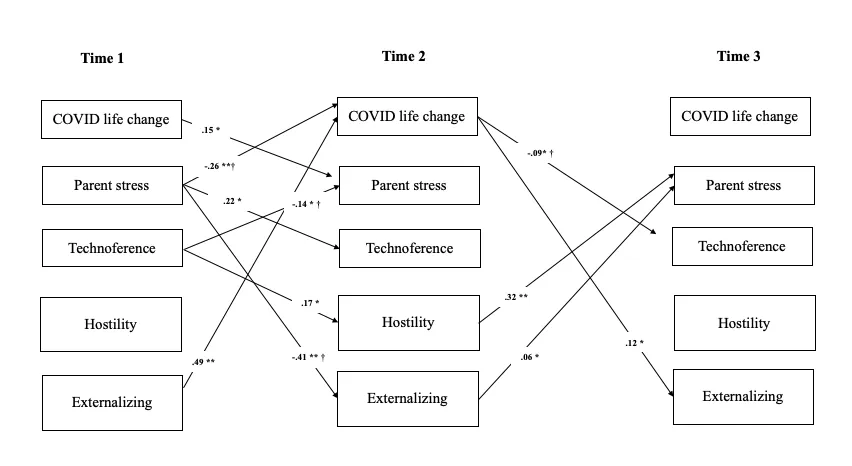
Note. *p < .05. **p < .01.
| 95% CI | |||||
|---|---|---|---|---|---|
| From | To | Estimate | p | Lower | Upper |
| Time 1 Prediction of Externalizing | |||||
| Stress 1 | Externalizing 1 | .23 | .02 | .03 | .39 |
| Technoference 1 | Externalizing 1 | .01 | .85 | -.12 | .18 |
| Hostility 1 | Externalizing 1 | .46 | < .001 | .29 | .64 |
| COVID life change 1 | Externalizing 1 | .27 | < .001 | .11 | .41 |
| Cross Lags Between Time 1 and Time 2 | |||||
| COVID life change 1 | COVID life change 2 | .52 | < .001 | .32 | .68 |
| Externalizing 1 | COVID life change 2 | .49 | < .001 | .25 | .69 |
| Stress 1 | COVID life change 2 | -.26 | .01 | -.49 | -.04 |
| Technoference 1 | COVID life change 2 | .13 | .05 | -.01 | .33 |
| Hostility 1 | COVID life change 2 | -.02 | .84 | -.19 | .24 |
| Externalizing 1 | Externalizing 2 | .56 | < .001 | .24 | .79 |
| Stress 1 | Externalizing 2 | -.41 | .004 | -.84 | -.11 |
| Technoference 1 | Externalizing 2 | -.01 | .96 | -.26 | .31 |
| Hostility 1 | Externalizing 2 | .00 | .99 | -.26 | .31 |
| COVID life change 1 | Externalizing 2 | -.03 | .75 | -.28 | .26 |
| Hostility 1 | Hostility 2 | .59 | < .001 | .35 | .79 |
| Externalizing 1 | Hostility 2 | .10 | .28 | -.06 | .29 |
| Stress 1 | Hostility 2 | .09 | .36 | -.13 | .30 |
| Technoference 1 | Hostility 2 | .17 | .02 | .03 | .35 |
| COVID life change 1 | Hostility 2 | .11 | .13 | -.07 | .32 |
| Stress 1 | Stress 2 | .68 | < .001 | .43 | .85 |
| Externalizing 1 | Stress 2 | .05 | .59 | -.16 | .26 |
| Technoference 1 | Stress 2 | -.14 | .05 | -.32 | -.04 |
| Hostility 1 | Stress 2 | -.07 | .53 | -.32 | .18 |
| COVID life change 1 | Stress 2 | .15 | .05 | -.02 | .36 |
| Technoference 1 | Technoference 2 | .62 | < .001 | .44 | .76 |
| Externalizing 1 | Technoference 2 | -.06 | .52 | -.27 | .14 |
| Stress 1 | Technoference 2 | .22 | .03 | .01 | .51 |
| Hostility 1 | Technoference 2 | -.01 | .89 | -.26 | .25 |
| COVID life change 1 | Technoference 2 | .09 | .23 | -.09 | .29 |
| Time 2 Prediction of Externalizing | |||||
| Stress 2 | Externalizing 2 | .33 | .004 | .03 | .58 |
| Technoference 2 | Externalizing 2 | .06 | .58 | -.22 | .34 |
| Hostility 2 | Externalizing 2 | .15 | .21 | -.15 | .46 |
| COVID life change 2 | Externalizing 2 | -.02 | .86 | -.29 | .24 |
| Cross Lags Between Time 2 and Time 3 | |||||
| COVID life change 2 | COVID life change 3 | .42 | < .001 | .19 | .57 |
| Externalizing 2 | COVID life change 3 | .08 | .40 | -.10 | .29 |
| Stress 2 | COVID life change 3 | .15 | .16 | -.17 | .42 |
| Technoference 2 | COVID life change 3 | .08 | .35 | -.20 | .35 |
| Hostility 2 | COVID life change 3 | -.13 | .20 | -.39 | .15 |
| Externalizing 2 | Externalizing 3 | .23 | < .001 | .05 | .45 |
| Stress 2 | Externalizing 3 | .07 | .45 | -.14 | .27 |
| Technoference 2 | Externalizing 3 | -.12 | .23 | -.47 | .10 |
| Hostility 2 | Externalizing 3 | .06 | .59 | -.21 | .35 |
| COVID life change 2 | Externalizing 3 | .12 | .05 | .01 | .27 |
| Hostility 2 | Hostility 3 | .80 | < .001 | .65 | .90 |
| Externalizing 2 | Hostility 3 | .04 | .54 | -.08 | .17 |
| Stress 2 | Hostility 3 | .00 | 1.00 | -.12 | .13 |
| Technoference 2 | Hostility 3 | .09 | 1.00 | -.09 | .28 |
| COVID life change 2 | Hostility 3 | -.06 | .34 | -.20 | .08 |
| Stress 2 | Stress 3 | .59 | < .001 | .43 | .76 |
| Externalizing 2 | Stress 3 | .06 | .04 | .10 | .24 |
| Technoference 2 | Stress 3 | -.02 | .75 | -.15 | .13 |
| Hostility 2 | Stress 3 | .32 | < .001 | .10 | .50 |
| COVID life change 2 | Stress 3 | -.01 | .83 | -.20 | .14 |
| Technoference 2 | Technoference 3 | .83 | < .001 | .68 | .93 |
| Externalizing 2 | Technoference 3 | -.02 | .72 | -.16 | .09 |
| Stress 2 | Technoference 3 | .04 | .57 | -.15 | .23 |
| Hostility 2 | Technoference 3 | -.03 | .66 | -.21 | .12 |
| COVID life change 2 | Technoference 3 | -.09 | .05 | -.20 | -.02 |
| Time 3 Prediction of Externalizing | |||||
| Stress 3 | Externalizing 3 | .07 | .48 | -.16 | .25 |
| Technoference 3 | Externalizing 3 | .15 | .14 | -.06 | .39 |
| Hostility 3 | Externalizing 3 | .43 | < .001 | .25 | .65 |
| COVID life change 3 | Externalizing 3 | .23 | < .001 | .10 | .35 |
| Time 1 Correlations | |||||
| COVID life change 1 | Hostility 1 | .04 | .70 | -.16 | .24 |
| COVID life change 1 | Stress 1 | .27 | .01 | .07 | .48 |
| COVID life change 1 | Technoference 1 | .21 | .03 | -.05 | .41 |
| Hostility 1 | Stress 1 | .67 | < .001 | .55 | .76 |
| Hostility 1 | Technoference 1 | .14 | .15 | -.06 | .36 |
| Technoference 1 | Stress 1 | .38 | < .001 | .22 | .54 |
| Time 2 Correlations | |||||
| COVID life change 2 | Hostility 2 | .13 | .19 | -.11 | .37 |
| COVID life change 2 | Stress 2 | .04 | .68 | -.14 | .24 |
| COVID life change 2 | Technoference 2 | .01 | .96 | -.19 | .24 |
| Hostility 2 | Stress 2 | .40 | < .001 | .09 | .60 |
| Hostility 2 | Technoference 2 | .24 | .01 | -.05 | .46 |
| Technoference 2 | Stress 2 | .09 | .36 | -.17 | .32 |
| Time 3 Correlations | |||||
| COVID life change 3 | Hostility 3 | .09 | .37 | -.16 | .31 |
| COVID life change 3 | Stress 3 | .15 | .13 | -.06 | .35 |
| COVID life change 3 | Technoference 3 | -.13 | .18 | -.35 | .09 |
| Hostility 3 | Stress 3 | .23 | .02 | .04 | .42 |
| Hostility 3 | Technoference 3 | .03 | .80 | -.19 | .25 |
| Technoference 3 | Stress 3 | .26 | .01 | .04 | .46 |
| Dependent Variable | Main effect significant | T1 vs. T2 | T2 vs. T3 | T1 vs. T3 |
|---|---|---|---|---|
| COVID-19 Life Change | Yes | Not significant | Decreased | Not significant |
| Child Mental Health | Yes | Increased | Not significant | Increased |
| Parent Screen Time | No | Not significant | Not significant | Not significant |
| Technoference | Yes | Decreased | Not significant | Decreased |
| Parent Stress | Not significant | Decreased | Not significant | |
| Hostility | Not significant | Not significant | Not significant | |
| Warmth | Decreased | Not significant | Not significant | |
| Physical Control | Increased | Not significant | Not significant | |
| Internalizing | Not significant | Not significant | Not significant | |
| Externalizing | Not significant | Not significant | Decreased |
Note. T1 = Time 1; T2 = Time 2; T3 = Time 3.
Interestingly, in both internalizing and externalizing models, there were several unexpected cross-lagged paths (see pathways in Figure 8 and Figure 9 marked with †). These direct effects were significant in the opposite direction than what theoretical and empirical literature suggests. These associations, however, represent direct effects after controlling for other variables in the model, which means that other variables may be acting through the predictor variable onto the outcome variable (Rohrer et al., 2022). The majority of the indirect effects between significant cross-lagged pathways in both the internalizing and externalizing model were significant. In this case, the direction of the direct effects seen in the cross-lagged paths may be a product of an inconsistent mediation and be different than the direction of the total effect when other potentially mediating variables are accounted for (Rohrer et al., 2022).
To illustrate this concept using an example from the model, cross-lagged effects of parent stress at Time 1 predicted greater internalizing difficulties at Time 2. The indirect effect of this path was significant (β = 0.69, p < .001, 95% CI [0.42, 0.93]; 95% confidence interval estimated based on 500 bootstrapped samples), suggesting that parent stress at Time 1 may be acting through other variables (i.e., COVID life change, severity, technoference, physical control at Time 2 while controlling for COVID life change, technoference, physical control and internalizing difficulties at Time 1) to internalizing difficulties at Time 2.
To further probe this speculation, a multiple mediation model tested whether COVID-19 life change at Time 2 (COVID- 19 LC, M1), parent stress at Time 2 (PSI, M3), technoference at Time 2 (TIPS, M4), and physical control at Time 2 (M5; transformed variable) mediated the relation between parent stress at Time 1 (PSI, IV) and internalizing difficulties at Time 2 (CBCL Int, DV). COVID life change (COVID-19 LC), technoference (TIPS), physical control and internalizing difficulties (CBCL Int) at Time 1 were entered as covariates. The total indirect effect of parent stress at Time 1 on internalizing difficulties at Time 1 through the set of mediators was significant (B = .22, SE = .07, 95% CI [.19, .38]). Specifically, parent stress (B = .19, SE = .05, 95% CI [.11, .32]), technoference (B = .05, SE = .04, 95% CI [.02, .14]), and physical control (B = .07, SE = .03, 95% CI [.03, .14]) at Time 2 emerged as significant unique mediators. As depicted in Figure 10, the total effect of parent stress at Time 1 on internalizing difficulties at Time 2 was significant and in the positive direction, but after parsing out the effect of the mediators, the strength of the direct effect was reduced to non-significance and changed to a negative association. Thus, representing an inconsistent mediation with parent stress, technoference, and physical control as significant mediators.
Figure 10
Inconsistent Multiple Mediation Model
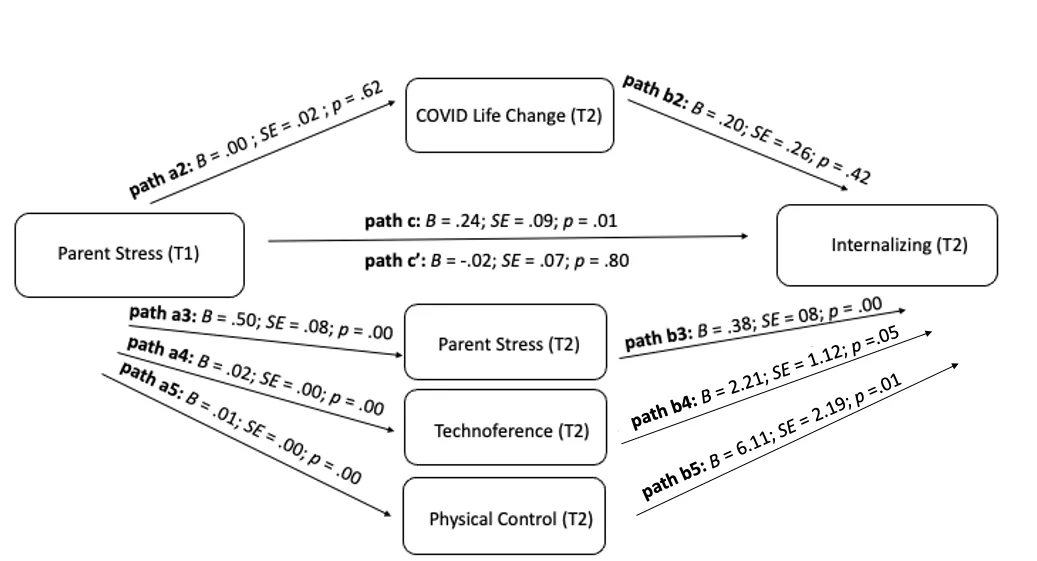
The first objective of the study was to examine the COVID-19 landscape and the impact the pandemic had on families. Prior to the start of data collection in February of 2021, the province of Ontario already underwent several significant changes. The province had undergone two states of emergencies (transition in and out of lockdown), work from home policies were implemented, group gatherings were limited, and daycares, schools, and businesses closed (Canadian Institute for Health Information, 2022). This period has been shown to be distressing for many people, including children. For instance, in a national survey of over 1,000 parents of children 18-years-old and younger, parents reported a significant decline in their children’s mental health during the pandemic (Patrick et al., 2020). As expected, results from the present study also indicated that children’s mental health challenges significantly increased following the onset of the COVID-19 pandemic (Time 1), compared to parents’ reporting of their retrospective perceptions of children’s mental health three months prior to the pandemic (baseline).
Parent’s overall smartphone and tablet use (parent screen time) at Time 1 also significantly increased during the COVID-19 pandemic, compared to parents’ reporting of their retrospective perceptions of screen time three months prior to the pandemic (baseline). This increase was consistent with other studies conducted during the pandemic (Carroll et al., 2020; Sun et al., 2020). An increased use of mobile technology may have occurred because people adopted technology to work from home. Accordingly, qualitative responses from the current study reflected the response of this mother who indicated that “I use it more frequently while working from home” (mother of 3-year-old boy, participant 89). Parents also reported using more technology to entertain themselves during lockdown, as well as to stay connected with others. For instance, a mother of a 3-year-old girl (participant 58) indicated that “during lockdowns, I used technology more often in an attempt to stay connected with friends and family,” while another parent indicated that their technology use at home “increased due to boredom” (mother of 4-year-old boy, participant 35). Taken together, it is evident that the COVID-19 pandemic led to significant psychological and technological changes in families, making the COVID-19 pandemic important to consider during the interpretation of the current study’s results.
The second objective of the study was to examine the relations between parent stress, parent mobile technology, specific parenting behaviours, and child internalizing and externalizing difficulties, as well as to identify whether parent stress and parent screen time are risk factors for negative parenting and child difficulties.
The hypothesis that increased parent stress would predict increased internalizing and externalizing difficulties in children was supported. These results are consistent with the existing body of research that demonstrates how the burden of parent stress is related to negative outcomes for children (Stone et al., 2016).
The three most important elements of parenting emphasized in the parenting literature include warmth, hostility, and behavioural control (Parent & Forehand, 2017). In line with these findings, the three parenting behaviours that emerged as significant predictors of children’s internalizing and externalizing difficulties in the present study were also warmth, hostility, and physical control.
More specifically, the hypothesis that higher negative parenting and lower positive parenting would predict increased internalizing difficulties in children was partially supported. When specific parenting behaviours were examined, none of the positive parenting behaviours (i.e., proactive parenting, positive reinforcement, warmth, supportiveness) predicted children’s internalizing difficulties. With respect to specific negative parenting behaviours, hostility and lax control did not predict children’s internalizing difficulties; however, higher physical control, emerged as a significant predictor. These results suggest that the presence of physical parenting is a significant risk factor for internalizing difficulties, over and above the absence of sensitivity, support, and warmth. Consistent with this, several meta-analytical findings of parenting have found physical control and punishment to be a consistent risk factor for internalizing difficulties in children across multiple studies (Ferguson et al., 2012; Rose et al., 2019).
Physical control has been defined as the use of physical force with the intention of the child to experience pain, but no injury (Straus, 2001). In the current study, physical control primarily reflected the use of force to correct, discipline, and control a child’s behaviour, specifically out of anger and frustration (Parent & Forehand, 2017). The coercion and negative emotionality associated with harsh parenting is related to poor socioemotional outcomes in children, including internalizing and externalizing difficulties (Gershoff et al., 2018; Pinqart, 2017). Notably, although some schools of thought may argue that harsh physical punishment is distinct from abuse (Dobbs, 2007), more physical control is associated with an increased risk of child maltreatment/abuse (Dobbs, 2007), which is a strong risk factor for child psychopathology. Accordingly, a number of studies have documented the detrimental impact that physical parenting, even for the purposes of correction or control, has on child outcomes (i.e., Engle & McElwain, 201; Scott et al., 2014; Straus, 2001; van der Sluis et al., 2015). Physical control may lead to greater internalizing difficulties in children for several reasons.
First, the use of physical control increases a child’s perception and vulnerability to threat and increases negative affect (Shackman & Pollak, 2014). Physical control induces fear in children, who may then wish to seek security from the same parent who is causing the fear and intimidation in the first place (Shackman & Pollak, 2014). This paradoxical interaction leads children to lose trust in their parents, lose trust in their ability to safely explore their environment while having a parent as a secure place, and ultimately places children at increased risk for internalizing difficulties (Erozkan, 2016).
Second, physical control, especially as a means to punish, can also induce feelings of hopelessness and powerlessness, as well as generate the development of negative self-schemas and low self-esteem as they mature (Bindman et al., 2015; Garber & Flynn, 2001; Mcleod et al., 2007; Rodriguez, 2015; Vasquez et al., 2016). These pessimistic self-beliefs and perspective about others are associated with internalizing difficulties in children.
Another line of thinking involves the notion of over control. Overly controlling parenting behaviours may thwart a child’s sense of autonomy and mastery. Excessive regulation of a child’s activities does not give the children an opportunity to develop mastery, which may lead to a sense of incompetence and erode self-esteem (Mcleod, Weisz, & Wood, 2007). Further, overcontrol decreases the opportunities for children to develop their own self-regulatory skills, interfere with their ability to regulate negative affect (Bynum & Brody, 2005; Doan, et al., 2012; Marcon et al., 2020), and ultimately lead to increased internalizing symptomatology.
With respect to externalizing difficulties, the hypothesis that higher negative parenting and lower positive parenting would predict greater externalizing difficulties in children was partially supported. Specifically, more hostility, which captures intrusive, overcontrolling and critical parenting, significantly predicted children’s externalizing difficulties. These findings were consistent with other parenting studies (e.g., Miner & Clarke-Stewart, 2008). The link between hostile parenting and externalizing difficulties in children can be largely summarized with the following three points.
First, externalizing difficulties are displays of under controlled behaviours, which reflect the lack of skills needed to inhibit and regulate disruptive behaviours (i.e., yelling, aggression). From a developmental perspective then, children must rely on their parents to help them regulate impulses to display disruptive behaviour (Kopp, 1982). If parents display hostility, they fail to provide children with the support needed to self-regulate. Further, they are putting their children in an emotionally aroused and dysregulated state that makes it even more difficult for the child to regulate their distress (Hoffman, 2000; Rubin, 2002; Spinrad et al., 2007). Over time, this may interfere with the child’s development of self-regulatory abilities and lead to greater externalizing difficulties.
Secondly, drawing from a behavioural perspective and social learning theory, parents often shape their child’s behaviours through modelling. The tendency for children to imitate adult aggressive and hostile behaviour and communication styles has been consistently reported in the literature (Bandura, Ross, and Ross, 1961; Greitemeyer, 2022; Ulman & Straus, 2003). By this reasoning then, hostile displays by parents may reinforce greater externalizing behaviours in children.
Third, hostile parenting also encompasses intrusive and overcontrolling parenting practices. Thus, from a self-determination perspective, children may also act out because their needs for autonomy are being suppressed (Assor et al., 2004). Further, as previously mentioned, excessive regulation of a child undermines the opportunity for them to internalize learning and develop mastery. Consequently, children who fail to internalize regulatory skills to manage strong emotions and behavioural urges may have greater difficulty inhibiting externalizing behaviours (Kopp, 1982).
Surprisingly, parental warmth also emerged as a significant predictor of children’s externalizing difficulties. Research findings have typically identified parental warmth as a protective factor that predicts adaptive functioning in children. By comparison however, the current study found that higher warmth predicted greater externalizing difficulties. These findings may be related to the fact that some parents, particularly those experiencing higher levels of stress, may display both warmth and hostility, but inconsistently, which is associated with greater externalizing difficulties (Kassing, Lochman, & Glenn, 2018; Deyuan et al., 2022). Even when parents intellectually understand how they should be parenting (i.e., displaying warmth, consistency), parenting can be mood dependent and thus susceptible to the negative influence of stress (Deyaun et al., 2022). Accordingly, as parent stress increases, so does the risk of more inconsistent parenting (Deyaun et al., 2021).
Additional analyses were conducted to further explore these findings. To do so, the sample was divided into low and high levels of parent reported stress. Within the low parent stress sample, increased warmth significantly predicted lower hostility. These findings suggest that parents who experienced lower levels of stress may have been more consistent in displaying warmth without hostility. By comparison, within the high parent stress sample, warmth did not significantly predict hostility. These findings may suggest that parents who experienced higher levels of stress may display both hostility and warmth, yet inconsistently. Therefore, consistent with previous studies (e.g, Deyaun et al., 2022), the inconsistent parenting displayed by highly stressed parents may contribute to externalizing difficulties. As parents waiver between warmth and hostility (Maccoby & Martin, 1983; Simons & Conger, 2007), they send the message to their children that their needs are not always consistently and adequately met (Ainsworth, 1967; Ainsworth et al., 1978). Children learn that their environment and caretakers are confusing, unpredictable, and unsafe. In turn, children may live in a state of heightened distress, helplessness, and may become preoccupied with seeking safety rather than internalizing and utilizing regulatory skills to regulate arousal and inhibit disruptive behaviour. Further, inconsistent displays of warmth and hostility may also teach children that verbal and physical aggression are normal parts of social conduct and loving relationships (Simons et al., 2012). Finally, inconsistent parenting makes it difficult for children to learn clear behavioural rules about appropriate behaviours and how to regulate disruptive behaviours or strong emotions (Deyaun et al., 2022).
The hypothesis that increased parent screen time would predict increased internalizing and externalizing difficulties was partially supported. Higher parent screen time predicted more internalizing difficulties but not externalizing difficulties. These findings were somewhat surprising; however, they may be due to methodological limitations regarding how parent screen time was operationalized. Specifically, studies that have drawn conclusions about the association between total screen time and parenting (and thus child outcomes) have been criticized because screen time does not necessarily translate to interruptions in the parent-child dyad (Modecki, 2020). Despite the author’s best attempt to collect an alternative measure of parent screen time (see Appendix G), of the N = 224 participants included in Part 1 of the study, only n = 57 entered the amount of screen time reported on their devices. Therefore, this measure was excluded from the current study.
Technoference rather than parent screen time, may more accurately reflect the influence of mobile technology use by parents on parenting quality and child well-being. Following suit, technoference emerged as a significant predictor of both increased internalizing and externalizing difficulties. These results are consistent with previous research linking technoference with more maladaptive child outcomes (McDaniel & Radesky, 2018). Taken together, results of the current study indicate that parent stress, harsh or inconsistent parenting behaviours, and technoference are all risk factors for children’s internalizing and externalizing difficulties.
The hypothesis that higher parent stress would predict less positive parenting behaviours was supported. Higher parent stress predicted less proactive parenting, positive reinforcement, warmth, and supportiveness. The hypothesis that higher parent stress would predict more negative parenting behaviours was also supported. Higher parent stress predicted greater hostility, lax control, and physical control. These findings are consistent with decades of research outlining the pervasive impact that stress can have on parenting behaviours. Stressed parents are more likely to experience challenges regulating their own emotions and behaviours, have limited resources to attend to their child’s needs, display hostility and frustration, use harsh discipline, and be more inconsistent in their parenting (Anthony et al, 2005; Carapito et al., 2018; Doan et al., 2012).
With respect to positive parenting behaviours, greater technoference in the parent-child relationship significantly predicted lower proactive parenting, supportiveness, and warmth. These parenting behaviours represent one’s ability to
respond to child difficulties, offer support, provide praise, and display sensitivity. Technoference has been shown to interfere with parental awareness of children’s cues and lead parents to misinterpret cues (Golen & Venture, 2015; Radesky et al., 2014; Sosa, 2015). Further, technoference has been associated with decreased verbal and nonverbal interactions within the parent-child dyad (Kildare & Middlemiss, 2017; Radesky et al., 2015a). Therefore, the current findings support the idea that technoference can interrupt opportunities for parents to display positive parenting.
With respect to negative parenting behaviours, greater technoference predicted more hostility, lax control, and physical control. The tendency for parents to be more hostile and physical while using technology around their children has been documented across several observational studies (e.g., Radesky et al., 2014). For instance, parents have been observed to use insensitive language, display impatient gestures, and communicate with their children using loud and annoyed tones of voices (Ewin et al., 2021). On occasion, parents have also been observed to respond physically to children (Radesky et al., 2014) and immediately return to their devices after being interrupted by their children without an apology or change to their negative demeanour (Ewin et al., 2021).
Lax control encompasses the absence of control, parents who are easily coerced and back down by lacking follow through with discipline, and parents who are inconsistent with their parenting. Not surprisingly, the current study found that greater lax parenting was associated with increased technoference, which is consistent with past studies (e.g., Golen & Venture, 2015; Radesky et al., 2014; Sosa, 2015). In fact, in these studies, parent withdrawal, absence, or permissiveness has been conceptualized as a way for parents to withdraw from their parenting demands. Therefore, these findings could imply that increased screen time (and thus technoference) is a result of parents “virtually escaping” from demanding parenting duties (Oduor et al., 2016; Radesky et al., 2016; Torres et al., 2021).
Greater parent screen time did not significantly predict any negative or positive parenting behaviour. This finding was somewhat unexpected; yet it may reflect the conceptual difference between parent screen time and technoference. Technoference involves interruptions that mobile technology creates specifically between the parent-child dyad. Therefore, one would expect that as technoference interrupts the parent-child dyad, the quality of these interactions would decrease, and result in higher negative parenting (and theoretically lower positive parenting albeit this finding was not supported in the present study). On the other hand, screen time may not necessarily be associated with negative parenting behaviours in this study because it may capture times when parents are using technology when they are away from their children, and therefore have less impact on harsh parenting. Modecki and colleagues (2020) highlighted this conclusion by noting that parents’ time on mobile devices does not always equate to technoference. A review of the literature that has found a link between total parent screen time and parenting often yielded weak and mixed results (Modecki et al., 2020). Therefore, the impact of mobile technology on parenting is better understood when technoference is considered (Modecki et al., 2020).
The lack of association between parent screen time and positive parenting was also noteworthy because an existing group of literature has previously highlighted the positive influence that mobile technology can have on the parent-child dyad. For instance, some parents use mobile technology interactively with their children, rather than using it passively alone, or around their children (Reid Chassiakos et al., 2016). The interactive use of technology may create opportunities for parents to demonstrate supportiveness and positive reinforcement by facilitating their children’s exposure and learning of new ideas and concepts, providing praise and encouragement regarding the activity at hand, as well as encouraging them to express their feelings, opinions, and ideas (Reid Chassiakos et al., 2016; Archer et al., 2021). For instance, in one study of 104 Canadian parent-child dyads of preschool children, parents who used mobile technology jointly with their children were observed to display large numbers of verbal, emotional, and physical support to their child (Wood et al., 2016). These shared uses of mobile technology may have been especially prevalent during the time that the current study took place because parents may have spent more time assisting children with online school or using technology together to entertain themselves during the COVID-19 lockdown. Therefore, parents’ reported screen time could also represent the time they are using mobile technology interactively with their children, and mobile technology could provide parents with opportunities to display positive and supportive parenting. Despite this line of reasoning, these findings were not supported in the current study and may be an avenue for future research. It is possible that the stressful emotional climate that parents experienced during the COVID-19 pandemic clouded the opportunities to use mobile technology in ways that promote positive parenting and parent-child interactions.
Taken together, the novelty of this study adds to the parenting literature by confirming what has been frequently observed in naturalistic studies: that technoference in the parent-child relationship is related to suboptimal parenting, by making parents more hostile and physically controlling around their children.
The hypothesis that specific parenting behaviours (physical control, hostility, and warmth), as well as parent screen time/technoference would mediate the relation between parent stress and children’s internalizing and externalizing difficulties was largely supported.
The first significant indirect effect in the multiple mediation models was parenting, which represented a partially mediating effect of parenting behaviours between parent stress and child outcomes. More specifically, greater parent stress was associated with more internalizing difficulties through more physical control. Greater parent stress was associated with more externalizing difficulties through more hostility, but not warmth. Parent stress continued to have a significant direct effect on internalizing and externalizing difficulties in the presence of the mediators (parenting behaviours and technoference), signifying that both direct and indirect effects operate simultaneously (Hayes, 2013).
The lack of a mediating effect of warmth may suggest that the presence of harsh parenting had a stronger influence on child outcomes than the absence of warmth. Consistent with this, parent stress is a well-known risk factor for harsh parenting (e.g., Carapito et al., 2018; Fletcher et al., 2008; Mackler et al., 2015), and many previous studies have identified harsh parenting as a mediator between parent stress and maladaptive outcomes for children over parental sensitivity (e.g., warmth). Further, the frustration-aggression hypothesis posits that when individuals are blocked from obtaining a goal, they experience a negative affective state that predisposes them towards aggression (Berkowitz, 1989; Dollard et al., 1939). The specific type of aggression may include physical aggression, verbal aggression, feelings of anger, and hostility (Berkowtiz, 1989). It follows then, that as parents become increasingly stressed, they may perceive their goals (i.e., having more resources to cope with parenting demands) as difficult to obtain. Consequently, this may lead to increased feelings of frustration that end up manifesting as displays of aggression through physical and hostile parenting. Consistent with this theory, parents have historically admitted to using harsh and physical means to parent their children as a way to release stress (i.e., Gough & Reavey, 1997).
Of note, COVID-19 related stressors may have heightened the level of frustration and aggression in parents during the pandemic. With the current study, although life changes due to COVID-19 was included as a covariate in the multiple mediation models, it is reasonable to conclude that the historical context may have continued to impact the study variables measured in this study despite the authors best attempts to control for these variables. Results from the current study should therefore be interpreted in light of the COVID-19 pandemic.
First, the number of changes that parents endured over the COVID-19 pandemic, such as isolating themselves, staying at home, adjusting to reduced economic stability, adapting to virtual work demands and schooling (if parents had older, school-aged children in the home), and managing all of these changes while parenting would have undoubtedly introduced more stress and frustration. Congruent with the frustration-aggression hypothesis, parents’ goals to socialize or seek support from their networks, enter certain establishments, participate in recreational activities, and travel were restricted due to the COVID-19 lockdown. Therefore, the stress and frustrations that stemmed from the lockdown may have led parents to respond more harshly to children out of stress and frustration.
Accordingly, several studies conducted during the pandemic found that parents were more aggressive and utilized more harsh parenting during the COVID-19 lockdowns (Br, 2020; Chung et al., 2020; Killgore et al., 2021). Parents reported increased screaming, shouting, yelling, spanking, and slapping of their children since the pandemic was declared (Br et al., 2020). One study of 258 parents in Singapore found that greater parent stress had a significant negative impact on parents’ relationship with their children, and this relation was mediated through more harsh parenting during the COVID-19 pandemic (Chung et al., 2022). Similarly, an American study using a diverse, national sample of 796 parents found that increased parent hostility was amongst one of the parenting behaviours that mediated the relation between COVID-19 stressors and child internalizing and externalizing difficulties (Penner et al., 2022). Qualitative responses from the current study also indicated that many parents attributed their added stress to the burden of parenting while being stuck at home during lockdown. For instance, a mother of a 3-year-old girl (participant 24) noted that “my older child’s daycare closed and I was home alone with 2 kids all the time …doing the primary parenting (getting kids up, fed, dressed), then trying to do my full day of work.” Limitations on the number of activities families had to occupy themselves, as well as having limited supports from their social networks or communities (e.g., daycare centres) contributed to feelings of frustration, irritability, and boredom. These feelings were noted across several qualitative answers to multiple questions. For instance, a mother of a 3-year-old boy (participant 157) recalled that “I spend almost all the time with my son and it sometimes could lead to some conflict” while another parent felt “that we were unable to do anything outside of the home [which left us] bored and frustrated” (mother of 4-year-old boy, participant 109).
Second, frustration and aggression may have stemmed from the pressure parents felt to keep their families safe. Qualitative responses from the current study indicated that families prioritized keeping their families safe during the pandemic. For instance, one mother of a 5-year-old girl (participant 25) cited that “teaching social distancing” was one source of stress during the pandemic. Further, throughout the course of the pandemic, many public health measures were introduced and revised (e.g., frequent changes to physical distancing measures, mask mandates, opening and closing of establishments). These changes and transitions in and out of lockdown likely contributed to heighted stress and frustration in parents. In one study of 30 families living through the pandemic in the United States, many parents described increased stress surrounding how to safely adapt their family routines, such as grocery shopping, working, and socializing with others, while keeping up with COVID-19 safety guidelines and keeping the family safe (Michelson et al., 2021). Dalton and colleagues (2020) noted that during distressing situations, parents should discuss and explain the situation to children, provide them with correct information about what is happening, and explain the reasons behind COVID-19 restrictions to prevent negative psychological consequences (Dalton et al., 2020). Yet, parents may have felt too overwhelmed to support their children or find appropriate ways to address or reassure their children’s questions and fears (DiGiovanni et al., 2004). From the perspective of the frustration-aggression hypothesis then, parents may have inadvertently implemented public health measures in a hostile manner, used dominating control, voiced their demands in a harsh tone, made decisions for a child without explanation, and enforced public health measures without explanation or sensitivity. These approaches would therefore increase the risk of emotional and behavioural problems in children (Dalton et al., 2020).
Finally, younger children may have found it especially difficult to transition in and out of lockdowns without parental guidance if they lacked understanding about the virus or could not remember to keep up with constant changes to public health measures. Child distress and confusion may have contributed to parent stress and frustration. In turn, parents would be more likely to respond to their children’s violations to public health measures, as well as needs for reassurance and guidance in a harsh and disciplinary manner, such as by yelling or spanking to punish or correct the child’s behaviour.
The second significant indirect effect in the multiple mediation models was technoference, which represented a partially mediating effect of technoference between parent stress and child outcomes. More specifically, greater parent stress was associated with more internalizing and externalizing difficulties through technoference, but not through parent screen time.
The association between parent stress and technoference may reflect parents “virtual escape” from parenting. Mobile technology has offered people a way to relieve stress (McDaniel & Coyne, 2016; Oduor et al., 2016), cope with anxiety (Bayer et al., 2016), ease boredom, connect with others for support (David & Roberts, 2021) and withdraw from social interactions (Nakamura, 2015). The same holds true for parents. Accordingly, in previous studies that have included qualitative data, parents have described using mobile technology when they needed a break from difficult child behaviour, as well as to relieve stress (i.e., McDaniel & Radesky, 2018; Tran, 2018; Tran & Menna, 2020). In the current study, several parents echoed this theme. One parent reported that using mobile technology “helps relieve some stress” (father of 3-year-old boy, participant 209), while another mother of a 5-year-old girl (participant 24) noted that she uses technology “to escape [my children] being on me all day.” Another parent noted that it “gives me a moment to have a mental break” (mother of a 4-year-old boy, participant 118) while another mother of a 4-year-old boy (participant 114) indicated that “I carry my smartphone with me at all times and will take it out to destress.” The urge for parents to withdraw from their children during the COVID-19 pandemic was also reflected in one study of over 800 parents. Specifically, participants who reported greater parent stress (during the pandemic) also reported more emotional and behavioural difficulties in their children, as well as being less interested in their children, paying less attention to their children, and wanting to spend less time with their children (Spinelli et al., 2020). One may speculate then, that the link between parent stress and technoference reflects parents’ “virtual escape” from stress. Yet, the current findings suggest that the benefit of this coping strategy is short-lived as it may exacerbate internalizing and externalizing difficulties in children.
It is possible that technoference does not reflect “virtual escaping” but simply reflects intrusions from technology due to parents working from home or assisting children with virtual school. Afterall, the most common activities parents qualitatively reported using their devices for was to attend virtual meetings or school. Yet, when parents were asked specifically how they use mobile technology around their children, the most common reasons cited were texting, social media, and reading. For instance, a mother of a 4-year-old boy (participant 19), indicated that their mobile technology increased because of “texting, browsing Reddit, social media, and taking pictures” while another parent attributed their increase to “mostly texting, sometimes social media” (mother of 3-year-old boy, participant 37). These qualitative responses suggest that the technoference that occurred around children was primarily due to leisure activities (e.g., texting, social media) and not work or school demands. Thus, the idea that stressed parents opted to use mobile technology to entertain themselves, cope with stress, or cope with parenting duties is more strongly supported.
Altogether, parent stress was found to be a strong risk factor for internalizing and externalizing difficulties in children because it elicited more harsh parenting and introduced more technoference. Hostile and physically controlling parenting threatens a child’s sense of safety inside and outside of the home, models hostile behaviour, undermines children’s perception of autonomy and control, instills a sense of helplessness, and ultimately leads to greater internalizing and externalizing challenges in young children. What remains unknown however, is how technoference impacts child outcomes. More specifically, could technoference be associated with maladaptive child outcomes because it also influences parenting behaviours?
The hypothesis that specific parenting behaviours and parent stress would mediate the relation between technoference and children’s internalizing and externalizing difficulties was largely supported.
The indirect effect of parenting in the multiple mediation models was significant, which represented a partially mediating effect of parenting behaviours between technoference and child outcomes. More specifically, more technoference was associated with more internalizing difficulties through more physical control. More technoference was associated with more externalizing difficulties through more hostility, but not warmth. Technoference continued to have a significant direct effect on internalizing and externalizing difficulties in the presence of the mediators (parenting behaviours and parent stress), signifying that both direct and indirect effects operate simultaneously (Hayes, 2013).
Although previous studies have suggested that technoference limits sensitive parenting, the absence of parental warmth as a mediator in the current study (and significant indirect effect of harsh parenting) was not surprising because the link between technoference and harsh parenting has been more frequently described in the literature. Specifically, technoference may lead to greater internalizing and externalizing difficulties in children because it creates a landscape ripe for discoordinated parent-child interactions and parental negative affect, which then increases the risk of frustration and harsh parenting.
First, technoference reduces the attentional capacity of parents and leads to discoordinated parent-child interactions. Stothart and colleagues (2015) found that when parents hear an alert from their mobile device, just the awareness of the smartphone notification significantly reduces their performance on a simultaneous attention-based task. This reduced attentional capacity impairs parents’ abilities to accurately interpret and appropriately respond to child cues. Many parents in the current study were aware of their reduced attentional capacity by noting that technology “reduced the attention I paid to my kids (father of 5-year-old boy, participant 44).” Despite this awareness however, parents have been observed to completely miss their children’s bids for attention (Abels et al., 2018; Radesky et al., 2014) while using mobile technology. This discoordination may then lead to greater behavioural difficulties in children. For instance, in response to parents’ lack of attention, children have been observed to escalate their bids for attention (Hiniker et al., 2015; Oduor et al., 2016; Radesky et al., 2014;), with some children acting out in provocative ways (e.g., yelling, crawling over furniture). These behaviours in children were also noticed by parents in this current study. For instance, one parent noted that “it is extra frustrating this this child will do all things to get the attention he wants … so there is a lot of screaming, thrown toys, hitting and tantrums” (mother of 3-year-old boy, participant 79). While these disruptive behaviours may finally captivate the attention of parents, by the time parents notice the child, they may only see the child’s escalated behaviour. Since parents missed the multiple, subtle attempts their child previously made to gain their attention, their disruptive behaviour may be interpreted as inappropriate. As a result, parents may respond harshly, by scolding, raising their voices, and even physically hurting the child (i.e., pushing child, kicking child’s foot, Radesky, Kistin, et al., 2014), which further exacerbate difficult child behaviours. It is also possible that parents inadvertently reinforce disruptive behaviour by finally responding to children after they have escalated their behaviour.
Second, technoference while parenting may elicit frustration due to the competing demands of multitasking. Given the portable nature of mobile devices, it is possible for parents to complete work-related tasks, connect and socialize with others, and find entertainment or leisure activities while simultaneously caring for their children. Therefore, mobile technology can blur the boundaries between work, social, and home life and increase opportunities to multitask. In line with the frustration-aggression hypothesis, the competing demands of multitasking between using mobile technology and caring for children may have elicited more frustration and harsher parenting (Kushlev & Dunn, 2019; McDaniel, 2019). For instance, a mother of a 4-year-old girl (participant 58) noted that “I will express a frustrated tone at the multiple interruptions when I need to reply by phone text or email to a time sensitive [demand]” while another mother of a 4-year-old boy (participant 84), noted that “”working full time, while home with 2 kids, 1 of which is school age is TERRIBLE.” Parents also appeared to get frustrated when their technology use was interrupted by their children. For instance, one mother of a 4-year-old boy (participant 77) recalled getting “frustrated with my child if they interrupt me.” These reflections of frustration from multitasking between technology and childcare are similar to the themes of frustration found in previous qualitative studies (Tran, 2018; Tran & Menna, 2020).
Lastly, the specific type of activities parents engaged in on their mobile devices may induce emotions such as stress, anger, and jealousy (McDaniel, 2019). These emotions have been shown to elicit more aggressive behaviour (Berkowtiz, 1998). Accordingly, in the current study, one two-year-old boy’s mother (participant 139) noted that “sometimes I read something upsetting [which] can impact my mood” while another parent indicated that mobile technology is “distracting for the most part, and can also lead to comparison when seeing things on social media” (mother of 3-year-old boy, participant 37). This comparison may make it more difficult for parents to accept themselves and their children nonjudgmentally and parent with compassion (Lippold et al., 2022). During the COVID-19 pandemic specifically, many important updates regarding lockdowns, the spread of the virus, and public health measures were communicated through technology. Many parents in the current study, as well as other studies (Topić & Jelovčić 2020) also indicated that they would read news or go on social media around their children to monitor events around the world and seek information about the pandemic. A mother of a 3-year-old boy (participant 92) from the current study noted that “the media uses a lot of fear mongering while reporting about COVID and it’s draining.” Therefore, it is possible that the technoference parents experience was negatively charged by frustrating and fearful information about the development of the COVID-19 virus and public health measures. As a result, the strong feelings from the type of content parents encountered on their mobile technology may have spilled over to affective aggression, such as hostility and physical control.
Taken together, these novel findings provide preliminary evidence to suggest that technoference negatively impacted parenting quality by increasing hostile and physically controlling behaviours, especially during the COVID-19 pandemic. These associations reinforce what has been observed in naturalistic studies (e.g., Abels et al., 2018; Radesky et al., 2014; Wolfers et al., 2020) and further extends these claims by demonstrating that the negative impact of technoference on harsh parenting may exacerbate children’s internalizing and externalizing difficulties.
The second significant indirect effect in the multiple mediation models was parent stress, which represented a partially mediating effect of parent stress between technoference and child outcomes. More specifically, more technoference was associated with more internalizing and externalizing difficulties through more parent stress.
The idea that technoference contributes to increased stress was not surprising given the undertones of stress expressed by the qualitative responses of parents who used technology around their children. There are several reasons why technoference may lead to stress. As previously mentioned, the reduced attentional capacity of parents who use technology around their children may result in discoordinated and stressful parent-child interactions (McDaniel, 2018).
Second, parent exposure to specific types of activities, such as monitoring the status of the evolving COVID-19 virus, and navigating public health measures, could also contribute to stress. In fact, seeking news through mobile technology (e.g., online sites, social media) has been found to be associated with more negative psychological outcomes in adults (Chao et al., 2020) than reading news through traditional mediums (e.g., radio, newspaper). Further, individuals using social media during epidemics have been found to be more susceptible to encountering emotionally stressful situation as they interacted with contradicting and less valid information online about the status of the evolving virus (Chao et al., 2020).
Third, demands to multitask between technology use and parenting can also contribute to parent stress. It is now widely recognized that the pressure for parents to occupy their children during the COVID-19 pandemic was heightened because community infrastructures that typically supported parents (i.e., extracurricular activities, socializing, schooling) were closed (Michelson et al., 2021). Further, many parents increased their technology use during the pandemic. Therefore, the need to use technology while parenting children would have introduced more technoference and further add to parenting stress. One mother of a 4-year-old girl (participant 41) reported that multitasking “increased my stress and irritability when trying to parent and work simultaneously” (mother of 4-year-old girl). Stressed parents would therefore be less able to support their children’s needs during a period when they were especially dependent on their parents because of lost contact with friends, inability to attend preschool/school, lost contact with important adult figures (e.g., teachers, coaches), and lack of extracurricular activities (Brown et al., 2020). These findings add to the idea put forth by McDaniel (2018) – that multitasking between technology use and childcare can not only translate to poor parenting quality, but also add to greater parenting stress.
Importantly, these findings suggest that the association between parent stress and technoference is bidirectional. Specifically, stressed parents may use mobile technology to “virtually escape” (which increases technoference). Yet, this strategy may backfire as technoference may add to even more parent stress, and ultimately lead to greater internalizing and externalizing difficulties. Consistent with this, Torres and colleagues (2021) recently found that parents who used technology to escape from parenting also reported greater parenting stress. Therefore, the use of mobile technology to cope with parent stress is unsustainable. Regardless of whether technoference was due to parent withdrawal or due to multitasking, results from the current study suggest that technoference nevertheless leads to increased parent stress, which ultimately contributes to greater internalizing and externalizing difficulties in children.
Altogether, results from the multiple mediation models can be summarized by the following three conclusions. First, parent stress was shown to be a strong risk factor for children’s internalizing and externalizing difficulties. More so, parent stress introduced additional risk factors, namely harsh parenting and technoference that exacerbated the negative impact of stress on child well-being. Second, this was the first known study that demonstrated the negative impact that technoference can have on specific parenting behaviours. The study demonstrated that technoference is associated with more physically controlling and hostile parenting, which in turn, led to greater internalizing and externalizing difficulties in children. Third, findings point to a cyclical relation between parent stress, harsh parenting, and technoference. Specifically, higher parent stress not only elicited harsher parenting, but it also introduced more technoference; however, technoference was also found to evoke harsher parenting and contribute to more parent stress. Thus, technoference creates a self-reinforcing mechanism in a cycle of risk factors that exacerbate internalizing and externalizing difficulties in young children (see Figure 11 for a theoretical model of the self-reinforcing cycle of risk factors). These findings underscore the need for parents to be mindful about the impact technoference can have on their parenting, set boundaries on multitasking between technology and parenting, as well as find more adaptive and sustainable strategies to cope with stress that buffer, rather than exacerbate, the negative impact of parent stress on child outcomes.
Figure 11
Theoretical Model of the Self-Reinforcing Cycle of Risk Factors
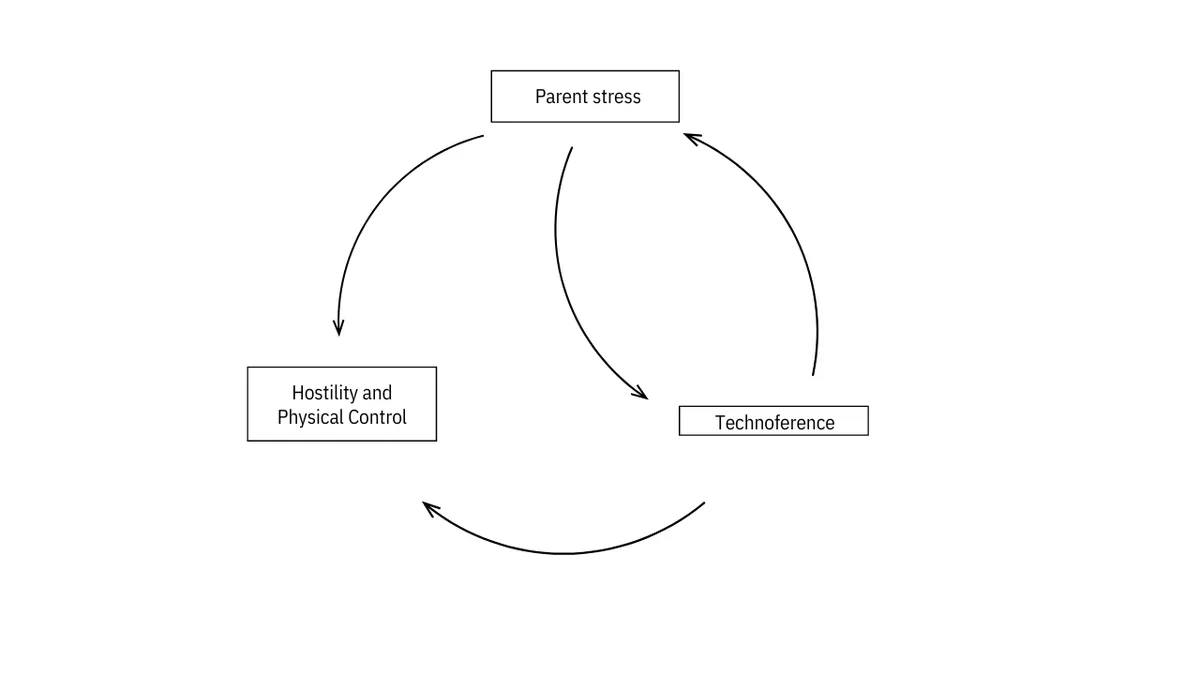
The third study objective to was to explore parents’ qualitative responses regarding their stress, technology use, parenting, and child behaviours during the pandemic. Parents were asked questions about how their stress and mobile technology use changed due to the pandemic, the type of activities they engaged in while using mobile technology, how they multitasked between technology use and parenting demands, and how they perceived their technology use to impact their parenting and children. Responses to these questions were examined using a content analysis to provide a frequency count of what parents reported. Responses complemented the quantitative results in the current study and were presented in the aforementioned discussion. Qualitative findings are further discussed in the following section.
Parents clearly perceived themselves to be burdened with additional stress during the COVID-19 pandemic. The most common sources of stress came from additional parenting responsibilities during lockdown, a fear of the pandemic, and stress from working from home and helping children navigate online school. It was very clear that parents had a hard time juggling multiple demands while being stuck at home with their families. For example, a mother of a 5-year-old girl (participant 65) noted that with “The kids being home, I never get a break from them and helping [them with] online school is a nightmare.” Other responses also identified technology as a source of stress. One parent indicated that “working from home is a challenge with a child who is expected to do virtual JK at the same time as my own work expectations” (mother of 5-year-old boy, participant 86).
Most parents described an increase in their technology use rather than a decrease, which is consistent with parents’ reports of increased screen time after the onset of the COVID-19 pandemic, compared to three months before the pandemic. Many parents had a similar response to this mother of a 4-year-old boy (participant 32), who wrote that “I spend more time on it [mobile technology] now because I am home more,” as well as this mother of a 5-year-old boy (participant 234), who reported that mobile technology was “needed more often for work at home and communication with family and friends.”
When parents were asked specifically how their way of using mobile technology changed, most parents cited work (i.e., to take virtual meetings) and online schooling as the primary reasons for their increased screen time. These findings support the assumption that technology use increased due to work from home policies, stay-at-home orders, and virtual schooling that were triggered by the COVID-19 pandemic. Parents also cited using technology to entertain themselves as the second most common reason for increased screen time. These responses support the assumption in the current study that parents increased their use of technology to occupy themselves when the province was under lock down. It is evident then, that the COVID-19 pandemic influenced increased stress and technology use in parents.
Although the primary reason for increased screen time was due to work or virtual school, this finding changed when parents were asked about the types of activities they engaged in when they were around their children specifically. The most commonly cited reasons for increased technology use around children were to communicate with others (i.e., text message) and use social media. Parents often reported engaging in several leisure activities such as “watching movies, listening to music, playing games, and [using] Facebook, Twitter, [and] Youtube” around their children (mother of 4-year-old girl, participant 198). This change was particularly interesting, as it supports the idea that technoference was introduced into the parent-child relationship due to parents’ voluntarily use of mobile technology, such as by socializing or spending time on social media, as opposed to responding to work or school demands. By this reasoning, these responses reinforced the assumption in the current study that the association between parent stress and technoference was due to parents’ attempts to “virtually escape” from stress and difficult parenting demands. Accordingly, one parent noted that they “use it too much to escape [my children] being on me all day” (mother of 5-year-old girl, participant 24). Likewise, another parent noted that technology “makes me less present and engaged but also gives me a moment to have a mental break” (mother of 4-year-old boy, participant 118).
The assumption in the current study that parents often multitasked between technology use and parenting was further solidified by most parents’ written responses. The majority of parents reported multitasking between using mobile technology and caring for children. Only five parents denied multitasking, and very few of them reported setting boundaries on multitasking, using technology when children were occupied with something else, or using technology separately. Although most parents reported using mobile technology for leisure around their children, some reported that technoference was due to work/school demands. A 3-year-old boy’s mother (participant 73) recalled having to “answer emails and phone calls while interacting with my children” while another parent noted that “I work for [workplace] so I am often on my smartphone or computer helping my team or customers. I am often bouncing back and forth between my children and my phone” (mother of 4-year-old girl, participant 51). Thus, although some parents may have been better able to separate their screen time and parenting, which would decrease technoference, it appears as though the portable nature of mobile technology allowed many parents to blur the boundaries between work, school, and home life, especially during the lockdown.
Most parents noticed that their attention towards their child decreased, that parent-child relationship quality decreased, and their irritability and frustration increased while multitasking – which are all precursors for harsher parenting. The majority of parents indicated that their attention and focused decreased, and that they were more easily distracted from parenting when using technology around their children. For instance, a father of a 4-year-old boy (participant 4) reported that technology “is a distraction [and I am] not able to focus on the kids 100%.” Several parents also reported that the quality of their parenting decreased. Their responses reflect the idea that technoference can lead to discoordinated parenting and decreased engagement with children, which may make parents more likely to misread their child’s cues and respond more aggressively. Some parents specifically cited that multitasking increased their feelings of irritability and frustration. For example, a mother of a 5-year-old girl (participant 126) cited that mobile technology “increase irritation and makes me become snappy”. Responses like this indicate that technoference can certainly elicit more parent frustration and harsher parenting, which support the relevance of the frustration-aggression in the current study.
Interestingly however, the second most reported impact of technology use was the ability to use it as a parenting tool. Several parents indicated that they used technology to seek information about parenting or find activities for children to do in the community. Mobile technology may therefore help support parenting rather than disrupt parenting. however, it remains unclear how these behaviours impact parenting quality.
Most of the parents’ descriptions of their children’s behaviour reflected that parent preoccupation with technology is associated with maladaptive child functioning. Most parents mentioned that their children wanted more attention and would escalate their bids for attention. For example, one mother of a 5-year-old girl (participant 66) noted that her child “whines, [displays] poor behaviour to seek a reaction or attention.” Similarly, another mother of a 4-year-old boy (participant 95) recalled that mobile technology “keeps me distracted so the kids start to act up because they know my attention is not on them” (mother of 4-year-old boy).
The second most common behaviour parents reported was that their children increased whining, dysregulation, and disobedience while parents were occupied with their mobile technology. One parent described her child resorting to “speaking loud, repeating themselves, wanting more attention, [and start] whining” (mother of 3-year-old boy, participant 101). Even if parents did not report increased disruptive behaviour, some parents noticed that their children wanted to use the technology and were curious about what parents were doing. Only a small subset of parents did not notice any changes to child behaviour. Qualitative responses therefore suggest that children are very sensitive to when their parents’ attention is preoccupied elsewhere. Children who display greater bids for attention are essentially competing with technology for attention and nurturance. If their bids are not successful, it is reasonable to presume that young children may be at greater risk for developing internalizing and externalizing difficulties.
Taken together, the qualitative data supports the conclusions drawn from the current study so far. Specifically, the COVID-19 pandemic created additional stress for parents and increased their screen time. Technoference was due to parent withdrawal from children and stress, as well as to multitask between personal tasks and parenting demands. In turn, technoference contributed to discoordinated parent-child interactions, frustration, irritability, and increased stress, which are all risk factors for harsh parenting. Technoference also reportedly increased children’s disruptive behaviours.
The second part of the current study examined data across three time points. The period of data collection spanned a nine-month period and took place between February of 2021 to November of 2021. During this period, additional changes occurred as the province managed the spread of the COVID-19 virus. The fourth study objective was to explore these changes. Some of the major changes are outlined in Appendix H (Canadian Institute for Health Information, 2022).
During Time 1 and Time 2 of data collection, the province underwent two provincial states of emergencies (Canadian Institute for Health Information, 2022). During Time 1, a state of emergency was declared and lifted approximately one month later. During Time 2, another state of emergency was declared and lifted two months later. There were no state of emergencies during Time 3 of data collection.
The province also experienced many changes related to the closing and re-opening of schools, workplaces, as well as essential (e.g., grocery stores) and non-essential business (e.g., retail; Canadian Institute for Health Information, 2022). During the beginning of Time 1 data collection, students shifted to remote learning, and dining, retail and recreational restrictions were in effect. Towards the end of Time 1 data collection, schools remained closed; however, various essential and non-essential businesses began to slowly re-open with limited capacity until all businesses were permitted to operate. During Time 2 of data collection, schools were re-opened with the option for in-person or remote learning. By Time 3 of data collection, the province’s schools, essential and non-essential were all operating without capacity limits; however, proof of COVID-19 vaccination was required in these settings.
Throughout the COVID-19 pandemic, social gatherings were limited and people were advised to distance themselves from others (Canadian Institute for Health Information, 2022). During Time 1 of data collection, small social gatherings were permitted; however, during the end of Time 1 and beginning of Time 2, indoor social gatherings were prohibited. By the middle of Time 2, the province slowly re-opened to allow gatherings of people indoors and outdoors (proof of COVID-19 vaccine required). By the end of Time 3, all capacity limits on indoor and outdoor gatherings were lifted (proof of COVID-19 vaccine required). Throughout this entire period, people were required to wear medical masks indoors and outdoors when physical distancing was not possible.
Upon the start of data collection, people who travelled were required to quarantine for 14 days upon returning from international travel. Travellers were also required to stay at a hotel, at their own expense, while waiting for their COVID-19 test results. Towards the end of Time 1 and beginning of Time 3, residents of Ontario were permitted to travel within the province. Travel restrictions for those who were fully vaccinated (two doses of approved vaccine) were eased and there was no mandatory quarantine period.
With respect to COVID-19 related restrictions and mandates, the general trend indicated that participants experienced the greatest disruption during Time 1 of the current study. As data collection for the study progressed into Time 2 and Time 3, COVID-19 restrictions eased. Consistent with this, life changes due to COVID-19 was found to significantly decrease between Time 2 and Time 3, which indicate that as the study progressed, parents perceived their lifestyles to be less disturbed by COVID-19.
As families’ lifestyles began to return to a sense of normalcy, results also indicated that parents became significantly less stressed towards the end of the study, between Time 2 and Time 3. These findings suggest that as families were permitted to socialize with others, seek support from others, participate in their communities, attend school or work in-person, and access vaccines, they were also less stressed. Interestingly however, one may expect that as parent stress decreased, that parenting behaviours would have also improved (i.e., more warm parenting, less harsh parenting). Instead, parenting behaviours that were negatively impacted by the pandemic did not rebound. Specifically, parental warmth decreased while physical control increased between Time 1 and 2 of the study. Yet, while parent stress significantly decreased between Time 2 and Time 3, parent warmth and physical control did not significantly change. These results suggest that reductions in parent stress levels during the nine-month period the current study took place, did not translate to warmer parenting or less physical parenting.
Children’s externalizing difficulties significantly decreased between Time 1 and Time 3. As parent and children reintegrated back into their community and had greater access to external supports, they may have been less frustrated and therefore, less likely to act out. With respect to internalizing difficulties, changes across time were significant; however, differences between time were not significant. These results suggest that although externalizing difficulties significantly decreased over time, changes to internalizing difficulties were slower to change. Notably, despite the easing of COVID-19 restrictions, many precautionary measures remained in place. For instance, families were permitted to dine in at restaurants if they explicitly displayed proof of vaccination, many facilities and businesses continued to have capacity limits, and mask mandates continued to be in effect. Families may have also continued to remain wary about the COVID-19 virus and return of a more dangerous variant of the virus (Thakur et al., 2022). Therefore, children may have continued to perceive their world as unsafe, unpredictable, and out of their control, which maintained internalizing symptoms (i.e., worry, low mood). Disaster research has also shown that children are often impacted more than adults, and experience more prolonged physical and psychological effects after the disaster is over (Rubens et al., 2018).
Technoference significantly decreased between Time 1 and Time 2, as well as between Time 1 and Time 3. These changes may reflect how technology use changed throughout the pandemic. Specifically, as COVID-19 restrictions eased, parents may have had less work demands at home, children may have returned to school, parents were able to access their support networks again, and families may have found more ways to entertain themselves aside from using technology once their community re-opened. Thus, parents may have reported less technoference because they were not using technology as frequently, or not multitasking as often, compared to when they were under lockdown with their children.
Of note, parent screen time did not significantly change over time. These findings were not surprising given that COVID-19 introduced many permanent changes to the way we use technology. After workplaces underwent a digital transformation to cope with the COVID-19 pandemic, many people have continued to work from home or have adopted a hybrid model for work (e.g., to attend virtual meetings; Savić, 2020). Lifestyle changes and habits that developed from the COVID-19 pandemic may have also remained. For instance, people may have continued to prefer online shopping rather than visiting physical stores. Attitudes towards technology use may have also shifted towards being more accepting as people were forced to adopt technology (i.e., to socialize, for entertainment) during the pandemic. Therefore, it is possible that boundaries between work, school, and home life have remained blurry insofar that parents are now spending more time on their mobile devices at home since before the pandemic started.
Overall, as COVID-19 restrictions eased, there were subsequence decreases in lifestyle changes due to COVID-19, parent stress levels, children’s externalizing difficulties, and technoference between parents and children. Yet, parents’ use of physical control and screen time appeared to increase over time. Children’s internalizing difficulties also remained unchanged. Therefore, it appears as though the COVID-19 pandemic and lockdowns had several unintended consequences that had a lasting impact on children’s internalizing symptoms, parenting, and the amount of screen time parents are consuming.
An additional objective was to explore the temporal sequence amongst study variables, as well as examine bidirectional relations and transactional effects during the course of the COVID-19 pandemic using a cross-lagged path model (CLPM).
Cross-lagged effects between variables revealed several notable findings. The cross-lagged effect of greater COVID-19 life change at Time 1 predicted increased parent stress at Time 2, even after controlling for previous parent stress (along with other Time 1 variables). Cross-lagged effects also revealed that greater COVID-19 life change at Time 2 predicted greater internalizing difficulties at Time 3, after controlling for prior internalizing difficulties.
These results suggest that COVID-19 had a significant impact on later parent stress levels and children’s internalizing difficulties, which is consistent with cross-sectional and longitudinal studies of COVID-19 to date (i.e., Spinelli et al., 2020; Brown et al., 2020). These results also reinforce the current study’s finding (i.e., results of ANOVA) regarding the lingering impact that COVID-19 had on children’s internalizing difficulties.
The temporal sequence of cross lagged effects also provided evidence for child driven effects. Specifically, cross-lagged paths indicated that COVID-19 life changes at Time 1 predicted greater internalizing difficulties in children at Time 2. In turn, internalizing difficulties at Time 2 uniquely predicted greater parenting stress at Time 3. Additional child driven effects included the cross-lagged effect of internalizing difficulties at Time 1 predicting more physical control at Time 2, even when controlling for previous physical control. Therefore, consistent with past literature (i.e., Williford et al., 2017), child driven effects, such as child internalizing symptomatology, can uniquely contribute to greater parent stress and physically controlling parenting, even during times of disaster.
Interestingly, the cross-lagged effect of internalizing difficulties at Time 1 predicted greater COVID-19 life changes at Time 2, even when controlling for prior COVID-19 life change. Therefore, internalizing difficulties also appeared to impact family adjustment to COVID-19. Specifically, an examination of the items included in the COVID-19 life measure revealed that children with more internalizing difficulties may have had more trouble following COVID-19 restrictions, maintaining quality relationships with others, and experienced greater stress regarding changes and restrictions related to COVID-19. Therefore, this association highlights a bidirectional relation whereby greater COVID-19 life changes negatively impacted children’s internalizing difficulties, while internalizing difficulties also predicted greater perceptions of COVID-19 life change. Consistent with this, a meta-analysis of 26 studies examining child adjustment following disaster events found that children with higher socio-emotional difficulties also had greater difficulties adjusting to stressful events (Raccanello et al., 2023); thereby potentially contributing to the perception of the disaster as more stressful and disruptive.
Cross-lagged effects demonstrated that more physical control at Time 1 predicted greater COVID-19 life changes at Time 2, after controlling for previous life changes due to the pandemic. These results may suggest that parenting practices also influence the amount of life changes caused by the pandemic. For instance, the use of physical control may be an ineffective way for parents to help their children adapt to the pandemic. The hostile nature of physical control likely heightens parents’ perceptions of their child having greater difficulty adapting to the pandemic, maintaining quality relationships with family members, and thus greater overall lifestyle disruptions due to COVID-19.
Physical control at Time 2 also predicted greater technoference at Time 3, after controlling for previous physical control. The relation between physical control and technoference may reflect parents’ inability to sustain harsh parenting over time and eventually withdraw from their children by turning to their mobile device for solace. According to the coercion theory (Patterson, 2002), parents might initially exert harsh discipline and control to regulate difficult child behaviours; however, they may eventually decrease parental control if it is not successful. A hallmark of the coercion theory captures parents who give into child behaviours, do not follow through with demands, or completely withdraw from difficult child behaviours (Patterson 2002). This coercive pattern between parents and children has been documented in numerous cross-sectional studies, longitudinal studies, and studies that include preschool children (e.g., Eisenberg et al., 2015; Miner & Clarke-Stewart, 2008; Pinquart, 2017). For instance, one study interviewed 30 stressed parents living in low-income neighbourhoods in the United States who shared their experiences on how stress has influenced their discipline approaches (Kistin et al., 2014). True to the coercion theory, these parents shared that they felt gentle approaches to discipline would not be effective in their parenting. As a result, they reported use of harsh disciplinary practices, such as yelling or spanking, as an effort to prevent future behaviour problems in children (Kistin et al., 2014). Eventually however, parents expressed being exhausted and withdrawing from their children as a means to cope with their stress and ineffective parenting strategies (Kistin et al., 2014). The temporal sequence of cross-lagged paths between internalizing difficulties, physical control, and later technoference in the current study (i.e., internalizing difficulties at Time 1 predicting physical control at time 2, and physical control at Time 2 predicting technoference at Time 3) may therefore suggest that parents initially respond to their children’s internalizing difficulties using physically controlling parenting, yet, if their parenting is ineffective, they eventually turn to their mobile devices to withdraw from their children.
Consequently however, cross-lagged effects also revealed that greater technoference at Time 2 also predicted more physical control at Time 3, even after controlling for previous technoference. Therefore, beyond the preliminary evidence that technoference contributes to negative parenting behaviours over time, evidence for a bidirectional association between physical control and technoference over time was also found. This bidirectional mechanism may therefore create a feedback loop that strengthens the self-reinforcing cycle of risk factors on child functioning over time. See pathway denoted with asterisk in theoretical model (Figure 12).
Figure 12
Theoretical Model of COVID-19’s Impact on the Self-Reinforcing Cycle of Risk Factors with Additional Feedback Loops (denoted with †)
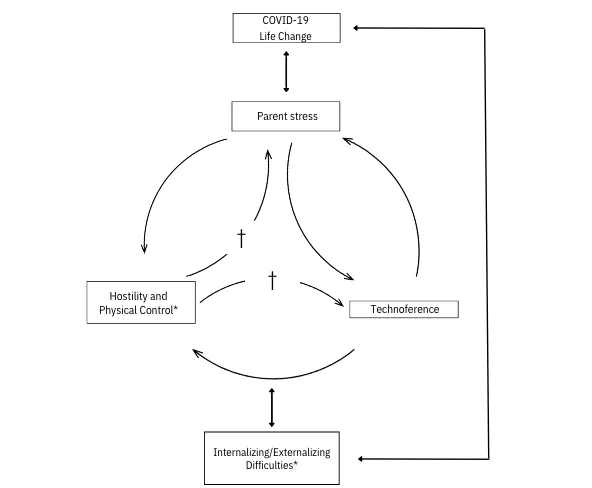
The cross-lagged effect of greater COVID-19 life change at Time 1 predicted greater parent stress at Time 2, even after controlling for previous parent stress. Cross-lagged effects also revealed that greater COVID-19 life change at Time 2 predicted greater externalizing difficulties and technoference at Time 3, after controlling for prior externalizing difficulties and technoference. Consistent with the internalizing CLPM, these results suggest that COVID-19 had a significant impact on later parent stress and child externalizing difficulties – even towards the end of the pandemic when COVID-19 restrictions eased.
The cross-lagged effect of externalizing difficulties at Time 2 predicted greater parent stress at Time 3, after controlling for previous parent stress. Consistent with the internalizing CLPM, these findings lend further support for the presence of child driven effects, that contribute to increased parent stress.
The cross-lagged effect of externalizing difficulties at Time 1 predicted greater COVID-19 life changes at Time 2, even when controlling for prior COVID-19 life change. Therefore, like the internalizing CLPM, externalizing difficulties also appeared to impact family adjustment to COVID-19.
The cross-lagged effect of parent stress at Time 1 predicted greater technoference at Time 2, after controlling for previous parent stress. The temporal sequence of this relation therefore strengthens the assumption that stress can be a precursor to technoference – as parent use technology as a way to “virtually escape” from parent stress.
Cross-lagged effects also demonstrated that technoference at Time 1 was associated with more hostile parenting at Time 2, even after control for previous hostility. Therefore, further support for the longitudinal impact that technoference has on negative parenting behaviours was found.
Finally, cross-lagged effects indicated that more hostility at Time 2 predicted greater parent stress at Time 3, after controlling for previous parent stress. Therefore, this noteworthy finding suggests that the relation between parent stress and negative parenting is bidirectional. Evidence for unidirectional and bidirectional associations between parent stress and parenting quality has been previously established. For instance, in one study of 149 parents and their preschool children, parents who displayed hostility during a parent-child interaction task also produced higher physiological markers of stress (Merwin et al., 2015). In sum then, the reciprocal association between hostility and parent stress, is an additional feedback loop that reinforces the cycle of risk factors on child internalizing and externalizing difficulties (see pathway denoted with asterisk in Figure 12 for theoretical model). Based on the temporal sequence of cross-lagged effects, one may further theoretically speculate that technoference not only triggers harsher parenting, but that this effect leads to increased parenting stress over time.
Interestingly, in both the internalizing and externalizing CLPM, there were several unexpected cross-lagged effects (see pathways in Figure 8 and Figure 9 marked with †). These cross-lagged paths may represent the direct effects of inconsistent mediations. In other words, if other variables in the CLPM were allowed to covary with the predictor and outcome variable, it is possible that the direction of the total effects may have been in the expected directions (Rohrer & Murayama, 2023). There was preliminary evidence to support this assumption. Cross-lagged effects suggest that greater parent stress at Time 1 predicted lower internalizing difficulties at Time 2; however, once parallel mediators were entered into the multiple mediation model (using the PROCESS macro), the total effect was positive. These findings therefore suggest that greater parent stress at Time 1 predicts higher internalizing difficulties at Time 2 by acting through additional parenting stress (at Time 2), technoference, physical control, and COVID-19 life change. Importantly, as with many studies examining cumulative risk factors, these patterns of results underscore that the interplay between parent stress, parenting, technoference, and child socioemotional difficulties is complex and cannot be fully understood when examined in isolation. Future research examining these interrelated associations would be of benefit.
Taken together, results from the CLPMs can be summarized as follows. First, disaster events such as a global pandemic not only impact parent stress and child internalizing and externalizing difficulties, but can trigger a multitude of cascading risks. Thus, COVID-19 represents a contextual risk factor and parent stress may act as an entry point into the cyclical relation between parent stress, harsh parenting, and technoference (see Figure 12 for a theoretical model of COVID-19’s impact on the self-reinforcing cycle of risk factors). In fact, previous studies examining the impact of the COVID-19 pandemic on child well-being in the United States and Italy has either found a lack of direct effect, or a weak direct effect, between COVID-19 and child well-being when parent related factors were considered (i.e., Brown et al., 2020; Spinelli et al., 2020). Therefore, parent stress may be an important area of intervention that could mitigate cumulative risk factors for child psychopathology. Resources to help parents break this cyclical relation are critical, especially during times of heighted distress.
Second, the temporal sequence of cross-lagged effects revealed that risk factors related to child internalizing and externalizing difficulties, such as parent stress, harsh parenting, and technoference were often interrelated and bidirectional. Therefore, risk factors may operate within a mutually reinforcing system that exacerbates cumulative risk of child difficulties. One may conclude then, that during times of disaster or heightened stress, there are multiple avenues through which parent stress can be transmitted onto children (i.e., through harsh parenting and technoference). Consequently, parents strongly contribute to several self-reinforcing mechanisms within a cycle of risk and play a critical role by introducing risk factors (i.e., parenting behaviours, technoference) that may exacerbate the negative impact of disaster on child well-being (Prime et al., 2021).
Third, child driven effects revealed that children also play a reinforcing role in the cycle of risks – by contributing to harsher parenting, and parent stress. Of note, evidence for child difficulties driving greater technoference was not found longitudinally. Yet, the qualitative literature suggests otherwise. Aside from qualitative responses from the current study, Tran (2018) also found that parents cited using technology to escape from difficult children. Similarly, this virtual escape was also cited by several mothers who reported withdrawing from screaming and yelling children by using mobile technology to distract themselves (e.g., Torres et al., 2021). It is possible that the lack of direct association between child internalizing and externalizing difficulties, and technoference is due to the presence of mediators that were not directly explored in the cross-lagged path models. Consistent with this, Radesky and McDaniel (2018), found that greater internalizing and externalizing difficulties predicted later technoference, but this relation was mediated through increased parent stress.
Fourth, a significant novel contribution to the literature includes evidence that technoference threatens parenting quality by increasing parents physically controlling and hostile behaviours. Further, this study found preliminary evidence that the association between technoference and harsh parenting holds over time. Moreover, the temporal sequence of cross-lagged effects suggests that parent stress and physical control preceded technoference. These results further support the assumption that parents who are stressed, or frustrated with their ineffective parenting (i.e., physical control), use technology to “virtually escape” from parenting demands.
Lastly, there was some evidence to suggest that cross-lagged effects also represented the indirect effects of inconsistent mediation models. One variable (i.e., parent stress) may trigger a cascade of other risk factors and pathways (i.e., harsh parenting, technoference) that also interplay with each other (Prime et al. 2020). By this line of reasoning then, one may conclude that consideration of risk factors on child internalizing and externalizing difficulties cannot be examined in isolation. A greater understanding of the various avenues of risks that impact child internalizing and externalizing difficulties can create more opportunities for families, intervention efforts, health providers, policy development, and professional organizations to interrupt cycles of risk at various junctures.
The conclusions from the current study must be interpreted in light of several limitations. The sample was primarily comprised of mothers, which is similar to most samples in the technology and parenting literature (i.e., see Kildare & Middlemiss, 2017 for a review). Naturalistic observations studies have included more fathers but have not made any claims regarding gender differences in how parents use mobile technology around their children, or how technoference may impact parenting (Abels et al. 2018, Hiniker et al., 2015, Radesky et al., 2018). The field would benefit from future studies that include more equal numbers of fathers and mothers, to explore how gender differences may be related to parents’ technology use, parenting, and parent stress.
Furthermore, the sample was limited to mothers who were primarily, Caucasian, upper-middle class, university-educated, and from two-parent homes. The stress, parenting, and technology profiles amongst various demographic groups may differ, which limit the generalizability of the current study results. It has been recommended that the inclusion of demographics as covariates should match the choice of analyses (Spectro & Brannick, 2011). Yet, the analyses conducted in objective two of Part 1 of the study, as well as objective five of Part 2 of the study were limited by the PROCESS macro. Specifically, researchers must choose to control the influence of covariates on the mediator and outcome variable, only on the mediator, or only on the outcome variable. Since the PROCESSS macro only allows researchers to select one option of how covariates are controlled for, it limits the number of controls that can be confidently added (Rohrer, 2022). In cases when control variables are not consistently associated with the predictor, mediator, or outcome variable (i.e., one control is only associated with the mediator, while another control is associated with both the mediator and outcome variable), it is recommended that controls associated with both the mediator and outcomes variable be added (K. Soucie, personal communication, 2018). In the current study, demographic variables did not meet this recommendation and were therefore excluded in several analyses. Future research may wish to use more sophisticated structural modelling that permits the inclusion of different covariates while considering their unique associations with study variables.
Further, the idea that demographics are blindly entered as controls with the assumption that they will “purify” results (referred to as a purification approach) relies on the assumption that demographics variables are inflating or contaminating results (Spector & Brannick, 2011). This assumption is considered reckless without a thorough review of how demographics may predict, moderate, or mediate study variables (Spector & Brannick, 2011). Therefore, future research should closely examine the specific mechanisms by which demographic variables influence associations found in this study (Spector & Brannick, 2011). Further, studies conducted in the future should test competing hypotheses that include demographic variables, which is considered better research practice than using the purification approach (Spectro & Brannick, 2011). Nonetheless, it is hopeful that this study offered a first glance at the interrelated cycle of parent stress, parenting, and technoference as risk factors for child internalizing and externalizing difficulties.
Selection bias may have influenced study results, as parents who agreed to participate in the study may have pre-existing interests on the subject matter. Similarly, attrition bias may have led certain participants to complete subsequent questionnaires. For instance, parents who were less stressed may have been more likely to complete Time 2 and Time 3 of the study. In an attempt to minimize including two characteristically different groups, the same sample was included across all three time points in the cross-lagged path model. Further, examining unequal sample sizes increases the risk that the assumption of constant variance is violated, and may risk reducing the strength of effects due to group differences across time (Jackson, 2023; Gracia & Marder; 2017).
A strength of the current study was the longitudinal model, that allowed for causal inferences, temporal sequence, and bidirectional associations to be found. Yet, the small sample size in the CLPM posed some limitations. The sample size included in the CLPM fell under the recommended sample of 200 for path modelling (Kline, 2009). The number of parameters estimated in the models also exceeded the sample size, which may affect the robustness or generalizability of the results. Therefore, the models may have been underpowered, which increases the risk of Type II error. Accordingly, some expected associations were not replicated or found in the longitudinal analysis; however, this does not mean the relation does not exist. Cross-lagged effects are not causal or definitive because there are indirect effects present. However, alternative software packages that permit further exploration of indirect effects (e.g., Mplus) could not be used because they require the sample size to exceed the number of estimated parameters. Future research may endeavour to examine the indirect effects found in this study to illuminate total effects and mediators that may clarify the unexpected associations. Future research with a larger sample size could also provide a clearer picture of the temporal sequence amongst parent stress, technoference, parenting, and child internalizing and externalizing difficulties, as well as identify more child driven effects and bidirectional relationships.
This study was limited by the absence of additional variables that would be important for future research to include. For instance, the current study only examined the use of mobile technology by parents; however, the literature suggests that child screen time can also have an impact on child behaviour. In a study of over 2,500 children, increased child screen time predicted higher psychopathology three years later (Bado et al., 2022). In another longitudinal study, cross-lagged models revealed that child screen time may mediate distal risk factors (e.g., parent mental health concerns, housing instability) to child psychopathology (McArthur et al., 2022). Therefore, future studies are encouraged to include a measure of child screen time to better understand the unique role that child technology use may play in maintaining or buffering risk factors on child well-being.
Child temperament may also influence parents’ perceptions and in turn their reporting of their parenting stress and their child’s behaviours. Previous studies have found that children who are perceived by their parents to display more difficult temperaments, such as greater negative affect and less effortful control, were more likely to report higher levels of self-reported stress, more negative parenting behaviours, as well as greater internalizing and externalizing difficulties in their children (Klien, 2015; Lengua, 2016; Liu et al., 2010). By this reasoning then, future research may explore the role of temperament in transactional models of parenting to examine how child temperament may predict changes in parenting behaviours, parent stress, and vice versa.
Previous research also suggests that pre-existing parent vulnerabilities influence parent stress, parenting, and technology use. For example, parent anxious and depressive symptomatology has been identified as a predictor of children’s internalizing and externalizing difficulties (i.e., Amrock & Weitzman, 2014). This relation generalized to studies that took place during the COVID-19 pandemic. For instance, in a study of 68 mothers, parents who reported greater anxious and depressive symptoms during the COVID-19 pandemic also reported greater internalizing and externalizing difficulties in their children later in time (Khoury et al., 2021). In another study, of over 16,000 parents of children aged 3 to 9 years of age, increased parent mental health challenges predicted more harsh parenting (Wang et al., 2021). Finally, in a study of 206 parents of adolescent children, parents who reported greater anxiety were more likely to use more mobile technology (i.e., to connect with others, to scroll through social media). Therefore, parent mental health appears to play an influential role on parents’ level of stress, type of parenting, and amount of mobile technology use. It would be worthwhile for future studies to include pre-existing parent vulnerability to examine how they may influence study results.
Finally, in the current study, the absence of positive parenting was not associated with technoference; however, this association may have been washed out due to the heightened level
of stress and increased aggression (and therefore harsh parenting) observed in the overall population throughout the COVID-19 pandemic (Killgore et al., 2021). The generalizability of these study findings may therefore be limited. Future research may benefit from a replication of the current study’s research questions when the pandemic has subsided.
There were several methodological limitations in the study that should also be considered. Fraudulent responses were identified and removed from the data set. Future researchers are encouraged to be aware of fraudulent responses and implement precautionary measures during online data collection to screen for fraudsters (e.g., collecting IP addresses, reviewing the quality of response before including participants in data analyses).
All data were collected using self-report measures, which introduces self-report bias. It is possible that parents may have judged technoference, stress, and child difficulties as occurring more frequently or intensely because parents were confined at home with their children with little to distract or focus on during the lockdown. Therefore, variables included in the study may have been subject to frequency or recency biases as parents judged the likelihood of what they reported based on what they could easily recall (Nikolopoulou, 2023). Aside from self-reporter bias, quantitative information was only collected from one informant, which introduces single-informant biases. Measures of parenting may have benefited from multiple informants, especially if children are subject to the different parenting styles and varying degrees of technoference between both parents.
As with many studies examining technology use, interpretations are limited by the retrospective, self-reported accounts of parent screen time (Modecki et al., 2020). Further, parents may lack the awareness of how their screen time influences their parenting and child behaviours due to the attention absorbing nature of mobile technology (Oduor et al., 2016). In this study however, parent screen time was not used in the primary analyses. Instead, the impact of mobile technology on parenting in the primary analyses (objective two and five) was operationalized through technoference rather than total parent screen time because the presence of mobile technology does not necessarily translate to technology interference with parenting (Modecki et al., 2020).
An additional limitation with respect to measures of mobile technology is that it remains unclear what type of activities parents are doing on their devices alone, and when they are around their children. The type of activity is relevant considering that past literature has found that less immersive uses of mobile technology, such as taking voice calls, allow parents to maintain interactions with their children (Hiniker et al., 2015; Oduor et al., 2016). Meanwhile, more absorbing activities, such as the passive use of scrolling through social media, divides parents’ attention and limits interactions with children (Lemish et al., 2019). The types of activities parents engage in may therefore have differential impacts on parenting and child outcomes.
More insight into the type of activity could also clarify whether parent technoference is due to multitasking (i.e., between childcare and work) or due to “virtual escape.” Future research is encouraged to more accurately measure what parents are doing on their devices by using alternative methods to measure screen time and activity, such as time diaries, which are more highly correlated with the accuracy of video recording (Anderson et al., 1985). Nonetheless time diaries have additional limitations, such as the cost-prohibitive nature of providing physical materials for participants to monitor their screen time, longer time of engagement with the study required (as opposed to completing a self-report questionnaire), and possible disruption of organic mobile technology activity due to observation.
In the current study, parent screen time did predict parenting behaviours or mediate the relation between stress and child internalizing or externalizing difficulties. While this finding may be due to limitations regarding how parent screen time is operationalized and measured, there is evidence to suggest that parent screen time may benefit children (Modecki et al., 2020). Previously cited benefits of parent screen time included: accessing information and resources to help with parenting, to connect with others, to relieve stress and boredom, to regulate emotions (Lippold et al., 2022). Consistent with this, several parents in this study described having greater access to media and information about parenting, which had a positive impact on their parenting. Mobile technology use for the purposes of calling or texting others has also been positively related to parenting in past studies (Warren & Aloia, 2018; Wolfers et al., 2020).
Interactive and joint use between parent and children may also facilitate interactions that promote child learning and well-being, as well as increase opportunities for parents to display positive parenting behaviours (i.e., autonomy support, positive reinforcement). For instance, when parents and children jointly use technology, there are many opportunities for parents to scaffold their children’s learning by discussing the content on the screen, orienting children to important information, and helping children make connections to their own personal experiences (Archer et al., 2021). These verbalizations may help foster children’s socioemotional, numeracy, and language development. Therefore, an interesting avenue of future research to pursue is the possible benefits of technology use for parenting, the parent-child dyad, and child outcomes.
The current study demonstrated that parents could introduce several risk factors, such as stress, harsh parenting and technoference into the parent-child dyad, which contribute to greater internalizing and externalizing symptomatology in young children. These findings are a unique contribution to the Canadian literature.
In Part 1 of the study, it was found that parent stress was a particularly strong risk factor as it introduces additional risk factors – such as harsh parenting and technoference. Parents can therefore play a strong role in exacerbating or buffering the impact of stress (and disaster) on child well-being. Thus, it is important that practitioners routinely explore and help parents identify signs of parental burnout, especially during disaster events. Helping parents cope with stress is a primary intervention target that can help mitigate compounding risks on child well-being.
A significant novel contribution of this study is that technoference can significantly threaten the quality of parenting behaviours, by eliciting more physically controlling and harsh parenting. Considering the widespread use of mobile technology by parents, intervention efforts and targeted discussions about the following topics are imperative. First, parents are encouraged to be more mindful about their relationship with technology and how mobile devices can influence family dynamics. Intervention efforts, parenting education materials, and dialogue with health providers should aim to make parents aware of how mobile technology may reduce their attentional capacity and be difficult to disengage with (addictive nature; McDaniel, 2018). These consequences can lead to discoordinated parent-child interactions, decreased understanding of their child’s mental state, and negatively impact their mood, which increase the risk for parents to be more harsh and physical controlling while parenting. This awareness can help parents make more informed decisions about using technology while around their children.
Second parents should be informed about the pitfalls of multitasking between technology use and childcare. Very few parents in this study reported using any specific skills to navigate technology use and parenting. Helping parents find ways to set better boundaries around their technology will be important. Skills training could also help parents manage multitasking.
For instance, children have reported feeling frustrated when parents suddenly withdrawal to technology when the reason is unclear. Therefore, parents could be encouraged to develop better communication skills by explaining the reason behind their withdrawal to children (Oduor et al., 2016). Similarly, parents have been observed to respond harshly to children after their technology is interrupted and then immediately return to their devices without acknowledging their child’s feelings or initiating an emotional repair (Ewin et al., 2021). Another skill then, could be developing parents’ mindful awareness of when they respond harshly to children, sensitively taking accountability for this reaction, and then re-connecting with their children or acknowledging their child’s bids for attention before returning to their devices. These skills would be especially important for parents whose work, school, and parent life are blurred together because they work at home.
Third, findings suggest that stressed parents may be more likely to “virtually escape” from their children. The current study found bidirectional associations between parent stress and technoference. Therefore, using technology to escape may lead to even more stress (and harsh parenting) making it an unsustainable coping strategy. Discussions aimed at helping parents understand the consequences of “virtual escape” as well as find healthier ways to cope with stress (i.e., mediation, cognitive restructuring, progress muscle relaxation, physical activity) is an important intervention target to mitigating cumulative risk factors (technoference leading to more harsh parenting and parent stress) on child internalizing and externalizing difficulties.
In Part 2 of the study, cross-sectional findings were confirmed with longitudinal associations and additional bidirectional relations were identified. Specifically, harsh parenting also elicited greater stress and technoference over time. This self-reinforcing cycle of risk between parent stress, harsh parenting, and technoference may appear alarming at first glance; yet, given their interrelated connections – interventions efforts that aim to improve parenting behaviours may also reduce stress and technoference. Therefore, parenting interventions, such as Parent Child Interaction Therapy (Berkovits et al., 2010) and Triple P (Tarver et al., 2014) may yield more effective outcomes by adding/emphasizing components into their program that address stress management and mindful technology use, especially during times of crisis.
Implementation of parent intervention and support would have been difficult during the COVID-19 pandemic due to lockdowns. Therefore, parents would have benefited from having these programs and resources readily available online and/or through self-directed learning (with the caveat that online learning may introduce more technoference). Self-directed parenting interventions have been shown to reduce difficult child behaviours, improve parenting, and reduce parent stress (Tarver et al., 2014; Berkovits et al., 2010). Greater discussions about cumulative risk and strategies/resources to manage parent stress in the public domains (i.e., news, radio, public policy) during stressful world events would also be of benefit.
The negative impact of COVID-19 on parents and children was made evident in the Part 2 of the study. During times of disaster and heightened stress then, supports and interventions that target parent stress, ineffective parenting strategies, and technology are important to disrupt self-reinforcing cycles of risk factors on child well-being. Families may also benefit from introducing or capitalizing on protective factors. Increased family and social support are well-known protective factors but was inaccessible due to physical distancing measures during the pandemic (Prime et al., 2020). Of course, parents may use mobile technology to connect with others, which may have a protective function on family well-being; however, technology use may have drawbacks by impacting parenting quality and child outcomes.
Encouraging families to foster other protective factors are therefore important. For instance, just as family dynamics (e.g., harsh parenting, parent stress) function as pathways through which COVID-19 impacted child internalizing and externalizing difficulties, they may also buffer environment risk. Family belief systems surrounding the pandemic, such as narratives about “being in it together,” making meaning out of adversity, and resisting forecasting worst-case scenarios are established resilience factors (Prime et al., 2020; Walsh, 2012). Moreover, having greater perceived control, as well as practicing acceptance can help mitigate stress (Baer, Carmondy, & Hunsinger, 2012; Brown et al., 2020). Therefore, mindfulness-based approaches and interventions that highlight cognitive flexibility and perceived control may benefit families.
The longitudinal data in the Part 2 of the study also showed that, like most developmental processes, associations between parents and children are transactional. Children must cope with external risks (i.e., COVID-19), on top of the spillover effects that parent stress, harsh parenting, and technoference can have. The same could be said for parents – who must cope with the external risk, as well as the spillover effects that difficult child behaviours can have on stress and parenting. This makes both parents of young children and young children vulnerable population groups as their dependence on each other opens them up to absorbing the risks that each party introduces or maintains. Therefore, both parents and children are important intervention targets.
Finally, the longitudinal data showed that some aftereffects of the pandemic, such as harsh parenting and child internalizing symptoms were slower to recover following the disaster. As such, the implications of this study’s findings, as well as directions for intervention and future research will remain relevant well beyond the remission of the COVID-19 pandemic.
Abels, M., Vanden Abeele, M. M. P., van Telgen, T., & van Meijl, H. (2018). Nod, nod, ignore: An exploratory observational study on the relation between parental mobile media use and parental responsive- ness towards young children. In E. M. Luef & M. M. Marin (Eds.), The talking species: Perspectives on the evolutionary, neuronal, and cultural foundations of language (pp. 195–228). Graz: Uni-Press Verlag.
Abidin, R, R. (1986). Parenting Stress Index, Second Edition. Charlottesville, VA: Pediatric Psychology Press.
Abidin, R, R. (1992). The determinants of parenting behavior. Journal of Clinical Child Psychology, 21, 407–412. https://doi.org/10.1207/s15374424jccp2104_12
Abidin, R. R. (2012). Parenting Stress Index, Fourth Edition (PSI-4): Professional manual. Lutz, FL: Psychological Assessment Resources.
Achenbach, T. M., & Rescorla, L. A. (2001). Manual for the ASEBA School-Age Forms & Profiles. Burlington, VT: University of Vermont, Research Center for Children, Youth, & Families.
Achterberg, M., Dobbelaar, S., Boer, O. D., & Crone, E. A. (2021). Perceived stress as a mediator for longitudinal effects of the COVID-19 lockdown on wellbeing of parents and children. Nature, 11(2971). https://doi.org/10.1038/s41598-021-81720-8
Ainsworth, M. D. S. (1967). Infancy in Uganda: infant care and the growth of love. Johns Hopkins Press.
Ainsworth, M. D. S. (1977). Affective aspects of the attachment of infant to mother: Individual differences and their correlates to maternal behavior. Paper presented at the symposium on emotional development in infants at the meeting of the American Association for the Advancement of Science, Washington, DC.
Ainsworth, M. D. S., Blehar, M. C., Waters, E., & Wall, S. (1978). Patterns of attachment: A psychological study of the strange situation. Lawrence Erlbaum.
Allmann, A., Klein, D., & Kopala-Sibley, D. (2022). Bidirectional and transactional relationships between parenting styles and child symptoms of ADHD, ODD, depression, and anxiety over 6 years. Development and Psychopathology, 34(4), 1400-1411. https://doi.org/10.1017/S0954579421000201
Ali, I. (2020). COVID-19: Are we ready for the second wave? Disaster Medicine and Public Health Preparedness, 14(5), 316-e18. https://doi.org/10.1017/dmp.2020.149
Alink, L. R. A., Bakermans-Kranenburg, M. J., Juffer, F., Koot, H. M., Mesman, J., & Stolk, M. N. (2006). The early childhood aggression curve: Development of physical aggression in 10- to 50-month-old children. Child Development, 77(4), 954-966. https://doi.org/10.1111/j.1467-8624.2006.00912.x
American Psychiatric Association (2013). Diagnostic and statistical manual of mental disorders, Fifth Edition. Arlington, VA.
American Psychological Association (2020, October). Stress in America. American Psychological Association. https://www.apa.org/news/press/releases/stress/2020/report-october
Anderson, D. R., Field, D. E., Collings, P. A., Lorch, E. P. & Nathan, J G. (1985). Estimates of young children’s time with television: A methodological comparison of parent reports with time-lapse video home observations. Child Development, 56(5), 1345-1357. https://doi.org/10.2307/1130249.
Anderson, C. A., Gentile, D.A., & Buckley, K. E. (2007). Violent video game effects on children and adolescents: Theory, research, and public policy. New York, NY: Oxford University Press.
Anthony, L.G., Anthony, B. J., Glanville, D. N, Naiman, D. Q., Waanders, C., & Shaffer, S. (2005). The relationships between parenting stress, parenting behavior and preschoolers’ social competence and behavior problems in the classroom. Infant and Child Development, 14, 133–154. https://doi.org/10.1002/icd.385
Arbuckle, J. L. (2019). AMOS (Version 26.0) [Computer Program]. Chicago: IBM SPSS.
Archer, K., Wood, E., & Pasquale, D. D. (2021) Examining joint parent-child interactions involving infants and toddlers when introducing mobile technology. Infant Behaviour and Development, 63. https://doi.org/10.1016/j.infbeh.2021.101568
Assor, A., Roth, G., & Deci, E. L. (2004). The emotional costs of parents' conditional regard: a self-determination theory analysis. Journal of personality, 72(1), 47–88. https://doi.org/10.1111/j.0022-3506.2004.00256.x
Bandura, A., & National Institute of Mental Health. (1986). Prentice-Hall series in social learning theory. Social foundations of thought and action: A social cognitive theory. Prentice-Hall, Inc.
Bandura, A. (1989). Social cognitive theory. In R. Vasta (Ed.), Annals of child development: Six theories of child development (Vol. 6, pp. 1-60). Greenwich, CT: JAI Press
Bayer, J. K., Sanson, A. V., & Hemphill, S. A. (2006). Parent influences on early childhood internalizing difficulties. Journal of Applied Developmental Psychology, 27, 542–559. https://doi.org/10.1016/j.appdev.2006.08.002
Bengtsson, M. (2016). How to plan and perform a qualitative study using content analysis. Nursing Plus Open, 2, 8-14. https://doi.org/10.1016/j.npls.2016.01.001
Benzies, K. M., Harrison, M. J., & Magill‐Evans, J. (2004). Parenting stress, marital quality, and child behavior problems at age 7 years. Public Health Nursing, 21, 111–121. https://doi.org/10.1111/j.0737-1209.2004.021204.x
Berkowitz, L. (1989). Frustration-aggression hypothesis: Examination and reformulation. Psychological Bulletin, 106(1), 59–73. https://doi.org/10.1037/0033-2909.106.1.59
Bindman, S. W., Pomerantz, E. M., & Roisman, G. I. (2015). Do children's executive functions account for associations between early autonomy supportive parenting and achievement through high school? Journal of Educational Psychology, 107, 756–770. https://doi.org/10.1037/edu0000017
Blake, B. F., Valdiserri, J., Neuendorf, K. A., & Nemeth, J. (2006). Validity of the SDS-17 measure of social desirability in the American context. Personality and Individual Differences, 40, 1625-1636. https://doi.org/10.1016/j.paid.2005.12.007
Boles, R. E., & Roberts, M. C. (2008). Supervising children during parental distractions. Journal of Pediatric Psychology, 33(8), 833-41. http://dx.doi.org/10.1093/ jpepsy/jsn021
Br, S., Roopesh, B. N., Kashyap, R. S. (2020). Perceived stress, parental stress, and parenting during COVID-19 lockdown: A preliminary study. Journal of Indian Association of Child and Adolescent Mental Health, 16(4), 44-63. https://doi.org/10.1177/0973134220200404
Bronson, B. M. (2000). Recognizing and supporting the development of self-regulation in young children. Young Children, 55(2), 32-37. https://doi.org/10.1007/s11409-019-09213-8
Brotto, L. A., Chankasignh, K., Baaske, A., Albert, A., Booth, A., Kaida, A., Smith, L. W., Racey, S., Gottschlich, A., Murray, M. C. M., Sadarangani, M., Ogilvie, G. S., & Galea, L. (2021). The influence of sex, gender, age, and ethnicity on psychosocial factors and substance use throughout phases of the COVID-19 pandemic. PLOS One. https://doi.org/10.1371/journal.pone.0259676
Brown, S. (2020). Perinatal mental health and the COVID-19 pandemic. World Psychiatry, 19(3), 333-334. https://doi.org/10.1002/wps.20779
Bus, A. G., Takacs, Z. K., & Kegel, C. A. T. (2015). Affordances and limitations of electronic storybooks for young children’s emergent literacy. Developmental Review, 35, 79-97. https://doi.org/10.1016/j.dr.2014.12.004
Bynum, M. S., & Brody, G. H. (2005). Coping behaviors, parenting, and perceptions of children’s internalizing and externalizing problems in rural African American mothers. Family Relations, 54(1), 58–71. https://doi.org/10.1111/j.0197-6664.2005.00006.x
Calkins, S. D., Graziano, P. A., Berdan, L. E., Keane, S. P., & Degnan, K. A. (2008). Predicting cardiac vagal regulation in early childhood from maternal-child relationship quality during toddlerhood. Developmental Psychobiology, 50(8), 751-66. https://doi.org/10.1002/dev.20344.
Canadian Institute for Health Information. (2022, October). Canadian COVID-19 Intervention Timeline. Canadian Institute for Health Information. https://www.cihi.ca/en/canadian-covid-19-intervention-timeline
Cappa, K. A., Begle, A. M., Conger, J. C., Dumas, J. E., & Conger, A. J. (2011). Bidirectional relationships between parenting stress and child coping competence: Findings from the PACE study. Journal of Child and Family Studies, 20(3), 334–342. https://doi.org/10.1007/s10826-010-9397-0
Card, N. A., & Little, T. D. (2006). Proactive and reactive aggression in childhood and adolescence: A meta-analysis of differential relations with psychosocial adjustment. International Journal of Behavioral Development, 30, 466–480. https://doi.org/10.1177/0165025406071904
Carlson, S. M. (2003). Executive function in context: Development, measurement, theory, and experience. Monographs of the Society for Research in Child Development, 68(3), 138– 151.
Carapito, E., Ribeiro, M. T., Pereira, A. I., & Roberto, M. S. (2018). Parenting stress and preschoolers’ socio-emotional adjustment: The mediating role of parenting styles in parent–child dyads. Journal of Family Studies, 26(4). https://doi.org/10.1080/13229400.2018.1442737
Carroll, N., Sadowski, A., Laila, A., Hruska, V., Nixon, M., Ma, D. W. L., & Haines, J. (2020). The impact of COVID-19 on health behaviour, stress, financial and food security among middle to high income Canadian families with young children. Nutrients, 12(8): 2352. https://doi.org/10.3390/nu12082352.
Casa J. F., Weigel, S. M. Crick, N. R., Ostrov, J. M, Woods, K. E., Yeh, E. A. J., & Huddleston-Casa, C. A. (2006). Early parenting and children’s relational and physical aggression in the preschool and home contexts. Applied Developmental Psychology, 27, 209-27. https://doi.org/10.1016/j.appdev.2006.02.003
Cicchetti, D., Ackerman, B. P., & Izard, C. E. (1995). Emotions and emotion regulation in developmental psychopathology. Development and Psychopathology, 7(1), 1–10. https://doi.org/10.1017/S0954579400006301
Chang, L., Dodge, K. A., Schwartz, D., & McBride-Chang, C. (2003). Harsh parenting in relation to child emotion regulation and aggression. Journal of Family Psychology, 17(4), 598-606. https://doi.org/10.1037/0893-3200.17.4.598
Chao, M., Xue, D., Liu, T., Yang, H., & Hall, B. J. (2020). Media use and acute psychological outcomes during COVID-19 outbreak in China. Journal of Anxiety Disorders, 74(102248). https://doi.org/10.1016/j.janxdis.2020.102248
Chemtob, C. M., Nomura, Y., Rajendran, K., Yehuda, R., Schwartz, D., & Abramovitz, R. (2010). Impact of maternal posttraumatic stress disorder and depression following exposure to the September 11 Attacks on preschool children’s behavior: Impact of PTSD and depression. Child Development, 81(4), 1129–1141. https://doi.org/10.1111/j.1467-8624.2010.01458.x
Cherry, K. E., Gerstein, E. D., & Ciciolla, L. (2019). Parenting stress and children’s behavior: Transactional models during Early Head Start. Journal of Family Psychology, 33(8), 916– 926. https://doi.org/10.1037/fam0000574
Chung, G., Lanier, P., & Wong, P. Y. J. (2020). Mediating effect of parental stress on harsh parenting and parent-child relationship during Coronavirus (COVID-19) pandemic in Singapore. Journal of Family Violence, 37, 801-812. https://doi.org/10.1007/s10896-020-00200-1
Clark, R., Menna, R., McAndrew, A.J., & Johnson, E.M. (2021) Language, aggression and self-regulation in young children, Journal of Emotional and Behavioral Disorders, 31, 135-147. https://doi.org/10.1177/1063426620937691
Cost, K. T., Crosbie, J., Anagnostou, E., Birken, C. S., Charach, A., Monga, S., Kelley, E., Nicolson, R., Maguire, J. L., Burton, C. L., Schachar, R. J., Arnold, P. D., & Korczak, D. J. (2021). Most worse, occasionally better: impact of COVID-19 pandemic on the mental health of Canadian children and adolescents. European Child and Adolescent Psychiatry, 31, 671-684. https://doi.org/10.1007/s00787-021-01744-3
Cooke, J. E., Deneault, A., Devereux, C., Eirich, R., Fearson, R. M. P., & Madigan, S. Parental sensitivity and child behavioural problems: A meta-analytic review. Child Development, 93(5), 1231-1248.
Committee on Psychosocial Aspects of Child and Family Health. (1998). Guidance for effective discipline. Pediatrics, 101(4), 723–728. https://doi.org/10.1542/peds.101.4.723
Conger, R. D., & Donnellan, M. B. (2007). An interactionist perspective on the socioeconomic context of human development. Annual Review of Psychology, 58, 175–199. https://doi.org/10.1146/annurev.psych.58.110405.085551
Coyne, L. W., Gould, E. R., Grimaldi, M., Wilson, K. G., Baffuto, G., & Biglan, A. (2020). First Things First: Parent Psychological Flexibility and Self-Compassion During COVID-19. Open Science framework. https://doi.org/10.31219/osf.io/pyge2.
Cluver, L., Lachman, J., M., Sherr, L., Wessels, I., Krug, E., Rakatomalala, S., Blight, S., Hillis, S., Bachman, G., Green, O., Butchart, A., Tomilson, M., Ward, C. L., Doubt, J., & McDonald, K. (2020). Parenting in a time of COVID-19. The Lancet, 395(10231). https://doi.org/10.1016/S0140-6736(20)30746-4.
Crnic, K, A., Gaze, C., & Hoffman, C. (2005). Cumulative parenting stress across the pre-school period: Relations to maternal parenting and child behavior at age 5. Infant and Child Development, 14, 117–132. https://doi.org/10.1002/icd.384
Crnic, K., & Greenberg, M. T. (1990). Minor parenting stresses with young children. Child Development, 61, 1628–1637. https://doi.org/10.2307/1130770
Crnic, K., & Low, C. (2002). Everyday stresses and parenting. In M. H. Bornstein (Ed.), Handbook of parenting: Vol. 2005: Practical issues in parenting (2nd ed., pp. 2243–2267). Mahwah, NJ: Lawrence Erlbaum Associates Publishers.
Cummings, E. M., Davies, P. T., & Campbell, S. B. (2000). Developmental psychopathology and family processes: Theory, research, and clinical implications. New York: Guilford.
Dalton, L., Rapa, E., and Stein, A. (2020). Protecting the psychological health of children through effective communication about COVID-19. The Lancet Child and Adolescent Health, 4, 346–347.doi: 10.1016/S2352-4642(20)30097-3
Davidov, M., & Grusec, J. E. (2006). Untangling the links of parental responsiveness to distress and warmth to child outcomes. Child Development, 77(1), 44-58. doi.org/10.1111/j.1467-8624.2006.00855.x
David, M. E., & Roberts, J. A. (2021). Smartphone Use during the COVID-19 Pandemic: Social Versus Physical Distancing. International journal of environmental research and public health, 18(3), 1034. https://doi.org/10.3390/ijerph18031034
Deater-Deckard, K. (2004). Parenting Stress. New Haven, CT: Yale University Press. https://doi.org/10.12987/yale/9780300103939.001.0001
Deater-Deckard, K., Ivy, L., & Petrill, S. (2006). Maternal warmth moderates the link between physical punishment and child externalizing behavior problems: A parent–offspring behavior genetic analysis. Science and Practice, 6, 59–78. https://doi.org/10.1207/s15327922par0601_3
Delvecchio, E., Germani, A., Raspa, V., Lis, A., & Mazzeschi, C. (2020). European Journal of Psychology, 16(3), 514-531. https://doi.org/10.5964/ejop.v16i3.2013
Diamond, A. (2013). Executive functions. Annual Review of Psychology, 64(1), 135-168.
Dierckx, B., Tulen, J. H. M., Tharner, A., Jaddoe, V. W., Hofman, A., Verhulst, F. C., & Tiemeier, H. (2011). Low autonomic arousal as vulnerability to externalising behaviour in infants with hostile mothers. Psychiatry Research, 185(1), 171–175. https://doi.org/10.1016/j.psychres.2009.09.014.
DiGiovanni, C., Conley, J., Chiu, D., & Zaborski, J. (2004). Factors influencing compliance with quarantine in Toronto during the 2003 SARS outbreak. Biosecurity and bioterrorism: biodefense strategy, practice, and science, 2(4), 265–272. https://doi.org/10.1089/bsp.2004.2.265
Doan, S. N., Fuller-Rowell, T. E., & Evans, G. W. (2012). Cumulative risk and adolescent’s internalizing and externalizing problems: The mediating roles of maternal responsiveness and self-regulation. Developmental Psychology, 48(6), 1529-39. https://doi.org/ 10.1037/a0027815
Dobbs, T. (2007). What do children tell us about physical punishment as a risk factor for child abuse? Social Policy Journal of New Zealand, 30, 145-162.
Dollard, J., Miller, N. E., Doob, L. W., Mowrer, O. H., & Sears, R. R. (1939). Frustration and aggression. Yale University Press. https://doi.org/10.1037/10022-000
Drouin, M., McDaniel, B. T., Pater, J., & Toscos, T. (2020). How parents and their children used social media and technology at the beginning of the COVID-19 pandemic and associations with anxiety. Cyberpsychology, Social Networking, and Behaviour, 23(11), 727-736. https://doi.org/10.1089/cyber.2020.0284.
Grolnick, W. S., & Ryan, R. M. (1989). Parent styles associated with children's self-regulation and competence in school. Journal of Educational Psychology, 81, 143–154.
Eisenberg, N., Cumberland, A., Spinrad, T. L., Fabes, R. A., Shepard, S. A., Reiser, M., Murphy, B. C., Losoya, S. H., & Guthrie, I. K. (2001). The relations of regulation and emotionality to children’s externalizing and internalizing problem behaviour. Child Development, 72(4), 1112-34. https://doi.org/10.1111/1467-8624.00337
Eisenberg, N., Hernández, M. M., & Spinrad, T. L. (2017). The relation of self-regulation to children's externalizing and internalizing problems. In C. A. Essau, S. LeBlanc, & T. H. Ollendick (Eds.), Emotion regulation and psychopathology in children and adolescents (p. 18–42). Oxford University Press.
Eisenberg, N., Spinrad, T. L., & Eggum, N. D. (2016). Emotion-related self-regulation and its relation to children’s maladjustment. Annual Review of Clinical Psychology, 6, 495-525. https://doi.org/10.1146/annurev.clinpsy.121208.131208
Eisenberg, N., Taylor, Z. E., Widaman, K. F., & Spinrad, T.L. (2015). Externalizing symptoms, effortful control, and intrusive parenting: A test of bidirectional longitudinal relations during early childhood. Developmental Psychopathology, 27, 958-68. https://doi.org/10.1017/S0954579415000620.
Eltanamly, H., Leijten, P., Jak, S., & Overbeek, G. (2019). Parenting in times of war: A Meta-analysis and qualitative synthesis of war exposure, parenting, and child adjustment. Trauma, Violence, & Abuse, 22(1), 147-160. https://doi.org/10.1177/1524838019833001
Engle, J. M., & McElwain, N. L. (2011). Parental reactions to toddlers’ negative emotions and child negative emotionality as correlates of problem behaviour at the age of three. Social Development, 20(2), 251–271. https://doi.org/10.1111/j.1467-9507.2010.00583.x
Erozkan, A. (2016). The link between types of attachment and childhood trauma. Universal Journal of Educational Research, 4(5), 1071-1079. https://doi.org/10.13189/ujer.2016.040517
Evers, O., Georg, A. K., Wegener, C., Sidor, A., & Tauber, S. (2023). Transactional relations between child functioning and parent stress in the first years of life: A longitudinal study among psychosocially burdened families. Psychopathology, 56(1), 29-40. doi: 10.1159/000524101.
Ewin, C. A., Reupert, A. E., McLean, L. A., & Ewin, C. J. (2020). The impact of join media engagement on parent-child interactions: A systematic review. Human Behaviour and Emerging Technologies, 3(2), 230-254. https://doi.org/10.1002/hbe2.203
Faul, F., Erdfelder, E., Lang, A. G., & Buchner, A. (2007). G*Power 3: A flexible statistical power analysis program for the social, behavioural, and biomedical sciences. Behaviour Research Methods, 39(2), 175-91. https://doi.org/10.3758/BF03193146
Feinberg, M. E., Mogle, J. A., Lee, J., Tornello, S. L., Hostetler, M. L., Cifelli, J. A., Bai, S., & Hotez, E. (2022). Impact of the COVID-19 pandemic on parent, child, and family functioning. Family Process, 61(1). https://doi.org/10.1111/famp.12649
Ferguson, C. J. (2013). Spanking, corporal punishment and negative long- term outcomes: A meta-analytic review of longitudinal studies. Clinical Psychology Review, 33, 196–208. http://dx.doi.org/10.1016/j.cpr.2012 .11.002
Flannery, A. J., Awada, S. R., & Shelleby, E. C. (2021). Influences of maternal parenting stress on child behaviour problems: Examining harsh and positive parenting as mediators. Journal of Family Issues, 44(5). https://doi.org/10.1177/0192513X21105620
Fletcher, A. C., Walls, J. K., Cook, E. C., Madison, K. J., & Bridges, T. H. (2008). Parenting style as a moderator of associations between maternal disciplinary strategies and child well-being. Journal of Family Issues, 29(12), 1724-44. https://doi.org/10.1177/0192513X08322933
Garber, J., & Flynn, C. (2001). Vulnerability to depression in childhood and adolescence. In R. E. Ingram & J. M. Price (Eds.), Vulnerability to psychopathology: Risk across the lifespan (pp. 175−225). New York, NY: The Guilford Press.
Gershoff, E. T. (2002). Corporal punishment by parents and associated child behaviour experiences: A meta-analytic and theoretical review. Psychological Bulletin, 128(4), 539-79. https://doi.org/10.1037//0033-2909.128.4.539
Gershoff, E. T., & Grogan-Kaylor, A. (2016). Spanking and child outcomes: Old controversies and new meta-analyses. Journal of Family Psychology, 30(4), 453-89. http://dx.doi.org/10.1037/fam0000191
Golen, R. P., & Ventura, A. K. (2015). What are mothers doing while bottle-feeding their infants? Exploring the prevalence of maternal distraction during bottle-feeding interactions. Early Human Development, 91(12), 787-791. https://doi.org/10.1016/j.earlhumdev.2015.09.006
Gough, B., & Reavey, P. (1997). Parental accounts regarding the physical punishment of children: Discourses of dis/empowerment. Child Abuse & Neglect, 21(5), 417– 430. https://doi.org/10.1016/S0145-2134(97)00003-3
Government of Canada (2020, July 1). Epidemiological summary of COVID-19 cases in Canada. https://health-infobase.canada.ca/covid-19/epidemiological-summary-covid-19-cases.html
Government of Canada (2020, June 9). Reopening Ontario. https://www.ontario.ca/page/reopening-ontario
Greitemeyer, T. (2002). Prosocial modeling: person role models and the media. Current Opinion in Psychology, 44, 135-139.
Griffith, A. K. (2020). Parental burnout and child maltreatment during the COVID-19 pandemic. Journal of Family Violence, 37, 725-731. https://doi.org/10.1007/s10896-020-00172-2
Grolnick, W. S., & Farkas, M. (2002). Parenting and the development of children's self-regulation. In M. H. Bornstein (Ed.). Handbook of parenting: Vol. V. Practical issues in parenting (pp. 98-110). Mahwah, NJ: Lawrence Erlbaum Associates.
Ha, E.H., Kim, S.Y., Song, D.H., Kwak, E.H., & Eom S.Y. (2011). Discriminant validity of the CBCL 1.5-5 in diagnosis of developmentally delayed infants. Journal of the Korean Academy of Child Adolescent Psychiatry, 22(2), 120-127. https://doi.org/10.5765/JKACAP.2011.22.2.120
Hair, J.F., Black, W.C., Babin, B.J. & Anderson, R.E. (2010) Multivariate data analysis, seventh edition. Pearson, New York.
Hanson, W. E., Creswell, J. W., Clark, V. L. P., Petska, K. S., & Creswell, J. D. (2005). Mixed methods research designs in counseling psychology. Journal of Counseling Psychology, 52(2), 224–235. https://doi.org/10.1037/0022-0167.52.2.224
Hayes, A. F. (2012). PROCESS: A versatile computational tool for observed variable mediation, moderation, and conditional process modeling. http://www.afhayes.com/ public/process2012.pdf
Hiniker, A., Sobel, K., Suh, H., Sung, Y. C., Lee, C. P., & Kientz, J. (2015). Texting while parenting: How adults use mobile phones while caring for children at the playground. Proceedings of the 33rd Annual ACM Conference on Human Factors in Computing, 727-736. http://dx.doi.org/10.1145/2702123.2702199
Hipwell,. A, Keenan, K., Kasza, K., Loeber, R., Stouthamer-Loeber, M., & Bean, T. (2008). Reciprocal influences between girls’ conduct problems and depression, and parental punishment and warmth: a six year prospective analysis. Journal of Abnormal Child Psychopathology, 36, 663–677. https://doi.org/10.1007/s10802-007-9206-4
Hoeve, M., Dubas, J. S., Eichelsheim, V. I., Van der Laan, P. H., Smeenk, W., & Gerris, J. R. M. (2009). The relationship between parenting and delinquency: A meta-analysis. Journal of Abnormal Child Psychology, 37, 749–775. https://doi.org/10.1007/s10802-009-9310-8
Holochwost, S. J. (2013). Cumulative risk, parenting behaviours, and the development of executive functions in early childhood: A moderating role for physiological self-regulation? [Unpublished doctoral dissertation]. University of North Carolina at Chapel Hill.
Hsiu-Fang, H., & Shannon, S. E. (2005). Three approaches to qualitative content analysis. Qualitative Health Research, 15(9). https://doi.org/10.1177/1049732305276687
Hughes, C., White, A., Sharpen, J., & Dunn, J. (2000). Antisocial, angry and unsympathetic: “Hard-to-manage” preschoolers’ peer problems and possible cognitive influences. Journal of Child Psychology and Psychiatry, 41, 169–179. https://doi.org/10.1111/1469-7610.00558
IBM Corp. (2017). IBM SPSS Statistics for Macintosh (Version 25.0) [Computer Program]. Armonk, NY. IBM Corp.
Inge Bretherton (2013) Revisiting Mary Ainsworth’s conceptualization and assessments of maternal sensitivity-insensitivity, Attachment & Human Development, 15:5-6, 460-484. https://doi.org/10.1080/14616734.2013.835128
Ivanova, M . Y., Achenbach, T. M., Rescorla, L. A., Harder, V. S., Ang, R. P., Bilenberg, N, Bjarnadottir, G., Capron, C., De Pauw, S. S., Dias, P., Dobrean, A., Doepfner, M., Duyme, M., Eapen, V., Erol, N., Esmaeili, E. M., Ezpeleta, L., Frigerio, A., Goncalves, M.M., Gudmundsoon, & H. S. Bjarnadottir, G. (2010). Preschool psychopathology reported by parents in 23 societies: Testing the seven-syndrome model of the child behaviour checklist for ages 1.5 – 5. Journal of the American Academy of Child and Adolescent Psychiatry, 49(120), 1215- 1224. https://doi.org/10.1016/j.jaac.2010.08.019
Jarvers, I., Ecker, A., Schleicher, D., Brunner, R., & Kandsperger, S (2023). Impact of preschool attendance, parental stress, and parental mental health on internalizing and externalizing problems during COVID-19 lockdown measures in preschool children. PLoS ONE, 18(2): e0281627. https://doi. org/10.1371/journal.pone.0281627
Johnson, A. O. (2015). Test Review: Abidin, R. R. (2012) “Parenting Stress Index, Fourth Edition” (“PSI-4”). Lutz, Florida: Psychological assessment resources. Journal of Psychoeducational Assessment, 33(7), 698-702. https://doi.org/10.1177/0734282914556069
Johnson, D. (2017). Parents’ perceptions of smartphone use and parenting practices. [Unpublished doctoral dissertation] . University of Nevada Las Vegas.
Johnson, N.P.A.S., & Mueller, J. (2002). Updating the accounts: global mortality of the 1918-1919 “Spanish” influenza pandemic. Bulletin of the History of Medicine, 76, 105-15.
Wajcmann, J., Bittman, M., & Brown, J. (2008). Families without borders: Mobile phones, connectedness and work-home divisions. Sociology, 42(4), 635-652. https://doi.org/10.1177/003803850809162
Kassing, F., Lochman, J. E., & Glenn, A. L. (2018). Autonomic functioning in reactive versus proactive aggression: The influential role of inconsistent parenting. Aggressive Behavior, 44(5), 524–536. https://doi.org/10.1002/ab.21772
Khourochvili, M. (2017). Technology and Parent-child interaction: The effect of parental mobile device use on infants. [Unpublished master’s thesis]. University of York.
Khoury, J. E., Kaur, H., & Gonzalez, A. (2021). Parental mental health and hostility are associated with longitudinal increases in child internalizing and externalizing problems during COVID-19. Frontiers in Psychology, 12(706168). https://doi.org/10.3389/fpsyg.2021.706168
Kildare, C. A., (2017). Infants’ perceptions of mothers’ phone use: Is mothers’ phone use generating the still face effect? [Unpublished doctoral thesis]. University of North Texas.
Kildare, C. A., & Middlemiss, W. (2017). Impact of parent mobile device use on parent-child interactions: A literature review. Computers in Human Behaviour, 579-593. http://dx.doi.org/10.1016/j.chb.2017.06.003
Killgore, W. D. S., Cloonan, S. A., Taylor, E. C., Anlap, I., & Dailey, N. S. (2021). Increasing aggression during the COVID-19 lockdowns. Journal of Affective Disorders Reports, 5, 100163. https://doi.org/10.1016/j.jadr.2021.100163
Kistin, C. J., Radesky, J., Diaz-Linhart, Y., Tompson, M. C., O’Conner, E., & Silverstein, M. (2014). A qualitative study of parenting stress, coping, and discipline approaches among low-income traumatized mothers. Journal of Developmental Behavioural Pediatrics, 35(3), 189-96. https://doi.org/10.1097/DBP.0000000000000032.
Klein, M. R. (2015). Bidirectional relations between temperament and parenting predicting preschool-age children’s adjustment. [Master’s thesis, University of Washington].
Kline, R. B. (2012). Assumptions in structural equation modeling. In R. H. Hoyle (Ed.), Handbook of structural equation modeling (pp. 111–125). The Guilford Press.
Knitter, B., & Zemp, M. (2020). Digital family life: A systematic review of the impact of parental smartphone use on parent-child interactions. Digital Psychology, 1(1). https://doi.org/10.24989/dp.v1i1.1809
Kopp, C. B. (1982). Antecedents of self-regulation: A developmental perspective. Developmental Psychology, 18(2), 199-214. 10.1037/0012-1649.18.2.199
Kopp, C. B. (1989). Regulation of distress and negative emotions: A developmental view. Developmental Psychology, 25(3), 343–354. https://doi.org/10.1037/0012-1649.25.3.343
Kondracki, N. L., Wellman, N. S., & Amundson, D. R. (2002). Content analysis: Review of methods and their applications in nutrition education. Journal of Nutrition Education and Behavior, 34(4), 224-230. https://doi.org/10.1016/S1499-4046(06)60097-3
Krippendorff, K. (1980). Content Analysis an Introduction to its Methodology. London: Sage.
Kushlev, K., & Dunn, E. W. (2018). Smartphones distract parents from cultivating feelings of connection when spending time with their children. Journal of Social and Personal Relationships. 1-21. https://doi.org/10. 1177/0265407518769387
Landry, S. H., Miller-Loncar, C. L., Smith, K. E., & Swank, P. R. (2002). The role of early parenting in children’s development of executive processes. Developmental Neuropsychology, 21, 15–41. https://doi.org/10.1207/S15326942DN2101_2
Lauricella, A. R., Wartella, E., & Rideout, V. J. (2015). Young children’s screen time: The complex role of parent and child factor. Journal of Applied Developmental Psychology, 36, 11-17. https://doi.org/10.1016/j.appdev.2014.12.001
Lee, J., & Wood, E., (2021). Examining parent-child spatial play interaction using traditional toys and touch screen tablets. Parenting, 21(4), 304-331. https://doi.org/10.1080/15295192.2020.1811062
Lemish, D., Elias, N., & Floegel, D. (2019). “Look at me!” Parental use of mobile phones at the playground. Mobile Media and Communication, 8 (2). https://doi.org/10.1177/2050157919846916
Lengua, L. J. (2016). Growth in temperament and parenting as predictors of adjustment during children’s transition to adolescence. Developmental Psychology, 24(5), 819-832. https://doi.org/10.1037/0012-1649.42.5.819
Lewis, C., & Carpendale, J. I. M. (2009). Introduction: Links between social interaction and executive function. In C. Lewis & J. I. M. Carpendale (Eds.), Social interaction and the development of executive function (New Directions in Child and Adolescent Development, Vol. 123, pp. 1–15). San Francisco: Jossey–Bass.
Lippold, M. A., McDaniel, B. T., & Jensen, T. M. (2022). Mindful parenting and parent technology use: Examining the intersections and outlining future research directions. Social Sciences, 11(2). https://doi.org/10.3390/socsci11020043
Liu, P., Kryski, K. R., Smith, H. J., Joanisse, M. R., & Hayden., E. P. (2019). Transactional relations between early child temperament, structured parenting, and child outcomes: A three-wave longitudinal study. Development and Psychopathology, 32(3), 923-933. https://doi.org/ 10.1017/S0954579419000841
Lohaus, A., Chodura, S., Moller, C., Symanzik, T., Ehrenberg, D., Job, A., Reindl, V., Konrad, K., & Heinrichs, N. (2017). Children’s mental health problems and their relation to parental stress in foster mothers and fathers. Child and Adolescent Psychiatry and Mental Health, 11(43). https://doi.org/10.1186/s13034-017-0180-5
Lorence, B., Hidalgo, V., Perez-Padilla, J., & Menendez, S. (2019). International Journal of Environmental Research and Public Health, 16(15), https://doi.org/10.3390/ijerph16152767
Lovejoy, M. C., Weis, R., O'Hare, E., & Rubin, E. C. (1999). Development and initial validation of the Parent Behavior Inventory. Psychological Assessment, 11(4), 534- 545. https://doi.org/10.1037/1040-3590.11.4.534
Maccoby, E., & Martin, J (1983). Socialization in the context of the family: parent-child interaction. In Hetherington, E. M. (Eds.), Handbook of child psychology. Vol 4: Socialization, personality, and Social Development (pp 1-101). Plenum: New York.
Mackler, J. S., Kelleher, R. T., Shanahan, L., Calkins, S. D., Keane, S. P. & O’Brien, M. O. (2015). Parent stress, parental reactions, and externalizing behavior from ages 4 to 10. Journal of Marriage and Family, 77, 388-406. https://doi.org/10.1111/jomf.12163
Maggs, J. L., Patrick, M. E., & Feinstein, L. (2008). Childhood and adolescent predictors of alcohol use and problems in adolescence and adulthood in the National Child Development Study. Addiction, 103(1), 7–22. https://doi.org/10.1111/j.1360-0443.2008.02173.x.
Mangan, E., Leavy, J. E., & Jancey, J. (2017). Mobile device use when caring for children 0-5 years: A naturalistic playground study. Health Promotion Journal of Australia, 29(3), 337-343. https://doi.org/10.1002/hpja.38
Mangelsdorf, S. C., Schoppe, S. J., & Buur, H. (2014). The meaning of parental reports: A contextual approach to the study of temperament and behavior problems in childhood. In V. J. Molfeses & D. L. Molfese (Eds.), Temperament and personality development across the life span (pp 121-141). Routledge: New York, NY.
Mäntymaa, M., Puura, K., Luoma, I., Latva, R., Salmelin ,R. K., & Tamminen, T. (2012). Predicting internalizing and externalizing problems at five years by child and parental factors in infancy and toddlerhood. Child Psychiatry and Human Development, 43,153– 170. https://doi.org/10.1007/s10578-011-0255-0.
Marchand-Senecal, X., Kozak, R., Mubareka, S., Salt, N., Gubbay, J, B., Eshaghi A, Allen, V., Li, Y., Bastien, N., Gilmour, M., Ozaldin, O., & Leis, J. A. (2020). Diagnosis and management of first case of COVID-19 in Canada: Lessons applied from SARS. Clinical Infectious Disease. https://doi.org/10.1093/cid/ciaa227.
Marchetti, D., Mazza, C., Fontanesi, L., & Giandomenico, S. D. (2020). Parenting related exhaustion during the Italian COVID-19 lockdown. Journal of Pediatric Psychology, 45(10), 1-10. https://doi.org/10.1093/jpepsy/jsaa093
Marcone, R., Affuso, G., & Borrone, A., (2020). Parenting styles and children’s internalizing-externalizing behavior: The mediating role of behavioral regulation. Current Psychology, 39, 13-24.
Matte-Gagne, C., & Bernier, A. (2011). Prospective relations between maternal autonomy support and child executive functioning: Investigating the mediating role of child language ability. Journal of Experimental Child Psychology, 110, 611–625. https://doi.org/10.1016/j.jecp. 2011.06.006.
McCarty, C. A., Zimmerman, F. J., Digiuseppe, D. L., & Christakis, D. A. (2005). Parental emotional support and subsequent internalizing and externalizing problems among children. Journal of Developmental and Behavioral Pediatrics, 26, 267–275. http://dx.doi.org/10.1097/ 00004703-200508000-00002
McDaniel, B. T., & Radesky, J. S. (2018). Technoference: Longitudinal associations between parent technology use, parenting stress, and child behaviour problems. Pediatric Research, 84(2), 210-28. https://doi.org/10.1038/s41390-018-0052-6.
McDaniel (2019). Parent distraction with phones, reasons for use, and impacts on parenting and child outcomes: A review of the emerging research. Human Behaviour and Emerging Technology, 1, 72-80. https://doi.org/10.1002/hbe2.139
McDaniel, B. T., & Coyne, S. M. (2016a). “Technoference”: The interference of technology in couple relationships and implications for women’s personal and relational well-being. Psychology of Popular Media Culture, 5, 85-98. https://doi.org/10.1037/ppm0000065
McDaniel, B. T., & Coyne, S. M. (2016b). Technology interference in the parenting of young children: Implications for mothers’ perceptions of co-parenting. The Social Science Journal, 53(4), 435-443. https://doi.org/10.1016/j.soscij.2016.04.010
McDaniel, B. T., & Radesky, J. S. (2017). Technoference Parent distraction with technology and associations with child behaviour problems. Child Development, 89 (1), 1-10. https://doi.org/10.1111/cdev.12822
McHugh, M. L. (2012). Interrater reliability: The kappa statistic, Biochemical Medicine, 22(3), 276-282.
McLeod, B. D., Weisz, J. R., & Wood, J. J. (2007a). Examining the association between parenting and childhood depression: a meta-analysis. Clinical Psychology Review, 27, 986-1003. https://doi.org/10.1016/j.cpr.2007.03.001
McLeod, B. D., Wood, J. J., & Weisz, J. R. (2007b). Examining the association between parenting and childhood anxiety: a meta-analysis. Clinical Psychology Review, 27, 155-72. https://doi.org/10.1016/j.cpr.2006.09.002
Merikangas, K., Milham, M., & Stringaris, A. (2021) The CoRonavIruS health impact survey (CRISIS) V0.3. nimh-comppsych
Merwin, S. M., Smith, V. C., & Dougherty, L. R. (2015). “It takes two”: the interaction between parenting and temperament on parents’ stress physiology. Developmental Psychobiology, 57(3), 336-348. https://doi.org/10.1002/dev.21301
Meuwissen, A. S., & Carlson, S. M. (2019). An experimental study of the effects of autonomy support on preschoolers’ self-regulation. Journal of Applied Developmental Psychology, 60, 11-24. https://doi.org/10.1016/j.appdev.2018.10.001
Michelson, R., Dwitt, A., Nagar, R., Hiniker, A., Yip, J., Munson, S. A., & Kientz, J. (2021). Parenting in a pandemic: Juggling multiple roles and managing technology use in family life during COVID-19 in the United States. PACM on Human-Computer Interactions, 5(402). https://doi.org/10.1145/3479546
Michiels, D., Grietens, H., Onghena, P., & Kuppens, S. (2008). Parent–child interactions and relational aggression in peer relationships. Developmental Review, 28, 522–540. https://doi.org/10.1016/j.dr.2008.08.002
Miner, J. L., & Clarke-Stewart, K. A. (2008). Trajectories of externalizing behavior from age 2 to age 9: Relations with gender, temperament, ethnicity, parenting, and rater. Developmental Psychology, 44, 771–786. https://doi.org/10:10370012-1689.44.3.771
Modeck, K. L., Low-Choy, S., Uink, B. N., Vernon, L., Correia, H., & Andrews, K. (2020). Tuning into the real effect of smartphone use and parenting: A multiverse analysis. The Journal of Child Psychology and Psychiatry, 61(8), 855-856. https://doi.org/10.1111/jcpp.13282
Moran, K. (2010). Watching parents, watching kids: Water safety supervision of young children at the beach. International Journal of Aquatic Research and Education, 13(4), 269-77. http://dx.doi.org/10.1080/17457300903307045.
Muratori, F., Narzisi, A., Tancredi, R., Cosenza, A., Calugi, S., Saviozzi, I., Santocchi, E., & Calderoni, S. (2011). The CBCL 1.5 – 5 and the identification of preschoolers with autism in Italy. Epidemiology and Psychiatric Sciences, 20(4), 329-338. https://doi.org/10.1017/S204579601100045X
Myruski, S., Gulyayeva, O., Birk, S., Pérez-Edgar, K., Buss, K. A., & Dennis-Tiwary, T. A. (2016). Digital disruption? Maternal mobile device use is related to infant social-emotional functioning. Developmental Science, 21(4), e12610. https://doi.org/10.1111/desc.12610
Neece, C. L., Green, S. A., & Baker, B, L. (2012). Parenting stress and child behavior problems: A transactional relationship across time. American Journal on Intellectual and Developmental Disabilities, 117, 48–66. https://doi.org/10.1352/1944-7558-117.1.48
Newsham, G., Drouin, M., & McDaniel, B. T. (2018). Problematic phone use, depression, and technology interference among mothers. Psychology of Popular Media Culture, 9(2), 117-124. https://doi.org/10.1037/ppm0000220
NICHD Early Child Care Research Network. (2004). Trajectories of physical aggression from toddlerhood to middle childhood. Monographs of the Society for Research in Child Development, 69(4), 1-278. https://doi.org/0.1111/j.0037-976x.2004.00312.x
Nikoladis, A., Paksarian, D., Alexander, L., Derosa, J., Dunn, J., Nielson, D. M., Droney, I., Kang, M., Douka, I., Bromet, E., Milham, M., Stringaris, A., & Merikangas, K. R. (2021). The Coronavirus Health and Impact Survey (CRISIS) reveals reproducible correlates of pandemic-related mood states across the Atlantic. Scientific Reports, 11(8139), https://doi.org/10.1038/s41598-021-87270-3
Nikolopoulou, N. (2023, May 30). False Dilemma Fallacy, Examples and Definitions. Scribbr. https://www.scribbr.com/author/kassianin/
Obradović, J., Sulik, M. J., & Shaffer, A. (2021). Learning to let go: Parental over-engagement predicts poorer self-regulation in kindergartners. Journal of Family Psychology, 35(8), 1160–1170. https://doi.org/10.1037/fam0000838
Oduor, E., Neustaedter, C., Odom, W., Tang, A., Moallem, N., Tory, M., & Irani, P. (2016). The frustrations and benefits of mobile device usage in the home when co-present with family members. DIS, 1315-1327. http://dx.doi.org/10.1145/2901790.2901809
Park, J.L., & Johnston, C. (2020). The relations among Stress, Executive Functions, and harsh parenting in mothers. Journal of Abnormal Psychology, 48, 619–632. https://doi.org/10.1007/s10802-020-00622-x
Palen, L., & Hughes, A. (2007). When home base is not a place: Parents’ use of mobile telephones. Personal Ubiquitous Computing, 11(5), 339–348. https://doi.org/10.1007/s00779-006-0078-3
Pandolfi, V., Magyar, C. I., & Dill, C. A. (2009). Confirmatory factor analysis of the Child Behavior Checklist 1.5-5 in a sample of children with autism spectrum disorders. Journal of Autism Developmental Disorders, 39, 986-995. https://doi.org/10.1007/s10803-009-0716-5
Parent, J., & Forehand, R. (2017). The multidimensional assessment of parenting scale (MAPS): Development and psychometrics properties. Journal of Child and Family Studies, 26(8), 2136-51. https://doi.org/10.1007/s10826-017-0741-5
Patterson, G. R. (2002). The early development of coercive family process. In J. B. Reid, G. R. Patterson, & J. Snyder (Eds.), Antisocial behavior in children and adolescents: A developmental analysis and model for intervention (p. 25–44). American Psychological Association. https://doi.org/10.1037/10468-002
Patrick, S. W., Henkhaus, L. E., Zickafoose, J. S., Lovell, K., Halvorson, A., Loch, S., & Davis, M. M. (2021). Well-being of parents and children during the COVID-19 pandemic: A national survey. Pediatrics, 146(4), https://doi.org/10.1542/peds.2020-016824
Penner, F., Elzaki, Y., Contreras, H. T., Santos, R. P., & Sarver, D. E. (2022). Behavioral, affective, and cognitive parenting mechanisms of child internalizing and externalizing problems during the COVID-19 pandemic. Research on Child and Adolescent Psychopathology, 50, 1121-1138. https://doi.org/10.1007/s10802-022-00920-6
Pinquart, M. (2017). Associations of parenting dimensions and styles with externalizing problems of children and adolescents: An updated meta-analysis. Developmental Psychology, 53, 873–932. http://dx.doi.org/10 .1037/dev0000295
Piotrowski, J. T., Lapierre, M. A., Linebarger, D. L (2012). Investigating correlates of self-regulation in early childhood with a representative sample of English-speaking American families. Journal of Child and Family Studies, 22, 423-246.
Prime, H., Wade, M., & Brown, D. T. (2020). Risk and resilience in family well-being during the COVID-19 pandemic. American Psychological Association, 75(5), 631-643. http://dx.doi.org/10.1037/amp0000660
Pomerantz, E. M., Grolnick, W.S., & Price, C. E. (2005). The role of parents in how children approach achievement: A dynamic process perspective. In: A. J. Elliot., & C. S. Dweck (Eds.), Handbook of competence and motivation (pp. 229=278). Guilford Publications; New York, NY.
Putnam, S. P., & Rothbart, M. K. (2006). Development of Short and Very Short forms of the Children’s Behavior Questionnaire. Journal of Personality Assessment, 87 (1), 103-113. https://doi.org/10.1207/s15327752jpa8701_09
Putnam, S. P., Jacobs, J., Gartstein, M. A., & Rothbart, M. K. (2010, March). Development and assessment of short and very short forms of the Early Childhood Behavior Questionnaire. Poster presented at International Conference on Infant Studies, Baltimore, MD.
Raaijmakers, M. A. J., Smidts, D. P., Sergeant, J. A., Maassen, G. H., Posthumus, J. A., van Engeland, H., & Mathys, W. (2008). Executive functions in preschool children with aggressive behavior: Impairments in inhibitory control. Journal of Abnormal Child Psychology, 36(7), 1097-107. https://doi.org/10.1007/s10802-008-9235-7
Raccanello, D., Rocca, E., Barnaba, V., Vicentini, G., Hall, R., & Brondino, M. (2023). Coping strategies and psychological maladjustment: A meta-analytic approach with children and adolescents exposed to natural disasters. Child & Youth Care Forum, 52(1), 25–63. https://doi.org/10.1007/s10566-022-09677-x
Radesky, J. S., Dimitri, A., & Christakis, D. A. (2016a). Keeping children’s attention: The problem with bells and whistles. Journal of the American Medical Association Pediatrics, 170(2), 112-113. https://doi.org/10.1001/jamapediatrics.2015.3877
Radesky, J. S., Eisenberg, S., Kristin, C. J., Gross, J., Block, G., Zuckerman, B., & Silverstein, M. (2016b). Overstimulated consumers or next generation learning? Parent tensions about child mobile technology use. Annals of Family Medicine, 14(6), 503-508. https://doi.org/10.1370/afm.1976
Radesky, J. S., Kistin, C. J., Zuckerman, B., Nitzberg, K., Gross, J., Kaplan-Sanoff, M., Augustyn, M., & Silverstein, M. (2014). Patterns of mobile device use by parents and children during meals in fast food restaurants. Pediatrics, 133(4), 843-49. https://doi.org/10.1542/peds.2013-3703
Radesky, J., Leung, C., Appugliese, D., Miller, A. L., Lumeng, J. C., & Rosenblum, K. L. (2018). Maternal mental representations of the child and mobile phone use during parent-child mealtimes. Journal of Developmental Behavioural Pediatrics, 39(4), 310-17. https://doi.org/10.1097/DBP.0000000000000556.
Radesky, J., Miller A. L., Rosenblum, K. L., Appugliese, D., Kaciroti, N., & Lumeng, J. C. (2015a). Maternal mobile device use during a structured parent-child interaction task. Academic Pediatrics, 15(2), 238-244. https://doi.org/10.1016/j.acap.2014.10.001
Radesky, J. S., Peacock-Chambers, E., Zuckerman, B., & Silverstein., M. (2016c). Use of mobile technology to calm upset children: Associations with social-emotional development. Journal of the American Medical Association Pediatrics, 170(4), 397-399. https://doi.org/10.1001/jamapediatrics.2015.4260
Radesky, J.S., Schumacher, J., & Zuckerman, B. (2015b). Mobile and interactive media use by young children: the good, the bad, and the unknown. Pediatrics, 135(1), 1–3. https://doi.org/10.1542/peds.2014-2251
Radesky, J. S., Silverstein, M., Zuckerman, B., & Christakis, D. A. (2014). Infant self-regulation and early childhood media exposure. Pediatrics, 133, 1172-1178. https://doi.org/10.1542/peds.2013-2367
Rappaport, L. M., Mactavish, A., Mastronardi, C., Babb, K. A., Menna, R., Amstadter, A. B., & Battaglia, M. (2022). European Child and Adolescent Psychiatry. https://doi.org/10.1007/s00787-022-02121-4
Reid Chassiakos, Y. L., Radesky, J., Christakis, D., Moreno, M. A., Cross, C., & COUNCIL ON COMMUNICATIONS AND MEDIA (2016). Children and adolescents and digital media. Pediatrics, 138(5), e20162593. https://doi.org/10.1542/peds.2016-2593
Reebye, P. (2005). Aggression during early years-infancy and preschool. Canadian Child and Adolescent Psychiatry Review, 14(1), 16-20.
Rinaldi, C. M., & Howe, N. (2012). Mothers’ and fathers’ parenting styles and associations with toddlers’ externalizing, internalizing, and adaptive behaviors. Early Childhood Research Quarterly, 27(2), 266-73. https://doi.org/10.1016/j.ecresq.2011.08.001
Rodriguez, C. M. (2011). Association between independent reports of maternal parenting stress and children’s internalizing symptomatology. Journal of Child Family Studies, 20, 631-639. https://doi.org/10.1007/s10826-010-9438-8
Rohrer, J. M., & Murayama, K. (2023). These are not the effects you are looking for: Causality and the within-/between persons distinction in longitudinal data analysis. Advances in Methods and Practices in Psychological Science. https://doi.org/10.1177/251524592211408
Rose, J., Roman, N., Mwaba K., & Ismail, K. (2018). The relationship between parenting and internalizing behaviours of children: a systematic review. Early Child Development and Care, 188(10), 1468-1486. https://doi.org/10.1080/03004430.2016.1269762
Roskam, I., Stievenart, M., Meunier, J., & Noel, M. (2014). The development of children’s inhibition: Does parenting matter? Journal of Experimental Child Psychology, 122(1), 166-182. https://doi.org/10.1016/j. Jecp.2014.01.003.
Rothbart, M. K., Ellis, L. K., & Posner, M. I. (2004). Temperament and self-regulation. In R. F. Baumeister & K. D. Wohs (Eds.), Handbook of self-regulation: research theory, and applications (pp. 357-370). New York: Guildford Press.
Rothbaum, F., & Weisz, J. R. (1994). Parental caregiving and child externalizing behavior in nonclinical samples: A meta-analysis. Psychological Bulletin, 116, 55–74. https://doi.org/10.1037/0033-2909.116.1.55
Roxburgh S. (2002). Racing through life: The distribution of time pressures by roles and role resources among full-time workers. Journal of Family and Economic Issues, 23(2), 121-145. https://doi.org/10.1023/A:1015734516575
Rubens, S. L., Felix, E. D., & Hambrick, E. P. (2018). A meta-analysis of the impact of natural disasters on internalizing and externalizing problems in youth. Journal of Traumatic Stress, 31(3), 332–341. https://doi.org/10.1002/jts.22292
Rutter, M. (1979). Protective factors in children’s responses to stress and disadvantage. Annals of the Academy of Medicine, Singapore, 8(3), 324–338.
Sameroff, A. J. (2000). Dialectical processes in developmental psychopathology. In A. Sameroff, M. Lewis, & S. Miller (Eds.), Handbook of developmental psychopathology (2nd ed., pp. 23–40). New York: Kluwer/Plenum.
Sawyer, A. C. P., Miller-Lewis, L. R., Searle, A. K., Sawyer, M. G., & Lynch, J. W. (2015). Is greater improvement in early self-regulation associated with fewer behavioural problems later in childhood? Developmental Psychology, 51(12), 1740-55. http://dx.doi.org/10.1037/a0039829.
Scaramella, L. V., Sohr-Preston, S. L., Callahan, K. L., & Mirabile, S. P. (2008). A test of the family stress model on toddler-aged children’s adjustment among Hurricane Katrina impacted and nonimpacted low-income families. Journal of Clinical Child & Adolescent Psychology, 37(3), 530–541. https://doi.org/10.1080/15374410802148202
Schaefer, E. S. (1959). A circumplex model for maternal behavior. Journal of Abnormal and Social Psychology, 59, 226–235. https://doi.org/10.1037/h0041114
Shackman, J. E., & Pollak, S. D. (2014). Impact of physical maltreatment on the regulation of negative affect and aggression. Development and Psychopathology, 26, 1021–1033. https://doi.org/10.1017/S0954579414000546
Sciberras, E., Patel, P., Stokes, M. A., Coghill, D., Middeldorp, C. M., Bellgrove, M. A., Becker, S. P., Efron, D., Stringaris, A., Faraone, S. V., Bellows, S. T., Quach, J., Banaschewski, T., McGillivrary, J., Hutchinson, D., Silk, T. J. Melvin, G., Wood, A. G., Jackson, A., …Westrupp, E. (2022). Physical health, media use, and mental health in children and adolescents with ADHD during the COVID-19 pandemic in Australia. Journal of Attention Disorders, 26(4), 549-562. https://doi.org/10.1177/1087054720978549
Scott, J. K., Nelson, J. A., & Dix, T. (2018). Interdependence among mothers, fathers, and children from early to middle childhood: Parents’ sensitivity and children’s externalizing behavior. Developmental Psychology, 54, 1528–1541. http://dx.doi.org/10.1037/dev0000525
Selig, J. P., & Little, T. D. (2012). Autoregressive and cross-lagged panel analysis for longitudinal data. In B. Laursen, T. D. Little, & N. A. Card (Eds.), Handbook of Developmental Research Methods (pp. 265–278). The Guilford Press.
Shahroz, M., Ahmad, F., Youniz, M. S., Ahmad, N., Boulos, M. N. K., Vinuesa, R., & Qadir, J. (2021). COVID-19 digital contact tracing applications and technique: A review post initial deployments. Transportation Engineering, 5(100072). https://doi.org/10.1016/j.treng.2021.100072
Shelton, K. K., Frick, P. J., & Wootton, J. (1996). Assessment of parenting practices in families of elementary school- age children. Journal of Clinical Child Psychology, 25(3), 317–329.
Silverstein, W. K., Stroud, L., Cleghorn, G. E., & Leis, J. A. (2020). First imported case of 2019 novel coronavirus to Canada presenting as mild pneumonia. Lancet, 395(10225). https://doi.org/10.1016/S0140-6736(20)30370-6
Simons, L. G., & Conger, R. D. (2007). Linking mother-father differences in parenting to a typology of family parenting styles and adolescent outcomes. Journal of Family Issues, 28(2), 212–241. https://doi.org/10.1177/0192513X06294593
Spector, P. E., & Brannick, M. T. (2010). Methodological urban legends: The misuse of statistical control variables. Organizational Research Methods, 14(2), 287-305. https://doi.org/10.1177/10944281103698
Soenens, B., & Vansteenkiste, M. (2005). Antecedents and outcomes of self-determination in three life domains: The role of parents’ and teachers’ autonomy support. Journal of Youth and Adolescence, 34, 589–604
Sosa, A. V. (2016). Associate of the type of toy used during play with the quantity and quality of parent-infant communication. Journal of the American Medical Association Paediatrics, 170(2), 132-137. https://doi.org/10.1001/jamapediatrics.2015.3753
Spinelli, M., Setti, A., Lionetti, F., & Fasolo, M. (2020). Parenting stress during the COVID-19 outbreak: Socioeconomic and environmental risk factors and implications for children emotion regulation. Family Process, 1-15. https://doi.org/10.1111/famp.12601
Spinrad, T. L., Eisenberg, N., Gaertner, B., Popp, T., Smith, C. L., Kupfer, A., Greving, K., Liew, J., & Hofer, C. (2007). Relations of maternal socialization and toddlers’ effortful control to children’s adjustment and social competence. Developmental Psychopathology, 34(5), 1170-86. https://doi.org/10.1037/0012-1649.43.5.1170
Sroufe, L. A. (1996). Cambridge studies in social & emotional development. Emotional development: The organization of emotional life in the early years. Cambridge University Press. https://doi.org/10.1017/CBO9780511527661
Stober, J. (1999). The social desirability scale-17 (SDS17): Development and first results on reliability and validity. Diagnostica, 45, 173–177.
Stober, J. (2001). The social desirability scale-17 (SDS17): Convergent validity, discriminant validity, and relationship with age. European Journal of Psychological Assessment, 17(3), 222–232. https://doi.org/10.1027//1015-5759.17.3.222
Stone, L. L., Mares, S. H. W., Otten, R., Engels, R. C. M. E., & Janssens, J. M. A. M. (2016). The co-developmental of parenting stress and childhood internalizing and externalizing problems. Journal of Psychopathology and Behavioural Assessment, 28, 76-86. https://doi.org/10.1007/s10862-015-9500-3
Stothart, C., Mitchum, A., & Yehnert, C. (2015). The attentional cost of receiving a cell phone notification. Journal of Experimental Psychology. Human Perception and Performance, 41(4), 893–897. https://doi.org/10.1037/xhp0000100
Straus, M. A., (2001). Physical aggression in the family. In Martinez, M. (Ed.)., Prevention and Control of Aggression and the Impact on its victims (pp. 181-200). Springer, New York.
Sturge-Apple, M. L., Suor, J. H., & Skibo, M. A. (2014). Maternal child- centered attributions and harsh discipline: The moderating role of maternal working memory across socioeconomic contexts. Journal of Family Psychology, 28(5), 645-664. https://doi.org/10.1037/fam0000023.
Sun, Y., Li, Y., Bao, Y.,Meng, S., Sun, Y., Schumann, G., Kosten, T., Strang, J., Lu, L., & Shi, J. (2020). Brief report: Increased addictive internet and substance use behavior during the COVID-19 pandemic in China. The American Journal on Addictions, 29(4), 268–270. https://doi.org/10.1111/ajad.13066
Tabachnick, B. G., & Fidell, L. S. (2013). Using multivariate statistics (6th ed.). Upper Saddle River, NJ: Pearson.
Tatman, A. W., & Kreamer, S. (2014). Psychometric properties of the Social Desirability Scale-17 with individuals on probation and parole in the United States. International Journal of Criminal Justice Sciences, 9(1), 122-130.
Tavakol, M., & Dennick, R. (2011). Making sense of Cronbach’s alpha. International Journal of Medical Education, 2, 53-55. https://doi.org/10.5116/ijme.4dfb.8dfd
Teitcher, J. E., Bockting, W. O., Bauermeister, J. A., Hoefer, C. J., Miner, M. H., & Klitzman, R. L. (2015). Detecting, preventing, and responding to “fraudsters” in Internet research: Ethics and tradeoffs. The Journal of Law, Medicine & Ethics, 43(1), 116-133. https://doi.org/10.1111/jlme.12200
Thakur, V., Bhola, S., Thakur, P., Patel, S. K. S., Kulshrestha, S., Ratho, R. K., & Kumar, P. (2022). Waves and variants of SARS-CoV-2: understanding the causes and effect of the COVID-19 catastrophe. Infection, 50(2), 309–325. https://doi.org/10.1007/s15010-021-01734-2
Topić, M. K., & Jelovčić, V. V. S. (2020). Digital technology use during the COVID-19 pandemic and its relations to sleep quality and life satisfaction in children and parents. Drustvena Istrazivanja. https://doi.org/10.5559/di.30.2.04
Torres, C., Radesky, J., Levitt, K., & McDaniel, B. T. (2021). Is it fair to sim- ply tell parents to use their phones less? A qualitative analysis of parent phone use. Acta Paediatrica. https://doi.org/10.1111/apa.15893.
Tran, A. W. Y., (2018). Young children’s use of mobile technology: Impacts on self-regulation and aggression. [Unpublished master’s thesis]. University of Windsor.
Tran, W. A., & Menna, R. (2019, August 8 -11). The mediating role of self-regulation between young children’s mobile technology use and aggression [Poster Presentation]. American Psychological Association Annual Convention, Chicago, IL.
Tran, W. A., & Menna, R. (2020, July 6 – August 28). A thematic analysis of caregiver’s attitudes towards preschool children’s use of smartphones and tablets [Poster Presentation]. Canadian Psychological Association Annual Convention, Montreal, ON.
Tremblay, R. E., Nagin, D. W., Seguin, J. R., Zoccolillo, M., Zelazo, P. D., & Boivin, M. (2004). Physical aggression during early childhood: Trajectories and predictors. Pediatrics, 114, 43-50. https://doi.org/10.1542/peds.114.1.e43
Trentacosta, C. J., Hyde, L. W., Shaw, D. S., Dishion, T. J., Gardner, F., & Wilson, M. (2008). The relations among cumulative risk, parenting, and behavior problems during early childhood. Journal of Child Psychology and Psychiatry, 49, 1211- 1219. https://doi.org/10.1111/j.1469-7610.2008.01941.x
Trilla, A., Trilla, G., & Daer, C. (2008). The 1918 “Spanish Flu” in Spain. Clinical Infectious Diseases, 27(5), 668-673. https://doi.org/10.1086/590567
Tucker, M. C., & Rodriguez, C. M. (2014). Family dysfunction and social isolation as moderators between stress and child physical abuse risk. Journal of Family Violence, 29(2), 175-186. https://doi.org/10.1007/s10896-013-9567-0
Ulman, A., & Straus, M. A. (2003). Violence by children against mothers in relation to violence between parents and corporal punishment by parents. Journal of Comparative Family Studies, 34(1), 41–60. https://doi.org/10.3138/jcfs.34.1.41
Valcan, D. S., Davis, H., & Pino-Pasternak, D. P. (2018). Parental behaviors predicting early childhood executive functions: A meta-analysis. Educational Psychology Review, 30, 607-49. https://doi.org/10.1007/s10648-017-9411-9
Van der Bruggen, C. O., Stams, G. J. J. M., & Bo¨gels, S. M. (2008). Research review: The relation between child and parent anxiety and parental control: A meta-analytic review. Journal of Child Psychology and Psychiatry, 49, 1257-1269. https://doi.org/10.1111/j.1469- 7610.2008.01898.x
Van der Sluis, C. M., van Steensel, F. J., Bögels, S. M. (2015). Parenting clinically anxious versus healthy control children aged 2-12 years. Journal of Anxiety Disorders, 32, 1-7. https://doi.org/10.1016/j.janxdis.2015.03.002.
Vanderwater, E., & Lee, S. (2009). Measuring children’s media use in the digital age: Issues and challenges. American Behavioural Scientist, 52(8), 1152-1176. https://doi.org/10.1177/0002764209331539
Vasquez, A. C., Patall, E. A., Fong, C. J., Corrigan, A. S., & Pine, L. (2016). Parent autonomy support, academic achievement, and psychosocial functioning: a Meta-analysis of research. Educational Psychology Review, 28, 605-644. https://doi.org/10.1007/s10648-015-9329-z
Villarreal, D. L., Smith, O. A., & Nelson, J. A. (2022). Child behaviour problems related to inconsistency and average negativity in mother-child conflict characteristics. The mediating role of parenting stress. Journal of Child and Family Studies, 31, 1859-1868. https://doi.org/10.1007/s10826-021-02146-4
Vitaro, F., Barker, E. D., Boivin, M., Brendgen, M., & Tremblay, R. E. (2006). Do early difficult temperament and harsh parenting differentially predict reactive and proactive aggression? Journal of Abnormal Child Psychology, 34, 685-96. https://doi.org/10.1007/s10802-006-9055-6
Vygotsky, L. (1962). Thought and language. Cambridge, MA: MIT Press.
Vygotsky, L. (1978). Mind in society. The development of higher psychological processes. Cambridge, MA: Harvard University Press.
Walsh, F. (2012). Family resilience: Strengths forged through adversity. In F. Walsh (Ed.), Normal family processes: Growing diversity and complexity (pp. 399–427). The Guilford Press.
Wang, M., Beal, D., Chan, D., Newman, D. A., Vancouver, J. B., & Vandenberg, R. J. (2017). Longitudinal research: A panel discussion on conceptual issues, research design, and statistical techniques. Work, Aging, and Retirement, 3(1), 1-24. https://doi.org/10.1093/workar/waw033
Wang, F., Christ, S. L., Mills-Koonce, W. R., Garrett-Peters, P., & Cox, M. J. (2013). Association between maternal sensitivity and externalizing behavior from preschool to preadolescence. Journal of Applied Developmental Psychology, 34, (2), 89-100. https://doi.org/10.1016/j.appdev.2012.11.003
Wang, X., Gao, L., Yang, J., Zhao, F., & Wang, P. (2020). Parental phubbing and adolescents’ depressive symptoms: Self-esteem and perceived social support as moderators. Journal of Youth and Adolescence, 29, 427-437. https://doi.org/10.1007/s10964-019-01185-x
Wartella, E., Rideout, V., Lauricella, A. R., & Connell, S. L. (2014). Parenting in the age of digital technology: A national survey. Retrieved from University of North Western website:http://web5.soc.northwestern.edu/cmhd/wpcontent/uploads/2014/03/ParentingAg eDigitalTechnology.REVISED.FINAL_.2014.pdf.
White, B. A., Jarrett, M. A., & Ollendick, T. H. (2012). Self-regulation deficits explain the link between reactive aggression and internalizing and externalizing behavior problems in children. Journal of Psychopathology and Behavioral Assessment, 35(1), 1-9. https://doi.org/10.1007/s10862-012-9310-9
Williford, A. P., Calkins, S. D., & Keane, S. P. (2007). Predicting change in parenting stress across early childhood: Child and maternal factors. Journal of Abnormal Child Psychology, 35,251–263. https://doi.org/10.1007/s10802-006-9082-3
Willoughby, M., Kupersmidt, J., Voegler-Lee, M., & Bryant (2011). Contributes of hot and cool self-regulation to preschool disruptive behavior and academic achievement. Developmental Neuropsychology, 36, 162-180.
Whipple, N., Bernier, A., & Mageau, G. A. (2011). Broadening the study of infant security of attachment: Maternal autonomy support in the context of infant exploration. Social Development, 20, 17–32.
Wolfers, L. N., Kitzmann, S., Sauer, S., & Sommer, N. (2020). Phone use while parenting: An observational study to assess the association of maternal sensitivity and smartphone use in a playground setting. Computers in Human Behaviour, 102, 31-8. https://doi.org/10.1016/j.chb.2019.08.013
Wood, D., Bruner, J. S., & Ross, G. (1976). The role of tutoring in problem solving. Journal of Child Psychology and Psychiatry, 17, 89-100.
Woodward, L. J., & Fergusson, D. M. (2001). Life course outcomes of young people with anxiety disorders in adolescence. Journal of the American Academy of Child and Adolescent Psychiatry, 40, 1086-1093. https://doi.org/10.1097/00004583-200109000-
Wood, E., Petkovski, M., Pasquale, D. D., Gottardo, A., Evans, M. A., & Savage, R. S. (2016). Parent scaffolding of young children when engaged with mobile technology. Frontiers in Psychology, 7(690). https://doi.org/10.3389/fpsyg.2016.00690
Wood, J. J., McLeod, BD., Sigman, M., Hwang, WC., & Chu BC. (2003). Parenting and childhood anxiety: Theory, empirical findings, and future directions. Journal of Child Psychology and Psychiatry, 44(1), 134-51. https://doi.org/10.1111/1469-7610.00106
The World Health Organization. (2020, January 9). WHO statement regarding cluster of pneumonia cases in Wuhan, China. https://www.who.int/china/news/detail/09-01-2020-who-statement-regarding-cluster-of-pneumonia-cases-in-wuhan-china
Xu, S., & Li, Y. (2020). Beware of the second wave of COVID-19. The Lancet, 395(10233), 1321-22. https://doi.org/10.1016/S0140-6736(20)30845-X
Yan, N., Ansari, A., & Wang, Y. (2019). Intrusive parenting and child externalizing behaviours across childhood: The antecedents and consequences of child-drive effects. Journal of Family Psychology, 33(6), 661-70. http://dx.doi.org/10.1037/fam0000551
Yap, M. B. H., & Jorm, A. F. (2015). Parental factors associated with childhood anxiety, depression, and internalizing problems: A systematic review and meta-analysis. Journal of Affective Disorders, 175, 424-440. https://doi.org/10.1016/j.jad.2015.01.050.
Yates, T. M., Obradovic, J., & Egeland, B. (2010). Transactional relations across contextual strain, parenting quality, and early childhood regulation and adaptation in a high-risk sample. Development and Psychopathology, 22, 539-55. https://doi.org/10.1017/S095457941000026
Ytre-Arne, B. & Moe, M. (2021) Doomscrolling, monitoring and avoiding: News use in COVID-19 pandemic lockdown. Journalism Studies, 22(13), 1739-1755. https://doi.org/10.1080/1461670X.2021.1952475
Yuan, N., Weeks, H. M., Ball, R., Newman, M. W., Chang, Y., & Radesky, J. S. (2019). How much do parents actually use their smartphones? Pilot study comparing self-report to passive sensing. Pediatric Research, 86(4), 416-418. https://doi.org/10.1038/s41390-019-0452-2
Please complete this brief questionnaire. All data are confidential and will not be used in any way that identifies you or your child. If you have any questions concerning any of the items, please do not hesitate to ask them by contacting the researcher. Today’s Date ________________________________ City or region you live (e.g., Windsor, Toronto, Guelph) Child’s birth date (please include month and year) _________________________ Child’s age: o 3-years-old o 4-years-old o 5-years-old Child’s current grade o Not Applicable o Preschool/Daycare o Junior Kindergarten o Senior Kindergarten Child’s gender ___________________________________________________________ Your gender ____________________________________________________________ Your age ____________________________________________________________ Your relationship to child (e.g., mother, father) _________________________________ Your Marital Status
o Married, If so, for how long? __________________ o Divorced o Separated o Living together, If so, for how long? ___________________________ o Remarried o None of the above (Please Specify: _____________________________) Who does the child live with most of the time?
o Mother o Father o Step-father o Step-mother o Other (Please Specify: ________________________________________) Your education
o Less than 7 years o Junior high school (Grade 9) o Some high school (Grade 10 or 11) o Graduated from high school or equivalent high school diploma o Some college or university (at least one year) o Graduated from college or university o Graduate/professional school (e.g., Master’s, Ph.D.) o Other Education of another primary Parent of the child if applicable (e.g., father, mother, step-father, step-mother)
o Less than 7 years o Junior high school (Grade 9) o Some high school (Grade 10 or 11) o Graduated from high school or equivalent high school diploma o Some college or university (at least one year) o Graduated from college or university o Graduate/professional school (e.g., Master’s, Ph.D.) o Other Your occupation _____________________________________________________ Occupation of another primary Parent of the child if applicable (e.g., father, mother, step-father, step-mother) _______________________________________________________ Your ethnicity: (please choose the one that fits best)
o South Asian o East Asian o Caucasian o African Canadian o Caribbean o Hispanic o Native Canadian o Biracial – Please Specify ____________________________________ o Multi-racial – Please Specify ___________________________________ o Other – Please Specify Ethnicity (please choose the one that fits best) of another primary Parent of the child if applicable (e.g., father, mother, step-father, step-mother):
o South Asian o East Asian o Caucasian o African Canadian o Caribbean o Hispanic o Native Canadian o Biracial – Please Specify ____________________________________ o Multi-racial – Please Specify ___________________________________ o Other – Please Specify Your child’s ethnicity (please choose the one that fits best)
o South Asian o East Asian o Caucasian o African Canadian o Caribbean o Hispanic o Native Canadian o Biracial – Please Specify ____________________________________ o Multi-racial – Please Specify ___________________________________ o Other – Please Specify Approximate total annual income of Parents(s) who live with the child
o Under $30 000 o $ 30 000 to $45 000 o $46,000 to $60,000 o $61,0000 to $80,000 o $ 81 000 to $100 000 o $ 101 000 to $150 000 o $ 151 000 to $250 000 o Over $250 000 o Prefer not to answer
Does your child have any siblings? If so, please indicate gender and date of birth for each child. ________________________________________________________________________ ________________________________________________________________________
Next, we want to get a sense of the media devices you have in your household.
1. Which of the following, if any, do you have in your household? Check all that apply.
□ Cable or satellite TV — o If this option is selected the go to follow-up question: A way to connect your TV to the Internet so you can download or stream TV shows or movies onto your TV set (e.g., Apple TV, Google Chromecast) □ A laptop or desktop computer □ High speed Internet access (such as cable, wireless, or DSL) □ A video game player (like an X-box, PlayStation, or Wii) □ A handheld video game player (like a Gameboy, PSP, or Nintendo DS) □ A DVR (digital video recorder) like TiVo or through your cable company □ A DVD player □ A smartphone, that is, a cell phone that can be used to send email, watch videos, download apps, or access the Internet (like an iPhone, Galaxy, or Droid) □ A e-reader (like a Kindle) □ A video iPod (like an iTouch) □ A tablet device (like an iPad, Kindle FIRE, or Galaxy Tab)
2. How many TV sets do you have in your home? □ None □ One □ Two □ Three □ Four □ Five □ Six □ Seven □ More than seven (specify) ________
3. When someone is at home in your household, how often is the TV on, even if no one is actually watching it? □ Always □ Most of the time □ Some of the time □ Hardly ever □ Never
4. Do you have your own (Check all that apply): □ Cell phone — o If this option is selected then go to follow-up question: Is your cell phone a smart phone, or not? That is can you use apps or go online with it? □ Yes □ No □ Not sure □ iTouch or similar video iPod □ Educational game player (like a Leapster) □ Other hand-held game player (like a Gameboy, Nintendo DS or PSP) □ iPad or similar tablet □ None of these
5. Does your CHILD have frequent access to a smartphone or tablet? (Note: access may include using a Parent’s device, having a regular baby-sitter or nanny who allows the child to use a device, having a sibling who shares a device with the child) □ Yes (please select all that apply): o Through primary Parent o Through babysitter or nanny o Through sibling o Through other family member o Child owns their own tablet or smartphone □ No
6. Which of the following items, if any, are available in your CHILD’S room? Check all that apply. □ Television set □ Video game console □ DVD player □ Computer — o If this option is selected then go to follow-up question: Is the computer in your child’s room connected to the Internet? □ Yes □ No □ Not sure □ None of the above
7. How often, if at all, do you enforce rules about what types of TV shows, games, and websites your CHILD can use? □ All or most of the time □ Some of the time □ Hardly □ Do not have rules about this □ My child is too young/doesn’t use these media
8. How often, if at all, do you enforce rules about how long your CHILD can watch media or play shows, games, or website? □ All or most of the time □ Some of the time □ Hardly □ Do not have rules about this □ My child is too young/doesn’t use these media
During the PAST 2 WEEKS:
… how many days has your child spent going outside of the home (e.g., going to stores, parks, etc.)? [Item removed from final analyses] a) Not at all b) 1-2 days per week c) A few days per week d) Several days per week e) Every day
… how stressful have the restrictions on leaving home been for your child? a) Not at all b) Slightly c) Moderately d) Very e) Extremely
… how much difficulty has your child had following the recommendations to keep away from close contact with people? a) None b) A little c) Moderate d) A lot e) A great amount
… has the quality of the relationships between your child and members of his/her family changed? a) A lot worse b) A little worse c) About the same d) A little better e) A lot better
… how stressful have these changes in family contacts been for your child? a) Not at all b) Slightly c) Moderately d) Very e) Extremely
… has the quality of your child’s relationships with his/her friends changed? a) A lot worse b) A little worse c) About the same d) A little better e) A lot better
… how stressful have these changes in social contacts been for your child? a) Not at all b) Slightly c) Moderately d) Very e) Extremely
… how much has cancellation of important events (such as, play dates, indoor extracurricular activities or lessons etc.) in your child’s life been difficult for him/her? [Item removed from final analyses] a) Not at all b) Slightly c) Moderately d) Very e) Extremely
… to what degree have changes related to the Coronavirus/COVID-19 crisis in your area created financial problems for your family? [Item removed from final analyses] a) Not at all b) Slightly c) Moderately d) Very e) Extremely
During the THREE MONTHS BEFORE the start of the Coronavirus/COVID-19 crisis in your area:
… how worried was your child generally? a) Not worried at all b) Slightly worried c) Moderately worried d) Very worried e) Extremely worried = 5
… how happy versus sad was your child? a) Very sad/depressed/unhappy b) Moderately sad/depressed/unhappy c) Neutral d) Moderately happy/cheerful e) Very happy/cheerful
… how relaxed versus anxious was your child? a) Very relaxed/calm b) Moderately relaxed/calm c) Neutral d) Moderately nervous/anxious e) Very nervous/anxious = 5
… how fidgety or restless was your child? a) Not fidgety/restless at all b) Slightly fidgety/restless c) Moderately fidgety/restless d) Very fidgety/restless e) Extremely fidgety/restless = 5
… how fatigued or tired was your child? a) Not fatigued or tired at all b) Slightly fatigued or tired c) Moderately fatigued or tired d) Very fatigued or tired e) Extremely fatigued or tired = 5
… how well was your child able to concentrate or focus? a) Very focused/attentive b) Moderately focused/attentive c) Neutral d) Moderately unfocused/distracted e) Very unfocused/distracted = 5
… how irritable or easily angered was your child? a) Not irritable or easily angered at all b) Slightly irritable or easily angered c) Moderately irritable or easily angered d) Very irritable or easily angered = 5 e) Extremely irritable or easily angered
… how lonely was your child? a) Not lonely at all b) Slightly lonely c) Moderately lonely d) Very lonely e) Extremely lonely = 5
During the PAST 2 WEEKS:
… how worried was your child generally? a) Not worried at all b) Slightly worried c) Moderately worried d) Very worried e) Extremely worried
… how happy versus sad was your child? a) Very sad/depressed/unhappy b) Moderately sad/depressed/unhappy c) Neutral d) Moderately happy/cheerful e) Very happy/cheerful
… how much was your child able to enjoy his/her usual activities? a) Not at all b) Slightly c) Moderately d) Very much e) A lot
… how relaxed versus anxious was your child? a) Very relaxed/calm b) Moderately relaxed/calm c) Neutral d) Moderately nervous/anxious e) Very nervous/anxious
… how fidgety or restless was your child? a) Not fidgety/restless at all b) Slightly fidgety/restless c) Moderately fidgety/restless d) Very fidgety/restless e) Extremely fidgety/restless
… how fatigued or tired was your child? a) Not fatigued or tired at all b) Slightly fatigued or tired c) Moderately fatigued or tired d) Very fatigued or tired e) Extremely fatigued or tired
… how well has your child been able to concentrate or focus? a) Very focused/attentive b) Moderately focused/attentive c) Neutral d) Moderately unfocused/distracted e) Very unfocused/distracted
… how irritable or easily angered was your child? a) Not irritable or easily angered at all b) Slightly irritable or easily angered c) Moderately irritable or easily angered d) Very irritable or easily angered e) Extremely irritable or easily angered
… how lonely was your child? a) Not lonely at all b) Slightly lonely c) Moderately lonely d) Very lonely e) Extremely lonely
Parents have different ways of trying to raise their children. Please read each statement and rate how much each one best describes your parenting during the past two months. Remember to only think about: ü Your child between age 3 to 5
1. I express affection by hugging, kissing, and holding my child. □ Never (1) □ Almost Never (2) □ Sometimes (3) □ Often (4) □ Always (5)
2. If my child whines or complains when I take away a privilege, I will give it back. □ Never (1) □ Almost Never (2) □ Sometimes (3) □ Often (4) □ Always (5)
3. I am afraid that disciplining my child for misbehaviour will cause her/him to not like me. □ Never (1) □ Almost Never (2) □ Sometimes (3) □ Often (4) □ Always (5)
4. I argue with my child. □ Never (1) □ Almost Never (2) □ Sometimes (3) □ Often (4) □ Always (5)
5. I use threats as punishment with little or no justification. □ Never (1) □ Almost Never (2) □ Sometimes (3) □ Often (4) □ Always (5)
6. The punishment I give my child depends on my mood. □ Never (1) □ Almost Never (2) □ Sometimes (3) □ Often (4) □ Always (5)
7. I have warm and intimate times together with my child. □ Never (1) □ Almost Never (2) □ Sometimes (3) □ Often (4) □ Always (5)
8. I yell or shout when my child misbehaves. □ Never (1) □ Almost Never (2) □ Sometimes (3) □ Often (4) □ Always (5)
9. My child talks me out of punishing him/her after he/she has done something wrong. □ Never (1) □ Almost Never (2) □ Sometimes (3) □ Often (4) □ Always (5)
10. I show respect for my child’s opinions by encouraging him/her to express them. □ Never (1) □ Almost Never (2) □ Sometimes (3) □ Often (4) □ Always (5)
11. If my child does his/her chores, I will recognize his/her behaviour in some manner. □ Never (1) □ Almost Never (2) □ Sometimes (3) □ Often (4) □ Always (5)
12. I let my child out of a punishment early (like lift restrictions earlier than I originally said). □ Never (1) □ Almost Never (2) □ Sometimes (3) □ Often (4) □ Always (5)
13. I explode in anger toward my child. □ Never (1) □ Almost Never (2) □ Sometimes (3) □ Often (4) □ Always (5)
14. I spank my child with my hand when he/she has done something wrong. □ Never (1) □ Almost Never (2) □ Sometimes (3) □ Often (4) □ Always (5)
15. I give reasons for my requests (such as “we must leave in five minutes, so it’s time to clean up.”) □ Never (1) □ Almost Never (2) □ Sometimes (3) □ Often (4) □ Always (5)
16. I lose my temper when my child doesn’t do something I ask him/her to do. □ Never (1) □ Almost Never (2) □ Sometimes (3) □ Often (4) □ Always (5)
17. I encourage my child to talk about her/his troubles. □ Never (1) □ Almost Never (2) □ Sometimes (3) □ Often (4) □ Always (5)
18. If I give my child a request and she/he carries out the request, I praise her/him for listening and complying. □ Never (1) □ Almost Never (2) □ Sometimes (3) □ Often (4) □ Always (5)
19. I warn my child before a change of activity is required (such as a five-minute warning before leaving the house in the morning). □ Never (1) □ Almost Never (2) □ Sometimes (3) □ Often (4) □ Always (5)
20. If my child gets upset when I say “No,” I back down and give in to her/him. □ Never (1) □ Almost Never (2) □ Sometimes (3) □ Often (4) □ Always (5)
21. My child and I hug and/or kiss each other. □ Never (1) □ Almost Never (2) □ Sometimes (3) □ Often (4) □ Always (5)
22. I listen to my child’s ideas and opinions. □ Never (1) □ Almost Never (2) □ Sometimes (3) □ Often (4) □ Always (5)
23. I feel that getting my child to obey is more trouble than it’s worth. □ Never (1) □ Almost Never (2) □ Sometimes (3) □ Often (4) □ Always (5)
24. I spank my child when I am extremely angry. □ Never (1) □ Almost Never (2) □ Sometimes (3) □ Often (4) □ Always (5)
25. I use physical punishment as a way of disciplining my child. □ Never (1) □ Almost Never (2) □ Sometimes (3) □ Often (4) □ Always (5)
26. If my child cleans his/her room, I will tell him/her how proud I am. □ Never (1) □ Almost Never (2) □ Sometimes (3) □ Often (4) □ Always (5)
27. I give in to my child when she/he causes a commotion about something. □ Never (1) □ Almost Never (2) □ Sometimes (3) □ Often (4) □ Always (5)
28. I tell my child my expectations regarding behaviour before my child engages in an activity. □ Never (1) □ Almost Never (2) □ Sometimes (3) □ Often (4) □ Always (5)
29. When I am upset or under stress, I am picky and on my child’s back. □ Never (1) □ Almost Never (2) □ Sometimes (3) □ Often (4) □ Always (5)
30. I tell my child that I like it when he/she helps out around the house. □ Never (1) □ Almost Never (2) □ Sometimes (3) □ Often (4) □ Always (5)
31. I use physical punishment (for example, spanking) to discipline my child because other things I have tried have not worked. □ Never (1) □ Almost Never (2) □ Sometimes (3) □ Often (4) □ Always (5)
32. I provide my child with a brief explanation when I discipline his/her misbehaviour. □ Never (1) □ Almost Never (2) □ Sometimes (3) □ Often (4) □ Always (5)
33. I avoid struggles with my child by giving clear choices. □ Never (1) □ Almost Never (2) □ Sometimes (3) □ Often (4) □ Always (5)
34. When my child misbehaves, I let him/her know what will happen if she/he doesn’t behave. □ Never (1) □ Almost Never (2) □ Sometimes (3) □ Often (4) □ Always (5)
Next, we are going to ask you some questions about your experiences with mobile technology (smartphones and tablets) during activities that occur throughout your daily routines with your child. Interferences from smartphones and tablets can be initiated by either you or your child between the age of three and five. Interferences can also be prompted by the device itself (e.g., receiving a notification). Remember to only think about: ü Your child between age 3 to 5
1. Thinking only about the times you and your child play together, on a typical day, how often do smartphones or tablets interfere during playtime? □ Never □ Less than once a week □ Once a week □ Once every few days □ Once a day □ 2 to 5 times a day □ 6 to 9 times a day □ 10 or more times a day
2. Thinking only about the times you and your child spend time together (NOT including feeding, changing, or playing), on a typical day, how often do smartphones or tablets interfere during the time you spend together (NOT including feeding, changing, or play)? □ Never □ Less than once a week □ Once a week □ Once every few days □ Once a day □ 2 to 5 times a day □ 6 to 9 times a day □ 10 or more times a day
3. Thinking only about the times you and your child have conversations about parenting issues, on a typical day, how often do smartphones or tablets interfere during the conversations you are having with your child about parenting issues? □ Never □ Less than once a week □ Once a week □ Once every few days □ Once a day □ 2 to 5 times a day □ 6 to 9 times a day □ 10 or more times a day
4. Thinking only about the times you and your child engage in educational activities, on a typical day, how often do smartphones or tablets interfere during these educational activities? □ Never □ Less than once a week □ Once a week □ Once every few days □ Once a day □ 2 to 5 times a day □ 6 to 9 times a day □ 10 or more times a day
5. Thinking only about the times you and your child eat together, on a typical day, how often do smartphones or tablets interfere during mealtime? □ Never □ Less than once a week □ Once a week □ Once every few days □ Once a day □ 2 to 5 times a day □ 6 to 9 times a day □ 10 or more times a day
6. Thinking only about the times you get your child ready for bed, on a typical day, how often do smartphones or tablets interfere during bed time? □ Never □ Less than once a week □ Once a week □ Once every few days □ Once a day □ 2 to 5 times a day □ 6 to 9 times a day □ 10 or more times a day
7. Thinking only about the times you discipline or set limits for your child, on a typical day, how often do smartphones or tablets interfere while disciplining or setting limits with your child? □ Never □ Less than once a week □ Once a week □ Once every few days □ Once a day □ 2 to 5 times a day □ 6 to 9 times a day □ 10 or more times a day
8. Thinking only about the times you get your child ready for the day, on a typical day, how often do smartphones or tablets interfere while getting your child ready for the day? □ Never □ Less than once a week □ Once a week □ Once every few days □ Once a day □ 2 to 5 times a day □ 6 to 9 times a day □ 10 or more times a day
9. Thinking only about the times you and your child go on shopping trips (e.g., merchandise, groceries etc.), on a typical day, how often do smartphones or tablets interfere during shopping trips? □ Never □ Less than once a week □ Once a week □ Once every few days □ Once a day □ 2 to 5 times a day □ 6 to 9 times a day □ 10 or more times a day
10. Thinking only about the times you get your child ready for naps, on a typical day, how often do smartphones or tablets interfere during naptime? □ Never □ Less than once a week □ Once a week □ Once every few days □ Once a day □ 2 to 5 times a day □ 6 to 9 times a day □ 10 or more times a day
11. Thinking only about the times you get your child ready for a bath, on a typical day, how often do smartphones or tablets interfere during bath time? □ Never □ Less than once a week □ Once a week □ Once every few days □ Once a day □ 2 to 5 times a day □ 6 to 9 times a day □ 10 or more times a day
12. Thinking only about the times you change your child’s diapers, on a typical day, how often do smartphones or tablets interfere while changing diapers? □ Never □ Less than once a week □ Once a week □ Once every few days □ Once a day □ 2 to 5 times a day □ 6 to 9 times a day □ 10 or more times a day
13. Thinking only about the times you dress your child, on a typical day, how often do smartphones or tablets interfere while dressing? □ Never □ Less than once a week □ Once a week □ Once every few days □ Once a day □ 2 to 5 times a day □ 6 to 9 times a day □ 10 or more times a day
14. Thinking only about the times you spend with your child during the night, on a typical day, how often do smartphones or tablets interfere with you and your child during the night? □ Never □ Less than once a week □ Once a week □ Once every few days □ Once a day □ 2 to 5 times a day □ 6 to 9 times a day □ 10 or more times a day
Please report how much time you spend doing the follow activities using the spaces below. Please use the format HOURS: MINUTES. For example, 1:45 would indicate 1 hour and 45 minutes. If you DO NOT spend any time with these activities, please report 0. Remember to only think about: ü Yourself
1. On a typical week day (Monday through Friday), for how many hours do you watch TV/videos during each of the following times? (Please write numbers in the spaces below). This includes watching TV/videos on a television and NOT on a phone or tablet. 6 am – Noon _____ hours/day; Noon – 6 pm _____ hours/day; 6 pm – Midnight _____ hours/day
2. On a typical weekend day (Saturday or Sunday), for how many hours do you watch TV/videos during each of the following times? (Please write numbers in the spaces below). This includes watching TV/videos on a television and NOT on a phone or tablet. 6 am – Noon _____ hours/day; Noon – 6 pm _____ hours/day; 6 pm – Midnight _____ hours/day
3. On a typical week day (Monday through Friday), for how many hours do you play video games during each of the following times? (Please write numbers in the spaces below). This includes playing video games on a video console (e.g., PlayStation, X-Box) and NOT on a phone or tablet. 6 am – Noon _____ hours/day; Noon – 6 pm _____ hours/day; 6 pm – Midnight _____ hours/day
4. On a typical weekend day (Saturday or Sunday), for how many hours do you play video games during each of the following times? (Please write numbers in the spaces below). This includes playing video games on a video console (e.g., PlayStation, X-Box) and NOT on a phone or tablet. 6 am – Noon _____ hours/day; Noon – 6 pm _____ hours/day; 6 pm – Midnight _____ hours/day
5. On a typical week day (Monday through Friday), for how many hours do you use a tablet during each of the following times? (Please write numbers in the spaces below). Use of tablet includes watching videos and playing videogames. 6 am – Noon _____ hours/day; Noon – 6 pm _____ hours/day; 6 pm – Midnight _____ hours/day
6. On a typical weekend day (Saturday or Sunday), for how many hours do you use a tablet during each of the following times? (Please write numbers in the spaces below). Use of tablet includes watching videos and playing videogames. 6 am – Noon _____ hours/day; Noon – 6 pm _____ hours/day; 6 pm – Midnight _____ hours/day
7. On a typical week day (Monday through Friday), for how many hours do you use a smartphone during each of the following times? (Please write numbers in the spaces below). Using of smartphone includes watching videos and playing videogames. 6 am – Noon _____ hours/day; Noon – 6 pm _____ hours/day; 6 pm – Midnight _____ hours/day
8. On a typical weekend day (Saturday or Sunday), for how many hours do you use a smartphone during each of the following times? (Please write numbers in the spaces below). Using of smartphone includes watching videos and playing videogames. 6 am – Noon _____ hours/day; Noon – 6 pm _____ hours/day; 6 pm – Midnight _____ hours/day
9. On a typical week day (Monday through Friday), for how many hours do you use a computer during each of the following times? (Please write numbers in the spaces below). 6 am – Noon _____ hours/day; Noon – 6 pm _____ hours/day; 6 pm – Midnight _____ hours/day
10. On a typical weekend day (Saturday or Sunday), for how many hours do you use a computer during each of the following times? (Please write numbers in the spaces below). 6 am – Noon _____ hours/day; Noon – 6 pm _____ hours/day; 6 pm – Midnight _____ hours/day
Some smartphones and tablets are tracking your screen time automatically. In order to get more accurate measures of your screen time, we kindly ask you to check if this feature is turned on for your smartphone OR tablets. To access this information: 1) Go to “Settings” 2) Click on “Screen Time”
Do you see a chart with information about how much screen time you have used on your smartphone OR tablet? □ Yes □ No
We will ask you to report how much screen time your device has tracked in the past week. Please follow these instructions: 1) Go to “Settings” 2) Click on “Screen Time” 3) At the top of the screen you will see a chart with your “Daily Average.” Underneath this chart, click on “See All Activity.” 4) Swipe right on the chart that says “Daily Average.” 5) Your chart will now reflect “Last Week’s Average.” 6) Please report your “Total Screen Time” at the bottom of this chart. DO NOT report your “Last Week’s Average”
1. According to my smartphone device, the “Total Screen Time” for “Last Week’s Average” chart is: _____ Hours _____ Minutes □ I don’t have this feature turned on
2. According to my tablet device, the “Total Screen Time” for “Last Week’s Average” chart is: _____ Hours _____ Minutes □ I don’t have this feature turned on
| Date | Event |
|---|---|
| State of Emergencies | |
| March 17 to July 24 2020 | Provincial state of emergency |
| January 14 to February 19 2020 | Provincial state of emergency |
| Closures | |
| March 17 to July 17 2020 | Daycares closed |
| March 14 – March 30 2020 | Schools closed |
| March 19 – March 20 2020 | Non essential health services, bars and restaurants, indoor and outdoor recreational, and elective procedures suspended |
| Physical Distancing | |
| March 28 2020 | Gatherings of more than five people indoors prohibited |
| August 21 2020 | Indoor limitations of gatherings relaxed to 50 people |
| September 19 2020 | Gatherings of more than 10 people indoors prohibited |
| March 25 2020 | Work from home policies issued |
| Masks | |
| May 20 2020 | Recommendation to wear masks outdoors when distancing not possible; Recommendation to wear masks indoors in effect |
| Travel Restrictions | |
| March 16 2020 | Mandatory 14-day self-isolation for those returning from international travel announced |
| Vaccine Development and Implementation | |
| December 14 2020 | 1st shipment of approximately 6,000 doses of COVID-19 vaccine received |
| December 14 2020 | Start of Phase 1 vaccination administered; 1st recipients were health care workers, long-term care residents, and seniors |
Time 1: February 2021 – July 2021; Time 2: April 2021 – September 2021; Time 3: June 2021 – November 2021.
Date (Daily New Confirmed COVID-19 Cases Per Million People). Time 1: February 15: 74.08; March 15: 83.79; April 15: 230.44; May 15: 157.25; June 15: 31.45; July 15: 10.08. Time 2: April 15: 230.44; May 15: 157.25; June 15: 31.45; July 15: 10.08; August 15: 48.12; September 15: 112.37. Time 3: June 15: 31.45; July 15: 10.08; August 15: 48.12; September 15: 112.37; October 15: 78.95; November: 65.64.
State of Emergencies. April 8 to June 9: Provincial state of emergency.
Closures/Openings. Feb. 1 to Feb. 16: Elementary and secondary schools resumed in-person learning (originally closed March 14, 2020). April 19: Public and private elementary and secondary schools moved to remote learning. Aug. 17: Vaccination disclosure policy implemented for all schools. Sept. 7: Schools re-open for 2021-2022 with option of in-person or synchronous remote learning. June 7: Day camps of children allowed to operate (originally closed March 17, 2020; previously at 15 child capacity). Aug. 17: Vaccination disclosure policy implemented for staff of child care settings. April 3: Essential retail limited to 50% capacity; non-essential retail limited to 25% capacity; personal care and in person dining closed. April 8: Non-essential retailers limited to curbside pick up. April 17: Non-essential workplaces closed; essential retail limited to 25% capacity. June 11: Entered Step 1: outdoor dining permitted; essential retail at 25% capacity; non essential retail at 15% capacity; outdoor dining with capacity. June 30: Entered Step 2: essential retail open at 50%; non-essential retail at 25%; outdoor dining with capacity. July 16: Entered Step 3: essential and non-essential permitted. Sept. 22: Proof of Vaccination required for indoor public settings. Oct. 25: Lifted capacity limits and distancing (proof of vaccination required).
Distancing. Feb – June 2: Province wide stay-at-home-order in effect. Feb. 10: Private indoor and outdoor gathering restrictions eased (e.g., limit of 10 indoors and 25 outdoors, 5 indoors and 25 outdoors depending on region). March 19: Private indoor and outdoor restrictions implemented (e.g., limit of 5 indoor and 25 outdoor depending on region). April 13: Indoor events and social gatherings prohibited. April 19: Indoor and outdoor weddings, funerals and ceremonies limited to 10. June 2: Ended province-wide-stay-at-home order. June 11: Entered Step 1 of Roadmap to Reopen (gathering of 10 people and outdoor religious services with capacity limited). June 30: Entered Step 2 of Roadmap to Reopen: permitted outdoor gathers of 25 and indoor gatherings of 5, indoor religious services at 25%. July 16: Entered Step 3 of Roadmap to Reopen: permitted outdoor social gatherings, organized public events of 100, indoor social gatherings, public events of 25. Sept. 25: Increased capacity limits for indoor and outdoor settings where proof of vaccination required. Oct. 9: Capacity limits for outdoor meeting and event spaces lifted (proof of vaccination required). Oct. 25: Capacity limits for weddings, funerals, and religious services lifted (proof of vaccination required).
Travel. Feb. 22: Three night stay at own cost in hotel for air travelers while awaiting results of arrival test (submit test results pre and post arrival originally implemented Nov. 2020). June 2: Residents able to leave Ontario to travel within province to secondary resident. July 5: Travel restrictions for fully vaccinated eased; no quarantine required.
Vaccine Implementation. April 6: Moved to Phase 2 of vaccine distribution plan. May 18: Moved to Phase 3 of vaccine distribution plan; 1st doses administered to generate population age 18+ and children aged 12 to 17. Aug. 17: Mandated vaccination policies for workers in high-risk settings. Sept. 22: Proof of vaccination required in indoor public settings. Oct. 15: Enhanced vaccine certificate with QR code and Verify Ontario app available for download. Oct. 21: Standardization of COVID-19 proof of vaccine across Canada.
Vaccine Regulatory Approval. Feb. 26: Authorized COVIDSHIELD for 18+ years of age and older. Mar. 5: Authorized Johnson & Johnson for 18+ years of age and older. Mar. 29: Recommended immediate pause in AstraZeneca vaccine in Canada for age 55 and younger. May 3: Recommended Jassen vaccine for people 30 years old and older. May 5: Authorized use of Pfizer-BioNTech vaccine in children aged 12 to 15 years old. June 2: Guidance on mixed vaccine procedures updated. Sept. 10: Immunocompromised individuals to include additional dose following 1 or 2 dose series. Sept. 17: New names for Pfizer-BioN-Tech, Moderna, and AstraZeneca authorized for use. Oct. 29: Announced guidance on booster vaccine for people 18 years old or older. Nov. 9: Authorized use of Pfizer-BioNTech vaccine as booster vaccine. Nov. 12: Authorized Moderna vaccine as booster vaccine. Nov. 19: Authorize Pfizer-BioNTech vaccine for children 5 to 11 years old.
| COVID-19 LC | COVID-19 MH 2 Weeks | MT TOTAL | |
|---|---|---|---|
| Time 1 (T1) | |||
| Child Age | -.00 | .09 | .07 |
| Child Gender | .00 | .08 | .08 |
| Parent Education (of participant) | -.00 | -.14 | -.04 |
| Total Annual Income | -.06 | -.14* | .03 |
| Family Structure | -.04 | .13 | .13 |
| Time 2 (T2) | |||
| Child Age | .13 | -.08 | .13 |
| Child Gender | -.12 | -.04 | .06 |
| Parent Education (of participant) | -.04 | -.07 | -.12 |
| Total Annual Income | .01 | -.19* | -.21** |
| Family Structure | -.07 | -.08 | .16 |
| Time 3 (T3) | |||
| Child Age | .02 | .12 | .08 |
| Child Gender | .05 | -.03 | .18 |
| Parent Education (of participant) | -.06 | -.04 | .01 |
| Total Annual Income | -.05 | -.10 | -.10 |
| Family Structure | .00 | -.06 | .22* |
Note. COVID-19 LC = Total COVID-19 Life Changes; CCOVID-19 MH 2 Weeks = Child Mental Health 2 Weeks Prior to COVID-19 Pandemic; MT Total = Total Parent Screen Time (Smartphone and Tablet combined). *p < .05. **p < .01.
| Child Age | Child Gender | Parent Education (of participant) | Total Annual Income | Family Structure | |
|---|---|---|---|---|---|
| PSI_T1 | -.04 | .06 | -.03 | -.19** | .09 |
| PSI_T2 | -.13 | .07 | .00 | -.14 | .18* |
| PSI_T3 | -.18 | -.00 | -.03 | -.14 | -.07 |
| TIPS_T1 | .06 | .18* | -.01 | .03 | .07 |
| TIPS_T2 | -.15 | .11 | .06 | .02 | .16 |
| TIPS_T3 | -.03 | .16 | .13 | .07 | .06 |
| CBCL_INT_T1 | .18** | .13 | -.04 | -.10 | .16* |
| CBCL_INT_T2 | .08 | -.07 | -.07 | -.05 | .48 |
| CBCL_INT_T3 | .01 | .10 | .14 | -.05 | .00 |
| CBCL_EXT_T1 | .17* | .13 | -.05 | -.08 | .18 |
| CBCL_EXT_T2 | .07 | .01 | -.07 | -.04 | .10 |
| CBCL_EXT_T3 | .05 | .16 | .09 | -.01 | .14 |
| PC_T1 | .07 | .15* | -.04 | .04 | -.11 |
| PC_T2 | .03 | .05 | -.01 | .01 | -.07 |
| PC_T3 | .03 | .01 | -.04 | -.05 | -.12 |
| HS_T1 | .17* | .14* | .07 | .04 | .04 |
| HS_T2 | .02 | .02 | .05 | -.01 | .02 |
| HS_T3 | .07 | .02 | .05 | -.01 | .02 |
| WM_T1 | .01 | -.01 | .15* | .09 | .07 |
| WM_T2 | .29** | .07 | .06 | .05 | .01 |
| WM_T3 | .13 | .06 | .07 | .05 | -.00 |
Note. PSI = Parenting Stress Index (Total parenting stress); TIPS = Technology Interference in Parenting Scale (Total Technoference); CBCL Int = Child Behaviour Checklist – Preschool Version Internalizing Problems; CBCL Ext = Child Behaviour Checklist – Preschool Version Externalizing Problems; PC = Physical Control; HS = Hostility; WM = Warmth. *p < .05. **p < .01.

All work is written by human writers. 100% AI free, guaranteed.

100% money back guarantee if you find plagiarism in our work.
COMPANY DETAILS