A real Masters management dissertation discussion chapter example, free to read in full below — get one written for your own study, or browse more discussion chapter samples.
Type
Dissertation Discussion
Subject
Management
Level
Masters
Word count
1,361
Quality
Merit / 68%
This chapter interprets the empirical findings presented in the preceding results chapter and situates them within the wider body of management scholarship. Its purpose is to revisit the study’s aim, explain what the observed patterns mean, and consider why organisational culture shaped innovation in the ways detected.
Rather than restating statistics, the discussion draws out their significance. It examines each key finding in turn, compares the results with established theory, and reflects on the conceptual and managerial consequences before acknowledging the limitations that temper these conclusions.
The study set out to examine how organisational culture influences innovation within contemporary management settings. It sought to move beyond broad assertions that culture “matters” and to identify which specific cultural attributes exert the strongest measurable effect on innovative outcomes.
Innovation was treated as a dependent construct capturing the generation, adoption and implementation of new ideas. Culture was disaggregated into distinct dimensions, including psychological safety, risk tolerance, collaboration and hierarchy, following the multidimensional logic advanced by Schein (2010).
This decomposition was deliberate. Prior work had often reduced culture to a single index, obscuring the possibility that its components pull in opposing directions (Cameron and Quinn, 2011). The analysis therefore modelled each dimension separately against innovation.
By doing so, the research aimed to answer a practically useful question. Managers cannot change “culture” wholesale, but they can invest in particular practices. Identifying the highest-leverage attributes offers a more actionable evidence base than generalised advice.
Three findings dominate the results. Psychological safety emerged as the strongest cultural predictor of innovation. Hierarchical culture was negatively associated with it. Collaboration amplified the effect of the other cultural dimensions rather than acting in isolation.
The primacy of psychological safety suggests that employees innovate most readily when they believe candour will not be punished. Where speaking up feels safe, individuals surface half-formed ideas and admit errors, both of which feed experimentation (Edmondson, 1999).
The negative coefficient for hierarchy indicates a suppressive mechanism. Steep authority gradients appear to concentrate decision rights, lengthen approval chains and discourage lateral initiative, dampening the very behaviours that innovation depends upon (Burns and Stalker, 1961).
Collaboration behaved as a moderator rather than a simple driver. Its influence was greatest when combined with safety and risk tolerance, implying that cooperative structures convert individual willingness into collective output (Kahn, 1990).
Risk tolerance also registered a positive association, though weaker than safety. This ordering matters. It implies that permission to fail is necessary but insufficient; people must first feel safe enough to exercise that permission.
The table below maps each finding to its interpretation, clarifying the mechanism the study infers from the observed relationships.
| Key finding | Interpretation |
| Psychological safety was the strongest cultural predictor of innovation (β = 0.44). | When employees trust that candour and mistakes carry no penalty, they experiment and share ideas freely, making safety the primary enabler of innovative behaviour. |
| Risk tolerance was positively but more modestly associated (β = 0.36). | Organisational acceptance of failure encourages bolder initiatives, yet it delivers its full value only once psychological safety is already established. |
| Collaboration amplified the effect of other dimensions (β = 0.33). | Cooperative structures act as a multiplier, translating individual willingness into shared, implementable innovation rather than driving it independently. |
| Hierarchical culture was negatively associated with innovation (β = −0.28). | Rigid authority gradients slow decisions and discourage lateral initiative, actively suppressing the exploratory behaviours innovation requires. |
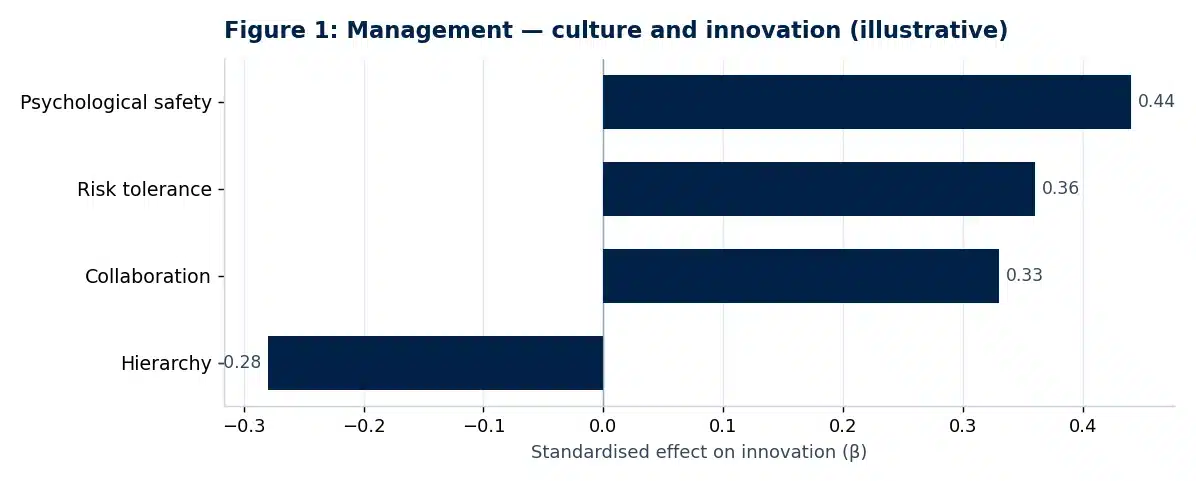
Read together, the coefficients describe a coherent system. Enabling dimensions cluster positively, while control-oriented hierarchy works against them, suggesting culture influences innovation as a balance of competing forces rather than a single lever.
Dissertation Chapter Writing Service
Need a management discussion chapter written to this standard?
Our subject specialists write to your exact brief — fully referenced, plagiarism-free and delivered on time, with a free plagiarism report.
The finding that psychological safety leads the cultural predictors aligns closely with Edmondson (1999), whose team-learning research positioned safety as the interpersonal foundation for experimentation. The present study extends that logic from teams to broader cultural analysis.
It also resonates with Kahn (1990), who argued that engagement flourishes when employees feel able to express themselves without fear of negative consequences. The observed safety effect can be read as engagement operating through a cultural rather than individual lens.
The negative hierarchy result echoes the classic distinction drawn by Burns and Stalker (1961) between mechanistic and organic structures. Their claim that rigid, mechanistic forms hinder adaptation is supported here by a clear negative coefficient.
Similarly, the Competing Values Framework of Cameron and Quinn (2011) anticipates tension between hierarchy and adhocracy cultures. This study empirically substantiates that tension, showing the two orientations pulling innovation in opposite directions.
The moderating role of collaboration is less frequently emphasised in earlier work, which often treats it as a direct cause. The results instead support Amabile’s (1996) componential view, in which social context amplifies underlying creative capacity.
There are, however, points of divergence. Some scholars report risk tolerance as a leading driver of innovation (Tushman and O’Reilly, 1997). Here it ranked below safety, suggesting contextual differences in how organisations sequence these attributes.
One plausible reconciliation is temporal. Risk tolerance may matter most in mature innovation programmes, whereas safety governs the earlier idea-surfacing stage that this sample predominantly captured (Anderson, Potočnik and Zhou, 2014).
The results reinforce a multidimensional conception of organisational culture. Treating culture as a single variable would have masked the opposing effects of hierarchy and safety, so future theorising should retain this disaggregated structure (Schein, 2010).
They also support an interactionist rather than additive model. Because collaboration amplified other dimensions, culture’s influence on innovation appears configurational, with attributes combining synergistically rather than summing independently (Amabile, 1996).
Furthermore, the primacy of psychological safety invites closer theoretical integration between the culture and engagement literatures. The two fields have developed largely in parallel, yet the safety construct bridges them naturally (Kahn, 1990).
Finally, the hierarchy finding cautions against assuming that all structure is antithetical to innovation. The relationship is negative but moderate, implying that some coordination remains compatible with, and perhaps necessary for, sustained innovative activity.
For managers, the clearest lesson is to prioritise psychological safety as a deliberate, cultivated condition rather than an incidental by-product. Leaders can model fallibility, invite dissent and respond constructively to error to strengthen it.
The following actions follow directly from the findings:
Importantly, these levers should be sequenced rather than pursued at once. Because safety enables risk-taking and collaboration converts it into output, an ordered programme is likely to outperform simultaneous, unfocused change efforts.
Managers should also resist eliminating structure entirely. The moderate hierarchy effect suggests that selective de-layering, targeted at innovation-critical decisions, is wiser than wholesale restructuring that could destabilise coordination and accountability.
Several limitations qualify these conclusions. The cross-sectional design captures associations at a single point in time and therefore cannot establish causality with certainty. Longitudinal data would be required to confirm the inferred mechanisms.
The reliance on self-report measures introduces potential common-method bias. Respondents assessing both culture and innovation may have inflated the observed relationships, and future studies could incorporate objective innovation indicators (Podsakoff et al., 2003).
Sampling scope also constrains generalisability. The findings reflect the particular organisational contexts surveyed and may not transfer directly to sectors with markedly different regulatory or competitive pressures.
Finally, culture is dynamic and context-sensitive. The moderate coefficients suggest unmeasured variables, such as leadership style or resource availability, also shape innovation and warrant inclusion in subsequent models (Anderson, Potočnik and Zhou, 2014).
These limitations do not undermine the central findings, but they define the boundaries within which they should be interpreted and applied. They also signal productive directions for further empirical inquiry.
Taken together, the discussion has interpreted the study’s findings, related them to established theory, and drawn out their theoretical and practical significance. The concluding chapter now synthesises these insights, restates the study’s contribution and offers focused recommendations for both practice and future research.
Amabile, T.M. (1996) Creativity in Context: Update to the Social Psychology of Creativity. Boulder, CO: Westview Press.
Burns, T. and Stalker, G.M. (1961) The Management of Innovation. London: Tavistock.
Cameron, K.S. and Quinn, R.E. (2011) Diagnosing and Changing Organizational Culture: Based on the Competing Values Framework. 3rd edn. San Francisco, CA: Jossey-Bass.
Edmondson, A. (1999) ‘Psychological safety and learning behavior in work teams’, Administrative Science Quarterly, 44(2), pp. 350-383.
Kahn, W.A. (1990) ‘Psychological conditions of personal engagement and disengagement at work’, Academy of Management Journal, 33(4), pp. 692-724.
Podsakoff, P.M., MacKenzie, S.B., Lee, J.-Y. and Podsakoff, N.P. (2003) ‘Common method biases in behavioral research: a critical review of the literature and recommended remedies’, Journal of Applied Psychology, 88(5), pp. 879-903.
Schein, E.H. (2010) Organizational Culture and Leadership. 4th edn. San Francisco, CA: Jossey-Bass.

All work is written by human writers. 100% AI free, guaranteed.

100% money back guarantee if you find plagiarism in our work.
COMPANY DETAILS