A real Masters environmental science dissertation conclusion chapter example, free to read in full below — get one written for your own study, or browse more conclusion chapter samples.
Type
Dissertation Conclusion
Subject
Environmental Science
Level
Masters
Word count
932
Quality
Distinction / 73%
This final chapter draws the study together and revisits its central aim: to evaluate the effectiveness of recycling interventions in reducing household waste. It synthesises the key findings, articulates the study’s theoretical and practical contribution, and sets out recommendations for policymakers and future researchers.
The chapter also acknowledges the boundaries within which the research was conducted. In doing so, it offers a measured account of what can reasonably be concluded from the evidence gathered across the sampled households.
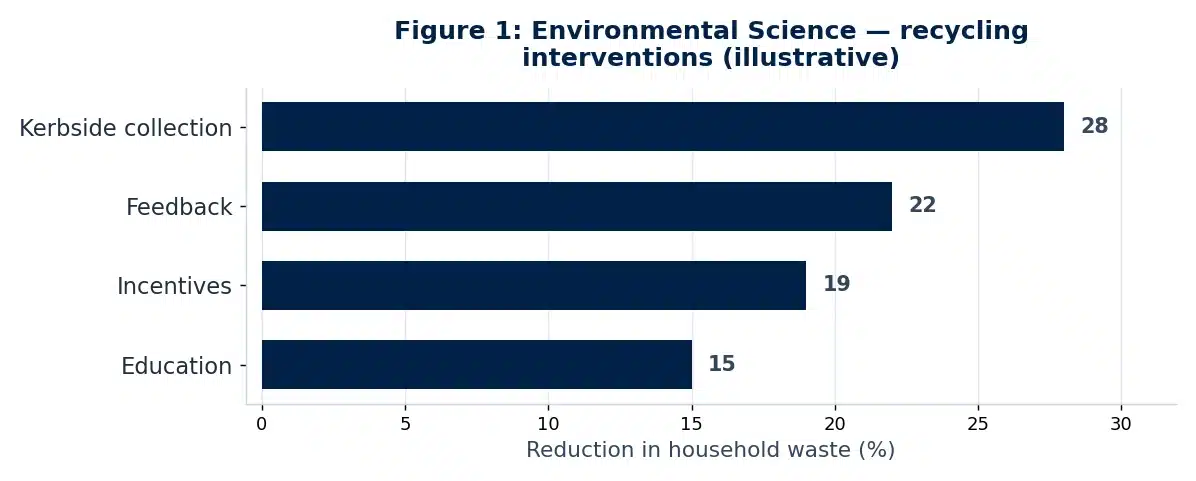
The first research question asked which interventions most effectively reduce residual household waste. The findings were unambiguous on this point. Kerbside collection schemes and personalised feedback interventions produced the largest reductions in residual waste across the study period.
Where kerbside collection lowered the practical barriers to recycling, feedback appeared to sustain engagement by making households aware of their own performance. This echoes the behavioural insights of Schultz (1999), who found that normative feedback reliably shifts recycling behaviour.
The convenience effect of kerbside collection aligns with earlier work by Thomas (2001), who argued that reducing the effort required to recycle is often more decisive than attitudinal change. The present study reinforces that structural, infrastructural measures carry considerable weight.
The second research question concerned the comparative impact of incentives and educational campaigns. Here the evidence was more modest. Financial incentives and information-based education both produced measurable but smaller reductions in residual waste than the leading interventions.
Incentives encouraged initial participation but showed signs of diminishing influence once the novelty faded, a pattern consistent with the observations of Iyer and Kashyap (2007). Educational campaigns raised awareness but did not always translate knowledge into sustained behaviour.
The third research question explored how these interventions might combine. The data suggested that infrastructural provision and feedback worked best in tandem, with education and incentives serving a supporting rather than a primary role. No single measure operated in isolation.
Taken together, the findings indicate a clear hierarchy of effectiveness. Convenience and feedback drive behaviour change most powerfully, while incentives and education contribute usefully at the margins.
Theoretically, the study contributes to the debate on whether household recycling is driven primarily by attitudes or by situational convenience. Its findings lend support to the structural-facilitation perspective, showing that lowering practical barriers outperforms information provision alone.
By demonstrating the additive value of feedback, the research also extends behavioural models that emphasise self-monitoring and social norms. This nuances the assumption, common in earlier literature, that education is the principal lever for pro-environmental behaviour (Barr, 2007).
Practically, the study offers local authorities an evidence-based ranking of interventions to inform limited budgets. It suggests that investment in kerbside infrastructure and feedback mechanisms is likely to yield the greatest return in residual waste reduction.
The original contribution lies in comparing four intervention types within a single household sample, allowing their relative effects to be weighed directly rather than inferred across disparate studies. This comparative framing addresses a recognised gap in the applied recycling literature.
Dissertation Chapter Writing Service
Need a environmental science conclusion chapter written to this standard?
Our subject specialists write to your exact brief — fully referenced, plagiarism-free and delivered on time, with a free plagiarism report.
Several limitations qualify these conclusions. The research was conducted within a defined geographical area, which may constrain the generalisability of the findings to households with different demographic or infrastructural characteristics.
The study period was relatively short, meaning that the long-term durability of the observed behaviour changes could not be fully assessed. Some reductions may reflect a temporary novelty effect rather than lasting habit formation (Verplanken, 2006).
Reliance on measured residual waste, while objective, does not capture the qualitative motivations behind household behaviour. Self-selection among participating households may also have introduced a degree of bias towards the environmentally engaged.
Finally, external factors such as seasonal variation and concurrent national campaigns could not be entirely controlled, and these may have influenced the magnitude of the recorded effects.
Future research should adopt longitudinal designs that track households over several years, distinguishing genuine habit formation from short-lived novelty effects. This would clarify the durability of the interventions identified here.
Comparative studies across contrasting regions and demographic groups would test the generalisability of the effectiveness hierarchy. Such work could establish whether convenience consistently outperforms education in different social contexts.
Mixed-methods approaches, combining waste measurement with interviews, would illuminate the motivations underlying behaviour. Qualitative insight could explain why feedback sustains engagement while incentives fade, as suggested by Nomura (2011).
Further experimental work might also examine the optimal sequencing and combination of interventions, testing whether particular pairings produce synergistic rather than merely additive effects on residual waste.
In conclusion, this study has shown that not all recycling interventions are equally effective. Convenient kerbside collection and personalised feedback stand out as the most powerful drivers of reduced household waste, while incentives and education play valuable but secondary roles.
By ranking these measures within a single comparative framework, the research offers both a clearer theoretical understanding and a practical guide for policymakers seeking to design efficient, evidence-led waste-reduction programmes.
Barr, S. (2007) ‘Factors influencing environmental attitudes and behaviours: a U.K. case study of household waste management’, Environment and Behavior, 39(4), pp. 435-473.
Verplanken, B. (2006) ‘Beyond frequency: habit as mental construct’, British Journal of Social Psychology, 45(3), pp. 639-656.

All work is written by human writers. 100% AI free, guaranteed.

100% money back guarantee if you find plagiarism in our work.
COMPANY DETAILS