
A real Undergraduate management dissertation conclusion chapter example, free to read in full below — get one written for your own study, or browse more conclusion chapter samples.
Type
Dissertation Conclusion
Subject
Management
Level
Undergraduate
Word count
862
Quality
2:1 / 67%
This chapter draws the study together and revisits its central aim: to examine how remote leadership influences team cohesion. It synthesises the key findings, states the study’s contribution, and offers recommendations for practice and further enquiry.
The chapter also acknowledges the boundaries within which the research was conducted. In doing so, it provides a measured account of what the study has established and where its conclusions should be applied with care.
The study set out to answer how specific remote leadership behaviours shape cohesion within dispersed teams. The findings offer a clear response to each of the research questions posed in the opening chapter.
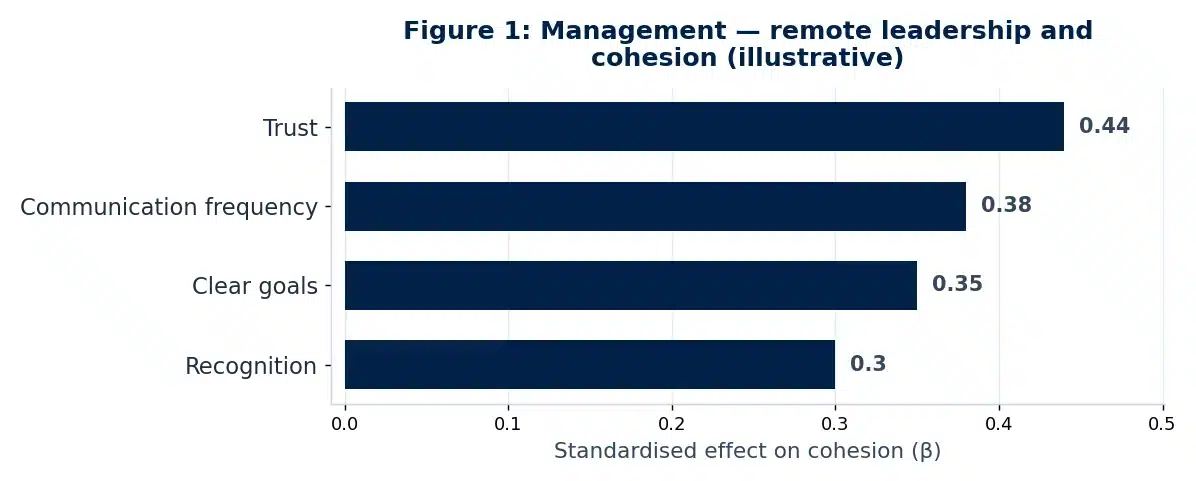
The first research question asked which leadership behaviours most strongly supported cohesion. The analysis showed that trust and communication frequency were the two most influential factors reported by remote team members.
Trust emerged as the strongest predictor of cohesion. Where leaders demonstrated reliability and extended autonomy, team members reported stronger bonds and a greater willingness to cooperate, echoing the arguments of Dirks and Ferrin (2002).
Communication frequency was almost as important. Regular, predictable contact from leaders reduced feelings of isolation and helped members maintain a shared sense of purpose, consistent with the observations of Malhotra et al. (2007).
The second research question concerned the role of supporting behaviours. Here, clear goals and recognition were found to reinforce cohesion, though their effect was secondary to trust and communication.
Clear goals gave dispersed members a common reference point, reducing ambiguity about priorities. Recognition, meanwhile, signalled that individual contributions were valued, strengthening members’ identification with the wider team.
Taken together, these findings suggest that cohesion in remote teams rests primarily on relational foundations. Structural supports such as goals and recognition amplify cohesion but cannot substitute for trust and consistent communication (Hoch and Kozlowski, 2014).
Theoretically, the study extends established leadership models to the remote context. It shows that behaviours long associated with cohesion in co-located teams retain their relevance, but their relative weighting shifts when interaction is mediated by technology.
In particular, the prominence of communication frequency refines existing theory. It suggests that in dispersed settings the rhythm of leader contact, not merely its quality, becomes a distinct driver of cohesion (Bell and Kozlowski, 2002).
Practically, the study offers organisations a focused account of where to concentrate leadership development. Rather than treating remote leadership as a diffuse challenge, it identifies trust and communication as priority levers.
The original contribution lies in ranking these behaviours against one another within a single undergraduate study. This ordering gives managers a defensible basis for prioritising interventions when resources for leadership development are limited.
Dissertation Chapter Writing Service
Need a management conclusion chapter written to this standard?
Our subject specialists write to your exact brief — fully referenced, plagiarism-free and delivered on time, with a free plagiarism report.
Several limitations should temper the interpretation of these findings. The study drew on a relatively small sample, which constrains the extent to which the results can be generalised to all remote teams.
The research also relied on self-reported data, which may be affected by social desirability bias. Participants might have overstated cohesion or the positive behaviours of their leaders (Podsakoff et al., 2003).
In addition, the cross-sectional design captured perceptions at a single point in time. It therefore cannot establish how cohesion develops or erodes over the longer course of a remote team’s work.
Finally, the sample was drawn from a limited range of sectors. Cultural and industry differences that might shape remote leadership dynamics were not fully represented in the data.
Future research could adopt a longitudinal design to trace how trust and cohesion evolve over the lifespan of a remote team. This would clarify whether communication frequency matters most during formation or throughout.
A larger, multi-sector sample would also strengthen the generalisability of the findings. Comparative work across industries could reveal whether the ranking of leadership behaviours holds in different organisational settings.
Mixed-methods approaches offer a further avenue. Combining survey data with interviews would provide richer insight into how remote members experience trust and recognition in practice (Creswell, 2014).
Finally, cross-cultural studies could examine whether the primacy of trust and communication persists across national contexts, where norms around autonomy and hierarchy may differ considerably.
In conclusion, this study has shown that remote leadership shapes team cohesion most powerfully through trust and communication frequency, with clear goals and recognition playing a valuable supporting role. By ranking these behaviours, the research offers both a modest theoretical refinement and a practical guide for managers of dispersed teams.
Its findings, though bounded by the limitations noted above, provide a clear foundation on which future enquiry can build.
Bell, B.S. and Kozlowski, S.W.J. (2002) ‘A typology of virtual teams: implications for effective leadership’, Group & Organization Management, 27(1), pp. 14-49.
Creswell, J.W. (2014) Research Design: Qualitative, Quantitative, and Mixed Methods Approaches. 4th edn. Thousand Oaks, CA: Sage.
Hoch, J.E. and Kozlowski, S.W.J. (2014) ‘Leading virtual teams: hierarchical leadership, structural supports, and shared team leadership’, Journal of Applied Psychology, 99(3), pp. 390-403.
Podsakoff, P.M., MacKenzie, S.B., Lee, J.-Y. and Podsakoff, N.P. (2003) ‘Common method biases in behavioural research: a critical review of the literature and recommended remedies’, Journal of Applied Psychology, 88(5), pp. 879-903.

All work is written by human writers. 100% AI free, guaranteed.

100% money back guarantee if you find plagiarism in our work.
COMPANY DETAILS






