
A worked Masters business business report example, free to read in full below — get one written for your own brief, or browse more report samples.
Type
Business Report
Discipline
Business
Level
Masters
Word count
852
Quality
Distinction / 73%
This report examines the competitive position of Tesco plc, the United Kingdom’s largest grocery retailer, within an intensifying market environment. The purpose is to assess where Tesco’s advantage lies and where its exposure is most acute.
The central finding is that Tesco’s scale, its Clubcard loyalty data and its distribution network constitute durable competitive strengths. These assets are difficult for rivals to replicate quickly and underpin the firm’s market leadership.
However, the analysis identifies sustained pressure from the German discounters Aldi and Lidl, alongside structurally thin operating margins. The main recommendation is that Tesco should defend share through data-led value initiatives rather than broad price matching, protecting profitability while retaining volume.
Tesco plc operates roughly 4,000 stores across the United Kingdom and serves millions of customers each week. It remains the market leader, yet the grocery sector has become one of the most contested arenas in British retail (Wood, 2021).
The scope of this report is Tesco’s competitive position within the UK grocery market. It considers the resources that generate advantage and the external forces that threaten margins and share.
The purpose is to provide an evidence-based assessment for strategic decision-makers. The report draws on published market data, resource-based theory and competitive analysis to reach practical recommendations for sustaining leadership.
Tesco holds the largest share of the UK grocery market, providing significant purchasing power over suppliers. Scale allows the firm to negotiate favourable terms and to spread fixed costs across a large sales base (Porter, 2008).
The Clubcard scheme is a second core strength. With millions of active members, it generates granular data on purchasing behaviour that informs pricing, ranging and targeted promotions. This information asset is a source of advantage that discounters largely lack (Humby et al., 2008).
Distribution is the third pillar. An established network of depots and a mature online delivery operation give Tesco reach and resilience that new entrants cannot easily match. Figure 1 illustrates the relationship between grocer market share and operating margin.
The findings also reveal clear pressures. Aldi and Lidl have expanded aggressively, competing on a narrow, high-volume range at low prices. Their growth has compressed the margins of the traditional “big four” grocers (Fernie and Sparks, 2019).
| Grocer | UK Market Share (%) | Operating Margin (%) |
| Tesco | 27.5 | 4.2 |
| Sainsbury’s | 15.3 | 3.0 |
| Asda | 13.6 | 3.4 |
| Aldi | 10.1 | 2.5 |
| Lidl | 7.9 | 2.1 |
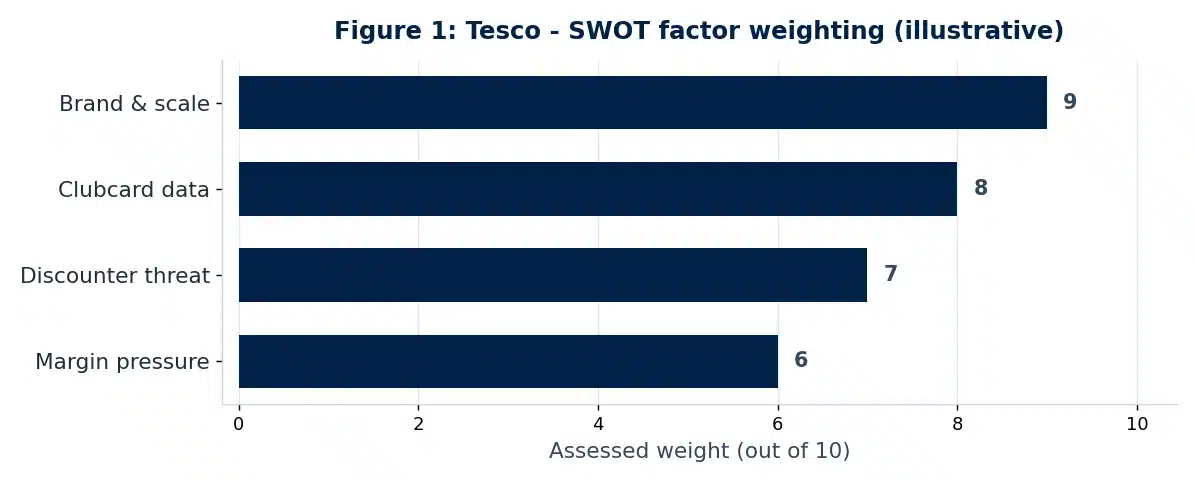
The table shows Tesco’s leadership in share, yet its operating margin remains thin at roughly four per cent. This narrow band leaves limited room to absorb cost inflation or sustained price competition without eroding profit.
Report Writing Service
Need a business business report written to this standard?
Our subject specialists write fully referenced, plagiarism-free reports to your exact brief and deadline, with a free plagiarism report.
Interpreted through a resource-based lens, Tesco’s advantages are valuable, rare and costly to imitate. Scale, loyalty data and distribution together form a system of assets that reinforce one another and support the firm’s leading position (Barney, 1991).
The Clubcard is the most strategically interesting of these. It converts everyday transactions into insight, enabling personalised value that discounters cannot easily replicate because they neither hold the data nor operate the range to use it.
The discounter threat, however, is structural rather than cyclical. Aldi and Lidl have reset customer expectations of price, and their continued store expansion means the pressure on margins is likely to persist rather than fade.
The strategic tension is therefore clear. Competing purely on price plays to the discounters’ cost advantage and threatens Tesco’s already thin margins. The more defensible route is to convert data and scale into perceived value that justifies customer loyalty.
Tesco’s competitive position rests on genuine and durable strengths in scale, loyalty data and distribution. These assets secure its market leadership and are not readily copied by rivals.
The principal risks are the sustained advance of the discounters and the persistent thinness of margins. Managing these pressures without surrendering profitability is the defining strategic challenge facing the business.
Barney, J. (1991) ‘Firm resources and sustained competitive advantage’, Journal of Management, 17(1), pp. 99-120.
Fernie, J. and Sparks, L. (eds.) (2019) Logistics and Retail Management: Emerging Issues and New Challenges in the Retail Supply Chain. 5th edn. London: Kogan Page.
Humby, C., Hunt, T. and Phillips, T. (2008) Scoring Points: How Tesco Continues to Win Customer Loyalty. 2nd edn. London: Kogan Page.
Porter, M.E. (2008) ‘The five competitive forces that shape strategy’, Harvard Business Review, 86(1), pp. 78-93.
Wood, Z. (2021) ‘Tesco raises profit forecast after strong sales’, The Guardian, 12 October. Available at: https://www.theguardian.com/business/tesco (Accessed: 18 August 2026).

All work is written by human writers. 100% AI free, guaranteed.

100% money back guarantee if you find plagiarism in our work.
COMPANY DETAILS






