A worked Undergraduate biochemistry lab report example, free to read in full below — get one written for your own brief, or browse more report samples.
Type
Lab Report
Discipline
Biochemistry
Level
Undergraduate
Word count
835
Quality
1st / 74%
The aim of this investigation was to determine how temperature affects the rate of an enzyme-catalysed reaction. It was hypothesised that the rate would increase with temperature to an optimum near 40°C, then decline sharply as the enzyme denatured above 50°C.
Enzymes are globular proteins that act as biological catalysts, lowering the activation energy required for metabolic reactions to proceed (Berg et al., 2015). Their catalytic power depends on a precisely folded three-dimensional active site that binds a specific substrate.
Temperature is a key factor governing enzyme activity. As temperature rises, the kinetic energy of substrate and enzyme molecules increases, producing more frequent and more successful collisions. Consequently, the reaction rate typically increases across a moderate temperature range.
However, enzymes are sensitive to heat. Above a critical temperature, the weak hydrogen bonds and hydrophobic interactions that maintain tertiary structure begin to break. This alters the active site, a process known as denaturation (Nelson and Cox, 2017).
Each enzyme therefore has an optimum temperature at which activity is greatest. For many enzymes derived from mammalian tissue, this optimum lies close to 37–40°C, reflecting normal body temperature. Understanding this relationship is central to biochemistry, medicine and industrial process design.
This experiment used catalase, an enzyme that decomposes hydrogen peroxide into water and oxygen. The volume of oxygen released over a fixed period provided a convenient and reproducible measure of reaction rate.
The following materials were used in the investigation:
Six water baths were prepared and allowed to equilibrate to the required temperatures. A thermometer was used to confirm each temperature before proceeding.
For each trial, 5 cm³ of catalase solution was measured into a conical flask and placed in the appropriate water bath for five minutes to reach thermal equilibrium.
Separately, 5 cm³ of hydrogen peroxide was warmed to the same temperature. The peroxide was then added to the flask, which was immediately sealed with the delivery tube and gas syringe.
The volume of oxygen collected in the gas syringe after 60 seconds was recorded. The apparatus was rinsed thoroughly between trials to avoid contamination.
Each temperature was tested three times and the mean volume of oxygen calculated. All variables other than temperature, including enzyme concentration and substrate volume, were kept constant to ensure a fair test.
Report Writing Service
Need a biochemistry lab report written to this standard?
Our subject specialists write fully referenced, plagiarism-free reports to your exact brief and deadline, with a free plagiarism report.
The mean volume of oxygen produced in 60 seconds was recorded at each temperature and used to calculate the reaction rate. The results are summarised in the table below and displayed graphically in Figure 1.
| Temperature (°C) | Mean oxygen produced in 60 s (cm³) |
| 10 | 8 |
| 20 | 17 |
| 30 | 31 |
| 40 | 46 |
| 50 | 28 |
| 60 | 6 |
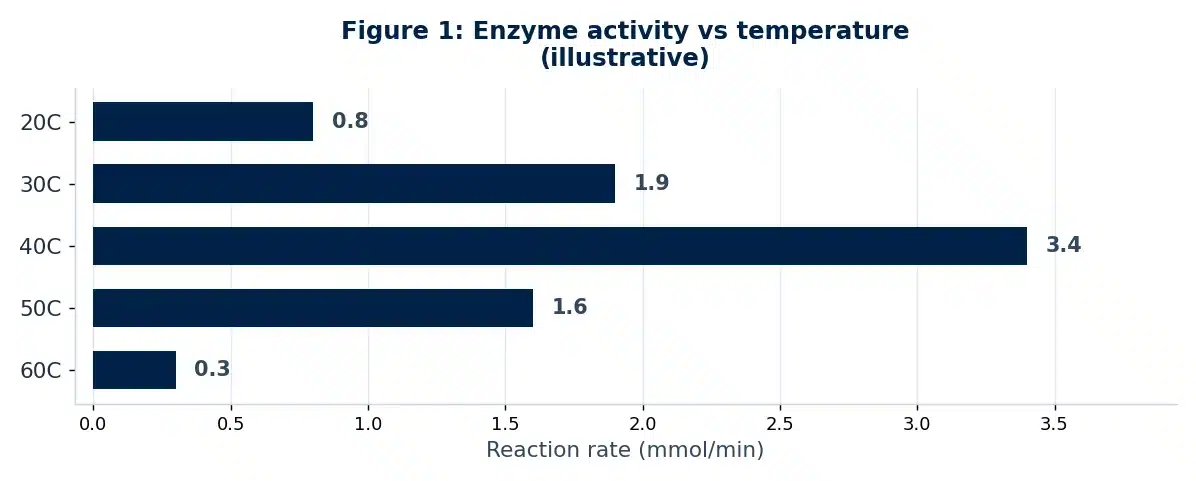
The volume of oxygen released rose steadily from 10°C to 40°C, where the greatest output of 46 cm³ was recorded. This temperature represented the peak of enzyme activity.
Above 40°C the trend reversed sharply. At 50°C output fell to 28 cm³, and by 60°C only 6 cm³ was collected, indicating a substantial loss of catalytic function.
The results support the initial hypothesis. Reaction rate increased with temperature up to an optimum near 40°C, then declined sharply above 50°C as expected for a mammalian-type enzyme (Berg et al., 2015).
The rise between 10°C and 40°C reflects increasing kinetic energy. Molecules collided more frequently and with greater energy, so more enzyme–substrate complexes formed per second, raising the rate of oxygen production.
The sharp fall above 50°C is attributed to denaturation. Excess thermal energy disrupted the bonds maintaining the tertiary structure, distorting the active site so that substrate could no longer bind effectively (Nelson and Cox, 2017).
The measured optimum of 40°C aligns closely with published values for catalase, which typically lie between 37°C and 45°C (Whitehurst and van Oort, 2010). The small deviation may reflect apparatus limitations rather than true enzyme behaviour.
Several sources of error should be noted. Gas may have escaped before the syringe was sealed, and the water baths fluctuated slightly during each trial. Both factors could have reduced measured oxygen volumes.
Reaction timing was controlled manually with a stopwatch, introducing possible human reaction-time error. Repeating each trial three times reduced the impact of random variation, but systematic errors would remain.
Reliability could be improved by using a data-logging oxygen sensor and a thermostatically controlled water bath. Testing narrower temperature intervals around 40°C would also locate the optimum more precisely.
The investigation demonstrated that temperature strongly influences enzyme activity. Reaction rate increased with temperature to an optimum near 40°C, then fell sharply above 50°C as the enzyme denatured. The aim was therefore achieved and the hypothesis supported.
Berg, J.M., Tymoczko, J.L., Gatto, G.J. and Stryer, L. (2015) Biochemistry. 8th edn. New York: W.H. Freeman and Company.
Nelson, D.L. and Cox, M.M. (2017) Lehninger Principles of Biochemistry. 7th edn. New York: W.H. Freeman and Company.

All work is written by human writers. 100% AI free, guaranteed.

100% money back guarantee if you find plagiarism in our work.
COMPANY DETAILS