A worked Undergraduate strategic management case study example on McDonald's, free to read in full below — get one written for your own brief, or browse more case study samples.
Type
Case Study
Discipline
Strategic Management
Level
Undergraduate
Word count
991
Quality
2:1 / 67%
McDonald’s Corporation is one of the world’s most recognisable quick-service restaurant brands, operating in over 100 countries. Since its post-war expansion, the organisation has become a benchmark case in international strategy and operations management.
This case study examines how McDonald’s combines global standardisation with local menu adaptation, underpinned by an extensive franchising model. The purpose is illustrative: to demonstrate how a structured external analysis informs strategic decisions.
The scope is limited to the organisation’s overarching business strategy and its external operating environment. Publicly known, general information is used throughout, and the analysis remains qualitative rather than reliant on specific financial figures.
McDonald’s pioneered a systematised approach to food service built on speed, consistency and low cost. Its operating philosophy, often summarised as Quality, Service, Cleanliness and Value, standardised the customer experience across geographically dispersed markets.
Central to this model is franchising. The overwhelming majority of restaurants are operated by franchisees rather than owned directly, allowing rapid expansion with reduced capital outlay while the organisation retains control of brand standards, supply chains and real estate.
The strategic issue this case examines is the tension between standardisation and localisation. Global consistency delivers economies of scale and brand recognition, yet diverse markets demand adaptation to local tastes, regulations and cultural norms (Johnson et al., 2020).
This tension is intensified by a shifting external environment. Rising health consciousness, volatile input and labour costs, and growing regulatory scrutiny all challenge a business model historically associated with inexpensive, calorie-dense convenience food.
Analysing this environment systematically helps clarify which pressures are most material. A PESTLE framework is well suited because it surveys the macro-environmental forces that shape strategic options across every market the organisation serves (Johnson et al., 2020).
PESTLE examines Political, Economic, Social, Technological, Legal and Environmental factors in the macro-environment. Applied to McDonald’s, it reveals which external forces most strongly condition the standardisation-versus-localisation balance and the resilience of the franchising model.
Political factors include trade policy, food-safety regulation and taxation regimes that differ sharply between markets. Economic factors, particularly inflation in commodity and labour costs, directly affect franchisee margins and the organisation’s value proposition (Grant, 2016).
Social factors are arguably the most significant contemporary force. Growing awareness of obesity, nutrition and ethical sourcing pressures the menu, while local dietary and religious norms require adaptation such as vegetarian ranges in India (Ghemawat, 2007).
Technological, legal and environmental factors complete the picture. Digital ordering reshapes convenience, employment and advertising law constrain operations, and packaging and emissions scrutiny drives sustainability commitments across the supply chain.
| PESTLE Factor | Strategic Implication for McDonald’s |
| Political | Divergent food-safety rules, trade tariffs and health-related taxation require market-by-market compliance while defending a standardised core model. |
| Economic | Inflation in ingredient and wage costs squeezes franchisee margins, testing the low-price value proposition during downturns and cost-of-living pressures. |
| Social | Rising health consciousness and diverse cultural and religious diets demand menu adaptation, from salads and plant-based items to region-specific offerings. |
| Technological | Mobile apps, self-service kiosks and delivery platforms reshape convenience, data-driven marketing and the labour model across restaurants. |
| Legal | Employment, franchising, advertising and nutritional-labelling laws impose obligations that vary by jurisdiction and shape operational practice. |
| Environmental | Scrutiny of packaging waste, sourcing and emissions drives sustainability commitments that carry both reputational risk and cost implications. |
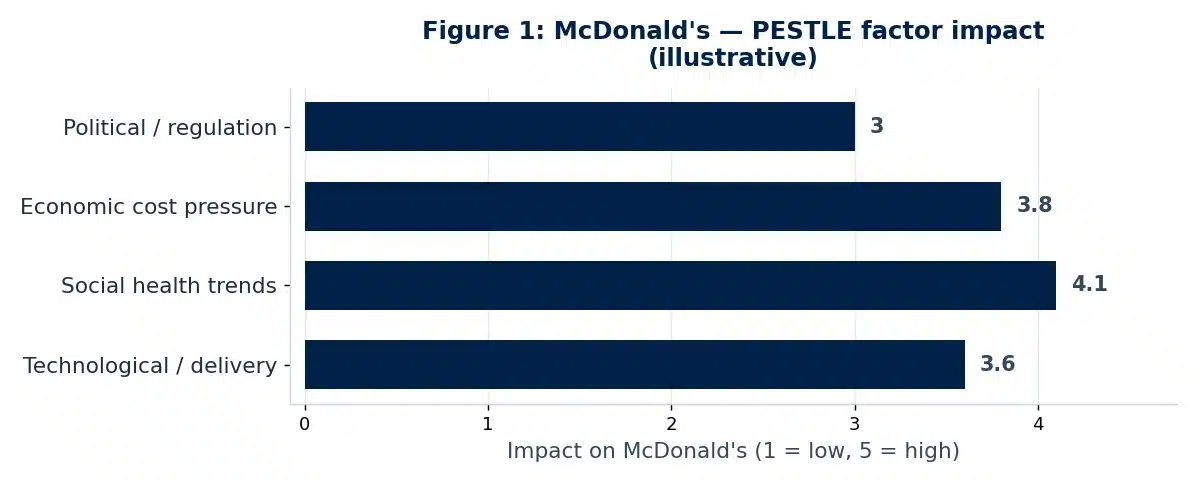
Read together, these factors show that the sharpest external pressures are social and economic. Health trends threaten the traditional menu’s appeal, while cost inflation strains the affordability that underpins the brand’s competitive position (Porter, 1985).
Political, legal and environmental factors are managed largely through compliance and reputation management. Technological change, by contrast, offers opportunity as well as risk, enabling new convenience formats and richer customer data.
Case Study Writing Service
Need a strategic management case study written to this standard?
Our subject specialists write fully referenced, plagiarism-free case studies to your exact brief and deadline, with a free plagiarism report.
The analysis confirms that McDonald’s franchising model is a core strategic strength. By devolving operations to franchisees, the organisation achieves rapid scale and local market knowledge while retaining central control over brand, systems and supply (Barney, 1991).
Global standardisation delivers consistency and cost efficiency. Standardised processes, layouts and core products create economies of scale, predictable quality and instant brand recognition wherever a customer encounters the organisation (Levitt, 1983).
Crucially, this standardisation is tempered by disciplined local menu adaptation. Region-specific products respond to cultural, religious and taste differences without dismantling the efficient global template, a balance often described as “glocalisation” (Ghemawat, 2007).
The findings also identify the dominant external threats. Social health trends erode the appeal of traditional high-calorie offerings, pressuring the organisation to reformulate and diversify its menu towards healthier and plant-based options.
Economic cost pressures form the second major challenge. Inflation in ingredients, energy and wages compresses franchisee profitability and strains the low-price positioning that has historically differentiated the brand (Grant, 2016).
Overall, the framework shows a resilient model whose scale and consistency remain formidable, but whose long-term value depends on adapting the menu and cost base to a changing social and economic environment.
McDonald’s illustrates how global standardisation and franchising can coexist with local adaptation to build durable competitive advantage. The PESTLE analysis shows scale and consistency remain powerful, but social health trends and economic cost pressures are the defining external challenges.
By balancing a standardised, efficient core with responsive menu adaptation and digital innovation, the organisation is well positioned to sustain its market leadership while navigating a demanding and evolving environment.
Barney, J. (1991) ‘Firm resources and sustained competitive advantage’, Journal of Management, 17(1), pp. 99-120.
Ghemawat, P. (2007) Redefining Global Strategy: Crossing Borders in a World Where Differences Still Matter. Boston, MA: Harvard Business School Press.
Grant, R.M. (2016) Contemporary Strategy Analysis. 9th edn. Chichester: Wiley.
Johnson, G., Whittington, R., Scholes, K., Angwin, D. and Regnér, P. (2020) Exploring Strategy: Text and Cases. 12th edn. Harlow: Pearson.
Levitt, T. (1983) ‘The globalization of markets’, Harvard Business Review, 61(3), pp. 92-102.
Porter, M.E. (1985) Competitive Advantage: Creating and Sustaining Superior Performance. New York: Free Press.

All work is written by human writers. 100% AI free, guaranteed.

100% money back guarantee if you find plagiarism in our work.
COMPANY DETAILS