A worked Masters strategic management case study example on Samsung, free to read in full below — get one written for your own brief, or browse more case study samples.
Type
Case Study
Discipline
Strategic Management
Level
Masters
Word count
912
Quality
Merit / 69%
Samsung Electronics is a South Korean multinational and one of the world’s foremost technology conglomerates. It operates across consumer electronics, mobile devices, displays and semiconductors.
The organisation forms the flagship of the wider Samsung Group, competing globally against Apple, Sony, TSMC and a growing cohort of Chinese manufacturers. Its scale spans both finished products and core components.
This case study examines Samsung’s innovation and diversification strategy through a structured SWOT analysis. The purpose is to illustrate how a strategic framework can be applied rigorously to a real organisation.
The scope is deliberately qualitative and illustrative, drawing on publicly known information about Samsung’s markets and strategic behaviour. It is intended as a teaching example for postgraduate strategic management study.
Samsung’s growth has been driven by aggressive diversification and heavy reinvestment in research and development. Unlike rivals that specialise narrowly, Samsung competes simultaneously in devices and in the components that power them.
This vertical integration is central to its strategic context. The organisation manufactures memory chips, displays and batteries that it uses internally and also sells to competitors, including firms it rivals in finished goods.
The competitive environment is intense and fast-moving. Product life cycles are short, capital intensity is high, and technological leadership can shift rapidly between generations (Johnson et al., 2020).
The strategic issue this case examines is how Samsung sustains competitive advantage across such a broad portfolio. It must balance premium innovation against cost pressures from lower-priced Asian competitors.
A further tension concerns brand positioning. Samsung leads on volume and technological breadth, yet it has historically struggled to command the same brand premium and customer loyalty as Apple in the high-end segment.
SWOT analysis organises the internal strengths and weaknesses of an organisation alongside the external opportunities and threats it faces (Johnson et al., 2020). Applied to Samsung, it exposes the interplay between capability and market position.
Internally, Samsung’s resources meet several tests of value, rarity and inimitability, offering a basis for sustained advantage (Barney, 1991). Its component manufacturing and R&D depth are especially difficult for rivals to replicate quickly.
Externally, Samsung’s position reflects the structure of its industry, where supplier power, rivalry and the threat of substitutes shape returns (Porter, 1985). The framework below summarises the four dimensions.
| Strengths | Weaknesses |
| High R&D intensity and rapid product innovation across multiple categories; vertical integration in semiconductors, displays and batteries; broad diversified portfolio; large-scale manufacturing and supply-chain control; strong global distribution. | Brand premium and loyalty below Apple in the high-end segment; heavy reliance on cyclical component revenues; complexity of managing a very broad portfolio; historical product-quality incidents; limited proprietary software ecosystem. |
| Opportunities | Threats |
| Leadership in foldable and next-generation display formats; rising global demand for advanced semiconductors and memory; growth in AI hardware and connected devices; expansion in emerging markets; premium wearables and health devices. | Intense price competition from Chinese manufacturers; cyclical downturns in the memory market; geopolitical and supply-chain disruption; dependence on the Android ecosystem controlled by Google; rapid technological substitution. |
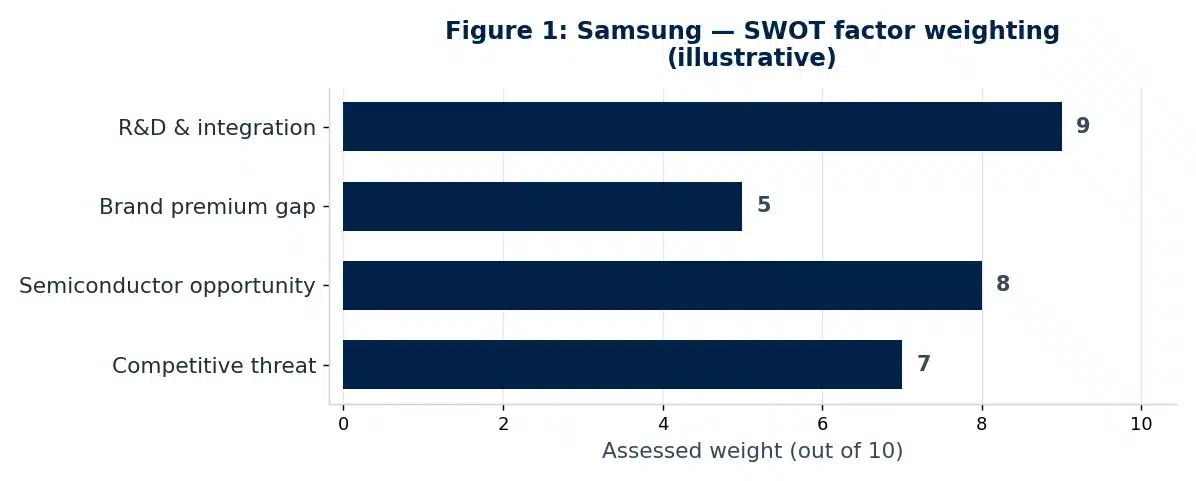
Each quadrant interacts with the others. Samsung’s strengths in components create the opportunity to lead in foldables, while its dependence on cyclical chip demand simultaneously exposes it to significant external threats.
Case Study Writing Service
Need a strategic management case study written to this standard?
Our subject specialists write fully referenced, plagiarism-free case studies to your exact brief and deadline, with a free plagiarism report.
The analysis reveals that Samsung’s most durable strengths are its R&D intensity, vertical integration and broad product portfolio. Together these allow the organisation to innovate faster and control more of its own value chain than most rivals.
This vertical integration is a distinctive source of advantage. By producing memory, displays and other components internally, Samsung captures margin, secures supply and can commercialise new technologies within its own devices first (Barney, 1991).
The findings also expose clear weaknesses. Samsung’s brand premium sits below Apple’s in the high-end segment, limiting pricing power and loyalty despite comparable or superior hardware specifications.
A related vulnerability is Samsung’s reliance on component revenues, which are highly cyclical. Downturns in the memory market can compress profitability regardless of how well the consumer-device business performs.
On the external side, foldables and advanced semiconductors emerge as the most significant opportunities. Samsung’s early leadership in foldable displays and its scale in memory position it to capture value as both markets expand (Porter, 1985).
Overall, the findings suggest that Samsung’s advantage is real but uneven. Its engineering and integration capabilities are formidable, yet brand and cyclicality constrain the quality and stability of its returns.
Samsung’s strategy demonstrates the power of combining relentless innovation with deep vertical integration across a diversified portfolio. These capabilities give it a rare breadth of competitive reach.
Yet the SWOT analysis shows that scale and engineering strength alone do not guarantee stable returns. Brand positioning and cyclical dependence remain material constraints on performance.
By reinforcing its lead in foldables and semiconductors while building durable brand equity, Samsung can convert its structural strengths into more resilient, long-term competitive advantage.
Barney, J. (1991) ‘Firm resources and sustained competitive advantage’, Journal of Management, 17(1), pp. 99-120.
Johnson, G., Whittington, R., Regnér, P., Angwin, D. and Scholes, K. (2020) Exploring Strategy: Text and Cases. 12th edn. Harlow: Pearson.
Porter, M.E. (1985) Competitive Advantage: Creating and Sustaining Superior Performance. New York: Free Press.

All work is written by human writers. 100% AI free, guaranteed.

100% money back guarantee if you find plagiarism in our work.
COMPANY DETAILS