A worked Masters strategic management case study example on Netflix, free to read in full below — get one written for your own brief, or browse more case study samples.
Type
Case Study
Discipline
Strategic Management
Level
Masters
Word count
944
Quality
Distinction / 72%
Netflix, Inc. is a global streaming entertainment organisation that has fundamentally reshaped how audiences consume filmed content. Founded in 1997 as a DVD-by-post rental service, it evolved into a subscription streaming pioneer.
This case study examines Netflix’s disruptive business model and its programme of global expansion. The purpose is to analyse the internal sources of the firm’s competitive advantage using the VRIO framework.
The scope is deliberately strategic rather than financial. It draws on publicly known, general information about Netflix’s approach to markets, technology and content, and interprets these qualitatively for teaching purposes.
The analysis is grounded in the resource-based view of the firm, which locates advantage in the resources and capabilities an organisation controls (Barney, 1991). It is illustrative and does not rely on confidential data.
Netflix disrupted the incumbent video-rental and broadcast industries by moving distribution from physical outlets to internet streaming. This shift removed the constraints of shelf space, late fees and fixed scheduling that characterised traditional models.
The organisation’s early advantage rested on subscription convenience and a recommendation engine that personalised viewing. As broadband penetration deepened, streaming became the dominant mode of on-demand entertainment across many markets.
From around 2016, Netflix pursued aggressive international expansion, launching in most countries almost simultaneously. This global reach required substantial investment in localisation, licensing and technical infrastructure to deliver reliable playback worldwide.
The strategic issue this case examines is sustainability. Netflix now competes with well-resourced rivals such as Disney, Amazon and Warner Bros. Discovery, all pursuing similar streaming strategies (Johnson et al., 2020).
As these entrants withdraw their catalogues and build their own platforms, Netflix has increasingly relied on original programming. The central question is whether its resources remain genuine sources of durable advantage under intensifying competition.
The VRIO framework assesses whether a resource is Valuable, Rare, costly to Imitate, and whether the organisation is structured to exploit it (Barney and Hesterly, 2015). Resources satisfying all four criteria yield sustained competitive advantage.
Applying this lens to Netflix isolates the capabilities that distinguish it from imitators. The analysis considers its data and personalisation engine, original content, global technical infrastructure, and brand equity in turn.
| Resource / Capability | VRIO assessment and competitive implication |
| Data-driven personalisation engine | Valuable, rare and costly to imitate; the recommendation system built on years of viewing behaviour is well organised to exploit, offering sustained advantage. |
| Original content (“Netflix Originals”) | Valuable and rare, but partially imitable as rivals fund their own titles; organised production capability yields a temporary-to-sustained advantage. |
| Global streaming infrastructure and CDN | Valuable and costly to imitate given scale and engineering depth; strongly organised, providing a durable advantage in delivery quality. |
| Brand equity and first-mover recognition | Valuable and rare, though imitable over time as rivals scale; supports a temporary competitive advantage. |
| Content licensing relationships | Valuable but increasingly non-rare and imitable as studios retreat to owned platforms; offers only competitive parity. |
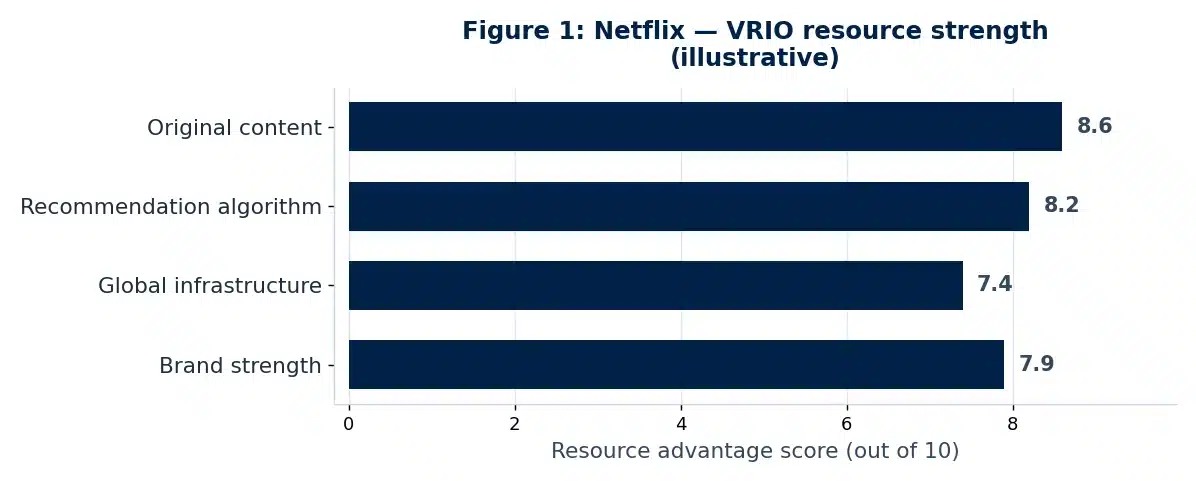
The personalisation engine emerges as the strongest resource. Its value derives from accumulated behavioural data that improves recommendations, reduces churn and informs commissioning decisions, an asset difficult for newer entrants to replicate quickly (Barney, 1991).
Original content is valuable and rare, yet its imitability is rising. Competitors can and do fund comparable programming, so advantage here depends on the organisation’s superior ability to select and produce resonant titles.
Global infrastructure is costly to imitate because it reflects sustained investment in content-delivery networks and adaptive streaming. Licensing relationships, by contrast, now confer only parity as studios reclaim their catalogues (Porter, 1985).
Case Study Writing Service
Need a strategic management case study written to this standard?
Our subject specialists write fully referenced, plagiarism-free case studies to your exact brief and deadline, with a free plagiarism report.
The analysis indicates that Netflix’s data-driven personalisation and its original content are its most valuable and rare sources of advantage. Together they differentiate the service and deepen subscriber engagement in ways rivals struggle to match.
The global streaming infrastructure is genuinely hard to imitate. Years of engineering investment in delivery networks and adaptive technology create a barrier that shields playback quality and reliability across diverse international markets.
However, the findings also expose pressure on margins. Rising content costs, driven by the shift to expensive original production, coincide with intensifying competition from deep-pocketed entrants that compresses profitability.
Licensing relationships have weakened as a differentiator. As studios withdraw content to supply their own platforms, this resource now delivers only competitive parity rather than advantage (Johnson et al., 2020).
Overall, Netflix retains meaningful, defensible advantages, but their durability is uneven. The personalisation engine and infrastructure look most sustainable, whereas content-based differentiation demands continuous, costly reinvestment to remain rare.
Netflix’s disruptive model rests on resources that the VRIO analysis shows to be genuinely valuable, and in several cases rare and hard to imitate. Its personalisation engine and global infrastructure remain the sturdiest foundations of advantage.
Yet sustained leadership is not guaranteed. Rising content costs and aggressive competition erode margins and challenge the rarity of content-based differentiation, demanding continual reinvestment and organisational agility.
For strategists, the case illustrates a central lesson of the resource-based view: advantage endures only where resources are continually renewed and exploited effectively (Barney and Hesterly, 2015).
Barney, J. (1991) ‘Firm resources and sustained competitive advantage’, Journal of Management, 17(1), pp. 99-120.
Barney, J.B. and Hesterly, W.S. (2015) Strategic Management and Competitive Advantage: Concepts and Cases. 5th edn. Harlow: Pearson Education.
Johnson, G., Whittington, R., Scholes, K., Angwin, D. and Regnér, P. (2020) Exploring Strategy: Text and Cases. 12th edn. Harlow: Pearson Education.
Porter, M.E. (1985) Competitive Advantage: Creating and Sustaining Superior Performance. New York: Free Press.

All work is written by human writers. 100% AI free, guaranteed.

100% money back guarantee if you find plagiarism in our work.
COMPANY DETAILS