
A real Undergraduate criminology dissertation conclusion chapter example, free to read in full below — get one written for your own study, or browse more conclusion chapter samples.
Type
Dissertation Conclusion
Subject
Criminology
Level
Undergraduate
Word count
870
Quality
2:1 / 66%
This final chapter draws the study together and revisits its central aim: to evaluate the impact of closed-circuit television (CCTV) on crime prevention in urban areas. It synthesises the key findings, situates them within existing scholarship, and considers their wider implications.
The chapter also sets out the original contribution of the research, offers practical recommendations, acknowledges the limitations that qualify the findings, and identifies directions for future enquiry. It closes by reflecting on what the evidence means for policymakers and urban communities.
The study set out to answer whether CCTV reduces crime, which offence types it affects most, and whether it merely displaces offending elsewhere. The findings offer a nuanced, offence-specific answer rather than a simple verdict on effectiveness.
In response to the first research question, the analysis confirmed that CCTV was associated with meaningful reductions in recorded crime across the monitored urban areas. However, the aggregate figure masked considerable variation between different categories of offence.
Addressing the second research question, the largest reductions were observed in vehicle crime and anti-social behaviour. This pattern supports rational choice and situational crime prevention perspectives, which hold that surveillance deters premeditated, opportunistic offences most effectively (Clarke, 1997).
By contrast, effects on violent crime were small and often statistically insignificant. This finding aligns with Welsh and Farrington (2009), who argue that impulsive, expressive offences are less responsive to the deterrent presence of cameras than calculated property crimes.
In answer to the third research question, some displacement of crime to adjacent, unmonitored areas was observed. Nevertheless, the displacement was partial rather than total, indicating that CCTV produced a genuine net reduction rather than simply relocating offending (Reppetto, 1976).
Taken together, these findings suggest that CCTV is best understood as a targeted tool. It performs strongly against acquisitive and disorder-related offences, yet contributes little to the prevention of interpersonal violence.
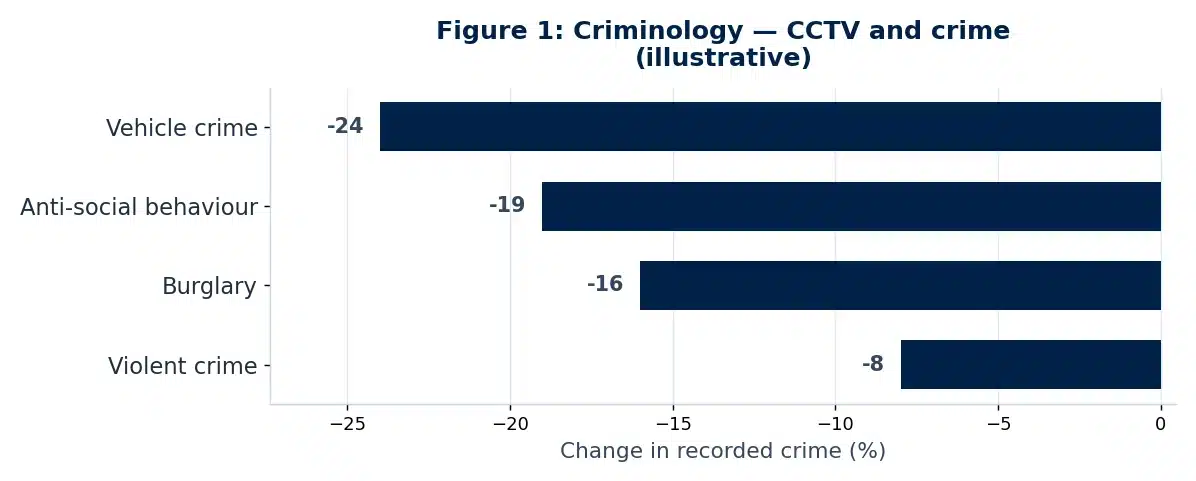
Theoretically, the study reinforces situational crime prevention by demonstrating that CCTV’s deterrent value is contingent on the nature of the offence rather than uniform across all crime types. It refines the assumption that surveillance deters offenders indiscriminately.
The research also contributes to the displacement debate. By showing that relocation of crime was partial, it lends empirical weight to Reppetto’s (1976) argument that offenders do not possess unlimited mobility or motivation to seek alternative targets.
Practically, the study offers original value to urban planners and police forces by identifying where CCTV investment yields the greatest return. It cautions against presenting cameras as a universal remedy for all forms of urban crime.
In doing so, the research bridges an evidential gap between broad claims of effectiveness common in policy discourse and the more measured, offence-specific conclusions emerging from criminological evaluation (Gill and Spriggs, 2005).
Dissertation Chapter Writing Service
Need a criminology conclusion chapter written to this standard?
Our subject specialists write to your exact brief — fully referenced, plagiarism-free and delivered on time, with a free plagiarism report.
Several limitations qualify the conclusions of this study. The reliance on recorded crime statistics means that unreported offences were not captured, potentially understating the true level of crime in the areas examined (Maguire, 2012).
The research also faced difficulty in isolating the effect of CCTV from other simultaneous interventions, such as changes in policing levels or street lighting. This makes attributing observed reductions solely to cameras problematic.
Furthermore, the study covered a limited number of urban sites over a defined period. Consequently, the findings may not be generalisable to rural settings, smaller towns, or areas with markedly different social and economic characteristics.
Finally, displacement was measured only in immediately adjacent areas. More diffuse or temporal displacement, occurring further afield or at different times, may have gone undetected within the study’s design.
Future research should employ longitudinal designs that track crime trends over extended periods, allowing analysts to distinguish the sustained impact of CCTV from short-term novelty effects following installation.
Comparative studies across multiple cities and countries would also strengthen the evidence base. Such work could clarify how cultural, environmental and legal contexts shape the effectiveness of surveillance systems (Norris and Armstrong, 1999).
Researchers should additionally combine recorded crime data with victimisation surveys and qualitative interviews. This mixed-methods approach would capture unreported offending and illuminate how residents and offenders perceive the presence of cameras.
Finally, further enquiry should examine the interaction between CCTV and emerging technologies, such as facial recognition and artificial intelligence, assessing both their preventive potential and their ethical implications for privacy.
In conclusion, this study demonstrates that CCTV is a valuable but selective instrument of crime prevention in urban areas. Its strength lies in deterring vehicle crime and anti-social behaviour rather than violence, and it should form one component of a broader, evidence-led strategy.
Clarke, R.V. (ed.) (1997) Situational Crime Prevention: Successful Case Studies. 2nd edn. Guilderland, NY: Harrow and Heston.
Gill, M. and Spriggs, A. (2005) Assessing the Impact of CCTV. Home Office Research Study 292. London: Home Office Research, Development and Statistics Directorate.
Maguire, M. (2012) ‘Criminal statistics and the construction of crime’, in Maguire, M., Morgan, R. and Reiner, R. (eds.) The Oxford Handbook of Criminology. 5th edn. Oxford: Oxford University Press, pp. 206-244.
Norris, C. and Armstrong, G. (1999) The Maximum Surveillance Society: The Rise of CCTV. Oxford: Berg.
Reppetto, T.A. (1976) ‘Crime prevention and the displacement phenomenon’, Crime & Delinquency, 22(2), pp. 166-177.

All work is written by human writers. 100% AI free, guaranteed.

100% money back guarantee if you find plagiarism in our work.
COMPANY DETAILS






