A real Masters finance dissertation conclusion chapter example, free to read in full below — get one written for your own study, or browse more conclusion chapter samples.
Type
Dissertation Conclusion
Subject
Finance
Level
Masters
Word count
859
Quality
Merit / 68%
This concluding chapter draws the study together and revisits its central aim: to examine how dividend policy influences shareholder value. It synthesises the empirical findings, situates them within the wider literature, and considers their implications.
The chapter restates the answers to the research questions, sets out the theoretical and practical contributions, and offers recommendations for managers. It closes by acknowledging the study’s limitations and identifying avenues for future enquiry.
The study set out to determine which dimensions of dividend policy are most strongly associated with shareholder value. Drawing on a panel of listed firms, it analysed dividend stability, growth signalling, dividend yield and payout ratio against market-based measures of value.
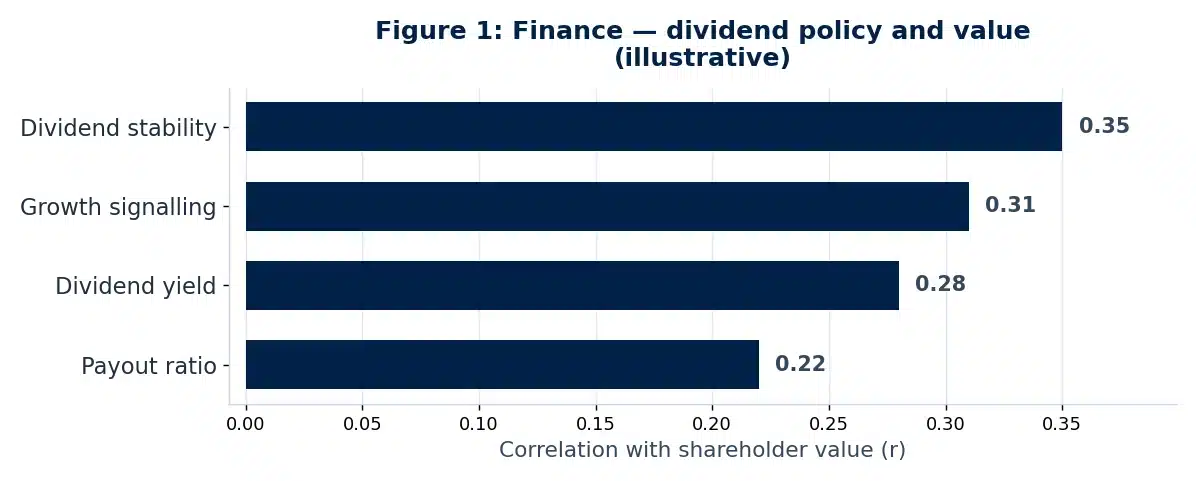
The first research question asked whether dividend stability affects shareholder value. The analysis found a clear positive association, indicating that firms maintaining consistent distributions were rewarded with stronger valuations, consistent with the smoothing behaviour described by Lintner (1956).
The second research question concerned the role of dividend growth as a signal. Growth signalling emerged as the other dominant factor, supporting the view that rising dividends convey credible information about future earnings (Bhattacharya, 1979).
These two findings together suggest that investors value predictability and positive momentum in distributions more than the headline generosity of a payout. This reinforces the signalling perspective advanced by Miller and Rock (1985).
The third research question examined dividend yield and payout ratio. Contrary to some expectations, both variables showed weaker and less consistent relationships with value once stability and growth were accounted for.
A high yield, in isolation, did not reliably translate into superior shareholder returns, and an elevated payout ratio was sometimes associated with concerns about reinvestment and sustainability. This partially echoes the irrelevance argument of Miller and Modigliani (1961).
Taken as a whole, the evidence indicates that how dividends behave over time matters more than their absolute size. The manner of distribution, rather than its magnitude, appears to be the primary driver of value in the sample examined.
Theoretically, the study contributes by disentangling distinct dimensions of dividend policy that are often treated interchangeably. By separating stability and growth signalling from yield and payout ratio, it offers a more nuanced test of competing dividend theories.
The findings lend qualified support to signalling theory while tempering the practical relevance of the dividend irrelevance proposition (Miller and Modigliani, 1961). They suggest that market imperfections and information asymmetries remain central to how distributions are priced.
Practically, the study provides an original, evidence-based framework that managers and investors can use to prioritise dividend attributes. Its contribution lies in showing that consistency and credible growth, rather than yield-chasing, should anchor distribution decisions.
In doing so, the research bridges academic debate and corporate practice, offering findings that are directly transferable to boardroom policy and portfolio construction.
Dissertation Chapter Writing Service
Need a finance conclusion chapter written to this standard?
Our subject specialists write to your exact brief — fully referenced, plagiarism-free and delivered on time, with a free plagiarism report.
Several limitations should be recognised when interpreting these findings. The study relied on a sample of listed firms within a defined market and period, which may constrain the generalisability of the results to other contexts or economic conditions.
The reliance on market-based measures of shareholder value, while common, cannot fully capture longer-term or intrinsic value creation. Alternative measures might yield somewhat different conclusions (Fama and French, 2001).
In addition, the quantitative approach, although rigorous, could not fully account for firm-specific qualitative factors such as management credibility, governance quality or investor sentiment. These may mediate the relationships analysed.
Finally, potential endogeneity between dividend policy and firm performance remains a challenge, as profitable firms may both pay stable dividends and command higher valuations for related reasons.
Future research could extend this analysis across multiple markets and economic cycles to test whether the primacy of stability and growth signalling holds under differing institutional conditions.
Longitudinal studies spanning periods of financial stress would be valuable, as investor responses to dividend behaviour may shift markedly during downturns (Baker and Wurgler, 2004).
Mixed-methods designs incorporating interviews with managers and institutional investors could illuminate the behavioural motivations behind dividend decisions that quantitative data alone cannot reveal.
Finally, further work might explore how share repurchases interact with dividend policy in shaping shareholder value, given their growing prominence as an alternative distribution channel.
In conclusion, this study affirms that the character of a firm’s dividend policy, its stability and credible growth, matters more for shareholder value than the size of its yield or payout ratio.
By clarifying which distribution attributes truly drive value, the research offers a practical foundation for managerial decision-making and a springboard for continued academic enquiry.
Baker, M. and Wurgler, J. (2004) ‘A catering theory of dividends’, The Journal of Finance, 59(3), pp. 1125–1165.
Bhattacharya, S. (1979) ‘Imperfect information, dividend policy, and “the bird in the hand” fallacy’, The Bell Journal of Economics, 10(1), pp. 259–270.
Fama, E.F. and French, K.R. (2001) ‘Disappearing dividends: changing firm characteristics or lower propensity to pay?’, Journal of Financial Economics, 60(1), pp. 3–43.
Miller, M.H. and Modigliani, F. (1961) ‘Dividend policy, growth, and the valuation of shares’, The Journal of Business, 34(4), pp. 411–433.

All work is written by human writers. 100% AI free, guaranteed.

100% money back guarantee if you find plagiarism in our work.
COMPANY DETAILS