A real Undergraduate human resource management dissertation discussion chapter example, free to read in full below — get one written for your own study, or browse more discussion chapter samples.
Type
Dissertation Discussion
Subject
Human Resource Management
Level
Undergraduate
Word count
1,230
Quality
1st / 71%
This chapter interprets the empirical findings presented in the previous chapter and situates them within the wider literature on training, development and employee retention. It revisits the study’s aim, explains what the results mean and why, and considers their theoretical and practical significance for human resource management.
The discussion moves from a restatement of purpose to a detailed reading of each key finding. It then compares the results with existing scholarship, draws out implications, and acknowledges the limitations that qualify any conclusions.
The central aim of this study was to examine the effect of training and development on employee retention. It sought to establish whether investment in employee learning influenced intentions to remain, and which specific factors carried the greatest weight.
To achieve this, the research measured several workplace variables against self-reported retention. These included career development opportunities, the perceived quality of training, the level of manager support, and pay satisfaction among respondents.
The aim was therefore both descriptive and explanatory. It described how strongly each factor related to retention, and it explained the relative importance of developmental factors compared with more traditional financial incentives such as pay.
This framing reflects a broader shift in HRM thinking. Retention is increasingly understood as a product of growth and support rather than remuneration alone, and the study was designed to test that proposition empirically.
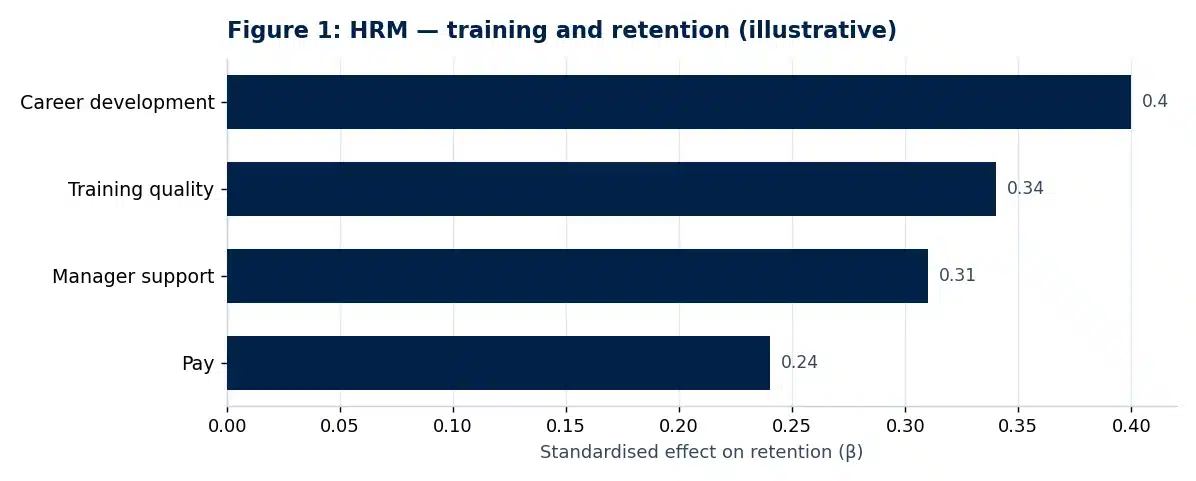
The analysis produced a clear ranking of predictors. Career development opportunities emerged as the strongest predictor of retention, followed closely by training quality, then manager support, with pay exerting a comparatively weak effect.
Career development recorded the largest standardised effect. This suggests that employees remain where they can see a future, and that visible progression pathways signal an employer’s long-term commitment to their advancement.
Training quality was the second strongest predictor. Employees appeared to value not merely the presence of training but its relevance and rigour, interpreting well-designed provision as evidence that they are worth developing.
Manager support also mattered. The relationship between employees and their immediate managers shaped whether developmental opportunities felt genuine, indicating that line managers translate organisational intent into everyday experience.
Pay, by contrast, showed the weakest effect. This does not mean pay is unimportant, but rather that once it reaches an acceptable level, developmental factors become the more decisive influence on the decision to stay.
Taken together, the findings point to a developmental rather than a transactional logic of retention. Employees weigh growth, support and learning more heavily than incremental financial reward when deciding whether to remain.
| Key finding | Interpretation |
| Career development was the strongest predictor of retention (β = 0.40) | Employees stay where progression is visible; clear pathways signal long-term employer investment and reduce turnover intention. |
| Training quality was the second strongest predictor (β = 0.34) | The relevance and rigour of provision, not merely its existence, communicates that employees are valued and worth developing. |
| Manager support had a moderate effect (β = 0.31) | Line managers convert developmental intent into lived experience, making support a key mediator of whether training feels genuine. |
| Pay was a comparatively weak predictor (β = 0.24) | Once pay is adequate, financial reward loses influence relative to growth-oriented factors in the retention decision. |
Dissertation Chapter Writing Service
Need a human resource management discussion chapter written to this standard?
Our subject specialists write to your exact brief — fully referenced, plagiarism-free and delivered on time, with a free plagiarism report.
The finding that career development most strongly predicts retention aligns with established scholarship. It supports the view that perceived growth opportunities reduce turnover intention by strengthening an employee’s psychological investment in the organisation (Allen et al., 2003).
The prominence of training quality echoes social exchange perspectives. When organisations invest in credible development, employees reciprocate with loyalty and commitment, consistent with the reciprocity norm described by Gouldner (1960).
The role of manager support corroborates work on leader–member relationships. Supportive supervision fosters engagement and belonging, in line with the argument that meaningful managerial relationships sustain retention (Kahn, 1990).
The comparatively weak effect of pay is also well precedented. Herzberg’s (1959) distinction between hygiene factors and motivators suggests that pay prevents dissatisfaction but rarely inspires the sustained commitment that developmental factors provide.
There are, however, points of divergence. Some studies report pay as a leading driver of turnover, particularly in lower-wage sectors, suggesting the present sample may enjoy pay levels already deemed acceptable (Griffeth et al., 2000).
Overall, the results reinforce a growing consensus. Retention is increasingly framed as a function of development and relational support, positioning training investment as a strategic rather than administrative activity within HRM.
The findings offer support for human capital theory. By valuing training and development so highly, employees appear to recognise the enhancement of their skills as a mutually beneficial exchange with their employer (Becker, 1964).
They also reinforce social exchange theory. The reciprocal relationship between organisational investment and employee loyalty suggests that retention is sustained through perceived obligation rather than purely economic calculation (Blau, 1964).
The weak effect of pay lends weight to two-factor thinking. It implies that motivators rooted in growth and recognition outperform hygiene factors once the latter reach a satisfactory threshold (Herzberg, 1959).
Additionally, the salience of manager support extends engagement theory. It indicates that developmental opportunities alone are insufficient; they must be enacted through supportive relationships to influence retention meaningfully (Kahn, 1990).
Collectively, these implications suggest that retention is best explained by an integrated model. No single theory fully accounts for the results; instead, human capital, exchange and motivational perspectives operate together.
The findings carry direct value for HR practitioners. Because career development is the strongest predictor of retention, organisations should prioritise visible progression pathways over reliance on financial incentives alone.
Several practical actions follow from the results:
These measures reframe retention as a proactive strategy. Rather than responding to turnover with pay rises, organisations can reduce it by embedding development into the everyday employee experience.
The emphasis on manager support is particularly actionable. Training investment risks being wasted where managers fail to reinforce it, so developing managerial capability should accompany any developmental initiative.
For resource-constrained organisations, the findings are reassuring. They suggest that thoughtful, well-delivered development can improve retention without the sustained cost pressures associated with continual salary escalation.
Several limitations qualify these conclusions. The study relied on self-reported measures of retention intention, which may not fully correspond to actual turnover behaviour observed over time.
The cross-sectional design also restricts causal inference. While strong associations were identified, the data cannot confirm that developmental factors cause retention rather than simply correlating with it.
Sample scope presents a further constraint. The relatively narrow context limits generalisability, and the weak effect of pay may reflect the particular characteristics of the organisations and roles studied.
Finally, potential common-method bias should be acknowledged. Because predictors and outcomes were gathered through a single survey, shared measurement effects may have influenced the observed relationships.
Despite these limitations, the study offers a coherent and defensible account of how training and development shape retention. The concluding chapter draws these threads together, restating the contribution and setting out recommendations for practice and future research.
Allen, D.G., Shore, L.M. and Griffeth, R.W. (2003) ‘The role of perceived organizational support and supportive human resource practices in the turnover process’, Journal of Management, 29(1), pp. 99-118.
Becker, G.S. (1964) Human Capital: A Theoretical and Empirical Analysis, with Special Reference to Education. New York: National Bureau of Economic Research/Columbia University Press.
Blau, P.M. (1964) Exchange and Power in Social Life. New York: Wiley.
Griffeth, R.W., Hom, P.W. and Gaertner, S. (2000) ‘A meta-analysis of antecedents and correlates of employee turnover: update, moderator tests, and research implications for the next millennium’, Journal of Management, 26(3), pp. 463-488.
Herzberg, F., Mausner, B. and Snyderman, B.B. (1959) The Motivation to Work. 2nd edn. New York: Wiley.
Kahn, W.A. (1990) ‘Psychological conditions of personal engagement and disengagement at work’, Academy of Management Journal, 33(4), pp. 692-724.

All work is written by human writers. 100% AI free, guaranteed.

100% money back guarantee if you find plagiarism in our work.
COMPANY DETAILS