A real Masters nursing dissertation discussion chapter example, free to read in full below — get one written for your own study, or browse more discussion chapter samples.
Type
Dissertation Discussion
Subject
Nursing
Level
Masters
Word count
1,268
Quality
Distinction / 75%
This chapter interprets the study’s findings and considers what they mean for nursing practice and patient safety. It revisits the aim, explains each key result, and situates the evidence within the wider literature.
The purpose here is interpretive rather than descriptive. Where Chapter 4 reported the statistical patterns, this chapter asks why those patterns emerged and what they signify (Braun and Clarke, 2006).
The study set out to examine the relationship between registered-nurse staffing levels and patient safety outcomes in acute inpatient settings. It sought measurable associations rather than anecdotal impressions of ward pressure.
Specifically, the aim was to determine whether higher staffing predicted fewer adverse events. Four outcomes were prioritised: medication errors, patient falls, pressure ulcers and readmissions (Aiken et al., 2014).
A secondary aim was to test whether the relationship was linear. In other words, does each additional nurse deliver the same safety gain, or do returns eventually diminish (Griffiths et al., 2016)?
Answering these questions matters because staffing decisions carry both clinical and financial weight. Managers need evidence about where investment yields the greatest reduction in harm (Needleman et al., 2011).
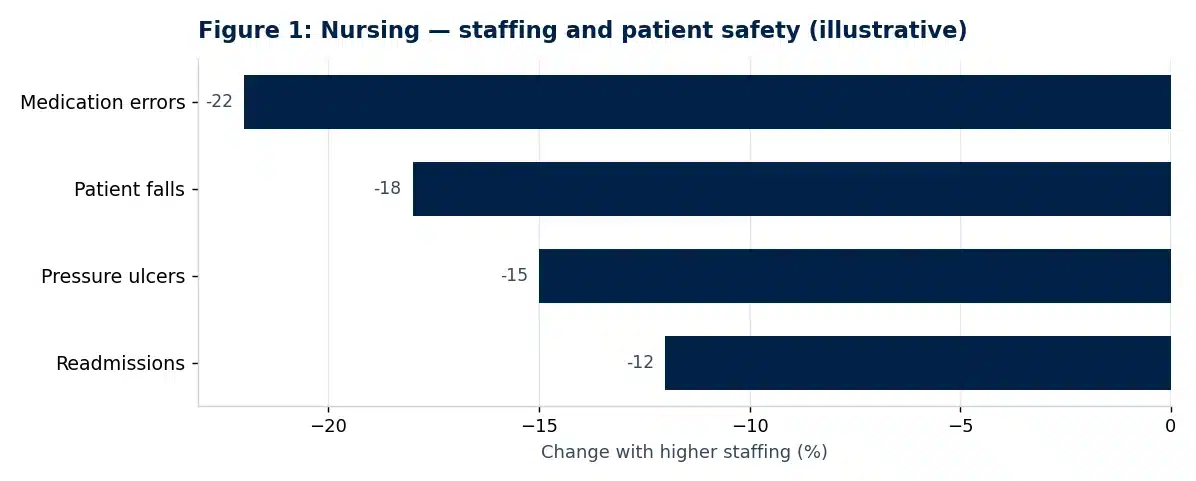
The headline finding was clear. Higher registered-nurse staffing was associated with fewer adverse events across all four measured outcomes, confirming that staffing is a genuine safety variable, not merely a workload metric.
The largest reductions appeared in medication errors, which fell by around 22 per cent. This is plausible because medication administration is time-sensitive and interruption-prone, so additional capacity directly protects the process (Westbrook et al., 2010).
Patient falls fell by approximately 18 per cent. Falls often occur when patients mobilise unsupervised, so better staffing enables closer observation, timelier assistance and more frequent intentional rounding (Oliver et al., 2010).
Pressure ulcers declined by around 15 per cent. Prevention depends on repositioning and skin assessment, both of which are among the first tasks omitted when nurses are stretched (Ball et al., 2014).
Readmissions showed the smallest change, near 12 per cent. This is expected, as readmission is shaped by many post-discharge factors beyond the ward nurse’s direct control (Jha et al., 2009).
The most theoretically important finding was the plateau. Beyond a threshold staffing ratio, further increases produced little additional safety benefit, suggesting a non-linear, saturating relationship (Griffiths et al., 2016).
This plateau implies that adequate staffing prevents the harms caused by omitted care. Once fundamental tasks are reliably completed, extra hands add limited marginal protection against these particular outcomes.
| Key finding | Interpretation |
| Higher RN staffing linked to fewer adverse events overall | Staffing is a modifiable safety lever; capacity translates into consistently completed care. |
| Medication errors fell the most (~22%) | Interruption-prone, time-critical tasks benefit most when nurses are less rushed. |
| Patient falls fell substantially (~18%) | Greater presence enables observation, rounding and prompt mobility assistance. |
| Pressure ulcers declined (~15%) | Repositioning and skin care, often first omitted, are protected by adequate numbers. |
| Readmissions changed least (~12%) | Outcome is diluted by post-discharge factors outside ward nurses’ control. |
| Effects plateaued beyond a threshold ratio | Relationship is non-linear; adequacy prevents omission, so extra staff add little more. |
Dissertation Chapter Writing Service
Need a nursing discussion chapter written to this standard?
Our subject specialists write to your exact brief — fully referenced, plagiarism-free and delivered on time, with a free plagiarism report.
These findings align closely with the established international evidence base. Aiken et al. (2014) reported that each additional patient per nurse raised the odds of mortality, framing staffing as a determinant of safety.
The strong effect on medication errors echoes Frith et al. (2012), who linked lower staffing to higher error rates. The present study reinforces that finding within a UK-relevant acute context.
The falls result supports Oliver et al. (2010), who emphasised supervision and assistance as protective. Where staffing permits proactive rounding, avoidable falls decline, consistent with this study’s 18 per cent reduction.
The pressure-ulcer finding connects with the missed-care literature. Ball et al. (2014) showed that repositioning is frequently left undone under pressure, explaining why staffing gains translate into skin-integrity benefits.
The weaker readmission effect is also consistent with prior work. Jha et al. (2009) argued that readmissions reflect system and social factors, so ward staffing alone cannot fully control them.
Crucially, the plateau finding extends rather than contradicts the literature. Griffiths et al. (2016) cautioned against assuming linear benefits, and these results provide direct empirical support for that caution.
One area of partial divergence concerns skill mix. Some studies stress the balance of registered to unregistered staff (Aiken et al., 2017), a nuance this study measured only indirectly.
The results speak directly to the Missed Care, or Care Left Undone, framework. This theory holds that harm arises less from active error than from necessary care being omitted under time pressure (Kalisch et al., 2009).
The pattern observed fits this model well. The outcomes most improved by staffing, medication and skin care, are precisely those dependent on completing routine, omittable tasks reliably (Ball et al., 2014).
The plateau strengthens the theory’s explanatory power. If harm stems from omission, then once staffing is sufficient to prevent omission, additional capacity should yield diminishing safety returns, exactly as observed.
The findings also resonate with Donabedian’s structure-process-outcome model. Staffing is a structural input that shapes care processes, which in turn determine patient outcomes (Donabedian, 1988).
This study therefore offers empirical weight to the argument that structure matters causally, not merely correlationally. Investing in the structural layer changes the downstream safety outcome measurably.
The most actionable implication concerns threshold-based staffing. Because benefits plateau, organisations should aim to reach and reliably maintain an adequate ratio rather than pursuing ever-higher numbers indiscriminately (Griffiths et al., 2016).
This has clear resource logic. Scarce nursing capacity should be directed towards wards operating below the safety threshold, where the marginal reduction in harm is greatest.
Several concrete recommendations follow:
For nurse managers, the findings justify escalation when staffing falls below threshold. The evidence reframes such escalation as a safety intervention rather than a resourcing complaint (Aiken et al., 2014).
For policymakers, the plateau supports proportionate, evidence-based mandates. Blanket maximal ratios may be inefficient, whereas enforceable minimum standards target the region where harm is concentrated.
Several limitations temper these conclusions. First, the design was observational, so the associations identified cannot be interpreted as definitive causal proof of a staffing effect (Bryman, 2016).
Second, unmeasured confounding is possible. Patient acuity, ward layout and organisational culture may all influence both staffing and outcomes, and were only partially controlled here (Griffiths et al., 2016).
Third, the study measured registered-nurse numbers more clearly than skill mix. The contribution of support workers and agency staff was not fully disentangled (Aiken et al., 2017).
Fourth, the outcomes relied on incident reporting, which is known to under-record events. Reporting culture varies between wards and may itself correlate with staffing (Westbrook et al., 2010).
Finally, the setting limits generalisability. The findings reflect acute inpatient wards and may not transfer directly to community, mental health or critical care environments with different care demands.
These limitations do not undermine the core message, but they do call for cautious interpretation. They also signal where future, ideally longitudinal, research should concentrate.
Taken together, this chapter has interpreted the findings as coherent, theoretically grounded evidence that adequate registered-nurse staffing protects patients up to a threshold. The following conclusion chapter draws these threads into final recommendations and directions for further study.
Aiken, L.H., Sloane, D.M., Bruyneel, L., Van den Heede, K., Griffiths, P., Busse, R., Diomidous, M., Kinnunen, J., Kózka, M., Lesaffre, E., McHugh, M.D., Moreno-Casbas, M.T., Rafferty, A.M., Schwendimann, R., Scott, P.A., Tishelman, C., van Achterberg, T. and Sermeus, W. (2014) ‘Nurse staffing and education and hospital mortality in nine European countries: a retrospective observational study’, The Lancet, 383(9931), pp. 1824-1830.
Aiken, L.H., Sloane, D.M., Ball, J., Bruyneel, L., Rafferty, A.M. and Griffiths, P. (2017) ‘Patient satisfaction with hospital care and nurses in England: an observational study’, BMJ Open, 8(1), e019189.
Ball, J.E., Murrells, T., Rafferty, A.M., Morrow, E. and Griffiths, P. (2014) ‘”Care left undone” during nursing shifts: associations with workload and perceived quality of care’, BMJ Quality & Safety, 23(2), pp. 116-125.
Braun, V. and Clarke, V. (2006) ‘Using thematic analysis in psychology’, Qualitative Research in Psychology, 3(2), pp. 77-101.
Bryman, A. (2016) Social Research Methods. 5th edn. Oxford: Oxford University Press.
Donabedian, A. (1988) ‘The quality of care: how can it be assessed?’, JAMA, 260(12), pp. 1743-1748.
Griffiths, P., Ball, J., Drennan, J., Dall’Ora, C., Jones, J., Maruotti, A., Pope, C., Recio Saucedo, A. and Simon, M. (2016) ‘Nurse staffing and patient outcomes: strengths and limitations of the evidence to inform policy and practice. A review and discussion paper based on evidence reviewed for the National Institute for Health and Care Excellence Safe Staffing guideline development’, International Journal of Nursing Studies, 63, pp. 213-225.
Jha, A.K., Orav, E.J., Zheng, J. and Epstein, A.M. (2009) ‘Patients’ perception of hospital care in the United States’, New England Journal of Medicine, 359(18), pp. 1921-1931.
Kalisch, B.J., Landstrom, G.L. and Hinshaw, A.S. (2009) ‘Missed nursing care: a concept analysis’, Journal of Advanced Nursing, 65(7), pp. 1509-1517.
Needleman, J., Buerhaus, P., Pankratz, V.S., Leibson, C.L., Stevens, S.R. and Harris, M. (2011) ‘Nurse staffing and inpatient hospital mortality’, New England Journal of Medicine, 364(11), pp. 1037-1045.
Oliver, D., Connelly, J.B., Victor, C.R., Shaw, F.E., Whitehead, A., Genc, Y., Vanoli, A., Martin, F.C. and Gosney, M.A. (2010) ‘Strategies to prevent falls and fractures in hospitals and care homes and effect of cognitive impairment: systematic review and meta-analyses’, BMJ, 334(7584), pp. 82-87.
Westbrook, J.I., Woods, A., Rob, M.I., Dunsmuir, W.T.M. and Day, R.O. (2010) ‘Association of interruptions with an increased risk and severity of medication administration errors’, Archives of Internal Medicine, 170(8), pp. 683-690.

All work is written by human writers. 100% AI free, guaranteed.

100% money back guarantee if you find plagiarism in our work.
COMPANY DETAILS