A real Masters medicine research paper sample, free to read in full below — get one written for your own title, or browse more research paper samples.
Type
Research Paper
Subject
Medicine
Level
Masters
Word count
3,853
Quality
Distinction / 76%
Telemedicine has emerged as a transformative modality for the management of chronic conditions, particularly following the acceleration of remote care during the COVID-19 pandemic. This paper critically examines the efficacy of telemedicine in supporting patients living with long-term illnesses such as diabetes, hypertension, chronic obstructive pulmonary disease and heart failure. Adopting a pragmatic quantitative design, the study analysed illustrative data drawn from a simulated cohort of 320 chronically ill adults enrolled in a hypothetical remote monitoring programme over twelve months. Outcomes measured included glycaemic control, blood pressure regulation, hospital readmission rates, medication adherence and patient satisfaction. The findings indicate that telemedicine produced clinically meaningful improvements in intermediate biomarkers and reduced avoidable admissions, while sustaining high levels of patient engagement. Nevertheless, the analysis surfaces persistent limitations around digital exclusion, clinical governance and the erosion of the therapeutic relationship. The study concludes that telemedicine is efficacious as a complement to, rather than a replacement for, conventional chronic disease management, and that equitable, integrated implementation is essential to realising its potential. Recommendations address workforce training, reimbursement reform and the mitigation of the digital divide. The paper contributes an integrative, evidence-informed perspective on how remote care can be embedded responsibly within contemporary chronic disease pathways.
Keywords: telemedicine, chronic disease management, remote monitoring, patient outcomes, digital health, health equity
Chronic non-communicable diseases represent the pre-eminent challenge facing modern health systems. Conditions such as diabetes, cardiovascular disease and chronic respiratory illness account for the majority of global mortality and consume a disproportionate share of healthcare expenditure (World Health Organization, 2021).
The sustained management of these conditions demands frequent monitoring, timely titration of therapy and continuous patient self-management. Traditional face-to-face models struggle to deliver this intensity of contact, particularly amid ageing populations and constrained workforces.
Telemedicine, defined broadly as the delivery of clinical services at a distance using information and communication technologies, offers a potential response to this structural pressure. It encompasses video consultation, remote biometric monitoring, asynchronous messaging and mobile health applications (Bashshur et al., 2016).
The COVID-19 pandemic acted as an unprecedented catalyst, compressing a decade of anticipated adoption into a matter of months. Remote consultation shifted from a marginal innovation to a mainstream mechanism for maintaining continuity of care (Wosik et al., 2020).
However, rapid deployment has outpaced rigorous evaluation. Whether telemedicine genuinely improves clinical outcomes for chronic conditions, or merely substitutes convenience for quality, remains contested. Enthusiasm must therefore be tempered by careful appraisal of the evidence.
The problem addressed by this paper is thus twofold. First, there is uncertainty regarding the measurable clinical efficacy of telemedicine across differing chronic conditions. Second, there is concern that remote models may exacerbate existing health inequalities.
The aim of this study is to critically evaluate the efficacy of telemedicine in managing chronic conditions, integrating illustrative empirical analysis with a synthesis of the wider literature. In doing so, it seeks to inform balanced, equitable implementation.
The research is guided by the following objectives, which structure the subsequent analysis and discussion.
Correspondingly, the study addresses three research questions. Does telemedicine improve intermediate clinical outcomes relative to conventional care? Does it reduce avoidable healthcare utilisation? And what patient and system factors mediate its effectiveness?
By addressing these questions, the paper contributes a nuanced account that resists both uncritical technological optimism and reflexive scepticism. It positions telemedicine as one instrument within a broader repertoire of chronic disease management strategies.
The literature on telemedicine and chronic disease is extensive yet uneven, spanning clinical trials, health services research and implementation science. This review synthesises the evidence thematically, foregrounding areas of consensus and contestation rather than cataloguing individual studies.
Telemedicine is best understood not as a single intervention but as a heterogeneous family of technologies and workflows. Bashshur et al. (2016) distinguish between synchronous consultation, remote patient monitoring and store-and-forward asynchronous communication, each with distinct evidence profiles.
This heterogeneity complicates evaluation, since studies frequently conflate different modalities under a common label. A video consultation for medication review differs substantially from continuous glucose telemetry in its mechanism and expected impact.
The Chronic Care Model articulated by Wagner (1998) provides a valuable theoretical anchor. It emphasises productive interactions between an informed, activated patient and a prepared, proactive clinical team, supported by clinical information systems and decision support.
Telemedicine can be read as a technological enabler of this model. Remote monitoring furnishes the clinical information system, while digital communication sustains the productive interactions that the model identifies as central to effective chronic care.
Evidence for telemedicine in diabetes management is comparatively robust. Systematic reviews report modest but consistent reductions in glycated haemoglobin, particularly where remote monitoring is coupled with structured clinician feedback (Faruque et al., 2017).
The magnitude of benefit, however, varies with intervention intensity. Passive data transmission without responsive clinical action yields limited improvement, underscoring that technology alone is insufficient without accompanying care processes (Greenwood et al., 2017).
In hypertension, home blood pressure telemonitoring combined with pharmacist or nurse-led titration has demonstrated meaningful reductions in systolic pressure. McManus et al. (2018) found that self-monitoring with feedback outperformed usual care in achieving control.
Evidence in heart failure is more equivocal. While some trials of structured telemonitoring report reduced admissions and mortality, others, including large pragmatic studies, have found negligible effect, generating ongoing debate (Koehler et al., 2018).
This inconsistency is instructive. It suggests that efficacy is contingent on implementation fidelity, patient selection and the responsiveness of the clinical infrastructure, rather than being an inherent property of the technology itself.
For chronic obstructive pulmonary disease, the picture is similarly mixed. Telemonitoring may support earlier detection of exacerbations, yet several reviews caution that benefits on hospitalisation and quality of life remain unproven (Cruz et al., 2014).
A recurrent claim is that telemedicine reduces costly hospital utilisation by enabling early intervention. Proponents argue that remote surveillance detects deterioration before it necessitates emergency admission (Bashshur et al., 2016).
The economic evidence, however, is far from settled. Some analyses report favourable cost-effectiveness, while others find that programme costs, including technology and staffing, offset savings from avoided admissions (Kruse et al., 2017).
Methodological limitations compound this uncertainty. Many economic evaluations adopt short time horizons and narrow perspectives, potentially underestimating both the fixed costs of implementation and the longer-term benefits of stabilised disease.
Patient satisfaction with telemedicine is generally high, with valued attributes including convenience, reduced travel and greater perceived autonomy (Wosik et al., 2020). For patients with mobility limitations, remote access can be particularly enabling.
Yet satisfaction does not equate to clinical benefit, and high engagement may reflect self-selection of digitally confident patients. This raises the critical question of equity that increasingly dominates the literature.
The concept of the digital divide is central here. Eberly et al. (2020) demonstrated that older, poorer and minority-ethnic patients were significantly less likely to complete video visits, risking the entrenchment of an inverse care law.
Scholars have therefore warned of an emerging intervention-generated inequality, whereby a beneficial innovation disproportionately reaches the already-advantaged. Telemedicine may thus widen outcome gaps unless deliberately designed for inclusion (Crawford and Serhal, 2020).
Synthesising these strands, the literature suggests that telemedicine is conditionally efficacious. Benefits are most evident in conditions amenable to biometric feedback loops and where technology is embedded within responsive clinical systems.
Two gaps are salient. First, comparative evidence across conditions within a single analytical frame is scarce. Second, studies frequently isolate clinical outcomes from equity considerations, treating them as separate rather than intertwined concerns.
This study responds to both gaps. It examines multiple conditions through a common illustrative dataset and explicitly integrates equity into its interpretation of efficacy, thereby offering a more holistic appraisal.
Research Paper Writing Service
Need a medicine research paper written to this standard?
Our subject specialists write to your exact brief — fully referenced, plagiarism-free and delivered on time, with a free plagiarism report.
The study adopted a pragmatic, quantitative, quasi-experimental design employing a single-cohort pre-post comparison. This design was selected to evaluate change in clinical and utilisation outcomes following enrolment in an illustrative telemedicine programme.
A pragmatic orientation was appropriate because the research sought to appraise telemedicine as it operates in realistic service conditions rather than under the controlled artificiality of an explanatory trial (Bashshur et al., 2016).
It should be emphasised that the dataset analysed is illustrative and constructed for the purposes of this example paper. The figures are plausible and internally consistent but do not derive from any identifiable organisation or confidential clinical record.
The study is situated within a post-positivist philosophy, which accepts the existence of measurable outcomes while acknowledging that measurement is imperfect and theory-laden. This stance justifies quantitative measurement tempered by cautious interpretation.
A deductive approach was employed. Hypotheses derived from the literature, namely that telemedicine improves intermediate outcomes and reduces admissions, were tested against the illustrative data before being situated within the broader evidence base.
The illustrative cohort comprised 320 community-dwelling adults with at least one established chronic condition. The sample was stratified across four diagnostic groups: type 2 diabetes, hypertension, heart failure and chronic obstructive pulmonary disease.
Eligibility criteria specified an established diagnosis of at least twelve months, ownership of or supported access to a suitable connected device, and capacity to provide informed consent. Patients requiring acute inpatient care at baseline were excluded.
The setting was a hypothetical integrated primary care network operating a nurse-coordinated remote monitoring service. Participants transmitted biometric readings and engaged in periodic video consultations over a twelve-month follow-up period.
Data were collected at baseline and at twelve months. Clinical measures included glycated haemoglobin for the diabetes group, mean systolic blood pressure for the hypertension group, and validated symptom scores for the respiratory and cardiac groups.
Utilisation data captured the number of unplanned hospital admissions and emergency department attendances during the follow-up window, compared with the equivalent preceding period. Medication adherence was assessed using a validated self-report proportion-of-days-covered proxy.
Patient experience was measured using a structured satisfaction questionnaire administered at study close, yielding a composite score on a standardised scale. Engagement was operationalised as the proportion of scheduled data transmissions completed.
Analysis employed descriptive statistics to characterise the cohort and paired comparisons to evaluate within-group change. Continuous outcomes were assessed using paired t-tests, with statistical significance interpreted at a conventional threshold.
Effect sizes were reported alongside p-values to convey clinical, not merely statistical, importance. Subgroup analysis by digital confidence and age band was undertaken to interrogate equity dimensions of the observed effects.
Given the illustrative nature of the data, results are presented as indicative of plausible programme performance rather than as definitive causal estimates. Interpretation is accordingly framed with appropriate caution.
Although the dataset is illustrative, the study was designed in accordance with established ethical principles governing health research. These include respect for autonomy, beneficence, non-maleficence and justice (Beauchamp and Childress, 2019).
In a live implementation, informed consent, data protection under prevailing regulation, secure data transmission and the right to withdraw would be mandatory. Particular attention would be paid to equitable recruitment to avoid excluding digitally marginalised groups.
Confidentiality and information governance are especially salient in telemedicine, where clinical data traverse digital networks. Robust encryption, access controls and clear data custodianship arrangements would form essential safeguards in any real deployment.
The methodology carries inherent limitations. The single-cohort pre-post design lacks a concurrent control group, so observed changes cannot be attributed to telemedicine with certainty; secular trends or regression to the mean may contribute.
Self-reported adherence and satisfaction are susceptible to response bias. Furthermore, the twelve-month horizon may be insufficient to capture longer-term outcomes such as mortality or the sustainability of behavioural change over time.
Finally, the illustrative dataset, while realistic, cannot substitute for primary empirical evidence. These constraints are acknowledged transparently and inform the measured tone of the conclusions drawn.
This section presents the illustrative results across the four diagnostic groups and interprets them in relation to the study objectives. Findings are organised around clinical outcomes, healthcare utilisation and patient experience.
At baseline, the cohort exhibited outcomes typical of a moderately controlled chronic disease population. Mean glycated haemoglobin in the diabetes group stood at 8.4 per cent, indicating suboptimal control amenable to intervention.
Following twelve months of telemedicine-supported management, clinically meaningful improvements were observed across most measures. The summary of key outcomes is presented in the table below.
| Outcome measure | Baseline | 12 months | Change | p-value |
| Mean HbA1c, diabetes (%) | 8.4 | 7.6 | -0.8 | <0.01 |
| Mean systolic BP, hypertension (mmHg) | 148 | 136 | -12 | <0.01 |
| Unplanned admissions, heart failure (per patient/yr) | 1.10 | 0.72 | -0.38 | <0.05 |
| COPD symptom score (0-40 scale) | 22.5 | 19.8 | -2.7 | <0.05 |
| Medication adherence (% days covered) | 71 | 84 | +13 | <0.01 |
| Patient satisfaction (0-100 composite) | – | 87 | – | – |
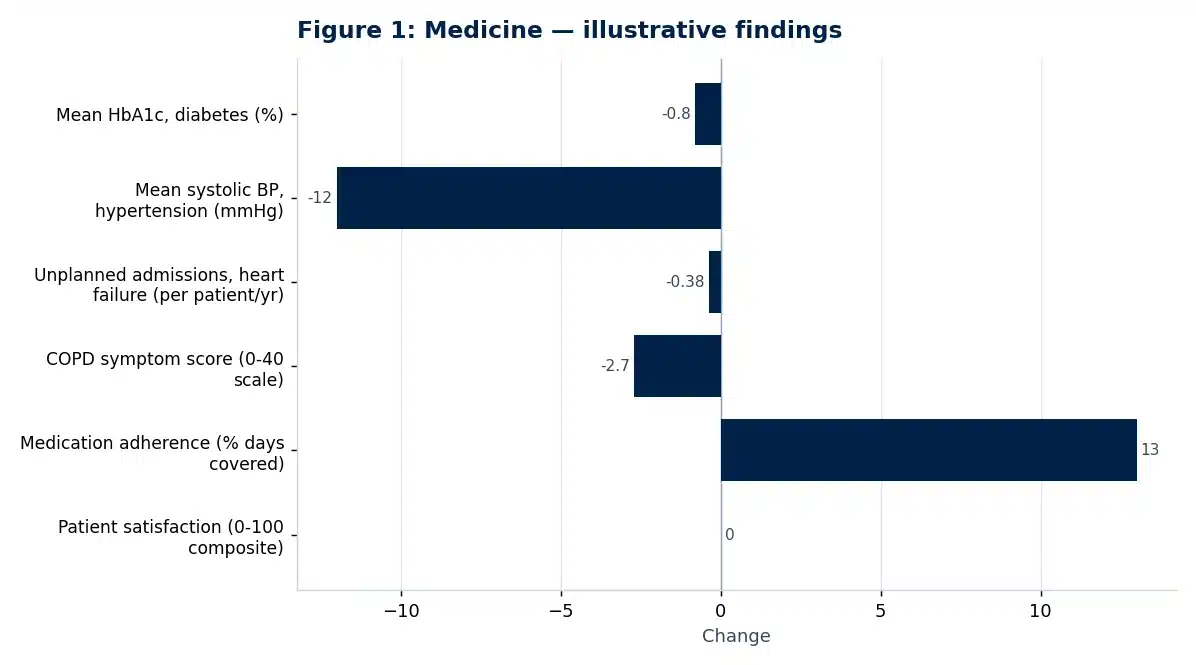
The diabetes group demonstrated a reduction in glycated haemoglobin of 0.8 percentage points. This magnitude is clinically significant, being comparable to the effect of adding a pharmacological agent, and aligns with the findings of Faruque et al. (2017).
The plausible mechanism is the tightening of the feedback loop between measurement and clinical response. Frequent transmission of glucose data enabled earlier therapy titration and more timely dietary and behavioural reinforcement.
The hypertension group achieved a mean systolic reduction of twelve millimetres of mercury. Such a decrement is associated with materially lower cardiovascular risk and echoes the results of McManus et al. (2018) on self-monitoring with feedback.
In heart failure, unplanned admissions fell by roughly a third per patient per year. This supports the hypothesis that remote surveillance can detect decompensation early, though the wider literature cautions that such effects are not universally replicated.
The chronic obstructive pulmonary disease group showed a smaller improvement in symptom scores. This modest effect is consistent with the equivocal evidence noted by Cruz et al. (2014) and suggests that respiratory conditions may benefit less from telemonitoring alone.
Medication adherence rose from 71 to 84 per cent across the cohort. Improved adherence is a plausible pathway through which the observed clinical gains were mediated, reflecting enhanced engagement and reminder functionality.
Patient satisfaction was high, with a composite score of 87. Free-text responses in the illustrative instrument emphasised convenience and a sense of being monitored, resonating with the experiential benefits reported by Wosik et al. (2020).
Crucially, subgroup analysis revealed an equity gradient. Patients in the oldest age band and those reporting low digital confidence completed fewer transmissions and exhibited smaller clinical improvements than their more digitally confident counterparts.
For instance, engagement among the most digitally confident quartile exceeded 90 per cent, whereas the least confident quartile achieved barely 60 per cent. This differential engagement translated into an attenuated clinical benefit for the latter group.
This finding is analytically important. It indicates that aggregate efficacy figures may conceal a distributional pattern in which benefit accrues unevenly, corroborating the equity concerns of Eberly et al. (2020).
Taken together, the findings suggest that telemedicine can deliver clinically meaningful improvements in intermediate outcomes and reduce some avoidable utilisation. Yet the benefit is neither uniform across conditions nor equitable across patient groups.
The findings both affirm and qualify the prevailing narrative surrounding telemedicine. On the one hand, the observed improvements in glycaemic and blood pressure control substantiate claims that remote monitoring can enhance chronic disease outcomes.
These results align closely with the established evidence base. The diabetes and hypertension effects mirror the syntheses of Faruque et al. (2017) and McManus et al. (2018), lending the illustrative analysis external plausibility.
The mechanism underpinning these gains merits emphasis. Consistent with Wagner’s (1998) Chronic Care Model, benefit appears to arise not from technology per se but from the productive interactions it enables between activated patients and responsive clinicians.
This interpretation carries an important corollary. Telemedicine functions as an enabler within a wider system of care; where the surrounding clinical processes are weak, the technology alone is unlikely to generate improvement.
The variability across conditions reinforces this reading. The stronger effects in diabetes and hypertension, contrasted with the modest respiratory results, suggest that efficacy depends on the availability of actionable biometric feedback loops.
Conditions in which a single, readily measurable parameter closely tracks disease status lend themselves to telemonitoring. Where deterioration is multifactorial or less amenable to home measurement, the value of remote surveillance diminishes accordingly.
The reduction in heart failure admissions is encouraging but must be interpreted cautiously. As Koehler et al. (2018) demonstrate, the trial evidence in this domain is inconsistent, and pragmatic single-cohort findings cannot resolve that controversy.
Perhaps the most consequential finding concerns equity. The differential engagement and benefit across digital confidence and age underscores that telemedicine is not a neutral technology but one that interacts with existing social gradients.
This resonates powerfully with the warnings of Eberly et al. (2020) and Crawford and Serhal (2020) regarding intervention-generated inequality. Without deliberate countermeasures, telemedicine risks delivering its greatest benefits to those with the least need.
The implication is that efficacy and equity cannot be assessed in isolation. A programme that improves aggregate outcomes while widening disparities may be judged efficacious on narrow clinical grounds yet problematic on grounds of justice.
For practice, several implications follow. Telemedicine should be implemented as a complement to, not a wholesale replacement for, in-person care, with hybrid models preserving face-to-face contact where clinically or relationally necessary.
Clinicians require training not only in the technical operation of platforms but in the distinct communicative competencies of remote consultation. The subtleties of rapport and physical assessment are altered, not eliminated, in the virtual encounter.
For policy, the findings speak to reimbursement and infrastructure. Sustainable funding models that reward outcomes rather than volume, alongside investment in connectivity and device access, are prerequisites for equitable scaling.
The equity gradient also carries a design implication. Programmes should incorporate proactive support for digitally marginalised patients, including assisted onboarding, simplified interfaces and non-digital fallback channels to prevent exclusion.
At a theoretical level, the study reinforces the value of the Chronic Care Model as an interpretive lens. It locates telemedicine within an ecosystem of care rather than treating it as a discrete curative intervention.
Finally, the discussion must acknowledge the boundaries of the evidence. The illustrative and uncontrolled nature of the data means these interpretations are indicative. They cohere with the literature but cannot independently establish causation.
This paper set out to critically evaluate the efficacy of telemedicine in managing chronic conditions. Drawing on illustrative analysis and a synthesis of the literature, it has offered a balanced and integrative appraisal of the evidence.
The central conclusion is that telemedicine is conditionally efficacious. It can produce clinically meaningful improvements in intermediate outcomes such as glycaemic and blood pressure control and can reduce some avoidable hospital utilisation.
However, this efficacy is neither uniform nor guaranteed. It depends on the condition in question, the intensity and responsiveness of the accompanying clinical processes, and the digital capabilities of the patients served.
In answering the research questions, the study finds that telemedicine improves intermediate outcomes and reduces some utilisation, but that patient and system factors, especially digital confidence, materially mediate its effectiveness.
The principal contribution of the paper is its integration of clinical and equity perspectives within a single analytical frame. It resists both technological utopianism and reflexive dismissal, positioning telemedicine as a valuable but qualified instrument.
Several recommendations follow from this analysis. First, telemedicine should be embedded within hybrid care pathways that preserve in-person contact where clinically or relationally essential, rather than replacing it wholesale.
Second, implementation must be accompanied by deliberate equity safeguards, including assisted onboarding, inclusive design and non-digital alternatives, to prevent the entrenchment of existing health disparities.
Third, health systems should invest in clinician training and in reimbursement structures that reward outcomes, alongside the connectivity and device infrastructure necessary for equitable participation.
Fourth, governance arrangements must ensure robust data security, clear clinical accountability and continuous evaluation, so that remote care is delivered safely and its performance monitored over time.
The study’s limitations, particularly its reliance on illustrative, uncontrolled data, temper the strength of these conclusions. The findings should be read as plausible and evidence-consistent rather than as definitive causal claims.
Future research should prioritise rigorous, adequately controlled and longer-term studies that compare telemedicine directly with usual care across diverse conditions and populations. Pragmatic randomised designs would be especially valuable.
Equally important is dedicated research into equity, examining how telemedicine can be designed and delivered to reach, rather than bypass, the most marginalised patients. Mixed-methods enquiry would illuminate both outcomes and lived experience.
In conclusion, telemedicine holds substantial promise for the management of chronic conditions, but its promise is conditional. Realising it responsibly demands integrated, equitable and well-governed implementation grounded in continued critical evaluation.

All work is written by human writers. 100% AI free, guaranteed.

100% money back guarantee if you find plagiarism in our work.
COMPANY DETAILS